

I have discovered some key problem areas with the delivery of the TAE40122 Certificate IV in Training and Assessment qualification. One of those problem areas is assessment validation.
I am finding that some TAE40122 students are expected to conduct assessment validation without knowing what they are meant to be doing. It seems that some RTOs delivering the TAE40122 qualification are not providing training, not providing sufficient training, or providing training that does not help.
The purpose of this article is to provide some basic information about pre-assessment validation. I have published other articles relating to assessment validation:
- What is assessment validation?
- How to conduct assessment validation?
- What are four key factors for effective assessment validation?
Introduction to pre-assessment validation
The TAEASS413 Participate in assessment validation unit of competency describes the skills and knowledge required to participate in the validation of assessment tools, practices and judgements, including in:
- pre-assessment validation of assessment tools before they are first used with candidates
- post-assessment validation of the assessment tools after having been used to assess candidates, and assessment practices including the assessment decisions made by assessors.
In this article we are focusing on pre-assessment validation, including answers to the following questions:
- What is pre-assessment validation?
- What do we need to know before we can participate in a pre-assessment validation meeting?
- How much training would be required to help someone learn how to participate in pre-assessment validation?
What is pre-assessment validation?
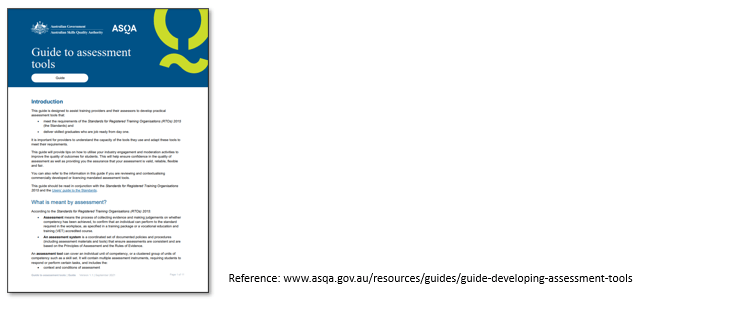
Pre-assessment validation is a check or review of an assessment tool. Firstly, we have to understand what is an assessment tool. ASQA has published a guide to assessment tools. This is a must-read document for TAFE teachers or trainers working in the Australian VET system.
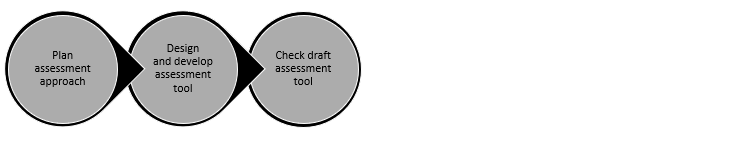
ASQA describes 3 steps for developing an assessment tool:
- Planning
- Design and development
- Quality checks.
The following diagram show these three steps as a flowchart.
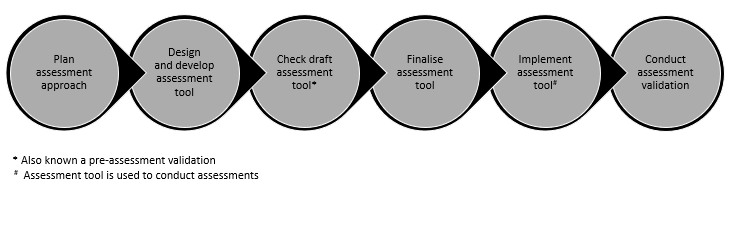
The next diagram adds onto ASQA’s 3 steps to show all the steps that should be taken before implementing the assessment tool. Also, it shows what happens after we have implemented the assessment tool.
The use of the term ‘pre-assessment validation’ is relatively new. Previously the activity of pre-validating an assessment tool was known as checking or reviewing the assessment tool before using it. Unfortunately, the word ‘validating’ is not as familiar to us the the words ‘checking’ or ‘reviewing’.
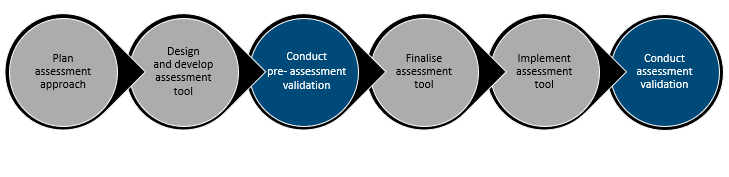
Pre-assessment validation is conducting a check of the assessment tool before it is implemented, in other words, before it has been used to conduct assessments. Post-assessment validation is a review of the assessment process after the assessment tool has been implemented.
The following diagram highlights when pre-assessment validation and post-assessment validation occur.
What do we need to know before we can participate in a pre-assessment validation meeting?
There is much to know before we can effectively participate in a pre-assessment validation meeting. For example:
- What is assessment? And what is meant by ‘competency-based assessment’?
- What is evidence? And why is evidence important?
- What the four rules of evidence? And how do we know if the assessment complies with the rules of evidence?
- What are the four principles of assessment? And how do we know if the assessment complies with the principles of assessment?
- What are the four methods of assessment? What assessment method is used to gather knowledge evidence? And assessment method is used to gather performance evidence?
- What is an assessment instrument?
- What is an assessment matrix? And how is it used when conducting pre-assessment validation?
- What is an assessment tool? And what is look for when conducting pre-assessment validation?
- How does RPL assessment differ from ‘non-RPL assessment’?
- What is the step-by-step procedure for conducting pre-assessment validation?
The following diagram gives an outline of the many things we need to know before we participate in pre-assessment validation.

How much training would be required to help someone learn how to participate in pre-assessment validation?
Ideally, an entire training day should be allocated to helping a TAE40122 student learn how to a participate in pre-assessment validation. For example:
- Introduction to competency-based assessment [about 3 to 4 hours]
- Demonstrate the conduct of a pre-assessment validation [about 1 ½ hours]
- Practice conducting a pre-assessment validation in small groups of 3 or 4 [about 1 ½ hours]
In appears that some TAE Students are expected to undertake assessment tasks associated with the TAEASS413 Participate in assessment validation unit of competency with no or limited relevant training. Some TAE Students are being given an assessment tool to validate without knowing what is an assessment tool, or what is an assessment instrument, or what are all the other documents in the assessment tool. These TAE Students are being given no or limited background information about competency-based assessment, principles of assessment, rules of evidence, or methods of assessment. And the assessment matrix or assessment mapping is still a mystery.
In conclusion
I am finding that some TAE40122 students are not receiving sufficient training before they are expected to complete assessment tasks relating to assessment validation. People with no previous experience with competency-based assessment should not be expected to figure it out for themselves about how to conduct pre-assessment validation or post-assessment validation. Proper training is the solution.
Do you need help with your TAE studies?
Are you a doing the TAE40122 Certificate IV in Training and Assessment, and are you struggling with your studies? Do you want help with your TAE studies?

Ring Alan Maguire on 0493 065 396 to discuss.

Training trainers since 1986

 On Target Work Skills