

The TAEDES412 Design and develop plans for vocational training unit of competency is a core unit for the TAE40122 Certificate IV in Training and Assessment qualification. This unit of competency requires the TAE Student to document a training delivery plan and training session plans for group-based training.
I have found that many people new to the Australian VET system are unsure about how to start designing a competency-based training program. The development of a one-page training agenda based on the Unit of Competency is a good starting point.
In this article, the following questions shall be answered:
- What is the difference between a training delivery plan and training session plans?
- What is a training agenda?
- What are the steps to developing a training agenda?
What is the difference between a training delivery plan and training session plans?
The training delivery plan provides an overview about how the entire training covering the unit or units of competency will be delivered. The training will be delivered over many sessions. The training session plans provides the details about how each session will be delivered.
It is highly likely that TAE Students shall be given a templates to use when documenting their training delivery plan and training session plans. But there are many steps and decisions to be taken before those templates can be used.
It is essential for the development of a one-page view of the training program. Let’s call this document a ‘training agenda’.

What is a training agenda?
A training agenda is an outline of:
- Timeframe
- Content points
- Sequence of content.
What are the steps to developing a training agenda?
The following 5 steps can be used to develop an agenda for competency-based training:
- Step 1. Develop the timeframe
- Step 2. Determine content points
- Step 3. Consider learning activities
- Step 4. Sequence the content points
- Step 5. Develop a training matrix.
Before looking at each of these steps, I want to talk about modes of delivery.
There are different modes of delivery. For example:
- Group-based, face-to-face
- Self-paced, online
- Self-paced, workbook
- Workplace learning
- Blended (combination of some or all of the above).
If you are a TAE Student, I suggest you keep things simple by designing face-to-face training that will be delivered by a trainer. Also, the training you design must be for a group of learners rather than for an individual learner. And it is highly likely that your training delivery plan will be uses as the background for training sessions that you will deliver later in your TAE40122 program. Avoid adding complexity by trying to incorporate different modes of delivery.
Step 1. Develop the timeframe
When developing a timeframe for a training program we will need to consider:
- The total training duration, such as, total number of training days
- Start time and expected finish time for each training day
- Blocks of time representing each training session.
Total training duration
One of the first things we need to do is estimate the total training duration. Most units of competency will require more than one day of training. We need to determine or estimate the duration of training.
If you are a TAE Student, I suggest you keep things simple by designing your training program around days. You will need to answer the following questions:
- How many training days will be needed?
- What time will the training start and finish?
Time is usually a major constraint. Many RTOs tend to want training with a shorter duration than what is needed by the typical learner. If you are a TAE Student, I suggest you select a sufficient number of days to deliver all the content specified by the unit of competency and associated assessment requirements.
Also, the timeframe for training shall need to consider:
- Breaks
- Introductions and conclusions
- Revision.
Breaks
Breaks are needed to avoid information overload or fatigue. Also, breaks allows for ‘spaced learning’. Spaced learning requires us to use several sessions of shorter durations with breaks in between the sessions. This approach aims to help learners retain more information.
Introductions and conclusions
We need to allocate time for introductions and conclusions. There will be an introduction and conclusion for every unit of competency. There will be an introduction and conclusion for every training day. And there will be an introduction and conclusion for every training session. The time required for introductions and conclusions will vary. However, as a general rule, allow about 30 minutes at the end of each day for a conclusion. The end-of-day conclusion may include:
- Revise the content covered during the training day
- Opportunity for learners to ask questions
- Preview the next training day
- Explain pre-work to be completed prior to the next training day.
Revision
We need to allocate time for revisions. Revision and repetition is important because it improves understanding and reduces forgetting. The time required for revisions will vary. However, as a general rule, allow time at the beginning of each training day to recap what was covered during the previous training day. Revision after lunch of the content covered during the morning is a good idea.
Blocks of time
The timeframe for the training agenda can be represented as ‘blocks of time’. This provides a visual structure for the entire training program.
Do’s and don’ts:
- Do keep the training agenda to one page
- Don’t start developing a training delivery plan until you have developed a one-page training agenda.
We can use Microsoft Word to create a table that will gives us a structure for our timeframe. The following are examples of one-page training agendas for a 1-day and a 3-day training program.

Use a ‘landscape orientation’ when there will be more than four training days. The following is an example for a 5-day training program.

The next example shows the layout for a training program with full days compared with a training program with half-days.
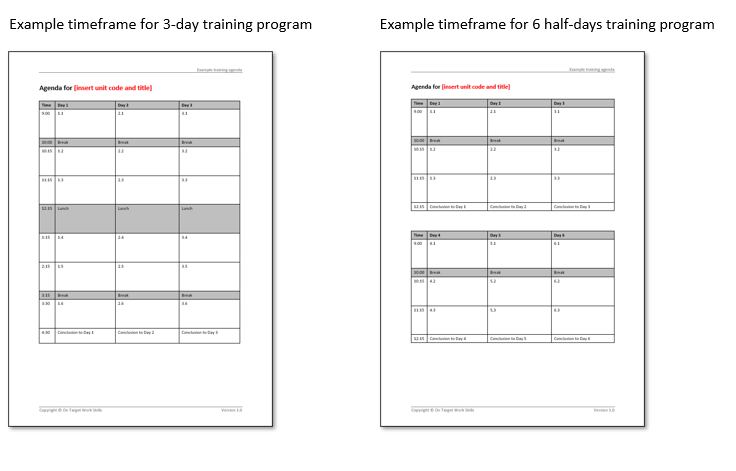
The above examples have shown when every training session has a duration of one hour. But sometimes a training session may require more time. The following example shows the layout for a training program with all training session with a one hour duration compared with a training program with a three hour training session on Day 2 and a two hour session on Day 3.

The purpose of showing a range of examples is to demonstrate the need for flexibility when developing the timeframe for the training agenda. However, start with one hour blocks of time. And keep the timeframe simple.
Step 2. Determine content points
We need to design training to ensure it is based on the unit of competency and associated assessment requirements.
Read and unpack the Unit of Competency and associate Assessment Requirements. Identify the content that must be covered during the training program, such as:
- Task or tasks to be performed
- Required knowledge
- Required skills.
Step 3. Consider learning activities
We need to design training to ensure it promote ‘active learning’ or ‘learn by doing’.
As a general rule, at least 50% of the available time should be allocated to activity. However, some training programs may have 80% or 90% of the available time allocate to activity.
Activities may include:
- Performing the task
- Role playing
- Researching
- Discussion
- Case studies
- Brainstorming
- Small group work.
Icebreakers and quizzes are two other types of activities that are useful to include.
Watching a video is passive and is not an activity. However, we can make it part of an activity by conducting a discussion or setting questions to be answered after viewing the video. The content from the video become an input for the activity.
Some activities can be conducted before or after the training day. These activities may include advance organisers and pre-work. These are valuable additions to a training program.
Step 4. Sequence the content points
Add content points and learning activities to the training agenda.
Sequence the content points:
- Overview before the details
- Simple before the complex (easy before the difficult)
- Step-by step sequence (logical or chronological sequence)
Take into consideration how much training time may be required as you add information to the training agenda. Estimate time required for:
- Presenting the content
- Demonstrating the performance of skills or tasks
- Explaining, conducting and debriefing learning activities
- Conducting introductions, conclusions and revision.
At this stage it will be an estimate of time. These estimates may need to be revised when you work on the details.
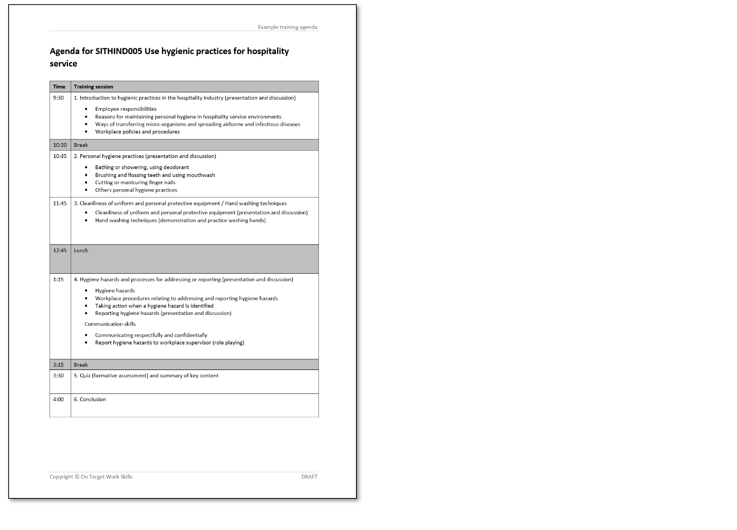
Very few units of competency in the Australian VET system can be adequately covered in one training day. The following is an example of a training agenda for the SITHIND005 Use hygienic practices for hospitality service unit of competency. It is one of those rare units that can be delivered in one day.
The next example is a 3-day agenda for the BSBOPS203 Deliver a service to customers unit of competency.

The above two examples show how very few details are provided on the training agenda. It is only meant to be an outline.
The training agenda is likely to be amended after you have developed the training delivery plan and training session plans. Some amendments may include:
- Time allocated
- Additional content
- Sequence of content
- Type and number of activities.
Step 5. Develop a training matrix
A training matrix is used to check that the training program shall cover the requirements specified by the Unit of Competency and associated Assessment Requirements.
The training agenda gives a structure that can be used to create the training matrix. The following is an example of a training matrix. It is only showing the first page of a 3-page document. The other two pages covers the Performance Evidence and Knowledge Evidence.

The next example shows the layout for a training matrix covering the BSBOPS203 Deliver a service to customers unit of competency.
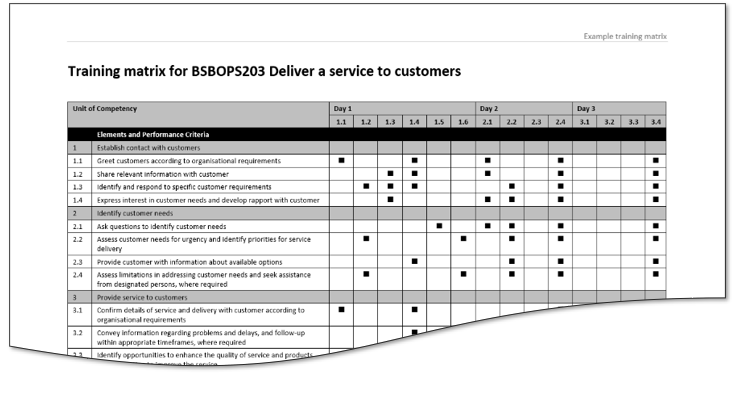
The development of the training matrix may identify content points that had not previously been considered while developing the training agenda. If this occurs, we will need to adjust the timing to cater for the additional content to be covered.
Consider your training agenda as a draft until you have completed developing the training delivery plan and training session plans. Your preliminary ideas may be changed after you have worked on the details. The training agenda must be consistent with your training delivery plan and training session plans.
The training agenda is useful piece of information for trainers and their learners. The one-page format gives a quick outline of the entire training program. It is a roadmap for the training. It is a good starting point for designing a competency-based training program. It is a roadmap for training.
Do you need help with your TAE studies?
Are you a doing the TAE40122 Certificate IV in Training and Assessment, and are you struggling with your studies? Do you want help with your TAE studies?

Ring Alan Maguire on 0493 065 396 to discuss.

Training trainers since 1986

 On Target Work Skills