
In the Australian VET system, the terms ‘holistic assessment’ and ‘integrated assessment’ are often used interchangeably. However, there is a differences between the two concepts.
Holistic assessment is an assessment approach that covers multiple elements of competency. This approach would not explicitly gather evidence for each item of required knowledge or required skill. The assessor would consider the learner’s overall performance, including their application of knowledge and skills.
Integrated assessment occurs when a learner performs an assessment task that can be used to gather evidence for multiple units of competency. The assessment task would be designed to explicitly gather evidence specified by two or more units of competency. [1]
Holistic assessment focuses on one unit of competency, and integrated assessment focuses on multiple units of competency. The following illustrates the difference between an holistic and integrated approach to assessment.
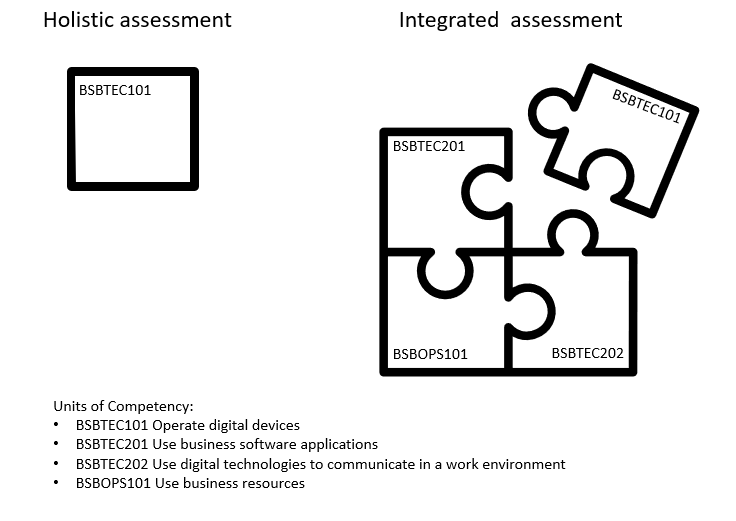
Both holistic and integrated assessment can be used to improve the quality of assessment in the Australian VET system. They can help to ensure that learners are assessed on their ability to apply their knowledge and skills to real-world situations.
What is integrated assessment?
Individual competencies are rarely performed in isolation in the workplace. Typical job roles involve a number of related tasks, and evidence gathering should reflect this.
Integrated assessment is the simultaneous assessment of two or more related units of competency. The integrated approach can reduce the time spent on assessing, but more importantly it will make assessment more realistic because it more closely reflects the real nature of work. [2]
An example of integrated assessment
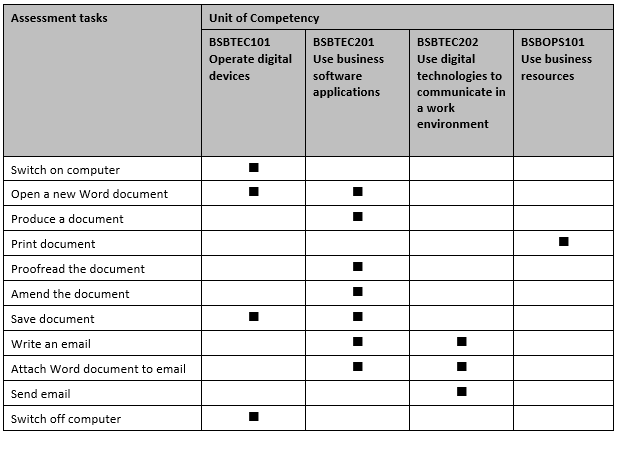
The following is an example of an assessment task that can be used to gather evidence for four different units of competency.
In conclusion
Although, ‘holistic assessment’ and ‘integrated assessment’ are often used interchangeably, they are two different concepts.
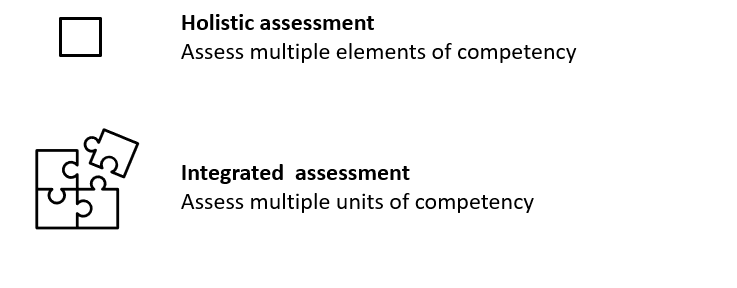
Integrated assessment can reduce the time spent on assessing, but more importantly it will make assessment more realistic because it more closely reflects the real nature of work.
This article has explored and described integrated assessment. Although, ‘holistic assessment’ and ‘integrated assessment’ are often used interchangeably, they are two different concepts. You may be interested in an article that I have published that focuses on holistic assessment.
Also, I have published another relevant article that gives examples on how to identify integrated assessment opportunities.
References
[1] https://www.voced.edu.au/vet-knowledge-bank-glossary-vet accessed 11 April 2022
[2] https://www.myskills.gov.au/media/1781/back-to-basics-vet-assessment.pdf accessed 11 April 2022 (the myskills website seems to have been removed and the link to this reference has been broken)
Do you need help with your TAE studies?
The terminology used in the Australian VET system can be confusing and overwhelming. Are you a doing the TAE40122 Certificate IV in Training and Assessment, and are you struggling with your studies? Do you want help with your TAE studies?
Ring Alan Maguire on 0493 065 396 to discuss.

Training trainers since 1986

 On Target Work Skills
One thought on “Integrated assessment”