
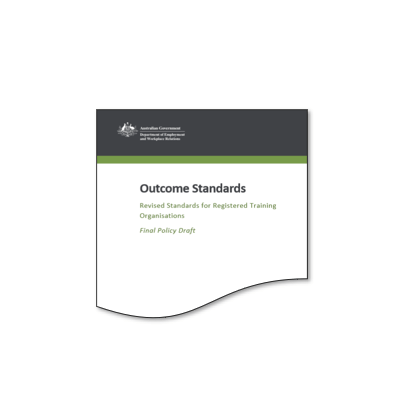
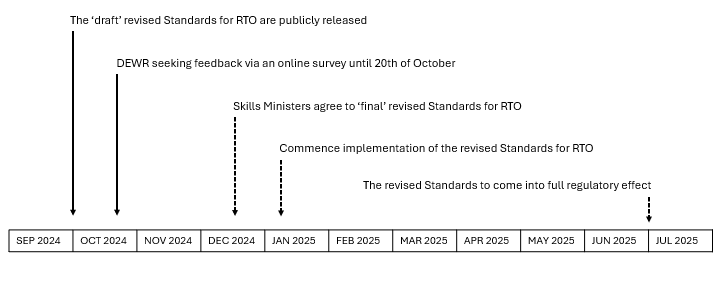
After much delay, the ‘draft’ revised Standards for RTOs were released to the public on the 1st of October 2024. The Department of Employment and Workplace Relations (DEWR) is seeking feedback via an online survey. This survey will close on the 20th of October 2024.
It feels like déjà vu. Haven’t we already released a draft and sought feedback? Anyway, we can do it again.
The exact wording of the revised Standards may change between now and when the ‘final’ revised Standards are released.
The final agreement by Commonwealth and state and territory Skills Ministers and the passing of legislation to enact the revised Standards for RTOs is expected by late 2024. This will enable the revised Standards to be implemented from January 2025. The aim is to have the revised Standards to come into full regulatory effect from 1 July 2025.
The following is an indicative timeline between now and when the revised Standards are planned be fully implemented by RTOs.
Is this the end of competency-based training?
The definition of ‘competency’ has been removed from the glossary for the revised Standards. Is this signalling the end of competency-based training system and the beginning of a non- competency-based training system?
I acknowledge that there still is a definition for ‘unit of competency’, but it is limited compared to the current definition of ‘competency’. For many years, there has been many people who have been lobbying for the end of Australia’s competency-based training system.
Is this the end of Australia’s training system?
The word ‘learner’ has been replaced by ‘VET student’. The term ‘student’ is aligned with the institutionalisation of VET, by strengthen the position of TAFE institutes and the continued removal of non-TAFE providers.
For many years, there has been many people who have been lobbying for VET to be an ‘education system’ rather than a ‘training system’. Education systems have students. Training systems have learners.
Are the changes in the revised Standards for RTOs signalling the end of ‘vocational education and training’ as we know it and the start of VET being a low-level part of ‘tertiary education’ in Australia? I don’t think we can expect universities to universally welcome VET as an equal partner in an Australian tertiary education system. Universities are higher education. VET will be lower education.
In conclusion
The preamble to the revised Standards for RTOs states that all Australian governments have agreed to build a high-performing and world-class VET sector – but I thought that was already agreed to in 1992 when the current VET system was implemented.
I suspect that the Australian VET system will significantly change over the next 2 years. And I suspect the quality of VET will continue to decline due to weak regulatory practices supported by vague descriptors in the revised Standards for RTOs.
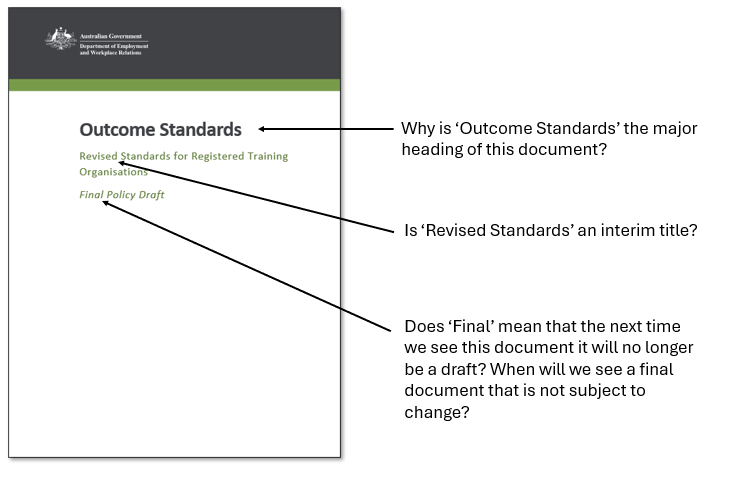
What are your thoughts about the ‘draft’ revised Standards for RTOs?
Reference
https://www.dewr.gov.au/standards-for-rtos accessed 1 October 2024

 On Target Work Skills