

The Australian VET system is being changed, or ‘reformed’, as governments likes to call it. It seems like whenever we get a new minister with responsibility for VET, they say it needs to be simplified and streamlined. I have heard this too many times over the past decade or more.
In 2025, we are seeing the implementation of two significant changes: Quality Reforms and Qualification Reform. These were initially announced by Scott Morrison’s Coalition government in 2019 and embraced by Anthony Albanese’s Labor government in 2022.

The new Standards for Registered Training Organisations and the new Training Package Organising Framework have been finalised and publicly released, and both are to be effective from the 1st of July 2025.
It is true that VET can be complex. It is also true that it is continuously changing, but not all change is improvement.
The new Standards for RTOs

On the 14th of March 2025, the revised Standards for Registered Training Organisations (RTOs) were published. RTOs are now tasked with aligning their policies and procedures with these updated requirements. The effectiveness of these new Standards in enhancing the quality of training and assessment services remains a subject of debate.
A potential avenue for quality improvement could be increased resourcing for VET regulators, enabling more frequent onsite audits. This would facilitate closer monitoring and ensure RTOs adhere to the established standards. Without such increased oversight, the current level of quality within the VET sector is likely to persist.
The new Training Package Organising Framework

Simplification?
The new Training Package Organising Framework introduces significant complexity. It isn’t going to simplify things. For example, currently there is one template for Units of Competency. As from the 1st of July 2025, there will be two templates. The following table shows the difference between the templates. [2]
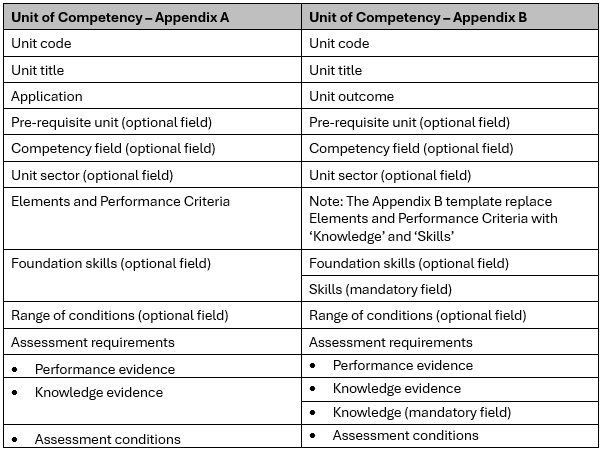
The first observation is that Template A is the same as what currently exists. The next observation is that the two templates have many items that are the same or similar. However, a closer inspection reveals that Template B is a departure from a VET system being based on competencies, and it is a move back towards curriculum.
A move to curriculum-based training returns the VET system to 1994, before the current competency-based VET system was introduced. Also, having two different templates for Units of Competency will add unnecessary complexity. Is this what the government ministers with responsibility of VET want? Do the skills ministers know what they are doing?
Streamlined?
It has been said that it takes too long to develop new training products or modify existing training products. It was said that the process could take 12 to 18 months. The new approach for developing and endorsing training packages has been described in the new Training Package Organising Framework.
The following provides an overview of the new training packages development and endorsement process. [3]

The new process for developing and endorsing training packages does not look much different to the previous, apart from changes to the entities involved, for example, the training package developers are now the Jobs and Skills Councils (JSCs) rather than the Industry Reference Committees (IRCs) supported by Skill Service Organisations (SSOs). Also, the indicative timeframe still seems to be about 12 to 18 months. It would appear that very little has been streamlined.
In conclusion
We’re not seeing streamlining or simplification; instead, complexity is increasing. It’s inevitable that the next VET minister will announce a plan for simplification and streamlining. This cycle of perpetual change seems destined to repeat itself.
References
[1] https://www.dewr.gov.au/skills-reform accessed 16 March 2025
[2] Training Package Organising Framework, pages pages 51 to 55
[3] Training Package Organising Framework, page 24
[4] https://www.dewr.gov.au/skills-commonwealth-state-relations/resources/skills-and-workforce-ministerial-council-communique-6-december-2024 accessed 16 March 2025

 On Target Work Skills