

During the first week of May 2025, I conducted a LinkedIn poll asking people who work for a TAFE or other types of RTO the following question, “What is the typical size of a group of learners?”
Here are the results.
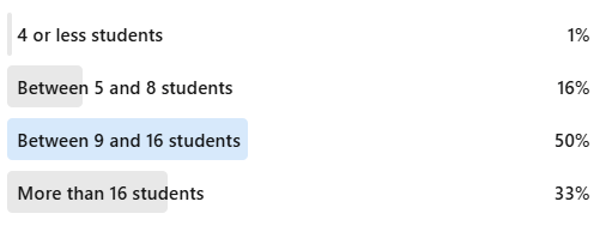
The results of this poll would indicate that a competent trainer working in the Australian VET sector should have the ability to deliver training to a group of at least 9 learners.
The TAE40122 Certificate IV in Training and Assessment is the current qualification designed for trainers working in the Australian VET sector. It requires a person to have the ability to deliver training to a group of 4 learners. This group size is significantly less than what’s required. More than 80% of the poll respondents said that the typical group size is more than 9 learners.
Why is there a discrepancy relating to group size?
The following table shows the history of group size requirements for the current and previous two Certificate IV in Training and Assessment qualifications.
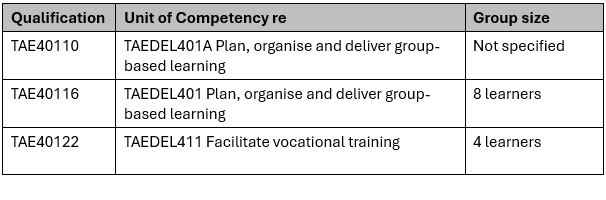
In 2010, the TAE40110 Certificate IV in Training and Assessment did not specify a group size. There was significant inconsistency relating to group size because each RTO delivering the qualification determined what was an acceptable group size. The committee with the responsibility for updating the qualification had to determine what was a group size that would be relevant for trainers working in the Australian VET sector. It decided that the minimum group size would be 8 learners. Therefore, in 2016, the TAE40116 Certificate IV in Training and Assessment specified that a trainer should have the ability to deliver training to a group of at least 8 learners.
The next committee (different to the previous committee) with the responsibility for updating the qualification received submissions from RTOs delivering the qualification saying that it was often difficult for their learners to organise at least 8 people, being the specified group size. This is not a valid reason for reducing group size. Group size should be determined by the realistic requirements of performing the role of a trainer. Trainers working for a TAFE or other types of RTO will typically be expected to delivery training to nine or more learners.
Anyway, in 2022, the TAE40122 Certificate IV in Training and Assessment specified that a trainer should have the ability to deliver to a group of at least 4 learners. This group size is significantly less than what’s required to perform the job. Competency is defined as the consistency application of knowledge and skills to the standard of performance required in the workplace. Hence, a competent trainer should be able to delivery training to at least 9 learners, and the current TAE40122 qualification does not represent this reality.
Sadly, many newly trained TAE40122 graduates will not have the ability to perform the role of trainer. They will not be work-ready. This isn’t how the Australian VET system should work.
Does group size matter?
Group size does matter. Communication complexity and the impact of other challengers increases with increased group size.
Communication complexity
The following dramatically shows how communication complexity increases with the increased number of people.
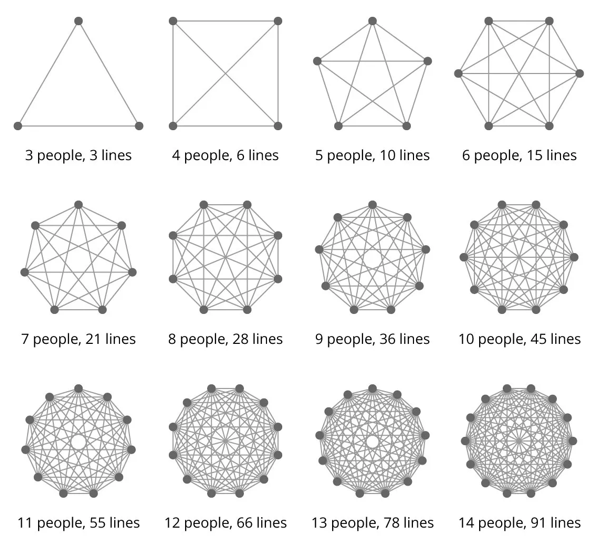
The greater number of people, the greater number of lines of communication. And the greater number of lines of communication, the greater the communication complexity.
The following shows the increasing communication complexity for 5 people, 9 people, and 17 people.
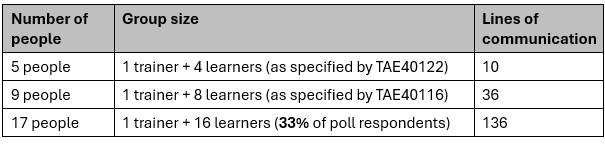
In the above table, the complexity of training 8 learners compared with training 4 learners is more than threefold. And the complexity of training 16 learners compared with training 8 learners is again more than threefold.
It is important to note that 33% of poll respondents said that trainers had to deliver training to group sizes greater than 16 learners. This tells us that trainers need the ability to deliver training in learning environments with high communication complexity. This performance standard is not adequately addressed by the current TAE40122 Certificate IV in Training and Assessment qualification. Also worth noting, is that more than 80% of the poll respondents said that trainers had group sizes greater than 8 learners. The current training of people entering the Australian VET workforce as trainers is inadequate.
Impact of other challengers
A group of 4 learners is a small group. The challengers associated with training a small group are limited compared with training a typical group size. My LinkedIn poll indicates that a typical group size is greater than 9 learners, and in many cases, it is greater than 16 learners.
Increasing group size in training can lead to a range of challengers, for example:
- Reduced individual attention
- Decreased participation
- Superficial discussions
- Logistical challenges
- Weaker group cohesion
- Potential for disengagement
- Difficulty in addressing individual needs.
Reduced individual attention
Trainers have less time to dedicate to each participant, potentially leading to some learners feeling overlooked or not receiving the specific guidance they need. This can be particularly challenging when participants have diverse learning needs or paces.
Decreased participation
Larger groups can make some individuals, especially those who are less confident or hesitant to speak up, ask questions, or actively participate in discussions and activities. This can limit their learning and the overall richness of the group’s experience.
Superficial discussions
With more people wanting to contribute, discussions may become less in-depth, and there might be less opportunity for individuals to share detailed insights or experiences.
Logistical challenges
Managing larger groups can be more complex. Activities may take longer to complete, and organising breakout sessions or individual feedback can become cumbersome.
Weaker group cohesion
It can be harder to build a strong sense of community and trust in a larger group, which can affect the willingness of participants to share openly and learn from each other.
Potential for disengagement
If participants feel lost in the crowd or that their individual needs aren’t being met, they may become disengaged from the training.
Difficulty in addressing individual needs
Identifying and addressing specific learning gaps or challenges becomes more difficult for the trainer in a larger setting.
Trainers need the ability to adapt their training techniques
While increasing group size can offer some advantages in terms of cost and diversity, it often introduces communication complexity and significant challenges related to individual attention, participation, and engagement. Trainers need the ability to adapt their training techniques to mitigate the negative impacts of challengers associated with larger groups.
There are some skills and knowledge required to deliver training to a small group of 4 learners that are the same as those required to deliver training to a larger group. But the ability to deliver training to a larger group is different. The current TAE40122 qualification is not adequately covering the capabilities required to be a trainer working in the Australian VET sector.
In conclusion
I think the committee responsible for the TAE40122 qualification got it wrong. Having the ability to train 4 learners is insufficient. The committee responsible for the TAE40116 qualification would have deliberated the group size that would allow for a relatively realistic assessment of a person’s ability to deliver training to a group. The group size does not need to be 16 or more learners. A group of at least 8 learners is probably about right. A group of at least 8 learners add sufficient complexity and challengers.
There are many things wrong with the TAE40122 qualification. This article has only addressed one of those things: group size of 4 learners is not sufficient.
Let’s hope that a future committee with the responsibility for updating the TAE40122 Certificate IV in Training and Assessment will not make the mistakes made by the previous committee. I had predicted that the previous committee would make mistakes, and it did. It did not want to listen to me. Maybe it should’ve.
There is no timeline for reviewing and updating the Certificate IV in Training and Assessment qualification. However, the qualification or credential designed for trainers working in the Australian VET sector has been updated every 6 years: 1992, 1998, 2004, 2010, 2016, and 2022. If this pattern continues, the next Certificate IV in Training and Assessment qualification is due in 2028. Usually, it takes about 2 years to gain project approval, obtain project funding, review, design, and develop the qualification and associated units of competency.
The TAE40122 Certificate IV in Training and Assessment is not fit-for-purpose. The qualification design is wrong, and there are many things wrong with the TAE units of competency.
This qualification is important for the quality of the entire Australian VET system. It is too important to get wrong again.

 On Target Work Skills