

We will unpack a unit of competency as a starting point for various activities, such as:
- Designing and developing competency-based assessment
- Designing and developing competency-based training
- Preparing for assessment validation.
The unpacking of a unit of competency will be slightly different depending on what activity we are doing. In this article, I will focus on unpacking units of competency when we are preparing to conduct assessment validation.
Unpacking units of competency when preparing for assessment validation
‘Unpacking’ means reading, analysing, and understanding the contents of a unit of competency. Here is a 4-step process that can be used to unpack a unit of competency when preparing for assessment validation:
- Step 1. Read the Application statement
- Step 2. Check the Performance Evidence
- Step 3. Check the Assessment Conditions
- Step 4. Quick review of the Elements and Performance Criteria.
Step 1. Read the Application statement
The Application statement is often a summary of the elements of competency. This can give us a quick overview of the unit of competency. Also, other useful contextual information may be found in the Application statement.
Example 1. BSBCMM411 Make presentations
In the following example, the Application statement uses the elements of competency to give an overview of the unit of competency.

Example 2. CHCECE037 Support children to connect with the natural environment
In the following example, the Application statement includes three relevant pieces of information about this unit of competency.
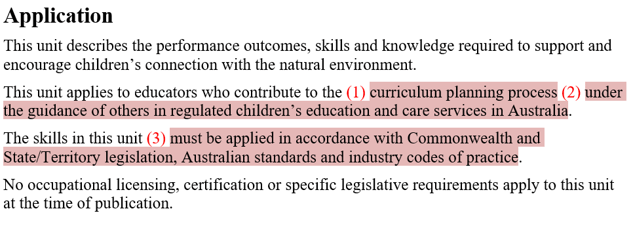
Nowhere else in the unit does it refer to the curriculum planning process. This is the first important piece of contextual information. A second piece of contextual information refers to the early childcare educator performing work under the guidance of others. And a third piece of contextual information refers to performing work in accordance with relevant legislation and industry standards. Early childcare and education is a highly regulated industry.
Step 2. Check the Performance Evidence
The Performance Evidence will consist of essential evidence of performance that must be gathered. You can use the following questions to identify relevant evidence requirements.
- Is the quantity of performance evidence specified?
- Is the type of performance evidence specified?
- Are Foundation Skills accessible items?
Example 3. BSBCMM411 Make presentations
In the following example, a quantity of performance evidence is specified. It requires evidence that at least two presentations. Also, the presentations must be different.

Therefore, during the assessment validation we will be checking that there is performance evidence of at least two presentations is planned to be gathered (pre-assessment validation) or has been gathered (post-assessment validation). And checking that the presentations are different.
Example 4. CHCECE037 Support children to connect with the natural environment
In the following example, a quantity and type of performance evidence is specified. It requires performance evidence to be gathered on three occasions. At least one of those occasions must involve Aboriginal and/or Torres Strait Islander peoples’ use of the natural environment. Also, at least one occasion must be indoors and at least one occasion must be outdoors.
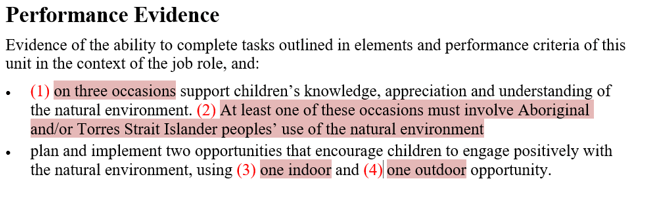
Therefore, during the assessment validation we will be checking that the specified quantity and type of performance evidence is planned to be gathered (pre-assessment validation) or has been gathered (post-assessment validation).
Example 5. SITHCCC025 Prepare and present sandwiches
In the following example, it shows a very detailed specification relating to the quantity and type of performance evidence. Also, it includes other details such as completing the task within commercial time constraints.

Therefore, during the assessment validation we will be checking that the specified performance evidence is planned to be gathered (pre-assessment validation) or has been gathered (post-assessment validation).
Example 6. BSBCMM411 Make presentations
Some units of competency may specify that Foundation Skills are accessible items. In the following example, it states that performance evidence relating to elements, performance criteria and foundation skills must be gathered.

Therefore, during the assessment validation we will be checking that evidence of all specified Foundation Skills are planned to be gathered (pre-assessment validation) or has been gathered (post-assessment validation). This is in addition to checking that evidence of all Performance Criteria are planned to be gathered (pre-assessment validation) or has been gathered (post-assessment validation).
Example 7. CHCECE037 Support children to connect with the natural environment
In the following example, it does not state that performance evidence relating to Foundation Skills must be gathered.
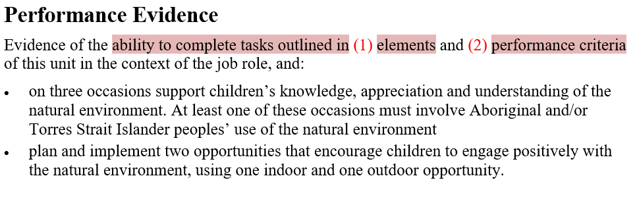
This is an example when there is no information about Foundation Skills being assessable items. We may need to check our RTO’s policies and procedures to determine if Foundation Skills are to be assessed.
Step 3. Check the Assessment Conditions
The Assessment Conditions may consist of relevant information to be checked during assessment validation. You can use the following questions to identify any relevant requirements.
- Is the location for performing assessment tasks specified?
- Is the access to equipment, materials, or other resources specified?
- Is a method of assessment specified?
- Do assessors need to satisfy any specified requirements?
Example 8. BSBCMM411 Make presentations
In the following example, the Assessment Conditions permit the performance specified by the unit of competency to occur in a workplace or simulated workplace. It is important to note that the simulated workplace must have conditions that are typical of those in a real workplace.

Example 9. CHCECE037 Support children to connect with the natural environment
In the following example, the Assessment Conditions states that the performance specified by the unit of competency must occur in a workplace. The workplace must be a regulated children’s education and care service, and it must be in Australia. Also, it should be noted that there must be children involved.
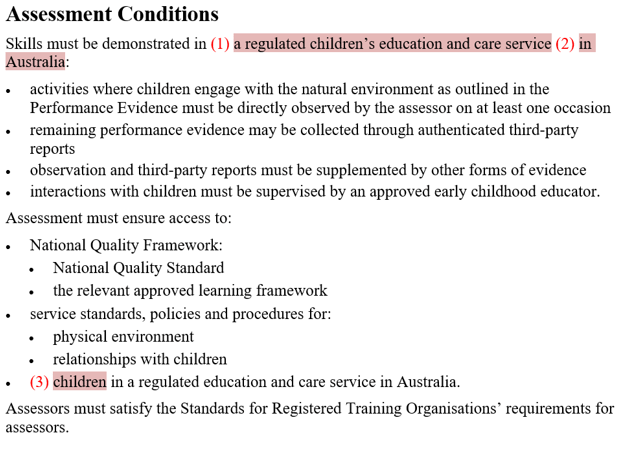
Therefore, during the assessment validation we will be checking that the assessment has occurred in a regulated children’s education and care service in Australia, and children were involved.
Example 10. SITHCCC025 Prepare and present sandwiches
In the following example, the Assessment Conditions permit the performance specified by the unit of competency to occur in a workplace or simulated workplace. It should be noted that the simulated workplace needs to be an industry-realistic kitchen, and it must be serving customers.
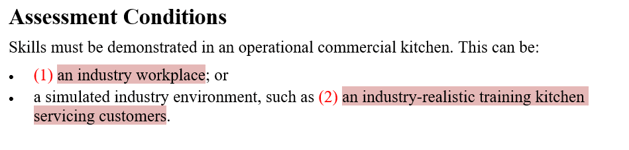
Therefore, during the assessment validation we will be checking that assessment has occurred in an operational commercial kitchen.
Example 11. SITHCCC025 Prepare and present sandwiches
In the following example, the Assessment Conditions has a very long list of items that must be available in the operational commercial kitchen for the assessment.
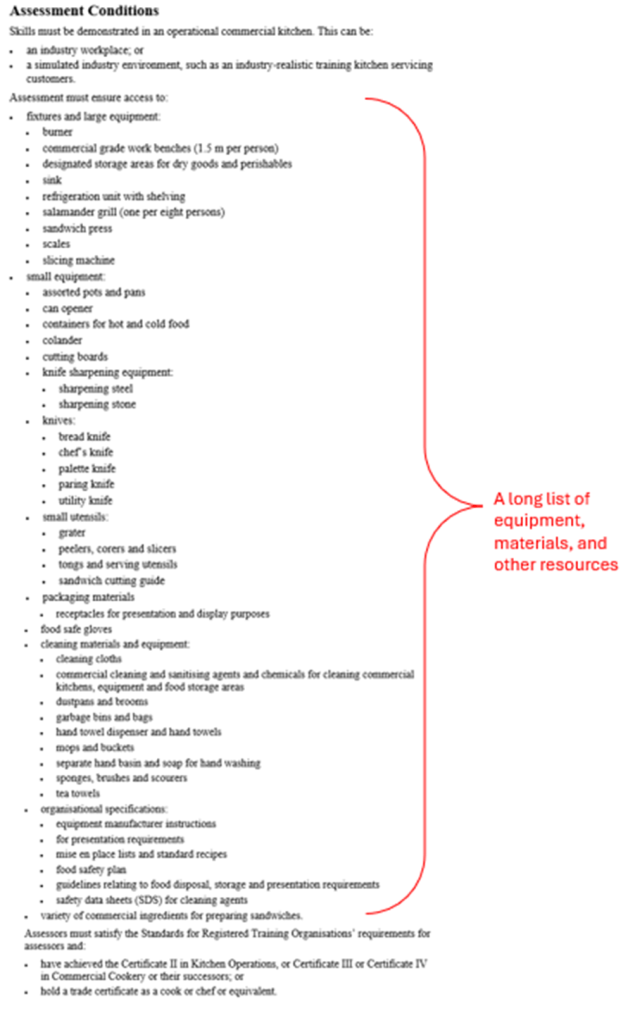
Therefore, during the assessment validation we will be checking that assessment has occurred in an operational commercial kitchen with access to all listed items of equipment, materials and other resources.
Example 12. CHCECE037 Support children to connect with the natural environment
In the following example, the unit of competency that specifies methods of gathering evidence.

Therefore, during the assessment validation we will be check that at least one occasion has been directly observed by the assessor. Also, we will check that observations and third-party reports are supplemented by other forms of evidence.
Example 13. SITHCCC025 Prepare and present sandwiches
In the following example, the Assessment Conditions specify additional requirements for assessors.

Therefore, during the assessment validation we will be checking that the assessors comply with the specified requirements to be an assessor.
Step 4. Quick review of the Elements and Performance Criteria
When preparing to conduct an assessment validation, I will not spend much time reading the Elements, Performance Criteria, Foundation Skills or Knowledge Evidence. This is because I will be spending a lot of time checking these in detail during the assessment validation.
However, it is worthwhile to quickly review the Elements and Performance Criteria. You may find something relevant without getting into the details. For example:
- Is the unit describing the performance of one work task?
- Is the unit describing the performance of more than one work task?
- Is the unit describing a behavioural or interpersonal skill?
- Is the unit primarily describing knowledge?
In conclusion
Effectively ‘unpacking’ a unit of competency is an essential activity in preparing for thorough and meaningful assessment validation. The outlined four-step approach provides a practical framework for this crucial preparatory work. By methodically reading the Application statement (Step 1), checking the Performance Evidence and Assessment Conditions through targeted questions (Steps 2 and 3), and conducting a preliminary review of the Elements and Performance Criteria (Step 4), assessment validators can gain a crucial understanding of the unit’s scope and requirements.
In short, taking the time to understand the unit first makes assessment validation clearer and more effective.
Do you need help with your TAE studies?
Are you a doing the TAE40122 Certificate IV in Training and Assessment, and are you struggling with your studies? Do you need help with your TAE studies?

Ring Alan Maguire on 0493 065 396 to discuss.

Training trainers since 1986

 On Target Work Skills
One thought on “Prepare for assessment validation by unpacking the unit”