

I have been around the current Australian VET system since it commenced in 1992. And during my career as a VET practitioner, I have seen and been a part of many changes designed to ensure training providers deliver a quality training and assessment service.
A short history of national training quality assurance frameworks
The past
The first national approach to quality assuring vocational education and training (VET) in Australia was the National Framework for the Recognition of Training (NFROT). It was introduced in 1992, and this is when Australia’s current competency-based training and assessment system was established.
The NFROT was replaced by the Australian Recognition Framework (ARF) in 1998. A few years later the ARF was replace by the Australian Training Quality Framework (ATQF). The ATQF was introduced in 2001 and became fully operational in 2002.
The AQTF was reviewed and revised in 2005, 2007, and 2010.
Next, the ATQF was replace by the Standards for NVR Registered Training Organisations 2012. These Standards were introduced as part of the National VET Regulator (NVR) system, which ASQA (Australian Skills Quality Authority) commenced operating under when it was established in 2011.
These 2012 Standards for RTOs were themselves later replaced by the Standards for Registered Training Organisations (RTOs) 2015.
The present
On the 1st of July 2025, the 2015 Standards for RTOs were replaced by the National Vocational Education and Training Regulator (Outcome Standards for Registered Training Organisations) Instrument 2025.
All RTOs that are regulated by ASQA are required to operate in accordance with these 2025 Standards for RTOs.
An overview of the 2025 Standards for RTOs
Standards for RTOs
The 2025 Standards for RTOs consists of 20 pages (including cover and contents page). It has been documented with four Parts, and each part has Divisions, and each division has one, two, or three Standards.
Standards provide two pieces of information:
- Outcome Standard – numbered with (1)
- Performance Indicators – numbered with (2).
Sub-points under the Performance Indicators are given (a), (b), etc.
And sub sub-points are given (i), (ii), etc.
Also, each Part is referred to as a Quality Area. The nomenclature and numbering used is somewhat cumbersome for the first-time reader.
The following shows an overview of the numbering method used in the 2025 Standards for RTOs.
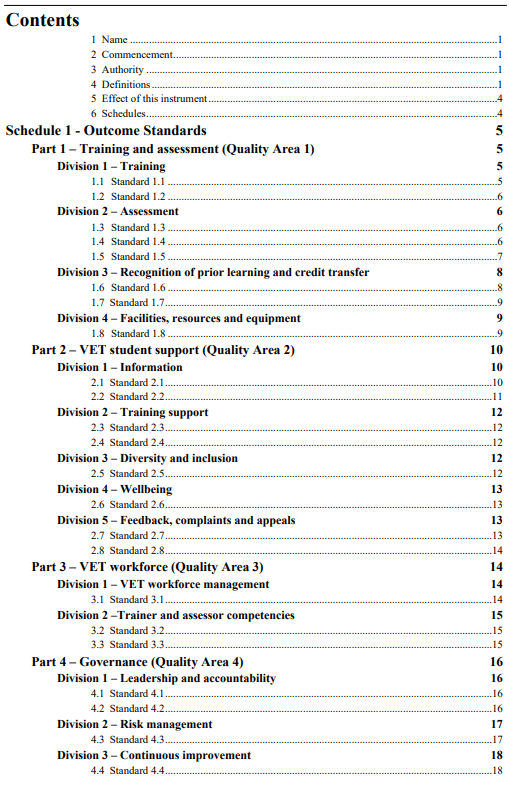
Access the 2025 Standards for RTOs from the Federal Register of Legislation website.
Practice Guides
ASQA has published Practice Guides. These Guides aim to support understanding of regulatory expectations.
The Practice Guides include:
- examples activities and considerations for demonstrating compliance
- examples of known risks to quality outcomes.
To align with the 2025 Standards for RTOs, these Practice Guides are grouped under each of the four Quality Areas. Specifically, there’s one Practice Guide for every Division within each Quality Area.
The following shows how ASQA has organised the Practice Guides relating to the 2025 Standards for RTOs.

The links (shown above) takes us to an online version of the Practice Guide, and a PDF copy of the Practice Guide can be downloaded. The following is an example for the online version of the Practice Guide for Training.

Access the Practice Guides from the ASQA website.
In conclusion
I am sure that many well-meaning legislators have tried their best. But after more than 30 years, and many changes to the quality assurance framework, the Australian VET system still seems to be unable to deliver the quality of training and assessment services expected by clients and stakeholders.
I believe that the attainment of quality will not be achieved by another document describing the Standards for RTOs. I predict that there will be another quality assurance framework developed in the future. This will probably make a future federal government minister with the responsibility for vocational education and training feel good because they have accomplished something – but nothing has really been accomplished by documenting a quality assurance framework.
Why do you think the delivery of quality training and assessment services is so elusive?
Do you need help with your TAE studies?
Are you a doing the TAE40122 Certificate IV in Training and Assessment, and are you struggling with your studies? Do you need help with your TAE studies?

Ring Alan Maguire on 0493 065 396 to discuss.

Training trainers since 1986

 On Target Work Skills