Guide to developing assessment tools

Coincidentally, or by design, every six years a guide to developing assessment tools is released by authoritative VET sources.

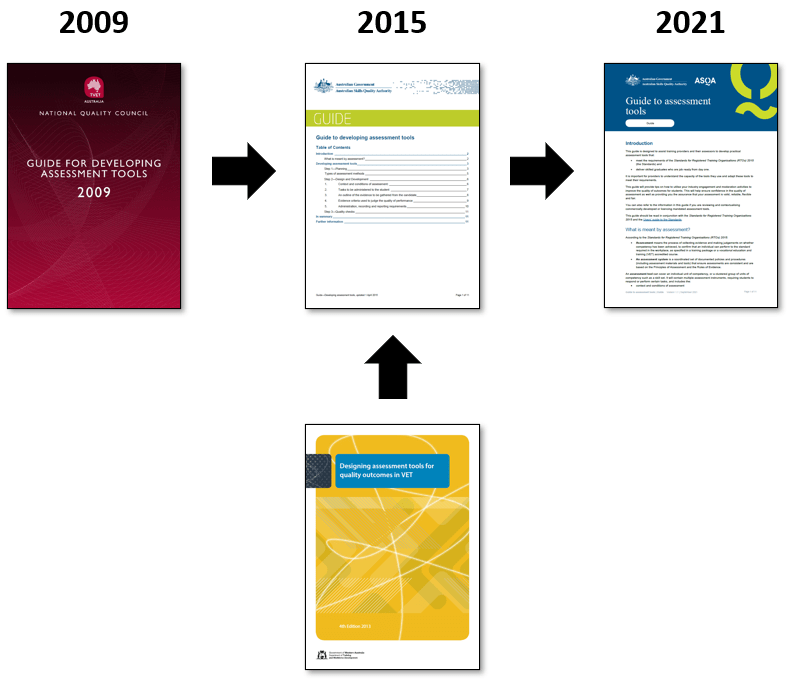
In 2009, the National Quality Council (NQC) released a guide. The NQC’s guide plus a guide published by the Western Australia’s Department of Training and Workforce Development were used by ASQA to produce their guide in 2015. And in 2021, ASQA updated their guide. It is interesting that ASQA’s 2021 version has removed the word ‘developing’ from the document title. However, it still is the guide to [developing] assessment tools.

How has ASQA updated the guide?

Industry engagement

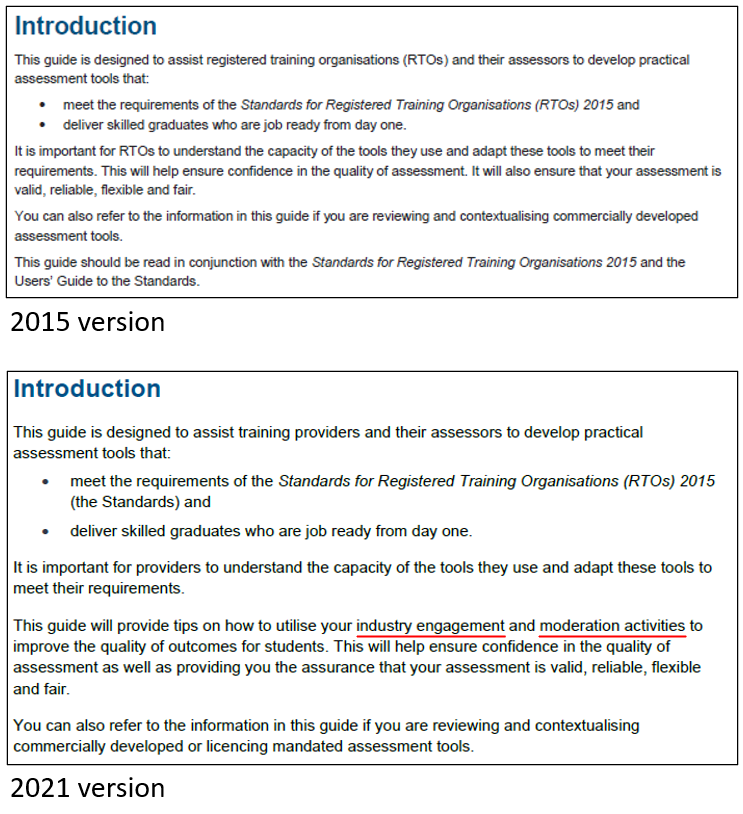
The first difference between the 2015 version and 2012 version of the guide is ASQA’s aim to encourage RTOs to engage industry when developing assessment tools. In the 2015 version, the involvement of industry was on page 4. The 2021 version brings forward a reference to industry to page 1. This update seems to be more symbolic rather than substantive.

Very little information of any substance about industry engagement is provided in the ASQA’s guide. The following is provided:

  • RTO must state how industry representative have contributed to the development of your assessment practices and resources
  • Industry engagement can be used to align the assessment tool with current methods, technologies, performance expectations, etc.

This information was already available in the 2015 version of the guide.

Has ASQA misunderstood ‘moderation’?

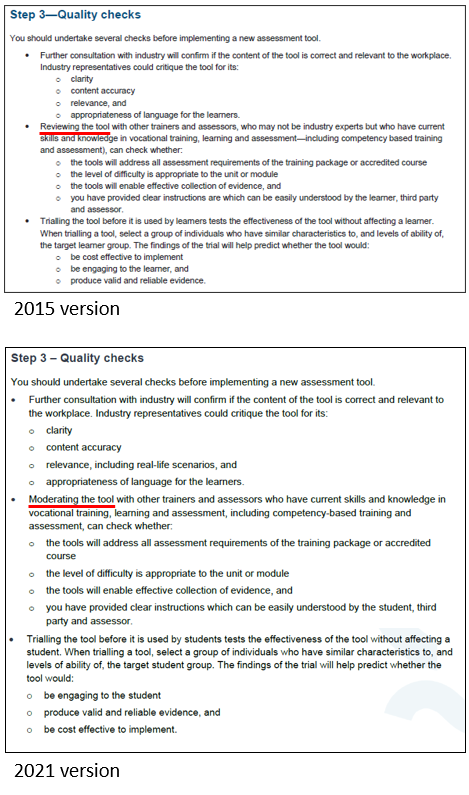
Another difference between the the 2015 version and 2012 version of the guide is the inclusion of ‘moderation’. It has replaced the activity of reviewing the assessment tool.

I believe that moderation is not part of the process for developing an assessment tool. For me, moderation is an activity that reviews some samples of completed assessment tasks and evidence that have been used to make an assessment decision. Assessors would meet to determine what decisions they would make based on the given evidence. Any discrepancies would need to be discussed to ensure all assessors standardise their assessment decisions. Therefore, moderation occurs after the assessment tool has been implemented.

Moderation is a useful activity for RTOs to seek the delivery of a reliable assessment process. It assists with compliance with the ‘reliability’ principle of assessment. I wonder if ASQA has misunderstood or misappropriated the concept of ‘moderation’. I would prefer the ASQA guide to revert back to ‘reviewing the tool’ rather than ‘moderating the tool’. Misuse of terms can cause confusion.

Who are the developers of assessment tools?

The introduction to ASQA’s guide to assessment tools states that it has been “designed to assist training providers and their assessors to develop assessment tools“. It would be interesting to know how many assessors are actually involved in the development of assessment tools.

Since 2016, there has been a strong view that very few assessors develop assessment tools. This has been the basis of complaint about the TAEASS502 Design and and develop assessment tools being a core unit in the TAE40116 Certificate IV in Training and Assessment qualification. I wonder why ASQA has not acknowledge that assessors are unlikely to develop assessment tools. It may be better if ASQA had used the job title of instructional designer or resources developer. Or, does ASQA still believe that assessors develop assessment tools?

What information does the Guide provide?

The Guide to [developing] assessment tools is a short and easy-to-read document. It begins with defining the terms:

  • Assessment
  • Assessment systems
  • Assessment tool.

These definitions are followed by an outline of a 3-step process for developing assessment tools

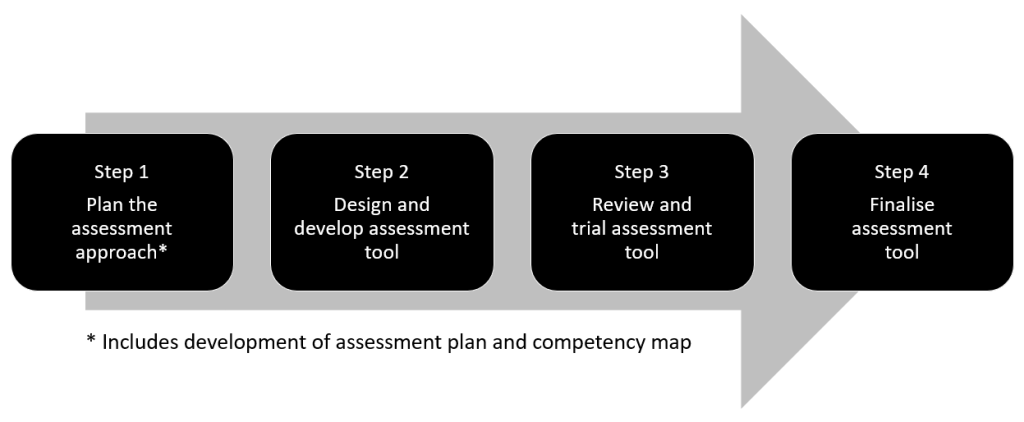
If anyone is familiar with my TAE40116 resources, you will know that I promote the following 4-step process.

My 4-step process is clear, logical, and consistent with:

  • TAEASS401 Plan assessment activities and processes
  • TAEASS502 Design and develop assessment tools.

Planning

ASQA’s guide to [developing] assessment tools briefly describes some planning considerations:

  • What are the assessment requirements of the training package or accredited course?
  • What does consultation from your industry engagement recommend?
  • What assessment methods are most appropriate for your student cohort?

Types of assessment methods

Four types of assessment methods are listed and described:

  • Direct observation
  • Product based methods
  • Questioning
  • Third-party evidence.

The 2021 version of the guide has removed the ‘portfolio of evidence’ assessment method from the list. That’s okay because it is adequately covered by the ‘product based methods’.

Design and development

ASQA’s guide to [developing] assessment tools briefly describes a number of components to be designed and developed so that the assessment tool will comply with the ‘principles of assessment’:

  • The context and conditions of assessment
  • The tasks a student must complete to demonstrate competency
  • An outline of evidence to be gathered from the student
  • Evidence criteria used to judge the quality of performance
  • Administration, recording and reporting requirments.

Quality checks

ASQA’s guide to [developing] assessment tools briefly describes three checks that should be undertaken before implementing a new assessment tool:

Further consultation with industry to confirm the content of the assessment tool is correct and relevant to the workplace

Moderating the tool (earlier in this article I have expressed by disagreement with using the term ‘moderation’, and I think the 2015 version of guide was right in using the term ‘reviewing the tool’)

Trialling the tool before it is used by students.

In conclusion

There is very little difference between the 2015 and 2021 versions of ASQA’s guide to [developing] assessment tools. It is a document that I think should be read and understood by all VET practitioners. It does not matter if a VET practitioner is developing an assessment tool, or not. ASQA’s guide provides the basic information about how an assessment tool supports compliance with requirements specified by:

  • Standards for Registered Training Organisations (RTOs)
  • Training packages and accredited courses.

Also, it encourages the consultation with employers and industry to ensure an RTO’s assessment approach meets current workplace requirements.

Do you need help with your TAE studies?

Are you a doing the TAE40122 Certificate IV in Training and Assessment, and are you struggling with your studies? Do you want help with your TAE studies?

Do you want more information? Ring Alan Maguire on 0493 065 396 to discuss.

Contact now!

logo otws

Training trainers since 1986

Do you need help with your TAE studies? Are you looking for a TAE Tutor?

Some TAE Students struggle with their TAE studies. I have established a tutoring service to help individuals studying for:

  • TAE40122 Certificate IV in Training and Assessment
  • TAE Update, TAE Diploma or TAE Skill Set.

Feeling overwhelmed or losing motivation are common experiences for many TAE Students. There is no shame in asking for help. My tutoring service can save time and save being frustrated.

Barriers to learning and assessment

Many people find the Certificate IV in Training and Assessment qualification difficult for a range of reasons. Typical barriers include:

  • Understanding VET jargon and acronyms
  • Understanding and interpreting units of competency and assessment requirements
  • Understanding assessment instructions
  • Understanding how to perform the assessment tasks
  • Computer skills.

Understanding VET jargon and acronyms

RTO, ASQA, AQF, JSA, JSC, LLN, ACSF, NYC, etc. The Australian VET system uses a lot of jargon and acronyms. This can be confusing for someone who is new to the world of VET. If you don’t understand the language of VET, then it is easy to get confused and overwhelmed. Topics or information about VET can have no meaning when a person starts their TAE studies.

Some strategies to help a TAE Student learn VET jargon and acronyms are:

  • Refer to the Glossary of terms from the Standards for RTOs
  • Develop your own glossary of VET jargon and acronyms
  • Encouragement to use VET jargon and acronyms.

As a TAE Tutor, I can create a ‘safe learning environment’ that encourages a TAE Student to practice using and learning the new terminology.

Understanding and interpreting units of competency and assessment requirements

Competency-based training and assessment is a fundamental part of Australia’s VET system. Units of competency are extracted from ‘training packages and accredited courses’. They are the building blocks for qualifications and skill sets. An understanding of them is foundational, but many people who are new to VET need help to develop their understanding.

And to make things worst, units of competency and assessment requirements are deliberately written to be ambiguous. This is not a fault. This is a feature of the Australian VET system. It allows units to be interpreted and contextualised to meet specific requirements for a workplace or industry.

As a TAE Tutor, I can focus on developing a practical understanding of units of competency and how to use them.

Understanding assessment instructions

Some assessment instructions are poorly written. Some assessment instructions are not written in plain English. Some assessment instructions are complex, using jargon and acronyms. And sometimes the structure of the the instructions are complex or defy logic.

If someone can not understand the assessment instructions, then they can not get started on performing the assessment task. Alternatively, if they misunderstand the instructions they may waste time and effort doing unnecessary work.

As a TAE Tutor, I can help untangle and explain what the assessment instructions are saying. Often, I need to simplify or prioritise the steps to be taken to undertake the assessment tasks.

Understanding how to perform the assessment tasks

Some training providers may not cover the required knowledge or required skills for performing tasks. Some training providers may not clearly describe how to perform tasks. And some training providers may deliver short-duration or poor quality TAE training that is insufficient.

As a TAE Tutor, I can diagnose what may be stopping a person from performing the assessment task:

  • Lack of required knowledge
  • Lack of required foundation skills
  • Unclear about the steps to perform the task.

Then as the TAE Tutor, I can help close knowledge gaps, skill gaps, or give a clear step-by-step procedure.

Reading and writing skills

Some TAE Students have inadequate reading and writing skills.

Reading tasks include:

  • Read learner guides
  • Read reference documents
  • Read assessment instructions.

Writing tasks include:

  • Write answers to questions
  • Develop training and assessment documents
  • Use templates or forms to complete assessment tasks.

Reading and writing can be difficult for people who’s first language is not English. Australia has welcomed many migrants and refugees who may experience language or literacy barriers.

Some TAE Students would benefit having extensive LLN support. However, other TAE Students can cope if they get clear explanations and guidance. As a TAE Tutor, I cannot give extensive LLN support but I can give clear explanations and guidance.

Computer skills

Technology has become common in today’s workplace. Trainers and TAFE teachers working in the VET sector are required to use technology. For example:

  • Learning management systems, such as Moodle
  • Word processing applications, such as Microsoft Word
  • Presentation applications, such as Microsoft PowerPoint
  • Video conferencing platforms, such as Zoom
  • Computer and projection equipment.

Some TAE Students have insufficient computer skills when they commence their TAE studies. The development of computer skills is essential. As a TAE Tutor, I can demonstrate some some basic computer functions to help learn to use Microsoft Word and this can help with competing assessment tasks.

About the TAE Tutoring service

Each tutoring session shall be conducted using video conferencing application (Zoom or Google Meet). The duration of a tutoring session is 60 minutes. The session is tailored to the needs of the individual with the aim of progressing assessment tasks. Sessions can be arranged for during the day, evenings, or weekends.

Do you want more information? Ring Alan Maguire on 0493 065 396 to discuss.

Contact now!

logo otws

Training trainers since 1986

TAE40116 is an entry requirement for working in VET

This article was originally published in 2021.

The TAE Training Package is being reviewed, including the TAE40116 Certificate IV in Training and Assessment qualification. The TAE40116 qualification is the most important qualification in the Australian VET system because the quality delivery of training and assessment services depends upon having skilled trainers and assessors.

The TAE40116 qualification is the entry requirement for working in VET.

The Qualification Description states: [1]

“This qualification reflects the roles of individuals delivering training and assessment services in the vocational education and training (VET) sector.”

And the Entry Requirements states: [1]

“Those entering this program must be able to demonstrate vocational competency in their proposed teaching and assessing area. Vocational competency is defined as broad industry knowledge and experience, and may include, but is not limited to, holding a relevant unit of competency or qualification.”

The possibility of replacing the TAE40116 qualification with something else raises some questions:

  • Why do people do the TAE40116 qualification?
  • How many people do the TAE40116 qualification because they want to work in VET?
  • Is the TAE40116 qualification required by all trainers?
  • Who must have the TAE40116 qualification?

Answers to these questions will help to determine what will replace the TAE40116 qualification.

Why do people do the TAE40116 qualification?

Some people do it because they are told they must do it. For example,

  • An RTO offers someone a job on the proviso of them getting the TAE40116 qualification (usually trades people, especially plumbers because of the short supply of trainers in the plumbing industry sector)
  • Teachers who are going to deliver a VET in Schools program are told that they need to get the TAE40116 qualification
  • Employees who are going to deliver training or conduct assessments as part of a VET program (workplace trainers, industry trainers, enterprise trainers, etc.)
  • Volunteers who are going to deliver training or conduct assessments as part of a VET program (community services trainers, emergency services trainers, etc.)
  • People seeking a HR job that specifies holding the Certificate IV in Training and Assessment as a job selection criteria.

Some people may be told by a friend, work colleague or career adviser to do it because it would be good for their future employment. For example,

  • Trades people who are getting older and are needing a job that is ‘off the tools’
  • Unemployed people who are struggling to get a job
  • Employed people who are wanting a job with better pay
  • Employed people who are wanting a better job at work
  • People wanting to become a trainer (working outside of the VET system)
  • New migrants who are highly qualified and may have worked for overseas universities but can not get employed at an Australian university.

Some people do it because they want to get a job working for TAFE or other RTO. Often, these people have limited or no idea about the opportunities open to working for private RTOs or jobs outside of TAFE institutes.

How many people do the TAE40116 qualification because they want to work in VET?

From my experience, most people commence the TAE40116 qualification without much knowledge of VET. And many of these people do not understand that the purpose of the TAE40116 qualification is to develop the entry-level skills required to work in VET as a trainer and assessor.

Many people are surprised by the content that they must learn. The terminology of VET is new to most. The need to be compliant with VET regulations, and the rigor of competency-based assessment is challenging for many. Some wonder if it was a good decision to have started to do the TAE40116 qualification. But none of this is good reason to change the TAE40116 qualification.

I think about 50% start the TAE40116 qualification with a clear idea about the career pathway into VET. And about 50% are unclear about the prime purpose of the TAE40116 qualification or think it is something that it isn’t.

Is the TAE40116 qualification required by all trainers?

No. Not every trainer needs the TAE40116 qualification. It is only the trainers who will deliver VET programs that require it. And this requirement is primarily determined by the VET regulations.

Some people start the TAE40116 qualification without understanding that it has the prime purpose of providing a pathway into the role of trainer and assessor working in the VET sector. There are valid alternatives to doing the TAE40116 qualification, such as:

  • TAE skill set
  • TAE unit or units of competency
  • Non-VET training course to learn the skills of being a trainer.

I have explored these alternatives in an article titled, ‘What credentials do trainers need?

Who must have the TAE40116 qualification?

RTOs often want to employ trainers and assessors with the TAE40116 qualification. This makes it easier during an audit to prove that a person meets the requirements as specified by the Standards for RTOs (Clause 1.14 and Schedule 1). [2]

However, not every trainer need to have the TAE40116 qualification. A person can deliver training for an RTO without holding the TAE40116 qualification (but they must work under the supervision of a qualified trainer). Also, they cannot determine assessment outcome (but they can still contribute to assessment). The only people who can determine assessment outcomes are those who hold the following four units of competency: [3]
  • TAEASS401 Plan assessment activities and processes
  • TAEASS402 Assess competence
  • TAEASS403 Participate in assessment validation
  • TAEASS502 Design and develop assessment tools.

Most RTOs do not want to employ someone to only deliver training. They do want their trainers to conduct assessments. Therefore, the only mandated credential required to work for an RTO are the four specified TAEASS units.

In conclusion

TAE40116 qualification is the doorway to a career as a trainer and assessor working in the VET sector. But other people try to use it for other purposes. And then these people say that the TAE40116 qualification is ‘not fit for purpose’. It is fit for the purpose it was designed for. It has not been designed for non-VET applications.

The TAE Training Package review will need to tackle some tricky questions:

  • Will the TAE40116 qualification be replaced by more than one qualification?
  • If there will be more than one qualification, will there be a qualification that allows people to ‘work in VET’ and another qualification that allows people to ‘work outside of VET but prohibits them from working in VET’ because they won’t have the required credentials specified by the Standards for RTOs?
  • Will having different qualifications cause confusion and disappointment? Confusion at the time of enrolment because people won’t understand which qualification is ‘better’. Disappointment after attaining one qualification to only discover they can’t work in VET because they needed a different qualification (or different elective units).
  • What will the AQF level be for the qualification or qualifications that replace the TAE40116 qualification?

I am watching and waiting to see what the TAE Training Package review will bring. I anticipate that it will bring confusion and disappointment. And I anticipate the quality of VET will not be improved by replacing the current TAE40116 qualification.
What do you think?

References

[1] https://training.gov.au/Training/Details/TAE40116 accessed 19 November 2021

[2] https://www.asqa.gov.au/standards/training-assessment/clauses-1.13-to-1.16 accessed 19 November 2021

[3] https://www.legislation.gov.au/Details/F2019C00503 accessed 19 November 2021

E-assessment guidelines for the VET sector

The following was written a decade ago:

The use of e-assessment is increasing rapidly in the VET sector in Australia. Recent national benchmarking surveys revealed that over 40 per cent of RTOs and more than 60 per cent of teachers and trainers are using some form of e-assessment. E-assessment is the use of information technology for any assessment-related activity. [1]

These words come from a research report titled, ‘E-assessment guidelines for the VET sector’. It was produced on behalf of the National Quality Council and the Australian Flexible Learning Framework with funding provided through the Australian Government Department of Education, Employment and Workplace Relations and state and territory governments.

Application of e-assessment

This document used the elements of the TAEASS402A Assess competence unit of competency to identify the application of technology. [2] It should be noted that the current TAEASS402 unit supersedes and is deemed equivalent to the TAEASS402B unit, and TAEASS402B unit supersedes and was deemed equivalent to the TAEASS402A units.

Therefore, the nexus between the skills of an assessor conducting assessment and the use of technology was established more than 10 years ago.

Compliance with the principles of assessment

The ‘E-assessment guidelines for the VET sector’ explains how e-assessment can comply with the principles of assessment. [3]

Compliance with the rules of evidence

The ‘E-assessment guidelines for the VET sector’ explains how e-assessment can comply with the rules for evidence. [4]

Candidate authentication and security

The ‘E-assessment guidelines for the VET sector’ explores how e-assessment must provide for candidate authentication and the security of both the assessment process and assessment data. [5]

In conclusion

What’s happened in the ten years since the ‘E-assessment guidelines for the VET sector’ was published?

  • More RTOs use technology to support their assessment processes and activities
  • Most trainers and TAFE teachers have used some form of e-assessment
  • Technology has become more accessible and intuitive to use
  • The use of an LMS has become ubiquitous.

The ‘e’ in e-assessment no longer stands for ‘electronic’, instead it has become to stand for ‘everyday’ (or ‘everywhere’).

The Education IRC wants to implement a new TAEASS404 Conduct e-assessment of competence unit of competency. This new unit duplicates what is adequately covered the the current TAEASS402 Assess competence unit of competency. As an example, the following table illustrates the similarity by comparing performance criteria.

If you would like to view the complete mapping of performance criteria, please refer to pages 33 to 37 in following document:

Do you think that a duplicate unit of competency is needed?

Using technology to support assessment processes and activities is not new. The current TAE Training Package released in 2016, and the previous TAE10 Training Package, have been developed with consideration of technology being used when conducting assessments. The only difference between now and ten years ago is that technology has generally become easier to learn and use. Technology is a foundation skill required to be an assessor but I do not believe we need to develop and implement a duplicate unit of competency.

Do you think that the Education IRC should scrap their idea of implementing the proposed TAEASS404 Conduct e-assessment of competence unit of competency?

References

[1] Australian Flexible Learning Framework and National Quality Council, E-assessment guidelines for the VET sector (page 3), 2011

[2] Australian Flexible Learning Framework and National Quality Council, E-assessment guidelines for the VET sector (pages 7 to 10), 2011

[3] Australian Flexible Learning Framework and National Quality Council, E-assessment guidelines for the VET sector (pages 19), 2011

[4] Australian Flexible Learning Framework and National Quality Council, E-assessment guidelines for the VET sector (pages 23 to 25), 2011

[5] Australian Flexible Learning Framework and National Quality Council, E-assessment guidelines for the VET sector (pages 21 and 22), 2011

E-assessment and E-learning: the development of two TAE units that we don’t need

As part of the TAE Training Package review, two new e-units has been drafted. PwC’s Skills for Australia is currently seeking our feedback about these two draft units of competency:

  • TAEASS404 Conduct e-assessment of competence (draft)
  • TAEDEL405 Plan, organise and facilitate e-learning (draft)

I have published two previous articles that presents a case against further developing and implementing these two units:

In this article, I provide a background to the development of these units of competency. I will also highlight the flawed process and missed opportunities.

Background to the E-assessment project

Case for Change

The Education IRC developed a Case for Change that covers:

  • Holistic review of the TAE Training Package: a holistic review of six qualifications and 55 units of competency in the TAE Training Package.
  • E-assessment project: an urgent response to address an identified gap in e-assessment in the TAE Training Package involving the development of two new units of competency.

The Case for Change was approved at the AISC meeting on 19 August 2021. [1]

E-assessment project

The following is an extract from the Case for Change. [2]

The AISC approval was for the creation of two new e-assessment units of competency. One unit of competency was to cover ‘designing e-assessment’, and the other to cover ‘facilitating e-assessment’ (as per Case for Change, see below).

The draft units of competency were released on 22 October 2021. Instead of two e-assessment units of competency, there was one e-learning unit and one e-assessment unit. This is a significant alteration to the project scope that had been approved by AISC. I have not seen any communication acknowledging or explaining this change of scope. This raises serious concerns about the decision-making and integrity of the Education IRC.

  • Why was the scope changed?
  • Has AISC approved the changed scope?
  • Why hasn’t the changed scope been communicated and justified?
  • Are members of the Education IRC aware of the changed scope? If so, why haven’t they ensured that the change be communicated?

The Case for Change identified an ‘e-assessment’ skills gap. AISC approved the creation of two new e-assessment units of competency. The Case for Change did not propose the creation of an e-learning unit of competency.

The Education IRC had considered VET sector stakeholder feedback and decided that two new e-assessment units of competency were needed. This was presented to the AISC, and subsequently approved.

  • Was the original e-assessment skills gap false? Therefore, the ability of the Education IRC to analyse VET sector stakeholder feedback and make decisions is faulty.
  • Was the original solution to create two e-assessment units of competency wrong? Therefore, the ability of the Education IRC to develop solutions is questionable.
  • Did the Education IRC feel compelled to create two new units of competency? Therefore, did the Education IRC think it was better to create two units of competency than admit they got it wrong and only develop one e-assessment unit of competency?

The Case for Change does not justify the creation of an e-learning unit of competency. And the creation of a ‘new’ e-learning unit of competency is not required. The unnecessary creation of an e-learning unit of competency has been discussed in my previous article titled, ‘Do we need a new e-learning unit of competency?‘.

The Case for Change states that e-assessment requires a significantly different set of skills and knowledge to traditional assessment practices.

  • What are ‘traditional’ assessment practices?
  • Are ‘traditional’ and ‘contemporary’ assessment practices the same thing?
  • Are the skills and knowledge to conduct e-assessment ‘significantly’ or ‘slightly’ different to those needed to conduct ‘traditional’ assessment?

These questions have been explored in my previous article titled, ‘Do we need a new e-assessment unit of competency?‘.

Required e-assessment skills

The following is an extract from the Case for Change. [2]

Five issues have been listed by the Education IRC. These issues or poor assessment practices may be caused by assessors lacking the required knowledge and skills. However, these issues may be caused by RTO management lacking knowledge or skills, inadequate allocation of resources for conducting quality assessment, or improper implementation of an RTO’s policies, procedures, or systems. Assessors may be falsely identified as the cause of issues, and then it is assumed that the development of knowledge and skills for assessors will resolve these issues. It is a waste of time and money to train assessors if the cause of issues is unrelated to assessor or their knowledge and skills.

The following is an analysis of the five issues.

None of the five issues seem to justify the creation of new e-assessment units of competency, especially, at developing the knowledge and skills of assessors.

The Case for Change was not made publicly available until after it had been approved by AISC. This meant that there had not been any prior opportunity to analyse and comment on the proposal or the justification of what was being proposed. The following is an extract from the Case for Change. [2]

A ‘strong evidence of industry support for the Case for Change’ is not the same thing as having strong evidence for change. The following peak bodies are listed as giving their support, or agreed with, the Case for Change:

  • TAFE Directors Australia
  • Enterprise RTO Association
  • Australian Industry Group
  • Independent Tertiary Education Council Australia
  • Australasian Curriculum and Certification Authorities
  • Regulators and state and territory training authorities (STAs).

Sadly, it seems that no one with current or detailed knowledge of the ‘contemporary assessment environment’ were consulted. The justification by the Education IRC for creating two new e-assessment units of competency is flawed. It is regrettable that no one consulted from the peak bodies, regulators, state and territory training authorities, or AISC knew enough to disagree with the false justifications and the proposed solution. The justifications for the ‘E-assessment project’ have already been proven as false because the project scope has been altered within two months of it being announced. This is evidence that the feedback from VET sector stakeholders, proposal by the Education IRC, and approval by AISC have been faulty.

Recent announcements [3] to scrap the current training package development and endorsement process will mean that the current people will have no accountability in the future. The current people involved will not have to face the consequences of getting things wrong or wasting government funding. I think it would be desirable to pause the current review of the TAE Training Package, including the ‘E-assessment project’, until the new Industry Cluster has been established.

Scope of the E-assessment project has changed

It is probably too late to stop the progress of the ‘E-assessment project’ that has morphed into the ‘E-learning and E-assessment project’. It should be noted that the Case for Change did not propose the creation of an e-learning unit of competency. This would indicate that the training product consultation and development process is flawed.

The scope of the ‘E-assessment project’ has been altered since it was approved by AISC. The following table shows that the proposed ‘Design e-assessment’ unit of competency has been dropped. It also shows that a ‘Plan, organise and facilitate e-learning’ has been created.

A ‘Design e-assessment’ unit of competency was proposed by the Case for Change but has not been pursued. I am unaware of any acknowledgement or communication about why it has silently been removed for the ‘E-assessment project’ scope. Instead, a new unit has been created that had not been proposed by the Case for Change. A new ‘Plan, organise and facilitate e-learning’ unit of competency has been drafted. Again, I am unaware of any acknowledgement or communication about why it has silently been added to the ‘E-assessment project’ scope. Evidence that supports the creation of a new e-learning unit of competency is unknown. It had not been identified by VET sector stakeholder and had not been presented to AISC for approval.

The work roles associated with e-assessment

The following diagram illustrates five work roles that perform tasks associated with e-assessment.

Some tasks performed by a trainer and assessor may crossover with those performed by a resources designer and developer. For example, some trainers and assessors may be required to develop simple learning or assessment resources.

Some tasks performed by a resources designer and developer may crossover with those performed by an LMS administrator. For example, some resource developers may upload resources to the LMS.

Some tasks performed by an LMS administrator may crossover with those performed by a training administrator. For example, some LMS administrator may set up courses and classes.

Some tasks performed by a training administrator may crossover with those performed by a training manager or coordinator. For example, some training administrators may have the ability to assign levels of LMS authority to other people.

The above diagram deliberately has a gap between:

  • Trainer and assessor / LMS administrator
  • LMS administrator / Training manager or coordinator
  • Resources designer and developer / Training administrator.

The crossover between these roles are rare.

The role of LMS administrator

It is important to recognise that LMS administrators are specialists and perform tasks that are not usually performed by trainers and assessors. The most critical role in making e-assessment work is the LMS administrator. The knowledge and skills of the LMS administrator is far beyond what is required by users of the LMS, such as, trainers and assessors. The Education IRC may like to consider developing a qualification or skill set for the work role of LMS administrator. Some trainers and assessors may like this as a career pathway – but many trainers and assessors would have no desire to deeply immerse themselves into the world of LMS technology.

Users of technology

Why was a new e-assessment unit required for trainers and assessors? Was it because they cannot conduct assessments? Or was it because they cannot use the technology? Using an LMS or other technology that supports the assessment process can be treated in the same ways as using Microsoft Word, Microsoft PowerPoint, Google Docs or other technology applications that may be used by trainers and assessors. Technology to support assessment activities is a foundation skill.

The current TAEASS402 Access competence unit of competency addresses the knowledge and skills required by trainers and assessors to conduct assessments. Therefore, the ‘real’ need is to develop the capability to use Moodle, use Canvas, use Job Ready, use other LMS, or use other technology that supports an RTO’s assessment processes. Addressing every possible technology is onerous, wasteful and impractical.

A dilemma for the VET system is whether a person should learn how to:

  • use all technologies although the VET graduate may never be required to use all technologies
  • use one technology although the VET graduate may have to learn a different technology when they get a job.

The VET system recognises the need for further learning after a person gets qualified and gets a job. In regard to performing the role of trainer or assessor, most technology used to support assessment processes are relatively quick and easy to learn.

There is no need for the creation of a ‘new’ e-assessment unit of competency for the work role of assessor. The solution could be to add a foundation skill or slightly modify the Performance Evidence requirements for the existing TAEASS402 Access competence unit of competency.

Thinking outside the box

The Education IRC has justified the creation of new e-assessment units of competency because they got feedback from VET sector stakeholders saying there was skill gaps. And the Education IRC has listed issues that they believe create those identified skill gaps. It is a shame that the Education IRC did not explore solutions to develop the e-capability in work roles other than trainers and assessor. This is a shame because the problems associated with the identified issues are unlikely to be solved by developing the skills of trainers and assessors.

A better solution would be to improve the way RTOs deliver the TAEASS402 Access competence unit of competency. Improving the way RTOs deliver the TAEASS402 unit, and more generally the TAE40116 Certificate IV in Training and Assessment qualification (or what replaces it) would have a greater impact on improving the conduct of ‘e-assessment’ and delivery of ‘e-learning’.

The Education IRC has focused on the work role of trainer and assessor. This was the wrong focus. Developing the capability in work roles other than trainers and assessors would have a greater impact on improving the quality of ‘e-assessment’ and ‘e-learning’. The Education IRC seem to be fixated on developing the skills of trainers and assessors.

The following diagram shows various work roles that have an impact on the quality of ‘e-assessment’ and ‘e-learning’ services.

In regard to e-assessment, I think that the capability development of training managers or coordinators, resource designers and developers, and training administrators should occur before skills development of trainers and assessors.

The employment or development of talented LMS administrators is vital for implementing and maintaining quality of ‘e-assessment’ and ‘e-learning’ services. The Education IRC does not seem to be able to think outside the box. The fixation on the work role of trainers and assessors is wrong. The Education IRC, or the VET sector stakeholders that provided feedback, have lacked an insight or understanding about ‘e-assessment’ and ‘e-learning’. Not every problem or issue is going to be rectified by focusing on the skills development of trainers and assessors. My past research into the quality of assessment identified the need to focus on the training manager rather than the assessor. And training is not always the solution.

The following table outlines the existing units of competency for developing e-capability and identify the current gaps in the TAE Training Package.

The Education IRC should investigate the development of TAE qualifications or skill sets for:

  • LMS administrator
  • Training administrator
  • Training manager or coordinator.

If a TAE qualification or skill set is developed for these work roles, it should include the skills and knowledge required to perform work tasks associated with ‘e-assessment’ and ‘e-learning’.

In conclusion

Some people may think my comments are a bit harsh. However, my comments are a critical analysis of the facts (as per the Case for Change). We have been told that feedback from industry has identified a need for two e-assessment units to be created. But we have not be given the evidence that supports the development of these units of competency. And instead of the creation of two e-assessment units, one e-assessment unit and one e-learning unit are being created.

  • How was the need for two e-assessment units identified?
  • Who in the VET sector identified the need?
  • What exactly was the identified need?
  • When was the need identified?
  • Why was the scope of the ‘E-assessment project’ changed?
  • Who in the VET sector identified the need for creating a new e-learning unit of competency?

The Case for Change had not be made public until after the AISC had approved it. The scope of the ‘E-assessment project’ has been changed without any justification. If the Education IRC and their SSO are unable to properly develop two units of competency after more than 12 months, then how can they be trusted to review the entire TAE Training Package within a shorter timeframe.

Please let me know what you think.

References

[1] https://www.skillsforaustralia.com/project-page/education-tae/ accessed 24 October 2021

[2] https://s3-ap-southeast-2.amazonaws.com/pwcau.prod.s4aprod.assets/wp-content/uploads/20210903164342/Final_TAE_2021-Case-for-Change_v2.5_Public.pdf accessed 9 November 2021

[3] https://www.dese.gov.au/skills-reform/resources/ministerial-statement-27-october-2021 accessed 7 November 2021