TAEDEL402 Plan, organise and facilitate learning in the workplace

The aim of this article is to clarify the application and terminology associated with the TAEDEL402 Plan, organise and facilitate learning in the workplace unit of competency.

Application

The TAEDEL402 Plan, organise and facilitate learning in the workplace unit describes skills and knowledge required to plan, organise and facilitate learning for individuals in a workplace, using real work activities as the basis for learning. There is a range of circumstances that are applicable for this unit, including:

  • Work placements
  • Apprenticeships
  • Traineeships.

It is common for VET trainers or TAFE teachers to be involved with coordinating or facilitating workplace training. For example, many qualifications from the Health and Community Services Training Packages require work placement. Trade qualifications are delivered as apprenticeships. And many industry sectors have qualifications that can be delivered as a traineeship.

Terminology

The TAEDEL402 Plan, organise and facilitate learning in the workplace unit has two terms that need to be clarified:

  • Work-based learning pathway
  • Learning-facilitation relationship.

From my experience, these two terms are not commonly used.

Work-based learning pathway

The work-based learning pathway can be thought of as a training plan. This plan should describe what training is planned, where and when the planned training will occur, and the role and responsibilities of people involved. The development of the training plan is covered by Elements 1 and 2 of the TAEDEL402 Plan, organise and facilitate learning in the workplace unit. And the implementation of the training plan is covered by Element 4.

The following flowchart illustrates three stages of developing and implementing a training plan or pathway.

Learning-facilitation relationship

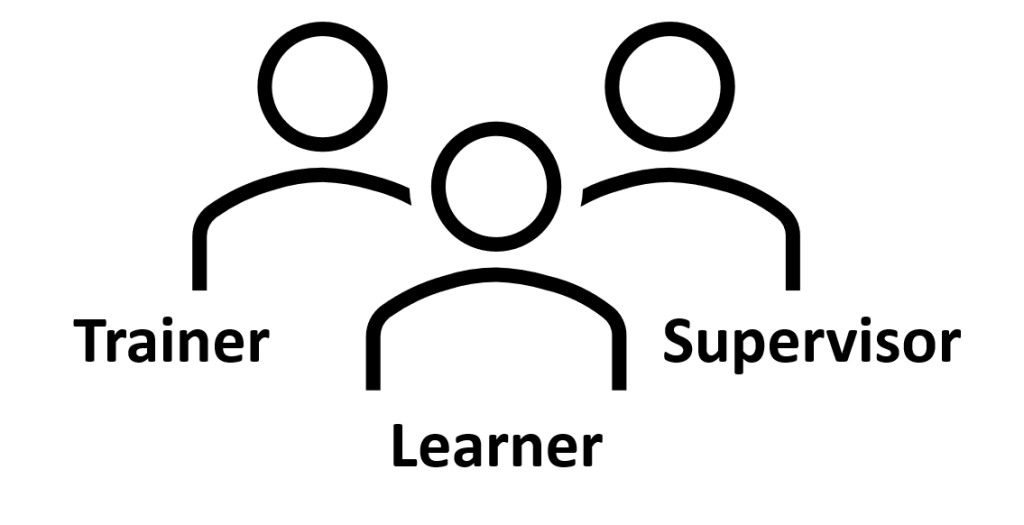
The learning-facilitation relationship can be thought of the relationships between the trainer and the learner, trainer and the learner’s supervisor in the workplace, and trainer and other people in the workplace. Successful workplace training requires the trainer and the learner’s supervisor working together to support the learner.

The establishment of relationship is covered by Element 3 of the TAEDEL402 Plan, organise and facilitate learning in the workplace unit. The maintenance of relationships is covered by Element 5. And the closure of relationships is covered by Element 6.

The following flowchart illustrates three stages of establishing, maintaining, and closing the relationships.

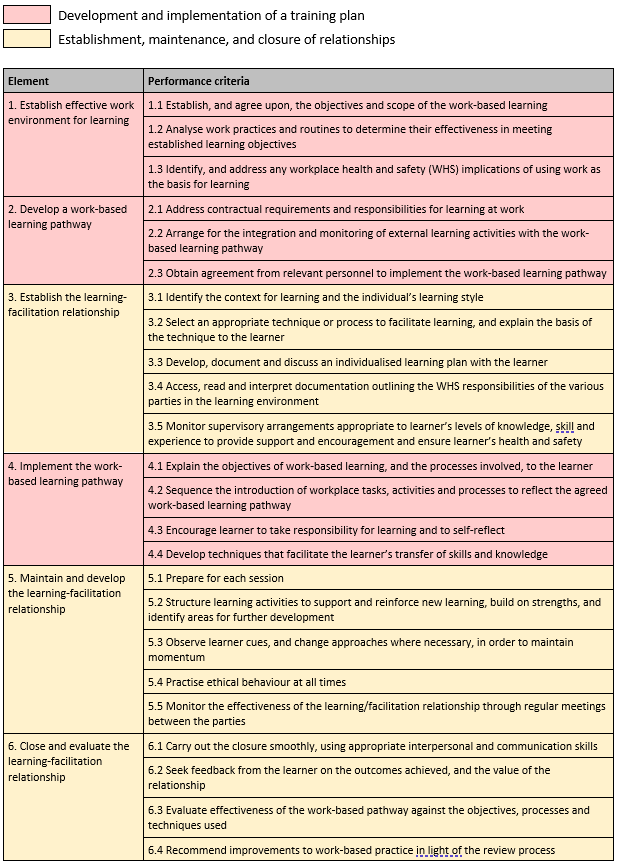
The following table shows how the TAEDEL402 Plan, organise and facilitate learning in the workplace unit is fundamentally about:

  • Developing and implementing a training plan
  • Establishing and maintaining relationships.

Competency-based training in the workplace

Training plan are developed to clearly describe a pathway to achieving confirmed learning objectives or goals. In the Australian VET system, competency standards, that have been developed and endorsed by industry, are used to determine the learning objectives.

Competency standards describe the desired outcome. The RTO must develop a training plans and seek agreement from those people involved. Workplace training will always involve the learner’s workplace supervisor. However, there may be other people in the workplace that are involved or need to be informed about the planned training. Training in the workplace can impact upon the normal workflow or operations.

Also, workplace training will require an appropriate level of supervision for the learner. Some work tasks may be dangerous. The health and safety of the learner and others in the workplace is essential. And sometimes mistakes, errors, or work tasks performed incorrectly may be expensive. For example, equipment could be damaged, valuable material wasted, or sub-standard product or poor customer service could lead to a damaged reputation.

Roles and responsibilities

The successful implementation of workplace training requires the roles and responsibilities to be clarified before the training plan is agreed to. The following are some questions that can help clarify roles and responsibilities:

  • Who will ensure safety of the learner in the workplace?
  • Who will supervise the learner? What level of supervision is appropriate for the learner’s levels of knowledge, skill, and experience?
  • How will the the supervisory arrangements be monitored?
  • What off-the-job training will be provided? What on-the-job training will be provided? Who will deliver the training? When will the training be delivered?
  • Who will monitor the learner’s progress against the training plan? How and when will progress be monitored? Who will be involved?
  • What records will be kept to record training and performance of work tasks in the workplace? Will a task book or logbook be used? Are third-party reports required? Who will keep the records?
  • What responsibilities does the learner have? What commitment must the learner make?
  • What is the process for raising and resolving concerns and issues?

In conclusion

An important role performed by many VET trainers or TAFE teachers is coordinating and monitoring the process of workplace training. The role of coordinator often requires a different set of skills than the skills needed to deliver training or assess competency. Sometimes being a coordinator will require diplomatic skills, meeting skills, issue resolution skills, and highly developed communication and interpersonal skills.

Also, contractual arrangements associated with work placements, apprenticeships and traineeships govern various aspects of workplace training, such as, safety and supervision.

Coordinating workplace learning can be challenging. But the workplace is the best place to truly develop competency. Remembering that competency is defined as the consistent application of knowledge and skill to the standard of performance required in the workplace.

Australia’s VET system

Australia’s vocational education and training (VET) system is complex and forever changing. People studying for their TAE40122 Certificate IV in Training and Assessment qualification may find useful information on this website. Tap or click on the following ABC logo to find out more.

ABC logo

Contact now!

logo otws

Training trainers since 1986

VET Reform: Qualification Design Survey

The VET Reforms are happening. And we are being asked to contribute to the changes. Generally, I think it is a waste of time for many of us to get involved in the consultation process because changes are being implemented anyway. However, I got an email this morning from the Skills Reform Engagement Team at the Department of Education, Skills and Employment reminding me that time was running out if I wanted to respond to the Qualification Design Survey.

Qualification design elements

I decided to do the survey. It first wanted to know my thoughts about the following key qualification design elements:

  • Qualifications based on appropriately grouped occupation and skills clusters to deliver broader vocational outcomes for students (including supporting stronger recognition of cross-sectoral and transferable skills).
  • Simplifying products and removing complexity through the separation of occupational and training standards to reduce the level of prescriptive conditions in current qualifications and make better use of industry and educationalist expertise.
  • Stand-alone and/or stackable short form training products, with improved pathways advice to support students to rapidly upskill or reskill to pursue new career opportunities (including facilitating stronger articulation pathways between school, VET and Higher Education to support lifelong learning).

Here is my reply to the survey.

The first point, about ‘Qualifications based on appropriately grouped occupation and skills clusters to deliver broader vocational outcomes for students (including supporting stronger recognition of cross-sectoral and transferable skills)’, is a reasonable idea. It is not a new idea, but it has been difficult idea to implement for the past few decades. If competency standards become too vague then they will weaken the VET system in Australia.

Some people do not focus on the details of a skill and how it may differ in different situations or circumstances. For these people they may think it is okay to have a ‘operate a vehicle’ unit of competency. But one unit of competency cannot cover operating a car, taxi, van, truck (different types of truck), forklift, tractor, etc. This is an exaggerated example design to illustrate the concept. We can only go so far in creating generic or cross-sectoral skills.

There has been many examples how generic or cross-sectoral skills have been widely used for many years. For example, first aid and make presentations.

The second point, about ‘Simplifying products and removing complexity through the separation of occupational and training standards to reduce the level of prescriptive conditions in current qualifications and make better use of industry and educationalist expertise’, is a really bad idea.

The separation of occupational and training standards will destroy the founding and fundamental principle of an Australian VET system that is industry-led. This proposal will not simplify or remove the perceived complexity.

Keep educational experts away from prescribing qualifications. In 1993, Australia implemented the new training system that we now know as VET. Industry and employers replaced educational experts as the people who should determine the skills needed by their workforce. Let’s not go back to a system that created unemployable VET graduates.

The third point seems to cover several points:

  • Stand-alone and/or stackable short form training products
  • Improved pathways advice
  • Facilitating stronger articulation pathways between school, VET and Higher Education.

Nothing new about these three sub-points. Skill Sets have been with us for more than a decade. Governments have squandered away millions of taxpayer dollars on creating and re-creating pathway advice. Investment in ‘new’ career advice needs to be done once and then maintained. We should not have to start from scratch everything we have a change of government or change of minister from the same government.

In regard to articulation, this has been an aspirational feature of Australia’s VET system for decades. VET people think it is a good idea. University people seem to have trouble with the idea with some exceptions. For example, dual-sector universities use it as a feed-in strategy to capture students who did not get the ATAR score need to do the higher education qualification. They may offer the student an opportunity to do a diploma for a year, and if successfully completed, the student is offered a second-year placement in a bachelor degree qualification. Articulation is selective and only offered when the university sees a marketing opportunity.

We should stop thinking that articulation is VET Reform. It should be shifted to being a Higher Education Reform.

Overall, the current key design elements of the Australia VET system include:

  • Qualifications based on occupations, and in some cases grouped occupations
  • Cross-sectoral and transferable units of competency are widely available and used
  • Stand-alone and stackable skill sets are widely available and used
  • Career pathways advice have been, and continues to be, available
  • The possibility of articulation has been available for a long time.

I don’t think these elements need to be tested.

Qualification design objectives

The survey gave the following preamble.

Trials will be underpinned by the following design objectives to ensure they align with the direction of the future training system design:

  1. Broader vocational outcomes to recognise skill commonality and promote labour mobility, where feasible.
  2. A reduction in unnecessary training product duplication.
  3. A reduction in training product complexity, through reducing over-specification and improving training delivery and assessment advice.
  4. An enhanced relationship between training products, training needs and pathways to employment and further education.
  5. Greater training product flexibility and enhanced responsiveness to changing industry need through short courses (micro-credentials and skill sets).
  6. Improved articulation and pathways between education sectors, building on the AQF review recommendations.

And here is my reply to the survey.

1. If the recently released BSB Business Services Training Package is an example for the future of broader vocational outcomes, then we are heading in the wrong direction.

2. The reduction in unnecessary training product duplication has already commenced. Why are we being consulted when it is already happening?

3. During 2020, there was evidence that an attempt to ‘reduce training product complexity’ has commenced. For example, the Release 7.0 of the BSB Business Services Training Package has made changes. But in the name of simplification, we are actually increasing the complexity. We know have training package documents (from training.gov.au), implementation guides and other companion volumes (from vetnet.gov.au), and interpretation guides. Multiple places to look for information, with the quantity of documentation increasing. And every new document seems to have different layout and format.

4. Anyone who knows the Australian VET system can understand the relationship between training products, training needs and pathways to employment and further education. Some people may be ignorant of these relationships. The VET system does not need the enhancements. These people need to learn more about the VET system – it is not that hard to learn.

5. For decades, the Australian VET system has had all the design elements to be flexible and responsive to client needs. It is inflexible and unresponsive RTOs have should be addressed. Many people have incorrectly blamed qualification design for issues. Most qualifications offer great flexibility and units of competency can be contextualised, with the exception being qualifications needing to be more rigid due to a regulator’s requirements.

6. We should stop thinking that articulation is VET Reform. It should be shifted to being a Higher Education Reform. (Articulation was covered by my comments to the previous question.)

In conclusion

The time it took to respond to the survey was probably a waste of time. However, after the VET Reforms have been implemented and the Australian VET system has be damaged, if not destroyed, then I shall have the great pleasure saying that someone should have listened to me.

I think the public consultation process is primarily a sham. The VET Reforms are going to happen anyway, and some reforms have already commenced. There seems to be a big rush to implement something before the next federal election, even if that something has no merit.

What do you think about the tsunami of VET Reforms? Did you know that the changes had already commenced?

Importance of interpretation and contextualisation in the Australian VET system

Units of competency are often ambiguous or vague. This is not a design fault of the Australian VET system. It is a design feature. When writing the units of competency, the Training Package Developers aim to describe elements and performance criteria as broadly as possible. This allows a single unit to cover a range of circumstances and situations. For example, there is one unit of competency for operating a forklift regardless of the type of forklift, type of work the forklift is being used for, or the industry sector.

The elements of competency and performance criteria need enough details to concisely describe the outcome to demonstrate competence but not too much detail to restricts customisation to meet client, industry, or workplace needs. The process of customisation starts with interpretation and contextualisation.

Trainers, assessors, and designers need to become VET detectives. We need to investigate. We need to read the clues given to us in the units of competency. We need to piece together a clear, concise and coherent understanding about what competence looks like.

Interpretation

We will need to spend time understanding, clarifying, and interpreting a unit of competency. The following is an example of an interpretation for the BSBOPS101 Use business resources unit.

What is a business resource? A business resource includes equipment used in an office. And a typical piece of equipment used in an office will be a printer. Therefore, one interpretation of ‘use business resources’ can be ‘use a printer’.

Other equipment may include:

  • Phone system and intercom
  • Binding machine
  • Laminator
  • Coffee machine.

The BSBOPS101 Use business resources unit can be used to cover all types of office equipment. It is the Registered Training Organisation (RTO) that is required to customise the unit to meet the needs of a specific workplace or the typical needs of industry. The RTO has the responsibility to determine the range of office equipment that will be covered during the training and assessment.

Contextualisation

An RTO must contextualise units of competency to reflect client, industry, or workplace needs. However, any contextualisation must ensure the integrity of the outcome of the unit of competency is maintained. In other words, the elements, performance criteria, and assessment requirements cannot be removed.

Units of competency have been written with broad or non-specific words that need to be specified, clarified, and contextualised. For example:

  • Policies (what policies?)
  • Procedures (what procedures?)
  • Equipment (what equipment?)
  • Tools (what tools?).

And performance criteria often use adverbial phrases such as ‘within a designated timeframe’ and ‘according to organisational requirements’. These must also be contextualised. What is the timeframe that a task must be performed within? What are the requirements required by an organisation? What is the workplace or industry standards?

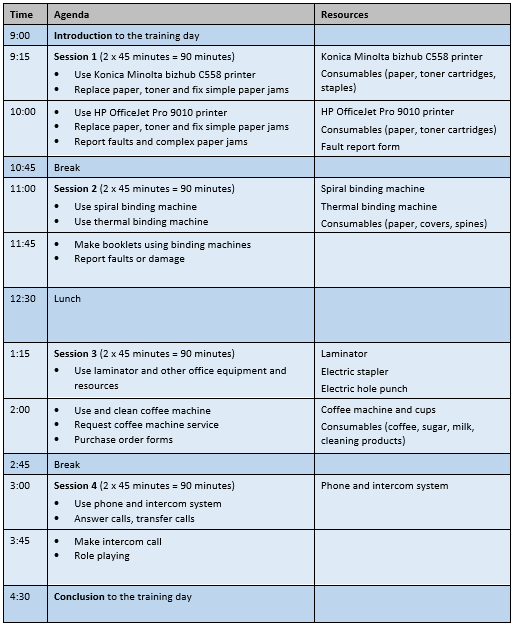
The following is an example of contextualisation for the BSBOPS101 Use business resources unit. A typical business resource is the printer. However, there is a plethora of printer types, makes, and models. Training can be contextualised by covering how to use and maintain a particular printer or a range of common types of printers, such as:
  • Use Konica Minolta bizhub C558 printer
  • Use HP OfficeJet Pro 9010 printer.

Different printers will have different characteristics, features, and functions. The training would need to include learning how to:

  • Switch on
  • Select paper tray
  • Select print quantity
  • Select double or single sided printing
  • Select collating options
  • Replace paper
  • Change toner cartridges
  • Clear paper jams.

An RTO should cover a range of printer types when delivering the BSBOPS101 Use business resources unit. Therefore, the contextualisation of ‘use business resources’ could include using a large networked multifunctional printer and using a smaller desktop printer. Each type of printer would have unique characteristics to be learnt.
Interpretation Manual

The above example has used the BSBOPS101 Use business resources unit from the BSB Business Service Training Package (Release 7.0). The developer for this Training Package has published a Companion Volume available from the VETNet website. It is known as an Interpretation Manual. Not all Training Packages will have a document like this.

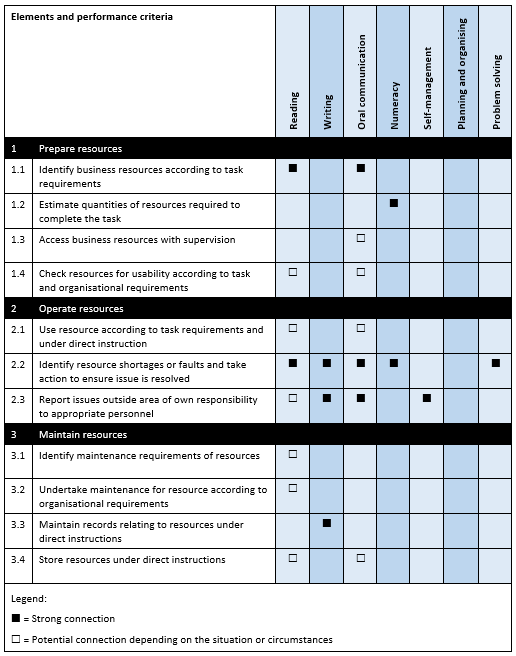
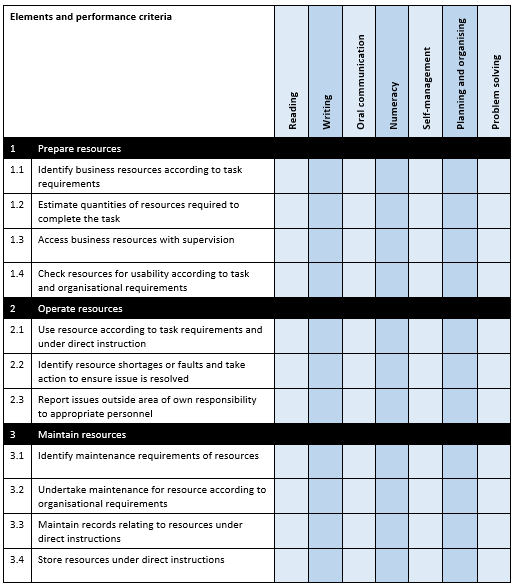
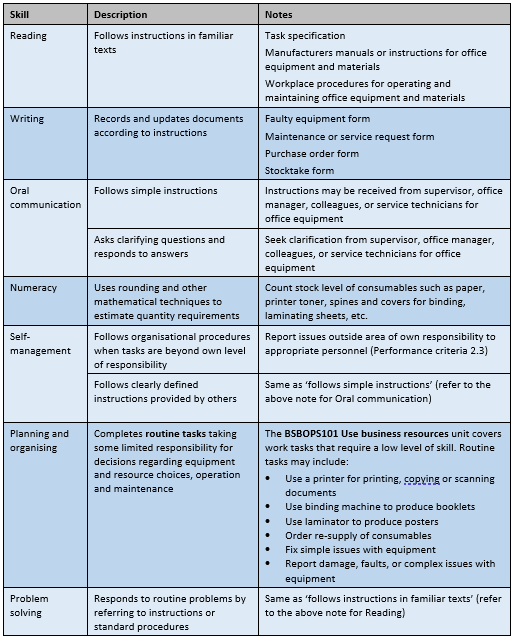
The Interpretation Manual for the BSB Business Service Training Package gives advice to RTOs about how requirements within units of competency may be contextualised for a workplace environment. [1] This manual provides the following interpretation summary for the BSBOPS101 Use business resources unit.

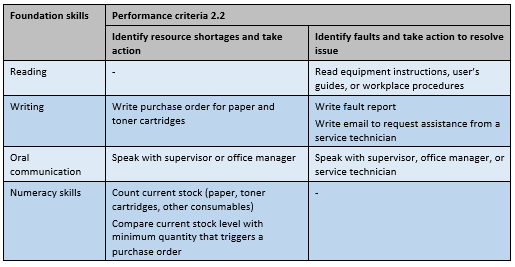
This information from the Interpretation Manual is useful but there are other terms from the BSBOPS101 Use business resources unit that still need to be interpreted and contextualised.

Range Statements

Another source of information to assist with interpreting and contextualising can be Range Statements from superseded ‘old format’ units of competency. I am using the term ‘old format’ to describe units that complied with the pre-2012 Standards for Training Packages. Training Packages have transitioned from the ‘old format’ to the ‘new format’ between 2015 and 2020.

The ‘old format’ units provide some really useful information. These units of competency remain available from the training.gov.au website. The following is an example of using the ‘Range Statements’ to help clarify the requirements for the BSBOPS101 Use business resources unit.

Step 1. Go to the BSBOPS101 Use business resources unit on the training.gov.au website.

Step 2. Click on the link to go to the superseded BSBADM101 Use business equipment and resources unit. You can tell from the BSBADM101 unit code that this is in ‘new format’.

Step 3. Click on the link to go to the superseded BSBADM101A Use business equipment and resources unit. You can tell from the BSBADM101A unit code that this is in ‘old format’ (the code has a letter at the end).

Step 4. Scroll down to the Range Statement for the BSBADM101A Use business equipment and resources unit.

Step 5. Use the Range Statement to help clarify the requirements for the BSBOPS101 Use business resources unit.

Range Statements from the superseded ‘old format’ units of competency can assist with interpreting and contextualising. And these Range Statements can save you time.

Brainstorming and consultation

You will need to use your knowledge and industry experience to interpret and contextualise units of competency. This may include brainstorming ideas with your RTO colleagues. Also, it would be wise to consult with employers, industry experts, industry representatives, and relevant people from the workplace.

In conclusion

Some people complain that units of competency are vague or lack details. These people may need to stop complaining and start contextualising. Having said that, there are some poorly written units of competency that should be reported to the relevant Industry Reference Committee (IRC) to be fixed.

Ambiguous units of competency are a feature of the Australian VET system. This allows training to be customised to meet client needs. We must start by interpreting and contextualising a unit of competency. This will have an impact on what training is delivered and how a unit of competency is assessed.

We need to interpret and contextualise units of competency so that we can communicate clearly, concisely, and in plain English to learners. Learners need to understand what they are going to learn and what will be assessed.

Reference

[1] Business Service Training Package Version 7.0: Interpretation Manual

Do you need help with your TAE studies?

Are you a doing the TAE40122 Certificate IV in Training and Assessment, and are you struggling with your studies? Do you want help with your TAE studies?

Ring Alan Maguire on 0493 065 396 to discuss.

Contact now!

logo otws

Training trainers since 1986

How to identify integrated assessment opportunities

What is integrated assessment?

Units of competency specify the standards of performance required in the workplace. [1] Each unit of competency describes a specific work activity or task, however, a small number of units may describe a body of knowledge or an essential skill.

For example:

  • The BSBMED301 Interpret and apply medical terminology appropriately unit covers the application of a body of knowledge
  • The BSBCRT311 Apply critical thinking skills in a team environment unit covers an essential skill.

Individual units of competency are rarely performed in isolation in the workplace. Typical job roles involve a number of related tasks. Integrated assessment is the simultaneous assessment of two or more related units of competency, and it is an efficient and authentic evidence gathering method, because it more closely reflects the real nature of work. [2]

Scenario

The following scenario shall be used to explain how to identify integrated assessment opportunities.

Let’s say, you work for an RTO that has been contracted by a community-based youth employment service to deliver some training. This client has been granted government funding to implement an innovative youth training and employment program.

Learners are early school leavers, typically with poor literacy skills, aged between 17 and 21.

The training program aims to prepare unemployed youth for basic office administration work. The client wants an emphasis on the development of computer skills.

A recent survey of local businesses identified that most use Microsoft Office applications. Several meetings with the client have occurred. The client has agreed to the delivery of the BSB20120 Certificate II in Workplace Skills qualification.

The training program shall be structured around four topics or learning blocks: work safely, work effectively, work sustainably, and use technology.

The following lists the ten (10) units of competency that will make up the BSB20120 Certificate II in Workplace Skills qualification.

Example 1

The following gives an example about how to plan for integrated assessment. It focuses on the four units of competency covered by the ‘Use technology’ cluster:

  • ICTICT102 Operate word-processing applications
  • BSBTEC202 Use digital technologies to communicate in a work environment
  • BSBTEC201 Use business software applications
  • BSBOPS101 Use business resources

Step 1. Comprehend performance evidence requirements

Read the elements and performance criteria to identify the scope of performance required. And read the Performance Evidence to identify the volume or frequency of evidence that is specified. For example:

Step 2. Create table

Create a table to assist with identifying typical work tasks and mapping the units of competency. For example:

Step 3. List typical work tasks

List the typical tasks performed in the workplace. For example:

Step 4. Map units of competency to typical work tasks

Use the table to identify any overlap. For example:

Step 5. Identify opportunities for integrated assessment

Assessment options are:

  • Gather performance evidence for a single unit during training
  • Gather performance evidence for multiple units during training
  • Gather performance evidence from the workplace
  • Combination of the above three.

Integrated assessment is when we gather performance evidence for multiple units. The following two examples have been designed to give a simple illustration of opportunities for integrated assessment. But do not be deceived by the apparent simplicity. From this point onward, the development of the assessment tool can get complex, and non-compliance with the Training Package requirements can easily occur.

Opportunity # 1

The ICTICT102 Operate word-processing applications unit has an element of competency that requires the candidate to print documents. And using a printer is covered by the BSBOPS101 Use business resources unit. Therefore, when a candidate prints a document, they can be producing evidence for the two units of competency.

The evidence produced when the candidate prints documents must ensure the performance criteria and any relevant assessment requirements for both units, ICTICT102 and BSBOPS101, are covered. This is necessary to ensure compliance with the specified Training Package requirements.

Opportunity # 2

The BSBTEC201 Use business software applications unit requires the candidate to have evidence of using at least three business software applications on two occasions each.

In this example, the ICTICT102 Operate word-processing applications unit has been contextualised for using Microsoft Word. This can be one of the three business software applications required for the BSBTEC201 unit.

If the candidate produces one or two Microsoft Word documents as evidence for the ICTICT102 unit, this same evidence can be used for the BSBTEC201 unit. However, much more evidence will still be required to satisfy the volume or frequency of evidence specified by the BSBTEC201 unit.

The above five steps explain how to identify opportunities for integrated assessment.

The next activity would be to design and develop the assessment tools.

Example 2. Use diagrams to show connection

The following gives an example about how a diagram can be used to see connections and uncover opportunities for integrated assessment. It focuses on the four units of competency covered by the ‘Work effectively’ cluster.

Communication skills are used when we manage time. Communication skills are used when we solve problems. Communications skills, time management skills, and problem solving skills are all used when we perform work. These are the opportunities for integrated assessment.

Example 3. Integrate assessment

The examples above are for integrated assessment within a cluster of units. In the case of the BSB20120 Certificate II in Workplace Skills qualification, there is opportunity for a integrated assessment across the four topics or learning blocks. An RTO may decide to follow a relatively simple pathway commencing and completing each unit or cluster before moving onto the next. But each unit or cluster of units is not an independent or discrete activity or task performed in the workplace. It is common for an overlap.

The holistic assessment needs an end-of-program assessment in a workplace or a simulated workplace. This will add further complexity to the assessment approach, assessment tools, and assessment reporting processes.

The following shows how opportunities for integrated or holistic assessment for all units of competency can be identified.

  • The first work task on the list below, ‘Check work area is safe’, relates to gathering assessment evidence for a single unit of competency.
  • The second work task, ‘Plan and prioritise work tasks’, can overlap five units of competency and is across two clusters.
  • You can complete the remainder of the matrix, if you want, but I hope you can see the method for identifying integrated assessment opportunities.

In conclusion

Integrated assessment will add complexity to the assessment approach but it still can be simply organised for learners so that they do not have a confusing or complicated experience.

Government funding contracts can work against the concept of integrated assessment when there is a payment to RTOs for the completion of units. An RTO will most likely want to secure a positive cash flow by completing units or cluster of units as soon as possible, rather than waiting to the end of a program to receive payments from the government.

The concept of integrated assessments is important because it more closely reflects the real nature of work.

References

[1] Standards for Training Packages https://docs.employment.gov.au/documents/standards-training-packages accessed 20 November 2020

[2] Back 2 Basics Fact Sheet – Assessment https://www.myskills.gov.au/media/1781/back-to-basics-vet-assessment.pdf accessed 20 November 2020

Do you need help with your TAE studies?

Are you a doing the TAE40122 Certificate IV in Training and Assessment, and are you struggling with your studies? Do you want help with your TAE studies?

Ring Alan Maguire on 0493 065 396 to discuss.

Contact now!

logo otws

Training trainers since 1986

Volume of learning and other VET terminology that can be confusing

In a previous article, I have explored the notion of ‘nominal hours’ and explained that nominal hours are not the same thing as the number of hours of contact between a learner and their trainer. Contact hours are usually less than the nominal hours, and often substantially less.

This article is primarily about the AQF volume of learning but it requires an understanding of other terms such as supervised hours and unsupervised hours.

Definition of volume of learning

The volume of learning is defined in the AQF as follows: [1]

“The volume of learning is a dimension of the complexity of a qualification. It is used with the level criteria and qualification type descriptor to determine the depth and breadth of the learning outcomes of a qualification. The volume of learning identifies the notional duration of all activities required for the achievement of the learning outcomes specified for a particular AQF qualification type. It is expressed in equivalent full-time years.”

I am unsure if this definition simplifies or complicates our understanding.

The generally accepted length of a full-time year is 1200 hours. [1] And this would equate to about one training day per week. I wish full-time work was like this!

The AQF volume of learning is not a term exclusive to VET. It is a term that covers all qualifications in Australian education and training: senior secondary certificate of education, VET, and higher education. [2]

ASQA provides information to help people understand the AQF volume of learning within a VET context. The volume of learning describes how long a learner who does not hold any of the competencies would take to develop all the required skills and knowledge. It includes all training, learning and assessment activities that a typical learner must undertake to achieve the learning outcomes. [3]

ASQA expects to see the appropriate volume of learning documented in the Training and Assessment Strategy (TAS) before the RTO has a qualification added to its scope of registration. The following table outlines the expected volume of learning for Certificate I qualification to Diploma qualification.

Extract from Users’ guide to Standards for RTOs

Volume of learning hours, nominal hours, and contact hours

‘Volume of learning hours’ and ‘nominal hours’ are two different things. Before I explain the difference, there is one thing that is the same for both. The hours are from the learner’s perspective or what the learner experiences.

Nominal hours are used to calculate money paid to an RTO under a funding contract. Also, nominal hours are used by the RTO to report AVETMISS data.

The following is an example of nominal hours for a BSB20120 Certificate II in Workplace Skills qualification.

It becomes obvious that ‘volume of learning hours’ and ‘nominal hours’ are not the same thing when we compare the hours. Let us use 600 hours as the volume of learning for the BSB20120 Certificate II in Workplace Skills qualification. The nominal hours in the above example are less than half the required volume of learning hours.

The next thing to establish is that ‘volume of learning hours’ and ‘contact hours’ are not the same thing. Contact hours is not an official VET term. However, it is a useful term to explain a concept. The learner may not experience or think that they receive the number of hours specified by the AQF volume of learning. From the learner’s perspective, they may only think the training being received is when there is contact between them and their trainer. In other word, attending a training session.

Supervised hours and unsupervised hours

ASQA says that the volume of learning identifies the notional [estimated] duration of all activities required to achieve the learning outcomes of the course, including:

  • training sessions with guidance from an RTO trainer
  • learning activities without guidance from an RTO trainer
  • self-study and research
  • work placement or work experience
  • learning at work as part of an apprenticeship or traineeship
  • assessment activities.

ASQA says we can calculate the volume of learning using the following equation: [4]

Definitions:

  • Supervised hours represent the supervised structured learning and assessment activity delivered by a Registered Training Organisation (RTO).
  • Unsupervised hours represent activities that contribute to achieving the training programs outcomes that are not supervised by an RTO trainer or assessor.

The following is an example of volume of learning hours for a BSB20120 Certificate II in Workplace Skills qualification. For this example, let us say that this qualification is being used as a structured training program targeting unemployed and disengaged youth, and one training day is being delivered each week.

Step 1. Calculate the supervised hours

The 25 supervised [contact] days gives us 200 volume of learning hours. This is far short of the 600 hours required for the Certificate II qualification.

Step 2. Add unsupervised hours

We could expect that some unemployed and disengaged youth enrolled in this program would lack the interest or motivation to complete pre-reading each week or undertake research tasks. In reality, the purpose of adding these unsupervised hours is not to improve the learning experience but to increase the total number of volume of learning hours.

Unfortunately, in this example:

The planned 308 hours of supervised and unsupervised training, learning, and assessment activities is slightly higher than the 295 nationally agreed nominal hours. But the proposed program for the BSB20120 Certificate II in Workplace Skills qualification is still half of the required volume of learning hours. I assume we just keep adding hours until we get to 600 and satisfy the regulator’s requirements. In reality, the training program still has, or only needs, a 25-day duration.

In conclusion

There is a difference between volume of learning hours, nominal hours, and contact hours. The following graph illustrates a numerical difference between these terms.

Planned hours, scheduled hours, actual hours, contact hours, nominal hours, notional hours, supervised hours, unsupervised hours, volume of learning hours, etc.

Sometimes, VET is very confusing.

References

[1] Volume of Learning: An Explanation https://www.aqf.edu.au/sites/aqf/files/volume-of-learning-explanation-v2-2014.pdf accessed 18 November 2020

[2] Australian Qualifications Framework https://www.aqf.edu.au/ accessed 18 November 2020

[3] Users’ guide to Standards for RTOs https://www.asqa.gov.au/standards/training-assessment/clauses-1.1-to-1.4-2.2#what-clauses-1-1-to-1-4-and-2-2-mean-for-your-rto accessed 18 November 2020

[4] https://www.asqa.gov.au/course-accreditation/apply/integrating-volume-learning-course accessed 18 November 2020

Australia’s VET system

Australia’s vocational education and training (VET) system is complex and forever changing. People studying for their TAE40122 Certificate IV in Training and Assessment qualification may find useful information on this website. Tap or click on the following ABC logo to find out more.

ABC logo

Contact now!

logo otws

Training trainers since 1986