Volume of learning and other VET terminology that can be confusing

In a previous article, I have explored the notion of ‘nominal hours’ and explained that nominal hours are not the same thing as the number of hours of contact between a learner and their trainer. Contact hours are usually less than the nominal hours, and often substantially less.

This article is primarily about the AQF volume of learning but it requires an understanding of other terms such as supervised hours and unsupervised hours.

Definition of volume of learning

The volume of learning is defined in the AQF as follows: [1]

“The volume of learning is a dimension of the complexity of a qualification. It is used with the level criteria and qualification type descriptor to determine the depth and breadth of the learning outcomes of a qualification. The volume of learning identifies the notional duration of all activities required for the achievement of the learning outcomes specified for a particular AQF qualification type. It is expressed in equivalent full-time years.”

I am unsure if this definition simplifies or complicates our understanding.

The generally accepted length of a full-time year is 1200 hours. [1] And this would equate to about one training day per week. I wish full-time work was like this!

The AQF volume of learning is not a term exclusive to VET. It is a term that covers all qualifications in Australian education and training: senior secondary certificate of education, VET, and higher education. [2]

ASQA provides information to help people understand the AQF volume of learning within a VET context. The volume of learning describes how long a learner who does not hold any of the competencies would take to develop all the required skills and knowledge. It includes all training, learning and assessment activities that a typical learner must undertake to achieve the learning outcomes. [3]

ASQA expects to see the appropriate volume of learning documented in the Training and Assessment Strategy (TAS) before the RTO has a qualification added to its scope of registration. The following table outlines the expected volume of learning for Certificate I qualification to Diploma qualification.

Extract from Users’ guide to Standards for RTOs

Volume of learning hours, nominal hours, and contact hours

‘Volume of learning hours’ and ‘nominal hours’ are two different things. Before I explain the difference, there is one thing that is the same for both. The hours are from the learner’s perspective or what the learner experiences.

Nominal hours are used to calculate money paid to an RTO under a funding contract. Also, nominal hours are used by the RTO to report AVETMISS data.

The following is an example of nominal hours for a BSB20120 Certificate II in Workplace Skills qualification.

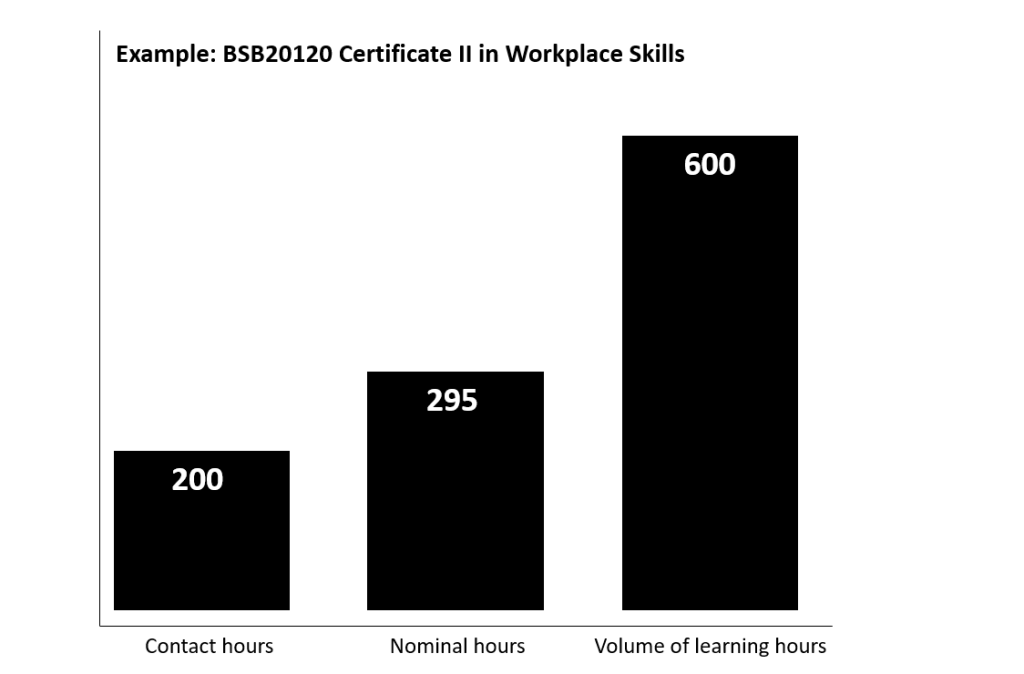
It becomes obvious that ‘volume of learning hours’ and ‘nominal hours’ are not the same thing when we compare the hours. Let us use 600 hours as the volume of learning for the BSB20120 Certificate II in Workplace Skills qualification. The nominal hours in the above example are less than half the required volume of learning hours.

The next thing to establish is that ‘volume of learning hours’ and ‘contact hours’ are not the same thing. Contact hours is not an official VET term. However, it is a useful term to explain a concept. The learner may not experience or think that they receive the number of hours specified by the AQF volume of learning. From the learner’s perspective, they may only think the training being received is when there is contact between them and their trainer. In other word, attending a training session.

Supervised hours and unsupervised hours

ASQA says that the volume of learning identifies the notional [estimated] duration of all activities required to achieve the learning outcomes of the course, including:

  • training sessions with guidance from an RTO trainer
  • learning activities without guidance from an RTO trainer
  • self-study and research
  • work placement or work experience
  • learning at work as part of an apprenticeship or traineeship
  • assessment activities.

ASQA says we can calculate the volume of learning using the following equation: [4]

Definitions:

  • Supervised hours represent the supervised structured learning and assessment activity delivered by a Registered Training Organisation (RTO).
  • Unsupervised hours represent activities that contribute to achieving the training programs outcomes that are not supervised by an RTO trainer or assessor.

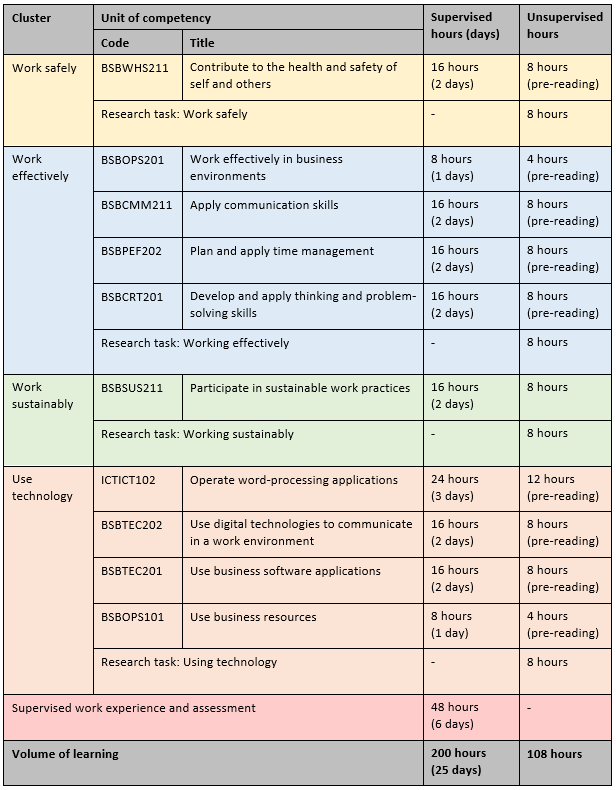
The following is an example of volume of learning hours for a BSB20120 Certificate II in Workplace Skills qualification. For this example, let us say that this qualification is being used as a structured training program targeting unemployed and disengaged youth, and one training day is being delivered each week.

Step 1. Calculate the supervised hours

The 25 supervised [contact] days gives us 200 volume of learning hours. This is far short of the 600 hours required for the Certificate II qualification.

Step 2. Add unsupervised hours

We could expect that some unemployed and disengaged youth enrolled in this program would lack the interest or motivation to complete pre-reading each week or undertake research tasks. In reality, the purpose of adding these unsupervised hours is not to improve the learning experience but to increase the total number of volume of learning hours.

Unfortunately, in this example:

The planned 308 hours of supervised and unsupervised training, learning, and assessment activities is slightly higher than the 295 nationally agreed nominal hours. But the proposed program for the BSB20120 Certificate II in Workplace Skills qualification is still half of the required volume of learning hours. I assume we just keep adding hours until we get to 600 and satisfy the regulator’s requirements. In reality, the training program still has, or only needs, a 25-day duration.

In conclusion

There is a difference between volume of learning hours, nominal hours, and contact hours. The following graph illustrates a numerical difference between these terms.

Planned hours, scheduled hours, actual hours, contact hours, nominal hours, notional hours, supervised hours, unsupervised hours, volume of learning hours, etc.

Sometimes, VET is very confusing.

References

[1] Volume of Learning: An Explanation https://www.aqf.edu.au/sites/aqf/files/volume-of-learning-explanation-v2-2014.pdf accessed 18 November 2020

[2] Australian Qualifications Framework https://www.aqf.edu.au/ accessed 18 November 2020

[3] Users’ guide to Standards for RTOs https://www.asqa.gov.au/standards/training-assessment/clauses-1.1-to-1.4-2.2#what-clauses-1-1-to-1-4-and-2-2-mean-for-your-rto accessed 18 November 2020

[4] https://www.asqa.gov.au/course-accreditation/apply/integrating-volume-learning-course accessed 18 November 2020

Australia’s VET system

Australia’s vocational education and training (VET) system is complex and forever changing. People studying for their TAE40122 Certificate IV in Training and Assessment qualification may find useful information on this website. Tap or click on the following ABC logo to find out more.

ABC logo

Contact now!

logo otws

Training trainers since 1986

Nominal hours and the Australian VET system

This article was originally written in 2020. Another article with more recent information was published in 2024. The title of this more recent article is:

What are nominal hours?

Introduction to nominal hours

Nominal hours are used for two different purposes:

  • Nominal hours are used for reporting purposes
  • Nominal hours are used for funding purposes.

Nominal hours are about money, not time

Nominal hours are used by State and Territory Governments to determine the amount of money paid to an RTO when they deliver government subsidised training. Each unit of competency is assigned ‘nominal hours’, and a dollar amount per hour is allocated for each qualification that the government is willing to subsidise.

The following formula is used to calculate the amount of money to be paid to an RTO for delivering government-subsidised training.

Nominal hours x Dollar amount per hour = Dollars paid to an RTO

Each State and Territory Government determines their own subsidy rate. Therefore, the subsidy rate for a particular qualification can vary in different jurisdictions. And a qualification may be subsidised by one State Government, but not by another.

Nationally agreed nominal hours

Victoria was the first State or Territory Government that implemented market-based pricing for government-subsidised training. It publishes nominal hours in Victorian Purchasing Guides.

In recent years, nationally agreed nominal hours have been established for RTOs when reporting ‘nominal hours’ in their AVETMISS submissions. [4]

Nominal hours and contact hours differ

Nominal hours are about money, not time because they are used to calculate how much money and RTO gets paid for delivering government-subsidised training.

Nominal hours have very little to do with the contact hours (the time allocated for contact between a learner and their trainer). Contact hours are determined by an RTO and they are usually less than the nominal hours, and can be substantially less.

This article was originally written in 2020. Another article with more recent information and examples was published in 2024. The title of this more recent article is: What are nominal hours?

Do you need help with your TAE studies?

Are you a doing the TAE40122 Certificate IV in Training and Assessment, and are you struggling with your studies? Do you want help with your TAE studies?

Ring Alan Maguire on 0493 065 396 to discuss.

Contact now!

logo otws

Training trainers since 1986

Will a national VET workforce strategy improve quality?

Australia will have a national vocational education and training (VET) workforce strategy developed over the next 12 months. What will it cover? And will it improve quality? This article is the first of a series that will explore potential elements of a workforce strategy for the Australian VET sector, including:

  • Registration of VET trainers and assessors
  • Initial or entry-level qualification for VET practitioners
  • Further qualifications to support career pathways and specialisations.

In this article I will outline the background to why we are talking about a national VET workforce strategy.

What is driving the development of a national VET workforce strategy?

Every so often over the past decade or more, someone or a lobby group suggested that Australia needs a national workforce strategy for the VET sector. Stephen Joyce, an ex-politician from New Zealand, conducted a review of the entire Australian VET system. He gathered a variety of ideas – some good, some bad, and some truly ugly. The review had a short three-month duration and it resulted in a report titled, ‘Strengthening Skills: Expert Review of Australia’s Vocational Education and Training System‘; also known as the Joyce Report. [1]

Recommendations from the Joyce Report have been endorsed by the Australian Government and form the basis for the VET Reform Roadmap. One reform is for the development of a VET Workforce Strategy to be implemented during 2021 and 2022. [2]

The National Centre for Vocational Education Research (NCVER) is owned by the Commonwealth, state and territory ministers responsible for VET. It has been conducting research in preparation for the VET workforce strategy. Two recent NCVER publications have been:

  • Understanding the Australian vocational education and training workforce [3]
  • Building capability and quality in VET teaching: opportunities and challenges [4]

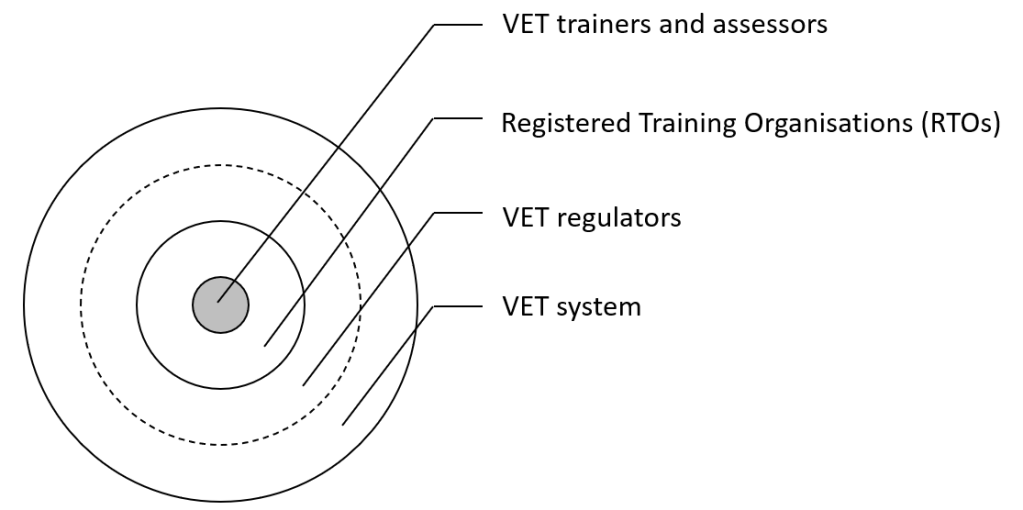
Before talking more about the workforce strategy, I want to acknowledge that the VET Reform Roadmap will pursue many initiatives. The entire VET system will be changed. The following illustrates the various layers being tackled by the VET Reforms.

The VET workforce strategy is focus on building the capability and quality of VET trainers and assessors. There is an implication that the current VET trainers and assessors are not good enough. And ASQA has implied that VET trainers and assessors haven’t been good enough for many years. This year’s ASQA Regulatory Strategy has identified ‘trainer and assessor capability’ as it’s number one strategic initiative. [5]

How will the VET Workforce Strategy build capability and quality of trainers and assessors?

The VET workforce strategy aims to build the capability and quality of trainers and assessors.

The NCVER’s Building capability and quality in VET teaching: opportunities and challenges research report explores a range of workforce strategies to improve the quality of training and assessment services. I have categorised these in the five areas:

  • Mandatory registration
  • Recruitment, selection and induction
  • Initial qualification (TAE40116 Certificate IV in Training and Assessment)
  • Further qualifications to support career progression and specialisation
  • Continuous professional development.

In conclusion

This article is brief and sets the scene for some future articles.

In the next article, I will do my best to convince you that mandatory registration of VET trainers and assessors is a really bad idea.

In the meantime, you may like to do your own reading and investigating about the VET workforce strategy. I have listed source documents as references below.

References:

[1] https://www.pmc.gov.au/sites/default/files/publications/strengthening-skills-independent-review-australia-vets_1.pdf accessed 17 October 2020

[2] https://www.employment.gov.au/vet-reform-roadmap accessed 17 October 2020

[3] https://www.ncver.edu.au/research-and-statistics/publications/all-publications/understanding-the-australian-vocational-education-and-training-workforce accessed 17 October 2020

[4] https://www.ncver.edu.au/research-and-statistics/publications/all-publications/building-capability-and-quality-in-vet-teaching-opportunities-and-challenges accessed 15 September (it has been removed from the NCVER website, to be reviewed and re-released at a later date)

[5] https://www.asqa.gov.au/resources/publications/asqa-regulatory-strategy-2020-22 accessed 17 October 2020

logo otws

Prerequisite units in the Australian VET system

Prerequisite is a term that has a specific meaning in the Australian VET system.

The Standards for Training Packages defines a prerequisite unit as any unit or units in which the candidate [learner] must be deemed competent prior to the determination of competency in this unit. Therefore, the sequence of delivering a unit must comply with prerequisite requirements when specified.

Prerequisite requirements can be found in the units of competency. You may also find prerequisite information in Training Package Implementation Guides that are developed by the Training Package Developers. These documents are published on the VETNet.gov.au website.

This article is primarily aimed at helping TAE Students who are studying the TAEDES402 Use training packages and accredited courses to meet client needs unit. It is a follow on from a recently published article title, How to use training packages to meet client needs. However, this article may also be of interested to recently qualified or experienced VET practitioners to refresh their ability to use training packages.

A 5-step process shall illustrate my approach to ensuring a training program complies with prerequisite requirement.

Scenario

For this example, let’s say you work for an RTO and you have been asked to design a training program for food and beverage attendants.

Photo by Cyril Saulnier on Unsplash

The SIT20316 Certificate II in Hospitality qualification is applicable for this scenario. And the packaging rules for this qualification are:

12 units must be completed

6 core units

6 elective units, consisting of:

  • 1 unit from Group A
  • 3 units from Group B
  • 2 units from Group B, elsewhere in the SIT Training Package, or any other current Training Package or accredited course.

Step 1. Create a table and insert core units

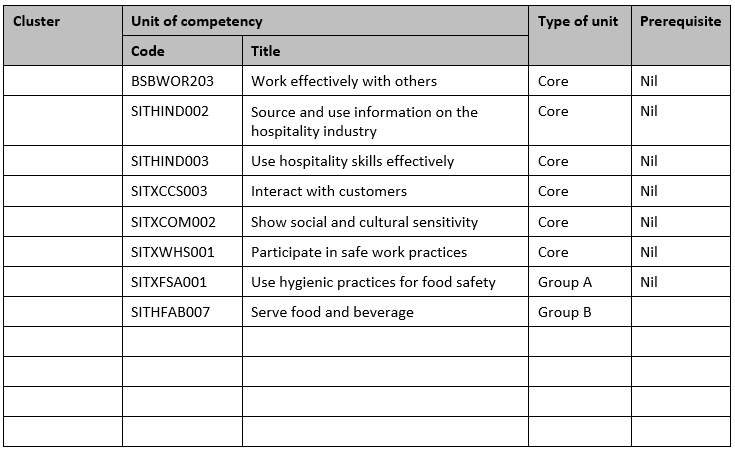
For this example, a table is created with 12 blank rows in preparation to insert the 12 units required by the SIT20316 Certificate II in Hospitality qualification packing rules. The 6 core units have been inserted. None of these units have a prerequisite.

Step 2. Start selecting elective units

The packaging rules for the SIT20316 Certificate II in Hospitality qualification requires one unit from Group A to be selected. In this example, SITXFSA001 Use hygienic practices for food safety unit has been selected and it does not have a prerequisite.

Step 3. Continue selecting elective units

Next, the SITHFAB007 Serve food and beverage unit has been selected.

The SITHFAB007 Serve food and beverage unit states that SITXFSA001 Use hygienic practices for food safety unit is a prerequisite.

In this case, the SITXFSA001 Use hygienic practices for food safety unit has already been selected as the Group A elective.

Step 4. Include prerequisite units

If a unit specifies a prerequisite that has not previously been selected, then include it and check that the qualification packaging rules are still being complied with.

In this case:

  • the SITXFSA001 Use hygienic practices for food safety unit has already been selected
  • the SITHFAB002 Provide responsible service of alcohol unit has not already been selected and it must be included.

The prerequisite sequence can be sorted in the next step. Also, this is an example showing that a unit may have more than one prerequisite.

Step 5. Give structure and sequence to the qualification

The delivery sequence of units can be decided, and the training program can be given structure.

Double-check for compliance:

  • Qualification packing rules
  • Prerequisite units

* The SITHFAB002 Provide responsible service of alcohol unit must be completed before the SITHFAB003 Operate a bar unit is commenced. This means integrated assessment of these two units is not permitted.

Note: In the above example, the sequence shows core units, followed by Group A unit, followed by Group B units. This sequence has not been deliberate and there are other ways that this qualification could be structured. For example, SITXCCS003 Interact with customers and SITHFAB007 Serve food and beverage units work together.

The Australian VET system can be extremely flexible and responsive to client needs. And this flexibility allows RTOs to be innovative in the way they deliver training and assessment services.

In conclusion

The sequence and structure for a qualification provides the essential starting point to design the training program. Prerequisite requirements must be complied with.

  • Do you find the 5-step process a useful guide?
  • Did you learn something from this article?

Australia’s VET system

Australia’s vocational education and training (VET) system is complex and forever changing. People studying for their TAE40122 Certificate IV in Training and Assessment qualification may find useful information on this website. Tap or click on the following ABC logo to find out more.

ABC logo

Contact now!

logo otws

How to use training packages to meet a client need

This article is primarily aimed at helping TAE Students who are studying the TAEDES402 Use training packages and accredited courses to meet client needs unit. However, it may also be of interested to recently qualified or experienced VET practitioners to refresh their ability to use training packages.

A 12-step process shall illustrate my approach to using a training package qualification to design a training program.

Step 1. Consult with client to understand their needs

For the purpose of this article I have created a scenario. This represents a synopsis of a client’s needs gathered from consultation.

Scenario

Let’s say, you work for an RTO that has been contracted by a community-based youth employment service to deliver some training. This client has been granted government funding to implement an innovative youth training and employment program.

Learners are early school leavers, typically with poor literacy skills, aged between 17 and 21.

The training program aims to prepare unemployed youth for basic office administration work. The client wants an emphasis on the development of computer skills.

A recent survey of local businesses identified that most use Microsoft Office applications.

The following photo can be considered as the type of learners expected to attend the training program.

Step 2. Select a relevant qualification

Consider option. For example:

  • 22523VIC Certificate I in Employment Pathways
  • BSB10120 Certificate I in Workplace Skills
  • BSB20120 Certificate II in Workplace Skills
  • BSB30120 Certificate III in Business

Step 3. Download qualification packaging rules

Step 4. Create table

Create a table with 4 columns. The number of rows is determined by the total number of units required plus two. For example, the BSB20120 Certificate II in Workplace Skills qualification will need a 4 x 12 table.

The result is the following blank table.

Step 5. Format table

Note: The table has 10 rows to insert a total of 10 units that is specified by the BSB20120 Certificate II in Workplace Skills qualification packaging rules.

Step 6. Insert core units

Step 7.  Select elective unit to meet the client needs

Step 8. Check compliance with qualification packaging rules

Step 9. Give structure and sequence to the qualification

Note: Some units of competency may have prerequisites specified. A prerequisite unit must be completed first. Therefore, they have an influence on the sequence.

Step 10. Present training program to client for approval

Initially, seek agreement with the ‘big picture’.

Outline the recommended units of competency after the ‘big picture’ has been agreed to.

Step 11. Determine duration for the training program

Step 12. Draft the training and assessment strategy

For example:

BSB20120 Certificate II in Workplace Skills (Release 1)

Qualification description

This qualification reflects the role of individuals in a variety of entry-level Business Services job roles.

This qualification also reflects the role of individuals who have not yet entered the workforce, and are developing the necessary skills in preparation for work.

These individuals carry out a range of basic procedural, clerical, administrative or operational tasks that require self-management and technology skills. They perform a range of mainly routine tasks using limited practical skills and fundamental operational knowledge in a defined context. Individuals in these roles generally work under direct supervision.

Licensing/Regulatory information

No licensing, legislative or certification requirements apply to this qualification.

Entry requirements

Nil

Client needs

The client is a community-based youth employment service. They want a training program to prepare unemployed youth for basic office administration work, with an emphasis on the development of computer skills.

A recent survey of local businesses identified that most use Microsoft Office applications.

Learner characteristics

Learners are early school leavers, typically with poor literacy skills, aged between 17 and 21.

Training program structure

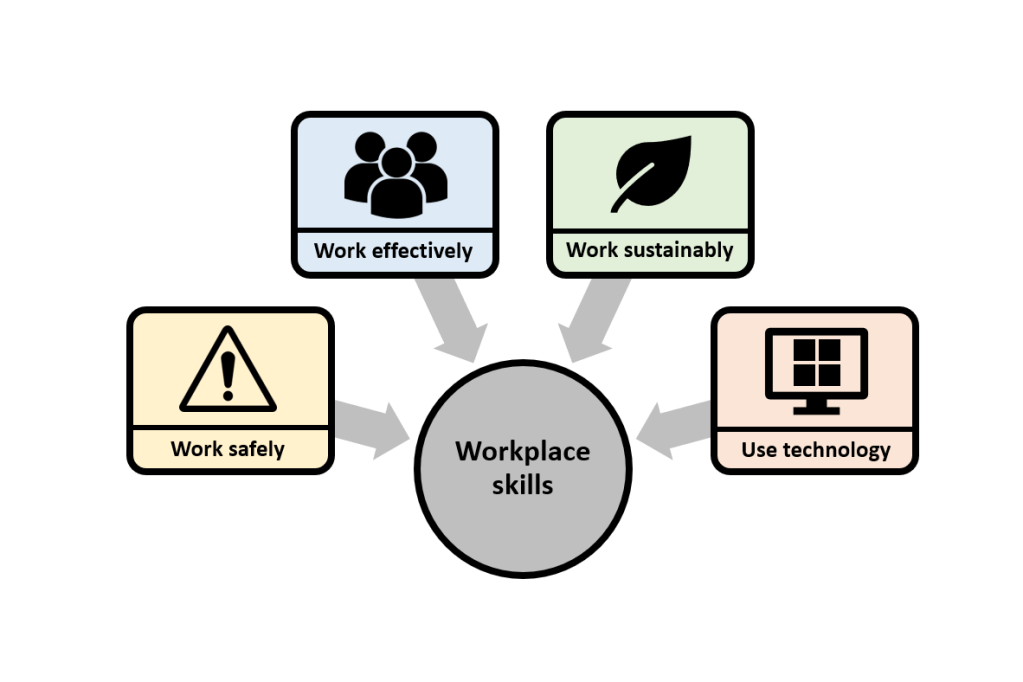
The training program has a structured covering four themes:

  • Work safely
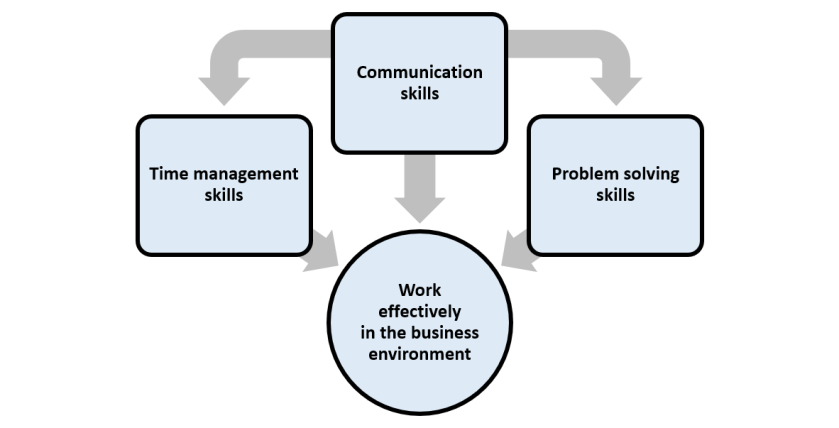
  • Work effectively
  • Work sustainably
  • Use technology.

Units of competency

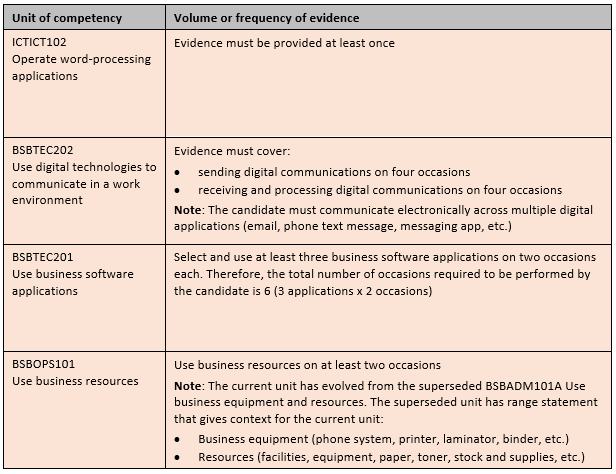
The qualification shall be delivered with the following ten units of competency.

Training mode and duration

The training shall be group-based learning facilitated by a trainer. The group size may be up to 20 learners.

There is a total duration of 25 training days. Each day shall be consistent with ‘normal’ business hours:

  • 9:00am start time
  • 5:00pm finish time

The training program shall be delivered over a period of five weeks.

Training delivery schedule

The following is the delivery schedule for the entire training program.

Assessment approach

Evidence of competency shall be gather using a range of assessment methods.

  • Questioning (Q)
  • Observation of performance (OP)
  • Review of products (RP)
  • Third-party reports. (TPR)

Refer to assessment tools for details.

The following is an overview of the assessment schedule.

Note: Opportunities for re-assessment shall be arranged.

In conclusion

The above draft training and assessment strategy is incomplete. However, for the purpose of this article, it gives a clear example about how a training program can be designed to meet a client’s need.

  • Do you find the 12-step process a useful guide?
  • Did you learn something from this article?

Australia’s VET system

Australia’s vocational education and training (VET) system is complex and forever changing. People studying for their TAE40122 Certificate IV in Training and Assessment qualification may find useful information on this website. Tap or click on the following ABC logo to find out more.

ABC logo

Contact now!

logo otws

Training trainers since 1986