40+ years experience as a trainer, instructional designer, quality manager, project manager, program manager, RTO auditor, RTO manager and VET adviser.
The Australian VET system is being changed, or ‘reformed’, as governments likes to call it. It seems like whenever we get a new minister with responsibility for VET, they say it needs to be simplified and streamlined. I have heard this too many times over the past decade or more.
In 2025, we are seeing the implementation of two significant changes: Quality Reforms and Qualification Reform. These were initially announced by Scott Morrison’s Coalition government in 2019 and embraced by Anthony Albanese’s Labor government in 2022.
The new Standards for Registered Training Organisations and the new Training Package Organising Framework have been finalised and publicly released, and both are to be effective from the 1st of July 2025.
It is true that VET can be complex. It is also true that it is continuously changing, but not all change is improvement.
The new Standards for RTOs
On the 14th of March 2025, the revised Standards for Registered Training Organisations (RTOs) were published. RTOs are now tasked with aligning their policies and procedures with these updated requirements. The effectiveness of these new Standards in enhancing the quality of training and assessment services remains a subject of debate.
A potential avenue for quality improvement could be increased resourcing for VET regulators, enabling more frequent onsite audits. This would facilitate closer monitoring and ensure RTOs adhere to the established standards. Without such increased oversight, the current level of quality within the VET sector is likely to persist.
The new Training Package Organising Framework
Simplification?
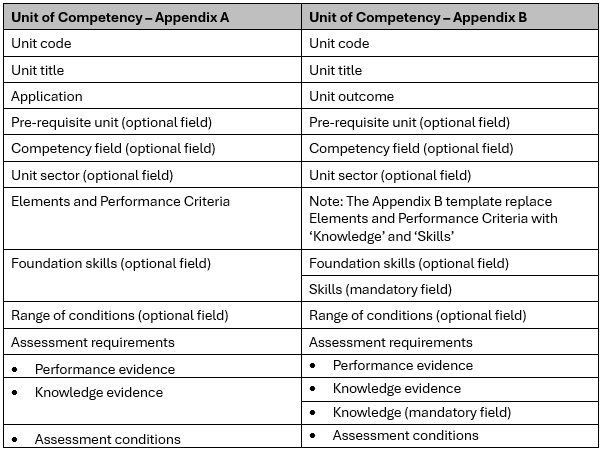
The new Training Package Organising Framework introduces significant complexity. It isn’t going to simplify things. For example, currently there is one template for Units of Competency. As from the 1st of July 2025, there will be two templates. The following table shows the difference between the templates. [2]
The first observation is that Template A is the same as what currently exists. The next observation is that the two templates have many items that are the same or similar. However, a closer inspection reveals that Template B is a departure from a VET system being based on competencies, and it is a move back towards curriculum.
A move to curriculum-based training returns the VET system to 1994, before the current competency-based VET system was introduced. Also, having two different templates for Units of Competency will add unnecessary complexity. Is this what the government ministers with responsibility of VET want? Do the skills ministers know what they are doing?
Streamlined?
It has been said that it takes too long to develop new training products or modify existing training products. It was said that the process could take 12 to 18 months. The new approach for developing and endorsing training packages has been described in the new Training Package Organising Framework.
The following provides an overview of the new training packages development and endorsement process. [3]
The new process for developing and endorsing training packages does not look much different to the previous, apart from changes to the entities involved, for example, the training package developers are now the Jobs and Skills Councils (JSCs) rather than the Industry Reference Committees (IRCs) supported by Skill Service Organisations (SSOs). Also, the indicative timeframe still seems to be about 12 to 18 months. It would appear that very little has been streamlined.
In conclusion
We’re not seeing streamlining or simplification; instead, complexity is increasing. It’s inevitable that the next VET minister will announce a plan for simplification and streamlining. This cycle of perpetual change seems destined to repeat itself.
The Standards for Registered Training Organisations (RTOs) 2015 required an RTO to review a statistically valid sample of the assessments. The national VET regulator, Australian Skills Quality Authority (ASQA) provided an online calculator to determine the sample size so that it would be statistically valid.
ASQA’s Validation sample size calculator has been used to calculate the statistically valid sample size for the following two examples. [1]
Example 1
Example 2
The new Standards for RTOs 2025 has introduced a significant change to assessment validation. Instead of a fixed requirement, RTOs are now required to adopt a risk-based approach to determine their validation sample size. This means the number of assessments validated will vary considerably across RTOs, reflecting their individual risk assessments.
Select the units to be validated
The new Standards for RTOs 2025 states that “every training product on the organisation’s scope of registration is validated at least once every five years and on a more frequent basis where the organisation becomes aware of risks to training outcomes, any changes to the training product, or receives relevant feedback from VET students, trainers, assessors, and industry.” [2]
What is a training product?
The new Standards for RTOs 2025 defines training products as:
VET Qualification
Skill set
Unit of competency
Accredited short course or module.
How many units per qualification should be validated?
ASQA has provided the following guidance for RTOs: [3]
“At least two units from each qualification must be validated; however, your RTO may choose to validate more if validation of the two units identifies risks or a potential harm to learners who may not have met the required assessment outcomes, inconsistent assessment judgements have been made by assessors or assessment has not been conducted in accordance with the Principles of Assessment or the Rules of Evidence.”
Prioritising high-risk units
When RTOs prioritise the validation of high-risk units over low-risk ones, they are strategically focusing their quality assurance efforts where they matter most. High-risk units often involve complex skills, critical safety implications, or significant industry impact. By concentrating validation on these areas, RTOs can identify and rectify potential assessment flaws that could lead to serious consequences, such as workplace accidents or compromised professional standards. This approach ensures that training quality is rigorously maintained in the most crucial areas, safeguarding both learner outcomes and industry integrity. Essentially, it’s about maximising the impact of validation resources by addressing the areas with the greatest potential for negative consequences.
Identifying risks
The new Standards for RTOs 2025 states that a risk-based approach should be used to determine the sample size of assessments that should be validated. It’s important to understand that the risk-based approach in the Australian VET sector is about ensuring quality and compliance. Therefore, the risks considered relate to factors that could negatively impact those outcomes. Here are five risks that RTOs could consider when determining assessment validation sample sizes:
Type of unit
Experience of assessors
Changes to assessment practices
Volume of assessments
Historical compliance and validation outcomes.
Risk 1. Type of unit
Units involving high-risk activities, complex skills, or critical safety components require more rigorous validation. The potential consequences of incompetent performance are higher.
Risk 2. Experience of assessors
If assessors are new, less experienced, or are not fully qualified, there is a higher risk of inconsistent or inaccurate assessments. This necessitates a larger validation sample.
Risk 3. Changes to assessment practices
Any recent changes to assessment tools or assessment procedures can introduce inconsistencies. A larger validation sample size helps identify any unforeseen issues.
Risk 4. Volume of assessments
A high volume of assessments within a short period can increase the risk of errors or inconsistencies. Larger sample sizes are needed to maintain quality assurance.
Risk 5. Historical compliance and validation outcomes
A history of non-compliance or poor validation outcomes should lead to a more conservative approach with larger sample sizes. This allows for closer scrutiny and helps build confidence in the RTO’s assessment practices.
The above five risks are examples, not a complete list, of risks that may influence an RTO’s risk assessment. In essence, the risk-based approach should encourage an RTO to prioritise validation efforts where the potential for errors or negative impacts is greatest.
Determining sample size
Let’s look at how a risk-based approach to assessment validation sample sizes might work with some numerical examples. Here are three scenarios.
Scenario 1. High-risk unit
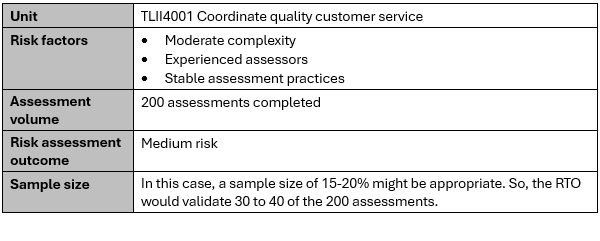
Scenario 2. Medium-risk unit
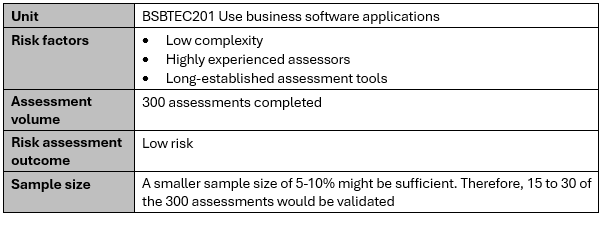
Scenario 3. Low-risk unit
The numbers in the above three scenarios are examples. The exact percentages will vary depending on the RTO’s own risk assessment and validation policies.
The following table compares the statistically valid sample size with the sample size for the three previous scenarios.
High-risk units should be selected for validation rather than low-risk units. Therefore, the new risk-based approach should not significantly reduce the sample size of assessments to be validated.
Selecting units to be validated
A VET qualification consists of many units of competency. The RTO will need to select at least two units to be validated. The following is a three-step process that can be used for risk-based selection of unit.
Step 1. Select the risk assessment criteria
Step 2. Create a risk assessment table
Step 3. Conduct and document the risk assessment.
Step 1. Select the risk assessment criteria
Here are some examples of risk assessment criteria:
Complex skills
High-risk activities
New, inexperienced or partly qualified assessors
New or changed assessment tools
Feedback or complaints from students, trainers, assessors, or industry.
Step 2. Create a risk assessment table
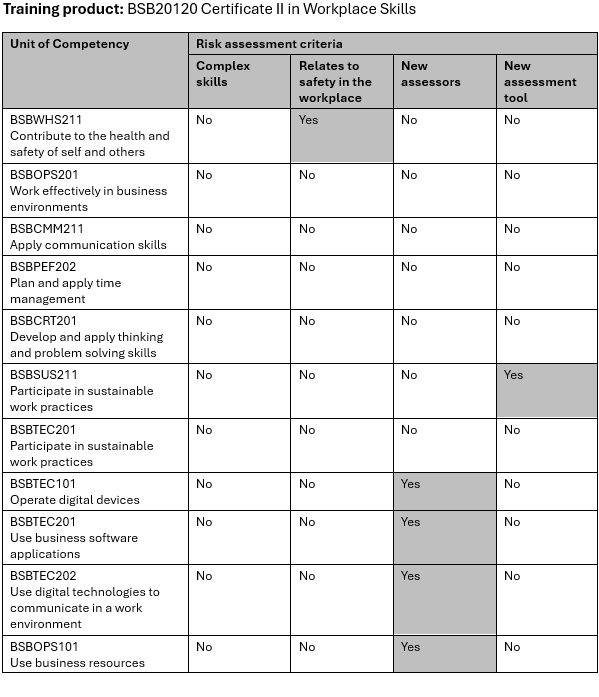
The following risk assessment table show an example with four risk assessment criteria. The number of risk assessment criteria shall be determined by the RTO, and this shall determine the number of columns required.
Step 3. Conduct and document the risk assessment
Here are risk assessment examples for two different qualifications.
Example 1
Selection of units to be validated based on the above risk assessment table should consider:
Units with newly implemented assessment tools (for example, BSBSUS211 Participate in sustainable work practices)
Units assessed by new assessors (for example, BSBTEC201 Use business software applications)
Units related to critical areas like safety (for example, BSBWHS211 Contribute to the health and safety of self and others).
Example 2
Unit selection for validation based on the above risk assessment table may prioritise two of the following:
SITHFAB025 Prepare and serve espresso coffee
SITHACS009 Clean premises and equipment
SITXFSA005 Use hygienic practices for food safety
SITXWHS005 Participate in safe work practices.
What assessment items must be kept? And how long do these items need to be kept?
ASQA has provided the following guidance for RTOs: [4]
“An RTO must keep all completed assessment items for each student for a period of six months from the date on which the judgement of competence for the student has been made. Completed student assessment items include the actual work completed by a student or evidence of that work, including evidence collected for a Recognition of Prior Learning (RPL) process.
If a student’s actual work is unable to be retained, an assessor’s completed marking guide, criteria, and observation checklist for each student may be sufficient. However, this evidence must have enough detail to demonstrate the assessor’s judgement of the student’s performance.”
Assessment items must be kept for at least 6 months. Some state and territory governments may require RTOs delivery government-funded or subsidised training to keep assessment items for a longer period of time.
Therefore, completed assessment items should be available for conducting assessment validation.
Random selection of assessments
While random selection is a common approach to assessment validation, best practice dictates including assessments conducted by new, inexperienced, or partially qualified assessors. Additionally, a sample of any Recognition of Prior Learning (RPL) assessments should always be included in the validation process.
In conclusion
The Standards for RTOs 2025 replace the previous fixed statistically valid sample size requirements with a risk-based approach. RTOs must now determine their own sample size based on their risk assessment.
Apart from determining the validation sample size, the RTO must select the units to be validated. An RTO should select units that are high risk rather than low risk. Prioritising high-risk units for validation allows RTOs to focus quality assurance where it’s most critical. By concentrating on complex skills and high-impact areas, RTOs can ensure assessment quality is maintained and mitigate potential serious consequences.
Are you a doing the TAE40122 Certificate IV in Training and Assessment, and are you struggling with your studies? Do you want help with your TAE studies?
Oh, the Certificate IV, a carousel of woe, Spinning and turning, round and round it does go. Every six years, a new twist, a new spin, But the core of the training remains the same within.
Trainers and assessors, trapped in this endless ride, Yearning for something new, something to abide. The changes are superficial, a mere facade, Compliance the focus, the journey’s a load.
In 2004, the carousel first took flight, A new qualification, shining so bright. But six years later, it spun once again, A new version, a different refrain.
And so it continued, six years after six years, A never-ending cycle, filled with fear. The changes were minor, the core remained the same, A monotonous journey, a pointless game.
But in 2022, a new twist appeared, A quest for flexibility, a hope to be cheered. Yet, the reality was far from grand, A close to standardised program, across the land.
So, why all this spinning, this endless parade? Is it truly necessary, or just a charade? The changes are superficial, the journey’s a bore, A monotonous carousel, forevermore.
Step 4 Contact the preferred RTO and discuss acceptable evidence with the RPL assessor
Step 5 Apply for RPL and follow RTO’s RPL procedure
This is the third article in a series about updating from the TAE40116 qualification to the TAE40122 qualification.
Step 3. Shop around for an RTO
An RTO can determine its own RPL process and associated fees. It is a good idea to contact a few RTOs and gather information about:
Cost of the RPL
Support provided
Flexibility
Cost of gap training
Cost of the RPL
The fee charged by RTO for RPL assessment can vary. I just did a quick internet search and found three different RTOs offering RPL at $1,300, $2,100 and $2,400. You may like to check if the RTO you work for is willing to pay for or subsidise your RPL.
Support provided
Cost is one criteria. Other criteria, such as the support provided by the RTO, may be important to you.
Does the RTO appear to be friendly and supportive?
What support will the RTO provide during the RPL process?
How much support will you need?
Another important criteria is the RTO’s willingness to be flexible.
Flexibility
Flexibility is one of the four principles of assessment. Is the RTO willing to be flexible?
Can you select the elective units that you want?
Is the RTO willing to recognise parts of a superseded and non-equivalent unit as substantive RPL evidence (therefore, no need to repeat training or assessment for those parts of the unit)?
Does the RTO willing to adapt or modify there assessment documents used to gather RPL evidence?
Cost of gap training
You may need to do some training to close any gaps. Some people many have a small number of units that can not attained by credit transfer and RPL. Each person applying for RPL will have their own unique circumstances.
How many units may be potential gaps?
How much would it costs to do gap training?
Compare RTOs
Shopping around for an RTO could save you money. And you could save time associated with the RPL application and assessment process. The following is a table that can be used to help you gather and compare information about different RTOs.
More tips and strategies shall be presented at the upcoming webinar.
Step 4 Contact the preferred RTO and discuss acceptable evidence with the RPL assessor
Step 5 Apply for RPL and follow RTO’s RPL procedure
This is the second article in a series about updating from the TAE40116 qualification to the TAE40122 qualification.
Step 2. Determine evidence required and identify evidence that can be gathered
Many TAE40122 units supersede and have been declared not equivalent to the relevant TAE40116 units. A unit that is ‘not equivalent’ does not mean that it is ‘completely different’. In other words, a unit that is ‘not equivalent’ can be ‘partly equivalent’.
What parts of a superseded unit are equivalent?
Let’s look at an example.
The TAEDES411 Use nationally recognised training products to meet vocational training needs supersedes and has been deemed not equivalent to TAEDES402 Use training packages and accredited courses to meet client needs.
Performance Criteria
The following table compares the Performance Criteria for the TAEDES411 unit with the Performance Criteria for the TAEDES402 unit.
Most of the Performance Criteria for the TAEDES402 unit are equivalent to the Performance Criteria for the TAEDES411 unit, with two exceptions. Performance Criteria 3.2 and 3.3 for the TAEDES411 unit are not covered by the TAEDES402 unit.
Performance Criteria 3.2
It is not difficult to seek feedback relating to whether applied training products meet specified requirements and identified needs. A person seeking RPL for this unit should be able to prove that they can do this performance.
Performance Criteria 3.3
This is an example of a poorly written Performance Criteria. It is vague, and it does not describe a typical work task. Training products have been developed to meet an identified need that has been specified by industry. The following is an interpretation of changes to product use:
Change the selected elective units
Change the clustering or sequence of units.
A person seeking RPL for this unit should be able to prove that they can analyse collected feedback and identify required changes to product use.
Knowledge Evidence
The following table compares the Knowledge Evidence for the TAEDES411 unit with the Knowledge Evidence for the TAEDES402 unit.
The TAEDES411 unit has two Knowledge Evidence items that are not covered by the TAEDES402 unit. A person seeking RPL for this unit may need to prove that they have relevant knowledge relating to some, or all, of the following:
Standards for RTOs
Australian Core Skill Framework (ACSF)
Digital Literacy Skills Framework (DLSF)
Australian Digital Capability Framework
Employability Skills Framework
Core Skills for Work.
What evidence is required?
The above example shows that very little evidence should be needed by a person seeking RPL for the TAEDES411 unit. This gap analysis can be replicated for all TAE40122 units that have superseded and been declared not equivalent to TAE40116 units. This approach should significantly reduce the time and effort required when seeking RPL to update to the TAE40122 qualification from the TAE40116 qualification.
What evidence can be gathered?
After determining the evidence required, the next thing is to identify the evidence that can be gathered that may support an RPL application. This evidence may include recent and relevant work experience.
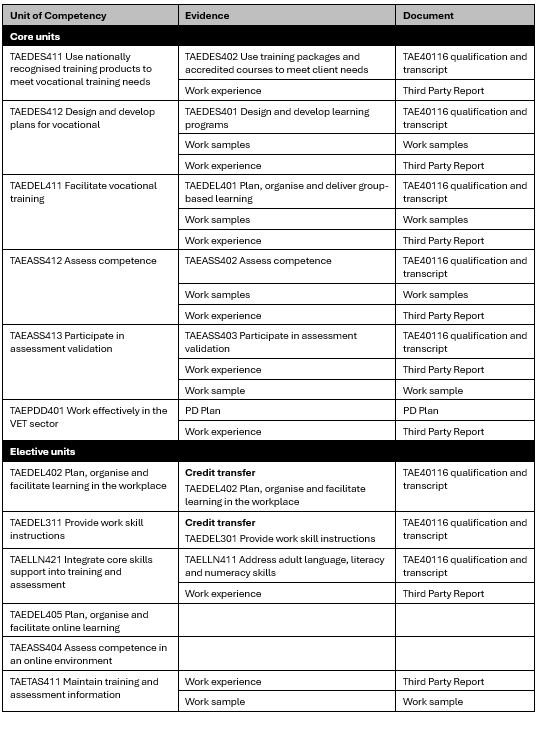
The following table shows a sample portfolio evidence.
In conclusion
This article has covered the second step of the 5-step process relating to updating from the TAE40116 to the TAE40122. This step is about determining RPL evidence required and identifying RPL evidence that can be gathered.
RPL is a process to assess and recognise relevant skills and knowledge gained through prior training and work experience. RTOs should acknowledge previous training and the completion of TAE40116 units. The discrepancy between superseded TAE40116 and TAE40122 units is often minimal, and many current RTO trainers and TAFE teachers possess the requisite work experience to bridge this gap.
More tips and strategies shall be presented at the upcoming webinar.
















 On Target Work Skills