Is there a difference between knowledge training and skill training?

I have found that some people studying for their TAE40116 Certificate IV in Training and Assessment qualification struggle with understanding the difference between knowledge and skills. In this article I aim to answer the following questions:

  • What is knowledge? And what is skill?
  • What is the difference between knowledge and skill?
  • Why is it important to know the difference?

Where do we start

In the Australian VET system, specific terms have been defined. For example, competency is partly defined as the consistent application of knowledge and skill to the standard of performance required in the workplace.
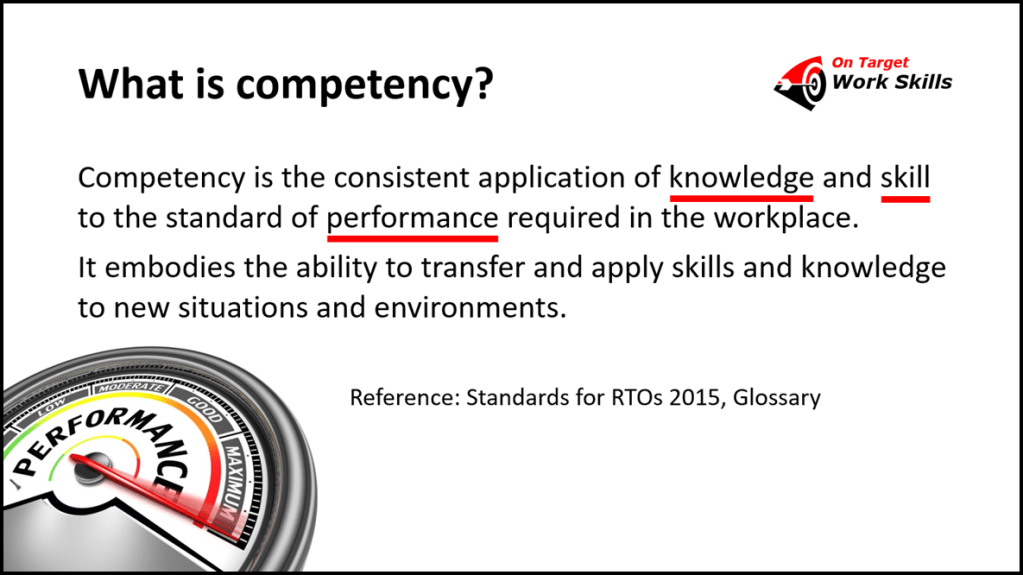
For the purpose of this article I am focused on three words from the definition of competency: knowledge, skill, and performance.

A primary objective of VET is to help people learn how to perform work tasks and activities. The performance of a work task will require a person to apply knowledge and apply skill.

If people do not currently have the required knowledge or required skills to perform a work task, then VET will deliver training to help people learn the required knowledge and skills. The learning of required knowledge will usually precede the learning of required skills.

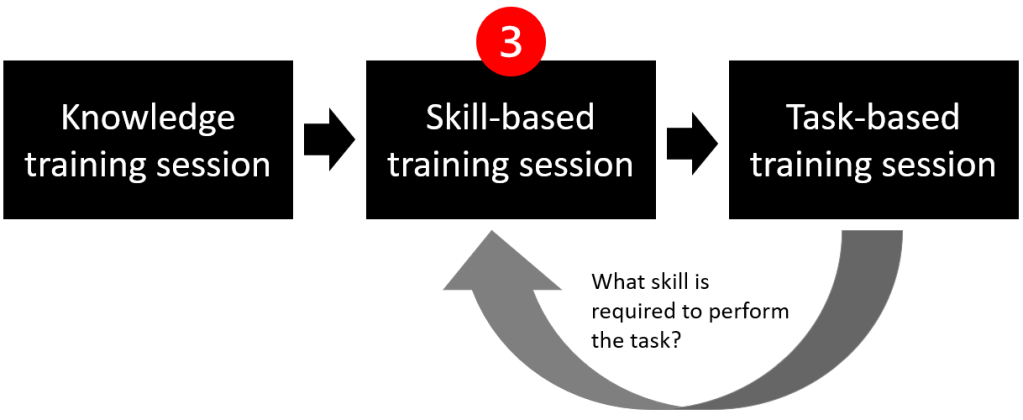
The following illustrates the typical training sequence.

After the required knowledge and skills have been learnt, then training can help people to apply their knowledge and skills to perform the work task or activity to the standard required in the workplace.

What is knowledge? What is skill? And what’s the difference?

Knowledge

What is knowledge? Can knowledge be observed?

These sound like philosophical questions. A person’s knowledge or knowledge held inside a person’s brain cannot been seen, per se.

  • Knowledge is intangible.
  • Knowledge can be factual, conceptual, or procedural.
  • Knowledge refers to learning information, principles, and concepts.
  • Knowledge is the theoretical understanding of something.
  • Knowledge refers to theory.

Knowledge learning is the process of acquiring the theory needed before progressing to the next stage of learning.

Skill

What is skill? Can skill be observed?

The performance of a skill can be observed unless it is a cognitive or thinking skill. We can observe a person performing the skill (the process) or we can see what is produced as a result (the product).

  • Skill is about doing or performing.
  • Skill refers to applying theory in practice and getting an outcome or result.
  • Skills are learnt through regular practice or trial and error.

Skill-based learning builds on knowledge by developing practical or ‘hands-on’ ability. People need knowledge and skills to perform a task.

What is the difference between knowledge and skill?

Knowledge and skill

The difference between knowledge and skill can best be explained by an example. What knowledge and skills does a chef need?

  • Before starting to cook, a chef requires the background knowledge about recipes, ingredients, food safety, types of cooking methods, and hazards in the kitchen.
  • A chef also needs to develop skills to perform specific tasks, such as reading recipes, measuring ingredients, mixing ingredients, and grilling, steaming, boiling, frying, baking, roasting, etc.

Having knowledge about something does not make a person skilled in it. And being skilled at something does not mean the person has all the required knowledge to work safely, effectively or independently.

  • A knowledge training session covers the theory.
  • A skill-based training session develops the practical or ‘hands-on’ ability to do something.

Skill and task

The difference between a skill-based and a task-based training session is subtle. Skills are used to perform a task. Both types of training session will involve doing something:

  • A skill-based training session involves a person performing a skill.
  • A task-based training session involves applying knowledge and skill to perform a task.

Learning the difference between knowledge and skill

I ensure that my TAE40116 Students learn the difference between a knowledge training session, a skill-based training session, and a task-based training session. The performance evidence for the TAEDEL401 Plan, organise and deliver group-based learning unit of competency requires three training sessions to be delivered. My TAE40116 Students deliver three consecutive training sessions: a knowledge training session, followed by a skill-based training session, followed by a task-based training session.

The overall objective of the three training sessions is to help a group of people learn to perform a simple work task. This requires the delivery of a training session to help people learn the required knowledge to perform the task, followed by a training session to help people learn a required skill to perform the task. The task-based training session puts together what was learnt in the two previous sessions to perform a task.

A trainer working in the VET sector must be able to deliver training sessions covering knowledge and training sessions covering skills. I believe that a TAE40116 Graduate must know:

  • The difference between knowledge and skill
  • The difference between delivering a knowledge training session and a skill-based training session
  • VET trains people so that they can apply knowledge and skills to perform work tasks.

I have found that many of my TAE40116 Students struggle with how to start planning for the delivery of the three different types of training sessions. I think some people find it unusual to start at the end and work backwards, rather than starting at the beginning and work forward.

The first thing is to clearly describe the objective for the task-based training session and develop a task breakdown.

(By the end of the task-based training session, the learner should be able to …)

The second thing is to clearly describe the objective for the knowledge training session. The task breakdown can be used to identify the relevant knowledge required to perform each step of the task. Also, the Knowledge Evidence can be used to identify the required knowledge.

(By the end of the knowledge training session, the learner should be able to …)

The third thing is to clearly describe the objective for the skill-based training session. The task breakdown can be used to identify the relevant skill required to perform the task. Also, the Foundation Skills can be used to identify the required skill or skills.
(By the end of the skill-based training session, the learner should be able to …)

An example

The following is an example using the ICTICT216 Design and create basic organisational documents unit of competency. Basic organisational documents may include letters, brochures, posters, forms, and procedures.

Step 1. Describe the task

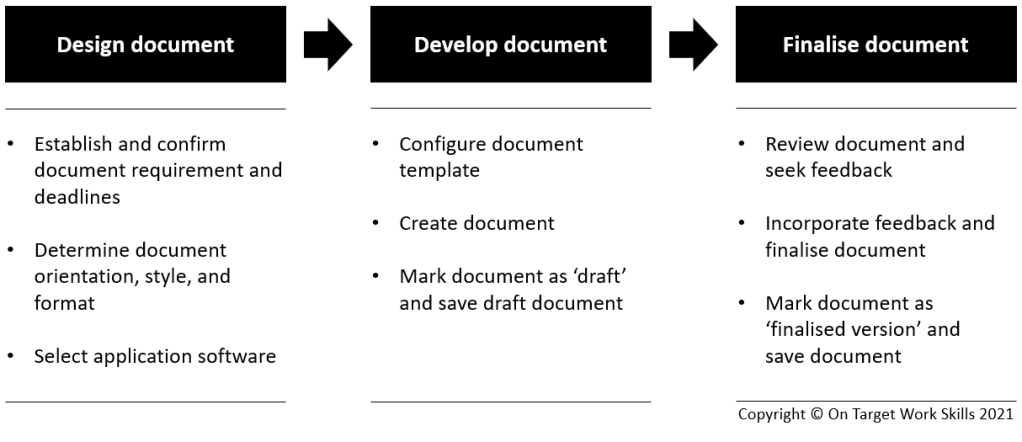
The task of designing and creating basic documents can be considered as having three stages: design document, develop document, and finalise document.

Each stage can be broken down as having three steps. The following flowchart outlines the 9-step process for designing and creating basic documents.
Step 2. Identify the required knowledge and required skills

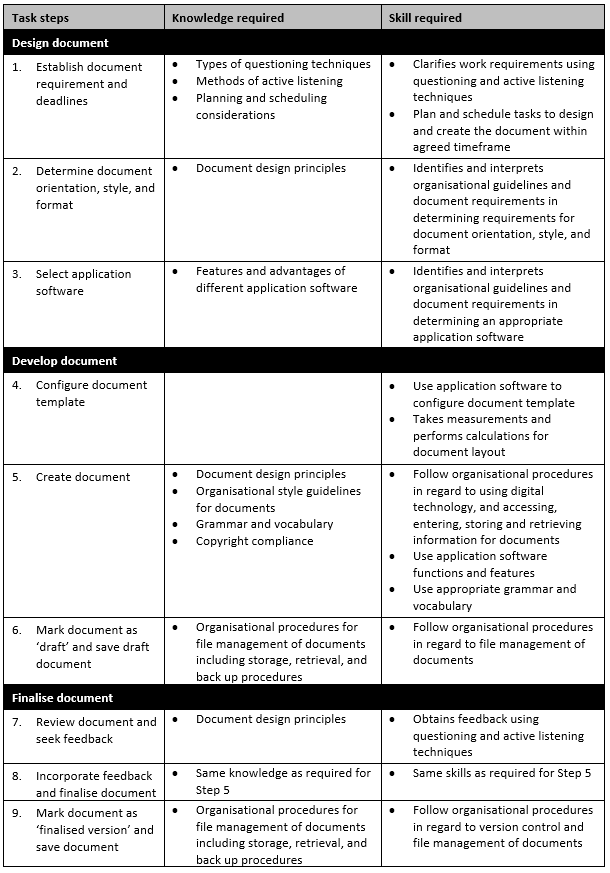
The following shows how a table can be used to identify the knowledge and skills required for each task step.
Step 3. Write objectives for training sessions

The following are selection of training objectives for the ICTICT216 Design and create basic organisational documents unit of competency.

Training objectives must be written.

Task-based training sessions

By the end of the task-based training sessions, the learner should be able to design, develop and finalise at least five types of documents: letter, brochure, poster, form, and procedure.

Knowledge training sessions

By the end of the knowledge training sessions, the learner should be able to:

  • List three types of questioning techniques
  • List three methods of active listening
  • List five planning and scheduling considerations
  • Describe three document design principles
  • Describe three features of Microsoft Word and how to apply these features when developing a document
  • Describe three features of Microsoft PowerPoint and how to apply these features when developing a document
  • Identify two advantages of using Microsoft Word and two advantages of using Microsoft PowerPoint for developing documents
  • Etc.

Note: There would be several knowledge training sessions. ‘Chunking and sequencing’ of required knowledge would determine the order and timing for each knowledge training session. Also, the characteristics and needs of the individual learners would need to be considered.

Skill-based training sessions

By the end of the skill-based training sessions, the learner should be able to:

  • Clarifies work requirements using questioning and active listening techniques
  • Plan and schedule tasks to achieve outcomes within agreed timeframes
  • Read organisational guidelines and document requirements to determine requirements for document orientation, style, and format
  • Read organisational guidelines and document requirements to select appropriate application software for different types of documents
  • Etc.

Note: There would be several skill-based training sessions. ‘Chunking and sequencing’ of required skills would determine the order and timing for each skill-based training session. Also, the characteristics and needs of the individual learners would need to be considered.

Step 4. Develop training session plans and resources

This step is outside the scope of this article.

Why is it important to know the difference between knowledge and skill-based training?

Active learning

Active learning methods are used to engage and actively involve learners in the learning process. I promote the idea that at least 50% of the available training time should be allocated for activity. I emphasis ‘at least’, therefore 60%, 75%, or 90% of the training time could be used for activities.

Learning activities

Learning activities can be done by the individual learner, by working in pairs, or by working in small groups. Types of learning activities include:

  • Perform the work task or activity
  • Project
  • Role play
  • Case study
  • Skills practice
  • Research assignment
  • Discussion
  • Answer questions
  • Presentations
  • Quiz.

The following shows the application for different types of learning activities.
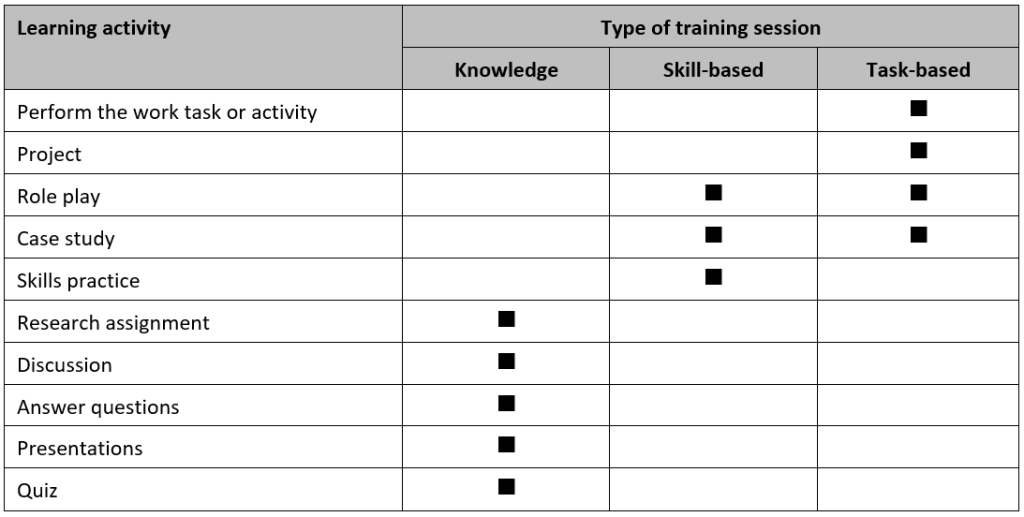
Note: All vocational education and training must include the performance of the work task or activity.

Structure of a training session

Finally, and importantly, the structure of a knowledge training session will be different to the structure of a skill-based or task-based training session.

Knowledge training session (EAS)

Skill-based or task-based training session (EDP)

In conclusion

The following diagram show from the learner’s perspective that the knowledge training is followed by skill-based training, followed by task-based training. But the planning process for competency-based training starts with the task, and then works back to the required knowledge and required skill.

Key points

  • A prime objective of VET is about help people learn how to perform work tasks and activities
  • People need knowledge and skills to perform work tasks and activities
  • Knowledge and skills are different.
  • Active learning methods must be used to engage and actively involve the learner in the learning process.
  • A trainer needs to know the difference between knowledge and skills because a knowledge training session is structured differently to a skill-based training session, and different types of learning activities are used.
  • The objective of a task-based training session is to ensure a person can apply the required knowledge and required skills to perform a work task or activity.
  • Training is not complete until the learner has performed the work task or activity to the standard required in the workplace.

Do you need help with your TAE studies?

Are you a doing the TAE40122 Certificate IV in Training and Assessment, and are you struggling with your studies? Do you want help with your TAE studies?

Ring Alan Maguire on 0493 065 396 to discuss.

Contact now!

logo otws

Training trainers since 1986

What is the VET Quality Framework?

The quality of vocational education and training (VET) in Australia is important. Systematic training aims to improve productivity, global competitiveness, and workplace safety. And each year, billions of taxpayers’ dollars is spent by governments on delivering VET programs.

Australian industry, employers, governments, and taxpayers deserve a VET system that delivers quality outcomes, and value for money. And job seekers, apprentices, trainees, and employees who undertake VET programs should expect to receive a quality service from training providers. It is the role of government departments and VET regulators to monitor and audit VET quality.

In Australia, the VET Quality Framework has been established. It consists of five elements [1]:

  • Australian Qualification Framework (AQF)
  • Standards for Registered Training Organisations (RTOs)
  • Fit and proper person requirements
  • Financial viability risk assessment requirements
  • Data provision requirements.

Australian Qualification Framework (AQF)

All Australian qualifications must comply with the AQF. [2] The learning outcomes for each AQF level and qualification type are described. The current AQF has evolved from the initial implementation handbook released in 1995. Since then, there has been a procession of revised frameworks:

  • AQF Implementation Handbook First Edition 1995
  • AQF Implementation Handbook Second Edition 1998
  • AQF Implementation Handbook Third Edition 2002
  • AQF Implementation Handbook Fourth Edition 2007
  • AQF First Edition 2011
  • AQF Second Edition 2013

And there has been at least three amendments to the AQF Second Edition 2013. [3]

AQF Volume of Learning

The AQF Volume of Learning [4] has become a prime focus for the national VET regulator. The aim is to discourage unduly short-duration VET training programs that do not provide sufficient training.

Standards for Registered Training Organisations (RTOs)

The Standards for RTOs are the regulatory requirements for the operation of training organisations registered to deliver training services and to issue nationally recognised training (NRT) qualifications or statements of attainment. Only registered training organisations (RTOs) can issue documents with the NRT logo (as shown below).

NRT logos provided for the purpose of display only

Many training organisations want to be registered, not as an expression of quality training, but because this is a prerequisite for being eligible to receive government funding when delivering training.

The current Standards for RTOs have evolved from the Australian Quality Training Framework (AQTF) that were first introduced in 2001. Since then, there has been a procession of revised standards: [5]

  • National Framework for the Recognition of Training (NFROT) 1992
  • Australian Recognition Framework (ARF) 1998
  • AQTF 2001
  • AQTF 2005
  • AQTF 2007
  • AQTF 2010
  • Standards for NVR 2011
  • Standards for NVR 2012
  • Standards for RTOs 2015.

And there has been at least two amendments to the Standards for RTOs 2015.

The Standards for RTOs require training providers to comply with:

  • Training packages and accredited courses
  • Legislation and regulations.

Training packages and accredited courses

RTOs must comply with the requirements specified by training packages and accredited courses when delivering nationally recognised training (NRT):

  • Qualification packaging rules
  • Units of competency including elements of competency, performance criteria, and foundation skills
  • Assessment requirements including performance evidence required, knowledge evidence required, and assessment conditions.

Legislation and regulations

RTOs must comply with all relevant legislation and regulations. For example:

  • Work health and safety
  • Antidiscrimination
  • Copyright
  • Privacy.

Fit and proper person requirements

The ‘Fit and proper person requirements’ are used to determine the suitability of owners, executives, or senior managers involved in the operation of a registered training organisation. [6]

Over the years, Australia has had a number of unfit and improper people owning and managing RTOs. I will say more about this topic during the conclusion of this article.

Financial viability risk assessment requirements

The ‘Financial viability risk assessment requirements’ are used to determine the ability of an RTO to meet financial obligation and remain financially viable. [7]

Over the years, Australia has seen a number of high-profile RTOs that have financially crashed. Many RTOs have a business model that is based on revenue from government funding. If the government funding changes, so does the financial viability of these RTOs.

Data provision requirements

The ‘Data provision requirements’ specify that RTOs must provided data when requested and submit quality indicator data annually to their VET regulator. [8]

Gathering data can provide useful insight about how an RTO is operating, or has been operating. There is always going to be a lag. Luckily, this is not the only source of intelligence used by the VET regulators to monitor the performance of RTOs.

In conclusion

Australia has had a long history in government sponsored and industry endorsed frameworks that have been designed for assuring the quality of vocational education and training (VET).

Over the years, it is sad that the Australian VET system has witnessed many cases of fraudulent, unethical, and unscrupulous behaviour displayed by RTO owners, executives, and senior managers. It is sad that greed, self-interest, profit, or a focus on personal financial gain has created some rotten operational practices. And TAFEs have not been immune from poor practices. In TAFE, ‘profit’ may be called ‘surplus’. And in TAFE, there is still a need to ‘cut costs’. There have been too many occasions when government funding has been rorted by all types of RTOs.

Unfortunately, this is why we need a highly regulated VET system. I say ‘unfortunately’, because the unintended consequence has been a VET system that is highly prescriptive. This can stifle innovation. This can stifle quality competition. And it has increased the administrative burdens placed on trainers and assessors.

The VET Quality Framework is necessary. It plays an important role in the assurance of VET quality. It can be used by the VET regulators and government departments to monitor and audit RTOs operations. I think it is doubly important to closely monitor and audit RTOs that receive government funding. There is a worrying trend for the VET regulators to take a ‘light-touch’ approach to their regulating duties.

References

[1] https://www.asqa.gov.au/about/asqa/key-legislation/vet-quality-framework accessed 11 May 2021

[2] https://www.aqf.edu.au/sites/aqf/files/aqf-2nd-edition-january-2013.pdf accessed 11 May 2021

[3] https://www.aqf.edu.au/aqf-second-edition-january-2013 accessed 11 May 2021

[4] https://www.aqf.edu.au/sites/aqf/files/volume-of-learning-explanation-v2-2014.pdf accessed 11 May 2021

[5] https://www.voced.edu.au/vet-knowledge-bank-getting-know-vet-overviews-vet-quality-framework-and-aqtf accessed 11 May 2021

[6] https://www.legislation.gov.au/Details/F2011L01341 accessed 11 May 2021

[7] https://www.legislation.gov.au/Details/F2011L01405 accessed 11 May 2021

[8] https://www.legislation.gov.au/Details/F2013C00497 accessed 11 May 2021

Do you need help with your TAE studies?

Are you a doing the TAE40122 Certificate IV in Training and Assessment, and are you struggling with your studies? Do you want help with your TAE studies?

Ring Alan Maguire on 0493 065 396 to discuss.

Contact now!

logo otws

Training trainers since 1986
What credentials do trainers need?

Introduction

Over the past few weeks I have been thinking about what tasks do trainers perform and what credentials do trainers need. This was triggered by the release of the Australian Skills Classification by the National Skills Commission. The occupation profile for a vocational trainer described in the Australian Skills Classification was appalling. My various thoughts have been recently published in four articles:

I would like to thank the many people who commented in response to these previous articles on this topic. In this article, I want to put together my many and varied thoughts.

What tasks are performed by trainers?

Qualifications must have an occupational outcome. Therefore, we need to develop an occupation profile based on work tasks and activities performed by a trainer. There are different types of trainers and not all trainers perform the same range of tasks.

What are the different types of trainers?

Some trainers work as part of Australia’s vocational education and training (VET) system. And some do not. This is the first significant difference between trainers:

  • VET trainers
  • Non-VET trainers.

Another difference is the job role performed: [1]

  • Employed as a VET trainer (TAFE, private RTO, other RTO)
  • Employed in a job role other than a VET trainer (experienced worker, workplace supervisor, workplace manager, etc.)
  • School teacher delivering a VET in Schools program.

And another difference is the employment status: [1]

  • Permanent employee (full-time and part-time employee)
  • Non-permanent employee (casual, sessional or employed under fixed-term or short-term contract)
  • Volunteer.

What are the different types of RTOs?

It has been said that VET trainers perform different tasks depending on the type of RTO they work for. The Education IRC identified six types of RTOs: [2]

  • TAFE Institute
  • University RTO
  • Private RTO
  • School RTO
  • Community RTO
  • Enterprise RTO.

I am not convinced that a person delivering training and assessment services for different types of RTOs actually perform profoundly different tasks:

  • Are trainers expected to deliver training?
  • Are trainer expected to keep training records?
  • Are trainers expected to monitor progress?
  • Are trainers expected to resolve issues?
  • Are trainers expected to assess competence?
  • Are trainers expected to keep assessment records?

Fundamentally, I think trainers will perform the same core tasks regardless of the type of RTO they work for. Some people may disagree with me, but they haven’t provided any details to persuade me otherwise.

I do acknowledge that trainers may operate under different conditions:

  • Different types of learners, with different characteristics and needs
  • Different types of content for different industry sectors
  • Different types of training and assessment resources
  • Different types of locations where training and assessment is conducted
  • Different technology to be used (Moodle, Canvas, other LMS, Zoom, Cisco Webex, other web conferencing platform, etc.).

The different conditions do not essentially alter the work tasks or activities performed by a trainer. One important feature of the Australian VET system is ‘contextualisation’, and this allows RTOs to customise what they deliver to respond to different conditions. Therefore, an RTO delivering a TAE Certificate IV qualification can tailor content for a particular learner group need.

What qualifications, skill sets, and units of competency are needed?

Units of competency are used to describe the performance of work tasks and activities. They are then used as the building blocks for qualifications and skill sets. The needs of industry determines qualifications, skill sets, and units of competency. And the VET industry is mainly represented by the VET regulators, in particular ASQA, lobby groups, and the employers of VET trainers.

What are the regulatory requirements?

VET is highly regulated to ensure quality and to protect clients. The regulations specify the credentials that must be held by a VET trainer.

Deliver training within the VET context

An RTO’s training must be delivered only by a person who has the appropriate credential. Currently, this credential is the TAE40116 Certificate IV in Training and Assessment qualification or a diploma or higher-level qualification in adult education. [3]

Where the RTO engages an individual, who does not hold the appropriate credential, the individual can deliver training but they must be supervised by a person who does have the appropriate credential. The supervisor must monitor the individual under their supervision. And the supervisor is accountable for the quality of the training provided and the quality of assessment evidence collected. [3]

Assess competency within the VET context

Assessment must be conducted by a person who has attained the following units of competency: [3]

  • TAEASS401 Plan assessment activities and processes
  • TAEASS502 Design and develop assessment tools
  • TAEASS402 Assess competence
  • TAEASS403 Participate in assessment validation.

Alternatively, the person conducting assessments can have a diploma or higher-level qualification in adult education. [3] Do all higher-level qualifications in adult education ensure competence in the TAEASS401, TAEASS402, TAEASS403, and TAEASS502 units?

Where the RTO engages an individual, who does not hold the appropriate credential, the individual can contribute to assessment by collecting assessment evidence and providing it to a ‘qualified assessor’. It is the ‘qualified assessor’ who is accountable for the assessment process and determines the assessment outcome. The ‘unqualified individual’ is prohibited from determining assessment outcomes. [3]

Industry experts may also be involved in the assessment judgement, working alongside the ‘qualified assessor’. Again, it is the ‘qualified assessor’ who is accountable for the assessment process and determines the assessment outcome. The ‘unqualified individual’ is prohibited from determining assessment outcomes. [3]

What tasks are performed by a trainer?

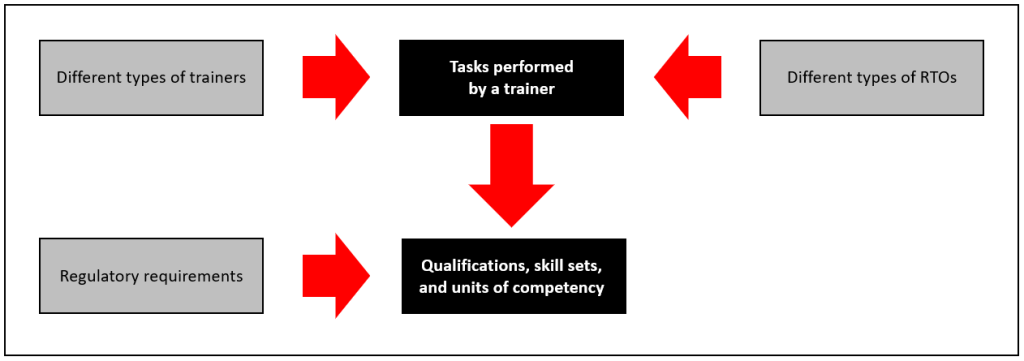
The following diagram shows the relationship between:

  • Tasks performed by a trainer
  • Regulatory requirements
  • Qualifications, skill sets, and units of competency.

I acknowledge that not all trainers perform the same range of tasks. Some work for RTOs and others do not, and maybe some RTOs expect their trainers to do things that are not required when working for other RTOs. Therefore, I have created five categories of trainer.

Category 1 trainer

  • Deliver training within a non-VET context
  • Deliver training under supervision within a VET context
  • Prohibited from conducting assessment within a VET context

Category 2 trainer

  • Deliver training under supervision within a VET context
  • Contribute to assessments within a VET context
  • Prohibited from conducting assessments within a VET context

Category 3 trainer

  • Deliver training under supervision within a VET context
  • Conduct assessments within a VET context

Category 4 trainer

  • Perform the role of trainer or TAFE teacher
  • Deliver training within a VET context
  • Conduct assessments within a VET context
  • Has the capability to design and develop training and assessment resources
  • Has the capability to participate in assessment validation and moderation activities

Category 5 trainer

  • Perform the role of senior trainer or senior TAFE teacher
  • Has all the capabilities to perform the role of a Category 4 trainer
  • Has the capability to design and develop training and assessment strategies
  • Has the capability to lead assessment validation and moderation activities
  • Has the capability to evaluate training and assessment services
  • Supervise or mentor trainers or TAFE teachers.

The following table identifies the typical tasks performed by each category of trainer.

Tasks performed will determine the category. For example:

What category would match the requirements of a school teacher who is delivering a VET in Schools program? Probably, most would be a Category 3 trainer. Some would be a Category 4 trainer.

What category would match the requirements for a volunteer trainer working for a community-based RTO? Depending on the RTO requirements and supervision arrangements, the volunteer could be Category 1, 2, 3, or 4 trainer.

How to select the appropriate qualification or skill set

The following diagram can be used to help select the appropriate qualification or skill set.

A person only needs the TAE Certificate IV if:

  • They are a trainer working in the VET system
  • They will be responsible for conducting assessments
  • They will not work under supervisions (as per the Standards for RTOs)
  • They a new to the VET system.

Is AQF Level 4 appropriate for VET trainers?

The qualification for new trainers has been at the AQF Level 4 for the past 23 years. Some people think that the current qualification for VET trainers is at the wrong AQF level. I think it is the right level because of the supervision responsibilities of a trainer: supervise learners, supervise their safety, supervise their progress, etc.

Should there be more than one TAE Certificate IV qualifications?

Some people suggest that more than one TAE Certificate IV qualification is needed. How many qualification are needed? What units of competency would be included in each qualification? What units of competency would be the same? And what units of competency would be different?

I am not convinced that we need multiple qualifications. If people think some tasks are not being covered, then maybe the solution is have a few elective units. Currently, the TAE40116 Certificate IV in Training and Assessment qualification only has provision for one elective unit. If there was two or three elective units, then RTOs could select electives to meet different needs. Having said that, most RTOs would probably continue to deliver a fixed program.

In conclusion

In this article, I have introduced the concept of five categories of trainers.

Each category is supported by a different credential. Category 1, 2, and 3 trainers are covered by skill sets. Category 4 trainers are covered by a Certificate IV, and Category 5 trainers are covered by a Diploma. A pathway from Category 1 trainer to Category 5 trainer is provided with minimal duplication. In other words, one credential leads onto the next.

References

[1] https://www.ncver.edu.au/research-and-statistics/publications/all-publications/understanding-the-australian-vocational-education-and-training-workforce accessed 20 April 2021

[2] Education IRC, Industry Skills Forecast and Proposed Schedule of Work, March 2019 assessed 20 April 2021

[3] https://www.legislation.gov.au/Details/F2019C00503 accessed 20 April 2021

What tasks do trainers do?

Background

Some people are working towards shifting Australia’s VET system from being a ‘training system’ to being an ‘education system’.

I have recently written articles exploring the difference between ‘training’ and ‘teaching’, and the difference between ‘trainers’ and ‘teachers’. I appreciate that there can be a crossover but the responses to my articles have overwhelmingly endorsed my view that there is a difference.

A difference between teaching and training can be expressed as:

  • Teaching is about imparting knowledge and providing information, while training is about developing capabilities.
  • Teaching is more theoretical and abstract, while training is more hands-on and practical.
  • Teaching is more academic and knowledge based, while training is more practical and skills based or job focused.

In the Australian context, vocational education and training (VET) is about helping others learn to perform work tasks and activities. The prime focus has been on helping people get a job or get a better job. And the prime role of a trainer or TAFE teacher has been to deliver ‘training’, not ‘teaching’. Training involves ‘hands-on learning’. It involves performing the task or activity, and practicing until it has been learnt. Some learning is quick and easy. And sometimes learning can be a long and slow process.

Training involves ‘hands-on learning’

Tasks performed by trainers

Australia’s VET system has been organised around qualifications. Each qualification relates to an occupation or a job function. However, in the past decade, skill sets have emerged to develop skills relating to part of a job. It is highly likely that the required qualification to be a trainer working in the VET sector will be reviewed during 2021/22. I look forward to the TAE40122 Certificate IV in Training and Assessment qualification, or whatever the qualification code and title will be. Maybe there will be more than one qualification targeting the work needs of different types of trainers.

An Australian VET qualification is meant to be a pathway to an occupational outcome. A review of the current TAE40116 Certificate IV in Training and Assessment qualification will require an analysis of the work tasks and activities performed by trainers and assessors.

The main target audience for the TAE40116 qualification are individuals delivering training and assessment services in the vocational education and training (VET) sector.

The following are some tasks performed by trainers and assessors working in the Australian VET sector:

  • Complete administrative tasks
  • Design and develop training and assessment resources
  • Plan, organise, and deliver training
  • Plan, organise, and conduct assessments
  • Participate in assessment validation and moderation activities
  • Evaluate training and assessment services
  • Plan, organise, and monitor learning in the workplace
  • Maintain and enhance vocational competencies.

Task titles can be vague

The task titles above may be a bit vague. Knowledge and skills required to perform a task can be hidden in the details. Therefore, the following begins to clarify some of the typical tasks performed by a trainer, without getting into too much details.

Complete administrative tasks may include the following sub-tasks:

  • Attend meetings
  • Reply to emails
  • Resolve issues.

Design and develop training and assessment resources may include the development of technology based resources and non-technology based resources. There may be an advantage to splitting this task into two sub-tasks:

  • Design and develop assessment resources
  • Design and develop training resources.

It has become a common task for trainers to address adult language, literacy, and numeracy skills. Many adult learners have LLN skills that are less than the required level for the specified outcome of the training program. This task would be performed in conjunction with the delivery of training and assessment of competency.

Plan, organise, and deliver training may include the following sub-tasks:

  • Plan and prepare for the delivery of training
  • Request facilities or equipment required for assessment
  • Conduct safety risk assessment
  • Gather training materials, including photocopying
  • Ensure safe learning environment
  • Deliver group-based training
  • Maintain records, including attendance and participation records
  • Provide support and training to an individual
  • Gather feedback or evaluation data about training services.

Plan, organise, and conduct assessments may include the following sub-tasks:

  • Request facilities or equipment required for assessment
  • Conduct safety risk assessment
  • Gather assessment materials, including photocopying
  • Ensure safe assessment environment
  • Assess competence
  • Maintain records, including assessment evidence and results
  • Gather feedback or evaluation data about training and assessment services.

RTOs may require their trainers and assessors to participate in assessment validation and moderation activities. This is an important task for ensuring quality and continuous improvement.

RTOs may require their trainers and assessors to analyse feedback and evaluate training and assessment services. This task may include identifying trends and recommending improvements.

Plan, organise, and monitor learning in the workplace is required when coordinating apprenticeships, traineeships, or work placements.

Trainers and assessors must maintain and enhance their vocational competencies, including their the continued development of their training and assessment skills (as specified by the Standards for RTOs).

Note: Additional tasks may be performed by an experienced trainer or senior TAFE teacher. For example, supervise and mentor new trainers.

Are all VET trainers the same?

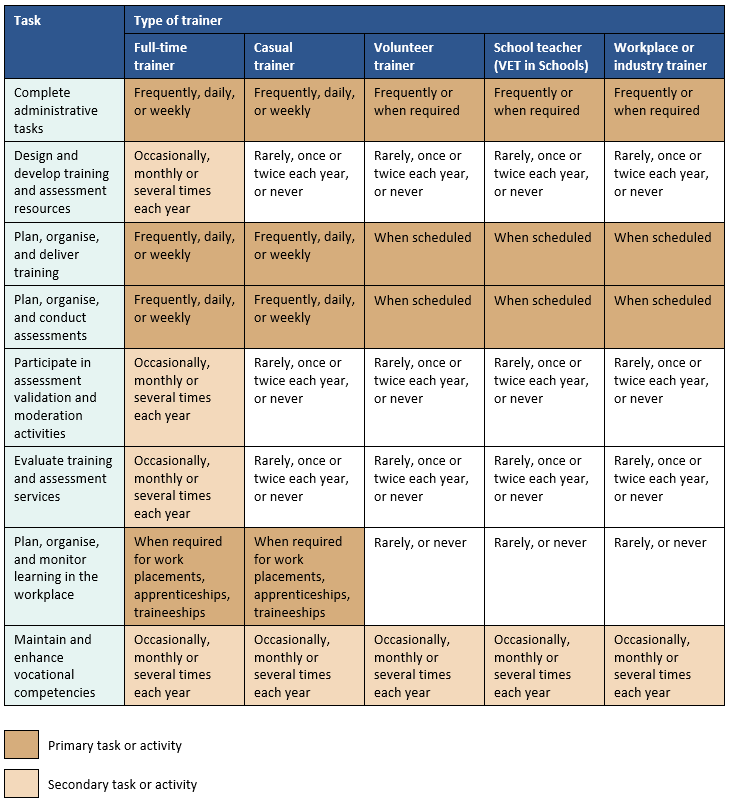
Not all trainers perform the same tasks or spend the same amount of time on performing a particular task or activity.

There can be a difference determined by the type of trainer:

  • Full-time trainer
  • Casual trainer
  • Volunteer trainer
  • School teacher who delivers a VET in Schools program
  • Workplace or industry trainer who’s main job is not being a trainer.

The following table gives an indicative amount of time on performing the various tasks.

In conclusion

I am seeking your help to further clarify or confirm the tasks performed by trainers. A clear understanding of work tasks and activities can have, and should have, an impact on the future qualification or qualifications required to be a trainer.

  • Are the tasks I have identified, the tasks performed by trainers?
  • Are my estimates for the indicative amount of time performing each task reasonable?
  • Are there other tasks performed by trainers that I haven’t listed? For example, should I include ‘design and develop a training program’ task?
  • Do you think there should be one TAE qualification for all trainers, or should there be different qualifications for different types of trainers?

If there are different qualifications we may have some trainers restricted in moving from one type of RTO to another type of RTO, or from one type of employment as a trainer to another. This may create a ‘gap training’ requirement, and a delay in taking up new job or career opportunities until the ‘qualified trainer’ gets further qualified. Is it desirable to set up two categories of ‘qualified trainers’? Would this confuse would-be trainers? How many would-be trainers will want to pay money to become a ‘qualified but restricted trainer’?

I welcome your comments.

I am especially keen to hear from RTO managers who employ trainers. What tasks do you want a ‘qualified trainer’ to perform when they work for your RTO?

What AQF level is appropriate for a qualification that targets a trainer working in the VET sector?

The Australian Qualification Framework (AQF) specifies the expected outcomes for qualifications in Australia. It consists of 10 qualification levels, and has a descriptor for each level.

This article is a case study in using the AQF to determine the appropriate level for a qualification. The aim is to answer the question:

What AQF level is appropriate for a qualification that targets a trainer working in the VET sector?

The target audience are people wanting to work as a trainer in the Australian VET sector. These people have not previously worked in VET. I would narrow the choice to AQF Levels 3, 4, or 5.

For the past 23 years, the qualification for this target audience has been pitched at the AQF Level 4. We are checking if this is still the appropriate level.

Here is the descriptor for the AQF Level 3.

Here is the descriptor for the AQF Level 4.

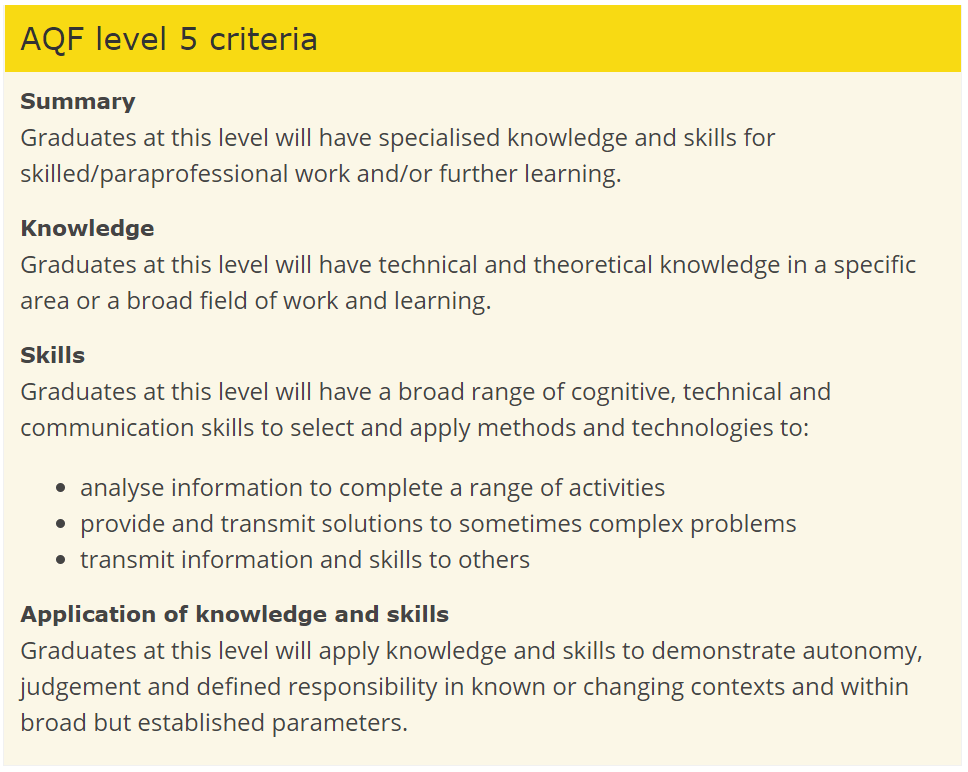
And here is the descriptor for the AQF Level 5.

The following table makes it a little easier to compare the various levels. Highlighted in ‘red’ are some key words that we can use to explore the difference between the AQF levels.

The current qualification required to be held by trainers working in VET is at the AQF Level 4. The following questions can be used to confirm or dispute the current AQF level.

  • Does a trainer need narrow or broad factual knowledge about training?
  • Does a trainer need skills to complete routine and non-routine activities?
  • Does a trainer need skills to solve a variety of predictable and sometimes unpredictable problems?
  • Does a trainer work in stable or changing environment?
  • Does a trainer have limited responsibilities?

The first four question above can help to differentiate between AQF Levels 3 and 4. The last question begins to differentiate between AQF Levels 4 and 5.

AQF Level 3 qualifications are used for skilled worker occupations. AQF Level 4 qualifications are often used for supervisory occupations. And AQF Level 5 qualifications are often used for management occupations. Does a trainer need to take the responsibility of a skilled worker, supervisor, or manager?

Trainers must supervise people when they deliver group-based training. There is a limit to their responsibilities. RTO management, not the trainer, are ultimately responsible for quality and the delivery of training and assessment services.

What are the consequences of selecting an AQF level that is lower than is required?

If the AQF level for a qualification is too low, then ‘qualified trainers’ will not have the knowledge and skills to perform their job. Delivery of poor quality training and assessment services would follow.

I think the AQF Level 3 is too low for the responsibilities of being a trainer. And the AQF Level 4 seems to be the appropriate qualification level. What do you think?

What are the consequences of selecting an AQF level that is higher than is required?

If the AQF level for a qualification is greater than what is need to perform the occupation, then this will severely limit who can get qualified. The VET system would have insufficient trainers.

I think the AQF Level 7 is far too high for the job role of trainer. And the AQF Level 5 is too high for a new trainer. Currently, there are two TAE Diplomas. One Diploma is used as the pathway to become a senior trainer. And the other Diploma is used as the pathway to become an instructional designer or resource developer.

In conclusion

Some people say AQF Level 4 is too low. Of these people, some say the AQF Level 5 is the correct level. And others say AQF Level 7. To make things really confusing, there are some people who say the AQF Level 3 is the correct level. Not everyone can be right.

But maybe the AQF level of the qualification is not the real issue. Some people find studying to attain their TAE40116 Certificate IV in Training and Assessment qualification as being too difficult, or too time consuming. This is further complicated because some people may not have the capability to attain the required competencies. Sometimes, the person may have the capability but the training strategy delivered by the RTO does not help the person to learn, or training duration is insufficient.

And some people disagree with certain units of competency being core units, such as TAEASS502 Design and develop assessment tools. ASQA decided that the TAEASS502 unit had to be a core unit. The aim was to improve the quality of assessment. Has the aim been achieved or is there progress towards achieving the aim? I assume that there will soon be a review of the TAE40116 qualification. And this would include a review of the TAE units of competency.

I welcome your comments.