Is training the same thing as teaching?

For several years, some people have been trying to shift vocational education and training from being a ‘training system’ to a ‘tertiary education system’. This requires the removal of the words ‘training’ and ‘trainer’ from the lexicon.

Some people have started to drop the word ‘training’ and starting to use ‘vocational education’ instead of ‘ vocational education and training’. I believe that removing the words ‘training’ and ‘trainer’ undermines the value of VET. It is trying to make VET something that it is not. It seems to be a shift towards academic studies rather than training and developing skills for work.

The recently released Australian Skills Classification has used the occupation title of ‘Vocational Education Teacher’ instead of trainer and assessor. In a previous article, I have expressed my disappointment with the use of this occupation title. Also, the Australian Skills Classification does a poor job at describing the occupation and describing the tasks performed by trainers and assessors working in the Australian VET system.

The Australian Skills Classification has used the icon of a mortarboard (also known as a graduate cap or academic cap) to represent the occupation of trainers and assessors. For me, this icon is symbolic of university. It isn’t the best icon for representing trainers and assessors working in the VET sector.

Having earned a bachelors degree, masters degree, or a PhD is no guarantee that a person can be an effective trainer, especially an effective trainer in the Australian VET system. People need vocational skills to be a trainer, not academic achievement.

Training skills and methods can be fundamentally different to the skills and methods needed to teach. Teaching school children and teaching university students is not the same as training job seekers and workers. And being a current teacher or university lecturer does not automatically mean that the person can deliver competency-based training and assessment services without receiving the appropriate training.

Australia needs skilled and experienced butchers, bakers, dress makers, florists, hairdressers, carpenters, brick layers, roof tilers, plumbers, electricians, air-conditioning mechanics, civil construction workers, welders, machine operators, warehouse workers, office admin. workers, farm worker, gardeners, truck drivers, bus drivers, heavy equipment operators, vehicle mechanics, pet groomers, veterinary assistants, dental assistants, laboratory technicians, operation theatre technicians, chefs, cooks, kitchen assistants, aged care workers, disability support workers, etc. to be trainers. We need people with vocational skills and current work experience, and we need these people to proudly identify as being a ‘trainer’.

The mortarboard icon does not symbolise a trainer in the Australian VET workforce.

Teaching is not the same as training. And a teacher is not the same as a trainer.

A teacher will have a four year Bachelor of Education or a minimum of a three year degree, followed by a postgraduate course such as, Graduate Diploma or Master of Teaching for a particular age group, for example, early childhood, primary or secondary. Each state or territory may have slight variations to the qualification requirements to be a teacher. Basically, teachers will have attained a qualification at the AQF Level 7 or above.

Will a Vocational Education Teacher need to meet the same qualification requirements?

  • If no, we are setting up two-tiers of teachers: ‘real teachers’ and ‘un-real teachers’, ‘first-class teachers’ and ‘second-class teachers’, or ‘higher educated teachers’ and ‘lower educated teachers’.
  • If yes, we are stopping skilled and experienced workers from helping others to learn the skills to perform work , a trade, an occupation, or a para-profession.

A person can be a trainer without being a teacher. And the qualification requirements for a trainer doesn’t need to be at the same level as a teacher.

What level of qualification does a trainer need?

The first qualification designed for vocational trainers was introduced in 1998. It was the BSZ40198 Certificate IV in Assessment and Workplace Training. After 23 years, some people are saying that this qualification, and the subsequent qualifications that have replaced it, have been pitched at the wrong level:

  • TAA40104 Certificate IV in Training and Assessment
  • TAE40110 Certificate IV in Training and Assessment
  • TAE40116 Certificate IV in Training and Assessment.

What AQF Level is the correct level of trainers working in the VET sector? Some people say AQF Level 4 is too low. Of these people, some say the AQF Level 5 is the correct level. And others say AQF Level 7. To make things really confusing, there are some people who say the AQF Level 3 is the correct level. Not everyone can be right. We can go to the AQF document and use it to determine the correct level. No need for discussion. No need for opinions.

Go to the Australian Qualification Framework (AQF):

  • Review the criteria for the various AQF Levels
  • What descriptor for knowledge and skills best fits the role of a vocational trainer?
  • Does the description of autonomy, judgement, and responsibility match the role of a vocational trainer?

Please tell me what you think the correct AQF Level is.

What is the Australian Skills Classification? And how does it describe the tasks performed by a trainer working in the VET sector?

What is the Australian Skills Classification?

The Australian Skills Classification was announced and publicly released by the National Skills Commission on the 18th of March 2021. It includes skills profiles for 600 occupations. Each skill profile has three elements:

  • specialist tasks
  • core competencies
  • technology tools.

The announcement says that each skill profile clearly outlines what skills are required for a particular occupation. [1]

The Australian Skills Classification has 25 cluster families. [2]

How does the Australian Skills Classification describe the tasks performed by a trainer working in the VET sector?

The cluster family that covers a trainer working in the VET sector is ‘Teaching and education’. The following shows the details for the ‘Teaching and education’ cluster family. [3]

‘Teach tertiary and vocational courses’ seems to be the obvious place to look within the cluster family for the occupation of trainer in the VET sector. However, is being a lecturer or tutor at a university the same thing as being a trainer delivering a VET course? I think there is a difference. Many university lecturers and tutors are highly qualified academics. How do they feel being lumped together with their VET counterparts? And the qualification requirements are, and should, be different for a person who delivers VET training courses.

‘Teach tertiary and vocational courses’ gives a list of related occupations or roles. I am surprised that trainers working in the VET sector are classified with economists, geologists, biochemists, meteorologists, and historian. Are economists, geologists, biochemists, meteorologists, and historian happy being grouped with trainers? Has the National Skills Commission got their classifications right? I assume that many people with big brains have been paid big bucks to develop the Australian Skills Classifications. Could they have got it wrong?

Is teaching the same thing as training?

The National Skills Commission has created the occupation title of ‘Vocational Education Teacher’. The following is the description that is given for this occupation. [4]

I think there is a difference between teaching and training. And I think there is a difference between a teacher and a trainer. Teachers are degree qualified (AQF Level 7 or above). Trainers are Certificate IV qualified (AQF Level 4). Vocational training can, and should be, delivered by a person with the vocational competence and relevant work experience. For example:

  • Plumbers should be trained by a person who is a plumber
  • Hairdressers should be trained by a person who is a hairdresser
  • Prison guards should be trained by a person who is a prison guard
  • Sheep shearers should be trained by a person who can shear sheep
  • Cleaners should be trained by a person who has worked as a cleaner
  • Café workers should be trained by a person who has café experience
  • Aged care worker should be trained by an experienced aged care worker
  • Etc.

People training others to be a plumber, hairdresser, prison guard, sheep shearer, cleaner, café worker, or aged care worker do not need a degree. They do not need a teaching degree. They do need the vocational skills that they are helping others learn. They do need relevant and current workplace or industry experience relating to those vocational skills.

Will trainers of the future be called teachers? And will they need to be degree qualified? Will they need a teaching degree? Will part-time trainers, volunteer trainers, community trainers, workplace trainers, and industry trainers need a teaching degree? Or will there be first-rate teachers (those with a teaching degree and work in schools) and second-rate teachers (those without a teaching degree and work in VET)? When did a trainer and assessor become a teacher? Are teachers outraged that their profession is being undermined?

Also, the National Skills Commission has described the ‘Vocational Education Teacher’ occupation. The description does not cover all trainers and assessors in the current VET workforce. What about the trainers and assessors who do not work for TAFEs, polytechnics, and other training institutes? Many trainers and assessors work for small private RTOs, community-based RTOs, and enterprise RTOs. And there are many people who work in schools and organisations that have an auspice arrangement with an RTO to deliver training as an expert or experienced worker.

Did the National Skills Commission consult with VET before giving the occupation a new title and limiting the role description to institutional training? If there did consult, who did they consult? I can only assume they did consult with VET people. It seems that the consultation process got things wrong. Did the National Skills Commission consult with the wrong people? Or did the National Skills Commission ignore the information provided by VET people?

Occupation profile

The following is the occupation profile for Vocational Education Teachers. [5]

There are 21 tasks identified. The percentage (%) of time likely to be spent on the task by a person working in this occupation is given by ‘clicking’ on each box.

The following table lists the 21 tasks, the % of time on task given by the Australian Skills Classification, the % of time on task from my own experience as a trainer, and some additional comments.

I think the 21 tasks are unreal:

  • Much of the terminology used are not common VET terms
  • Some of the percentages of time spent performing tasks seem to be wrong
  • Some sub-tasks have been given the same status as tasks
  • Some uncommon tasks should not be on the list, for example, ‘Supervise laboratory work’
  • Tasks with 0% of time on task have been listed (this means that task not performed by a trainer have been listed as part of their occupation profile).

Here is my revised list consisting of 5 tasks. I have used the same terminology or task titles as used in the Australian Skills Classification.

And here is my revised occupation profile for a trainer and assessor working in the Australian VET sector, referred to as a Vocational Education Teacher by the Australian Skills Classification. In this example I have used terminology more commonly used in VET.

Limitations of the Australian Skills Classification

The Australian Skills Classification is said to offer a deeper understanding of the labour market. This may be true, but it is too shallow to be used for planning, designing, and delivering vocational training and skills development. The Australian Skills Classification identifies occupations and lists tasks performed by an occupation as represented by the following diagram.

The developers of the Australian Skills Classification seem to be fixated on labour market analysis and the transferability of skills across occupations. Some people may think the Australian Skills Classification has applications beyond its capability. It is limited. Should the Australian Skills Classification be renamed as the Australian Labour Market Classification to avoid misunderstand?

The following diagram represents the depth of the current VET system.

This is the depth of specification required for:

  • analysis of training needs
  • design of training and assessment programs
  • delivery of vocational training and skills development
  • assessment to determine if the specified outcomes have been achieved.

I hope our politicians and bureaucrats responsible for VET are smart enough to know they should not tamper with the current VET frameworks in an attempt to find alignment with the Australian Skills Classification. Alignment would be a disaster for VET.

In conclusion

The Australian Skills Classification can be thought of as the Australian Labour Market Classification. It has limitations and should not be used to change the current VET frameworks.

The Australian Skills Classification has used the Vocational Education Teacher as the occupation title for a trainer working in the VET sector. It seems to be a deliberate attempt to remove the words ‘training’ and ‘trainer’. A teacher is not the same as a trainer. And teaching is not the same as training.

It is unfortunate that the same acronym for vocational education and training (VET) can be used for the vocational education teacher (VET) occupation. Some people may get confused between VET (the system) and VET (the individual).

There are 21 tasks listed for the Vocational Education Teacher occupation. The tasks are poorly titled or use terminology that is foreign to VET. And there are unnecessary tasks listed. The percentage of time on tasks are not realistic. Are other occupations poorly described by the Australian Skills Classification?

Are we entering a new era? An era when there will be no ‘training’, only ‘vocational education’. And there will be no ‘trainers’, only ‘teachers’. I am proud to say that I am a ‘trainer’. I lament the demise of ‘vocational training’. Why have people pursued an agenda to remove the words ‘training’ and ‘trainer’ from our lexicon? How will the removal of these words change things? (Will industry start calling their trainers, teachers? I don’t think so. Why create a divide between VET and industry?)

Also, I have looked at the ‘core competencies’ found in the Australian Skills Classification . I’ve decided to reserve my comments because this article has gone on for long enough. I may decide to write an article dedicated to the ‘core competencies’.

The Australian Skills Classification may be useful for labour market analysis (assuming that something is wrong with the current way of doing it). It is not useful for VET (the system).

In closing, I should say something nice. The Australian Skills Classification has used a spectrum of pretty colours and an array of icons.

References

[1] https://www.dese.gov.au/newsroom/articles/australian-skills-classification-common-language-skills accessed 3 April 2021

[2] https://www.nationalskillscommission.gov.au/our-work/australian-skills-classification#clusters accessed 3 April 2021

[3] https://www.nationalskillscommission.gov.au/our-work/australian-skills-classification#clusters~2120 accessed 3 April 2021

[4] https://www.nationalskillscommission.gov.au/our-work/australian-skills-classification#occupations accessed 3 April 2021

[5] https://www.nationalskillscommission.gov.au/our-work/australian-skills-classification#occupations~2422 accessed 3 April 2021

Learning styles and the Australian VET system

This article was originally published in 2021.

Learning style theories have been criticised by many academics, researchers, and educationalists. The manta from these people sounds like:

“Numerous studies have debunked the concept of learning styles.”

The TAEDEL401 Plan, organise and deliver group-based learning and TAEDEL402 Plan, organise and facilitate learning in the workplace units of competency specify that a competent trainer or TAFE teacher must have some knowledge about learning styles. Therefore, learning styles must be covered during the TAE40116 Certificate IV in Training and Assessment qualification.

In this article, I want to explore:

  • Are learning styles a myth?
  • Should learners be treated as an individual?
  • Do people learn in different ways?

Are learning styles a myth?

Critics say there is no consistent evidence that identifying an individual student’s learning style and teaching for specific learning styles produces better student outcomes. [1] Most of this rhetoric refers to school systems. And most of the criticism seems to stem from an argument against ‘streaming school children’ based on their ‘learning style’. For example, offer ‘hands-on’ school subjects for ‘kinaesthetic learners’; compared with offering them ‘academic’ school subjects.

Learning styles may be a pseudoscience. Learning styles may be a myth. However, learning styles as a concept may be useful for trainers and TAFE teachers. I am not an academic. I am a person who likes good ideas that work, and I think the concept of learning styles can be useful. I shall explain myself soon.

Should learners be treated as an individual?

I believe that in the Australian VET sector there is a wide-spread agreement that learners should be treated as individuals. But it does not matter if people were to disagree with this because the Standards for RTOs demand that learners are to be treated as individuals.

Learners must be treated as individuals in the Australian VET system.

Do people learn in different ways?

Individuals are different. And individuals may prefer different approaches or methods to learning. Often the different preferred learning methods are referred to as learning styles.

Learning style models

There are many different learning styles models. I like to cover two models during the delivery of the TAE40116 Certificate IV in Training and Assessment qualification:

  • VAK or VARK models
  • Honey and Mumford’s model

VAK or VARK models

The five senses of sight, hearing, smell, taste, and touch collect information about our environment, and this information is interpreted by the brain. The VAK or VARK models is based on learning through our senses and the way that the brain processes information.

Walter Burke Barbe and colleagues proposed the VAK model:

  • Visual learning
  • Auditory learning
  • Kinaesthetic learning.

And Neil Fleming’s VARK model adds the possibility that some people may prefer to learn by reading/writing.

The VAK or VARK models promote the idea that people can have a preferred learning style and some people prefer to use a combination of learning styles. According to research conducted by Walter Burke Barbe and colleagues, the most common learning styles are visual or combination. [2]

It does not matter to me if the concept of learning styles have been debunked. I still believe that the following methods or learning styles are ways that people learn:

  • Learn by reading
  • Learn by writing
  • Learn by listening
  • Learn by watching
  • Learn by doing.

And I believe that trainers and TAFE teachers must address different learning styles by designing and implementing a range of strategies:

  • Reading textbooks and writing notes
  • Using visual aids, diagrams and charts
  • Explaining a topic aloud for auditory learners
  • Practical activities for the kinaesthetic learners.

The vocational education and training (VET) system is focused on helping people learn to perform work tasks and activities. All learners, regardless of their preferred learning styles, will need to perform tasks described by units of competency. They will need to learn by doing.

The following flow chart shows a typical VET training pathway and the corresponding learning style or method.

Note: In the above training pathway, I would suggest that using appropriate visual aids can greatly assist when we explain and clarify the task. For example, use task breakdowns, flow charts, cycle diagrams, photos, etc.

Honey and Mumford’s model

Peter Honey and Alan Mumford adapted David Kolb’s experiential learning model. Their model is based on a learning cycle: [3]

  • Doing something, having an experience
  • Reflecting on the experience
  • Concluding from the experience, developing a theory
  • Planning the next steps, to apply or test the theory.

Honey and Mumford gave names (also called learning styles) to the people who prefer to enter the cycle at different stages: [4]

  • Activist – prefers doing something
  • Reflector – prefers reflecting on the experience
  • Theorist – prefers developing a theory
  • Pragmatist – prefers planning to test the theory.

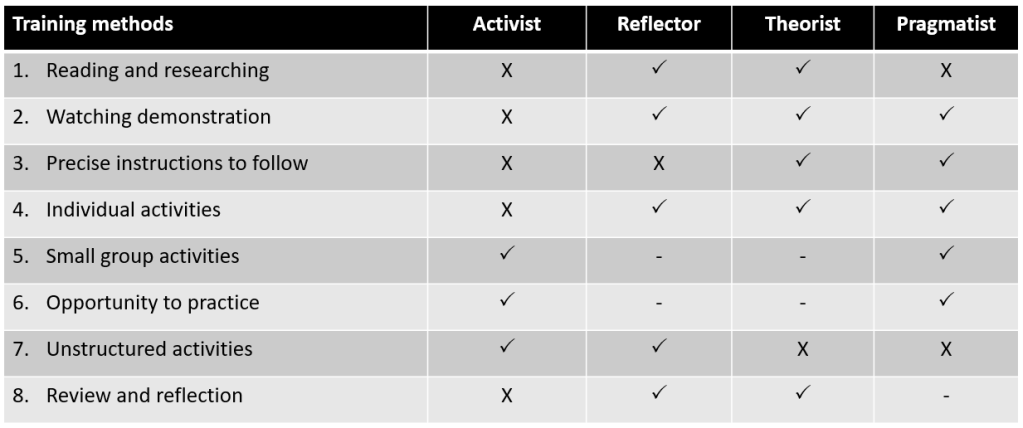
During my delivery of the TAE40116 Certificate IV in Training and Assessment qualification, I use the Honey and Mumford’s Learning Styles Questionnaire as a ‘learn by doing’ activity. My TAE Students learn that not everyone likes to learn the same way, and a group will consist of people with different preferred learning styles. At the end of this activity, I provide the following information about various training methods that may be liked or disliked by people with different learning styles.

As previously stated, I believe that trainers and TAFE teachers must cater for different learning styles by designing and implementing a range of strategies. I encourage my TAE Students to incorporate the above eight training methods when they deliver their training sessions.

Also, knowing that some people do not like to learn certain ways helps us to respond to situations when learners complain about having to do something during training. For example, most VET practitioners are likely to think that reflection is an important part of the learning process. But an ‘activist’ may not want to spend their time reviewing and reflecting.

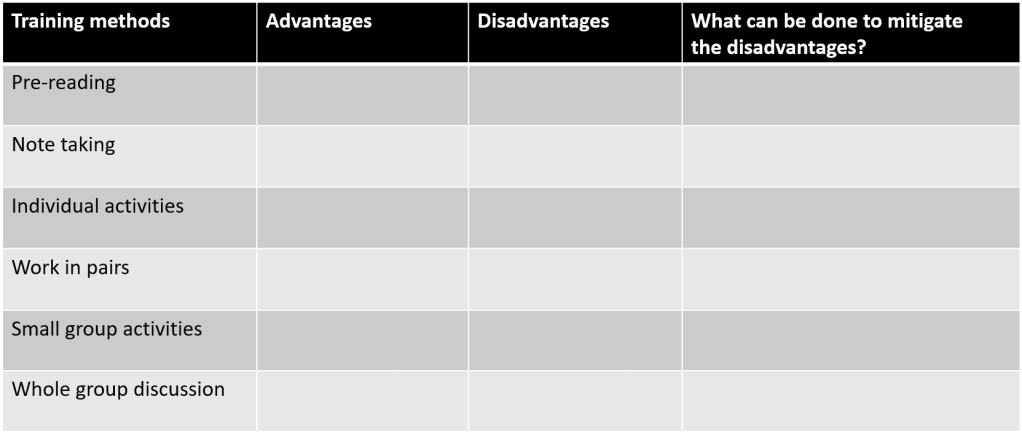
All training methods will have some advantages and disadvantages. Therefore, another activity I facilitate during the TAE40116 Certificate IV in Training and Assessment qualification is based on the following table.

In conclusion

Trainers and TAFE teachers must expect to encounter a diversity of learners with different characteristics and needs. Different training methods will be needed to cater for a range of preferred learning styles or methods.

I believe that preferred learning styles can change over time. An individual’s may favour a learning method at the start of a training program that is different to what they would prefer at the end of a training program. And from my own experience, preferred learning styles or methods can change with age.

My most important insight is:

“Not every learner will like to learn the way we do.”

We need to design and implement a range of training methods to address different learning styles; not just use the training methods that we prefer.

Wikipedia’s Learning styles has been used as a reference for some content in this article marked as [1], [2], [3], and [4].

It does not matter to me if learning styles are based on science, pseudoscience, or folklore. I do find the concept of learning styles useful to introduce the need for VET practitioners to use a variety of training methods. However, I welcome your feedback and comments.

  • Do you like the concept of learning styles? Can you explain why?
  • Do you dislike the concept of learning styles? Can you explain why?
  • Do you have any experience with learners who have exhibited particular learning styles?

Australia’s VET system

Australia’s vocational education and training (VET) system is complex and forever changing. People studying for their TAE40122 Certificate IV in Training and Assessment qualification may find useful information on this website. Tap or click on the following ABC logo to find out more.

ABC logo

Contact now!

logo otws

Training trainers since 1986

How to determine the requirements for competency-based assessment

Quality assessment begins with a proper understanding of the assessment requirements. In theory, all qualified trainers and TAFE teachers should be able to analyse and interpret assessment requirements because it is covered during the TAE40116 Certificate IV in Training and Assessment qualification.

Element 5 from the TAEDES402 Use training packages and accredited courses to meet client needs unit of competency requires assessment information to be analysed and interpreted. The following are questions that need to be answered when we ‘unpack’ a competency standard to determine the requirements for assessment:

  • What are the tasks to be performed?
  • Is the location of assessment specified?
  • Is access to specified resources specified?
  • What knowledge must be demonstrated?
  • What is the volume or frequency of evidence required?

What are the tasks to be performed?

Generally, the assessment tasks used to gather performance evidence should be realistic tasks or activities that would be performed in a typical workplace. Each unit of competency provides a description of performance criteria that must be demonstrated before a candidate can be deemed competent. And there must be evidence for every performance criteria.

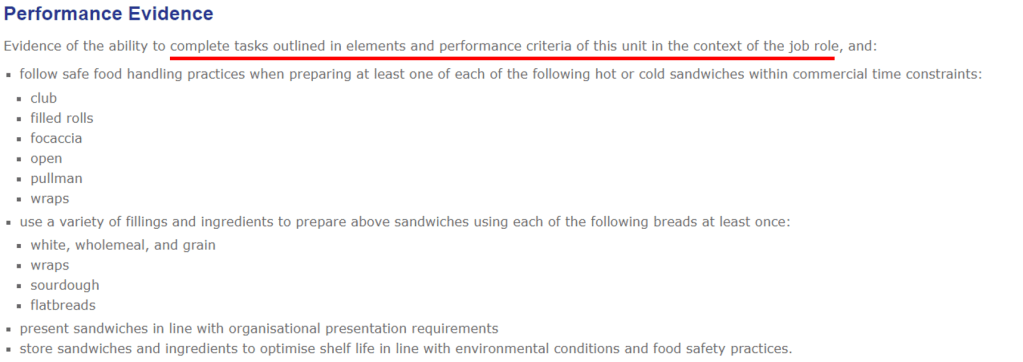
Performance evidence

The following is the Performance Evidence for the SITHCCC003 Prepare and present sandwiches unit of competency. This is an example showing that all the elements and performance criteria must be assessed.

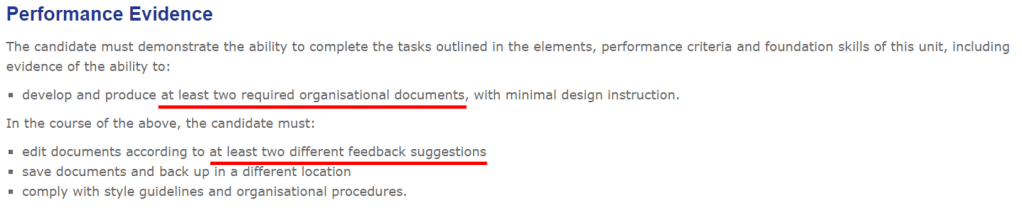
Some Training Packages, such as the BSB Business Services, FNS Financial Services, and ICT Information and Communications Technology, have specified that the foundation skills must also be demonstrated before a candidate can be deemed competent. The following is the Performance Evidence for the ICTICT216 Design and create basic organisational documents unit of competency. This is an example showing that all the elements, performance criteria and foundations skills must be assessed.

If you would like more information about integrating foundation skills and performance criteria, please see my previous article titled, How to incorporate foundation skills in vocational education and training.

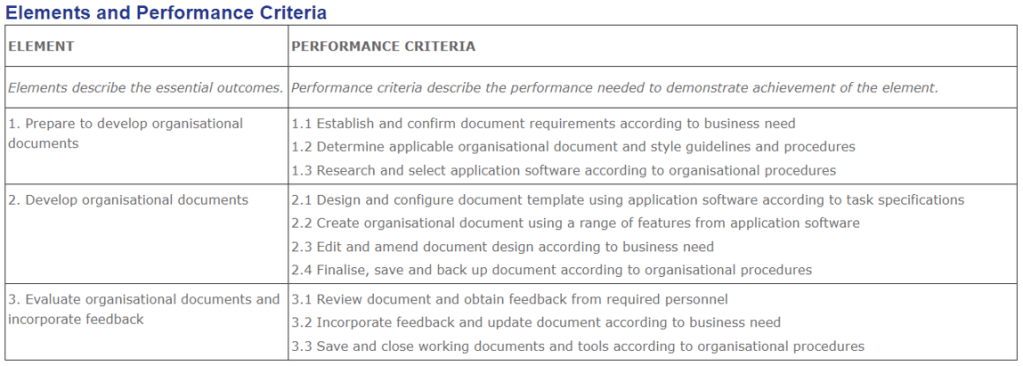
Elements and performance criteria

Some units of competency may describe one, and only one, work task or activity. The following are the elements and performance criteria for the ICTICT216 Design and create basic organisational documents unit of competency. This is an example showing that all elements flow together to describe one task:

  • Prepare to develop a document
  • Develop the document
  • Evaluate and finalise the document.

One assessment task could be used to gather the performance evidence for all the elements and performance criteria.

Some units of competency may describe more than one work task or activity. The following are the elements and performance criteria for the BSBWHS211 Contribute to the health and safety of self and others unit of competency.

In the above example, the range of tasks include:

  • Carry out pre-start checks
  • Identify, respond and report incidents (this implies that more than one or different incidents need to be covered)
  • Identify, record and report hazards (this may to part of a pre-start check or a workplace inspection)
  • Participate at a workplace safety meeting.

Therefore, three or four assessment tasks would be needed to gather the performance evidence for the different work tasks or activities covered by the BSBWHS211 unit.

Is the location of assessment specified?

Sometimes the assessment must be conducted in the workplace. For example, the TLIC3033 Drive an electric tram to operational requirements unit of competency states that the practical assessment must occur in the workplace.

The next example is for the CHCECE005 Provide care for babies and toddlers unit of competency. This unit specified that the assessment must be conducted in a workplace, and that workplace must be a registered childcare centre.

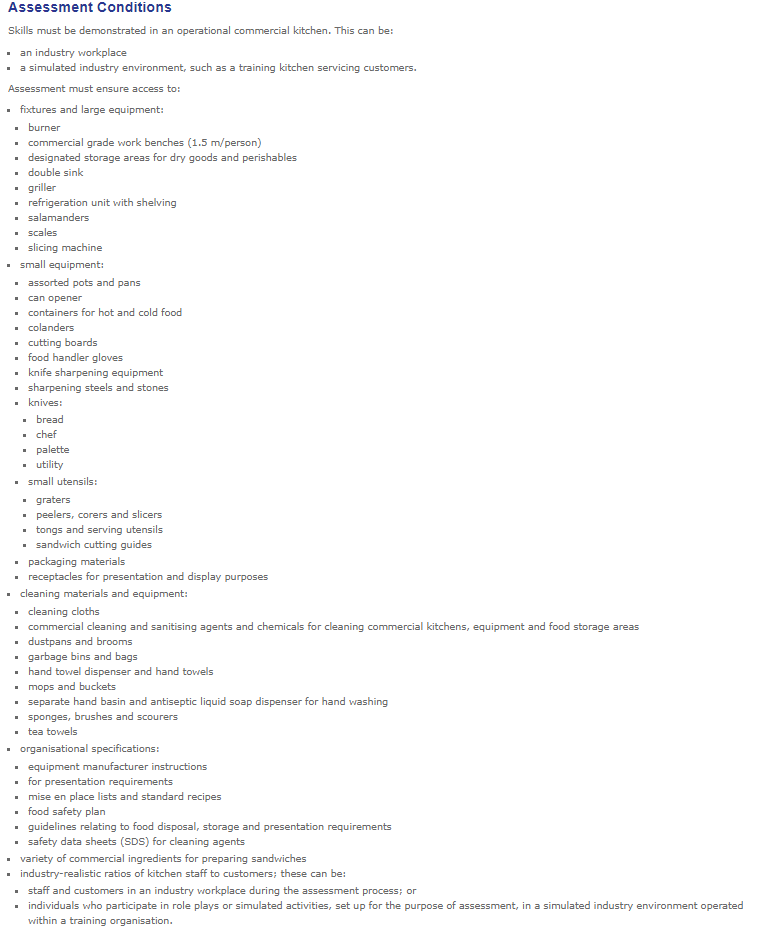
The SITHCCC003 Prepare and present sandwiches unit of competency requires the assessment to be conducted in an operational commercial kitchen. This location can be a workplace or a ‘fully-equipped training kitchen’. During the 1990s, many TAFEs established ‘training kitchens’ to serve ‘training restaurants’. These facilities operate exactly like any other operational commercial kitchen with paying customers.

It is common to find units that permit assessment to be conducted in a workplace or a simulated workplace. The following example is for the ICTICT216 Design and create basic organisational documents unit of competency. It clearly states that a simulated environment must replicate the conditions that would be found in a real workplace.

The above four examples illustrates the variation in assessment locations that have been specified by industry.

Is access to specified resources specified?

It is common for units to specify facilities, equipment, or materials that a candidate must have access to.Sometimes the list of resources required are short. For example, here are the two requirements (two bullet points) specified for the ICTICT216 Design and create basic organisational documents unit of competency.

Sometimes the list of resources required are extensive. For example, here are the requirements specified for the SITHCCC003 Prepare and present sandwiches unit of competency. There are many bullet points with most have many sub-bullet points (and some sub-bullet points have sub-bullet points).

An RTO needs a checklist to ensure all the specified resources are available at the time of assessment. The checklist would need to be signed and dated by the assessor for quality assurance purposes, with the date being the same date as the assessment.

What knowledge must be demonstrated?

Identifying the required knowledge evidence is reasonably straight forward. Some units of competency list a small number of knowledge evidence items. For example, the following short list (three bullet points) is for the ICTICT216 Design and create basic organisational documents unit of competency.

Some units of competency have a long list of knowledge evidence items. For example, the following is the list (many bullet points and sub-bullet points) for the SITHCCC003 Prepare and present sandwiches unit of competency.

What is the volume or frequency of evidence required?

Many units of competency specify a volume or frequency of evidence require. For example, the TAEDES402 Use training packages and accredited courses to meet client needs unit of competency requires a candidate to analyse training specifications at least twice.

Here is another example for the ICTICT216 Design and create basic organisational documents unit of competency. It requires a candidate to produce at least two documents. Also, it requires the candidate to edit documents according to at least two different feedback suggestions.

The performance evidence must be read carefully to understand the amount of evidence required or the number of times the work task needed to be performed by the candidate. In the next example for the SITHCCC003 Prepare and present sandwiches unit of competency specifies six types of sandwiches that must be prepared, and a specified variety of breads and fillings must be used to make those sandwiches. Also, the sandwiches must be prepared within commercial time constraints.

Sometimes the volume or frequency of performance evidence required can become complex.

Contextualisation

Units of competency and their assessment requirements are usually written in a vague or ambiguous way. This allows us to contextualise them to fit different workplaces, different work tasks and activities, different facilities, equipment and materials, etc.

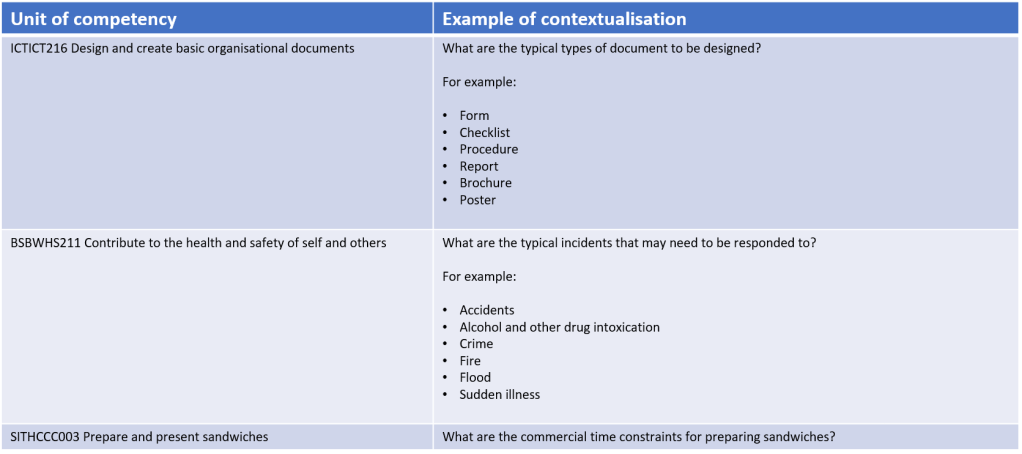
The following are some examples of contextualisation.

If you would like more information about contextualisation, please see my previous article titled, Importance of interpretation and contextualisation in the Australian VET system.

Usually, contextualisation will be needed to clearly determine the assessment requirements for different situations and circumstances. This is one of the great features of Australia’s VET system.

In conclusion

How do we determine the requirements for competency-based assessment? We must read the entire unit of competency and its associated assessment requirements. Industry will have specified:

  • Knowledge evidence required
  • Performance evidence required
  • Assessment conditions.

Evidence for all elements and performance criteria must be gathered. And some Training Packages are mandating that the foundation skills must also be assessed.

Other assessment requirements need to be identified, such as:

  • Volume or frequency of evidence
  • Location and resource required.

Quality assessment begins with a proper understanding of the assessment requirements.

Australia’s VET system

Australia’s vocational education and training (VET) system is complex and forever changing. People studying for their TAE40122 Certificate IV in Training and Assessment qualification may find useful information on this website. Tap or click on the following ABC logo to find out more.

ABC logo

Contact now!

logo otws

Training trainers since 1986

Why does it cost $133,333 to train a sheep shearing teacher?

This morning I read a media release from the Victorian Minister for Training and Skills. It proudly announced that the Victorian Government spent $1.2m to train nine expert sheep shearers to be trainers. That works out at costing $133,333 to train each trainer.

The $1.2m was used to deliver the Certificate IV in Training and Assessment qualification. And some of the money was used for the development of an App with some videos. Did someone make a profit? Was this value for money? Should tax-payers be outraged?

I would have delivered the Certificate IV in Training and Assessment qualification and made some videos for half that price!!!

Is someone pulling the wool over our eyes?

The following is the media release.