

I conducted a LinkedIn poll during May 2025 asking, “Does your RTO expect trainers to participate in assessment validation?”
Here are the results:

The result of this poll means that the TAE40122 Certificate IV in Training and Assessment qualification should include a core unit about participating in assessment validation – and it does. The relevant unit of competency covering assessment validation is TAEASS413 Participate in assessment validation. This unit requires a person to not only participate in assessment validation but also participate in pre-assessment validation.
‘Assessment validation’ is different from ‘pre-assessment validation’. This raises another question, “Do RTOs expect trainers to participate in pre-assessment validation?” Let’s explore this topic a little before answering the question.
What is pre-assessment validation?
Over the past few years, the term ‘pre-assessment validation’ has been introduced to describe the review of an assessment tool prior to implementation. This review activity has been around for much longer than the term ‘pre-assessment validation’.
In 2015, ASAQ published a guide to the development of assessment tools. This guide was structured around a 3-step process:
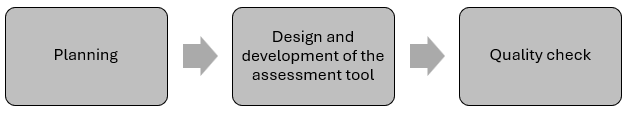
ASQA’s guidelines states that the quality checking should occur before implementing the assessment tool. This quality check has recently become known as ‘pre-assessment validation’.
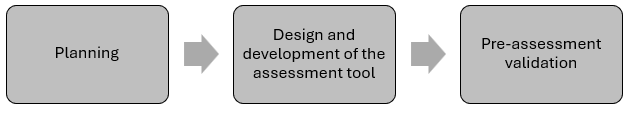
The elements of the TAEASS512 Design and develop assessment tools unit of competency is consistent with the 3-step process published by ASQA, and it includes ‘undertake a systematic review of the assessment tool [before implementing it]’ as a performance criteria.

Currently, the Australian VET system is using three different ways to describe the same activity that should be conducted before an assessment tool is implemented:

‘Pre-assessment validation’ is the review of an assessment tool prior to implementation. This includes checking for:
- Relevance to the current workplace and industry requirements
- Compliance with the principles of assessment
- Compliance with the rules of evidence
- Usability of the assessment tool.
What’s the difference between pre-assessment validation and assessment validation?
‘Pre-assessment validation’ is not the same thing as ‘assessment validation’. In an attempt to avoid confusion, it is useful to refer to ‘assessment validation’ as ‘post-assessment validation’. Using the prefix ‘pre’ or ‘post’ helps to identify these two different activities as being different.
The TAEASS413 Participate in assessment validation unit of competency describes the following:
- Pre-assessment validation is the validation of an assessment tool before it is first used.
- Post-assessment validation is the validation of the assessment tool, practices and judgements after it has been used to conduct assessments.
Most RTOs expect their trainers to participate in post-assessment validation (93% of poll respondents). However, it is highly unlikely that trainers will participate in pre-assessment validation. Pre-assessment validation is an activity conducted when developing an assessment tool or purchasing an assessment tool.
Developing an assessment tool
The person developing an assessment tool should conduct a pre-assessment validation. The committee with the responsibility for developing the TAE40122 qualification said that most trainers would not be involved in developing assessment tools. This was the reason for removing the ‘design and develop assessment tools’ unit of competency as a core unit for the Certificate IV in Training and Assessment.
Very few trainers will be the developers of assessment tools or have the responsibility for the RTO’s compliance. Therefore, it is highly unlikely that trainers will participate in pre-assessment validation when assessment tools are developed by the RTO.
Purchasing an assessment tool
An RTO may purchase an assessment tool rather than develop it. The person with the authority to purchase assessment tools will usually check the assessment tool before it is purchased. (If they don’t, they should!)
Very few trainers will have the authority to purchase assessment tools or have the responsibility for the RTO’s compliance. Therefore, it is highly unlikely that trainers will participate in pre-assessment validation when assessment tools are being purchased by the RTO.
In conclusion
I wish we weren’t using the term ‘pre-assessment validation’ because it gets confused with ‘assessment validation’. To avoid some of the confusion, it is best to refer ‘assessment validation’ as ‘post-assessment validation’.
In this article, I have shown that trainers are highly likely to participate in ‘post-assessment validation’, but highly unlikely to participate in ‘pre-assessment validation’.
I think the committee responsible for the TAE40122 Certificate IV in Training and Assessment qualification got it wrong. Very few trainers will participate in pre-assessment validation, and it should not have been included within a core unit for the qualification. There are many things wrong with the TAE40122 qualification. This article has only addressed one of those things.
Let’s hope that a future committee with the responsibility for updating the TAE40122 Certificate IV in Training and Assessment will not make the mistakes made by the previous committee. I had predicted that the previous committee would make mistakes, and it did. It did not want to listen to me. Maybe it should’ve. There is no timeline for reviewing and updating the Certificate IV in Training and Assessment qualification. However, the qualification or credential designed for trainers working in the Australian VET sector has been updated every 6 years: 1992, 1998, 2004, 2010, 2016, and 2022. If this pattern continues, the next Certificate IV in Training and Assessment qualification is due in 2028. Usually, it takes about 2 years to gain project approval, obtain project funding, review, design, and develop the qualification and associated units of competency.














 On Target Work Skills