

In this article, the following shall be explained:
- Nominal hours are used for reporting purposes
- Nominal hours are used for funding purposes
- Nominal hours are not the same as actual training hours
Nominal hours are used for reporting purposes
Nominal hours are nationally agreed hours that have been agreed to by all state and territory governments for use in national reporting of VET data only. [1]
RTOs use ‘nominal hours’ when reporting via AVETMISS.
AVETMISS stands for the Australian Vocational Education and Training Management Information Statistical Standard. It is a national data standard which ensures the consistency of VET information reported by RTOs.
Nominal hours are used for funding purposes
Nominal hours reflect the anticipated time taken to deliver and assess the outcomes of a unit of competency excluding unsupervised delivery or the time taken for repeated practical application of skills. Nominal hours are primarily developed for funding purposes. [2]
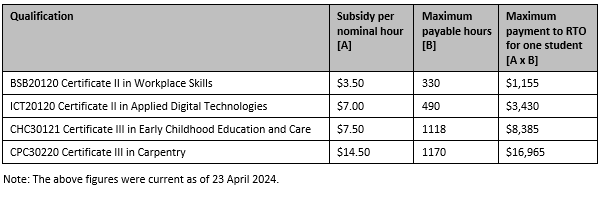
Each state or territory government can specify the dollar amount it will pay an RTO that has been contracted to deliver government-subsidised or government-funded training. For example, the following shows the funding paid to contracted RTOs by the Victorian government for the delivery of four different qualifications. [3]
Units of competency are the building blocks for qualifications. And each unit of competency is allocated a number of nominal hours. For example, the following shows the nominal hours for a BSB20120 Certificate II in Workplace Skills qualification. [4]

Nominal hours are used to calculate the amount of money the state or territory government will pay an RTO. If a contracted RTO delivered the BSB20120 Certificate II in Workplace Skills qualification with the above units of competency in Victoria, the RTO would claim $962.50 (275 nominal hours x $3.50).
Nominal hours are not the same as actual training hours
RTOs use nominal hours for reporting and funding purposes, not to determine the training duration.
While nominal hours might influence actual training time, most RTOs deliver fewer ‘actual training hours’ than ‘nominal hours’.
The reason? Supervised hours are expensive. They require trainer and assessor involvement, driving up costs. So, RTOs often look for ways to minimise supervised hours.
In conclusion
If you are a TAE40122 student, you may be required to develop a training plan covering an entire unit of competency with a duration equal to the nominal hours for that unit. This is unreal. Usually, an RTO will deliver less ‘supervised hours of training’ than the ‘nominal hours’.
Nominal hours = Dollars
Nominal hours ≠ Time
However, if you must do what your training provider wants, then you may like to select a unit with a smaller number of ‘nominal hours’.
For example:

The number of ‘training days’ will determine the amount of your time and effort that will be required to design the training plan. It will take a greater amount of time and effort to design 8.5 days of training compared with designing 2 or 3 days of training.
References
[1] Nationally agreed nominal hours (https://www.ncver.edu.au/rto-hub/statistical-standard-software/nationally-agreed-nominal-hours accessed 23 April 2024)
[2] Victorian Purchasing Guide for BSB Business Services Training Package, Release 8, Page 26 (https://www.education.vic.gov.au/Documents/training/providers/rto/vpgbsb-current.pdf accessed 23 April 2024)
[3] Funded Programs Report (https://www.education.vic.gov.au/svts/ accessed 23 April 2024)

[4] Nationally agreed nominal hours (https://www.ncver.edu.au/rto-hub/statistical-standard-software/nationally-agreed-nominal-hours accessed 23 April 2024)

Do you need help with your TAE studies?
Are you a doing the TAE40122 Certificate IV in Training and Assessment, and are you struggling with your studies? Do you want help with your TAE studies?

Ring Alan Maguire on 0493 065 396 to discuss.

Training trainers since 1986
 On Target Work Skills