Since 2016, many people have complained about the inclusion of the TAEASS502 Design and develop assessment tools as a core unit for the TAE40116 Certificate IV in Training and Assessment qualification.
It is said that trainers and assessors working in the VET sector do not design and develop assessment tools. Therefore, the inclusion of the TAEASS502 unit is unwarranted. I like having this unit included in the TAE40116 qualification because it helps people to learn how assessment tools are (or should be) structured. Also, they learn (or should learn) the importance of good quality assessment tools in our VET system. Anyway, it does not matter what I think. There will be many people pushing to have the TAEASS502 unit removed from the qualification that will replace the TAE40116 qualification.
Also, it is said that many TAE40116 students find the TAEASS502 unit difficult. Removing something because it is difficult to learn is not a good reason for it to be removed. I assume that people who want the TAEASS502 unit removed do not know what is covered by the TAEASS401 Plan assessment activities and processes unit. If a person is struggling with the TAEASS502 unit then they would also be struggling with the TAEASS401 unit.
Comparison
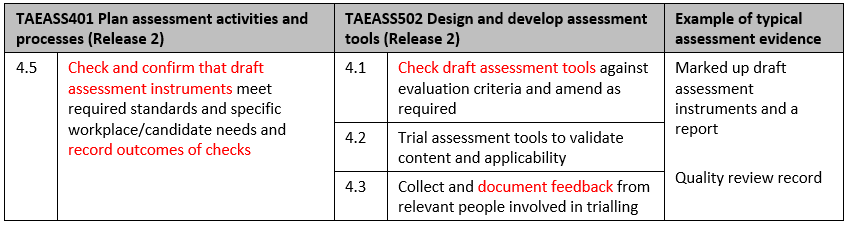
The following tables compare the performance criteria for the TAEASS401 and TAEASS502 units.
Plan the assessment approach
Develop assessment instruments and instructions / Design and develop assessment tool
Review and trial assessment document / Review and trial assessment tool
The following compares the knowledge evidence for the TAEASS401 and TAEASS502 units.
A review of the above comparisons clearly shows very little difference between the TAEASS401 and TAEASS502 units. And some parts of the TAEASS401 unit are more challenging than the TAEASS502 unit. For example, the requirement to determine opportunities for integrated assessment.
In conclusion
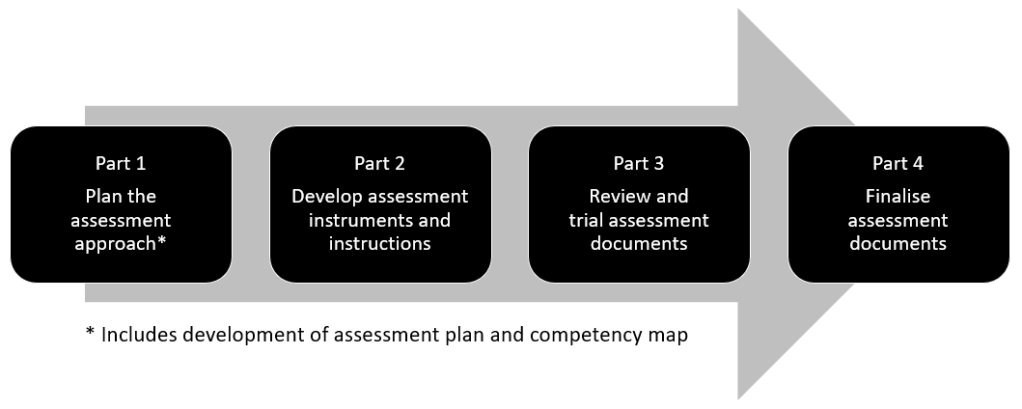
Currently when I deliver the TAE40116 qualification, I integrate the TAEASS401 and TAEASS502 units. This results in a seamless 4-part process that is illustrated by the following diagram.
What happens if the TAEASS502 unit is removed but the TAEASS401 unit is kept? The following diagram shows that very little changes.
If a person is struggling to learn the TAEASS502 unit then they would also be struggling to learn the TAEASS401 unit.
My research indicates that trainers and assessors are required to have the capability to develop assessment instruments and write assessment instructions. The solution to people struggling to learn should not be to remove units. The solution should be about improving how RTOs deliver these units and find ways to help their students learn.
The TAE Training Package is being reviewed. And a replacement for the TAE40116 qualification is being designed.
Should the TAEASS502 unit be removed or should it remain?
Should the TAEASS401 unit be removed or should it remain?
The TAE Training Package is currently under review. And this includes the development of one or more qualifications to replace the TAE40116 Certificate IV in Training and Assessment qualification. I am publishing two article to explore what may replace the TAE40116 qualification.
This first article takes a historical look at the qualification packaging rules that have been used to develop training and assessment skills. A second article will look at what the future qualification packaging rules may look like.
Qualification packaging rules
The packaging rules for a qualification specify the total number of number required. It states the number of core units and the number of elective units. And it lists the core units and identifies what units can be selected as electives.
Some qualifications have a small number of core units and many elective units. And there are a small number of qualifications that have all core units and no elective units. Qualifications that are used for occupations or work functions in a highly regulated industry sector will usually have no or very few elective units.
How many units should a qualification have?
The TAE40116 qualification is used as the credential specified by VET regulation to work as a trainer and assessor. The qualification packaging rules requires a total of 10 units, consisting of 9 core units and 1 elective unit.
At recent presentations about the TAE Review, it has be said that the average number of units of Certificate IV qualifications is 14. And because of this a future replacement for the TAE40116 Certificate IV in Training and Assessment qualification may require a total of 14 units.
Using the average number of units for qualifications at an AQF level is not a methodological way of deciding how many units a qualification should have. We may as well pull a number out of a bowl or use an app to randomly generate a number between 8 and 18.
Qualifications should be built to meet the requirements for performing an occupation or work function. If a proper occupational or functional analysis is conducted, the tasks performed will be identified and units of competency can be constructed. Starting with a number, like 14, and then figuring out what will be the units of competency seems to be an inappropriate way to develop a qualification.
How have the qualification packaging rules changed over time?
BSZ40198
The first training package qualification for trainers and assessors was the BSZ40198 Certificate IV in Assessment and Workplace Training (released in 1998). The BSZ40198 qualification had 8 units of competency.
BSZ401A Plan assessment
BSZ402A Conduct assessment
BSZ403A Review assessment
BSZ404A Train small groups
BSZ405A Plan and promote a training program
BSZ406A Plan a series of training sessions
BSZ407A Deliver training sessions
BSZ408A Review training
All 8 units were required. No electives.
TAA40104
The BSZ40198 qualification was replaced by the TAA40104 Certificate IV in Training and Assessment (released in 2004). The TAA40104 qualification required a total of 14 units. There were 12 core units and 2 units had to be selected as electives. The core units were:
Learning environment
TAAENV401B Work effectively in vocational education and training
TAAENV402B Foster and promote an inclusive learning culture
TAAENV403B Ensure a healthy and safe learning environment
Design
TAADES401B Use Training Packages to meet client needs
TAADES402B Design and develop learning programs
Delivery
TAADEL401B Plan and organise group-based delivery
TAADEL404B Facilitate work-based learning
TAADEL403B Facilitate individual learning
Assessment
TAAASS401C Plan and organise assessment
TAAASS402C Assess competence
TAAASS403B Develop assessment tools
TAAASS404B Participate in assessment validation
The listed elective units included:
TAADEL301C Provide training through instruction and demonstration of work skills
TAADEL402B Facilitate group-based learning
TAADEL405B Coordinate and facilitate distance-based learning
TAAENV404B Develop innovative ideas at work
TAATAS401B Maintain information requirements of training and/or assessment organisations
TAALLN401B Address language, literacy and numeracy issues within learning and assessment practice
How did we go from 8 units to 14 units?
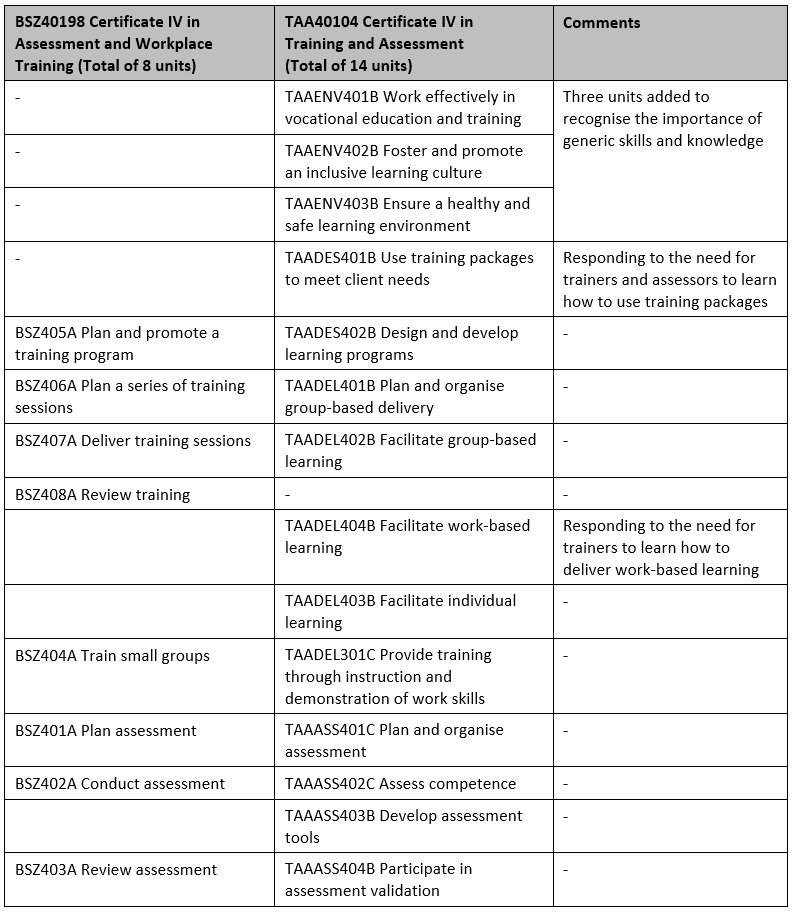
The following table compares the BSZ40198 and TAA40104 qualifications.
The total total number of units had been increased because:
3 generic units were added
a unit about using training packages was added
a unit about delivering work-based learning was added.
TAE40110
The TAA40104 qualification was replaced by the TAE40110 Certificate IV in Training and Assessment (released in 2010). The TAE40110 qualification required a total of 10 units. There were 7 core units and 3 units had to be selected as electives. The core units were:
Design
TAEDES402A Use training packages and accredited courses to meet client needs
TAEDES401A Design and develop learning programs
Delivery
TAEDEL401A Plan, organise and deliver group-based learning
TAEDEL402A Plan, organise and facilitate learning in the workplace
Assessment
TAEASS401B Plan assessment activities and processes
TAEASS402B Assess competence
TAEASS403B Participate in assessment validation
How did we go from 14 units to 10 units?
The following table compares the TAA40104 and TAE40110 qualifications.
The total total number of units had been increased because:
The three generic units were integrated within other units
Merging two units into one (twice).
TAE40116
The TAE40110 qualification was replaced by the TAE40116 Certificate IV in Training and Assessment (released in 2016). The TAE40116 qualification required a total of 10 units. There were 9 core units and 1 unit had to be selected as an elective. The core units were:
Design
TAEDES402 Use training packages and accredited courses to meet client needs
TAEDES401 Design and develop learning programs
Delivery
TAEDEL401 Plan, organise and deliver group-based learning
TAEDEL402 Plan, organise and facilitate learning in the workplace
Assessment
TAEASS401 Plan assessment activities and processes
TAEASS502 Design and develop assessment tools
TAEASS402 Assess competence
TAEASS403 Participate in assessment validation
Language, literacy and numeracy
TAELLN411 Address adult language, literacy and numeracy skills
Why did the number of core units change?
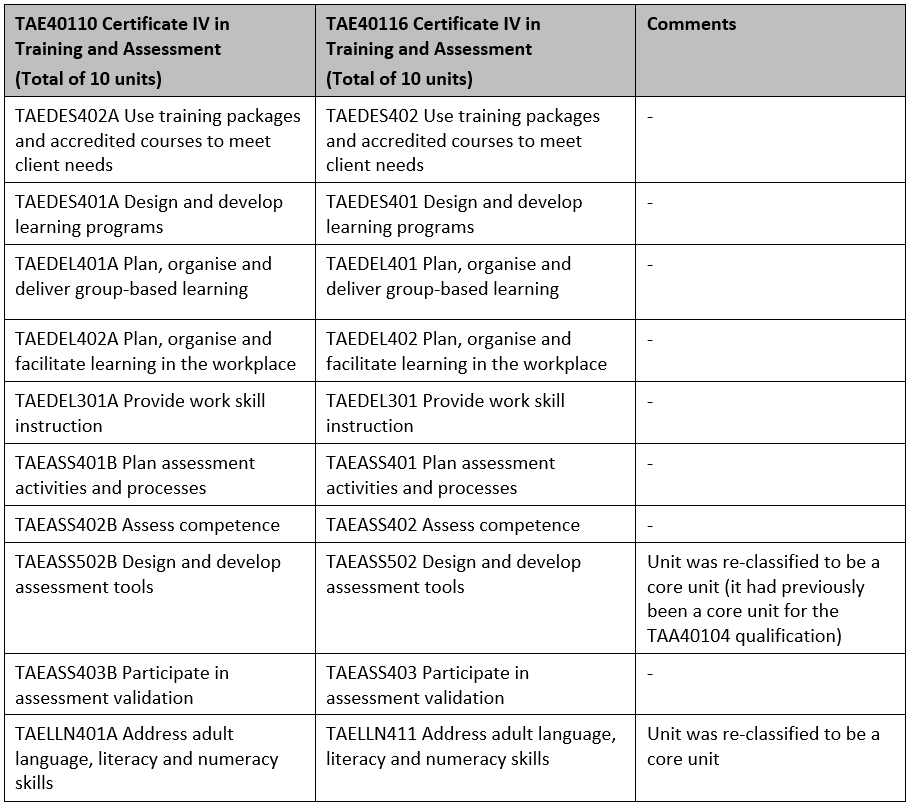
The following table compares the TAE40110 and TAE40116 qualifications.
It had become common for trainers and assessors to have learners with low LLN skills. Therefore, the LLN unit became core.
ASQA had evidence that the quality of assessment was extremely poor and it believed that poorly skilled assessors was a significant contributing factor. It forced the re-classification of the TAEASS502 unit to become a core unit again, as it was in the TAA40104 qualification. (I actually think the inclusion of the TAEASS502 unit as a core was a good idea but there are many people who would disagree.)
Although the number of core units changed, the total number of units required remained the same.
In conclusion
The following graph shows how the qualification packaging rules have changed over time.
The VET sector is highly regulated. This leads to a greater number of core units. Also, the occupation or work function of a trainer and assessor working in VET has a defined set of tasks to be performed within much variation:
Trainers need to plan, organise and deliver group based learning
Assessors need to plan, organise and conduct assessment
Trainers and assessors working for an RTO are asked to participate at assessment validation meetings
Trainer and assessors working for an RTO are asked to develop simple training and assessment resources
Trainers and assessors need to know how to address LLN skills
Trainers and assessors need to know how training packages and accredited courses are used as the foundations for delivering competency-based training and assessment services.
Technology may have changed since 1998 but the fundamental competencies remain. It is my view that technology should be treated as a foundation skill or current units of competency can be contextualised for the application of various technologies.
What will replace the TAE40116 qualification?
The design of a qualification or qualifications to replace the TAE40116 Certificate IV in Training and Assessment is underway.
Is 14 the right number of units?
If there is going to be 14 units, how many units will be core and how many units will be electives?
What will the core units be? And what will be the available elective units?
Is 14 the right number of units?
The number 14 has been based on an average. Here are some more numbers based on averages. For the past quarter of a century, there has been four successive qualifications for trainers and assessors to learn to delivery training and conduct assessments. On average, there has been 10.5 total number of units for these qualifications.
The average number of elective units has been 1.5 for these qualifications.
Based on the logic of averages, a replacement for the TAE40116 qualification should have a total of 10 or 11 units with 1 or 2 elective units.
This article has taken a historical view. Some people may not like looking at history. These people may prefer to look forward, and into the future. And that is exactly what I shall do in my next article about what will replace the TAE40116 qualification.
Are you needing to develop an assessment instrument to gather knowledge evidence? The following is a 5-step process that can be used:
Step 1. Identify the knowledge evidence to be gathered
Step 2. Write questions to gather the knowledge evidence
Step 3. Write sample answers for each question
Step 4. Write instructions for your assessment instrument
Step 5. Trial the assessment instrument before implementing
Here is an example demonstrating how to use these five steps. The BSBPEF202 Plan and apply time management unit of competency has been used for the purposes of this example.
Step 1. Identify the knowledge evidence to be gathered
The knowledge evidence to be gathering is easy to identify. It is specified under the Knowledge Evidence heading in the Assessment Requirements for the unit of competency.
The required knowledge evidence specified for the BSBPEF202 Plan and apply time management unit of competency are:
time management techniques and strategies
features of a time management plan
organisational standards, policies and procedures relevant to own work role
relationship between own work goals and plans and organisation’s goals and plans
factors affecting work progress and performance improvement techniques.
Step 2. Write questions to gather the knowledge evidence
I recommend writing at least one question for each item of knowledge evidence. As a starting point for the BSBPEF202 Plan and apply time management unit of competency, plan to write at least five questions because there are five bullet points.
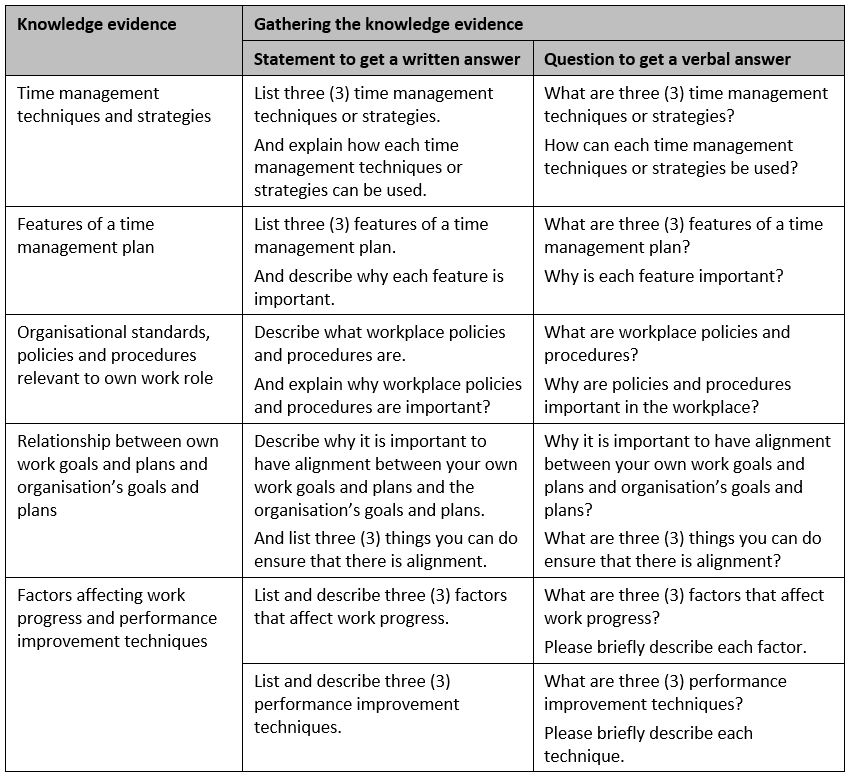
Questions are not the evidence. It is the answers are the evidence. A person can write their answers or give their answers verbally. The following table shows two approaches that can be used to get answers.
The above example shows how two questions have been used to gather knowledge for the fifth bullet point for the BSBPEF202 Plan and apply time management unit of competency.
Sometimes, one question is insufficient to gather the range or depth of knowledge required. This is often the case with knowledge evidence relating to workplace health and safety. Often, there may be sub-bullet points and each sub-bullet point requires a different question to gather the required knowledge.
Step 3. Write sample answers for each question
An RTO may have templates to be used when you develop assessment instruments. These templates may have been designed for providing sample answers for each questions. These answers may be in a ‘marking guide’ or an ‘assessment guide’.
You will need to write sample answers for each question being used to gather the knowledge evidence. This is important to help the RTO to comply with the ‘reliability’ principle of assessment.
Searching for the answers
Is a learning resource being used?
Is there a particular reference being used?
What to do if you don’t know the answers to the questions?
Is a learning resource being used?
An RTO may have decided to purchase a learning resource or develop their own learning resource. Align your assessment instrument to the content covered by the learning resource to avoid confusing your learners being assessed.
Is there a particular reference being used?
An RTO may have decided to use a particular reference. For example, a great reference for time management is Stephen Covey’s First Things First. A reference text may include time management techniques and strategies, features of a time management plan, etc.
Align your assessment instrument to the content covered by the reference text to avoid confusing your learners being assessed.
What to do if you don’t know the answers to the questions?
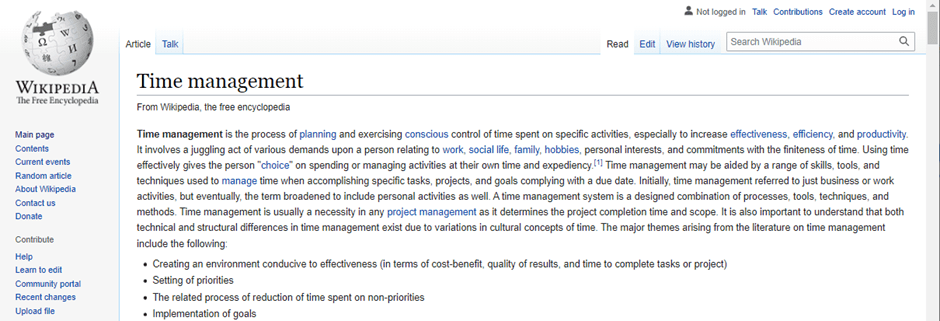
You will need to do some research if you don’t know the answers to the questions. Wikipedia can be a good way to start researching a topic.
An internet search may be required. For example, you will find that many people have published lists of time management techniques and strategies.
Sometimes, you may find it useful to search images. The following search result illustrates that a time management plan is typically a calendar with blocks of time allocate to perform tasks.
Sometimes your search of the internet will not provide the answer you are needing. There may be other useful and free resources available. For example, there is an Interpretation Manual for the BSB Business Services Training Package. The following is information that gives an interpretation for ‘time management techniques and strategies’ and ‘features of a time management plan’.
Unfortunately, the Interpretation Manual for the BSB Business Services Training Package does not provide an interpretation of everything. I wish it had given an interpretation for ‘organisational standards, policies and procedures relevant to own work role’.
Another possible document to check is the superseded unit of competency in the ‘old format’. These documents had range statements that may provide useful information. For example, the following are the range statements for BSBWOR202A Organise and complete daily work activities unit of competency (in the old format) had superseded the The required knowledge evidence specified for the BSBPEF202 Plan and apply time management unit of competency.
An assessment instrument for gathering knowledge evidence must have sample answers to the questions being asked. This supports an RTO’s compliance with the ‘reliability’ principle of assessment. Sample answers can be used by an assessor to judge if a candidate’s answer is satisfactory, or not.
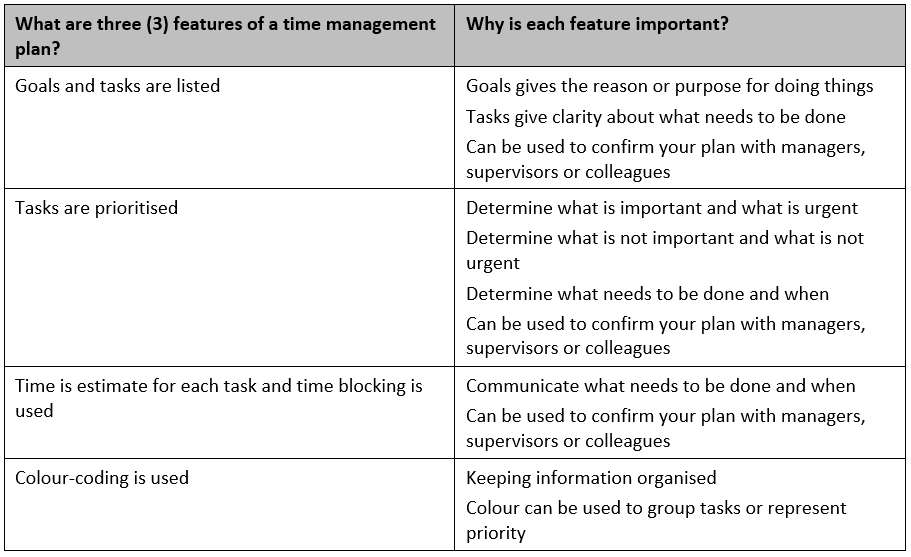
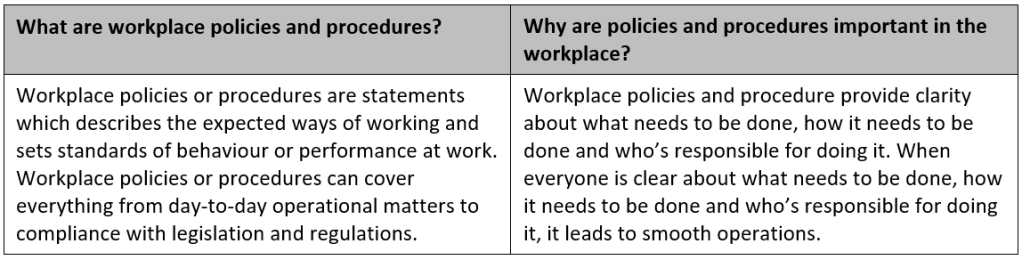
The following is an example of sample answers for the BSBPEF202 Plan and apply time management unit of competency.
Sample answers for Question 1
In the above example, ten possible answers to the question are given although the question is only asking for three. This illustrates that a candidate’s answer may come from a wide range of possible answers. Therefore, an assessor needs to be given the range of possible answers. And sometimes, an answer may be given by the candidate that is not listed but are still acceptable. The assessor must exercise their fairness and flexibility in those situations.
Sample answers for Question 2
Sample answers for Question 3
Researching and writing answers to questions can be time consuming. I have not provided example answers for the following questions:
Question 4. Why it is important to have alignment between your own work goals and plans and organisation’s goals and plans? What are three (3) things you can do ensure that there is alignment?
Question 5. What are three (3) factors that affect work progress? Please briefly describe each factor.
Question 6. What are three (3) performance improvement techniques? Please briefly describe each technique.
Step 4. Write instructions for your assessment instrument
When developing an assessment instrument to gather knowledge evidence, you will need to:
Write questions
Write sample answers
Write instructions.
You must write instructions for the assessor and the candidate so that they know what needs to be done, and what is the expected standards for a satisfactory result.
Your RTO may have templates for you to use when developing assessment instruments.
Step 5. Trial the assessment instrument before implementing
Ask one or two of your work colleagues to help you trial the assessment instrument. Use this opportunity to identity what does not work so that these things can be fixed before the assessment instrument is implemented.
Do you need help with your TAE studies?
Are you a doing the TAE40122 Certificate IV in Training and Assessment, and are you struggling with your studies? Do you want help with your TAE studies?
Do you want more information? Ring Alan Maguire on 0493 065 396 to discuss.
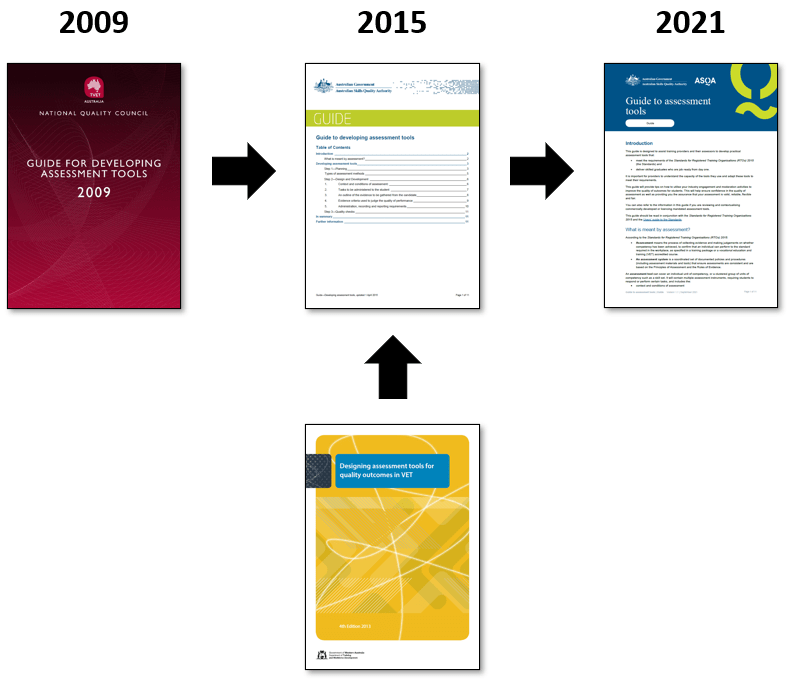
Coincidentally, or by design, every six years a guide to developing assessment tools is released by authoritative VET sources.
In 2009, the National Quality Council (NQC) released a guide. The NQC’s guide plus a guide published by the Western Australia’s Department of Training and Workforce Development were used by ASQA to produce their guide in 2015. And in 2021, ASQA updated their guide. It is interesting that ASQA’s 2021 version has removed the word ‘developing’ from the document title. However, it still is the guide to [developing] assessment tools.
How has ASQA updated the guide?
Industry engagement
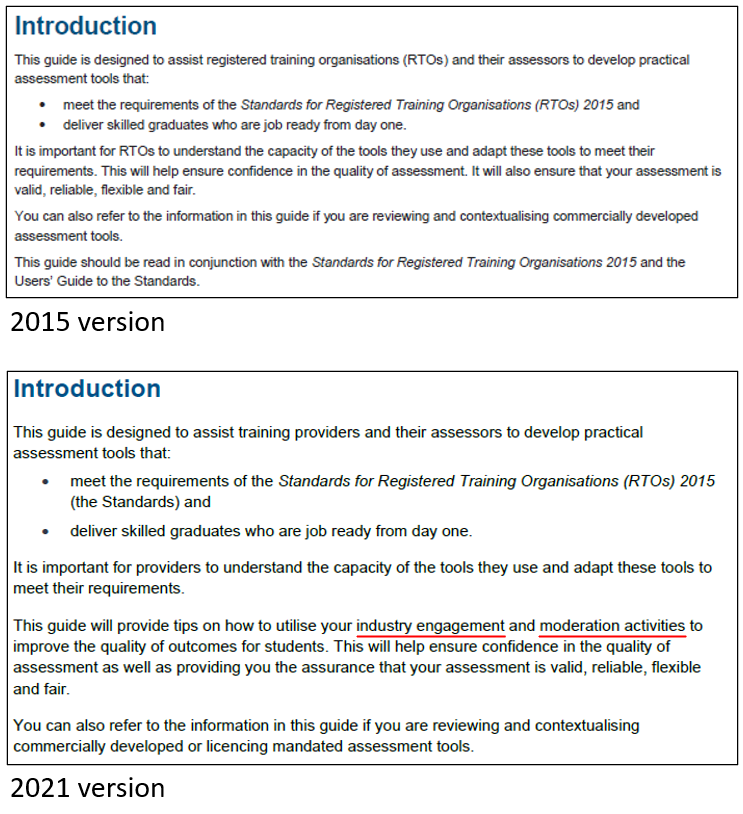
The first difference between the 2015 version and 2012 version of the guide is ASQA’s aim to encourage RTOs to engage industry when developing assessment tools. In the 2015 version, the involvement of industry was on page 4. The 2021 version brings forward a reference to industry to page 1. This update seems to be more symbolic rather than substantive.
Very little information of any substance about industry engagement is provided in the ASQA’s guide. The following is provided:
RTO must state how industry representative have contributed to the development of your assessment practices and resources
Industry engagement can be used to align the assessment tool with current methods, technologies, performance expectations, etc.
This information was already available in the 2015 version of the guide.
Has ASQA misunderstood ‘moderation’?
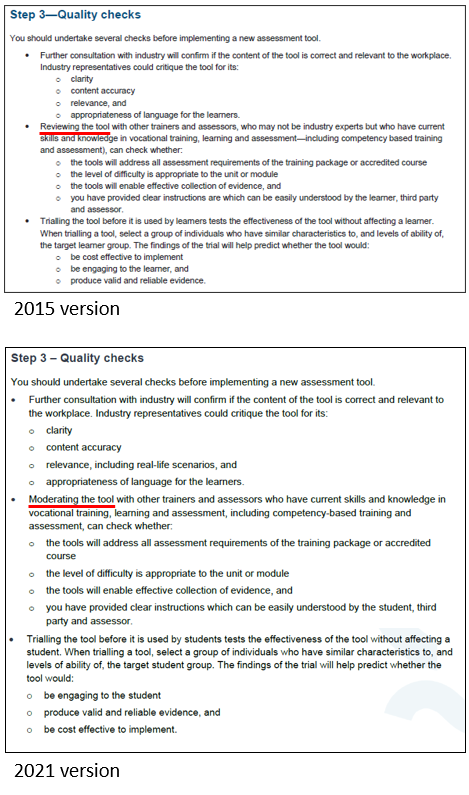
Another difference between the the 2015 version and 2012 version of the guide is the inclusion of ‘moderation’. It has replaced the activity of reviewing the assessment tool.
I believe that moderation is not part of the process for developing an assessment tool. For me, moderation is an activity that reviews some samples of completed assessment tasks and evidence that have been used to make an assessment decision. Assessors would meet to determine what decisions they would make based on the given evidence. Any discrepancies would need to be discussed to ensure all assessors standardise their assessment decisions. Therefore, moderation occurs after the assessment tool has been implemented.
Moderation is a useful activity for RTOs to seek the delivery of a reliable assessment process. It assists with compliance with the ‘reliability’ principle of assessment. I wonder if ASQA has misunderstood or misappropriated the concept of ‘moderation’. I would prefer the ASQA guide to revert back to ‘reviewing the tool’ rather than ‘moderating the tool’. Misuse of terms can cause confusion.
Who are the developers of assessment tools?
The introduction to ASQA’s guide to assessment tools states that it has been “designed to assist training providers and their assessors to develop assessment tools“. It would be interesting to know how many assessors are actually involved in the development of assessment tools.
Since 2016, there has been a strong view that very few assessors develop assessment tools. This has been the basis of complaint about the TAEASS502 Design and and develop assessment tools being a core unit in the TAE40116 Certificate IV in Training and Assessment qualification. I wonder why ASQA has not acknowledge that assessors are unlikely to develop assessment tools. It may be better if ASQA had used the job title of instructional designer or resources developer. Or, does ASQA still believe that assessors develop assessment tools?
What information does the Guide provide?
The Guide to [developing] assessment tools is a short and easy-to-read document. It begins with defining the terms:
Assessment
Assessment systems
Assessment tool.
These definitions are followed by an outline of a 3-step process for developing assessment tools
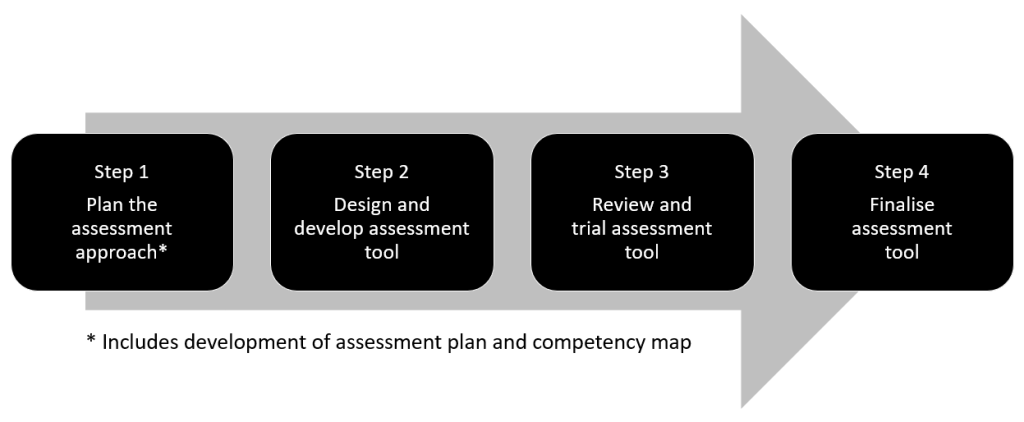
If anyone is familiar with my TAE40116 resources, you will know that I promote the following 4-step process.
My 4-step process is clear, logical, and consistent with:
TAEASS401 Plan assessment activities and processes
TAEASS502 Design and develop assessment tools.
Planning
ASQA’s guide to [developing] assessment tools briefly describes some planning considerations:
What are the assessment requirements of the training package or accredited course?
What does consultation from your industry engagement recommend?
What assessment methods are most appropriate for your student cohort?
Types of assessment methods
Four types of assessment methods are listed and described:
Direct observation
Product based methods
Questioning
Third-party evidence.
The 2021 version of the guide has removed the ‘portfolio of evidence’ assessment method from the list. That’s okay because it is adequately covered by the ‘product based methods’.
Design and development
ASQA’s guide to [developing] assessment tools briefly describes a number of components to be designed and developed so that the assessment tool will comply with the ‘principles of assessment’:
The context and conditions of assessment
The tasks a student must complete to demonstrate competency
An outline of evidence to be gathered from the student
Evidence criteria used to judge the quality of performance
Administration, recording and reporting requirments.
Quality checks
ASQA’s guide to [developing] assessment tools briefly describes three checks that should be undertaken before implementing a new assessment tool:
Further consultation with industry to confirm the content of the assessment tool is correct and relevant to the workplace
Moderating the tool (earlier in this article I have expressed by disagreement with using the term ‘moderation’, and I think the 2015 version of guide was right in using the term ‘reviewing the tool’)
Trialling the tool before it is used by students.
In conclusion
There is very little difference between the 2015 and 2021 versions of ASQA’s guide to [developing] assessment tools. It is a document that I think should be read and understood by all VET practitioners. It does not matter if a VET practitioner is developing an assessment tool, or not. ASQA’s guide provides the basic information about how an assessment tool supports compliance with requirements specified by:
Standards for Registered Training Organisations (RTOs)
Training packages and accredited courses.
Also, it encourages the consultation with employers and industry to ensure an RTO’s assessment approach meets current workplace requirements.
Do you need help with your TAE studies?
Are you a doing the TAE40122 Certificate IV in Training and Assessment, and are you struggling with your studies? Do you want help with your TAE studies?
Do you want more information? Ring Alan Maguire on 0493 065 396 to discuss.
Some TAE Students struggle with their TAE studies. I have established a tutoring service to help individuals studying for:
TAE40122 Certificate IV in Training and Assessment
TAE Update, TAE Diploma or TAE Skill Set.
Feeling overwhelmed or losing motivation are common experiences for many TAE Students. There is no shame in asking for help. My tutoring service can save time and save being frustrated.
Barriers to learning and assessment
Many people find the Certificate IV in Training and Assessmentqualification difficult for a range of reasons. Typical barriers include:
Understanding VET jargon and acronyms
Understanding and interpreting units of competency and assessment requirements
Understanding assessment instructions
Understanding how to perform the assessment tasks
Computer skills.
Understanding VET jargon and acronyms
RTO, ASQA, AQF, JSA, JSC, LLN, ACSF, NYC, etc. The Australian VET system uses a lot of jargon and acronyms. This can be confusing for someone who is new to the world of VET. If you don’t understand the language of VET, then it is easy to get confused and overwhelmed. Topics or information about VET can have no meaning when a person starts their TAE studies.
Some strategies to help a TAE Student learn VET jargon and acronyms are:
Develop your own glossary of VET jargon and acronyms
Encouragement to use VET jargon and acronyms.
As a TAE Tutor, I can create a ‘safe learning environment’ that encourages a TAE Student to practice using and learning the new terminology.
Understanding and interpreting units of competency and assessment requirements
Competency-based training and assessment is a fundamental part of Australia’s VET system. Units of competency are extracted from ‘training packages and accredited courses’. They are the building blocks for qualifications and skill sets. An understanding of them is foundational, but many people who are new to VET need help to develop their understanding.
And to make things worst, units of competency and assessment requirements are deliberately written to be ambiguous. This is not a fault. This is a feature of the Australian VET system. It allows units to be interpreted and contextualised to meet specific requirements for a workplace or industry.
As a TAE Tutor, I can focus on developing a practical understanding of units of competency and how to use them.
Understanding assessment instructions
Some assessment instructions are poorly written. Some assessment instructions are not written in plain English. Some assessment instructions are complex, using jargon and acronyms. And sometimes the structure of the the instructions are complex or defy logic.
If someone can not understand the assessment instructions, then they can not get started on performing the assessment task. Alternatively, if they misunderstand the instructions they may waste time and effort doing unnecessary work.
As a TAE Tutor, I can help untangle and explain what the assessment instructions are saying. Often, I need to simplify or prioritise the steps to be taken to undertake the assessment tasks.
Understanding how to perform the assessment tasks
Some training providers may not cover the required knowledge or required skills for performing tasks. Some training providers may not clearly describe how to perform tasks. And some training providers may deliver short-duration or poor quality TAE training that is insufficient.
As a TAE Tutor, I can diagnose what may be stopping a person from performing the assessment task:
Lack of required knowledge
Lack of required foundation skills
Unclear about the steps to perform the task.
Then as the TAE Tutor, I can help close knowledge gaps, skill gaps, or give a clear step-by-step procedure.
Reading and writing skills
Some TAE Students have inadequate reading and writing skills.
Reading tasks include:
Read learner guides
Read reference documents
Read assessment instructions.
Writing tasks include:
Write answers to questions
Develop training and assessment documents
Use templates or forms to complete assessment tasks.
Reading and writing can be difficult for people who’s first language is not English. Australia has welcomed many migrants and refugees who may experience language or literacy barriers.
Some TAE Students would benefit having extensive LLN support. However, other TAE Students can cope if they get clear explanations and guidance. As a TAE Tutor, I cannot give extensive LLN support but I can give clear explanations and guidance.
Computer skills
Technology has become common in today’s workplace. Trainers and TAFE teachers working in the VET sector are required to use technology. For example:
Learning management systems, such as Moodle
Word processing applications, such as Microsoft Word
Presentation applications, such as Microsoft PowerPoint
Video conferencing platforms, such as Zoom
Computer and projection equipment.
Some TAE Students have insufficient computer skills when they commence their TAE studies. The development of computer skills is essential. As a TAE Tutor, I can demonstrate some some basic computer functions to help learn to use Microsoft Word and this can help with competing assessment tasks.
About the TAE Tutoring service
Each tutoring session shall be conducted using video conferencing application (Zoom or Google Meet). The duration of a tutoring session is 60 minutes. The session is tailored to the needs of the individual with the aim of progressing assessment tasks. Sessions can be arranged for during the day, evenings, or weekends.
Do you want more information? Ring Alan Maguire on 0493 065 396 to discuss.



















 On Target Work Skills