Do we need a new e-assessment unit of competency?

As part of the TAE Training Package review, a new e-assessment unit has been drafted. The title of of the proposed unit is TAEASS404 Conduct e-assessment of competence.

PwC’s Skills for Australia is currently seeking our feedback about this draft. The following is my feedback about the unit, and I would be happy to hear your comments before I submit it.

(You may also like to read an article that I have previously posted about another proposed unit with the title of TAEDEL405 Plan, organise and facilitate e-learning.)

A definition of e-assessment

E-assessment may mean different things to different people. I have categorised two different types of e-assessment:

  • Assessment conducted by technology
  • Assessment supported by technology

Assessment conducted by technology

Assessment conducted by technology may also be known as computer-based assessment (CBA) or e-marking. This type of e-assessment is assessment which is both delivered and marked by computer. And the computer may provide feedback automatically to students without the involvement of an assessor (or any other person).

Benefits of conducting assessment using technology

Benefits of using technology to conduct assessments include:

  • consistency of assessments decisions
  • supports the record keeping of evidence and results
  • speed of getting the assessment done and providing feedback
  • reduces the workload of assessors.

Limitations of conducting assessment using technology

Assessment conducted by technology can be used for assessing knowledge, but it is not an appropriate method for assessing performance, such as:

  • bake a cake
  • repair a lawn mower
  • care for an elderly person
  • unblock a toilet
  • shear sheep.

The Australian VET system requires evidence of a person’s ability to perform work tasks and activities. Therefore, this type of e-assessment should only be used to assess knowledge, and in some cases, the breath and depth of knowledge required cannot be covered by this application of technology.

This method of computer-based assessment requires the design and development of valid test questions with answers (and sometimes responses to be sent as automatic feedback). Not every trainer will have the ability to develop effective test questions. Usually, the writing of test questions would be the responsibility of an instructional designer or resources developer.

What skills are needed to develop computer-based assessment?

An instructional designer or resources developer need the following skills to develop computer-based assessment:

  • Write questions
  • Write answers
  • Write feedback
  • Upload to computer-based assessment instrument.

The value of computer-based assessment is that there is no involvement of an assessor during the assessment process. The computer-based assessment instrument performs the assessment and records the result.

Some trainers and assessors may be involved in the development of questions, answers and feedback for computer-based assessment. However, this would be outside the scope of normal activities for most trainers and assessors.

Assessment supported by technology

It has become common for RTOs to use technology to support the assessment process. Many RTOs have implemented a learning management system (LMS), such as Moodle or Canvas. It is more than 5 years since I worked for an RTO that wasn’t using an LMS for students to submit their assessments.

What does the ‘e’ in e-assessment stand for? Does is stand for ‘electronic’ or ‘everyday’? Assessment supported by technology has become the norm. The distinction between ‘e-assessment’ and ‘assessment’ has dissolved over the past 5 years. It would be rare for the assessment process not to supported by technology.

The Education IRC believes that ‘e-assessment’ is different to ‘assessment’ . How did the Education IRC identify a need to create a ‘new’ e-assessment unit of competency? Most RTOs use technology for students to submit their evidence and support the assessment process conducted by assessors. A very small number of exceptions to this may include:

  • VET in School programs that use print-based workbooks
  • Creative arts qualifications, such as, music or dance
  • Small RTO that have a paper-based system.

Is it difficult to learn how to use an LMS?

No, it is not difficult to learn how to use an LMS. So far, I have had to learn three different LMS platforms. The first LMS I learnt was Moodle. I attended a 3-hour session about how to use it to perform my role as an assessor. This was enough to get me using Moodle to conduct assessments. Later, I started to work for an RTO that used Canvas. About 30 minutes was taken during my induction to show me how to log-on, navigate, and use this LMS. And later again, another RTO emailed me a 5-page document to show how to log-on, navigate, and use Job Ready for conducting assessments.

Learning an LMS is not difficult. The knowledge and skills required to use an LMS are insufficient and insignificant for the creation of a unit of competency. It is possible that using an LMS or other technologies could be identified as a foundation skill for the TAEASS402 Assess competence unit of competency. However, learning one LMS does not negate the need for a newly qualified assessor to need to learn a different LMS once they get employment.

What skills are need to conduct assessments that are supported by technology?

The skills required by an assessor to conduct assessment that are support by technology include:

  • Prepare for assessment
  • Brief the candidate
  • Gather evidence
  • Support the candidate
  • Make the assessment decision
  • Record and report the assessment decision

These skills are the same as what is covered by the current TAEASS402 Assess competence unit of competency.

TAEASS404 Conduct e-assessment of competence (draft)

Feedback about elements and performance criteria

The following are the performance criteria for the first element.

Answers to questions raised

The Training Package Developer has raised some questions. The following are my answers to the three questions raised.

The following are the performance criteria for elements 2, 3 and 4.

There is very little difference between the draft TAEASS404 Conduct e-assessment of competence unit of competency and the current TAEASS402 Assess competence unit of competency.

What happens if we remove duplicate performance criteria from the TAEASS404 Conduct e-assessment of competence unit of competency? After removing all the performance criteria that duplicates what is already in the TAEASS402 Assess competence unit of competency, we are left with five performance criteria. The following table lists the five performance criteria.

Contrary to the Case for Change, there is very little difference between conducting ‘traditional assessment’ (as described by the TAEASS402 unit) and conducting ‘e-assessment’ (as described by the TAEASS404 unit). The TAEASS404 Conduct e-assessment of competence unit of competency is basically an attempt to contextualise the TAEASS402 Assess competence unit of competency. The minor differences does not warrant the development and implementation of new e-assessment unit of competency.

Feedback about foundation skills

A candidate will be required to demonstrate the ability to complete the tasks outlined in the elements, performance criteria and foundation skills (as per the Performance Evidence statement). This makes the foundation skills assessable.

The following are the foundation skills.

Analysis and comprehensive feedback about the foundation skills would require much more time and effort. However, some of the foundation skills seem to poorly describe or do not describe a skill. For example:

Feedback about performance evidence

The following are the performance evidence.
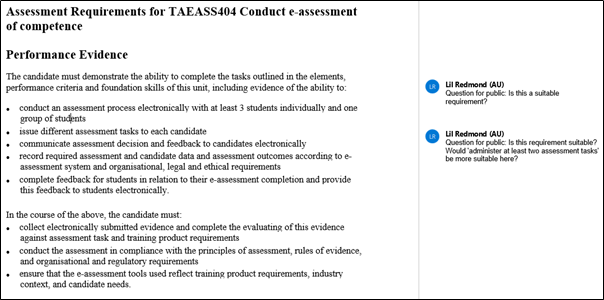
The performance evidence is poorly written. I am an experienced assessor and for many years I have been conducting e-assessment. I find the performance evidence is complicated, confusing, and difficult to comprehend. For example:

  • How is an e-assessment conduct for a group of students? When does this occur?
  • What is the size of the group of students? How is an individual’s competence assessed in a group?
  • What is the definition for an assessment task? Assessing one assessment task is far short of assessing competence.
  • Will sending an email be appropriate for communicating to candidates electronically?
  • What does ‘complete feedback for students in relation to their e-assessment completion’ mean?

Why is there a distinction being made between an ‘e-assessment tool’ and an ‘assessment tool’? Why are we using or alternating between the words ‘student’ and ‘candidate? The performance evidence is poorly written and needs to be significantly reworked.

Feedback about knowledge evidence

Analysis and comprehensive feedback about the knowledge evidence would require much more time and effort. However, I believe that a critical analysis of the knowledge evidence should be done prior to implementation.

Feedback about assessment conditions

The following are the assessment conditions.
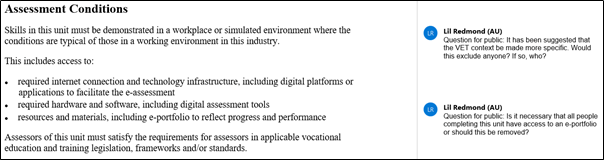
Why is the term ‘digital assessment tool’ being used? And why is the term ‘e-portfolio being used?

I think the entire Assessment Requirements need to be thoroughly reworked. But I really think that the draft TAEASS404 Conduct e-assessment of competence unit of competency should be scrapped.

In conclusion

Is there a need for a new e-assessment unit of competency? Can the current TAEASS402 Assess competence unit of competency adequately cover the requirements of conducting e-assessment?

Most assessors are using an LMS or other technology when they conduct assessments. Using an LMS or other technology has become fundamental or foundational to conducting assessments. The distinction between conducting ‘e-assessment’ or conducting ‘non-e-assessment’ is blurred. And the knowledge and skills required by assessors to conduct ‘e-assessment’ or ‘non-e-assessment’ are the same.

The current TAEASS402 Assess competence unit of competency adequately covers the requirement of conducting assessment that are supported by technology (e-assessment). At best, the draft TAEASS404 Conduct e-assessment of competence unit of competency is an attempt to contextualise the TAEASS402 Assess competence unit of competency. The minor differences does not warrant the development and implementation of new e-assessment unit of competency.

We do not need a new e-assessment unit of competency.

Please let me know what you think.

Nine golden rules when developing an assessment tool

Here is a list of nine golden rules when designing and developing a competency-based assessment tool within the Australian VET system:

  1. Comply with principles of assessment and rules of evidence
  2. Select an appropriate number of assessment tasks
  3. Gather all specified knowledge evidence
  4. Gather the specified volume or frequency of performance evidence
  5. Gather all specified performance evidence, and this must include evidence for each performance criteria
  6. Keep the assessment task to gather knowledge evidence separate from assessment tasks that gather performance evidence
  7. Do not ask ‘how-to’ questions
  8. Comply with the specified assessment conditions
  9. Trial and review the assessment tool before implementing it.

Ensure that the assessment tool complies with the requirement specified by the Standards for RTOs, in particular:

  • Principles of assessment
  • Rules of evidence.

ASQA has published useful information about the principles of assessment and the rules of evidence, and how to comply.

The assessment tool will always have at least two assessment tasks; one assessment task to gather the knowledge evidence, and another to gather the performance evidence.

The volume or frequency of performance evidence may be used to determine the number of assessment tasks required to gather the required performance evidence. See ‘Golden rule number 4’.

All specified knowledge evidence must be gathered.

A simple assessment strategy is to write at least one question for each item of knowledge evidence specified. Consider each bullet point listed under the heading of Knowledge Evidence as an item of knowledge evidence to be gathered.

Sometimes a bullet point may have sub-bullet points. Each sub-bullet point may require its own question, or it might be possible to use one question to gather evidence that would cover all the sub-bullet points.

The following is a simple assessment strategy that can keep the gathering of performance evidence as simple as possible for assessors to implement and for candidates to understand.

Use the same number of assessment tasks to gather performance evidence that is equal the volume or frequency of performance evidence specified. For example, if the performance evidence specifies that the task must be performed on three occasions, then plan for three assessment tasks to gather the specified quantity of evidence. In this example, the same assessment instrument may be able to be used for each of the three occasions (but this may not always be appropriate).

There must be evidence gather for all specified performance evidence. And this includes gathering evidence for each performance criteria. There are some Training Packages that specify that evidence for foundation skills are also to be gathered. Therefore, the foundation skills become assessible items.

Avoid integrating the gathering of knowledge evidence while gathering performance evidence because this will quickly complicate the assessment task. It can also interrupt the flow of performing a task if the assessor stops the candidate mid-task and starts asking them questions about what they are doing.

The following diagram shows the common assessment methods (and in brackets the evidence to be gathered by the assessment instruments).

Keep the assessment task to gather knowledge evidence separate from the assessment task or tasks used to gather performance evidence.

Note: It is a good idea to gather the knowledge evidence before gathering the performance evidence. If a candidate has insufficient knowledge, they are likely to have difficulties performing the work tasks or activities. It may be best to delay the gathering of performance evidence until the candidate has gained sufficient knowledge.

Do not ask ‘how-to’ questions to gather performance evidence. Performance evidence will require a candidate to perform the task or tasks.

Comply with the specified assessment conditions. This may include location, facilities, equipment or resources required for assessment.

Always trial and review the assessment tool before implementing it.

The following are some check points when trialling and reviewing the assessment tool:

  • Instructions to assessor are clear and written in plain English
  • Instructions to candidates are clear and written in plain English
  • If applicable, instructions to third parties are clear and written in plain English
  • Headings, sub-heading, page layout and formatting, page breaks, and white space have been used to make assessment documents easy to read and navigate
  • Assessment instruments can be used for collecting evidence and making judgements, including space provided for results, comments and feedback
  • Assessment decision-making criteria are provided, for example:
    • Sample answers for knowledge questions
    • Criteria for determining the standard of performance
  • Assessment documents are free of typos and grammatical errors
  • Assessment task titles and numbering are consistent across all documents.

The assessment tool should never be implemented before it has been trialled or piloted. This is when we find out if the assessment tool works, or not.

Some rules, like ‘Golden rule number 1’ should never be broken.

And sometimes you may need to break some of the rules.

The guiding principle should always be about making the assessment tool as simple as possible for assessors to implement and for candidates to understand.

Do you need help with your TAE studies?

Are you a doing the TAE40122 Certificate IV in Training and Assessment, and are you struggling with your studies? Do you want help with your TAE studies?

Do you want more information? Ring Alan Maguire on 0493 065 396 to discuss.

Contact now!

logo otws

Training trainers since 1986

How to conduct assessment validation (Part 1)

Introduction to assessment validation

Validation is defined as the quality review of the assessment process. It involves checking that the assessment tool produces valid, reliable, sufficient, current and authentic evidence to enable reasonable judgements to be made as to whether the requirements of the training package or VET accredited courses are met. It includes reviewing a statistically valid sample of the assessments and making recommendations for future improvements to the assessment tool, process and/or outcomes and acting upon such recommendations. [1]

Assessment validation has two distinct parts:

  • Part 1. Check the assessment tool for compliance
  • Part 2. Review a sample of the assessments.

This article covers the first part only.

If you want to know more about the second part, then I recommend reading the information published by ASQA about how to conduct assessment validation. This information covers: [2]

  • Who conducts validation?
  • Scheduling validation
  • Statistically valid sampling and randomly selecting samples to be validated
  • Effective validation
    • Reviewing assessment practice
    • Reviewing assessment judgements
  • Validation outcomes and the implementation of recommendations for improvement.

Part 1. Check the assessment tool for compliance

The assessment tool must be checked to ensure it complies with the requirements specified by the Standards for RTOs, in particular: [3]

  • Compliance with the principles of assessment and the rules of evidence
  • Compliance with the requirements specified by the training package or VET accredited course.

The following 6-step process can be used to check the assessment tool for compliance:

  • Step 1. Read the assessment requirements
  • Step 2. Review the assessment plan
  • Step 3. Review the assessment matrix (mapping)
  • Step 4. Check the details about how the knowledge evidence is planned to be being gathered
  • Step 5. Check the details about how the performance evidence is planned to be being gathered
  • Step 6. Check the overall quality of the assessment tool.

Step 1. Read the assessment requirements

This is a quick step to perform. You will read and re-read the unit of competency and its assessment requirements many times during the assessment validation process. During this first step, have a quick read of the assessment requirements and answer the following questions:

  1. What is the volume or frequency of performance evidence?
  2. Is the location, facilities, equipment, or other assessment conditions specified?

Step 2. Review the assessment plan

This step should also be quick. The purpose of this step is to get an overview of what is the planned assessment approach During this second step, answer the following questions:

  1. Has the correct unit code and title been used?
  2. How many assessment tasks are planned?
  3. Is there a plan to gather the knowledge evidence?
  4. Does there appear to be sufficient assessment tasks for gathering the volume or frequency of performance evidence?
  5. Does the planned assessment approach seem to be simple or complex?

Note: This planned assessment approach may be found in the Training and Assessment Strategy (TAS) or other documents covering how the RTO plans to implement the delivery of the training and assessment for a unit or cluster of units.

Step 3. Review the assessment matrix (mapping)

This step should be a relatively quick step. The assessment matrix is an important document used to display how the RTO plans to gather evidence that comply with the requirements specified by the training package or VET accredited course. The assessment matrix will be used during Step 4 and Step 5 to cross-check the RTO’s planned assessment approach and the assessment instruments being used to gather evidence.

During this third step, answer the following questions:

  1. Has the correct unit code and title been used?
  2. Has the entire unit of competency and its assessment requirements been copied into the matrix? Are the number of items the same? For example, if the unit has five elements does the matrix have five elements? And scan the wording to ensure the matrix has the exact words as the unit of competency and its assessment requirements.
  3. Is there one column for each planned assessment task?
  4. Are the titles or descriptions of the assessment tasks the same in the assessment plan and assessment matrix?
  5. Is every item from the unit of competency and its assessment requirements planned to be assessed? For example, is there at least one ‘tick’ in every row?

Note: Some assessment matrices will provide information or numerical indicator about the assessment item instead of using a ‘tick’. For example, the matrix may indicate that a piece of knowledge evidence will be gather by Question 1.

Step 4. Check the details about how the knowledge evidence is planned to be being gathered

This step requires an attention to details. The purpose is to ensure that the assessment tool will gather the required knowledge evidence. During this fourth step, answer the following questions:

  1. Is there an assessment instrument for gathering the knowledge evidence?
  2. Are the instructions to the assessor clear and concise?
  3. Are the instructions to the candidate clear and concise?
  4. Is the structure, format, and layout of the assessment instrument easy to follow? This includes headings, sub-headings, page numbers, and numbering of questions.
  5. Is there consistency between the assessment plan, assessment matrix and assessment instrument? For example, if the assessment plan states that there are 17 questions, does the assessment instrument have 17 questions?
  6. Is every item of knowledge evidence being adequately gathered? A judgement about ‘adequately’ will need to be made.

Step 5. Check the details about how the performance evidence is planned to be being gathered

This step requires an attention to details and it can take time to examine the assessment documents for compliance. The purpose is to ensure that the assessment tool will gather the required performance evidence. During this fifth step, answer the following questions:

  1. Is there one or more assessment instruments for gathering the performance evidence?
  2. Are the assessment conditions compliant with those stated in the Assessment Requirements for the unit of competency? This may include assessment location, facilities, equipment, and access to specified documents. For example, if the assessment conditions state that the assessment occurs in the workplace, then the assessment tasks must state that the evidence must be gathered from a workplace (not from a simulated workplace).
  3. Are the instructions to the assessor clear and concise?
  4. Are the instructions to the candidate clear and concise?
  5. Are the items of performance evidence clearly listed or identified?
  6. Is the structure, format, and layout of the assessment instrument or instruments easy to follow? This includes headings, sub-headings, and page numbers.
  7. Is there consistency between the assessment plan, assessment matrix and assessment instrument? For example, if the assessment matrix states that evidence for Performance Criteria 1.1 will be gather during Assessment Task 2, then Assessment Task 2 must cover the gathering of evidence for Performance Criteria 1.1.
  8. Is every item of performance evidence being adequately gathered? A judgement about ‘adequately’ will need to be made. This includes a check that the amount of evidence being gathered is compliant with the specified volume or frequency of performance evidence.

Note: Verbs are important. For example, if performance criteria says, ‘negotiate and agree with a supervisor’, then there needs to be evidence that the candidate has negotiated and agreed with a supervisor’. Also, the letter ‘s’ is important. A item of performance evidence may specify plural rather than singular. For example, if it states ‘write reports’, then more than one written report is required for evidence.

Step 6. Check the overall quality of the assessment tool

This step can take time to examine the assessment tool for compliance, readability, and usability.

  1. Are there sample answers and assessment decision criteria for assessors?
  2. Is the structure, format, and layout of all assessment documents easy to follow?
  3. Are all instructions written clearly and concisely?
  4. Are there any grammar, spelling and typo errors?
  5. Is there a list of all the assessment documents required for the assessor?
  6. Does the assessment tool have all the documents required for the assessor?
  7. Is there a list of all the assessment documents required for the candidate?
  8. Does the assessment tool have all the documents required for the candidate?
  9. Has the correct unit code and title been used throughout all the assessment documents? This may include release number.
  10. Do all the assessment documents have version control information?

In conclusion

Assessment validation has two distinct parts:

  • Part 1. Check the assessment tool for compliance
  • Part 2. Review a sample of the assessments

Assessment validation can be time-consuming and mind-bending.

Preparation before an assessment validation meeting can reduce the time at the assessment validation meeting. However, you can expect a typical assessment validation meeting to require anywhere between a few hours and an entire day. The duration of the assessment validation meeting can depend on the quality of the assessment tool and number of assessment samples to be reviewed. I regularly see poor quality assessment tools, and it takes time to properly check large numbers of assessment samples.

Clear and critical thinking is required by people participating in an assessment validation meeting. There are usually many documents to be reviewed and checked. Printing paper copies of documents (or some documents) and using ‘split screens’ on computers will help when comparing information from two or more documents, such as:

  • unit of competency
  • assessment requirements
  • assessment plan
  • assessment matrix
  • assessment instructions
  • assessment instruments.

Frustration and fatigue can be experienced during long assessment validation meetings. Breaks will be needed (and sometimes chocolate helps). It is a good idea to assign an experienced VET practitioner to lead the assessment validation meeting.

References

[1] https://www.asqa.gov.au/standards/appendices/glossary accessed 2 September 2021

[2] https://www.asqa.gov.au/resources/fact-sheets/conducting-validation accessed 2 September 2021

[3] https://www.asqa.gov.au/standards/training-assessment/clauses-1.8-to-1.12 accessed 2 September 2021

Do you need help with your TAE studies?

Are you a doing the TAE40122 Certificate IV in Training and Assessment, and are you struggling with your studies? Do you want help with your TAE studies?

Ring Alan Maguire on 0493 065 396 to discuss.

Contact now!

logo otws

Training trainers since 1986

What is a task breakdown? And why use it in VET?

I have found that some people studying for their Certificate IV in Training and Assessment qualification struggle with understanding what a task breakdown is, and how to develop a task breakdown. In this article, I aim to answer the following questions:

  • What is a task breakdown?
  • How can a task breakdown be developed?
  • When can a task breakdown be used?

Where do we start

Australia’s VET system is competency-based. A primary objective of VET is to help people learn how to perform work tasks and activities.

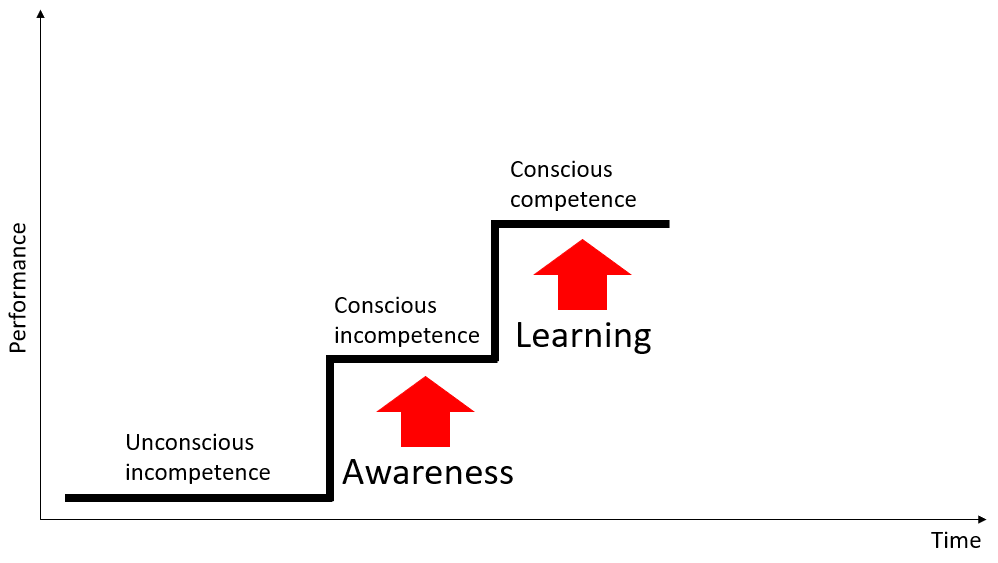
The four stages of competence, also known as the ‘conscious competence learning model’, describes the process of progressing from incompetence to competence in performing a task or activity. [1]

Stage 1. Unconscious incompetence

At this ‘unconscious incompetence’ stage, a person is unaware of their inability to perform a particular task or activity.

Stage 2. Conscious incompetence

At the ‘conscious incompetence’ stage, a person becomes aware that they are unable to perform a particular task or activity.

Stage 3. Conscious competence

A person who is aware of their incompetence may decide it is worth their time and effort to learn how to perform the particular task or activity. At the ‘conscious competence’ stage, the person can perform the task but they will require concentration and may need to think about each step.

Stage 4. Unconscious competence

In the final stage of ‘unconscious competence’, performing the task becomes second nature because the person has learnt and practiced performing the task so much. They can perform the task easily and without thinking about it. As a result, the task may be performed while executing another task.

An experienced or skilled worker often performs many work tasks and activities without needing to think about how or what to do.

Becoming conscious again

As a trainer, we often have mastered skills and we are no longer conscious about how we perform work tasks or activities. We just do it.

But as a trainer, we must explain and demonstrate to others how to perform work tasks, and to do this we have to again become conscious about the steps required to perform the task. The development of a task breakdown is a method that helps us become conscious again about how to perform a work task or activity.

A task breakdown is a step-by-step description about how to perform a task. It may also be known as a procedure or work instructions.

What is a task breakdown?

A ‘task breakdown’ is a document that breaks down a task. It describes the steps in a logical sequence to perform the particular work task or activity.

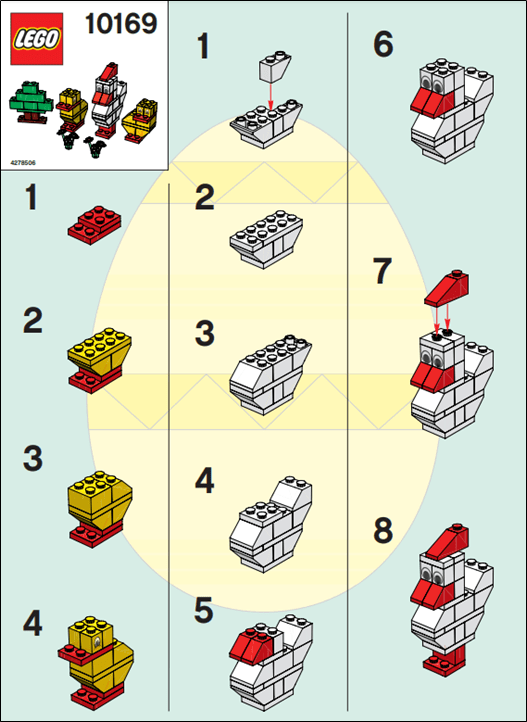
I use three analogies to help people understand and appreciate the value of a task breakdown: Lego instructions, Ikea instructions, and a cooking recipe.

The following three examples have three common features:

  • Steps are numbered
  • Illustrations are used to visually communicate
  • The outcome or desired result is shown.

Lego instructions

Ikea instructions

Cooking recipe

How can a task breakdown be developed?

Use the following six steps to develop a task breakdown.

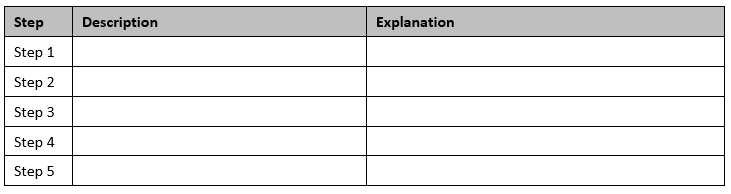
Step 1. Create 3-column table

Open a new Microsoft Word document and create a 3-column table. For example:

Step 2. Add table headings and adjust column width

The following illustrates the recommended layout and format for the task breakdown. For example:

Note: Layout and format can be modified later, if required.

Step 3. Enter step numbers

Use the first column to enter step numbers. The numbers imply a logical sequence to followed, and repeatedly use the word ‘step’ because this reinforces that each row is a step to be performed. For example:

Note: Table rows can be added or removed later, as required.

Step 4. Write brief description for each step

Perform the task or observe someone performing the task. Write a brief description for each step. For example:

Step 5. Write explanations

Write a clear and concise explanation for each step. Use illustrations, diagrams, and photos to show examples. Do not decorate or use unnecessary visuals. For example:

Important note: Remember to highlight safety requirements for the task or for a particular step.

Step 6. Review and finalise task breakdown

Ask someone to use your draft task breakdown to perform the task. Observe the person performing the task, checking the sequence of steps, and seek feedback about readability.

Check your task breakdown for grammar and spelling. Add task title, version control, and page numbers before finalising the document. For example:

Download the finished product

You can download a PDF version of the finished task breakdown for creating a task breakdown from here.

When can a task breakdown be used?

The task breakdown has multiple uses:

  • Used as a planning tool to identify required knowledge, required skills, safety requirements, and resources required to perform a task
  • Used to explain the process or performance of the task
  • Used to demonstrate the process or performance of the task
  • Used by the learner to guide them when they learn or practice performing the task
  • Used to check or assess the performance of the task
  • Used as a diagnostic tool when a person is struggling with learning or performing the task (used to identify what step the learner is stuck on).

Training session plan

A task breakdown describes a task. A session plan is used to describe the training to be delivered. The task breakdown should not make reference to the training process. It should only describes the work task or activity.

A training session plan can be developed based on the steps described by the task breakdown.

Observation checklist

A task breakdown can be converted into an observation checklist. For example:

A procedure that can be used in the workplace

A task breakdown should be written to guide performance of a work task or activity. It should describe the step-by-step procedure to be followed in a training environment or in a real workplace. The task breakdown should be the procedure to follow, no matter where the task is performed.

In conclusion

Creating a task breakdown is a basic skill that all trainers and TAFE teachers must have. A task breakdown describes the steps in a logical sequence to perform a particular work task or activity.

A task breakdown has a multitude of uses:

  • Used by the trainer as a planning tool
  • Used by the trainer when explaining and demonstrating the performance of the task
  • Used by the learner to guide them when they learn or practice performing the task
  • Used by the trainer when checking or assessing the performance of the task
  • Used by the trainer as a diagnostic tool.

Reference

[1] https://en.wikipedia.org/wiki/Four_stages_of_competence accessed 2 March 2023

Do you need help with your TAE studies?

Are you a doing the TAE40122 Certificate IV in Training and Assessment, and are you struggling with your studies? Do you want help with your TAE studies?

Ring Alan Maguire on 0493 065 396 to discuss.

Contact now!

logo otws

Training trainers since 1986

Is there a difference between knowledge training and skill training?

I have found that some people studying for their TAE40116 Certificate IV in Training and Assessment qualification struggle with understanding the difference between knowledge and skills. In this article I aim to answer the following questions:

  • What is knowledge? And what is skill?
  • What is the difference between knowledge and skill?
  • Why is it important to know the difference?

Where do we start

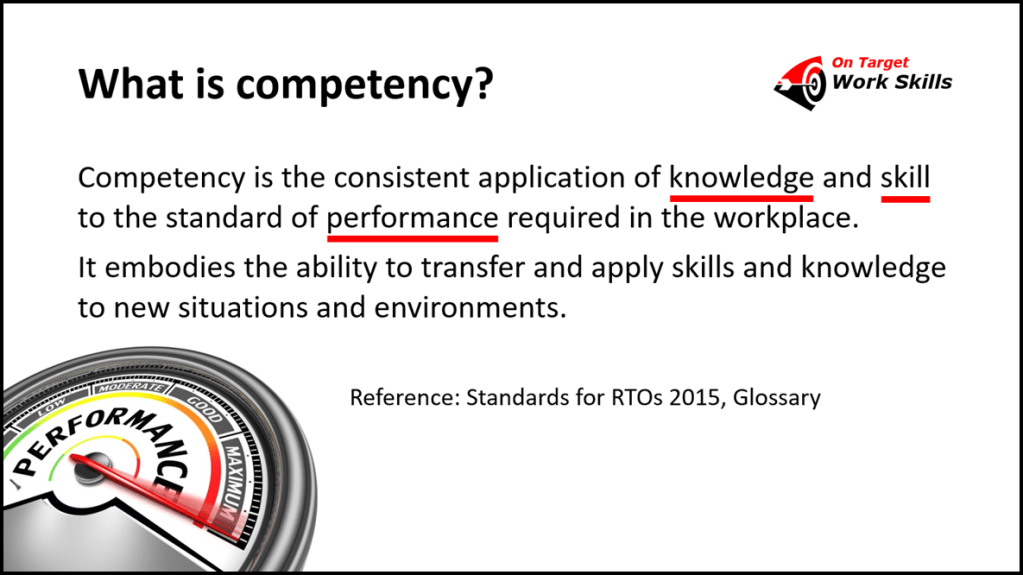
In the Australian VET system, specific terms have been defined. For example, competency is partly defined as the consistent application of knowledge and skill to the standard of performance required in the workplace.

For the purpose of this article I am focused on three words from the definition of competency: knowledge, skill, and performance.

A primary objective of VET is to help people learn how to perform work tasks and activities. The performance of a work task will require a person to apply knowledge and apply skill.

If people do not currently have the required knowledge or required skills to perform a work task, then VET will deliver training to help people learn the required knowledge and skills. The learning of required knowledge will usually precede the learning of required skills.

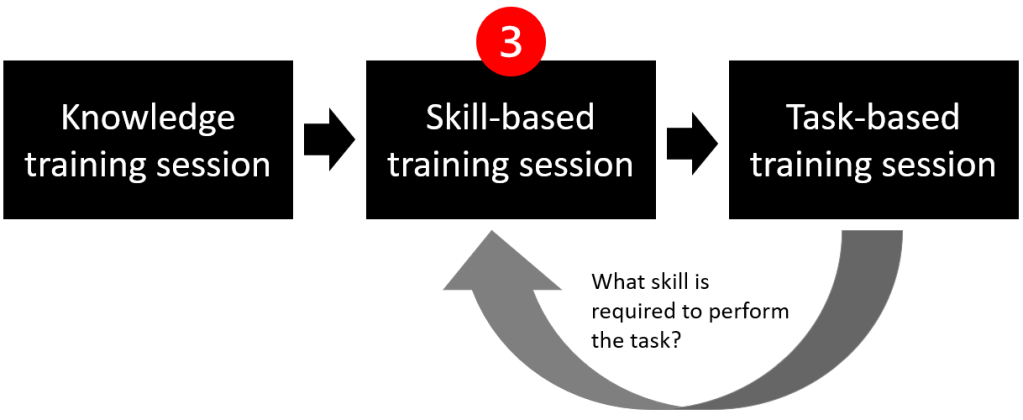
The following illustrates the typical training sequence.

After the required knowledge and skills have been learnt, then training can help people to apply their knowledge and skills to perform the work task or activity to the standard required in the workplace.

What is knowledge? What is skill? And what’s the difference?

Knowledge

What is knowledge? Can knowledge be observed?

These sound like philosophical questions. A person’s knowledge or knowledge held inside a person’s brain cannot been seen, per se.

  • Knowledge is intangible.
  • Knowledge can be factual, conceptual, or procedural.
  • Knowledge refers to learning information, principles, and concepts.
  • Knowledge is the theoretical understanding of something.
  • Knowledge refers to theory.

Knowledge learning is the process of acquiring the theory needed before progressing to the next stage of learning.

Skill

What is skill? Can skill be observed?

The performance of a skill can be observed unless it is a cognitive or thinking skill. We can observe a person performing the skill (the process) or we can see what is produced as a result (the product).

  • Skill is about doing or performing.
  • Skill refers to applying theory in practice and getting an outcome or result.
  • Skills are learnt through regular practice or trial and error.

Skill-based learning builds on knowledge by developing practical or ‘hands-on’ ability. People need knowledge and skills to perform a task.

What is the difference between knowledge and skill?

Knowledge and skill

The difference between knowledge and skill can best be explained by an example. What knowledge and skills does a chef need?

  • Before starting to cook, a chef requires the background knowledge about recipes, ingredients, food safety, types of cooking methods, and hazards in the kitchen.
  • A chef also needs to develop skills to perform specific tasks, such as reading recipes, measuring ingredients, mixing ingredients, and grilling, steaming, boiling, frying, baking, roasting, etc.

Having knowledge about something does not make a person skilled in it. And being skilled at something does not mean the person has all the required knowledge to work safely, effectively or independently.

  • A knowledge training session covers the theory.
  • A skill-based training session develops the practical or ‘hands-on’ ability to do something.

Skill and task

The difference between a skill-based and a task-based training session is subtle. Skills are used to perform a task. Both types of training session will involve doing something:

  • A skill-based training session involves a person performing a skill.
  • A task-based training session involves applying knowledge and skill to perform a task.

Learning the difference between knowledge and skill

I ensure that my TAE40116 Students learn the difference between a knowledge training session, a skill-based training session, and a task-based training session. The performance evidence for the TAEDEL401 Plan, organise and deliver group-based learning unit of competency requires three training sessions to be delivered. My TAE40116 Students deliver three consecutive training sessions: a knowledge training session, followed by a skill-based training session, followed by a task-based training session.

The overall objective of the three training sessions is to help a group of people learn to perform a simple work task. This requires the delivery of a training session to help people learn the required knowledge to perform the task, followed by a training session to help people learn a required skill to perform the task. The task-based training session puts together what was learnt in the two previous sessions to perform a task.

A trainer working in the VET sector must be able to deliver training sessions covering knowledge and training sessions covering skills. I believe that a TAE40116 Graduate must know:

  • The difference between knowledge and skill
  • The difference between delivering a knowledge training session and a skill-based training session
  • VET trains people so that they can apply knowledge and skills to perform work tasks.

I have found that many of my TAE40116 Students struggle with how to start planning for the delivery of the three different types of training sessions. I think some people find it unusual to start at the end and work backwards, rather than starting at the beginning and work forward.

The first thing is to clearly describe the objective for the task-based training session and develop a task breakdown.

(By the end of the task-based training session, the learner should be able to …)

The second thing is to clearly describe the objective for the knowledge training session. The task breakdown can be used to identify the relevant knowledge required to perform each step of the task. Also, the Knowledge Evidence can be used to identify the required knowledge.

(By the end of the knowledge training session, the learner should be able to …)

The third thing is to clearly describe the objective for the skill-based training session. The task breakdown can be used to identify the relevant skill required to perform the task. Also, the Foundation Skills can be used to identify the required skill or skills.

(By the end of the skill-based training session, the learner should be able to …)

An example

The following is an example using the ICTICT216 Design and create basic organisational documents unit of competency. Basic organisational documents may include letters, brochures, posters, forms, and procedures.

Step 1. Describe the task

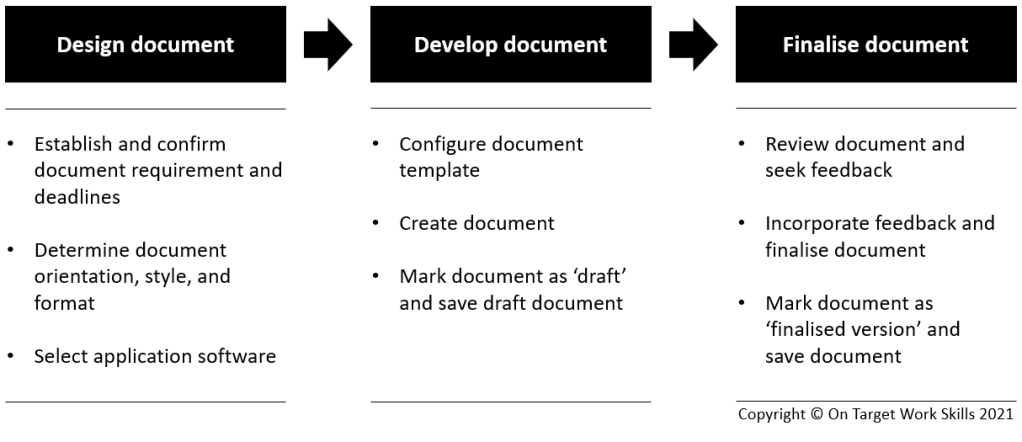
The task of designing and creating basic documents can be considered as having three stages: design document, develop document, and finalise document.

Each stage can be broken down as having three steps. The following flowchart outlines the 9-step process for designing and creating basic documents.

Step 2. Identify the required knowledge and required skills

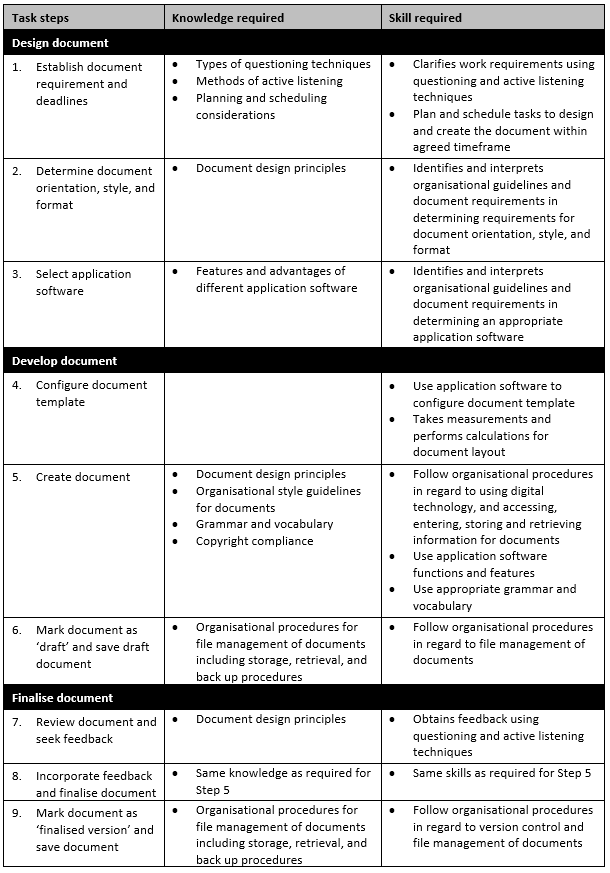
The following shows how a table can be used to identify the knowledge and skills required for each task step.

Step 3. Write objectives for training sessions

The following are selection of training objectives for the ICTICT216 Design and create basic organisational documents unit of competency.

Training objectives must be written.

Task-based training sessions

By the end of the task-based training sessions, the learner should be able to design, develop and finalise at least five types of documents: letter, brochure, poster, form, and procedure.

Knowledge training sessions

By the end of the knowledge training sessions, the learner should be able to:

  • List three types of questioning techniques
  • List three methods of active listening
  • List five planning and scheduling considerations
  • Describe three document design principles
  • Describe three features of Microsoft Word and how to apply these features when developing a document
  • Describe three features of Microsoft PowerPoint and how to apply these features when developing a document
  • Identify two advantages of using Microsoft Word and two advantages of using Microsoft PowerPoint for developing documents
  • Etc.

Note: There would be several knowledge training sessions. ‘Chunking and sequencing’ of required knowledge would determine the order and timing for each knowledge training session. Also, the characteristics and needs of the individual learners would need to be considered.

Skill-based training sessions

By the end of the skill-based training sessions, the learner should be able to:

  • Clarifies work requirements using questioning and active listening techniques
  • Plan and schedule tasks to achieve outcomes within agreed timeframes
  • Read organisational guidelines and document requirements to determine requirements for document orientation, style, and format
  • Read organisational guidelines and document requirements to select appropriate application software for different types of documents
  • Etc.

Note: There would be several skill-based training sessions. ‘Chunking and sequencing’ of required skills would determine the order and timing for each skill-based training session. Also, the characteristics and needs of the individual learners would need to be considered.

Step 4. Develop training session plans and resources

This step is outside the scope of this article.

Why is it important to know the difference between knowledge and skill-based training?

Active learning

Active learning methods are used to engage and actively involve learners in the learning process. I promote the idea that at least 50% of the available training time should be allocated for activity. I emphasis ‘at least’, therefore 60%, 75%, or 90% of the training time could be used for activities.

Learning activities

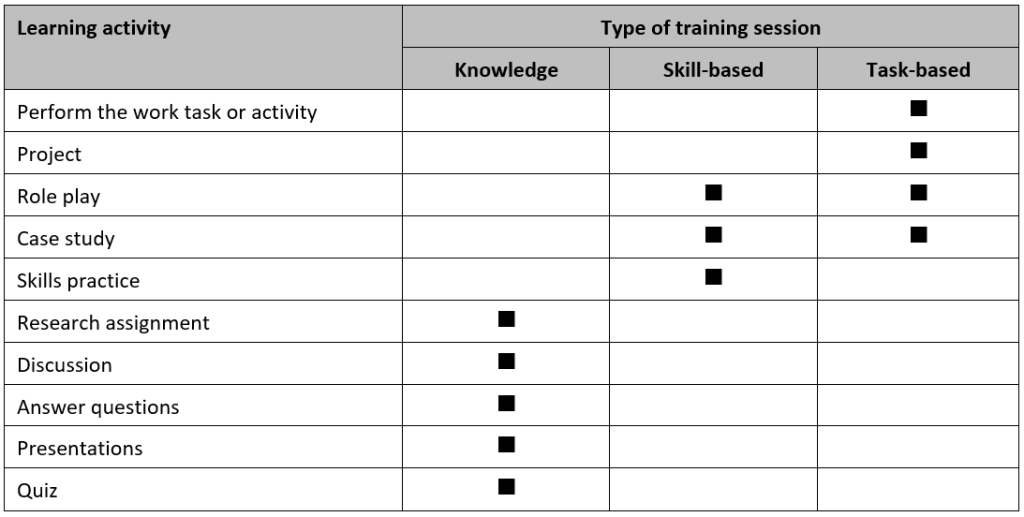
Learning activities can be done by the individual learner, by working in pairs, or by working in small groups. Types of learning activities include:

  • Perform the work task or activity
  • Project
  • Role play
  • Case study
  • Skills practice
  • Research assignment
  • Discussion
  • Answer questions
  • Presentations
  • Quiz.

The following shows the application for different types of learning activities.

Note: All vocational education and training must include the performance of the work task or activity.

Structure of a training session

Finally, and importantly, the structure of a knowledge training session will be different to the structure of a skill-based or task-based training session.

Knowledge training session (EAS)

Skill-based or task-based training session (EDP)

In conclusion

The following diagram show from the learner’s perspective that the knowledge training is followed by skill-based training, followed by task-based training. But the planning process for competency-based training starts with the task, and then works back to the required knowledge and required skill.

Key points

  • A prime objective of VET is about help people learn how to perform work tasks and activities
  • People need knowledge and skills to perform work tasks and activities
  • Knowledge and skills are different.
  • Active learning methods must be used to engage and actively involve the learner in the learning process.
  • A trainer needs to know the difference between knowledge and skills because a knowledge training session is structured differently to a skill-based training session, and different types of learning activities are used.
  • The objective of a task-based training session is to ensure a person can apply the required knowledge and required skills to perform a work task or activity.
  • Training is not complete until the learner has performed the work task or activity to the standard required in the workplace.

Do you need help with your TAE studies?

Are you a doing the TAE40122 Certificate IV in Training and Assessment, and are you struggling with your studies? Do you want help with your TAE studies?

Ring Alan Maguire on 0493 065 396 to discuss.

Contact now!

logo otws

Training trainers since 1986