Was the Certificate IV in Training and Assessment overhaul necessary?

The Certificate IV in Training and Assessment qualification has become a monotonous carousel. Every six years, it undergoes an overhaul, spinning around the same curriculum, offering the same familiar content with minor tweaks. The changes have been fundamentally superficial. Trainers and assessors have felt trapped in a cycle of endless repetition, unable to break free from the real or implied compliance requirements to upgrade. The journey has become devoid of meaningful growth and development, reduced to a mere formality that trainers must endure rather than embrace.

Background

2004

The first Certificate IV in Training and Assessment qualification was released in 2004. This TAA40104 Certificate IV in Training and Assessment qualification superseded the BSZ40198 Assessment and Workplace Training qualification.

2010

Six years later in 2010, the TAE40110 Certificate IV in Training and Assessment qualification superseded the TAA40104 Certificate IV in Training and Assessment qualification. The TAE40110 qualification required a total of 10 units:

  • 7 core units, plus
  • 3 elective units.

2016

And six years later in 2016, the TAE40116 Certificate IV in Training and Assessment qualification superseded the TAE40110 Certificate IV in Training and Assessment qualification. The TAE40116 qualification required a total of 10 units:

  • 9 core units, plus
  • 1 elective units.

Several strategic audits conducted by the national VET regulator prior to 2016 had identified that trainers and assessors lacked assessment related capability. Also, it had become apparent that many VET students had low level language, literacy and numeracy skills. The national VET regulator had demanded two units that were previously elective units to become core units for the TAE40116 qualification: TAEASS502 Design and develop assessment tools and TAELLN411 Address adult language, literacy and numeracy skills.

2022

And again, six years later in 2022, the TAE40122 Certificate IV in Training and Assessment qualification superseded the TAE40116 Certificate IV in Training and Assessment qualification. The TAE40122 qualification requires a total of 12 units:

  • 6 core units, plus
  • 6 elective units.

The developers of the TAE40122 qualification said that the previous TAE40116 qualification needed to have greater flexibility to meet the different needs within the VET sector. Two years after the release of the TAE40122 qualification, it has become apparent that this need for greater flexibility was untrue or overstated. Most RTOs delivering the TAE40122 Certificate IV in Training and Assessment qualification have selected very similar elective units. There is a trend towards a fairly standardised TAE40122 training program.

You may ask yourself, did we really need to change the Certificate IV in Training and Assessment qualifications every six years over the past 20 years?

What has changed?

The following shows sample training programs for the previous two and the current Certificate IV in Training and Assessment qualifications.

The TAE40122 qualification has two differences from its predecessors:

  • Assessment capability, and
  • Online learning and assessment capability.

Assessment capability

There is a reduced emphasis on developing assessment related capability. The unit relating to the design and development of assessment tools has been re-categorised as an elective unit. Most RTOs delivering the TAE40122 qualification are not selecting this elective unit because many TAE40116 participants found it difficult and time-consuming.

Also, the competency to plan assessment activities and processes has been integrated into the TAEASS412 Assess competence unit of competency.

Online learning and assessment capability

The capability to delivery online learning and conduct online assessment has been emphasised. Initially, this was because the Australian Government felt there was need to respond to the shift to online delivery during the COVID-19 pandemic. The technology to deliver online training and conduct online assessment is relatively easy to learn and easy to use. And each RTO can use different technology.

A person who can deliver training should have the capability to deliver online training. Likewise, a person who can conduct assessment should have the capability to conduct online assessment. It is not that difficult to learn and use the technology.

Changes to the units

There has been changes to the units for the TAE40122 qualification relating to:

  • Professional development plan
  • Training capability
  • Pre-assessment validation
  • Unreal and duplicated content.

Professional development plan

The TAEPDD401 Work effectively in the VET sector unit has introduced the need to develop a professional development plan. Every trainer and assessor working for an RTO will need to develop a professional development plan. RTOs will have a template to be completed, usually on an annual basis. This is not a difficult administrative task to perform, and it didn’t warrant inclusion into a unit.

Training capability

The duration of training sessions to a group has been reduced from 40 minutes to 30 minutes. And the group size has been reduced from ‘at least 8 learners’ to ‘at least 4 learners’. This change is significantly more unrealistic compared to the actual competencies required as a trainer working for an RTO. This means that the TAE40122 graduate will have less proven training capability compared with their predecessors.

Pre-assessment validation

The TAEASS413 Participate in assessment validation unit has introduced the need to participate in pre-assessment valuations as well as participate in assessment valuations. This is unnecessary since a person who is competent at participating in assessment valuations will have the ability to participate in pre-assessment valuations. Also, participating in pre-assessment valuations is one of many unrealistic requirements that have been added to the TAE40122 qualification. It is highly unlikely that a trainer or assessor will be involved with pre-assessment valuations. It is much more likely that trainers or assessors will be given assessment tools to use, and they will not be expected to question if the assessment tools are valid.

Unreal and duplicated content

Content that is unrealistic has been added to the TAE40122 qualification. Also, content has been duplicated across many units making the training course unnecessarily repetitive for the TAE40122 participant. Awkward and complicated language has been created and used throughout many units. All these things are making the training far more complex and difficult to understand than it needs to be.

In conclusion

In this article, I have argued that the never-ending overhaul to the Certificate IV in Training and Assessment qualification have been generally unnecessary. I have also raised some of the consequences associated with the creation of the TAE40122 qualification, such as:

  • Training capability of the TAE40122 graduate is decreased compared with their predecessors
  • Assessment capability of the TAE40122 graduate is decreased compared with their predecessors
  • Poorly-written units that include unnecessary, unrealistic and duplicated content that has made training more complex and confusing for TAE40122 participants.

Is the solution another overhaul to the Certificate IV in Training and Assessment qualification?

The standardisation of the TAE40122 qualification

The TAE40122 Certificate IV in Training and Assessment qualification was released in December 2022. After about two years since it was released, there is a trend towards a standardised TAE40122 qualification relating to the units of competency.

The qualification packaging rules for the TAE40122 Certificate IV in Training and Assessment qualification requires a total of 12 units of competency:

  • 6 core units plus
  •  6 elective units.

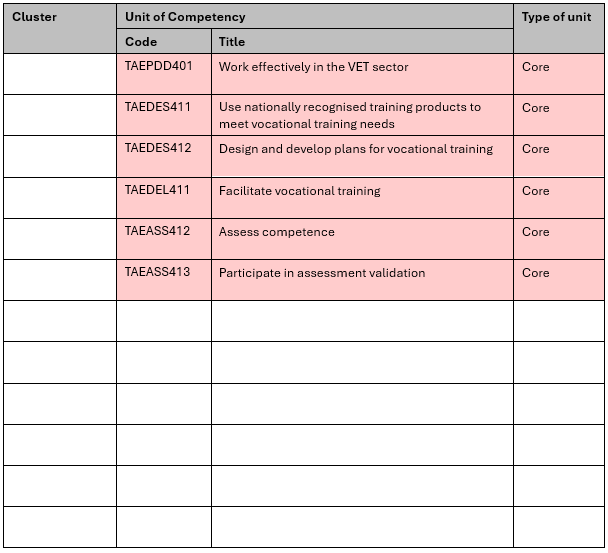
The following shows the typical sequence used when delivering the core units.

Selecting elective units

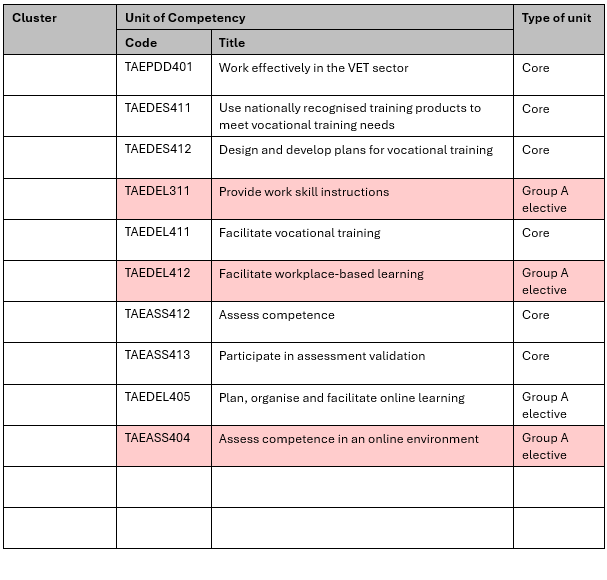
It has become common for RTOs delivering the TAE40122 qualification to select the following elective units:

  • TAEDEL311 Provide work skill instructions
  • TAEDEL412 Facilitate workplace-based learning
  • TAEDEL405 Plan, organise and facilitate online learning
  • TAEASS404 Assess competence in an online environment.

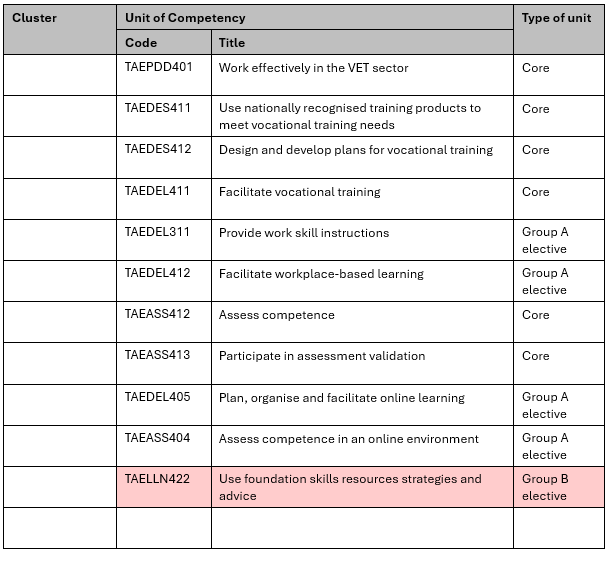
It has become common for RTOs delivering the TAE40122 qualification to select at least one of the LLN units:

  • TAELLN422 Use foundation skills resources, strategies and advice
  • TAELLN421 Integrate core skills support into training and assessment
  • TAELLN423 Integrate employability skills support into training and assessment.

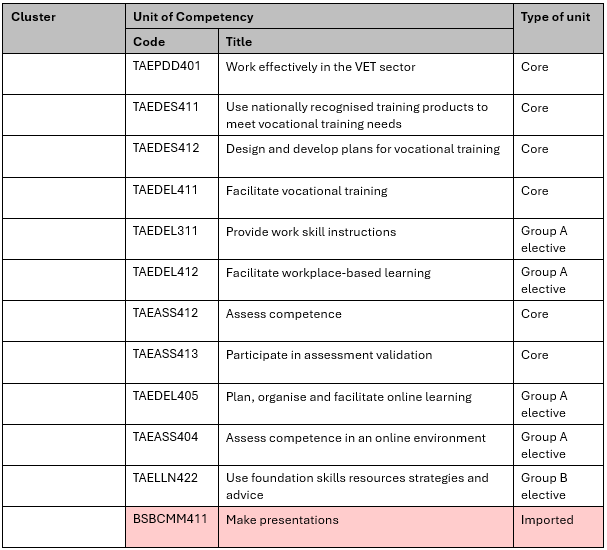
The twelfth unit may be BSBCMM411 Make presentations or TAEDEL414 Mentor in the workplace unit. And TAFEs training new TAFE teachers may select the TAEDEL416 Facilitate learning for young vocational learners unit.

For the purposes of this article, I have selected to use the BSBCMM411 Make presentations unit.

Clustering elective units

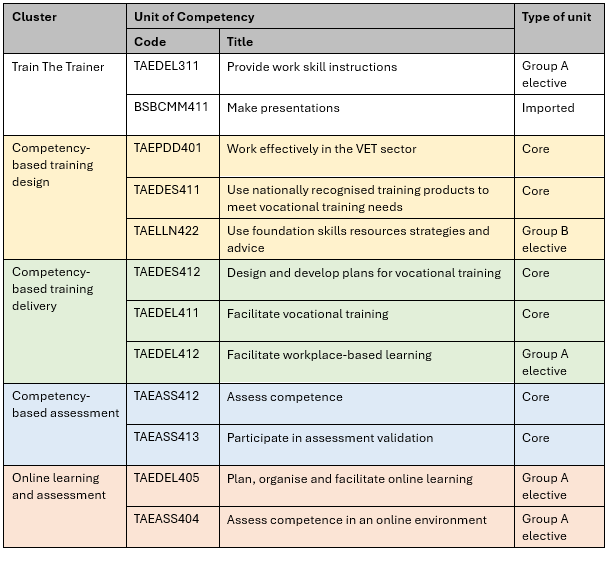
In the above examples, I have commenced sequencing and clustering units. The following example completes this clustering process.

Option 1

This option starts with some basic training skills. It is a useful approach for TAFEs that are wanting to get their new TAFE teachers delivering training under supervision as soon as possible.

The following illustrates the flow of the TAE40122 program with 5 clusters.

Option 2

This option uses the same units of competency as Option 1, but it integrates the Train The Trainer cluster with the Competency-based training delivery cluster. This approach saves duplication and consequently it saves time.

The following illustrates the flow of the TAE40122 program with 4 clusters.

In conclusion

Most TAE40122 Certificate IV in Training and Assessment programs will consist of the same units of competency, with the only variation being one or two units.

One of these unit variations will be the selection of the LLN unit. There are three to select from and not all RTOs are selecting the same LLN unit. The other variation will likely be a different unit being used instead of the BSBCMM411 Make presentations unit. Fundamentally, TAE40122 Certificate IV in Training and Assessment programs will be very similar regarding outcomes.

Some RTOs delivering the TAE40122 Certificate IV in Training and Assessment qualification will cluster units while other RTOs will take a unit-by-unit approach. Clever clustering will reduce the duplication of content, reduce the number of 30-minute training sessions needing to be planned and delivered, and it will save time.

Although there is a trend towards a standardised TAE40122 qualification relating to the units of competency, there is still variation relating to:

  • Price
  • Quality
  • Duration
  • Mode of delivery.

Do you need help with your TAE studies?

Are you a doing the TAE40122 Certificate IV in Training and Assessment, and are you struggling with your studies? Do you want help with your TAE studies?

Ring Alan Maguire on 0493 065 396 to discuss.

Contact now!

logo otws

Training trainers since 1986

VET terminology: What is an entry requirement? What is a pre-requisite?

People studying for the TAE40122 Certificate IV in Training and Assessment qualification will need to learn many new terms, such as, ‘entry requirements’ and ‘pre-requisites’. These two terms have a precise meaning when used in the context of the Australian VET system. The reference document that defines these terms is the Standards for Training Packages. [1]

Schools and universities may use the same terms but use them to mean different things.

What is entry requirement in the Australian VET system?

A VET qualification may specify a mandatory entry requirement. For example, entry into the CHC50121 Diploma of Early Childhood Education and Care qualification requires a person to hold the CHC30121 Certificate III in Early Childhood Education and Care qualification or its predecessor.

The qualification itself determines whether or not there is an entry requirement. The training provider does not set this requirement.

The following is an example of a qualification with an entry requirement.

And the following is an example of a qualification without an entry requirement.

Most qualifications do not have an entry requirement.

What is a pre-requisite in the Australian VET system?

A unit of competency may have pre-requisites. This means that the learner must be deemed competent in one or more other units before they can be assessed in this unit.

The following are some examples of units that specify pre-requisites The first three examples have one unit as a pre-requisite.  The fourth example is an example of a unit that have many pre-requisite units.

The following shows how the pre-requisite is documented within a unit of competency.

Often, pre-requisite units relate to safety.

The unit itself determines whether or not there is a pre-requisite. The training provider does not set this requirement.

The majority of units do not have pre-requisites.

In conclusion

Qualifications specify entry requirements.

Units of competency specify pre-requisites.

It is the Training Package Developers, in consultation with industry and employers, that determine if a qualification has an entry requirement and if a unit of competency has pre-requisites.

The training provider does not set these requirements and should not use these terms to describe other requirements, such as, the language, literacy or numeracy skills required prior to enrolling into a training course.

Reference:

https://www.dewr.gov.au/training-package-assurance/resources/standards-training-packages accessed 6 October 2024

Do you need help with your TAE studies?

Are you a doing the TAE40122 Certificate IV in Training and Assessment, and are you struggling with your studies? Do you want help with your TAE studies?

Ring Alan Maguire on 0493 065 396 to discuss.

Contact now!

logo otws

Training trainers since 1986

Unpacking Units: Big or Small?

This is an introductory article for people who are new to unpacking units of competency.

Units of Competency vary in size. Some units are big, and some are small.

But what do we mean by a big unit or small unit? The size of the unit may vary depending on what we are measuring, for example:

  • The time required to deliver the training to help someone, or a group learn the knowledge, skills and how to perform the task or tasks described by the unit
  • The time and effort required to learn the knowledge, skills and how to perform the task or tasks described by the unit, or
  • The time required to perform the task or tasks.

In this article, I am primarily focused on the time required to perform the task or tasks described by the unit. This can have an impact on the time and effort required to design, develop and deliver training or the time and effort required learn how to perform the task or tasks.

We may think that looking at the number of elements and performance criteria would tell us if it were a big or small unit. But the number of elements and performance criteria can be deceptive.

A unit with many elements and performance criteria may be a small unit, and a unit with few elements and performance criteria may be a big unit.

A big unit that looks small

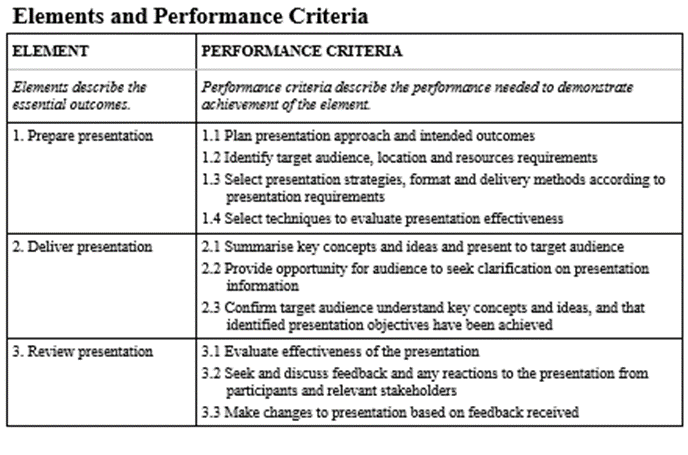
Let’s look at the BSBCMM411 Make presentations unit of competency. This unit has 3 elements and a total of 10 performance criteria.

The time required to plan and prepare for a presentation can vary widely depending on several factors, including the complexity of the topic, the length of the presentation, the audience, and the presenter’s familiarity with the subject. Here are some general guidelines:

Simple presentations (with a duration of 10-15 minutes)

  • Research and content development: 2-4 hours
  • Creating visual aids (for example, PowerPoint slides): 1-2 hours
  • Rehearsal and practice: 1-2 hours
  • Total time: Approximately 4-8 hours

Moderate presentations (with a duration of 20-30 minutes)

  • Research and content development: 4-8 hours
  • Creating visual aids: 2-4 hours
  • Rehearsal and practice: 2-3 hours
  • Total time: Approximately 8-15 hours

Complex presentations (with a duration of 45 minutes or more)

  • Research and content development: 8-12 hours
  • Creating visual aids: 4-6 hours
  • Rehearsal and practice: 3-5 hours
  • Total time: Approximately 15-23 hours

The total time required to prepare, deliver and review a presentation is significant. Therefore, this may be considered as a ‘big’ unit of competency although it may look like a ‘small’ unit.

A small unit that looks big

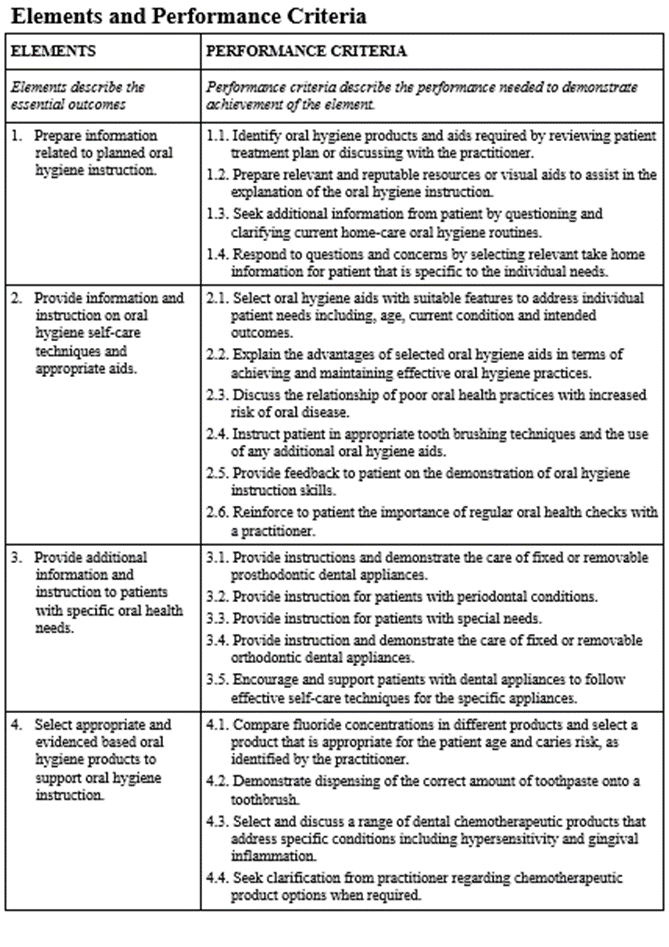
Let’s look at the HLTDEN028 Provide effective oral hygiene instruction to patients with an oral health treatment plan unit of competency. This unit has 4 elements and a total of 19 performance criteria. That is nearly double the amount performance criteria that the BSBCMM411 Make presentations unit has.

I have been told by a dental assistant that the task of providing oral hygiene instruction to patients take approximately 5 to 15 minutes. Therefore, this may be considered as a ‘small’ unit of competency to perform. However, it would require considerable time and effort by someone to learn the required knowledge that underpins this unit.

In conclusion

The size of a unit is not solely determined by the number of elements and performance criteria.

People studying for their TAE40122 Certificate IV in Training and Assessment qualification will need to develop training plans for two units of competency. They will often be told to select small units. But it isn’t always obvious what is a small unit or a big unit. There is a range of factors that may determine the size of a unit, for example:

  • The number of elements and performance criteria
  • The number of foundation skills
  • The quantity of knowledge evidence
  • The depth and breadth of the knowledge evidence
  • The complexity of the task or tasks covered by the unit of competency
  • The time required to perform the task or tasks covered by the unit of competency.

Some units of competency focus on a single task, while others cover multiple tasks.

Do you need help with your TAE studies?

Are you a doing the TAE40122 Certificate IV in Training and Assessment, and are you struggling with your studies? Do you want help with your TAE studies?

Ring Alan Maguire on 0493 065 396 to discuss.

Contact now!

logo otws

Training trainers since 1986

How to conduct pre-assessment validation: a step-by-step procedure

Yesterday, I was tutoring someone who is currently doing their TAE40122 Certificate IV in Training and Assessment at a TAFE. This person was needing help to understand what was required to conduct a pre-assessment validation.

The TAE Trainer at the TAFE doesn’t seem to know how to explain the topic. And at the previous week’s training session, the TAE Students were set up in small groups to figure out how to conduct a pre-assessment validation by themselves. The TAE Trainer was absent during the small group work. It sounded a bit chaotic. It was not the fault of the TAE Students, but the training session involved the naïve leading the naïve. No learning was achieved.

The person seeking my help as a TAE Tutor wanted to understand the topic and believed that there had to be a method to conducting pre-assessment validation. This person was wanting a step-by-step procedure.

Here are the key points we covered during the tutoring session.

Terminology

First, I started with explaining and defining what assessment validation is.

We evaluate training. But we validate assessment.

Most people understand that training is evaluated. Most people have attended training when they have been asked to complete a feedback form that can be used to help evaluate the training so that future training can be improved.

The validation of assessment can be thought of as an evaluation of assessment.

Next, I went to the glossary from the Standards for RTOs 2015. This is where we can find the definition of validation, as it is used in the Australian VET system.

Validation is the quality review of the assessment process. Validation involves checking that the assessment tool/s produce/s valid, reliable, sufficient, current and authentic evidence to enable reasonable judgements to be made as to whether the requirements of the training package or VET accredited courses are met. It includes reviewing a statistically valid sample of the assessments and making recommendations for future improvements to the assessment tool, process and/or outcomes and acting upon such recommendations. [1]

Key points from the definition:

  • Quality review of the assessment process
  • Checking the assessment tool
  • Reviewing a statistically valid sample of the assessments
  • Making recommendations for future improvements.

Difference between pre-assessment validation and assessment validation

The TAEASS413 Participate in assessment validation unit of competency specifies that the TAE Student must:

  • participate in the pre-assessment validation of at least 3 assessment tools before they are first used with candidates
  • participate in the validation of the 3 assessment tools after they have been used to assess candidates.

The following table show the fundamental difference between pre-assessment validation and assessment validation.

Pre-assessment valuation will occur when an RTO has developed its own assessment tools or when the RTO purchases assessment tools to be used. The RTO must take responsibility for the quality of the assessment tools used, and this includes checking them before use.

Some TAE Students probably wish their RTO delivering the TAE40122 qualification had conducted a pre-assessment validation of the assessment tools being used to deliver the TAE40122 Certificate IV in Training and Assessment. Many TAE40122 assessment tools are dreadful.

A step-by-step procedure

The following is a step-by-step procedure for conducting a pre-assessment validation that I discussed and demonstrated during yesterday’s tutoring session.

Step 1. Unpack competency standard

Unpacking‘ means reading, analysing and understanding the requirements specified in the Unit of Competency and its Assessment Requirements.

Step 2. Review Pre-assessment Validation Report template

RTO will most likely have a template or form to be used to guide the pre-assessment validation process, and report findings. For the purposes of this article, let’s call this document a ‘Pre-assessment Validation Report’ template.

This template is likely to include checking the assessment tool for following:

  • Compliance with the principles of assessment
  • Compliance with the rules of evidence
  • Readability and usability of the assessment tool.

Step 3. Review Unit Mapping document

Review the Unit Mapping document. This includes:

  • Check that Unit of Competency and its Assessment Requirements have been correctly and completed copied into the Unit Mapping document
  • Check that every row has been completed with at least one piece of evidence planned to be gathered
  • Check that the assessment method is appropriate.

Step 4. Cross-check the unit mapping with assessment instruments

Check details from the Unit Mapping document are found in the assessment instruments.

Step 5. Review assessment instructions and assessment instruments

Conduct a detailed review of assessment instructions and assessment instruments.

Step 6. Complete Pre-assessment Validation Report template

Complete the Pre-assessment Validation Report template. This includes documenting your finding, justification that supports your findings, and recommendations for improvement.

In conclusion

A pre-assessment valuation can be complex and time-consuming. A pre-assessment valuation meeting may require two hours or more, depending on the quantity and complexity of the assessment tool. Also, the time can depend on how prepared and how experienced the valuators are.

The TAEASS413 Participate in assessment validation unit of competency requires an experienced VET practitioner to lead validation activities. [2] Some RTOs delivering the TAE40122 qualification have rightly interpreted this to mean that the TAE Trainer leads the pre-assessment valuation meetings, and the TAE Students participate at these meetings. Some RTOs are not doing the right thing and are not providing an experienced VET practitioner to lead these meetings.

It is a shame that some RTOs delivering the TAE40122 qualification do not provide sufficient training, do not demonstrate good practice, and do not provided the level of support to help their TAE Students learn.

References

[1] https://www.asqa.gov.au/glossary accessed 5 September 2024

[2] https://training.gov.au/Training/Details/?id=TAEASS413 accessed 5 September 2024

Do you need help with your TAE studies?

Are you a doing the TAE40122 Certificate IV in Training and Assessment, and are you struggling with your studies? Do you want help with your TAE studies?

Ring Alan Maguire on 0493 065 396 to discuss.

Contact now!

logo otws

Training trainers since 1986