Prepare for assessment validation by unpacking the unit

We will unpack a unit of competency as a starting point for various activities, such as:

  • Designing and developing competency-based assessment
  • Designing and developing competency-based training
  • Preparing for assessment validation.

The unpacking of a unit of competency will be slightly different depending on what activity we are doing. In this article, I will focus on unpacking units of competency when we are preparing to conduct assessment validation.

Unpacking units of competency when preparing for assessment validation

‘Unpacking’ means reading, analysing, and understanding the contents of a unit of competency. Here is a 4-step process that can be used to unpack a unit of competency when preparing for assessment validation:

  • Step 1. Read the Application statement
  • Step 2. Check the Performance Evidence
  • Step 3. Check the Assessment Conditions
  • Step 4. Quick review of the Elements and Performance Criteria.

Step 1. Read the Application statement

The Application statement is often a summary of the elements of competency. This can give us a quick overview of the unit of competency. Also, other useful contextual information may be found in the Application statement.

Example 1. BSBCMM411 Make presentations

In the following example, the Application statement uses the elements of competency to give an overview of the unit of competency.

Example 2. CHCECE037 Support children to connect with the natural environment

In the following example, the Application statement includes three relevant pieces of information about this unit of competency.
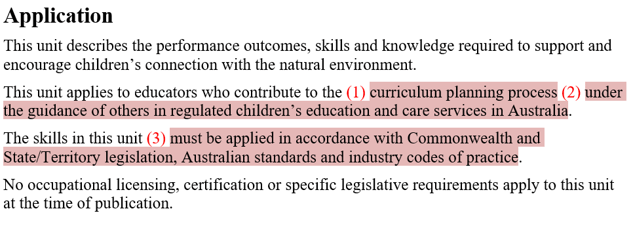
Nowhere else in the unit does it refer to the curriculum planning process. This is the first important piece of contextual information. A second piece of contextual information refers to the early childcare educator performing work under the guidance of others. And a third piece of contextual information refers to performing work in accordance with relevant legislation and industry standards. Early childcare and education is a highly regulated industry.

Step 2. Check the Performance Evidence

The Performance Evidence will consist of essential evidence of performance that must be gathered. You can use the following questions to identify relevant evidence requirements.

  • Is the quantity of performance evidence specified?
  • Is the type of performance evidence specified?
  • Are Foundation Skills accessible items?

Example 3. BSBCMM411 Make presentations

In the following example, a quantity of performance evidence is specified. It requires evidence that at least two presentations. Also, the presentations must be different.

Therefore, during the assessment validation we will be checking that there is performance evidence of at least two presentations is planned to be gathered (pre-assessment validation) or has been gathered (post-assessment validation). And checking that the presentations are different.

Example 4. CHCECE037 Support children to connect with the natural environment

In the following example, a quantity and type of performance evidence is specified. It requires performance evidence to be gathered on three occasions. At least one of those occasions must involve Aboriginal and/or Torres Strait Islander peoples’ use of the natural environment. Also, at least one occasion must be indoors and at least one occasion must be outdoors.
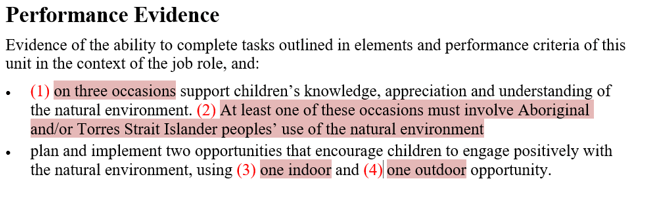
Therefore, during the assessment validation we will be checking that the specified quantity and type of performance evidence is planned to be gathered (pre-assessment validation) or has been gathered (post-assessment validation).

Example 5. SITHCCC025 Prepare and present sandwiches

In the following example, it shows a very detailed specification relating to the quantity and type of performance evidence. Also, it includes other details such as completing the task within commercial time constraints.

Therefore, during the assessment validation we will be checking that the specified performance evidence is planned to be gathered (pre-assessment validation) or has been gathered (post-assessment validation).

Example 6. BSBCMM411 Make presentations

Some units of competency may specify that Foundation Skills are accessible items. In the following example, it states that performance evidence relating to elements, performance criteria and foundation skills must be gathered.

Therefore, during the assessment validation we will be checking that evidence of all specified Foundation Skills are planned to be gathered (pre-assessment validation) or has been gathered (post-assessment validation). This is in addition to checking that evidence of all Performance Criteria are planned to be gathered (pre-assessment validation) or has been gathered (post-assessment validation).

Example 7. CHCECE037 Support children to connect with the natural environment

In the following example, it does not state that performance evidence relating to Foundation Skills must be gathered.
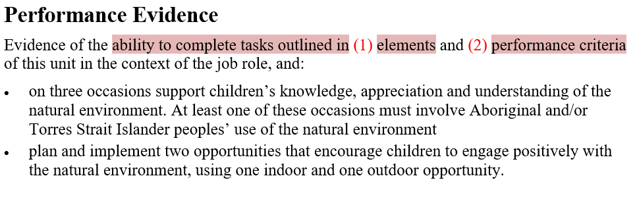
This is an example when there is no information about Foundation Skills being assessable items. We may need to check our RTO’s policies and procedures to determine if Foundation Skills are to be assessed.

Step 3. Check the Assessment Conditions

The Assessment Conditions may consist of relevant information to be checked during assessment validation. You can use the following questions to identify any relevant requirements.

  • Is the location for performing assessment tasks specified?
  • Is the access to equipment, materials, or other resources specified?
  • Is a method of assessment specified?
  • Do assessors need to satisfy any specified requirements?

Example 8. BSBCMM411 Make presentations

In the following example, the Assessment Conditions permit the performance specified by the unit of competency to occur in a workplace or simulated workplace. It is important to note that the simulated workplace must have conditions that are typical of those in a real workplace.

Example 9. CHCECE037 Support children to connect with the natural environment

In the following example, the Assessment Conditions states that the performance specified by the unit of competency must occur in a workplace. The workplace must be a regulated children’s education and care service, and it must be in Australia. Also, it should be noted that there must be children involved.
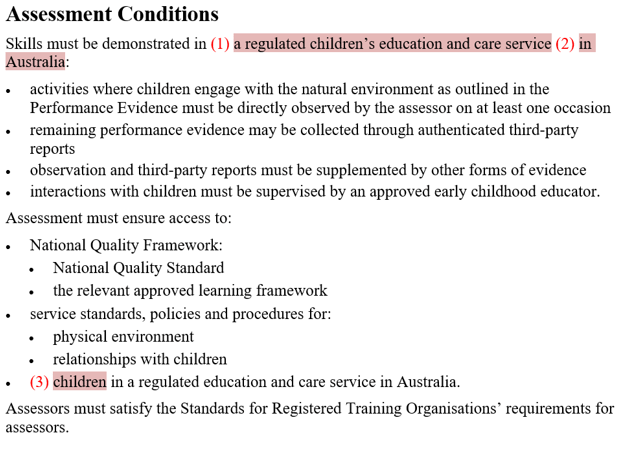
Therefore, during the assessment validation we will be checking that the assessment has occurred in a regulated children’s education and care service in Australia, and children were involved.

Example 10. SITHCCC025 Prepare and present sandwiches

In the following example, the Assessment Conditions permit the performance specified by the unit of competency to occur in a workplace or simulated workplace. It should be noted that the simulated workplace needs to be an industry-realistic kitchen, and it must be serving customers.
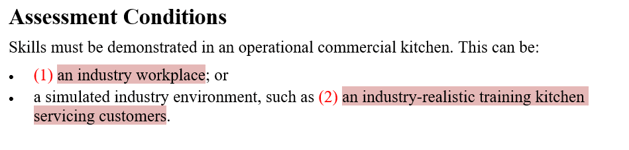
Therefore, during the assessment validation we will be checking that assessment has occurred in an operational commercial kitchen.

Example 11. SITHCCC025 Prepare and present sandwiches

In the following example, the Assessment Conditions has a very long list of items that must be available in the operational commercial kitchen for the assessment.
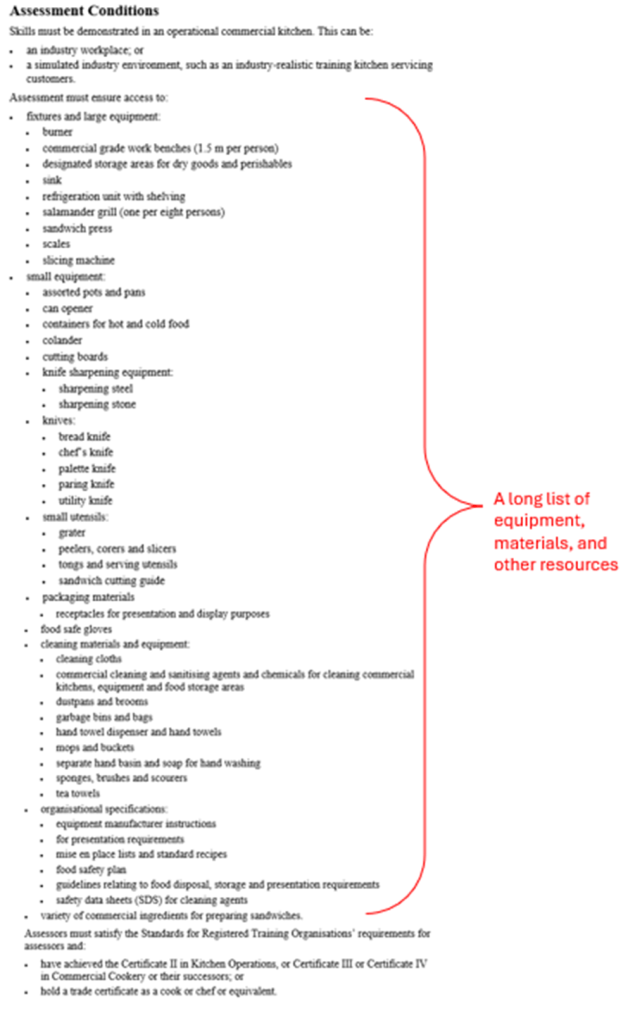
Therefore, during the assessment validation we will be checking that assessment has occurred in an operational commercial kitchen with access to all listed items of equipment, materials and other resources.

Example 12. CHCECE037 Support children to connect with the natural environment

In the following example, the unit of competency that specifies methods of gathering evidence.

Therefore, during the assessment validation we will be check that at least one occasion has been directly observed by the assessor. Also, we will check that observations and third-party reports are supplemented by other forms of evidence.

Example 13. SITHCCC025 Prepare and present sandwiches

In the following example, the Assessment Conditions specify additional requirements for assessors.

Therefore, during the assessment validation we will be checking that the assessors comply with the specified requirements to be an assessor.

Step 4. Quick review of the Elements and Performance Criteria

When preparing to conduct an assessment validation, I will not spend much time reading the Elements, Performance Criteria, Foundation Skills or Knowledge Evidence. This is because I will be spending a lot of time checking these in detail during the assessment validation.

However, it is worthwhile to quickly review the Elements and Performance Criteria. You may find something relevant without getting into the details. For example:

  • Is the unit describing the performance of one work task?
  • Is the unit describing the performance of more than one work task?
  • Is the unit describing a behavioural or interpersonal skill?
  • Is the unit primarily describing knowledge?

In conclusion

Effectively ‘unpacking’ a unit of competency is an essential activity in preparing for thorough and meaningful assessment validation. The outlined four-step approach provides a practical framework for this crucial preparatory work. By methodically reading the Application statement (Step 1), checking the Performance Evidence and Assessment Conditions through targeted questions (Steps 2 and 3), and conducting a preliminary review of the Elements and Performance Criteria (Step 4), assessment validators can gain a crucial understanding of the unit’s scope and requirements.

In short, taking the time to understand the unit first makes assessment validation clearer and more effective.

Do you need help with your TAE studies?

Are you a doing the TAE40122 Certificate IV in Training and Assessment, and are you struggling with your studies? Do you need help with your TAE studies?

Ring Alan Maguire on 0493 065 396 to discuss.

Contact now!

logo otws

Training trainers since 1986

What are nominal hours?

In this article, the following shall be explained:

  • Nominal hours are used for reporting purposes
  • Nominal hours are used for funding purposes
  • Nominal hours are not the same as actual training hours

Nominal hours are used for reporting purposes

Nominal hours are nationally agreed hours that have been agreed to by all state and territory governments for use in national reporting of VET data only. [1]

RTOs use ‘nominal hours’ when reporting via AVETMISS.

AVETMISS stands for the Australian Vocational Education and Training Management Information Statistical Standard. It is a national data standard which ensures the consistency of VET information reported by RTOs.

Nominal hours are used for funding purposes

Nominal hours reflect the anticipated time taken to deliver and assess the outcomes of a unit of competency excluding unsupervised delivery or the time taken for repeated practical application of skills. Nominal hours are primarily developed for funding purposes. [2]

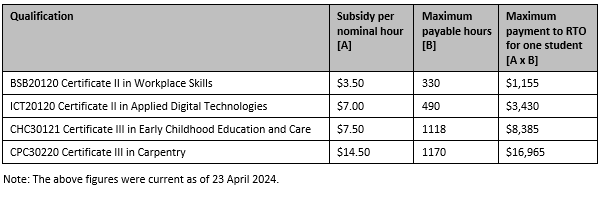
Each state or territory government can specify the dollar amount it will pay an RTO that has been contracted to deliver government-subsidised or government-funded training. For example, the following shows the funding paid to contracted RTOs by the Victorian government for the delivery of four different qualifications. [3]

Units of competency are the building blocks for qualifications. And each unit of competency is allocated a number of nominal hours. For example, the following shows the nominal hours for a BSB20120 Certificate II in Workplace Skills qualification. [4]

Nominal hours are used to calculate the amount of money the state or territory government will pay an RTO. If a contracted RTO delivered the BSB20120 Certificate II in Workplace Skills qualification with the above units of competency in Victoria, the RTO would claim $962.50 (275 nominal hours x $3.50).

Nominal hours are not the same as actual training hours

RTOs use nominal hours for reporting and funding purposes, not to determine the training duration.

While nominal hours might influence actual training time, most RTOs deliver fewer ‘actual training hours’ than ‘nominal hours’.

The reason? Supervised hours are expensive. They require trainer and assessor involvement, driving up costs. So, RTOs often look for ways to minimise supervised hours.

In conclusion

If you are a TAE40122 student, you may be required to develop a training plan covering an entire unit of competency with a duration equal to the nominal hours for that unit. This is unreal. Usually, an RTO will deliver less ‘supervised hours of training’ than the ‘nominal hours’.

Nominal hours = Dollars

Nominal hours ≠ Time

However, if you must do what your training provider wants, then you may like to select a unit with a smaller number of ‘nominal hours’.

For example:

The number of ‘training days’ will determine the amount of your time and effort that will be required to design the training plan. It will take a greater amount of time and effort to design 8.5 days of training compared with designing 2 or 3 days of training.

References

[1] Nationally agreed nominal hours (https://www.ncver.edu.au/rto-hub/statistical-standard-software/nationally-agreed-nominal-hours accessed 23 April 2024)

[2] Victorian Purchasing Guide for BSB Business Services Training Package, Release 8, Page 26 (https://www.education.vic.gov.au/Documents/training/providers/rto/vpgbsb-current.pdf accessed 23 April 2024)

[3] Funded Programs Report (https://www.education.vic.gov.au/svts/ accessed 23 April 2024)

[4] Nationally agreed nominal hours (https://www.ncver.edu.au/rto-hub/statistical-standard-software/nationally-agreed-nominal-hours accessed 23 April 2024)

Do you need help with your TAE studies?

Are you a doing the TAE40122 Certificate IV in Training and Assessment, and are you struggling with your studies? Do you want help with your TAE studies?

Ring Alan Maguire on 0493 065 396 to discuss.

Contact now!

logo otws

Training trainers since 1986
Conquering studies as an adult learner: Tips for success

This article has been written for adult learners who have not studied for a long time and are undertaking studies for a TAE40116 or TAE40122 qualification. It’s a brave, rewarding, and sometimes daunting step to commence studying for a qualification as an adult learner. Here are some tips to help you navigate this journey.

Embrace the refresh

You already have a wealth of life experience. Use it! Draw connections between what you’re learning and your past experiences. This will make the material more relatable and engaging.

Rekindle your studying skills

Start small: Don’t overwhelm yourself. Begin with short, focused study sessions and gradually increase the duration.

Find your rhythm: Experiment with different times of day and environments to discover when and where you focus best.

Prioritise and plan: Adult life often means juggling commitments at home, at work and your studies. Block out dedicated study time in your calendar and stick to it as much as possible.

Master the material

Active learning: Don’t just passively read. Take notes, rewrite concepts in your own words, and summarise key points.

Find your learning style: Do you learn best visually, by doing, or through discussion? Explore different study methods and find what works for you.

Don’t be afraid to ask for help

Seek help from the trainer: Don’t hesitate to ask your trainer questions.

Support services: Utilise the support services from your training provider.

Form a study group: Find colleagues who are undertaking the same training to discuss ideas, share resources, and motivate each other.

Seek help from a tutor: Get help from a tutor if your trainer and support services from the training provider are insufficient for your needs.

Stay motivated

Set goals: Goals will keep you focused and give you a sense of accomplishment.

Focus on the why: Remind yourself of your larger goal for pursuing this qualification. This will provide the drive to keep going when things get tough.

Celebrate milestones: Acknowledge and reward yourself for completing tasks, achieving goals, and overcoming challenges.

In conclusion

You have the life skills, intelligence, and determination to succeed. Be kind to yourself. There will be bumps along the road.

If you are finding your studies are difficult, please remember that it isn’t you. It is common for many people studying for their TAE40116 or TAE40122 qualification to find it difficult, challenging, confusing, overwhelming, frustrating, and exhausting. It is the training provider that has created the training and assessment experience that is dreadful.

Before concluding, I would like to highlight the following five tips for study success:

  • Get support from your trainer
  • Get support from your training provider
  • Get support from a tutor
  • Make a plan and allocate time for your study
  • Focus on one thing at a time.

By embracing these tips and believing in yourself, you’ll be well on your way to conquering your studies and making progress towards achieving your qualification!

Do you need help with your TAE studies?

Are you a doing the TAE40122 Certificate IV in Training and Assessment, and are you struggling with your studies? Do you want help with your TAE studies?

Ring Alan Maguire on 0493 065 396 to discuss.

Contact now!

logo otws

Training trainers since 1986

How to develop questions and sample answers to gather Knowledge Evidence

I recently published an article titled, ‘Assessment methods, assessment tasks and other jargon used by RTOs’. It provided examples that mainly focused on gathering Performance Evidence.

In this article, I shall focus on how to gather Knowledge Evidence:

  • Step 1. Identify the required knowledge evidence
  • Step 2. Write questions to gather the required knowledge evidence
  • Step 3. Develop sample answers or marking guide
  • Step 4. Add details to the assessment mapping matrix

Step 1. Identify the required knowledge evidence

All units of competency specify the required knowledge evidence. The following is an example of the knowledge evidence specified for the BSBCMM411 Make presentations unit of competency.

Step 2. Write questions to gather the required knowledge evidence

The RTO must explicitly gather the Knowledge Evidence. This will be achieved by getting the candidate to answer questions that have been designed specifically to gather all the Knowledge Evidence. Generally, this means that at least one question will be developed to gather each item of Knowledge Evidence (each bullet point).

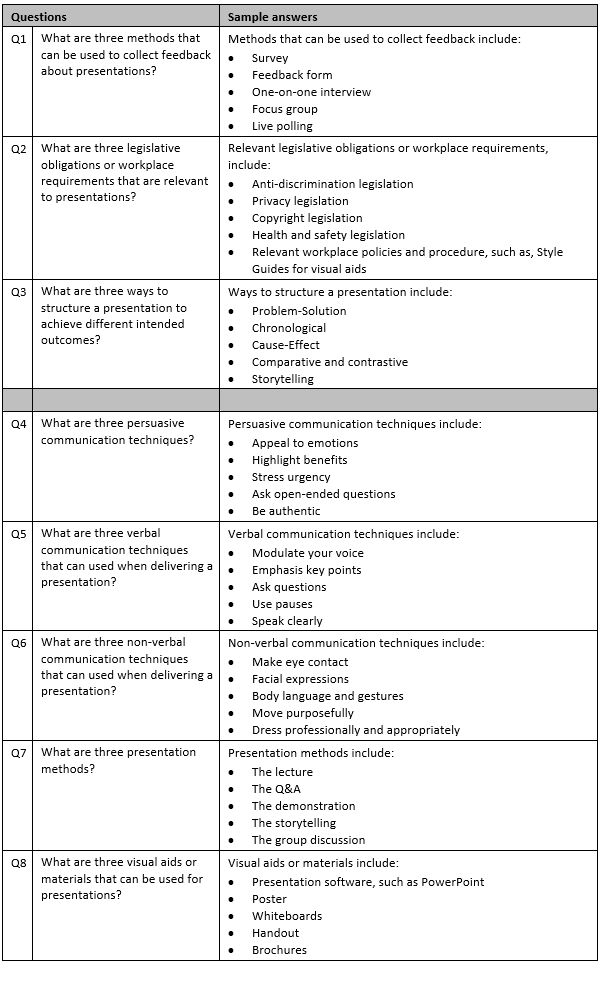
The following is an example of questions written to gather the Knowledge Evidence specified for the BSBCMM411 Make presentations unit of competency.

Note: Answers to questions may be oral or written.

Step 3. Develop sample answers or marking guide

The RTO must ensure that assessments are reliable. In other words, evidence presented for assessment should be consistently interpreted and assessment results are comparable irrespective of the assessor conducting the assessment. Sample answers or marking guide are used to support reliable assessment practices.

The following is an example of sample answers for the questions that have been designed to gather the Knowledge Evidence specified for the BSBCMM411 Make presentations unit of competency.

Note: AI was used to generate ideas for the sample answers.

Step 4. Add details to the assessment mapping matrix

The following is an example of an assessment mapping matrix that provides cross referencing details relating to the gathering of Knowledge Evidence for the BSBCMM411 Make presentations unit of competency.

In conclusion

All units of competency specify the required knowledge evidence. And all RTOs must explicitly gather the specified Knowledge Evidence. This article has outlined a 4-step process for writing questions and sample answers to gather knowledge evidence.

Here are some other relevant articles about gather knowledge evidence:

Do you need help with your TAE studies?

Are you a doing the TAE40122 Certificate IV in Training and Assessment, and are you struggling with your studies? Do you want help with your TAE studies?

Ring Alan Maguire on 0493 065 396 to discuss.

Contact now!

logo otws

Training trainers since 1986

Assessment methods, assessment tasks and other jargon used by RTOs

This article aims to clarify some of the jargon used by RTOs relating to assessments:

  • Assessment methods
  • Assessment instruments
  • Assessment tasks
  • Assessment mapping matrix.

Assessment methods

ASQA has published a Guide to assessment tools. This is a reputable source of information about assessment.

On pages 4 and 5 of this guide, it describes four types of assessment methods:

  • Questioning
  • Direct observation
  • Product based methods
  • Third-party evidence.

All other assessment methods are a variation of these four assessment methods. For example, an interview or competency conversation is questioning. And a Portfolio of Evidence is a product based method.

Questioning is applicable for gathering knowledge evidence. The other three types of assessment methods are applicable to gathering performance evidence.

Assessment instruments

The assessment instrument is the document used to support the gathering of evidence and recording the assessor’s judgements about the quality of the evidence (Satisfactory or Not Yet Satisfactory).

The following shows the assessment instrument relevant for each assessment method.

Assessment tasks

RTOs will use assessment tasks to organise and implement their assessment strategies. I would usually plan to gather the knowledge evidence first unless otherwise stated. Therefore, the first assessment tasks would be Knowledge Questions (the candidate provides oral or written answers to questions).

One or more assessment tasks would be needed to gather sufficient performance evidence. These days, many units of competency specify a frequency or volume of Performance Evidence.

For example, the Performance Evidence for the BSBCMM411 Make presentations states that the candidate must demonstrate the ability to complete the tasks outlined in the elements, performance criteria and foundation skills of this unit, including evidence of the ability to prepare and deliver at least two different presentations.

Therefore, one assessment task can be used to gather the knowledge evidence and two assessment tasks can be used to gather the performance evidence.

The following table shows the relationship between assessment tasks and assessment methods.

Unit of Competency: BSBCMM411 Make presentations

The above table shows that Assessment Task 2 uses two assessment methods to gather the performance evidence (direct observation and the review of product, and Assessment Task 3 also uses two assessment methods (third-party report and the review of product).

In this example, products may include relevant emails, presentation plans, feedback forms, visual aids, presentation materials, evaluation reports, self-reflections, etc.

Assessment mapping matrix

Competency-based assessment is assessment based the competency, and competency is described by the Unit of Competency and its associated Assessment Requirements. We use a matrix to visually connect the unit of competency with the assessment methods or assessment tasks.

There are two types of assessment matrix:

  • Mapping against assessment methods
  • Mapping against assessment tasks

Mapping assessment methods

The following is an example a mapping the assessment methods for the BSBCMM411 Make presentations unit of competency.

The above example visually shows that questioning is not being used to gather the performance evidence.

Mapping assessment tasks

The following is an example a mapping the assessment tasks for the BSBCMM411 Make presentations unit of competency.

The above example visually shows that questioning is not being used to gather the performance evidence.

Adding cross-referencing details

The following is an example of an assessment mapping matrix that provides cross referencing details relating to the assessment instruments for the BSBCMM411 Make presentations unit of competency.

The level of detail in the above example supports the review, validation or audit processes conducted by an RTO.

In conclusion

The jargon associated with competency-based assessments can be confusing, especially if the person is new to the Australian VET system. And using a matrix for mapping the assessment may take time to understand.

Competency-based assessment is assessment based the competency. We use a matrix to visually connect the unit of competency with the assessment methods or assessment tasks.

Step 1. Copy and paste the unit of competency

Step 2. Identify the assessment methods or assessment tasks that will be used to gather evidence of competency

My preference is to use assessment tasks rather than assessment methods to organise and implement the assessments.

Do you need help with your TAE studies?

Are you a doing the TAE40122 Certificate IV in Training and Assessment, and are you struggling with your studies? Do you want help with your TAE studies?

Ring Alan Maguire on 0493 065 396 to discuss.

Contact now!

logo otws

Training trainers since 1986