It is no secret that the TAE40122 Certificate IV in Training and Assessment is disliked by many people.
Every six months over the past 2 years I have conducted a poll to find out if people were enjoying their Certificate IV in Training and Assessment.
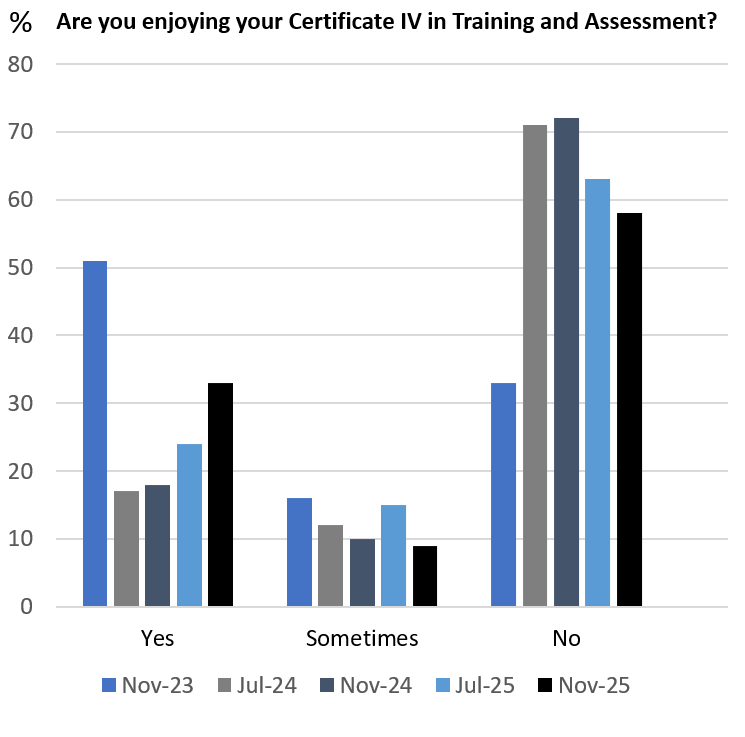
The following graph shows the most recent poll result and the results from previous polls.
And here is an analysis of the most recent poll compared with previous polls.
The result from November 2023 shows that 50% of people studying for their Certificate IV in Training and Assessment were enjoying it and 50% were not enjoying it, or only sometimes enjoying it. This is when most people were doing the TAE40116 qualification.
The results in July 2024 and November 2024 shows a massive decrease in satisfaction and massive increase in dissatisfaction. This is the year when the TAE40122 qualification began to be implemented by most RTOs.
The two results for 2025 shows an increasing satisfaction and subsequent decreasing dissatisfaction. I have assumed this is because RTOs have been improving the way they deliver the TAE40122 qualification. The November 2025 result shows 33% are satisfied. However, this is not a good result since two thirds of people are dissatisfied.
Does it matter if people enjoy doing their Certificate IV in Training and Assessment? Yes, it matters. If people are not enjoying it, then they become dissatisfied, and some get confused, frustrated, experience self-doubt, and the barriers to learning are increased.
Sadly, if you are not enjoying your Certificate IV in Training and Assessment, you are not alone.
Do you need help with your TAE studies?
Are you a doing the TAE40122 Certificate IV in Training and Assessment, and are you struggling with your studies? Do you need help with your TAE studies?
I conducted a LinkedIn poll during May 2025 asking, “Does your RTO expect trainers to participate in assessment validation?”
Here are the results:
The result of this poll means that the TAE40122 Certificate IV in Training and Assessment qualification should include a core unit about participating in assessment validation – and it does. The relevant unit of competency covering assessment validation is TAEASS413 Participate in assessment validation. This unit requires a person to not only participate in assessment validation but also participate in pre-assessment validation.
‘Assessment validation’ is different from ‘pre-assessment validation’. This raises another question, “Do RTOs expect trainers to participate in pre-assessment validation?” Let’s explore this topic a little before answering the question.
What is pre-assessment validation?
Over the past few years, the term ‘pre-assessment validation’ has been introduced to describe the review of an assessment tool prior to implementation. This review activity has been around for much longer than the term ‘pre-assessment validation’.
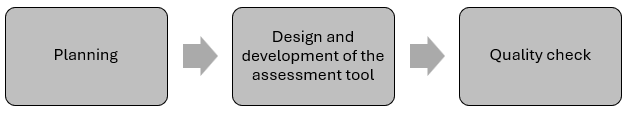
In 2015, ASAQ published a guide to the development of assessment tools. This guide was structured around a 3-step process:
ASQA’s guidelines states that the quality checking should occur before implementing the assessment tool. This quality check has recently become known as ‘pre-assessment validation’.
The elements of the TAEASS512 Design and develop assessment tools unit of competency is consistent with the 3-step process published by ASQA, and it includes ‘undertake a systematic review of the assessment tool [before implementing it]’ as a performance criteria.
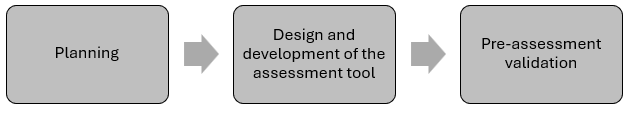
Currently, the Australian VET system is using three different ways to describe the same activity that should be conducted before an assessment tool is implemented:
‘Pre-assessment validation’ is the review of an assessment tool prior to implementation. This includes checking for:
Relevance to the current workplace and industry requirements
Compliance with the principles of assessment
Compliance with the rules of evidence
Usability of the assessment tool.
What’s the difference between pre-assessment validation and assessment validation?
‘Pre-assessment validation’ is not the same thing as ‘assessment validation’. In an attempt to avoid confusion, it is useful to refer to ‘assessment validation’ as ‘post-assessment validation’. Using the prefix ‘pre’ or ‘post’ helps to identify these two different activities as being different.
The TAEASS413 Participate in assessment validation unit of competency describes the following:
Pre-assessment validation is the validation of an assessment tool before it is first used.
Post-assessment validation is the validation of the assessment tool, practices and judgements after it has been used to conduct assessments.
Most RTOs expect their trainers to participate in post-assessment validation (93% of poll respondents). However, it is highly unlikely that trainers will participate in pre-assessment validation. Pre-assessment validation is an activity conducted when developing an assessment tool or purchasing an assessment tool.
Developing an assessment tool
The person developing an assessment tool should conduct a pre-assessment validation. The committee with the responsibility for developing the TAE40122 qualification said that most trainers would not be involved in developing assessment tools. This was the reason for removing the ‘design and develop assessment tools’ unit of competency as a core unit for the Certificate IV in Training and Assessment.
Very few trainers will be the developers of assessment tools or have the responsibility for the RTO’s compliance. Therefore, it is highly unlikely that trainers will participate in pre-assessment validation when assessment tools are developed by the RTO.
Purchasing an assessment tool
An RTO may purchase an assessment tool rather than develop it. The person with the authority to purchase assessment tools will usually check the assessment tool before it is purchased. (If they don’t, they should!)
Very few trainers will have the authority to purchase assessment tools or have the responsibility for the RTO’s compliance. Therefore, it is highly unlikely that trainers will participate in pre-assessment validation when assessment tools are being purchased by the RTO.
In conclusion
I wish we weren’t using the term ‘pre-assessment validation’ because it gets confused with ‘assessment validation’. To avoid some of the confusion, it is best to refer ‘assessment validation’ as ‘post-assessment validation’.
In this article, I have shown that trainers are highly likely to participate in ‘post-assessment validation’, but highly unlikely to participate in ‘pre-assessment validation’.
I think the committee responsible for the TAE40122 Certificate IV in Training and Assessment qualification got it wrong. Very few trainers will participate in pre-assessment validation, and it should not have been included within a core unit for the qualification. There are many things wrong with the TAE40122 qualification. This article has only addressed one of those things.
Let’s hope that a future committee with the responsibility for updating the TAE40122 Certificate IV in Training and Assessment will not make the mistakes made by the previous committee. I had predicted that the previous committee would make mistakes, and it did. It did not want to listen to me. Maybe it should’ve. There is no timeline for reviewing and updating the Certificate IV in Training and Assessment qualification. However, the qualification or credential designed for trainers working in the Australian VET sector has been updated every 6 years: 1992, 1998, 2004, 2010, 2016, and 2022. If this pattern continues, the next Certificate IV in Training and Assessment qualification is due in 2028. Usually, it takes about 2 years to gain project approval, obtain project funding, review, design, and develop the qualification and associated units of competency.
In Australia, Google introduced an AI Overview in the later part of 2024. The overviews are designed to be concise, providing a snapshot of relevant information on the queried topic. The feature also includes prominent links to source content, ensuring that users can access more in-depth information directly from authoritative websites. [1]
Content publishers raised concerns about potential decline in their website traffic, worrying that users might opt for AI-generated summaries instead of clicking through to the original sources. To address this, Google responded by putting strategies in place to give greater prominence to links within AI Overviews, aiming to balance providing convenient summaries for users and supporting the needs of content creators. [1]
The following example shows the results of a Google search for ‘dimensions of competency’.
In the above example, my On Target Work Skills website has been used to generate the AI Overview. Can you spot my logo? I am glad that my website has been used; however, people may not visit my website if they find the AI Overview is sufficient.
Concerns have been raised regarding the AI Overview feature. Critics argue that relying on AI-generated summaries could spread inaccuracies or oversimplify complex topics. Additionally, there’s worry about the ethical considerations of AI aggregating content, particularly concerning its impact on intellectual property rights and the visibility of smaller content providers. [1]
What’s a Zero-Click search?
The AI Overview leads to what is known as a Zero-Click search. A Zero-Click search occurs when a web browser, such as Google, displays the response to a user’s query at the top of the page, that does not lead to a click. The ‘click’ represents the user visiting the website of the publisher of the content. [2]
The following is an example. I used Google to search ‘Zero-Click search’ and got the following response.
In the example above, the AI Overview quickly provided a concise summary. Also, the links to the source of the information were provided but I got what I need and didn’t ‘click’ on any links to find out more. In the above example, it stated that nearly 60% of Google searches end without a click in 2024.
I am a sole trader who has spent years developing my On Target Work Skills website, and I continue to regularly publish content. Traffic to my website is extremely important to my operations. Unfortunately, since the introduction of AI Overview my website traffic has nearly halved compared to my statistics from the past few years. Less people are visiting my website.
In conclusion
Have you visited my On Target Work Skills website lately? You may have recently found me and my website, or you may have known me for many years. I use my website to publish information about:
Certificate IV in Training and Assessment
Australia’s vocational education and training system.
You are cordially invited to visit my On Target Work Skills website, and use the search function to explore topics of interest to you.
Are you seeking particular TAE or VET information that you can’t find on my website? Let me know and I’ll see if I can help.
Are you a doing the TAE40122 Certificate IV in Training and Assessment, and are you struggling with your studies? Do you need help with your TAE studies?
Many people undertaking the TAE40122 Certificate IV in Training and Assessment qualification find it difficult. Here are six reasons why.
1. High volume of learning
The Australian Qualifications Framework (AQF) indicates that a Certificate IV typically requires 600 to 2400 hours of learning. Even with prior experience, a significant time commitment is necessary. Training providers often recommend around 10 to 12 hours of study per week for a 6-month duration. And sometimes the duration is greater than 6 months.
2. In-depth knowledge requirements
The TAE40122 qualification demands a significant amount of knowledge, especially regarding the VET sector’s unique requirements and terminology. Furthermore, learning, navigating, and complying with the VET regulatory framework adds complexity.
3. Complex assessment tasks
Assessment instructions can be overly precise and detailed, paradoxically leading to confusion and making it difficult for learners to understand what is required. Also, the emphasis on simply completing assessment tasks can overshadow the importance of meaningful learning.
4. Emphasis on VET-specific skills
The qualification is heavily focused on the VET sector. Individuals without prior experience in this sector might find the specific terminology, regulations, and practices challenging to grasp.
5. Insufficient training and support
Some training providers may provide inadequate training, with brief or superficial sessions that don’t fully equip learners with the necessary knowledge and skills. Insufficient or non-existent support can leave learners feeling lost and struggling to understand requirements.
6. Repetitive content
The structure of the qualification, with multiple units having overlapping requirements, can lead to repetition in learning and assessment, which some learners find tedious and frustrating.
In conclusion
The TAE40122 Certificate IV in Training and Assessment demands a significant commitment to learning, a strong grasp of VET-specific knowledge and regulations, and the ability to effectively perform a range of training and assessment tasks. Many people did not know, or did not expect, the TAE40122 qualification to be difficult. They can be shocked by how difficult it is.
Many people find it difficult. Many people find it extremely time-consuming. And many people get confused and frustrated. Are you one of those people?
Do you need help with your TAE studies?
Are you a doing the TAE40122 Certificate IV in Training and Assessment, and are you struggling with your studies? Do you need help with your TAE studies?
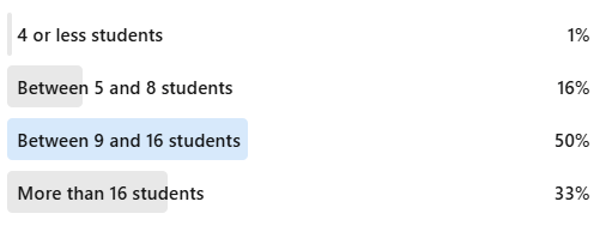
During the first week of May 2025, I conducted a LinkedIn poll asking people who work for a TAFE or other types of RTO the following question, “What is the typical size of a group of learners?”
Here are the results.
The results of this poll would indicate that a competent trainer working in the Australian VET sector should have the ability to deliver training to a group of at least 9 learners.
The TAE40122 Certificate IV in Training and Assessment is the current qualification designed for trainers working in the Australian VET sector. It requires a person to have the ability to deliver training to a group of 4 learners. This group size is significantly less than what’s required. More than 80% of the poll respondents said that the typical group size is more than 9 learners.
Why is there a discrepancy relating to group size?
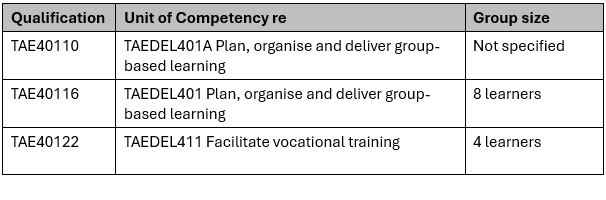
The following table shows the history of group size requirements for the current and previous two Certificate IV in Training and Assessment qualifications.
In 2010, the TAE40110 Certificate IV in Training and Assessment did not specify a group size. There was significant inconsistency relating to group size because each RTO delivering the qualification determined what was an acceptable group size. The committee with the responsibility for updating the qualification had to determine what was a group size that would be relevant for trainers working in the Australian VET sector. It decided that the minimum group size would be 8 learners. Therefore, in 2016, the TAE40116 Certificate IV in Training and Assessment specified that a trainer should have the ability to deliver training to a group of at least 8 learners.
The next committee (different to the previous committee) with the responsibility for updating the qualification received submissions from RTOs delivering the qualification saying that it was often difficult for their learners to organise at least 8 people, being the specified group size. This is not a valid reason for reducing group size. Group size should be determined by the realistic requirements of performing the role of a trainer. Trainers working for a TAFE or other types of RTO will typically be expected to delivery training to nine or more learners.
Anyway, in 2022, the TAE40122 Certificate IV in Training and Assessment specified that a trainer should have the ability to deliver to a group of at least 4 learners. This group size is significantly less than what’s required to perform the job. Competency is defined as the consistency application of knowledge and skills to the standard of performance required in the workplace. Hence, a competent trainer should be able to delivery training to at least 9 learners, and the current TAE40122 qualification does not represent this reality.
Sadly, many newly trained TAE40122 graduates will not have the ability to perform the role of trainer. They will not be work-ready. This isn’t how the Australian VET system should work.
Does group size matter?
Group size does matter. Communication complexity and the impact of other challengers increases with increased group size.
Communication complexity
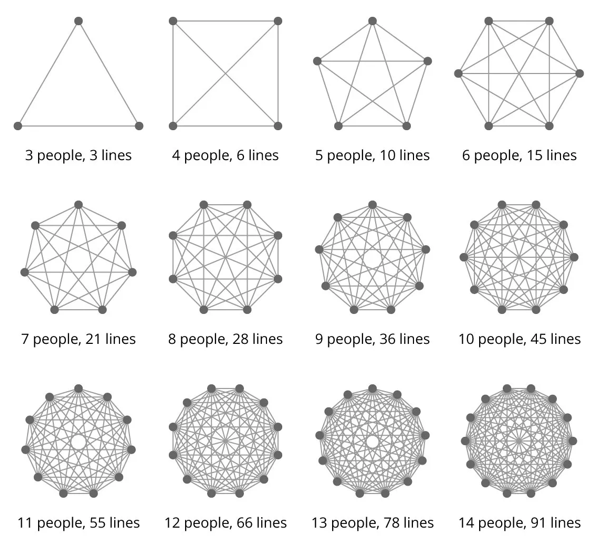
The following dramatically shows how communication complexity increases with the increased number of people.
The greater number of people, the greater number of lines of communication. And the greater number of lines of communication, the greater the communication complexity.
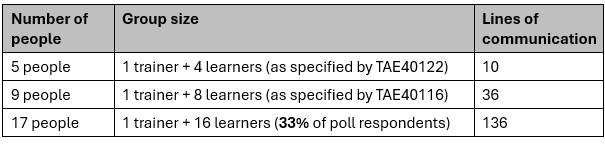
The following shows the increasing communication complexity for 5 people, 9 people, and 17 people.
In the above table, the complexity of training 8 learners compared with training 4 learners is more than threefold. And the complexity of training 16 learners compared with training 8 learners is again more than threefold.
It is important to note that 33% of poll respondents said that trainers had to deliver training to group sizes greater than 16 learners. This tells us that trainers need the ability to deliver training in learning environments with high communication complexity. This performance standard is not adequately addressed by the current TAE40122 Certificate IV in Training and Assessment qualification. Also worth noting, is that more than 80% of the poll respondents said that trainers had group sizes greater than 8 learners. The current training of people entering the Australian VET workforce as trainers is inadequate.
Impact of other challengers
A group of 4 learners is a small group. The challengers associated with training a small group are limited compared with training a typical group size. My LinkedIn poll indicates that a typical group size is greater than 9 learners, and in many cases, it is greater than 16 learners.
Increasing group size in training can lead to a range of challengers, for example:
Reduced individual attention
Decreased participation
Superficial discussions
Logistical challenges
Weaker group cohesion
Potential for disengagement
Difficulty in addressing individual needs.
Reduced individual attention
Trainers have less time to dedicate to each participant, potentially leading to some learners feeling overlooked or not receiving the specific guidance they need. This can be particularly challenging when participants have diverse learning needs or paces.
Decreased participation
Larger groups can make some individuals, especially those who are less confident or hesitant to speak up, ask questions, or actively participate in discussions and activities. This can limit their learning and the overall richness of the group’s experience.
Superficial discussions
With more people wanting to contribute, discussions may become less in-depth, and there might be less opportunity for individuals to share detailed insights or experiences.
Logistical challenges
Managing larger groups can be more complex. Activities may take longer to complete, and organising breakout sessions or individual feedback can become cumbersome.
Weaker group cohesion
It can be harder to build a strong sense of community and trust in a larger group, which can affect the willingness of participants to share openly and learn from each other.
Potential for disengagement
If participants feel lost in the crowd or that their individual needs aren’t being met, they may become disengaged from the training.
Difficulty in addressing individual needs
Identifying and addressing specific learning gaps or challenges becomes more difficult for the trainer in a larger setting.
Trainers need the ability to adapt their training techniques
While increasing group size can offer some advantages in terms of cost and diversity, it often introduces communication complexity and significant challenges related to individual attention, participation, and engagement. Trainers need the ability to adapt their training techniques to mitigate the negative impacts of challengers associated with larger groups.
There are some skills and knowledge required to deliver training to a small group of 4 learners that are the same as those required to deliver training to a larger group. But the ability to deliver training to a larger group is different. The current TAE40122 qualification is not adequately covering the capabilities required to be a trainer working in the Australian VET sector.
In conclusion
I think the committee responsible for the TAE40122 qualification got it wrong. Having the ability to train 4 learners is insufficient. The committee responsible for the TAE40116 qualification would have deliberated the group size that would allow for a relatively realistic assessment of a person’s ability to deliver training to a group. The group size does not need to be 16 or more learners. A group of at least 8 learners is probably about right. A group of at least 8 learners add sufficient complexity and challengers.
There are many things wrong with the TAE40122 qualification. This article has only addressed one of those things: group size of 4 learners is not sufficient.
Let’s hope that a future committee with the responsibility for updating the TAE40122 Certificate IV in Training and Assessment will not make the mistakes made by the previous committee. I had predicted that the previous committee would make mistakes, and it did. It did not want to listen to me. Maybe it should’ve.
There is no timeline for reviewing and updating the Certificate IV in Training and Assessment qualification. However, the qualification or credential designed for trainers working in the Australian VET sector has been updated every 6 years: 1992, 1998, 2004, 2010, 2016, and 2022. If this pattern continues, the next Certificate IV in Training and Assessment qualification is due in 2028. Usually, it takes about 2 years to gain project approval, obtain project funding, review, design, and develop the qualification and associated units of competency.
The TAE40122 Certificate IV in Training and Assessment is not fit-for-purpose. The qualification design is wrong, and there are many things wrong with the TAE units of competency.
This qualification is important for the quality of the entire Australian VET system. It is too important to get wrong again.








 On Target Work Skills