In the Australian VET system, the terms ‘holistic assessment’ and ‘integrated assessment’ are often used interchangeably. However, there is a differences between the two concepts.
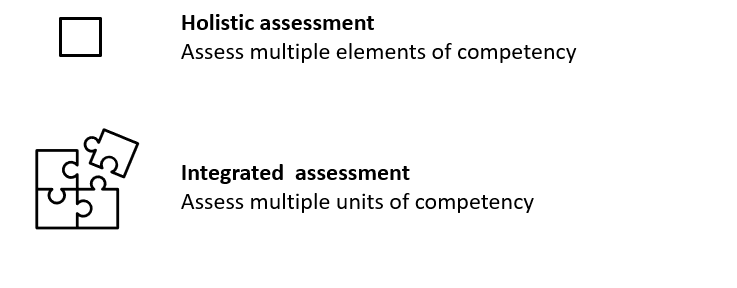
Holistic assessment is an assessment approach that covers multiple elements of competency. This approach would not explicitly gather evidence for each item of required knowledge or required skill. The assessor would consider the learner’s overall performance, including their application of knowledge and skills.
Integrated assessment occurs when a learner performs an assessment task that can be used to gather evidence for multiple units of competency. The assessment task would be designed to explicitly gather evidence specified by two or more units of competency. [1]
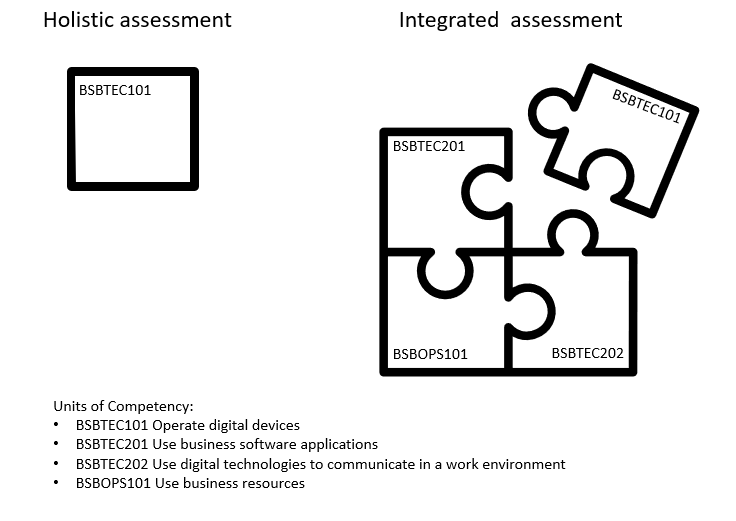
Holistic assessment focuses on one unit of competency, and integrated assessment focuses on multiple units of competency. The following illustrates the difference between an holistic and integrated approach to assessment.
Both holistic and integrated assessment can be used to improve the quality of assessment in the Australian VET system. They can help to ensure that learners are assessed on their ability to apply their knowledge and skills to real-world situations.
What is integrated assessment?
Individual competencies are rarely performed in isolation in the workplace. Typical job roles involve a number of related tasks, and evidence gathering should reflect this.
Integrated assessment is the simultaneous assessment of two or more related units of competency. The integrated approach can reduce the time spent on assessing, but more importantly it will make assessment more realistic because it more closely reflects the real nature of work. [2]
An example of integrated assessment
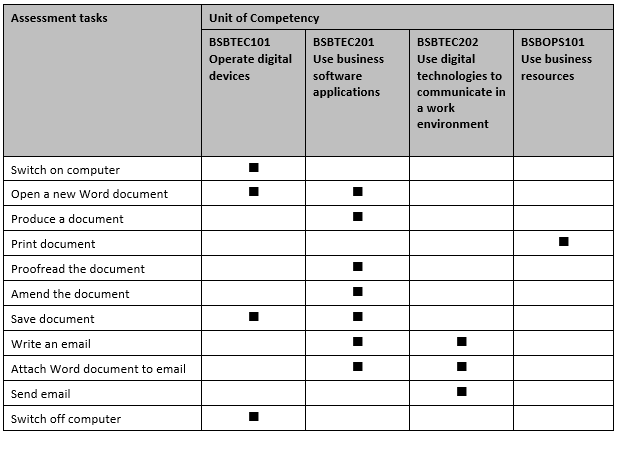
The following is an example of an assessment task that can be used to gather evidence for four different units of competency.
In conclusion
Although, ‘holistic assessment’ and ‘integrated assessment’ are often used interchangeably, they are two different concepts.
Integrated assessment can reduce the time spent on assessing, but more importantly it will make assessment more realistic because it more closely reflects the real nature of work.
This article has explored and described integrated assessment. Although, ‘holistic assessment’ and ‘integrated assessment’ are often used interchangeably, they are two different concepts. You may be interested in an article that I have published that focuses on holistic assessment.
The terminology used in the Australian VET system can be confusing and overwhelming. Are you a doing the TAE40122 Certificate IV in Training and Assessment, and are you struggling with your studies? Do you want help with your TAE studies?
Recently, I was asked by a person studying for their Certificate IV in Training and Assessment qualification:
“What is ‘amount of training’?”
The term ‘amount of training’ has a particular meaning in the Australian VET system.
The importance of quantity of training
Many people talk about the quality of training, however, the quantity of training a Registered Training Organisation (RTO) delivers is as important as the quality of the training. An RTO must ensure that the amount of training provided to a learner is sufficient. ASQA has published a guide to help RTOs determine if the amount of training is compliant with the Standards for RTOs 2015, clauses 1.1 and 1.2. [1]
Clause 1.1
The RTO’s training and assessment strategies and practices, including the amount of training they provide, are consistent with the requirements of training packages and VET accredited courses and enable each learner to meet the requirements for each unit of competency or module in which they are enrolled. [2]
Clause 1.2
For the purposes of Clause 1.1, the RTO determines the amount of training they provide to each learner with regard to: [2]
the existing skills, knowledge and the experience of the learner;
the mode of delivery; and
where a full qualification is not being delivered, the number of units and/or modules being delivered as a proportion of the full qualification.
What is ‘amount of training’?
ASQA describes ‘amount of training’ as an amount of time that a provider anticipates a learner would reasonably need to undertake the training. This amount of training must be suitable for the typical learner to gain the knowledge and skills specified in the relevant training product. [1]
The amount of training an RTO provides is determined by:
characteristics and needs of learners
training product being delivered
mode or modes of delivery.
Learner characteristics and how it impacts the amount of training required
Understanding the characteristics and needs of learners enables an RTO to identify an amount of training that reasonably supports a learner to fully absorb the required knowledge and develop the required skills over time in a range of situations they would experience in the workplace. The learner should have the opportunity to practice and apply these skills and knowledge requirements prior to assessment.
The time taken for a learner to develop the capabilities required by a training product will differ based on a learner’s: [1]
existing knowledge and skills
previous or current industry experience
language, literacy and numeracy skills
disability that may impede learning
motivation and time to learn.
Training product and how it impacts the amount of training required
Each training product describes the knowledge, skills and application of knowledge and skills required to be considered competent. The amount of training required for a training product is influenced by: [1]
amount, breadth and depth of knowledge required
amount, type and complexity of skills required
application of knowledge and skills required
any work placement requirements.
Delivery mode and how it impacts the amount of training required
Delivery modes can include one, or a combination, of: [1]
face-to-face, group-based training delivered by a trainer
synchronous or real-time online learning delivered by a trainer
asynchronous or self-paced online learning, that is included as a measurable, set exercise
other forms of self-paced delivery, where a student undertakes training in their own time and location
workplace delivery, including training activity conducted in the workplace by an RTO or an employer.
ASQA acknowledges that the amount of training will vary depending on which mode of delivery the RTO has selected with some delivery modes enabling learners to develop the required skills and knowledge in a shorter timeframe.
In conclusion
An RTO must determine how long it will take to deliver learners training so that they are prepared and ready to undertake assessment. Determining a suitable amount of training will require the RTO to consider: [1]
characteristic and needs of learners
requirements specified by the training product
mode or modes of delivery to be used.
The following is a checklist that may be used when checking if the amount of training described in an RTO’s training and assessment strategy is appropriate.
Are you a doing the TAE40122 Certificate IV in Training and Assessment, and are you struggling with your studies? Do you want help with your TAE studies?
The TAEDES412 Design and develop plans for vocational training unit of competency is a core unit for the TAE40122 Certificate IV in Training and Assessment qualification. This unit of competency requires the TAE Student to document a training delivery plan and training session plans for group-based training.
I have found that many people new to the Australian VET system are unsure about how to start designing a competency-based training program. The development of a one-page training agenda based on the Unit of Competency is a good starting point.
In this article, the following questions shall be answered:
What is the difference between a training delivery plan and training session plans?
What is a training agenda?
What are the steps to developing a training agenda?
What is the difference between a training delivery plan and training session plans?
The training delivery plan provides an overview about how the entire training covering the unit or units of competency will be delivered. The training will be delivered over many sessions. The training session plans provides the details about how each session will be delivered.
It is highly likely that TAE Students shall be given a templates to use when documenting their training delivery plan and training session plans. But there are many steps and decisions to be taken before those templates can be used.
It is essential for the development of a one-page view of the training program. Let’s call this document a ‘training agenda’.
What is a training agenda?
A training agenda is an outline of:
Timeframe
Content points
Sequence of content.
What are the steps to developing a training agenda?
The following 5 steps can be used to develop an agenda for competency-based training:
Step 1. Develop the timeframe
Step 2. Determine content points
Step 3. Consider learning activities
Step 4. Sequence the content points
Step 5. Develop a training matrix.
Before looking at each of these steps, I want to talk about modes of delivery.
There are different modes of delivery. For example:
Group-based, face-to-face
Self-paced, online
Self-paced, workbook
Workplace learning
Blended (combination of some or all of the above).
If you are a TAE Student, I suggest you keep things simple by designing face-to-face training that will be delivered by a trainer. Also, the training you design must be for a group of learners rather than for an individual learner. And it is highly likely that your training delivery plan will be uses as the background for training sessions that you will deliver later in your TAE40122 program. Avoid adding complexity by trying to incorporate different modes of delivery.
Step 1. Develop the timeframe
When developing a timeframe for a training program we will need to consider:
The total training duration, such as, total number of training days
Start time and expected finish time for each training day
Blocks of time representing each training session.
Total training duration
One of the first things we need to do is estimate the total training duration. Most units of competency will require more than one day of training. We need to determine or estimate the duration of training.
If you are a TAE Student, I suggest you keep things simple by designing your training program around days. You will need to answer the following questions:
How many training days will be needed?
What time will the training start and finish?
Time is usually a major constraint. Many RTOs tend to want training with a shorter duration than what is needed by the typical learner. If you are a TAE Student, I suggest you select a sufficient number of days to deliver all the content specified by the unit of competency and associated assessment requirements.
Also, the timeframe for training shall need to consider:
Breaks
Introductions and conclusions
Revision.
Breaks
Breaks are needed to avoid information overload or fatigue. Also, breaks allows for ‘spaced learning’. Spaced learning requires us to use several sessions of shorter durations with breaks in between the sessions. This approach aims to help learners retain more information.
Introductions and conclusions
We need to allocate time for introductions and conclusions. There will be an introduction and conclusion for every unit of competency. There will be an introduction and conclusion for every training day. And there will be an introduction and conclusion for every training session. The time required for introductions and conclusions will vary. However, as a general rule, allow about 30 minutes at the end of each day for a conclusion. The end-of-day conclusion may include:
Revise the content covered during the training day
Opportunity for learners to ask questions
Preview the next training day
Explain pre-work to be completed prior to the next training day.
Revision
We need to allocate time for revisions. Revision and repetition is important because it improves understanding and reduces forgetting. The time required for revisions will vary. However, as a general rule, allow time at the beginning of each training day to recap what was covered during the previous training day. Revision after lunch of the content covered during the morning is a good idea.
Blocks of time
The timeframe for the training agenda can be represented as ‘blocks of time’. This provides a visual structure for the entire training program.
Do’s and don’ts:
Do keep the training agenda to one page
Don’t start developing a training delivery plan until you have developed a one-page training agenda.
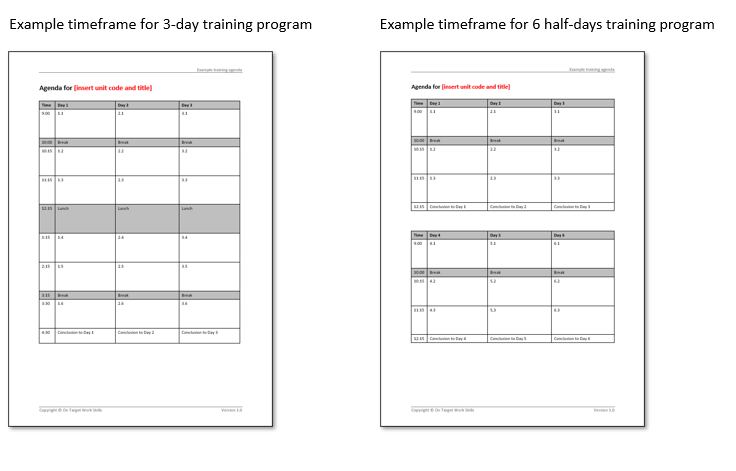
We can use Microsoft Word to create a table that will gives us a structure for our timeframe. The following are examples of one-page training agendas for a 1-day and a 3-day training program.
Use a ‘landscape orientation’ when there will be more than four training days. The following is an example for a 5-day training program.
The next example shows the layout for a training program with full days compared with a training program with half-days.
The above examples have shown when every training session has a duration of one hour. But sometimes a training session may require more time. The following example shows the layout for a training program with all training session with a one hour duration compared with a training program with a three hour training session on Day 2 and a two hour session on Day 3.
The purpose of showing a range of examples is to demonstrate the need for flexibility when developing the timeframe for the training agenda. However, start with one hour blocks of time. And keep the timeframe simple.
Step 2. Determine content points
We need to design training to ensure it is based on the unit of competency and associated assessment requirements.
Read and unpack the Unit of Competency and associate Assessment Requirements. Identify the content that must be covered during the training program, such as:
Task or tasks to be performed
Required knowledge
Required skills.
Step 3. Consider learning activities
We need to design training to ensure it promote ‘active learning’ or ‘learn by doing’.
As a general rule, at least 50% of the available time should be allocated to activity. However, some training programs may have 80% or 90% of the available time allocate to activity.
Activities may include:
Performing the task
Role playing
Researching
Discussion
Case studies
Brainstorming
Small group work.
Icebreakers and quizzes are two other types of activities that are useful to include.
Watching a video is passive and is not an activity. However, we can make it part of an activity by conducting a discussion or setting questions to be answered after viewing the video. The content from the video become an input for the activity.
Some activities can be conducted before or after the training day. These activities may include advance organisers and pre-work. These are valuable additions to a training program.
Step 4. Sequence the content points
Add content points and learning activities to the training agenda.
Sequence the content points:
Overview before the details
Simple before the complex (easy before the difficult)
Step-by step sequence (logical or chronological sequence)
Take into consideration how much training time may be required as you add information to the training agenda. Estimate time required for:
Presenting the content
Demonstrating the performance of skills or tasks
Explaining, conducting and debriefing learning activities
Conducting introductions, conclusions and revision.
At this stage it will be an estimate of time. These estimates may need to be revised when you work on the details.
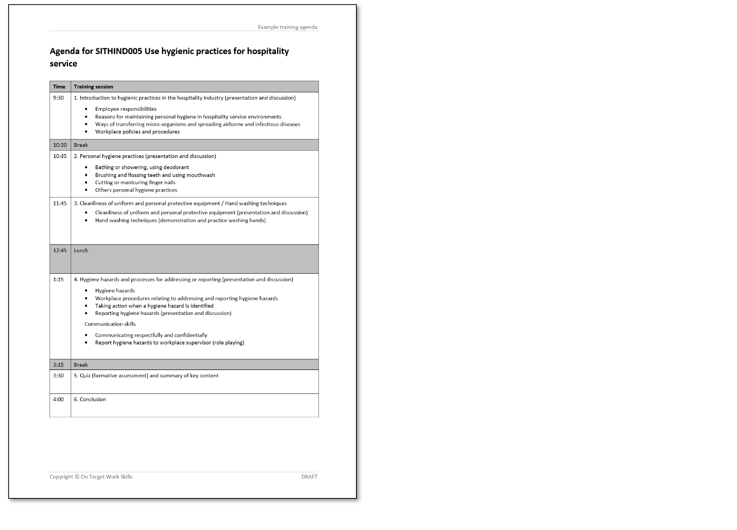
Very few units of competency in the Australian VET system can be adequately covered in one training day. The following is an example of a training agenda for the SITHIND005 Use hygienic practices for hospitality service unit of competency. It is one of those rare units that can be delivered in one day.
The next example is a 3-day agenda for the BSBOPS203 Deliver a service to customers unit of competency.
The above two examples show how very few details are provided on the training agenda. It is only meant to be an outline.
The training agenda is likely to be amended after you have developed the training delivery plan and training session plans. Some amendments may include:
Time allocated
Additional content
Sequence of content
Type and number of activities.
Step 5. Develop a training matrix
A training matrix is used to check that the training program shall cover the requirements specified by the Unit of Competency and associated Assessment Requirements.
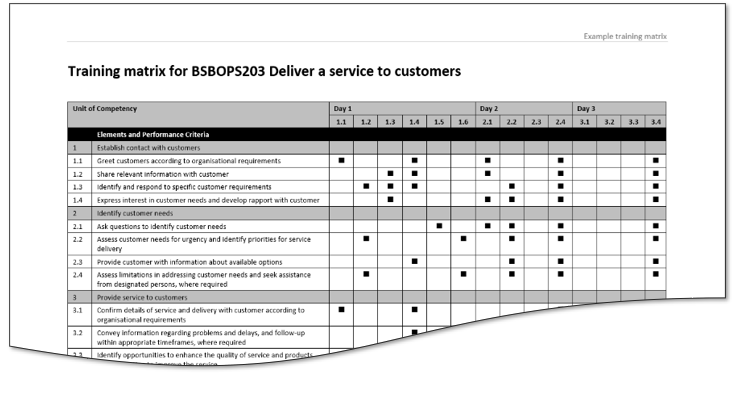
The training agenda gives a structure that can be used to create the training matrix. The following is an example of a training matrix. It is only showing the first page of a 3-page document. The other two pages covers the Performance Evidence and Knowledge Evidence.
The next example shows the layout for a training matrix covering the BSBOPS203 Deliver a service to customers unit of competency.
The development of the training matrix may identify content points that had not previously been considered while developing the training agenda. If this occurs, we will need to adjust the timing to cater for the additional content to be covered.
Consider your training agenda as a draft until you have completed developing the training delivery plan and training session plans. Your preliminary ideas may be changed after you have worked on the details. The training agenda must be consistent with your training delivery plan and training session plans.
The training agenda is useful piece of information for trainers and their learners. The one-page format gives a quick outline of the entire training program. It is a roadmap for the training. It is a good starting point for designing a competency-based training program. It is a roadmap for training.
Do you need help with your TAE studies?
Are you a doing the TAE40122 Certificate IV in Training and Assessment, and are you struggling with your studies? Do you want help with your TAE studies?
Some TAE Students studying for their TAE40122 Certificate IV in Training and Assessment qualification tell me that they get no or very limited training. And other TAE Students tell me that the training they get does not cover the knowledge or skills they need to complete their assessments.
Some TAE Students are being told that they are expected to do their own research and figure it out for themselves. This is not always as simple as it sounds.
Fortunately, I offer a TAE tutoring service that can help fill in the missing pieces.
The new TAELLN421 Integrate core skills support into training and assessment unit of competency has specified that a person needs to know about the ‘Survey of Adult Skills’ in relation to the ‘Programme of the International Assessment of Adult Competencies (PIAAC)’.
This article shall answer the following questions:
What is PIAAC?
What PIAAC information is relevant?
What is PIAAC?
PIAAC stands for Programme of the International Assessment of Adult Competencies. It is a large-scale international survey that assesses and analyses adults’ proficiency in key information-processing skills, and how adults use their skills at home, at work and in the wider community. [1]
The key information-processing skills are:
literacy
numeracy
problem solving .
The survey is known as the ‘Survey of Adult Skills’.
This survey has been completed twice so far, in 2011-2012 and 2018-2019. In the first cycle, the survey was administered in 24 countries, and in the second cycle, it was administered in 38 countries.
PIAAC is conducted by the Organisation for Economic Co-operation and Development (OECD). The OECD is an international organisation that provides knowledge and advice to inform better policies. It is one of the world’s largest and most trusted sources of comparative socio-economic data and analysis. [2]
What PIAAC information is relevant?
First, we need to find the PIAAC information relevant to Australia. On the 27th of July 2023, the following 3 steps .
Step 1. Googled ‘PIAAC’ and clicked the ‘Survey of Adult Skills (PIAAC)’
Step 2. Selected ‘Publications’ from the PIAAC Homepage menu.
Step 3. Selected ‘Country Specific Materials’ from the drop-down menu
Step 4. Use the links to explore information relevant to Australia
There are three links to follow:
OECD Country Note
Interactive country profile
National Report
OECD Country Note
The OECD Country Note provides information about the Survey of Adult Skills was conducted in Australia from October 2011 to March 2012. It states:
Adults (aged 16-65) in Australia show above-average proficiency in literacy, and problem solving in technology-rich environments compared with adults in the other countries participating in the survey, but only show average proficiency in numeracy.
Foreign-language immigrants in Australia have lower levels of literacy proficiency than the native-born and native-language Australians, although the difference observed is amongst the lowest across the participating countries.
The link between higher literacy and such social outcomes as trust in others, participation in volunteer and associative activities, belief that an individual can have an impact on the political process, and better health is stronger in Australia than in most other countries.
Australia shows a good match between the literacy proficiency of workers and the demands of their jobs.
Interactive country profile
The Interactive country profile provides the following infomration:
The mean proficiency score, in Australia, of 16-65 year-olds in literacy and problem solving in technology-rich environments is significantly above the average of the OECD countries participating in the Survey of Adult Skills (PIAAC). Whereas in numeracy, the country shows average proficiency.
On average, the young adult population (25-34 year-olds) scores at 287 in literacy, compared to 277 in the OECD countries participating in the Survey. In numeracy, they score at 275 (272 in average). In both domains, younger adults score higher than their older counterparts (55-65 year-olds).
In Australia, 7.5% of the adult population (16-65 year-olds) report no prior experience with computers or lack very basic computer skills. In contrast, 38% of the adult population score at the highest levels in problem solving in technology-rich environments.
In Australia, 12.6% of the adults score at the lowest levels in literacy and 20.1% score low in numeracy.
National Report
The ‘National Report’ link takes you to information published by the Australian Bureau of Statistics (ABS). You you find a lot of information and many graphs based on the Survey of Adult Skills conduct in 2011-2012.
In conclusion
This PIAAC information published by the OECD is not be easy to navigate, is not easy to understand, and is not presented in a format that is relevant to TAFE teachers and trainers working in the Australian VET system.
I believe the Education Industry Reference Committee (IRC) included the ‘Survey of Adult Skills’ and ‘PIAAC’ in the new TAELLN421 Integrate core skills support into training and assessment unit of competency without really understanding what it was doing. It is another example of something that the Education IRC got wrong when it released the new TAE Training Package in 2022.
It is difficult to find a concise summary of outcomes from the most recent Survey of Adult Skills conducted in 2018-2019. And it is time-consuming to sort through, and summarise, the publicly available information.
Are you a doing the TAE40122 Certificate IV in Training and Assessment, and are you struggling with your studies? Do you want help with your TAE studies?
Qualification packaging rules specifies the total number of units of competency required to achieve the qualification. Also, the number of core and elective units are specified. All core and elective unit codes and titles are listed, including identification where prerequisite units apply.
Each qualification has been designed to meet the needs of an occupation or job function. Packaging rules ensure that the selection of elective units achieve the desired outcomes for the qualification.
How are the qualification packaging rules used?
The following is a 7-step process for using the qualification packaging rules:
Step 1. Access the qualification packaging rules
Step 2. Read the qualification packaging rules
Step 3. Create a Microsoft Word table
Step 4. Insert the core units for the qualification
Step 5. Select elective units according to the qualification packaging rules
Step 6. Sequence the units of competency
Step 7. Check compliance with qualification packaging rules
The following is a case study showing how to use the qualification packaging rules for the SIT20322 Certificate II in Hospitality qualification.
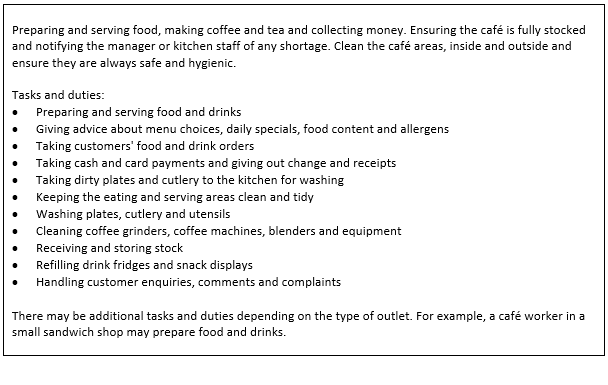
This qualification provides a pathway to work in various hospitality settings, such as restaurants, hotels, motels, catering operations, clubs, pubs, cafés, and coffee shops. For the purposes of this case study, I have focused on a training program for a worker in a café or coffee shop. The following is a brief job description for a café worker.
Step 1. Access the qualification packaging rules
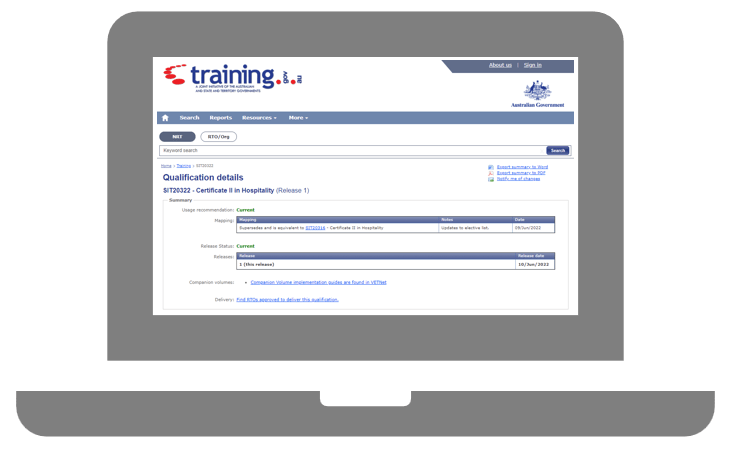
The training.gov.au website provides access to the packaging rule for the qualification. Use the search function to find the qualification details, and scroll down.
Step 2. Read the qualification packaging rules
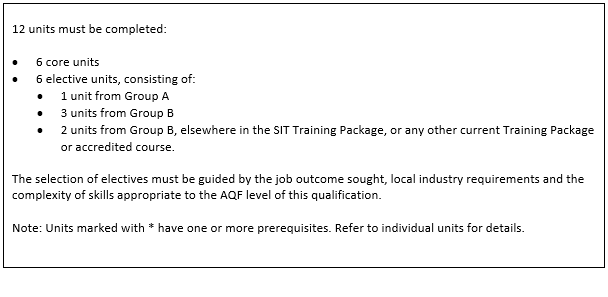
The following are the packaging rules for the SIT20322 Certificate II in Hospitality qualification.
Step 3. Create a Microsoft Word table
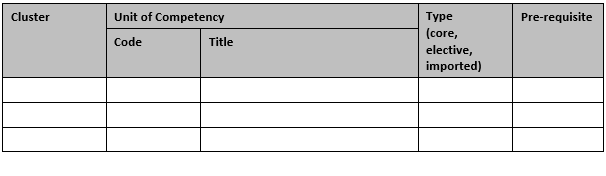
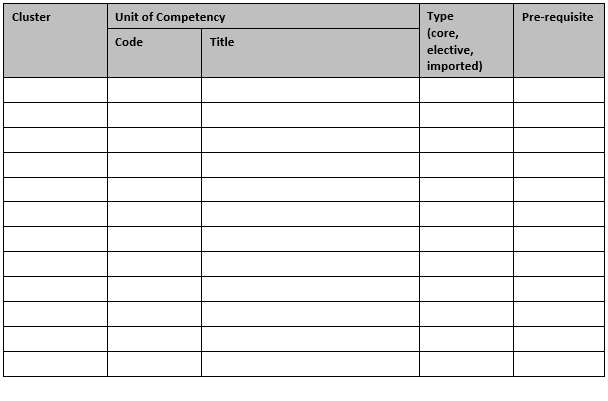
Create a 5-column table using Microsoft Word. The following shows the table headings and recommended format for the table.
The packaging rules for the SIT20322 qualification states that there must be a total of twelve units of competency. Therefore, I make sure the Microsoft Word table has 12 rows available for inserting 12 units.
Step 4. Insert the core units for the qualification
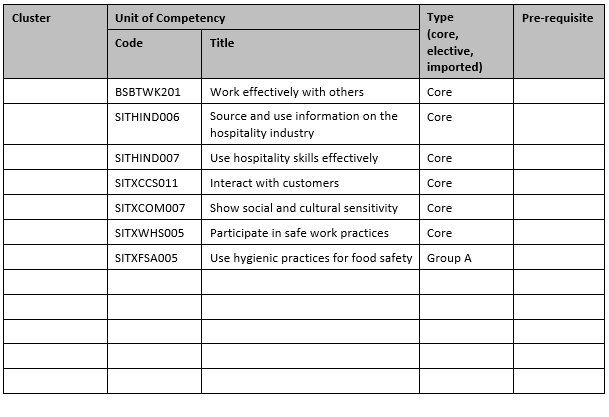
The core units for a qualification are listed. Insert the unit codes and titles. Also, insert the word ‘Core’ in the column indicating the type of unit. The SIT20322 qualification has six core units as shown below.
Step 5. Select elective units according to the qualification packaging rules
Consult with employers or industry about the typical work tasks or units of competency that should be covered by the qualification.
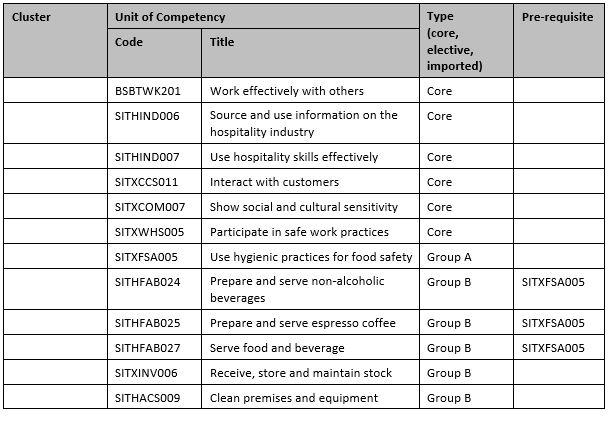
The qualification packaging rules specifies that one unit must be selected from the Group A list. The SITXFSA005 Use hygienic practices for food safety unit of competency has been selected and it has been added to the Microsoft Word table. Also, ‘Group A’ has been inserted in the column indicating the type of unit.
The remaining five elective units have been selected from the Group B list. The choice of electives is determined by the typical tasks performed by workers in a café or coffee shop.
The above table shows that three of the selected units identify the SITXFSA005 unit as a prerequisite. The SITXFSA005 unit had already been selected from the Group A list.
Step 6. Sequence the units of competency
Sequence
Safety first. If there is a unit relating to safety, I usually plan for it to be delivered first or close to the commencement of the training program. Then I consider delivering units covering simple tasks before delivering units covering advanced or complex tasks. Also, I consider if there is a logical sequence that the delivery of units would best follow. For example, learn customers service skills before learning how to prepare and serve beverages.
Prerequisites
Some units specify a prerequisite unit. A prerequisite unit or units must be completed before the unit that specifies it. This is a rule that must be considered when sequencing the units of competency.
Clusters
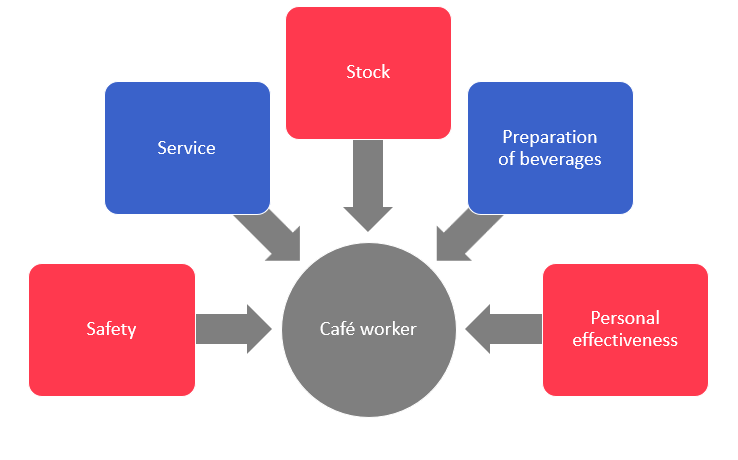
I often use clustering to organise the units of competency. This technique makes it easier for trainers to implement and easier for learners to understand the training program structure. A short descriptive title for the cluster can be used instead of using unit codes and titles that many learners can find confusing, especially at the commencement of the training program.
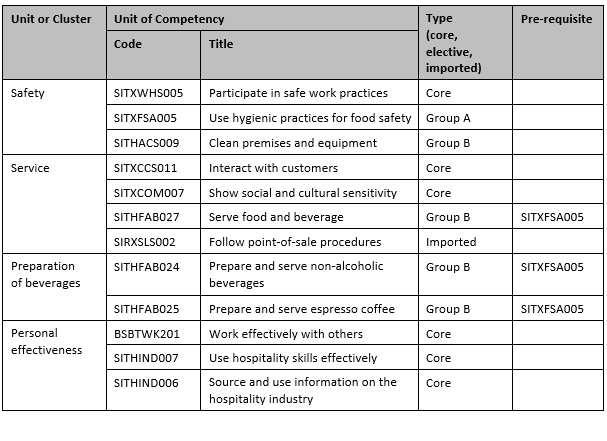
The following illustrates how five key areas have been used to structure the training program. It is much similar than the codes and titles for twelve units of competency.
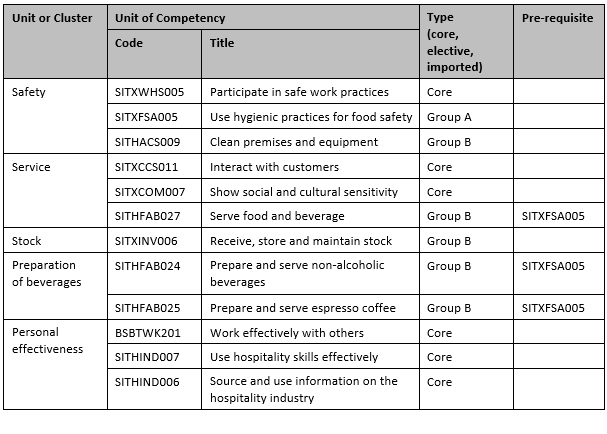
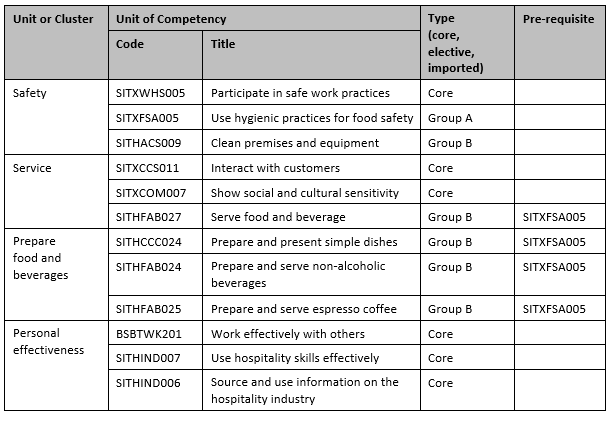
The following table shows how the twelve units of competency for the SIT20322 Certificate II in Hospitality qualification has been clustered and sequenced.
Step 7. Check compliance with qualification packaging rules
Check that the qualification packaging rules have been complied with. In the case of the SIT20322 Certificate II in Hospitality qualification:
Are there a total of 12 units?
Have the 6 core units been included?
Has 6 elective units been selected according to the packaging rules?
Are prerequisite unit requirements addressed?
Again, consult with employers or industry. Confirm that the units of competency for proposed training program meet the requirements for the occupation or job function. In this case, are the requirements for a café worker adequately covered.
In conclusion
Qualification packaging rules provide the flexibility required to customise a training program to respond to the needs of a client or industry.
In the following example, the SIRXSLS002 Follow point-of-sale procedures unit has been imported to cover taking cash and card payments and giving out change and receipts.
And in the following example, the SITHCCC024 Prepare and present simple dishes unit has been included to cover the preparation of food as well as beverages.
Do you need help with your TAE studies?
Are you a doing the TAE40122 Certificate IV in Training and Assessment, and are you struggling with your studies? Do you want help with your TAE studies?

















 On Target Work Skills