It is no secret that the TAE40122 Certificate IV in Training and Assessment is disliked by many people.
Every six months over the past 2 years I have conducted a poll to find out if people were enjoying their Certificate IV in Training and Assessment.
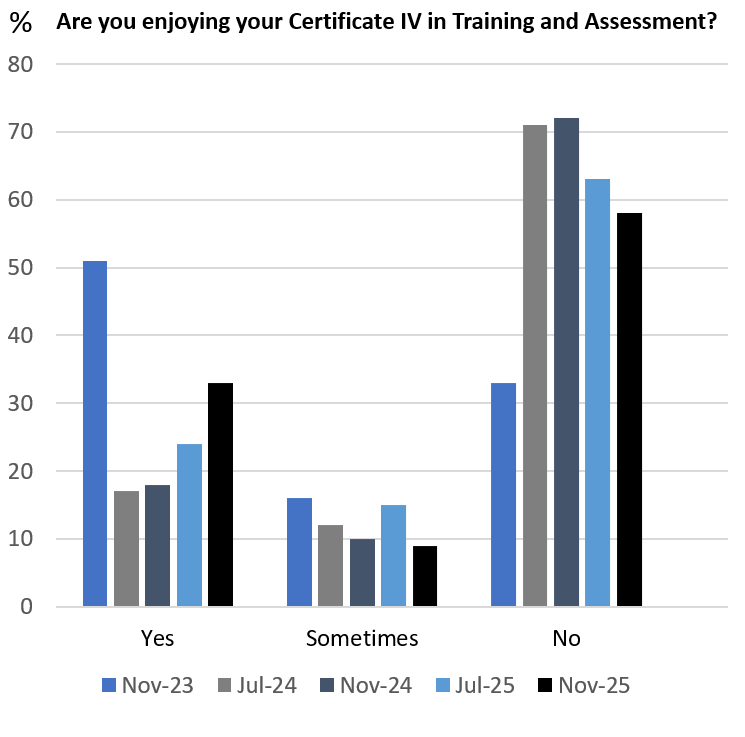
The following graph shows the most recent poll result and the results from previous polls.
And here is an analysis of the most recent poll compared with previous polls.
The result from November 2023 shows that 50% of people studying for their Certificate IV in Training and Assessment were enjoying it and 50% were not enjoying it, or only sometimes enjoying it. This is when most people were doing the TAE40116 qualification.
The results in July 2024 and November 2024 shows a massive decrease in satisfaction and massive increase in dissatisfaction. This is the year when the TAE40122 qualification began to be implemented by most RTOs.
The two results for 2025 shows an increasing satisfaction and subsequent decreasing dissatisfaction. I have assumed this is because RTOs have been improving the way they deliver the TAE40122 qualification. The November 2025 result shows 33% are satisfied. However, this is not a good result since two thirds of people are dissatisfied.
Does it matter if people enjoy doing their Certificate IV in Training and Assessment? Yes, it matters. If people are not enjoying it, then they become dissatisfied, and some get confused, frustrated, experience self-doubt, and the barriers to learning are increased.
Sadly, if you are not enjoying your Certificate IV in Training and Assessment, you are not alone.
Do you need help with your TAE studies?
Are you a doing the TAE40122 Certificate IV in Training and Assessment, and are you struggling with your studies? Do you need help with your TAE studies?
Based on recent reports and ongoing discussions, the top 5 topics relating to the Australian VET system are:
Quality and consistency of training
Engagement and responsiveness to industry
Funding models and financial sustainability
VET workforce
Tertiary harmonisation and pathways.
This article is a bit long. I hope you can make it to the end.
1. Quality and consistency of training
Quality and consistency of training remains a critical issue. While the VET sector is valued, there are ongoing concerns about the consistency of training quality across different Registered Training Organisations (RTOs) and TAFE courses. This includes ensuring that graduates have the relevant skills, that training is of a high standard, and that there’s enough focus on practical skills. The Australian Skills Quality Authority (ASQA) plays a key role in regulating and auditing RTOs to ensure compliance with the VET Quality Framework, but quality issues persist.
ASQA has been shifting its regulatory focus, moving away from extensive external audits towards a model of self-regulation for RTOs. This new approach emphasises an RTO’s internal ability to monitor, evaluate, continuously improve, and manage risks related to training quality. However, this shift presents a potential for failure due to an inherent conflict of interest. Providers might prioritise financial gain over genuine quality, potentially leading to a decline in overall standards within the sector.
The move towards self-regulation and a perceived lack of independent scrutiny may contribute to an environment where fraudulent activities can occur more easily. Relying on internal monitoring systems carries significant risks, as these can be manipulated or under-resourced. Proactive, regular external audits would likely be more effective in identifying potential issues early on, rather than waiting for problems to be reported through ASQA’s “VET tip-off line” after the fact.
The current spate of de-registered RTOs and cancelled qualifications may be linked to a lack of onsite audits being conducted by the regulator.
2. Engagement and responsiveness to industry
A crucial aspect of VET is its ability to meet the rapidly changing needs of employers and industries. There’s a strong focus on strengthening industry engagement to ensure that VET qualifications and training programs are relevant and aligned with current and emerging workforce demands. The establishment of Jobs and Skills Councils (JSCs) is a recent reform aimed at giving industry a stronger voice in identifying skills needs, developing training products, and collaborating with providers.
Since the establishment of the current Australian VET system in 1992, industry and employers have been positioned to give advice on workforce skill needs, VET qualifications, and units of competency. These industry-led groups have been the National Industry Training Advisory Boards, that were replaced by Industry Skills Councils (ISCs), that were replaced by Industry Reference Committees (IRCs), that have now been replaced by Jobs and Skills Councils (JSCs).
Each change has been designed to give industry a stronger voice and to streamline the training product development process. I agree that Australia’s VET system should be responsive to industry and employers. And I agree that Australia’s VET system should be national as well as industry led. However, many concerns expressed by industry and employers would be resolved if RTOs were more responsive to ‘local’ needs. There is significant flexibility for training products to be customisation and contextualisation.
Lack of responsiveness and flexibility can often by fixed at the local level by RTOs, rather than changing the training package development process.
3. Funding models and financial sustainability
The financial foundations of the VET sector are under pressure. Traditional funding models consist of a mix of government allocations and student fees. RTOs, including TAFEs, raise concerns that there isn’t adequate and sustainable funding to develop quality training and provide sufficient student support services.
In recent years, the Australian Government and the governments of states and territories have been prioritising funding to TAFEs. TAFEs have been, and continue to, spend a lot of money on fancy buildings and expensive technological infrastructure. It is questionable if learning is improved by TAFEs having these new buildings and advanced technology.
I think that there will never be enough funding. And I think that the dilemma of wanting high-quality but low-cost training will continue to be an unresolvable problem for the VET system. However, I will be happy to be proven wrong.
4. VET workforce
A major challenge is attracting, retaining, and developing a skilled VET workforce. National strategies are being developed to grow the workforce and improve retention, including the ‘Credential Policy’. This policy came into effect alongside the new Standards for Registered Training Organisations on the 1st of July 2025. I believe that this policy will have no or limited impact on the VET workforce, nor on improving training quality. Again, I will be happy to be proven wrong.
5. Tertiary harmonisation and pathways
Over the last few years, some VET influencers and some VET lobby groups have been saying that there needs to be a better connection between the VET system with Higher Education. Their goal is to break down the barriers between VET and university pathways. This is not a new idea.
Background
The Australian Qualifications Framework (AQF) was first introduced in 1995. It included ‘articulation arrangements’. These arrangements were a set of principle to assist the establishment of connections between different qualifications. An entire section of this first AQF was devoted to ‘articulation arrangements’. [1]
The Australian Qualifications Framework (AQF) was revised and republished in 2011. A second edition of the revised AQF was published in 2013. The revised AQF clearly states an objective to support the development and maintenance of pathways which provide access to qualifications and assist people to move easily and readily between different education and training sectors. [2] [3]
The AQF aims to assist people to plan their career progression. In this way, it encourages lifelong learning. The AQF 2013 defines ‘articulation arrangements’ as arrangements that enable students to progress from a completed qualification to another with admission and/or credit in a defined qualification pathway. [3]
In 2012, the Standards for Training Packages were published. In this document, the term ‘articulation arrangements’ was replaced by ‘credit arrangements’. These Standards for Training Packages have been republished several times, and in these documents ‘credit arrangements’ has been defined as the arrangements existing between Training Package qualifications and Higher Education qualifications. [4]
What’s new?
Thirty years has passed since the AQF was first published, and thirteen years has passed since the Standards for Training Packages were published (replaced by the Training Package Organising Framework on the 1st of July, 2025). Not one ‘credit arrangement’ was established. Not one nationally agreed articulation arrangement has been established.
Routinely, the universities have been unwilling to recognised VET qualifications. The disconnect between the VET system and Higher Education has been impenetrable. So, some VET influencers and some VET lobby groups have taken a new approach. This approach is called tertiary education harmonisation.
Tertiary education harmonisation means VET and Higher Education work more closely together. The aim is for a more seamless and aligned tertiary education system. This does not imply that Australian will merge Higher Education and VET into one system. ‘Alignment’ is not the same as ‘merge’.
VET and Higher Education would remain separate sectors with important differences in their missions and their approaches to learning. The Australian Government is currently investing $27.7 million over 4 years to 2027-28, including $15.9 million specifically for VET to improve ‘tertiary education’ collaboration. The only tangible deliverable at the moment seems to be a ‘roadmap’ to be developed. [5] [6]
Is a ‘roadmap’ worth $27.7 million investment?
How will VET spend $15.9 million to improve ‘tertiary education’ collaboration? And who will get this money?
Will ‘alignment arrangements’ achieve the same outcome as ‘articulation arrangements’ and ‘credit arrangements’? In other words, achieve nothing.
In conclusion
After more than 30 years, the VET system continues to be plagued with problems. The entire VET system is currently be changed.
ASQA’s new regulatory approach promoting self-regulation and the new Standards for RTOs (effective from the 1st of July 2025) aim to improve the quality and consistency of training.
Establishment of Jobs and Skills Councils and the new Training Package Organising Framework (effective from the 1st of July 2025) aim to improve engagement and responsiveness to industry’s skill needs.
Funding models prioritising TAFEs, strategies to positively impact the VET workforce, and tertiary education harmonisation aim to improve the Australian VET system.
These changes were started by the Scott Morrison’s government and have continued to be implemented by the Anthony Albanese’s government. But will all these changes make the Australian VET system better?
The 2025 Training Package Organising Framework has replaced the 2012 Standards for Training Packages. The 2025 Training Package Organising Framework makes a significant change regarding Foundation Skills:
The definition of Foundation Skills has changed, and
The information about Foundation Skills has changed.
The definition of Foundation Skills has changed
The 2012 Standards for Training Packages required Foundation Skills to be documented at the Unit of Competency level. Also, the 2012 Standards for Training Packages clearly defined Foundation Skills as the language, literacy, numeracy and employment skills. [1]
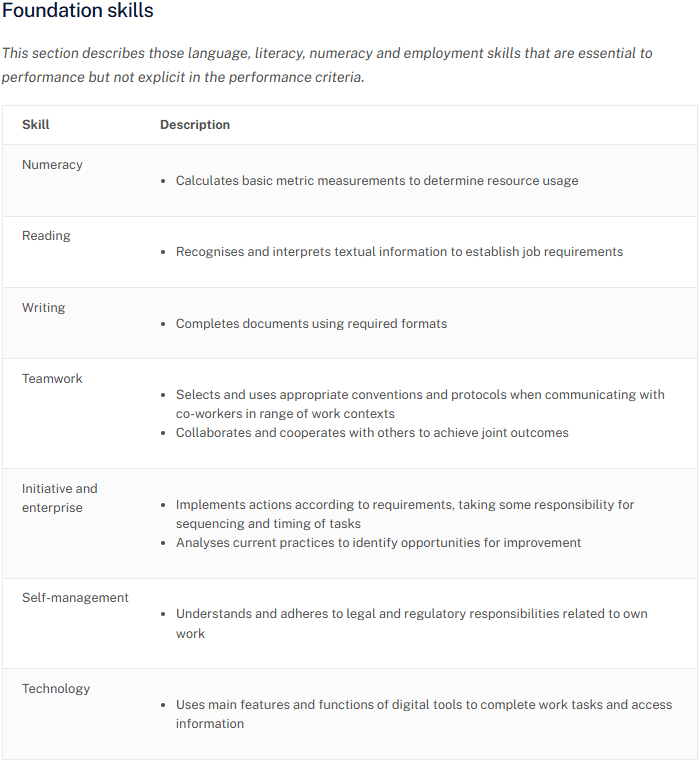
Training Package developers described Foundation Skills that specifically related to the Unit of Competency. For example, the following shows the Foundation Skills that have been specified for the BSBSUS211 Participate in sustainable work practices unit.
In the above example it describes three language, literacy and numeracy skills and several employment skills (teamwork, initiative and enterprise, self-management, and technology). This information about Foundation Skills will no longer be required at the Unit of Competency level. Also, this detailed information about Foundation Skills that specifically relates to the Unit of Competency will no longer be provided.
The 2025 Training Package Organising Framework makes a significant change to Foundation Skills. Instead of specifying Foundation Skills at the Unit of Competency level, Foundation Skills are to be specified within the Qualification or Skill Set. However, a Training Package developer may document Foundation Skills for a Unit of Competency that is a standalone unit or has high delivery as a single unit. [2]
A standalone unit is defined as a unit that is not packaged as part of a qualification. Previously, all units had to be packaged as part of a qualification. This requirement has changed. [2]
An example of a single unit with high delivery is First Aid. [2]
The 2025 Training Package Organising Framework redefines Foundations Skills. Foundation Skills are now defined as the five Australian Core Skills Framework (ACSF) skills: [2] [3]
Learning skills
Reading skills
Writing skills
Oral communication skills
Numeracy skills.
Specifying digital literacy skills is optional. [2]
The information about Foundation Skills has changed
The 2025 Training Package Organising Framework require Foundation Skills to be specified within the Qualification or Skill Set. The Training Package developer may document Foundation Skills within a Unit of Competency that is a standalone unit or has high delivery as a single unit, but this is optional. [2]
Importantly, the information about Foundation Skills provided by Training Package developers has changed. Instead of providing detailed information about relevant Foundation Skills for a Unit of Competency, the Training Package developers will state the required ACSF level for each of the five Core Skill from the ACSF and display this information as a bar chart. For example: [2]
Specifying digital literacy skills is optional. The Training Package developer may specify digital literacy skills as a descriptive statement below the Foundation Skills bar chart. [2]
The following table compares pre-2025 Foundation Skills and post-2025 Foundation Skills.
I hope the last row in the above table clearly shows how information about Foundation Skills provided by Training Package developers are significantly changing.
In conclusion
Units of Competency are the building blocks for Qualifications and Skill Sets. Each Unit of Competency has its own unique foundation skill requirements. The Foundation Skills bar chart for a Qualification or Skill Set provides no information relevant to foundation skills required to perform work tasks covered by any particular Unit of Competency.
When the 2012 Standards for Training were implemented many people complained about losing useful Range Statement information. As the 2025 Training Package Organising Framework are implemented, I wonder if people are going to complain about losing useful Foundation Skills information.
“You don’t know what you have until it’s gone.”
References
[1] 2012 Standards for Training Packages (last updated in 2022)
[2] 2025 Training Package Organising Framework
[3] Australian Core Skills Framework
Do you need help with your TAE studies?
Are you a doing the TAE40122 Certificate IV in Training and Assessment, and are you struggling with your studies? Do you need help with your TAE studies?
I have been around the current Australian VET system since it commenced in 1992. And during my career as a VET practitioner, I have seen and been a part of many changes designed to ensure training providers deliver a quality training and assessment service.
A short history of national training quality assurance frameworks
The past
The first national approach to quality assuring vocational education and training (VET) in Australia was the National Framework for the Recognition of Training (NFROT). It was introduced in 1992, and this is when Australia’s current competency-based training and assessment system was established.
The NFROT was replaced by the Australian Recognition Framework (ARF) in 1998. A few years later the ARF was replace by the Australian Training Quality Framework (ATQF). The ATQF was introduced in 2001 and became fully operational in 2002.
The AQTF was reviewed and revised in 2005, 2007, and 2010.
Next, the ATQF was replace by the Standards for NVR Registered Training Organisations 2012. These Standards were introduced as part of the National VET Regulator (NVR) system, which ASQA (Australian Skills Quality Authority) commenced operating under when it was established in 2011.
These 2012 Standards for RTOs were themselves later replaced by the Standards for Registered Training Organisations (RTOs) 2015.
The present
On the 1st of July 2025, the 2015 Standards for RTOs were replaced by the National Vocational Education and Training Regulator (Outcome Standards for Registered Training Organisations) Instrument 2025.
All RTOs that are regulated by ASQA are required to operate in accordance with these 2025 Standards for RTOs.
An overview of the 2025 Standards for RTOs
Standards for RTOs
The 2025 Standards for RTOs consists of 20 pages (including cover and contents page). It has been documented with four Parts, and each part has Divisions, and each division has one, two, or three Standards.
Standards provide two pieces of information:
Outcome Standard – numbered with (1)
Performance Indicators – numbered with (2).
Sub-points under the Performance Indicators are given (a), (b), etc.
And sub sub-points are given (i), (ii), etc.
Also, each Part is referred to as a Quality Area. The nomenclature and numbering used is somewhat cumbersome for the first-time reader.
The following shows an overview of the numbering method used in the 2025 Standards for RTOs.
ASQA has published Practice Guides. These Guides aim to support understanding of regulatory expectations.
The Practice Guides include:
examples activities and considerations for demonstrating compliance
examples of known risks to quality outcomes.
To align with the 2025 Standards for RTOs, these Practice Guides are grouped under each of the four Quality Areas. Specifically, there’s one Practice Guide for every Division within each Quality Area.
The following shows how ASQA has organised the Practice Guides relating to the 2025 Standards for RTOs.
The links (shown above) takes us to an online version of the Practice Guide, and a PDF copy of the Practice Guide can be downloaded. The following is an example for the online version of the Practice Guide for Training.
I am sure that many well-meaning legislators have tried their best. But after more than 30 years, and many changes to the quality assurance framework, the Australian VET system still seems to be unable to deliver the quality of training and assessment services expected by clients and stakeholders.
I believe that the attainment of quality will not be achieved by another document describing the Standards for RTOs. I predict that there will be another quality assurance framework developed in the future. This will probably make a future federal government minister with the responsibility for vocational education and training feel good because they have accomplished something – but nothing has really been accomplished by documenting a quality assurance framework.
Why do you think the delivery of quality training and assessment services is so elusive?
Do you need help with your TAE studies?
Are you a doing the TAE40122 Certificate IV in Training and Assessment, and are you struggling with your studies? Do you need help with your TAE studies?
I conducted a LinkedIn poll during May 2025 asking, “Does your RTO expect trainers to participate in assessment validation?”
Here are the results:
The result of this poll means that the TAE40122 Certificate IV in Training and Assessment qualification should include a core unit about participating in assessment validation – and it does. The relevant unit of competency covering assessment validation is TAEASS413 Participate in assessment validation. This unit requires a person to not only participate in assessment validation but also participate in pre-assessment validation.
‘Assessment validation’ is different from ‘pre-assessment validation’. This raises another question, “Do RTOs expect trainers to participate in pre-assessment validation?” Let’s explore this topic a little before answering the question.
What is pre-assessment validation?
Over the past few years, the term ‘pre-assessment validation’ has been introduced to describe the review of an assessment tool prior to implementation. This review activity has been around for much longer than the term ‘pre-assessment validation’.
In 2015, ASAQ published a guide to the development of assessment tools. This guide was structured around a 3-step process:
ASQA’s guidelines states that the quality checking should occur before implementing the assessment tool. This quality check has recently become known as ‘pre-assessment validation’.
The elements of the TAEASS512 Design and develop assessment tools unit of competency is consistent with the 3-step process published by ASQA, and it includes ‘undertake a systematic review of the assessment tool [before implementing it]’ as a performance criteria.
Currently, the Australian VET system is using three different ways to describe the same activity that should be conducted before an assessment tool is implemented:
‘Pre-assessment validation’ is the review of an assessment tool prior to implementation. This includes checking for:
Relevance to the current workplace and industry requirements
Compliance with the principles of assessment
Compliance with the rules of evidence
Usability of the assessment tool.
What’s the difference between pre-assessment validation and assessment validation?
‘Pre-assessment validation’ is not the same thing as ‘assessment validation’. In an attempt to avoid confusion, it is useful to refer to ‘assessment validation’ as ‘post-assessment validation’. Using the prefix ‘pre’ or ‘post’ helps to identify these two different activities as being different.
The TAEASS413 Participate in assessment validation unit of competency describes the following:
Pre-assessment validation is the validation of an assessment tool before it is first used.
Post-assessment validation is the validation of the assessment tool, practices and judgements after it has been used to conduct assessments.
Most RTOs expect their trainers to participate in post-assessment validation (93% of poll respondents). However, it is highly unlikely that trainers will participate in pre-assessment validation. Pre-assessment validation is an activity conducted when developing an assessment tool or purchasing an assessment tool.
Developing an assessment tool
The person developing an assessment tool should conduct a pre-assessment validation. The committee with the responsibility for developing the TAE40122 qualification said that most trainers would not be involved in developing assessment tools. This was the reason for removing the ‘design and develop assessment tools’ unit of competency as a core unit for the Certificate IV in Training and Assessment.
Very few trainers will be the developers of assessment tools or have the responsibility for the RTO’s compliance. Therefore, it is highly unlikely that trainers will participate in pre-assessment validation when assessment tools are developed by the RTO.
Purchasing an assessment tool
An RTO may purchase an assessment tool rather than develop it. The person with the authority to purchase assessment tools will usually check the assessment tool before it is purchased. (If they don’t, they should!)
Very few trainers will have the authority to purchase assessment tools or have the responsibility for the RTO’s compliance. Therefore, it is highly unlikely that trainers will participate in pre-assessment validation when assessment tools are being purchased by the RTO.
In conclusion
I wish we weren’t using the term ‘pre-assessment validation’ because it gets confused with ‘assessment validation’. To avoid some of the confusion, it is best to refer ‘assessment validation’ as ‘post-assessment validation’.
In this article, I have shown that trainers are highly likely to participate in ‘post-assessment validation’, but highly unlikely to participate in ‘pre-assessment validation’.
I think the committee responsible for the TAE40122 Certificate IV in Training and Assessment qualification got it wrong. Very few trainers will participate in pre-assessment validation, and it should not have been included within a core unit for the qualification. There are many things wrong with the TAE40122 qualification. This article has only addressed one of those things.
Let’s hope that a future committee with the responsibility for updating the TAE40122 Certificate IV in Training and Assessment will not make the mistakes made by the previous committee. I had predicted that the previous committee would make mistakes, and it did. It did not want to listen to me. Maybe it should’ve. There is no timeline for reviewing and updating the Certificate IV in Training and Assessment qualification. However, the qualification or credential designed for trainers working in the Australian VET sector has been updated every 6 years: 1992, 1998, 2004, 2010, 2016, and 2022. If this pattern continues, the next Certificate IV in Training and Assessment qualification is due in 2028. Usually, it takes about 2 years to gain project approval, obtain project funding, review, design, and develop the qualification and associated units of competency.