Humpty Dumpty sat on a wall Then along came some VET Reforms All the VET practitioners tried really hard But couldn’t put Humpty together again.
Humpty Dumpty is a metaphor for the specifications currently found in Training Packages. I am frustrated with politicians, bureaucrats, VET lobbyists, VET experts, and other ignorant or naïve people telling me that they are simplifying the VET system when they are actually doing the reverse. They either think I am a fool or they are deluded.
Training Packages
Many people learning about the Australian VET system for the first time, often are confronted with a vast array of terminology and acronyms. It has been known for a long time that the term, Training Package, is a misnomer. Training Packages do not specify training, nor do they include training materials. A simple solution would be to rename it. But the proposed VET Qualifications Reform wants to smash it to bits.
After 29 years since the current Australian VET system was implemented, there are many people working in and around VET who do not understand what is meant by competency-based training and competency-based assessment. Some people don’t understand that qualifications have an occupational outcome, that have been determined by industry. Also, there are some people who don’t understand units of competency.
Some people complain about how vague or ambiguous units of competency are. They want more information provided (making documents bigger). Some people complain that the Training Package documents are too big, and should be reduced in size. We should acknowledge that Training Package developers have to find a balance between having enough details documented, but not too much.
We wouldn’t have a problem if politicians, bureaucrats, VET lobbyists, VET experts, and some VET practitioners learnt to use our current VET system. It has many good features. It isn’t that bad. But we are going to make massive and unnecessary changes.
VET Qualification Reforms
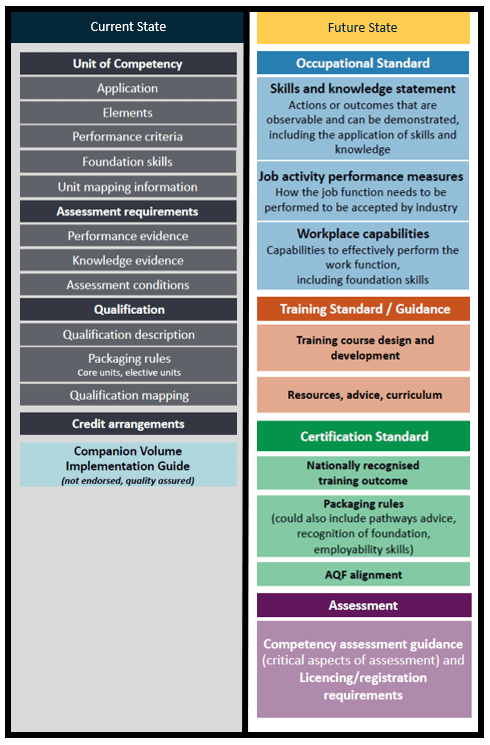
The framework for a future VET Qualifications architecture has been published by the Australian Government. It compares a boring ‘charcoal grey’ framework with a ‘colourful’ future framework. Of course we want to move to the vibrant future state.

In the following diagram, I have compared the current and future states side by side, in an attempt to compare the two frameworks.
And the next diagram show the connections between the current and future states.
It seems that we will be creating new documents, and the new document titles are likely to still confuse people. Also, it seems that we will rearrange the existing information (maybe I should use the ‘rearranging the deck chairs on the Titanic’ metaphor). I think we are adding complexity.
I could further analyse the proposed VET Qualifications Reforms, but that would be a waste of my time. Changes are going to happen anyway. So here is an illustration showing my concerns.
I may be wrong. I would like to see a complete sample for an entire set of documents that are planned to replace what we currently have. Then I will know if I am wrong, or right. I hope we get to see a sample before government ministers and their bureaucrats make the decision to implement chaos.
I can image the massive confusion, massive frustration, massive non-compliance, and massive costs associated with implementing the VET Reforms. Unfortunately, I cannot image that the future will be better than what we currently have. My greatest concern with the VET Reforms (now known as Skills Reform) is the potential of damaging, if not destroying, the entire Australian VET system.
Validation is defined as the quality review of the assessment process. It involves checking that the assessment tool produces valid, reliable, sufficient, current and authentic evidence to enable reasonable judgements to be made as to whether the requirements of the training package or VET accredited courses are met. It includes reviewing a statistically valid sample of the assessments and making recommendations for future improvements to the assessment tool, process and/or outcomes and acting upon such recommendations. [1]
Assessment validation has two distinct parts:
Part 1. Check the assessment tool for compliance
Part 2. Review a sample of the assessments.
This article covers the first part only.
If you want to know more about the second part, then I recommend reading the information published by ASQA about how to conduct assessment validation. This information covers: [2]
Who conducts validation?
Scheduling validation
Statistically valid sampling and randomly selecting samples to be validated
Effective validation
Reviewing assessment practice
Reviewing assessment judgements
Validation outcomes and the implementation of recommendations for improvement.
Part 1. Check the assessment tool for compliance
The assessment tool must be checked to ensure it complies with the requirements specified by the Standards for RTOs, in particular: [3]
Compliance with the principles of assessment and the rules of evidence
Compliance with the requirements specified by the training package or VET accredited course.
The following 6-step process can be used to check the assessment tool for compliance:
Step 1. Read the assessment requirements
Step 2. Review the assessment plan
Step 3. Review the assessment matrix (mapping)
Step 4. Check the details about how the knowledge evidence is planned to be being gathered
Step 5. Check the details about how the performance evidence is planned to be being gathered
Step 6. Check the overall quality of the assessment tool.
Step 1. Read the assessment requirements
This is a quick step to perform. You will read and re-read the unit of competency and its assessment requirements many times during the assessment validation process. During this first step, have a quick read of the assessment requirements and answer the following questions:
What is the volume or frequency of performance evidence?
Is the location, facilities, equipment, or other assessment conditions specified?
Step 2. Review the assessment plan
This step should also be quick. The purpose of this step is to get an overview of what is the planned assessment approach During this second step, answer the following questions:
Has the correct unit code and title been used?
How many assessment tasks are planned?
Is there a plan to gather the knowledge evidence?
Does there appear to be sufficient assessment tasks for gathering the volume or frequency of performance evidence?
Does the planned assessment approach seem to be simple or complex?
Note: This planned assessment approach may be found in the Training and Assessment Strategy (TAS) or other documents covering how the RTO plans to implement the delivery of the training and assessment for a unit or cluster of units.
Step 3. Review the assessment matrix (mapping)
This step should be a relatively quick step. The assessment matrix is an important document used to display how the RTO plans to gather evidence that comply with the requirements specified by the training package or VET accredited course. The assessment matrix will be used during Step 4 and Step 5 to cross-check the RTO’s planned assessment approach and the assessment instruments being used to gather evidence.
During this third step, answer the following questions:
Has the correct unit code and title been used?
Has the entire unit of competency and its assessment requirements been copied into the matrix? Are the number of items the same? For example, if the unit has five elements does the matrix have five elements? And scan the wording to ensure the matrix has the exact words as the unit of competency and its assessment requirements.
Is there one column for each planned assessment task?
Are the titles or descriptions of the assessment tasks the same in the assessment plan and assessment matrix?
Is every item from the unit of competency and its assessment requirements planned to be assessed? For example, is there at least one ‘tick’ in every row?
Note: Some assessment matrices will provide information or numerical indicator about the assessment item instead of using a ‘tick’. For example, the matrix may indicate that a piece of knowledge evidence will be gather by Question 1.
Step 4. Check the details about how the knowledge evidence is planned to be being gathered
This step requires an attention to details. The purpose is to ensure that the assessment tool will gather the required knowledge evidence. During this fourth step, answer the following questions:
Is there an assessment instrument for gathering the knowledge evidence?
Are the instructions to the assessor clear and concise?
Are the instructions to the candidate clear and concise?
Is the structure, format, and layout of the assessment instrument easy to follow? This includes headings, sub-headings, page numbers, and numbering of questions.
Is there consistency between the assessment plan, assessment matrix and assessment instrument? For example, if the assessment plan states that there are 17 questions, does the assessment instrument have 17 questions?
Is every item of knowledge evidence being adequately gathered? A judgement about ‘adequately’ will need to be made.
Step 5. Check the details about how the performance evidence is planned to be being gathered
This step requires an attention to details and it can take time to examine the assessment documents for compliance. The purpose is to ensure that the assessment tool will gather the required performance evidence. During this fifth step, answer the following questions:
Is there one or more assessment instruments for gathering the performance evidence?
Are the assessment conditions compliant with those stated in the Assessment Requirements for the unit of competency? This may include assessment location, facilities, equipment, and access to specified documents. For example, if the assessment conditions state that the assessment occurs in the workplace, then the assessment tasks must state that the evidence must be gathered from a workplace (not from a simulated workplace).
Are the instructions to the assessor clear and concise?
Are the instructions to the candidate clear and concise?
Are the items of performance evidence clearly listed or identified?
Is the structure, format, and layout of the assessment instrument or instruments easy to follow? This includes headings, sub-headings, and page numbers.
Is there consistency between the assessment plan, assessment matrix and assessment instrument? For example, if the assessment matrix states that evidence for Performance Criteria 1.1 will be gather during Assessment Task 2, then Assessment Task 2 must cover the gathering of evidence for Performance Criteria 1.1.
Is every item of performance evidence being adequately gathered? A judgement about ‘adequately’ will need to be made. This includes a check that the amount of evidence being gathered is compliant with the specified volume or frequency of performance evidence.
Note: Verbs are important. For example, if performance criteria says, ‘negotiate and agree with a supervisor’, then there needs to be evidence that the candidate has negotiated and agreed with a supervisor’. Also, the letter ‘s’ is important. A item of performance evidence may specify plural rather than singular. For example, if it states ‘write reports’, then more than one written report is required for evidence.
Step 6. Check the overall quality of the assessment tool
This step can take time to examine the assessment tool for compliance, readability, and usability.
Are there sample answers and assessment decision criteria for assessors?
Is the structure, format, and layout of all assessment documents easy to follow?
Are all instructions written clearly and concisely?
Are there any grammar, spelling and typo errors?
Is there a list of all the assessment documents required for the assessor?
Does the assessment tool have all the documents required for the assessor?
Is there a list of all the assessment documents required for the candidate?
Does the assessment tool have all the documents required for the candidate?
Has the correct unit code and title been used throughout all the assessment documents? This may include release number.
Do all the assessment documents have version control information?
In conclusion
Assessment validation has two distinct parts:
Part 1. Check the assessment tool for compliance
Part 2. Review a sample of the assessments
Assessment validation can be time-consuming and mind-bending.
Preparation before an assessment validation meeting can reduce the time at the assessment validation meeting. However, you can expect a typical assessment validation meeting to require anywhere between a few hours and an entire day. The duration of the assessment validation meeting can depend on the quality of the assessment tool and number of assessment samples to be reviewed. I regularly see poor quality assessment tools, and it takes time to properly check large numbers of assessment samples.
Clear and critical thinking is required by people participating in an assessment validation meeting. There are usually many documents to be reviewed and checked. Printing paper copies of documents (or some documents) and using ‘split screens’ on computers will help when comparing information from two or more documents, such as:
unit of competency
assessment requirements
assessment plan
assessment matrix
assessment instructions
assessment instruments.
Frustration and fatigue can be experienced during long assessment validation meetings. Breaks will be needed (and sometimes chocolate helps). It is a good idea to assign an experienced VET practitioner to lead the assessment validation meeting.
Are you a doing the TAE40122 Certificate IV in Training and Assessment, and are you struggling with your studies? Do you want help with your TAE studies?
I have found that some people studying for their Certificate IV in Training and Assessment qualification struggle with understanding what a task breakdown is, and how to develop a task breakdown. In this article, I aim to answer the following questions:
What is a task breakdown?
How can a task breakdown be developed?
When can a task breakdown be used?
Where do we start
Australia’s VET system is competency-based. A primary objective of VET is to help people learn how to perform work tasks and activities.
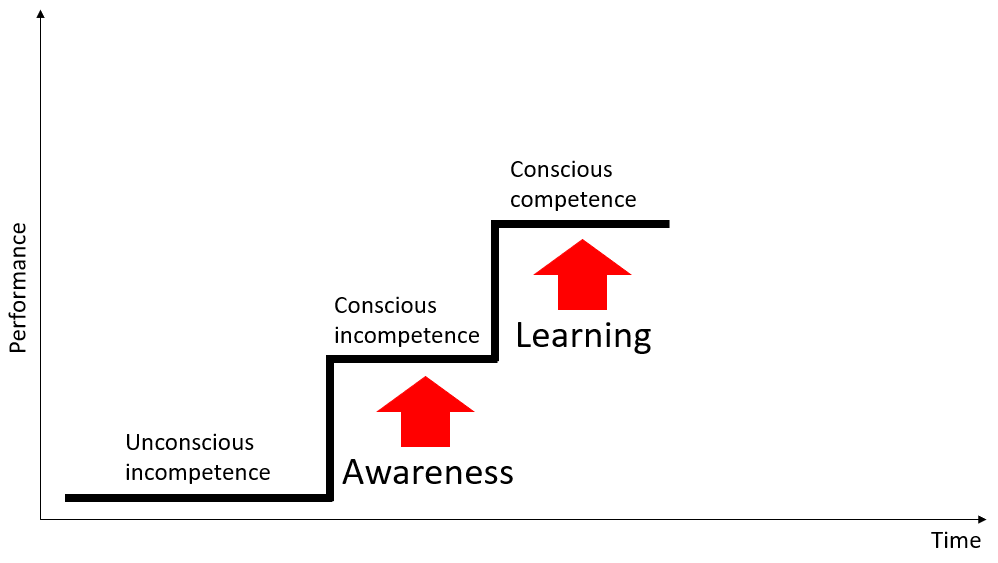
The four stages of competence, also known as the ‘conscious competence learning model’, describes the process of progressing from incompetence to competence in performing a task or activity. [1]
Stage 1. Unconscious incompetence
At this ‘unconscious incompetence’ stage, a person is unaware of their inability to perform a particular task or activity.
Stage 2. Conscious incompetence
At the ‘conscious incompetence’ stage, a person becomes aware that they are unable to perform a particular task or activity.
Stage 3. Conscious competence
A person who is aware of their incompetence may decide it is worth their time and effort to learn how to perform the particular task or activity. At the ‘conscious competence’ stage, the person can perform the task but they will require concentration and may need to think about each step.
Stage 4. Unconscious competence
In the final stage of ‘unconscious competence’, performing the task becomes second nature because the person has learnt and practiced performing the task so much. They can perform the task easily and without thinking about it. As a result, the task may be performed while executing another task.
An experienced or skilled worker often performs many work tasks and activities without needing to think about how or what to do.
Becoming conscious again
As a trainer, we often have mastered skills and we are no longer conscious about how we perform work tasks or activities. We just do it.
But as a trainer, we must explain and demonstrate to others how to perform work tasks, and to do this we have to again become conscious about the steps required to perform the task. The development of a task breakdown is a method that helps us become conscious again about how to perform a work task or activity.
A task breakdown is a step-by-step description about how to perform a task. It may also be known as a procedure or work instructions.
What is a task breakdown?
A ‘task breakdown’ is a document that breaks down a task. It describes the steps in a logical sequence to perform the particular work task or activity.
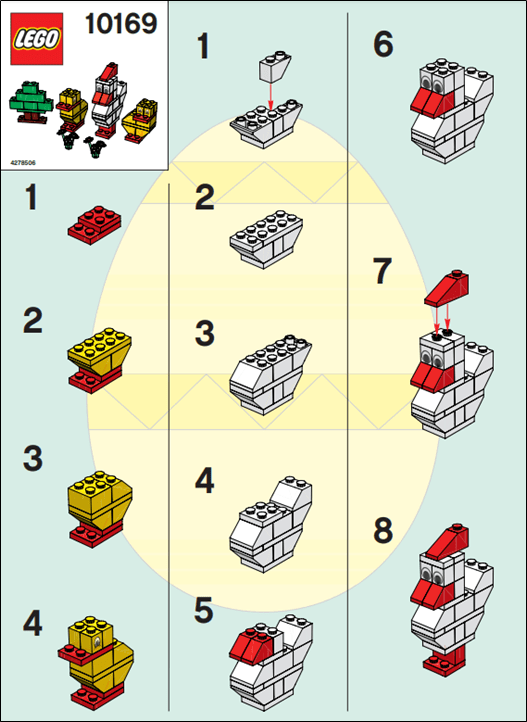
I use three analogies to help people understand and appreciate the value of a task breakdown: Lego instructions, Ikea instructions, and a cooking recipe.
The following three examples have three common features:
Steps are numbered
Illustrations are used to visually communicate
The outcome or desired result is shown.
Lego instructions
Ikea instructions
Cooking recipe
How can a task breakdown be developed?
Use the following six steps to develop a task breakdown.
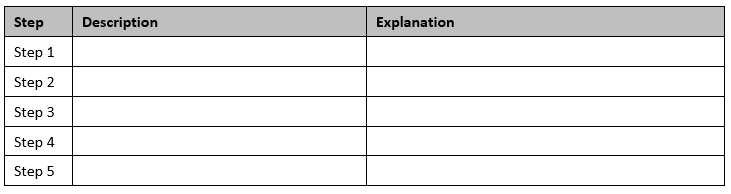
Step 1. Create 3-column table
Open a new Microsoft Word document and create a 3-column table. For example:
Step 2. Add table headings and adjust column width
The following illustrates the recommended layout and format for the task breakdown. For example:
Note: Layout and format can be modified later, if required.
Step 3. Enter step numbers
Use the first column to enter step numbers. The numbers imply a logical sequence to followed, and repeatedly use the word ‘step’ because this reinforces that each row is a step to be performed. For example:
Note: Table rows can be added or removed later, as required.
Step 4. Write brief description for each step
Perform the task or observe someone performing the task. Write a brief description for each step. For example:
Step 5. Write explanations
Write a clear and concise explanation for each step. Use illustrations, diagrams, and photos to show examples. Do not decorate or use unnecessary visuals. For example:
Important note: Remember to highlight safety requirements for the task or for a particular step.
Step 6. Review and finalise task breakdown
Ask someone to use your draft task breakdown to perform the task. Observe the person performing the task, checking the sequence of steps, and seek feedback about readability.
Check your task breakdown for grammar and spelling. Add task title, version control, and page numbers before finalising the document. For example:
Download the finished product
You can download a PDF version of the finished task breakdown for creating a task breakdown from here.
Used as a planning tool to identify required knowledge, required skills, safety requirements, and resources required to perform a task
Used to explain the process or performance of the task
Used to demonstrate the process or performance of the task
Used by the learner to guide them when they learn or practice performing the task
Used to check or assess the performance of the task
Used as a diagnostic tool when a person is struggling with learning or performing the task (used to identify what step the learner is stuck on).
Training session plan
A task breakdown describes a task. A session plan is used to describe the training to be delivered. The task breakdown should not make reference to the training process. It should only describes the work task or activity.
A training session plan can be developed based on the steps described by the task breakdown.
Observation checklist
A task breakdown can be converted into an observation checklist. For example:
A task breakdown should be written to guide performance of a work task or activity. It should describe the step-by-step procedure to be followed in a training environment or in a real workplace. The task breakdown should be the procedure to follow, no matter where the task is performed.
In conclusion
Creating a task breakdown is a basic skill that all trainers and TAFE teachers must have. A task breakdown describes the steps in a logical sequence to perform a particular work task or activity.
A task breakdown has a multitude of uses:
Used by the trainer as a planning tool
Used by the trainer when explaining and demonstrating the performance of the task
Used by the learner to guide them when they learn or practice performing the task
Used by the trainer when checking or assessing the performance of the task
Are you a doing the TAE40122 Certificate IV in Training and Assessment, and are you struggling with your studies? Do you want help with your TAE studies?
The quality of vocational education and training (VET) in Australia is important. Systematic training aims to improve productivity, global competitiveness, and workplace safety. And each year, billions of taxpayers’ dollars is spent by governments on delivering VET programs.
Australian industry, employers, governments, and taxpayers deserve a VET system that delivers quality outcomes, and value for money. And job seekers, apprentices, trainees, and employees who undertake VET programs should expect to receive a quality service from training providers. It is the role of government departments and VET regulators to monitor and audit VET quality.
In Australia, the VET Quality Framework has been established. It consists of five elements [1]:
Australian Qualification Framework (AQF)
Standards for Registered Training Organisations (RTOs)
Fit and proper person requirements
Financial viability risk assessment requirements
Data provision requirements.
Australian Qualification Framework (AQF)
All Australian qualifications must comply with the AQF. [2] The learning outcomes for each AQF level and qualification type are described. The current AQF has evolved from the initial implementation handbook released in 1995. Since then, there has been a procession of revised frameworks:
AQF Implementation Handbook First Edition 1995
AQF Implementation Handbook Second Edition 1998
AQF Implementation Handbook Third Edition 2002
AQF Implementation Handbook Fourth Edition 2007
AQF First Edition 2011
AQF Second Edition 2013
And there has been at least three amendments to the AQF Second Edition 2013. [3]
AQF Volume of Learning
The AQF Volume of Learning [4] has become a prime focus for the national VET regulator. The aim is to discourage unduly short-duration VET training programs that do not provide sufficient training.
Standards for Registered Training Organisations (RTOs)
The Standards for RTOs are the regulatory requirements for the operation of training organisations registered to deliver training services and to issue nationally recognised training (NRT) qualifications or statements of attainment. Only registered training organisations (RTOs) can issue documents with the NRT logo (as shown below).
NRT logos provided for the purpose of display only
Many training organisations want to be registered, not as an expression of quality training, but because this is a prerequisite for being eligible to receive government funding when delivering training.
The current Standards for RTOs have evolved from the Australian Quality Training Framework (AQTF) that were first introduced in 2001. Since then, there has been a procession of revised standards: [5]
National Framework for the Recognition of Training (NFROT) 1992
Australian Recognition Framework (ARF) 1998
AQTF 2001
AQTF 2005
AQTF 2007
AQTF 2010
Standards for NVR 2011
Standards for NVR 2012
Standards for RTOs 2015.
And there has been at least two amendments to the Standards for RTOs 2015.
The Standards for RTOs require training providers to comply with:
Training packages and accredited courses
Legislation and regulations.
Training packages and accredited courses
RTOs must comply with the requirements specified by training packages and accredited courses when delivering nationally recognised training (NRT):
Qualification packaging rules
Units of competency including elements of competency, performance criteria, and foundation skills
Assessment requirements including performance evidence required, knowledge evidence required, and assessment conditions.
Legislation and regulations
RTOs must comply with all relevant legislation and regulations. For example:
Work health and safety
Antidiscrimination
Copyright
Privacy.
Fit and proper person requirements
The ‘Fit and proper person requirements’ are used to determine the suitability of owners, executives, or senior managers involved in the operation of a registered training organisation. [6]
Over the years, Australia has had a number of unfit and improper people owning and managing RTOs. I will say more about this topic during the conclusion of this article.
Financial viability risk assessment requirements
The ‘Financial viability risk assessment requirements’ are used to determine the ability of an RTO to meet financial obligation and remain financially viable. [7]
Over the years, Australia has seen a number of high-profile RTOs that have financially crashed. Many RTOs have a business model that is based on revenue from government funding. If the government funding changes, so does the financial viability of these RTOs.
Data provision requirements
The ‘Data provision requirements’ specify that RTOs must provided data when requested and submit quality indicator data annually to their VET regulator. [8]
Gathering data can provide useful insight about how an RTO is operating, or has been operating. There is always going to be a lag. Luckily, this is not the only source of intelligence used by the VET regulators to monitor the performance of RTOs.
In conclusion
Australia has had a long history in government sponsored and industry endorsed frameworks that have been designed for assuring the quality of vocational education and training (VET).
Over the years, it is sad that the Australian VET system has witnessed many cases of fraudulent, unethical, and unscrupulous behaviour displayed by RTO owners, executives, and senior managers. It is sad that greed, self-interest, profit, or a focus on personal financial gain has created some rotten operational practices. And TAFEs have not been immune from poor practices. In TAFE, ‘profit’ may be called ‘surplus’. And in TAFE, there is still a need to ‘cut costs’. There have been too many occasions when government funding has been rorted by all types of RTOs.
Unfortunately, this is why we need a highly regulated VET system. I say ‘unfortunately’, because the unintended consequence has been a VET system that is highly prescriptive. This can stifle innovation. This can stifle quality competition. And it has increased the administrative burdens placed on trainers and assessors.
The VET Quality Framework is necessary. It plays an important role in the assurance of VET quality. It can be used by the VET regulators and government departments to monitor and audit RTOs operations. I think it is doubly important to closely monitor and audit RTOs that receive government funding. There is a worrying trend for the VET regulators to take a ‘light-touch’ approach to their regulating duties.
Are you a doing the TAE40122 Certificate IV in Training and Assessment, and are you struggling with your studies? Do you want help with your TAE studies?
Over the past few weeks I have been thinking about what tasks do trainers perform and what credentials do trainers need. This was triggered by the release of the Australian Skills Classification by the National Skills Commission. The occupation profile for a vocational trainer described in the Australian Skills Classification was appalling. My various thoughts have been recently published in four articles:
I would like to thank the many people who commented in response to these previous articles on this topic. In this article, I want to put together my many and varied thoughts.
What tasks are performed by trainers?
Qualifications must have an occupational outcome. Therefore, we need to develop an occupation profile based on work tasks and activities performed by a trainer. There are different types of trainers and not all trainers perform the same range of tasks.
What are the different types of trainers?
Some trainers work as part of Australia’s vocational education and training (VET) system. And some do not. This is the first significant difference between trainers:
VET trainers
Non-VET trainers.
Another difference is the job role performed: [1]
Employed as a VET trainer (TAFE, private RTO, other RTO)
Employed in a job role other than a VET trainer (experienced worker, workplace supervisor, workplace manager, etc.)
School teacher delivering a VET in Schools program.
And another difference is the employment status: [1]
Permanent employee (full-time and part-time employee)
Non-permanent employee (casual, sessional or employed under fixed-term or short-term contract)
Volunteer.
What are the different types of RTOs?
It has been said that VET trainers perform different tasks depending on the type of RTO they work for. The Education IRC identified six types of RTOs: [2]
TAFE Institute
University RTO
Private RTO
School RTO
Community RTO
Enterprise RTO.
I am not convinced that a person delivering training and assessment services for different types of RTOs actually perform profoundly different tasks:
Are trainers expected to deliver training?
Are trainer expected to keep training records?
Are trainers expected to monitor progress?
Are trainers expected to resolve issues?
Are trainers expected to assess competence?
Are trainers expected to keep assessment records?
Fundamentally, I think trainers will perform the same core tasks regardless of the type of RTO they work for. Some people may disagree with me, but they haven’t provided any details to persuade me otherwise.
I do acknowledge that trainers may operate under different conditions:
Different types of learners, with different characteristics and needs
Different types of content for different industry sectors
Different types of training and assessment resources
Different types of locations where training and assessment is conducted
Different technology to be used (Moodle, Canvas, other LMS, Zoom, Cisco Webex, other web conferencing platform, etc.).
The different conditions do not essentially alter the work tasks or activities performed by a trainer. One important feature of the Australian VET system is ‘contextualisation’, and this allows RTOs to customise what they deliver to respond to different conditions. Therefore, an RTO delivering a TAE Certificate IV qualification can tailor content for a particular learner group need.
What qualifications, skill sets, and units of competency are needed?
Units of competency are used to describe the performance of work tasks and activities. They are then used as the building blocks for qualifications and skill sets. The needs of industry determines qualifications, skill sets, and units of competency. And the VET industry is mainly represented by the VET regulators, in particular ASQA, lobby groups, and the employers of VET trainers.
What are the regulatory requirements?
VET is highly regulated to ensure quality and to protect clients. The regulations specify the credentials that must be held by a VET trainer.
Deliver training within the VET context
An RTO’s training must be delivered only by a person who has the appropriate credential. Currently, this credential is the TAE40116 Certificate IV in Training and Assessment qualification or a diploma or higher-level qualification in adult education. [3]
Where the RTO engages an individual, who does not hold the appropriate credential, the individual can deliver training but they must be supervised by a person who does have the appropriate credential. The supervisor must monitor the individual under their supervision. And the supervisor is accountable for the quality of the training provided and the quality of assessment evidence collected. [3]
Assess competency within the VET context
Assessment must be conducted by a person who has attained the following units of competency: [3]
TAEASS401 Plan assessment activities and processes
TAEASS502 Design and develop assessment tools
TAEASS402 Assess competence
TAEASS403 Participate in assessment validation.
Alternatively, the person conducting assessments can have a diploma or higher-level qualification in adult education. [3] Do all higher-level qualifications in adult education ensure competence in the TAEASS401, TAEASS402, TAEASS403, and TAEASS502 units?
Where the RTO engages an individual, who does not hold the appropriate credential, the individual can contribute to assessment by collecting assessment evidence and providing it to a ‘qualified assessor’. It is the ‘qualified assessor’ who is accountable for the assessment process and determines the assessment outcome. The ‘unqualified individual’ is prohibited from determining assessment outcomes. [3]
Industry experts may also be involved in the assessment judgement, working alongside the ‘qualified assessor’. Again, it is the ‘qualified assessor’ who is accountable for the assessment process and determines the assessment outcome. The ‘unqualified individual’ is prohibited from determining assessment outcomes. [3]
What tasks are performed by a trainer?
The following diagram shows the relationship between:
Tasks performed by a trainer
Regulatory requirements
Qualifications, skill sets, and units of competency.
I acknowledge that not all trainers perform the same range of tasks. Some work for RTOs and others do not, and maybe some RTOs expect their trainers to do things that are not required when working for other RTOs. Therefore, I have created five categories of trainer.
Category 1 trainer
Deliver training within a non-VET context
Deliver training under supervision within a VET context
Prohibited from conducting assessment within a VET context
Category 2 trainer
Deliver training under supervision within a VET context
Contribute to assessments within a VET context
Prohibited from conducting assessments within a VET context
Category 3 trainer
Deliver training under supervision within a VET context
Conduct assessments within a VET context
Category 4 trainer
Perform the role of trainer or TAFE teacher
Deliver training within a VET context
Conduct assessments within a VET context
Has the capability to design and develop training and assessment resources
Has the capability to participate in assessment validation and moderation activities
Category 5 trainer
Perform the role of senior trainer or senior TAFE teacher
Has all the capabilities to perform the role of a Category 4 trainer
Has the capability to design and develop training and assessment strategies
Has the capability to lead assessment validation and moderation activities
Has the capability to evaluate training and assessment services
Supervise or mentor trainers or TAFE teachers.
The following table identifies the typical tasks performed by each category of trainer.
Tasks performed will determine the category. For example:
What category would match the requirements of a school teacher who is delivering a VET in Schools program? Probably, most would be a Category 3 trainer. Some would be a Category 4 trainer.
What category would match the requirements for a volunteer trainer working for a community-based RTO? Depending on the RTO requirements and supervision arrangements, the volunteer could be Category 1, 2, 3, or 4 trainer.
How to select the appropriate qualification or skill set
The following diagram can be used to help select the appropriate qualification or skill set.
A person only needs the TAE Certificate IV if:
They are a trainer working in the VET system
They will be responsible for conducting assessments
They will not work under supervisions (as per the Standards for RTOs)
They a new to the VET system.
Is AQF Level 4 appropriate for VET trainers?
The qualification for new trainers has been at the AQF Level 4 for the past 23 years. Some people think that the current qualification for VET trainers is at the wrong AQF level. I think it is the right level because of the supervision responsibilities of a trainer: supervise learners, supervise their safety, supervise their progress, etc.
Should there be more than one TAE Certificate IV qualifications?
Some people suggest that more than one TAE Certificate IV qualification is needed. How many qualification are needed? What units of competency would be included in each qualification? What units of competency would be the same? And what units of competency would be different?
I am not convinced that we need multiple qualifications. If people think some tasks are not being covered, then maybe the solution is have a few elective units. Currently, the TAE40116 Certificate IV in Training and Assessment qualification only has provision for one elective unit. If there was two or three elective units, then RTOs could select electives to meet different needs. Having said that, most RTOs would probably continue to deliver a fixed program.
In conclusion
In this article, I have introduced the concept of five categories of trainers.
Each category is supported by a different credential. Category 1, 2, and 3 trainers are covered by skill sets. Category 4 trainers are covered by a Certificate IV, and Category 5 trainers are covered by a Diploma. A pathway from Category 1 trainer to Category 5 trainer is provided with minimal duplication. In other words, one credential leads onto the next.