What is the ACSF? And what are the ACSF Performance Indicators?

This is the first of two articles covering an overview of the Australian Core Skills Framework (ACSF). My aim is to answer the following questions:

  • What is the Australian Core Skills Framework (ACSF)?
  • What are the ACSF Performance Indicators?
  • Is there a connection between the ACSF and the AQF?
  • What is the Digital Literacy Skills Framework (DLSF)?
  • Is there a connection between the DLSF and the ACSF?

The second article explains how to use the Australian Core Skills Framework (ACSF) to identify LLN skill gaps.

This article has been primarily written for people studying for their TAE40116 Certificate IV in Training and Assessment qualification. However, qualified VET practitioners may still get something from the content or the way the content has been presented.

The information covered by this article is relevant to the TAELLN411 Address adult language, literacy and numeracy skills unit of competency. It is essential knowledge required by trainers and TAFE teachers.

I don’t think I need to repeat everything that is readily available from the internet. If you need more details than what I am providing in this article, I would highly recommend reading the following documents:

Also, general information about the ACSF can be accessed from the Australian Government Department of Education, Skills and Employment website.

What is the Australian Core Skills Framework (ACSF)?

The Australian Core Skills Framework (ACSF) was introduced in 2012. It is a tool used to describe an individual’s performance in the following five core skills:

  • Learning
  • Reading
  • Writing
  • Oral communication
  • Numeracy.

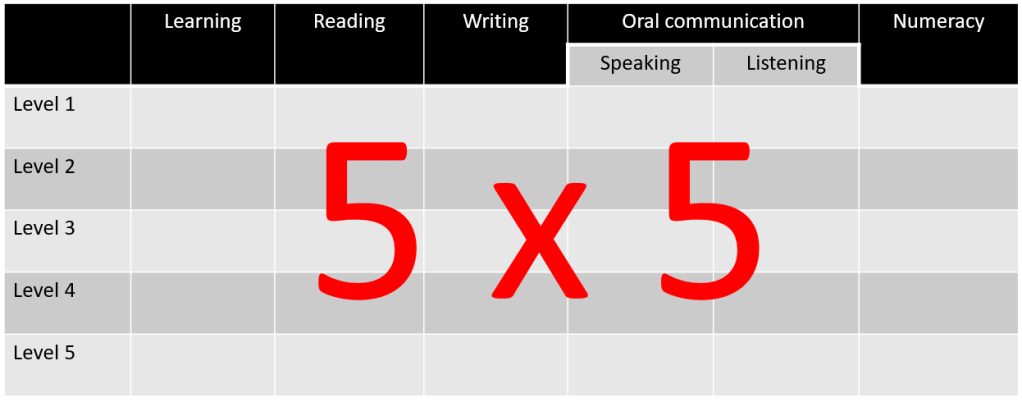
A 5 x 5 framework

Each core skill is described using five levels of performance ranging from one (low level performance) to five (high level performance).

The ACSF is a 5 x 5 framework:

  • Five core skills (learning, reading, writing, oral communication, numeracy)
  • Five levels of performance for each core skill.

ACSF Level 3

In 2006, the Australian Bureau of Statistics (ABS) released the results of the Adult Literacy and Life Skills Survey. It proposed that ‘Level 3’ in language, literacy, and numeracy skills was the minimum required for individuals to meet the complex demands of everyday life and work.

This ABS survey was conducted before the ACSF was published. However, it is common for people to consider that a minimum of ACSF Level 3 is required by skilled workers in today’s world of work.

ACSF Pre-Level 1

In  2017, a new Pre-Level 1 was introduced. Most trainers or TAFE teachers wouldn’t normally have learners that have been assessed with Pre-Level 1 core skills. These learners would usually need to participate in a qualification from the FSK Foundation Skills Training Package . And they would probably need extensive support from an LLN specialist.

Are you interested in finding out more about the ACSF Pre-Level 1? Please refer to the Pre-Level 1 supplement to the Australian Core Skills Framework (ACSF).

What are the ACSF Performance Indicators?

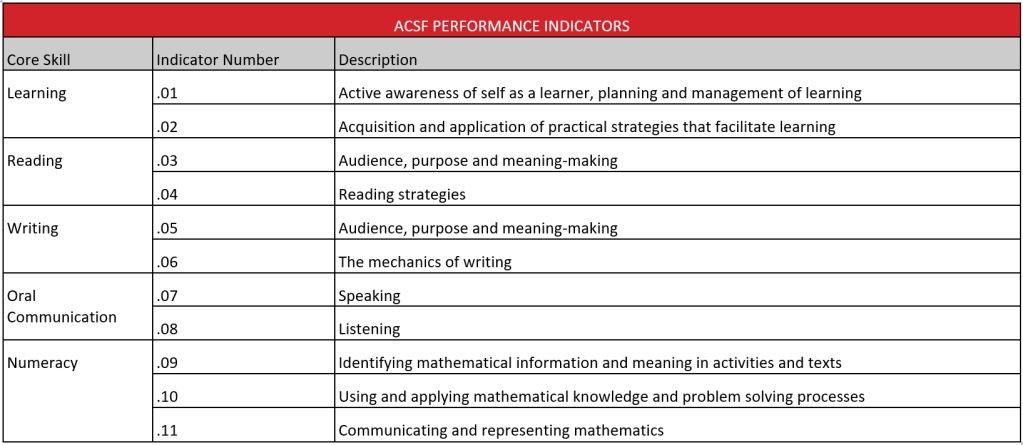
The ACSF Performance Indicators are statements that briefly describe performance at each level of the five core skills. There are eleven ACSF Performance Indicators:

  • 2 ACSF Performance Indicators for the Learning core skill
  • 2 ACSF Performance Indicators for the Reading core skill
  • 2 ACSF Performance Indicators for the Writing core skill
  • 2 ACSF Performance Indicators for the Oral Communication core skill
  • 3 ACSF Performance Indicators for the Numeracy core skill.

The following table has been copied from the ACSF (page 9). It gives a brief description for each ACSF Performance Indicators.

Some people can get confused by the numbering of the ACSF Performance Indicators. If you get confused, please come back to the above table to see how the numbering starts at .01 and .02 for the Learning core skill and continues until .09, .10 and .11 for the Numeracy core skill. It is just the way the core skills have been numbered.

Also, the ACSF has colour-coded each core skill. The following information uses the colours that are consistent with the ACSF document.

ACSF Performance Indicator for the Learning core skill

The following table has been copied from the ACSF (page 17). It briefly describes the ACSF Performance Indicators of each ACSF Level for the Learning core skill.

ACSF Performance Indicator for the Reading core skill

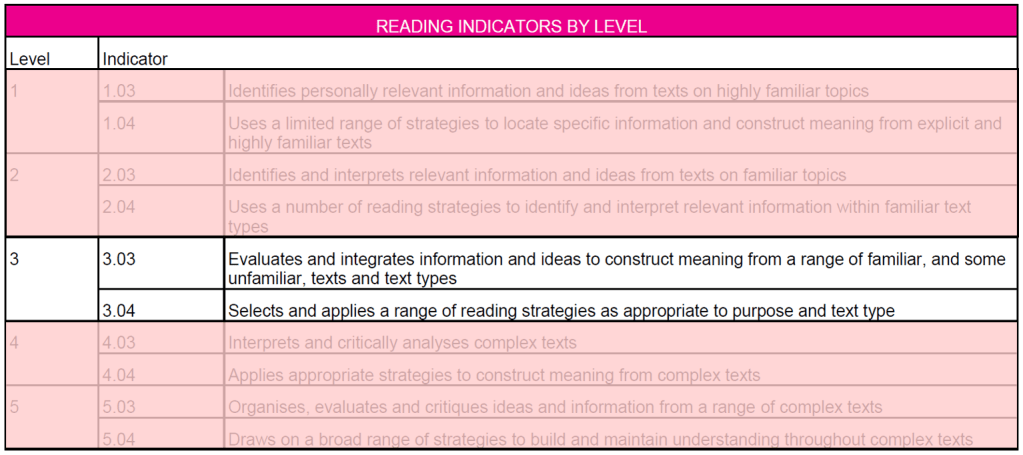
The following table has been copied from the ACSF (page 41). It briefly describes the ACSF Performance Indicators of each ACSF Level for the Reading core skill.

ACSF Performance Indicator for the Writing core skill

The following table has been copied from the ACSF (page 65). It briefly describes the ACSF Performance Indicators of each ACSF Level for the Writing core skill.

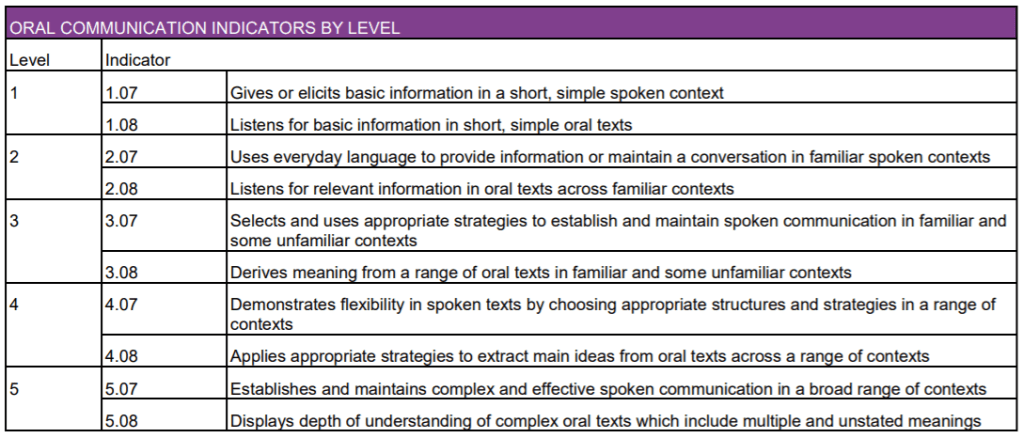
ACSF Performance Indicator for the Oral Communication core skill

The following table has been copied from the ACSF (page 90). It briefly describes the ACSF Performance Indicators of each ACSF Level for the Oral Communication core skill.

ACSF Performance Indicator for the Numeracy core skill

The following table has been copied from the ACSF (page 114). It briefly describes the ACSF Performance Indicators of each ACSF Level for the Numeracy core skill.

Numbering of ACSF Performance Indicators

The first number of the ACSF Performance Indicator is the ACSF Level. For example, all core skills at the ACSF Level 2 will start with the number 2.

The numbers after the decimal point are for the indicators that describe a specific ACSF core skill . For example, 2.03 and 2.04 refer to the two indicators used to determine if the Reading core skill is at the ACSF Level 2.

Note: The ACSF Performance Indicators provide a brief description. Additional information and examples are provided by the ACSF document. There are several pages of additional information for each ACSF Performance Indicator, and this information helps us understand the ACSF Level for each core skill.

Is there a connection between the ACSF and the AQF?

No. The Australian Core Skills Framework (ACSF) does not correlate with the Australian Qualification Framework (AQF). The levels of the AQF do not match up directly with the levels of the ACSF.

It is possible for a Certificate III (AQF Level 3 qualification) to have units of competency that require core skills at an ACSF Level greater than 3. For example, several units from the UEE30820 Certificate III in Electrotechnology Electrician require Numeracy skills at the ACSF Level 4 or 5.

And it is possible for a Diploma (AQF Level 5 qualification) to have units of competency that would only require core skills as the ACSF Level 3 or 4.

Digital literacy

Technology is frequently used to perform work tasks and activities. For example, screen-based reading and writing is common. Computers and other digital devices have transformed the type and amount of data available. This and other factors require improved numeracy skills. And during 2020, there was a massive increase in workers using web conferencing platforms, such as Zoom. This has required many people to further develop there speaking and listening skills to effectively communicate and collaborate online.

The world of work requires people to have effective language, literacy, and numeracy (LLN) skills, and these LLN skills are interrelated with digital literacy. Digital literacy covers the physical operations of digital devices and the software operations in those devices.

Is there a connection between the DLSF and the ACSF?

In 2020, the Digital Literacy Skills Framework (DLSF) was published by the Australian Government Department of Education, Skills and Employment. The DLSF adds onto the ACSF. The following table has been copied from the DLSF (pages 10 and 11).

You can see that Digital Literacy has been added to the five core skills of the ACSF. The two ACSF Performance Indicators for Digital Literacy (.12 and .13) have a descriptive statement for ACSF Levels 1, 2, and 3. There are no details given for ACSF Levels 4 and 5.

The following table has been taken from the DLSF (page 12). It briefly describes the ACSF Performance Indicators of ACSF Levels 1, 2, and 3 for the Digital Literacy core skill.

In conclusion

The Australian Core Skills Framework (ACSF) is a tool used to describe an individual’s performance in essential core skills. Descriptive statements, known as ACSF Performance Indicators, are used to determine the level of each core skill.

This article is the first of two articles about the ACSF. The how-to use the ACSF to determine levels and identify LLN skill gaps is covered by the second article.

There are three separate documents relating to the Australian Core Skills Framework, and this can make things complicated:

  • Australian Core Skills Framework (ACSF), 2012
  • Pre-Level 1 supplement to the Australian Core Skills Framework, 2017
  • Digital Literacy Skills Framework, 2020.

The future

Creating an updated version of the Australian Core Skills Framework (ACSF) that incorporates all three documents would significantly simplify things. The following diagram illustrates my suggestion.

This updated ACSF would become a 6 x 6 framework:

  • Six core skills (learning, reading, writing, oral communication, numeracy, digital literacy)
  • Six levels of performance for each core skill (Pre-Level 1, Level 1, Level 2, Level 3, Level 4, Level 5)

The following table shows what is currently available but we have to get the information from three different documents.

Note: The current Digital Literacy Skills Framework does not describe Digital Literacy Levels 4 and 5. Therefore, the above table show that information is ‘Not available’.

Do you need help with your TAE studies?

Are you doing the TAE40122 Certificate IV in Training and Assessment, and are you struggling with your studies? Do you want help with your TAE studies?

Ring Alan Maguire on 0493 065 396 to discuss.

Contact now!

logo otws

Training trainers since 1986

How to identify integrated assessment opportunities

What is integrated assessment?

Units of competency specify the standards of performance required in the workplace. [1] Each unit of competency describes a specific work activity or task, however, a small number of units may describe a body of knowledge or an essential skill.

For example:

  • The BSBMED301 Interpret and apply medical terminology appropriately unit covers the application of a body of knowledge
  • The BSBCRT311 Apply critical thinking skills in a team environment unit covers an essential skill.

Individual units of competency are rarely performed in isolation in the workplace. Typical job roles involve a number of related tasks. Integrated assessment is the simultaneous assessment of two or more related units of competency, and it is an efficient and authentic evidence gathering method, because it more closely reflects the real nature of work. [2]

Scenario

The following scenario shall be used to explain how to identify integrated assessment opportunities.

Let’s say, you work for an RTO that has been contracted by a community-based youth employment service to deliver some training. This client has been granted government funding to implement an innovative youth training and employment program.

Learners are early school leavers, typically with poor literacy skills, aged between 17 and 21.

The training program aims to prepare unemployed youth for basic office administration work. The client wants an emphasis on the development of computer skills.

A recent survey of local businesses identified that most use Microsoft Office applications. Several meetings with the client have occurred. The client has agreed to the delivery of the BSB20120 Certificate II in Workplace Skills qualification.

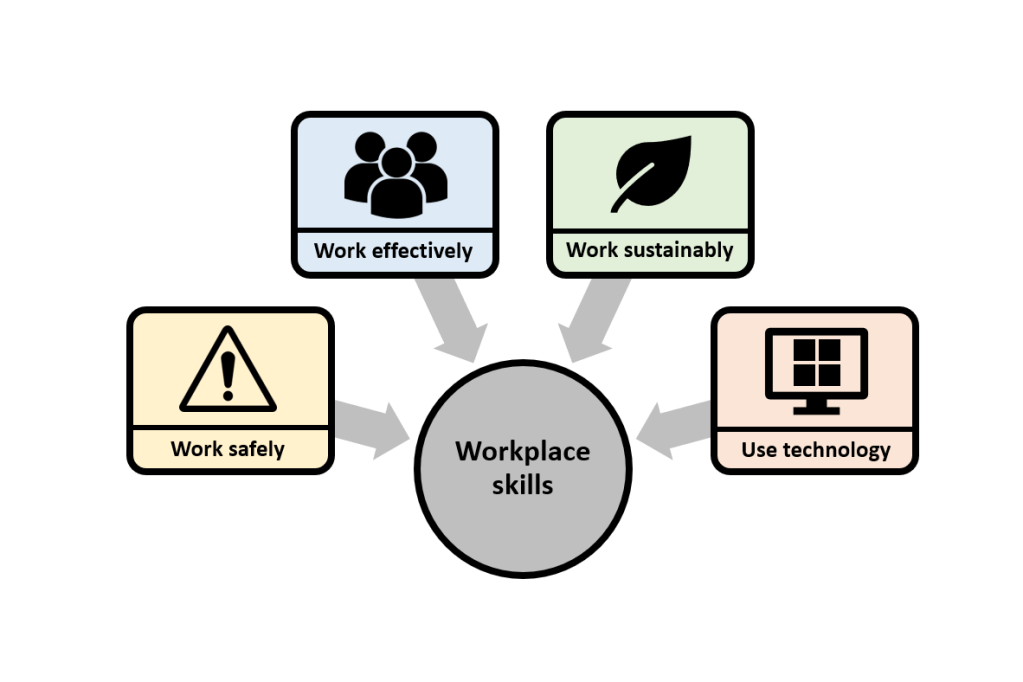
The training program shall be structured around four topics or learning blocks: work safely, work effectively, work sustainably, and use technology.

The following lists the ten (10) units of competency that will make up the BSB20120 Certificate II in Workplace Skills qualification.

Example 1

The following gives an example about how to plan for integrated assessment. It focuses on the four units of competency covered by the ‘Use technology’ cluster:

  • ICTICT102 Operate word-processing applications
  • BSBTEC202 Use digital technologies to communicate in a work environment
  • BSBTEC201 Use business software applications
  • BSBOPS101 Use business resources

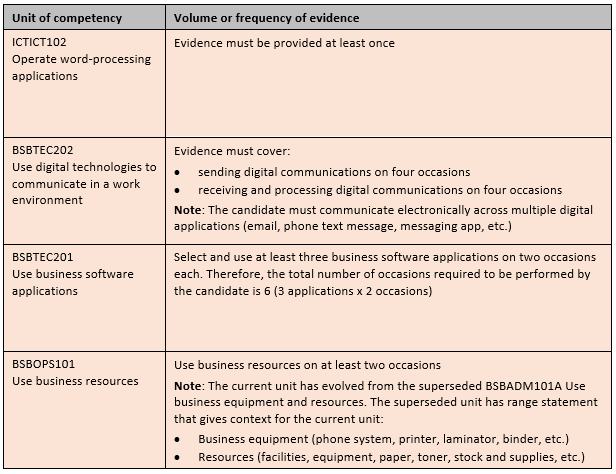
Step 1. Comprehend performance evidence requirements

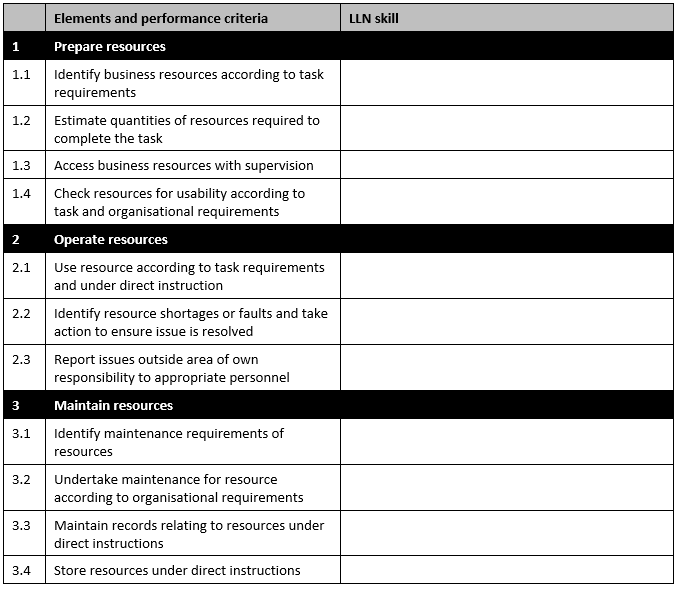
Read the elements and performance criteria to identify the scope of performance required. And read the Performance Evidence to identify the volume or frequency of evidence that is specified. For example:

Step 2. Create table

Create a table to assist with identifying typical work tasks and mapping the units of competency. For example:

Step 3. List typical work tasks

List the typical tasks performed in the workplace. For example:

Step 4. Map units of competency to typical work tasks

Use the table to identify any overlap. For example:

Step 5. Identify opportunities for integrated assessment

Assessment options are:

  • Gather performance evidence for a single unit during training
  • Gather performance evidence for multiple units during training
  • Gather performance evidence from the workplace
  • Combination of the above three.

Integrated assessment is when we gather performance evidence for multiple units. The following two examples have been designed to give a simple illustration of opportunities for integrated assessment. But do not be deceived by the apparent simplicity. From this point onward, the development of the assessment tool can get complex, and non-compliance with the Training Package requirements can easily occur.

Opportunity # 1

The ICTICT102 Operate word-processing applications unit has an element of competency that requires the candidate to print documents. And using a printer is covered by the BSBOPS101 Use business resources unit. Therefore, when a candidate prints a document, they can be producing evidence for the two units of competency.

The evidence produced when the candidate prints documents must ensure the performance criteria and any relevant assessment requirements for both units, ICTICT102 and BSBOPS101, are covered. This is necessary to ensure compliance with the specified Training Package requirements.

Opportunity # 2

The BSBTEC201 Use business software applications unit requires the candidate to have evidence of using at least three business software applications on two occasions each.

In this example, the ICTICT102 Operate word-processing applications unit has been contextualised for using Microsoft Word. This can be one of the three business software applications required for the BSBTEC201 unit.

If the candidate produces one or two Microsoft Word documents as evidence for the ICTICT102 unit, this same evidence can be used for the BSBTEC201 unit. However, much more evidence will still be required to satisfy the volume or frequency of evidence specified by the BSBTEC201 unit.

The above five steps explain how to identify opportunities for integrated assessment.

The next activity would be to design and develop the assessment tools.

Example 2. Use diagrams to show connection

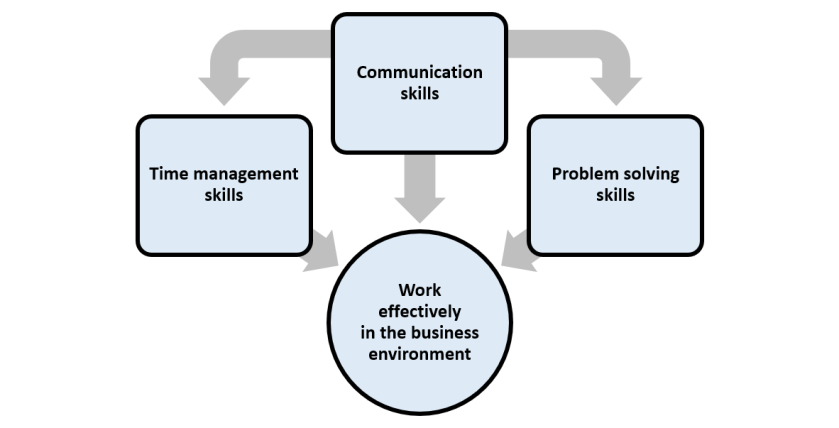
The following gives an example about how a diagram can be used to see connections and uncover opportunities for integrated assessment. It focuses on the four units of competency covered by the ‘Work effectively’ cluster.

Communication skills are used when we manage time. Communication skills are used when we solve problems. Communications skills, time management skills, and problem solving skills are all used when we perform work. These are the opportunities for integrated assessment.

Example 3. Integrate assessment

The examples above are for integrated assessment within a cluster of units. In the case of the BSB20120 Certificate II in Workplace Skills qualification, there is opportunity for a integrated assessment across the four topics or learning blocks. An RTO may decide to follow a relatively simple pathway commencing and completing each unit or cluster before moving onto the next. But each unit or cluster of units is not an independent or discrete activity or task performed in the workplace. It is common for an overlap.

The holistic assessment needs an end-of-program assessment in a workplace or a simulated workplace. This will add further complexity to the assessment approach, assessment tools, and assessment reporting processes.

The following shows how opportunities for integrated or holistic assessment for all units of competency can be identified.

  • The first work task on the list below, ‘Check work area is safe’, relates to gathering assessment evidence for a single unit of competency.
  • The second work task, ‘Plan and prioritise work tasks’, can overlap five units of competency and is across two clusters.
  • You can complete the remainder of the matrix, if you want, but I hope you can see the method for identifying integrated assessment opportunities.

In conclusion

Integrated assessment will add complexity to the assessment approach but it still can be simply organised for learners so that they do not have a confusing or complicated experience.

Government funding contracts can work against the concept of integrated assessment when there is a payment to RTOs for the completion of units. An RTO will most likely want to secure a positive cash flow by completing units or cluster of units as soon as possible, rather than waiting to the end of a program to receive payments from the government.

The concept of integrated assessments is important because it more closely reflects the real nature of work.

References

[1] Standards for Training Packages https://docs.employment.gov.au/documents/standards-training-packages accessed 20 November 2020

[2] Back 2 Basics Fact Sheet – Assessment https://www.myskills.gov.au/media/1781/back-to-basics-vet-assessment.pdf accessed 20 November 2020

Do you need help with your TAE studies?

Are you a doing the TAE40122 Certificate IV in Training and Assessment, and are you struggling with your studies? Do you want help with your TAE studies?

Ring Alan Maguire on 0493 065 396 to discuss.

Contact now!

logo otws

Training trainers since 1986