
In the Australian VET system, the terms ‘holistic assessment’ and ‘integrated assessment’ are often used interchangeably. However, there is a differences between the two concepts.
What is holistic assessment?
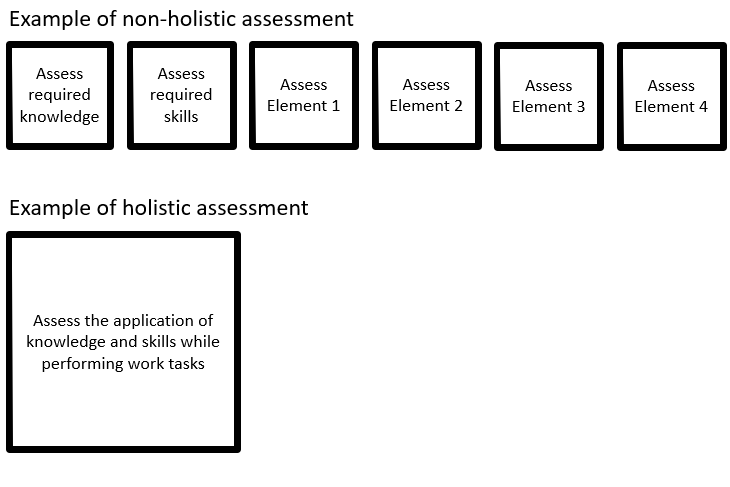
Holistic assessment is an assessment approach that covers multiple elements of competency. The assessor would consider the learner’s overall performance, including their application of knowledge and skills. This assessment approach would not explicitly gather evidence for each item of required knowledge or required skill.
What is integrated assessment?
Integrated assessment occurs when a learner performs an assessment task that can be used to gather evidence for multiple units of competency. The assessment task would be designed to gather evidence specified by two or more units of competency.
Both holistic and integrated assessment can be used to improve the quality of assessment in the Australian VET system. They can help to ensure that learners are assessed on their ability to apply their knowledge and skills to real-world situations.
Exploring words and their meaning
It is difficult to find an official definition of ‘holistic assessment’ in the context of the Australian VET system. Let’s explore various words and understand their meaning within Australia’s VET system:
- Competency
- Assessment
- Holistic
- Unit
- Unit of competency
What is the definition of competency?
In the Australian VET system, ‘competency’ is defined as: [1]
The consistent application of knowledge and skill to the standard of performance required in the workplace. It embodies the ability to transfer and apply skills and knowledge to new situations and environments.
A competent person must have the knowledge and skills required to perform a work task. And they must have the ability to apply those knowledge and skills to consistently perform work tasks to the standard that is expected in a workplace.
What is the definition of assessment?
In the Australian VET system, ‘competency’ is defined as: [1]
Assessment means the process of collecting evidence and making judgements on whether competency has been achieved, to confirm that an individual can perform to the standard required in the workplace, as specified in a Training Package or VET Accredited Course.
The smallest component of a Training Package that can be assessed and recognised is a unit of competency. Recognition is achieved by an RTO issuing a nationally recognised qualifications and statements of attainment.
What is the meaning of holistic and unit?
‘Assessment’ has an official definition (see above), but there isn’t an official definition of ‘holistic assessment’ in the context of the Australian VET system. Therefore, we’ll look at the common meaning for ‘holistic’ and add it to the definition of ‘assessment’.
The word ‘holistic’ is derived from the Greek ‘holo’, meaning ‘whole’. Wholistic has the same meaning as holistic, but it is typically thought of as a misspelling of holistic.
What is another word for holistic? And what is the opposite of holistic?
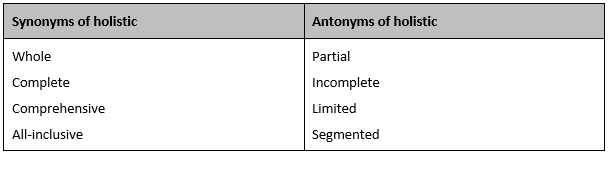
Another important word to explore is ‘unit’. The word ‘unit’ can be defined as an individual thing regarded as single and complete, but which can also form an individual component of a larger or more complex whole.
What is a unit of competency?
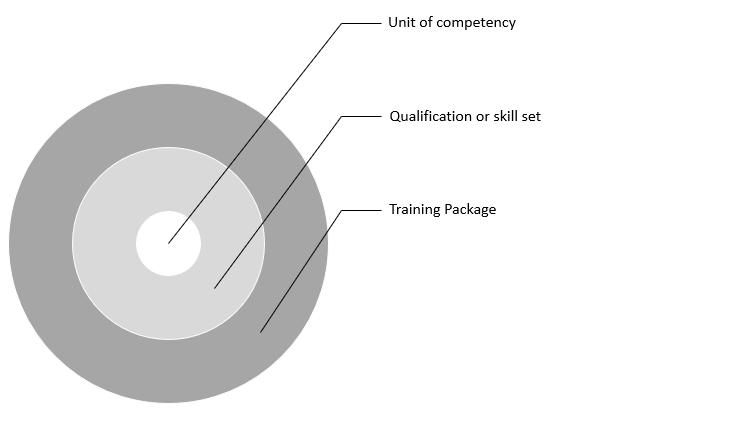
A unit of competency is the smallest component of a Training Package that can be assessed and recognised. It describes the knowledge and skills required to perform work tasks, and the standard of performance that is required in the workplace. Units of competency are used as the building blocks for qualifications or skill sets.
The following illustrates how a units of competency is single and complete, and it is used as a component for a qualification or skill set. Units of competency, qualifications, and skill sets are contained with a Training Package.
A unit of competency includes the following parts:
- Elements and Performance Criteria
- Required knowledge (Knowledge Evidence)
- Required skills (Foundation Skills)
A ‘holistic assessment’ of competency is an assessment that covers the whole unit of competency, rather than separately assessing the parts of the unit of competency.
In conclusion
In theory, holistic assessment means that we should not assess one part of a unit of competency separately from other parts, if we really want to determine if a person is competent as specified by a unit of competency. However, in reality, we do explicitly gather evidence of knowledge separately from gathering evidence of performance.
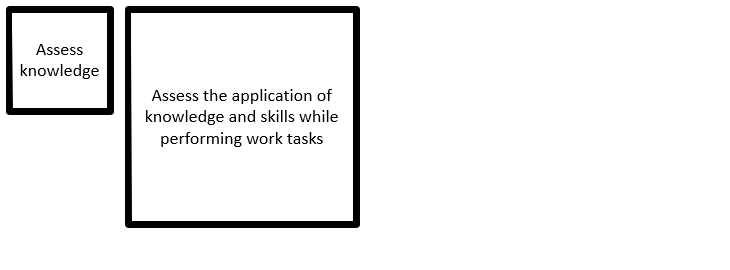
Also, some units of competency have been written in a way that do not allow for the assessment to be conducted holistically.
This article has explored and described holistic assessment. Although, ‘holistic assessment’ and ‘integrated assessment’ are often used interchangeably, they are two different concepts. You may be interested in an article that I have published that focuses on integrated assessment.
Reference
[1] Standards for RTOs 2015, Glossary
Do you need help with your TAE studies?
The terminology used in the Australian VET system can be confusing and overwhelming. Are you a doing the TAE40122 Certificate IV in Training and Assessment, and are you struggling with your studies? Do you want help with your TAE studies?

Ring Alan Maguire on 0493 065 396 to discuss.

Training trainers since 1986

 On Target Work Skills
“Delivering training that is outside of the current competency-based VET system would avoid the need for the RTO to be compliant with the Standards for RTOs 2015. I am unsure if the delivery of unregulated training will improve quality. ”
Alan, it might (or might not) improve quality, but it would sure shake up the system.
Another idea – Have RTOs responsible only for verifying that a learner has demonstrated learning outcomes aligned with the unit(s) of competency and give industry responsibility for determining competence.
LikeLike