

Some TAE Students studying for their TAE40122 Certificate IV in Training and Assessment qualification tell me that they get no or very limited training. And other TAE Students tell me that the training they get does not cover the knowledge or skills they need to complete their assessments.
Some TAE Students are being told that they are expected to do their own research and figure it out for themselves. This is not always as simple as it sounds.
Fortunately, I offer a TAE tutoring service that can help fill in the missing pieces.
The new TAEPDD401 Work effectively in the VET sector unit of competency has specified that a person needs to know about ‘code of conduct’ relating to trainers and assessors working for an RTO.
This article shall answer the following questions:
- What is a Code of Conduct?
- Is there a Code of Conduct for trainers and assessors in the Australian VET system?
- Is there a Code of Practice for trainers and assessors in the Australian VET system?
- What is the difference between a Code of Conduct and a Code of Practice?
- Do we need a Code of Conduct for trainers and assessors?
What is a Code of Conduct?
A code of conduct is a document outlining the rules and responsibilities or expected behaviour of an individual or an organisation. A code of conduct can be used to:
- Set expectations: A code of conduct helps to set expectations for employees of an organisation. It tells them what is considered acceptable behaviour and what is not.
- Promote a positive culture: A code of conduct can help to promote a positive culture within an organisation. It can help to create a sense of belonging and to foster trust and respect among employees.
- Protect the organisation: A code of conduct can help to protect the organisation from legal liability. By outlining the organisation’s expectations for behaviour, it can help to prevent employees from engaging in activities that could harm the organisation.
A code of conduct may have the following attributes:
- Clear and concise: Employees should be able to understand the code of conduct and know what is expected of them.
- Consistent with the organisation’s values and mission: The code of conduct should reflect the organisation’s values and mission statement.
- Enforceable: The code of conduct can include clear consequences for violating the rules (for example, termination of employment).
Employees should be aware of the code of conduct and should be trained on how to comply with it.
A code of conduct can be mandatory or voluntary. Mandatory codes of conduct are enforced by law, while voluntary codes of conduct are not. However, even voluntary codes of conduct can promote positive behaviour and reduce the risk of legal liability.
A code of conduct benefits an organisation more than it benefits the individual.
Is there a Code of Conduct for trainers and assessors in the Australian VET system?
No, there isn’t a nationally endorsed Code of Conduct for trainers and assessors working in the Australian VET system. However, in 1998, the BSZ98 Training Package for Assessment and Workplace Training first published a Code of Practice for assessors.
The following is the Code of Practice for assessors from the BSZ98 Training Package:
- The differing needs and requirements of the person being assessed, the local enterprise and/or industry are identified and handled with sensitivity.
- Potential forms of conflict of interest in the assessment process and/or outcomes are identified, and appropriate referrals are made, if necessary.
- All forms of harassment are avoided throughout the planning, conduct, reviewing and reporting of the assessment outcomes.
- The rights of the candidate are protected during and after the assessment.
- Personal or interpersonal factors that are not relevant to the assessment of competency must not influence the assessment outcomes.
- The candidate is made aware of rights and processes of appeal.
- Evidence that is gathered during the assessment is verified for validity, reliability, authenticity, sufficiency and currency.
- Assessment decisions are based on available evidence that can be produced and verified by another assessor.
- Assessments are conducted within the boundaries of the assessment system policies and procedures.
- Formal agreement is obtained from both the candidate and the assessor that the assessment was carried out in accordance with agreed procedures.
- Assessment tools, systems, and procedures are consistent with equal opportunity legislation.
- The candidate is informed of all assessment reporting processes prior to the assessment.
- The candidate is informed of all known potential consequences of decisions arising from an assessment, prior to the assessment.
- Confidentiality is maintained regarding assessment results.
- Results are only released with the written permission of the candidate(s).
- The assessment results are used consistently with the purposes explained to the candidate.
- Self-assessments are periodically conducted to ensure current competencies against the Assessment and Workplace Training Competency Standards.
- Professional development opportunities are identified and sought.
- Opportunities for networking amongst assessors are created and maintained.
- Opportunities are created for technical assistance in planning, conducting and reviewing assessment procedures and outcomes.
This Code of Practice was updated and republished in the TAA04 Training and Assessment Training Package and TAE10 Training and Education Training Package. Relevant points from the Code of Practice are covered by the Standards for Registered Training Organisations (RTOs) 2015 making the need for this Code of Practice redundant.
Although there isn’t a nationally endorsed Code of Conduct, it does not stop a TAFE or RTO from developing one.
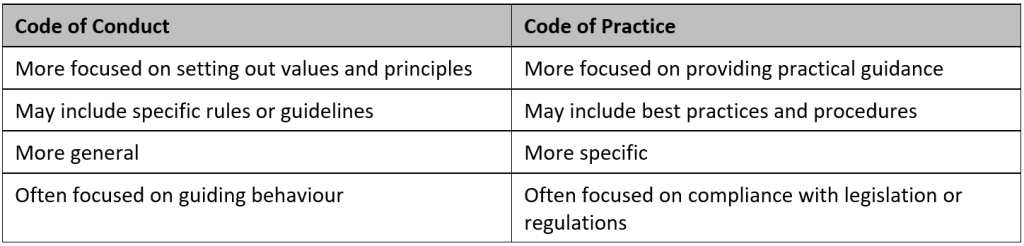
What is the difference between a Code of Conduct and a Code of Practice?
A code of conduct and a code of practice are both documents that outline the expected standards of behaviour for a particular group of people. However, there are some key differences between the two.
A code of conduct is typically focused on setting out the values and principles that should guide the behaviour of a particular group of people. It may also include specific rules or guidelines that members of the group are expected to follow.
A code of practice, on the other hand, is typically more focused on providing practical guidance on how to comply with a particular set of laws or regulations. It may also include best practices and procedures for achieving specific outcomes.
In general, a code of practice is more specific and focused on compliance with laws or regulations, while a code of conduct is more general and focused on setting out the values and principles that should guide behaviour. However, there is some overlap between the two, and some documents may be referred to as either a code of conduct or a code of practice.
Do we need a Code of Conduct for trainers and assessors?
No, we don’t need a Code of Conduct for trainers and assessors.
An RTO should ask their trainers and assessors to always follow the RTO’s policies and procedures. These policies and procedures should be written to ensure compliance to the requirements specified by the Standards for RTOs 2015. Clear, concise and well-written policies and procedures would eliminate the need for a Code of Conduct for trainers and assessors.
I believe that RTO managers must be held responsible, and be accountable, for the delivery of quality training and assessment services. A code of conduct may make some RTO managers unfairly shift responsibility to trainers and assessors who are not empowered to make important decisions that impact on quality.
In conclusion
For the past 30 years, I have worked for many TAFEs, private RTOs, industry association RTOs, and an enterprise RTO. None of these RTOs have had a Code of Conduct (or Code of Practice) for trainers and assessors.
Unfortunately, TAE Students studying for their TAE40122 qualification may have to answer a question relating to Code of Conduct for trainers and assessors. Depending on the question, your answer may need to cover these points:
- There is no nationally endorsed Code of Conduct for trainers and assessors.
- An RTO may develop its own Code of Conduct for trainers and assessors.
- A Code of Conduct is a document outlining the rules and responsibilities or expected behaviour for trainers and assessors.
Do you need help with your TAE studies?
Are you a doing the TAE40122 Certificate IV in Training and Assessment, and are you struggling with your studies? Do you want help with your TAE studies?

Ring Alan Maguire on 0493 065 396 to discuss.

Training trainers since 1986

 On Target Work Skills
Ever since coming into the VET Sector I have looked for, asked for and recommended a Code of Conduct & Code of Practice for Trainers and Assessors. Why not?
LikeLike
Ever since coming into the VET Sector I have looked for, asked for and recommended a Code of Conduct & Code of Practice for Trainers and Assessors. Why not?
LikeLike
Sure, RTOs don’t need a Code of Conduct for trainers and assessors. But I think it’s great that an RTO might establish a set of guiding values and principles for assessors to align themselves with. It gives meaning and value to the procedures they then follow.
In hiking we often refer to the Bushwalker’s Code, a code of conduct which includes things that help us get more out of the experience, hike safely, be more conscious and aware of our environmental impact, cultural considerations, leaving no trace, etc.
It’s better than someone just telling you to shut up and follow the map/guide/procedure.
LikeLike
Thank you, Leo, for commenting. I like what you have said.
LikeLike