

The ‘dimensions of competency’ is a concept. They are part of the broad concept of competency, which includes all aspects of work performance as represented by: [1]
- Task skills: the ability to perform individual tasks
- Task management skills: the ability to manage a number of different tasks or activities within the job role or work environment
- Contingency management skills: the ability to respond to irregularities and break downs in routine
- Job/role environment skills: demonstrating the ability to deal with responsibilities and expectations of the workplace, including working with others.
When the Education Industry Reference Committee (IRC) released the TAE40122 Certificate IV in Training and Assessment qualification in 2022, they tried to embed the dimensions of competency into as many units of competency as possible. For example:
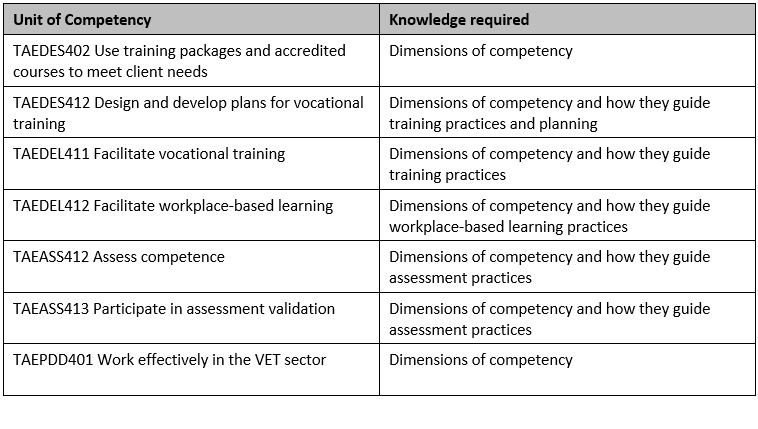
Unfortunately, some people studying for their TAE40122 Certificate IV in Training and Assessment qualification are being asked to answer ridiculous questions on multiple occasions about dimensions of competency. This article explores the four dimensions of competency and how they can guide training and assessment practices.
Task skills

Applying the dimensions of competency means that the training or assessment is comprehensive, rather than focusing narrowly on a single work task. However, the ability to perform the work task is still essential.
The first dimension of competency, task skills, refers to the knowledge and skills required to perform a work task. This includes both learning and assessing the ability to apply this knowledge and skills.
Task management skills

Work usually involves performing many different tasks, so it’s easier to apply the dimensions of competency when considering all the units of competency required for an entire job or role. It’s difficult and sometimes unrealistic to try to apply the dimensions to a single unit of competency.
Dimensions of competency mean that training and assessment are not narrowly focused on a single task. Instead, they embrace all aspects of performance and represent an integrated and holistic approach to work.
The second dimension of competency, task management skills, refers to a person prioritising, planning and organising their work to accomplish all that needs to be done. Learning to perform a single task in isolation from other tasks does not demonstrate that a person can manage multiple tasks.
Contingency management skills

Sometimes things at work do not go as planned. Accidents and emergencies occur. Mistakes and errors are made. And unexpected things happen.
The third dimension of competency, contingency management skills, refers to the ability to respond safely and appropriately when irregularities and break downs in routine occur.
Job/role environment skills

Employees are expected follow workplace policies and procedures. Also, employees need to take responsibility for getting work done and meeting expected standards.
The fourth dimension of competency, job/role environment skills, refers to an employee’s ability to take responsibility, meet expected standards, and interact effectively with others in the workplace.
How can the dimensions of competency guide training practices
A person studying for their TAE40122 Certificate IV in Training and Assessment is likely to be asked how do the dimensions of competency guide training practices.
The dimensions of competency in the Australian VET system guide training practices in a number of ways:
- They help to ensure that training is focused on the skills and knowledge that are most relevant to the workplace. By considering all four dimensions of competency, training providers can develop programs that help learners to develop the skills they need to be successful in their chosen occupation.
- They provide a framework for designing and delivering effective learning experiences. By understanding the different dimensions of competency, trainers can develop activities that allow learners to develop the skills they need in each area.
Here are some specific examples of how the dimensions of competency can guide training practices:
- Task skills: When training learners how to perform a specific task, trainers can provide them with opportunities to practice the task in a variety of settings and with different levels of complexity. This helps learners to develop the skills they need to perform the task safely and effectively in the workplace.
- Task management skills: Trainers can help learners to develop task management skills by training them how to plan, organise, and prioritise their work. They can also provide learners with opportunities to practice managing multiple tasks simultaneously.
- Contingency management skills: Trainers can help learners to develop contingency management skills by training them how to identify and respond to unexpected situations or problems. They can also provide learners with opportunities to practice managing these situations in a simulated or real workplace.
- Job/role environment skills: Trainers can help learners to develop job/role environment skills by informing them about the workplace culture and expectations. They can also provide learners with opportunities to practice interacting with other people in the workplace or simulated workplace, and working as part of a team.
How can the dimensions of competency guide assessment practices
A person studying for their TAE40122 Certificate IV in Training and Assessment is likely to be asked how do the dimensions of competency guide assessment practices.
The dimensions of competency guide assessment practices in the Australian VET system in a number of ways:
- Assessment tasks should be designed to assess all four dimensions of competency. This means that assessment tasks should not only focus on learners’ ability to perform specific tasks, but also on their ability to manage their work tasks effectively, respond to problems and challenges, and meet the expectations of the workplace.
- Assessment should be conducted in a simulated or real workplace to gather the performance evidence under realistic workplace conditions.
Here are some specific examples of how the dimensions of competency can be used to guide assessment practices:
- Task skills: An assessor might assess a learner’s task skills by observing them perform a specific task in a simulated or real workplace. For example, an assessor might observe a student electrician install a new electrical outlet.
- Task management skills: An assessor might assess a learner’s task management skills by asking them to plan and complete a complex task. For example, an assessor might ask an apprentice chef to plan and prepare a meal for a large group of people.
- Contingency management skills: An assessor might assess a learner’s contingency management skills by asking them to respond to a simulated problem or challenge in the workplace. For example, an assessor might ask a student nurse to respond to a medical emergency in a simulated hospital setting.
- Job/role environment skills: An assessor might assess a learner’s job/role environment skills by observing them interact with others in a simulated or real workplace. For example, an assessor might observe a trainee customer service representative interacting with a customer over the phone.
The complexity of work
Work is more complex than repeatedly doing one task. The following uses a geometry analogue to show how the four dimensions of competency attempt to capture the complexity of working safely and effectively in the modern workplace.
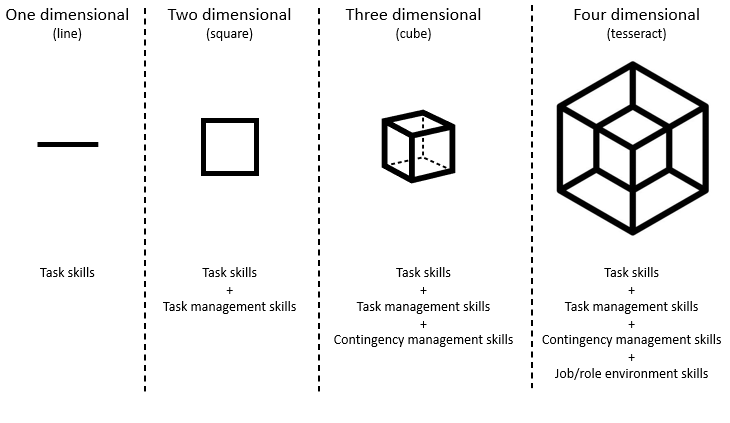
In conclusion
The ‘dimensions of competency’ is a concept.
Australia adopted the current competency-based approach to training and assessment in 1992. I have worked in the Australian VET system for over 30 years, and I have never consciously thought about how I have been applying the dimensions of competency. It has not been necessary for me to do so. However, I have always considered whether my training is realistic and whether my assessments are based on the performance of real work tasks under typical workplace conditions.
It is essential for trainers and assessors to make their training and assessment real, or as realistic as possible.
Other relevant articles about the dimensions of competency that you may like to read, include:
- Dimensions of competency
- Are there 4 or 5 dimensions of competency?
- What does ChatGPT know about the dimensions of competency?
Reference
Do you need help with your TAE studies?
Are you a doing the TAE40122 Certificate IV in Training and Assessment, and are you struggling with your studies? Do you want help with your TAE studies?
Ring Alan Maguire on 0493 065 396 to discuss.

Training trainers since 1986

 On Target Work Skills