Holistic assessment

In the Australian VET system, the terms ‘holistic assessment’ and ‘integrated assessment’ are often used interchangeably. However, there is a differences between the two concepts.

What is holistic assessment?

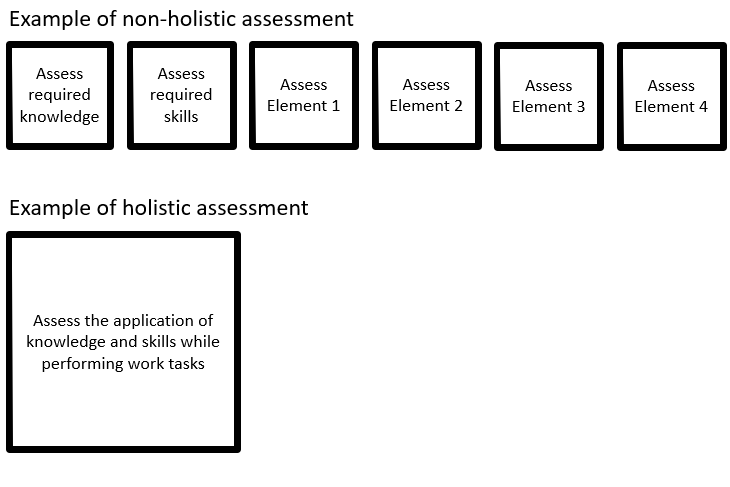
Holistic assessment is an assessment approach that covers multiple elements of competency. The assessor would consider the learner’s overall performance, including their application of knowledge and skills. This assessment approach would not explicitly gather evidence for each item of required knowledge or required skill.

What is integrated assessment?

Integrated assessment occurs when a learner performs an assessment task that can be used to gather evidence for multiple units of competency. The assessment task would be designed to gather evidence specified by two or more units of competency.

Both holistic and integrated assessment can be used to improve the quality of assessment in the Australian VET system. They can help to ensure that learners are assessed on their ability to apply their knowledge and skills to real-world situations.

Exploring words and their meaning

It is difficult to find an official definition of ‘holistic assessment’ in the context of the Australian VET system. Let’s explore various words and understand their meaning within Australia’s VET system:

  • Competency
  • Assessment
  • Holistic
  • Unit
  • Unit of competency

What is the definition of competency?

In the Australian VET system, ‘competency’ is defined as: [1]

The consistent application of knowledge and skill to the standard of performance required in the workplace. It embodies the ability to transfer and apply skills and knowledge to new situations and environments.

A competent person must have the knowledge and skills required to perform a work task. And they must have the ability to apply those knowledge and skills to consistently perform work tasks to the standard that is expected in a workplace.

What is the definition of assessment?

In the Australian VET system, ‘competency’ is defined as: [1]

Assessment means the process of collecting evidence and making judgements on whether competency has been achieved, to confirm that an individual can perform to the standard required in the workplace, as specified in a Training Package or VET Accredited Course.

The smallest component of a Training Package that can be assessed and recognised is a unit of competency. Recognition is achieved by an RTO issuing a nationally recognised qualifications and statements of attainment.

What is the meaning of holistic and unit?

‘Assessment’ has an official definition (see above), but there isn’t an official definition of ‘holistic assessment’ in the context of the Australian VET system. Therefore, we’ll look at the common meaning for ‘holistic’ and add it to the definition of ‘assessment’.

The word ‘holistic’ is derived from the Greek ‘holo’, meaning ‘whole’. Wholistic has the same meaning as holistic, but it is typically thought of as a misspelling of holistic.

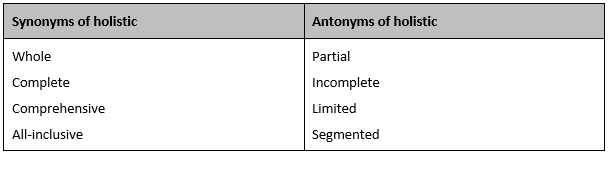
What is another word for holistic? And what is the opposite of holistic?

Another important word to explore is ‘unit’. The word ‘unit’ can be defined as an individual thing regarded as single and complete, but which can also form an individual component of a larger or more complex whole.

What is a unit of competency?

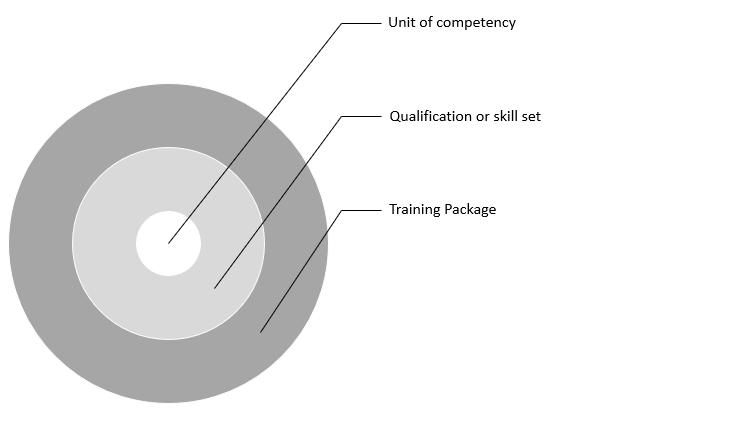
A unit of competency is the smallest component of a Training Package that can be assessed and recognised. It describes the knowledge and skills required to perform work tasks, and the standard of performance that is required in the workplace. Units of competency are used as the building blocks for qualifications or skill sets.

The following illustrates how a units of competency is single and complete, and it is used as a component for a qualification or skill set. Units of competency, qualifications, and skill sets are contained with a Training Package.

A unit of competency includes the following parts:

  • Elements and Performance Criteria
  • Required knowledge (Knowledge Evidence)
  • Required skills (Foundation Skills)

A ‘holistic assessment’ of competency is an assessment that covers the whole unit of competency, rather than separately assessing the parts of the unit of competency.

In conclusion

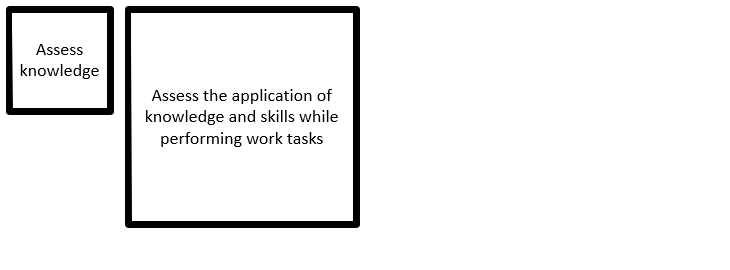
In theory, holistic assessment means that we should not assess one part of a unit of competency separately from other parts, if we really want to determine if a person is competent as specified by a unit of competency. However, in reality, we do explicitly gather evidence of knowledge separately from gathering evidence of performance.

Also, some units of competency have been written in a way that do not allow for the assessment to be conducted holistically.

This article has explored and described holistic assessment. Although, ‘holistic assessment’ and ‘integrated assessment’ are often used interchangeably, they are two different concepts. You may be interested in an article that I have published that focuses on integrated assessment.

Reference

[1] Standards for RTOs 2015, Glossary

Do you need help with your TAE studies?

The terminology used in the Australian VET system can be confusing and overwhelming. Are you a doing the TAE40122 Certificate IV in Training and Assessment, and are you struggling with your studies? Do you want help with your TAE studies?
Ring Alan Maguire on 0493 065 396 to discuss.

Contact now!

logo otws

Training trainers since 1986
What are microcredentials?

The Conversation published the following description on the 14th of October 2021:

“In Australia, the term microcredential describes different types of smaller bites of learning offered by universities, TAFEs and private education providers. The term is often used interchangeably with short courses…” [1]

The Australian Government’s Department of Education, Skills and Employment released the National Microcredentials Framework on the 22nd of April 2022. This document gives the following definition:

The framework defines microcredentials as a certification of assessed learning or competency, with a minimum volume of learning of one hour and less than an AQF award qualification, that is additional, alternate, complementary to or a component part of an AQF award qualification. [2]

From these sources, we can say that a microcredential is usually a short duration training program that includes assessment. Certification is issued to people who can demonstrate their attainment of the learning outcomes.

Who can provide a microcredential?

Microcredentials are unregulated, which differentiates them from other products delivered by higher education or vocational education and training sectors. [3] There are many providers of microcredentials.

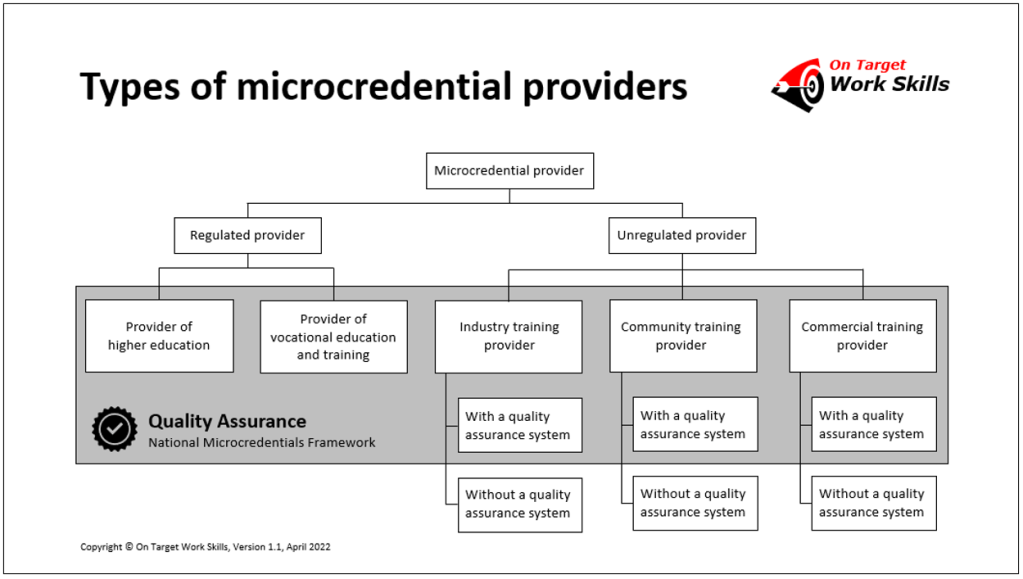
There are ‘regulated providers’ of microcredentials:

  • Universities and other higher education providers (regulated by TEQSA)
  • Registered training organisations (regulated by ASQA).

There is a myriad of ‘unregulated providers’ of microcredentials:

  • Providers of industry training (some are industry associations, others can be affiliated with an industry associations, and others may align their microcredentials to industry standards)
  • Providers of community training
  • Providers of commercial training.

Also, some ‘regulated providers’ are providing microcredentials that are ‘non-regulated microcredentials’. For example, a registered training organisation can provide a microcredential that is not a skill set, unit or units of competency from a Training Package. This leverages from the brand recognition of the provider and avoids requiring the microcredential to comply with the regulations for operating as a registered training organisation.

The following diagram provides a simplistic view of the range of microcredential providers.

In conclusion

The microcredentials ecosystem is disparate. The National Microcredentials Framework aims to bring some coherence to this ecosystem. [4]

Do you want to learn more about the National Microcredentials Framework? I am presenting a ‘How to implement the National Microcredentials Framework‘ training course. The following topics will be covered during the 2-hours of training:

  • National Microcredentials Framework
  • Unifying principles of microcredentials
  • Volume of learning for microcredentials
  • Learning outcomes and assessment methods
  • Critical information requirements for microcredentials
  • Essential quality assurance processes for microcredentials
  • Five steps towards implementing microcredentials.

Look here for more details.

References

[1] https://theconversation.com/microcredentials-what-are-they-and-will-they-really-revolutionise-education-and-improve-job-prospects-169265 accessed 6 April 2022

[2] https://www.dese.gov.au/higher-education-publications/resources/national-microcredentials-framework (page 3) accessed 6 April 2022

[3] https://www.dese.gov.au/higher-education-publications/resources/national-microcredentials-framework (page 12) accessed 6 April 2022

[4] https://www.dese.gov.au/higher-education-publications/resources/national-microcredentials-framework (page 2) accessed 6 April 2022

logo otws

Training trainers since 1986

How to create powerful PowerPoint presentations

Microsoft’s PowerPoint was released in 1987. Over the past 37 years there has been several updates, and with each update there has been new features added and improved functionality.

There is an estimated 500 million users worldwide, and 35 million PowerPoint presentations are given each day. [1] Some PowerPoint presentations are good, and some are dreadful.

Reference

[1] 10 little-known facts about PowerPoint, published by Poll Everywhere

PowerPoint is a software application that has endured. It is a powerful tool, and it has many features that many people will never use. However, I think it is beneficial for us to know the basic features in depth. It will save you a lot of time if you can quickly create simple but effective PowerPoint slides.

Useful knowledge and skills

Here are some useful knowledge and skills:

  • Design principles
  • Visual impact
    • Images
    • Visual style
    • Colour theme
  • PowerPoint basic features
  • SmartArt Graphics
    • Guides and gridlines
    • Insert photos and icons
    • Re-size, rotate handles, and cropping
    • Insert tables, charts, and SmartArt Graphs
    • Simple animation
  • Rules
    • Don’t breach copyright
    • 6 x 6 rule
    • 10, 20, 30 rule
    • Version control
      • Avoid typos, spelling or grammatical errors

Getting started with PowerPoint

Here are some basic PowerPoint skills to get started:

  • Start the PowerPoint application
  • Open a new blank presentation or existing file
  • View slide master
  • Add new slides to the presentation
  • Change font type and size
  • Insert shapes
  • Re-colour and re-size shapes
  • Copy, paste, and undo
  • Save file and shutdown the PowerPoint application.

Contact now!

logo otws

Training trainers since 1986

Webinar: How to implement the National Microcredentials Framework

The National Microcredentials Framework was released on the 22nd of March 2022. The Framework aims to provide a nationally consistent framework for defining microcredentials across higher education (HE), vocational education and training (VET), and industry.

On Target Work Skills is proud to have developed a learning program about how to implement the National Microcredentials Framework. This program consists of:

  • 2-hour training session
  • Assessment tasks (optional).

This program is being delivered as a microcredential with the following characteristics specified by the National Microcredentials Framework:

  • The learning outcomes for the microcredential must be clearly stated
  • A microcredential requires assessment that provides evidence that learning outcomes have been achieved
  • Microcredentials must have a volume of learning that is at least one hour
  • Microcredentials may certify the attainment of skills, knowledge, and competencies.

Learning outcomes

The learning outcomes for this program are:

  • Develop learning outcomes for a microcredential
  • Describe the assessment method for a microcredential
  • Estimate the volume of learning for a microcredential
  • Write a microcredential descriptor using the critical information requirements as a guide
  • Write a quality assurance statement
  • Draft an accurate and truthful certificate of attainment for a microcredential.

Key content points

The key content for this learning program are:

  • National Microcredentials Framework
  • Unifying principles of microcredentials
  • Volume of learning
  • Learning outcomes
  • Assessment methods
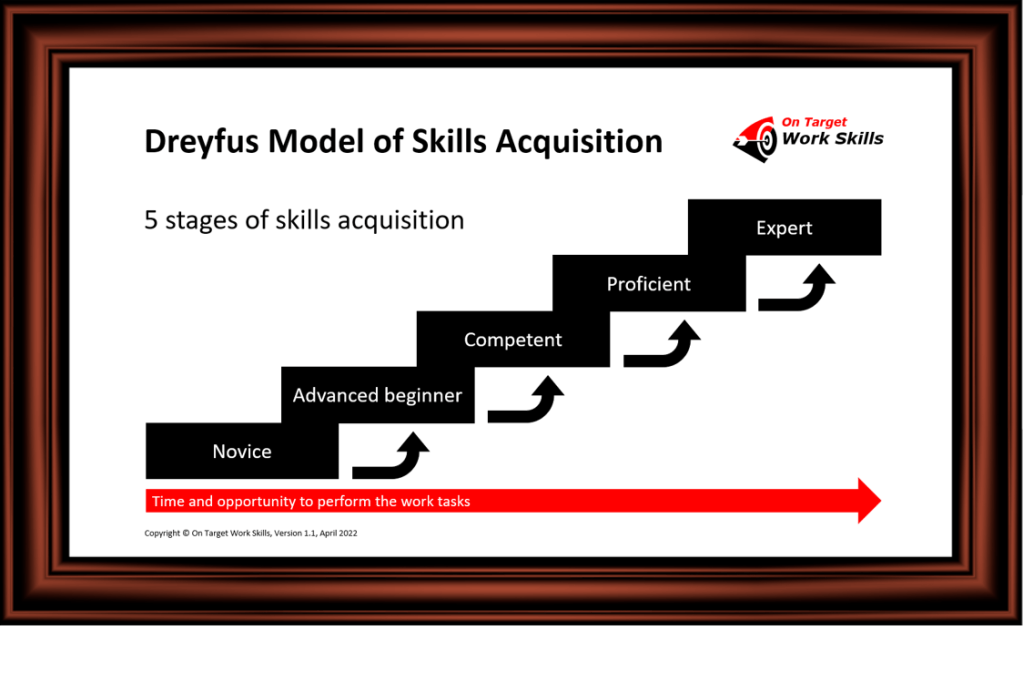
  • Levels of skills acquisition
  • Critical information requirements
  • Accurate and truthful certification
  • Essential quality assurance processes
  • Quality assurance statement
  • Implementation steps.

Assessment

Assessment is optional. You may complete and submit the following practical assessment tasks:

  • Develop learning outcome for a microcredential
  • Describe the assessment method for a microcredential
  • Estimate the volume of learning for a microcredential
  • Write a microcredential descriptor using the critical information requirements as a guide
  • Write a quality assurance statement
  • Draft an accurate and truthful certificate of attainment for a microcredential.

If you are assessed as having attained the learning outcome, then you will receive a ‘Certificate of Attainment’.

If you decide not to be assessed, you will be issued with a ‘Certificate of Attendance’ that still can be valid evidence of participation in structured professional development.

Please call Alan Maguire on 0493 065 396 for further details or to discuss.

Contact now!

logo otws

Training trainers since 1986
National Microcredentials Framework

The National Microcredentials Framework was released on the 22nd of March 2022.

About the National Microcredentials Framework

Microcredentials are unregulated. The aim of the National Microcredentials Framework is to provide a nationally consistent framework for defining microcredentials across higher education, vocational education, and industry.

The Framework encourages all microcredentials to adhere to the following four principles:

  • Outcome-based
  • Driven by industry need
  • Tailored or support lifelong learning
  • Transparent and accessible.

Critical information requirements

The National Microcredentials Framework outlines critical information requirements that providers should consider using when advertising their microcredentials.

Minimum standards

The National Microcredentials Framework describes a number of minimum standards for microcredentials:

The learning outcomes for the microcredential must be clearly stated.

A microcredential requires assessment that provides evidence that learning outcomes have been achieved.

Microcredentials must have a volume of learning that is at least one hour.

Microcredentials may certify the attainment of skills, knowledge, and competencies.

Unregulated providers of microcredentials must provide a quality assurance statement with the following suggested elements:

  • Profile of the provider
  • A description of the quality assurance processes
  • The process for reviewing and updating the microcredential.

Announcement from On Target Work Skills

As from the 29th of March 2022, On Target Work Skills has officially become a provider of microcredentials. The first microcredential being offered is, ‘How to implement the National Microcredentials Framework‘.

logo otws

Training trainers since 1986