40+ years experience as a trainer, instructional designer, quality manager, project manager, program manager, RTO auditor, RTO manager and VET adviser.
The Australian VET system is based on competencies. Units of competency have been developed by industry to describe the performance of work tasks or activities. By design, these units of competency are vague or ambiguous, so as to allow contextualisation for different workplaces, different circumstances or different situations. This may include different tools, equipment or materials being used to perform the work.
Trainers and TAFE teachers need the ability to translate, or transform, a unit of competency into something that can be understood by their learners. The structure and jargon of units of competency often need to be removed, or modified. When we communicate to our learners, we may need to:
Remove the decimal numbering of performance criteria (1.1, 1.2, 2.1, 2.2, 2.3, etc.)
Use a simple numbering system (Step 1, Step 2, Step 3, Step 4, Step 5, etc.)
Use different words to better describe the task step to be performed
Re-sequence because the performance criteria are not always in the order of performing the work task or activity
Re-structure because the elements are not always the best way to communicate how the work task or activity should be performed.
Structure of a work task or activity
A unit of competency has a ‘task, element, and performance criteria’ structure.
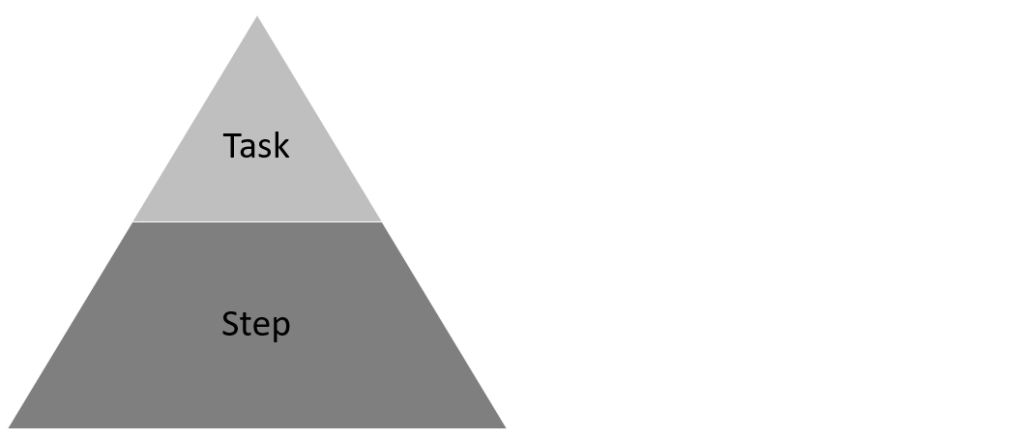
Generally, I use a ‘task and step’ structure.
However, if there are too many steps or stages that are needed to describe the performance of a work task or activity, I use ‘task, part and step’ structure.
Work flow: is it a process or a cycle?
It is useful to think about performing work as a flow. A work process can have a defined start and a defined end, or it could be a continuous cycle. A diagram can be used to help our learners ‘see’ the entire work task or activity, and how one step is followed by the next.
A simple flowchart
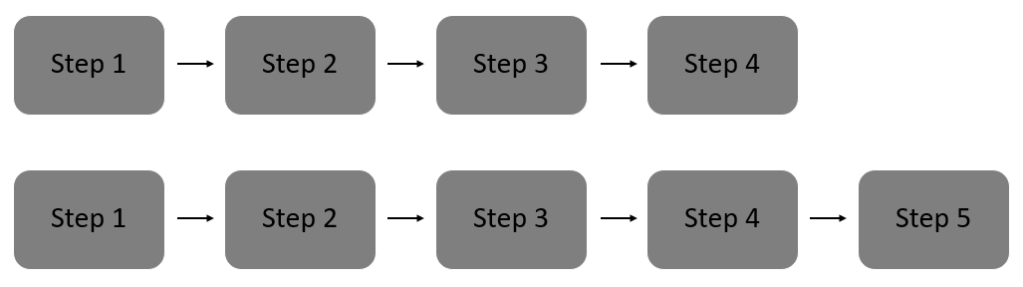
Flowcharts can get complicated. But a simple flowchart can quickly capture, and communicate, the essence of a work task or activity. The following flowcharts illustrates a 4-step and a 5-step process.
Note: When there are more than five steps, it is a good idea to add structure by ‘chunking’ steps into parts. People often count: one, two, three, a lot, far too much.
A simple cycle
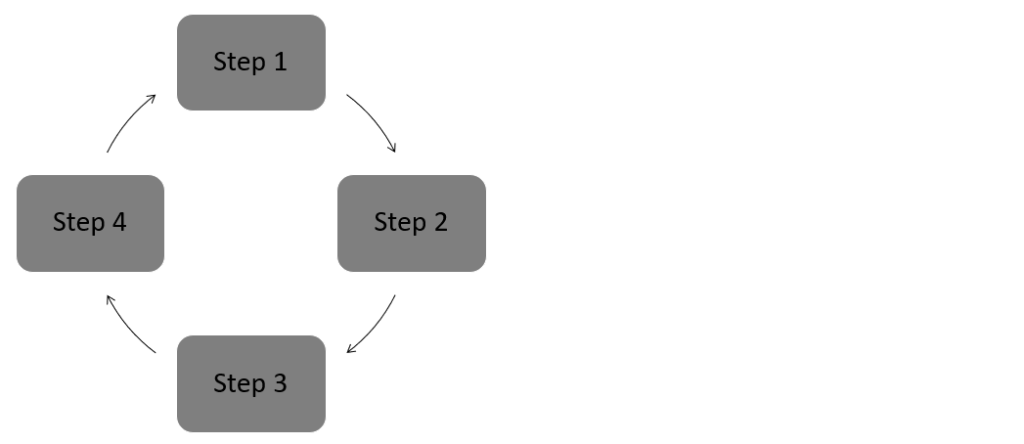
A cycle diagram can be used when the work task or activity is continuous, repetitive, or seasonal. The following illustrates a 4-step cycle.
And the following illustrates a a 5-step cycle.
Note: A cycle diagram can be used to describe steps or parts of a process. Each part could then be further described by a flowchart or task breakdown.
An example
The following shows how to translate and transform a unit of competency so that is can be better understood by learners. I have use the BSBSUS211 Participate in sustainable work practices unit for this example.
Step 1. Unpack the unit of competency
When unpacking the BSBSUS211 Participate in sustainable work practices unit, it becomes apparent that it consists of two distinct work tasks:
Workplace sustainability, and
Environmental hazards or breaches.
The following highlights performance criteria 2.2 and 2.3 as being sperate from the other performance criteria.
Step 2. Create a work flow structure
Select an appropriate diagram to describe the work flow.
Workplace sustainability
A cycle diagram has been used to create a new structure for performing the workplace sustainability task.
Note: The ‘implement improvement’ step has been added to show what happens after the ‘present suggestions for improvement’ step. However, learners are only required to satisfactorily perform the first four steps of the cycle for the BSBSUS211 Participate in sustainable work practices unit to be deemed competent. Implementation is outside the scope of this unit.
Environmental hazards or breaches
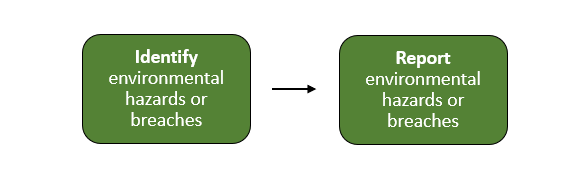
And a simple flowchart has been used to show the two steps for identifying and reporting environmental hazards or breaches.
Step 3. Map performance criteria
A matrix can be used to map the performance criteria to the new structure that will communicate how to perform the workplace sustainability task.
The purpose of the mapping document is for us to check compliance with the requirements specified by the unit of competency. This mapping can be expanded to cover foundation skills and assessment requirements. We would not give this mapping document to our learners because it has too much details.
Step 4. Develop a task breakdown
A task breakdown can be used to give details about performing a work task or activity.
In this example for the BSBSUS211 Participate in sustainable work practices unit, the performance criteria have been re-structured and re-sequenced. Also, the elements and performance criteria have been re-worded and simplified.
In conclusion
In this article, I have described how to translate and transform a unit of competency into something that can be understood by learners. A 4-step process can be used:
I believe that an appropriate diagram can help communicate the flow of work to our learners; but it must be keep simple. And a task breakdown can be used to provide procedural details.
Do you need help with your TAE studies?
Are you a doing the TAE40122 Certificate IV in Training and Assessment, and are you struggling with your studies? Do you want help with your TAE studies?

An understanding of the Australian Core Skills Framework (ACSF) is essential for trainers and TAFE teachers working in the Australian VET sector.
On Target Work Skills is proud to be presenting this interactive workshop facilitated by Alan Maguire.
Workshop objectives
In this workshop you will learn:
What is the ACSF?
What are the ACSF Performance Indicators?
What is the relationship between foundation skills and the ACSF?
How are digital literacy skills being integrated with the ACSF?
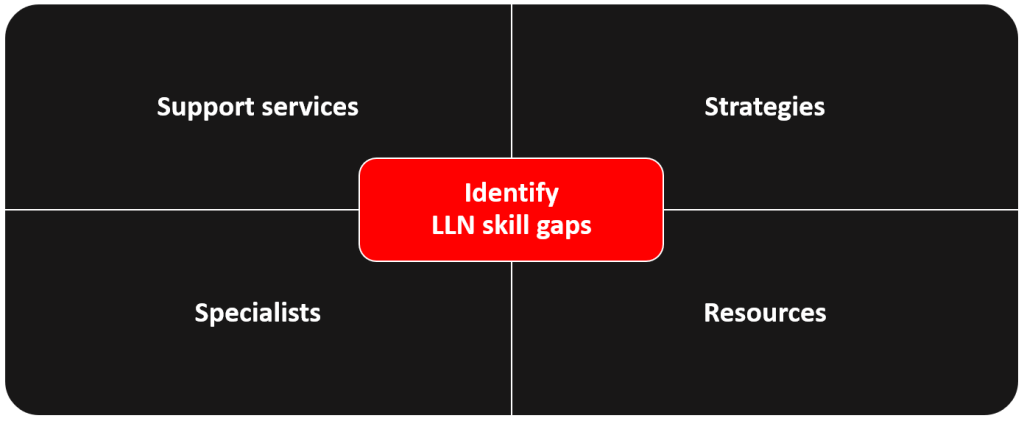
How can the ACSF be used to identify LLN skill gaps?
You will receive a certificate that can be used as evidence of your participation in this professional development activity.
Workshop dates
Select one of the following:
Monday 5th of July, 2021
Tuesday 13th of July, 2021
Friday 23rd of July, 2021
Start time 10:00am Australian Eastern Standard Time, finish by 3:00pm.
Workshop location
You can attend from your workplace or home because the workshop will be delivered via Zoom.
Are you new to Zoom video conferencing? Please don’t be concerned. The connection to Zoom is quick, and using Zoom is easy. Instructions about joining and using Zoom will be provided when your workshop enrolment is confirmed.
Workshop fee
The workshop fee is $197.
Workshop enrolment is essential.
Please call Alan Maguire on 0493 065 396 to reserve your place.
I have found that some people studying for their Certificate IV in Training and Assessment qualification struggle with understanding what a task breakdown is, and how to develop a task breakdown. In this article, I aim to answer the following questions:
What is a task breakdown?
How can a task breakdown be developed?
When can a task breakdown be used?
Where do we start
Australia’s VET system is competency-based. A primary objective of VET is to help people learn how to perform work tasks and activities.
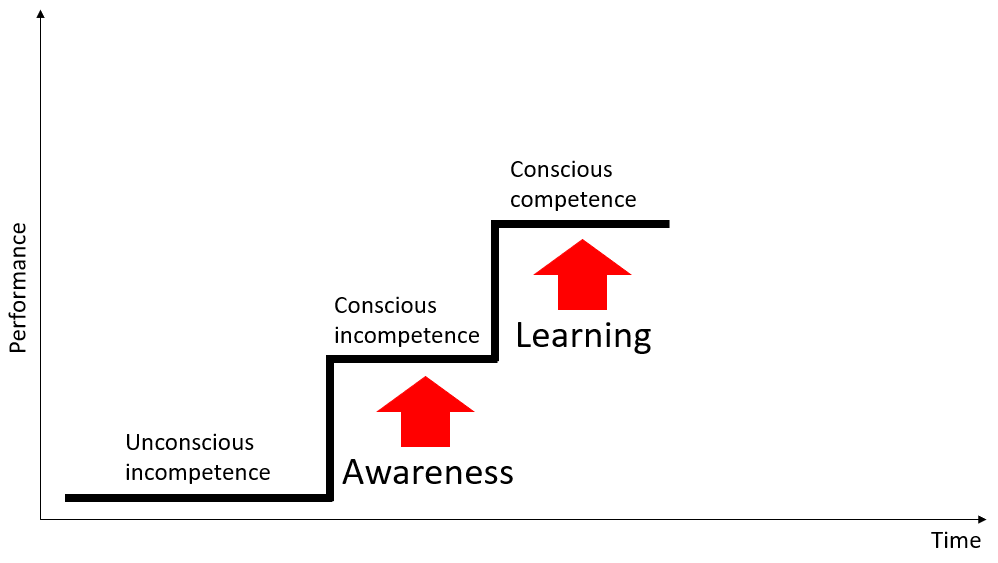
The four stages of competence, also known as the ‘conscious competence learning model’, describes the process of progressing from incompetence to competence in performing a task or activity. [1]
Stage 1. Unconscious incompetence
At this ‘unconscious incompetence’ stage, a person is unaware of their inability to perform a particular task or activity.
Stage 2. Conscious incompetence
At the ‘conscious incompetence’ stage, a person becomes aware that they are unable to perform a particular task or activity.
Stage 3. Conscious competence
A person who is aware of their incompetence may decide it is worth their time and effort to learn how to perform the particular task or activity. At the ‘conscious competence’ stage, the person can perform the task but they will require concentration and may need to think about each step.
Stage 4. Unconscious competence
In the final stage of ‘unconscious competence’, performing the task becomes second nature because the person has learnt and practiced performing the task so much. They can perform the task easily and without thinking about it. As a result, the task may be performed while executing another task.
An experienced or skilled worker often performs many work tasks and activities without needing to think about how or what to do.
Becoming conscious again
As a trainer, we often have mastered skills and we are no longer conscious about how we perform work tasks or activities. We just do it.
But as a trainer, we must explain and demonstrate to others how to perform work tasks, and to do this we have to again become conscious about the steps required to perform the task. The development of a task breakdown is a method that helps us become conscious again about how to perform a work task or activity.
A task breakdown is a step-by-step description about how to perform a task. It may also be known as a procedure or work instructions.
What is a task breakdown?
A ‘task breakdown’ is a document that breaks down a task. It describes the steps in a logical sequence to perform the particular work task or activity.
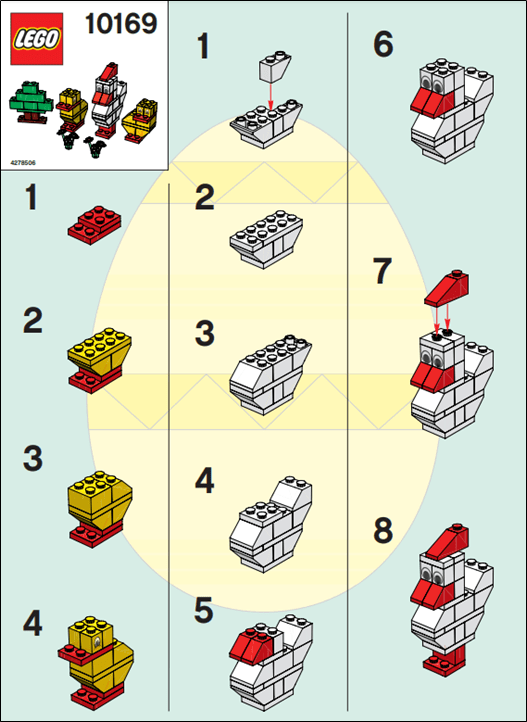
I use three analogies to help people understand and appreciate the value of a task breakdown: Lego instructions, Ikea instructions, and a cooking recipe.
The following three examples have three common features:
Steps are numbered
Illustrations are used to visually communicate
The outcome or desired result is shown.
Lego instructions
Ikea instructions
Cooking recipe
How can a task breakdown be developed?
Use the following six steps to develop a task breakdown.
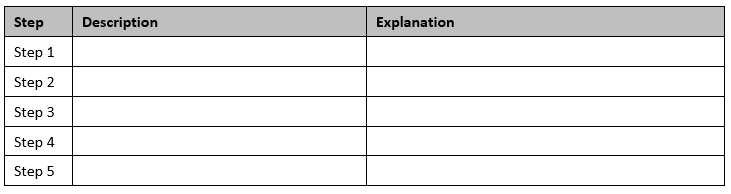
Step 1. Create 3-column table
Open a new Microsoft Word document and create a 3-column table. For example:
Step 2. Add table headings and adjust column width
The following illustrates the recommended layout and format for the task breakdown. For example:
Note: Layout and format can be modified later, if required.
Step 3. Enter step numbers
Use the first column to enter step numbers. The numbers imply a logical sequence to followed, and repeatedly use the word ‘step’ because this reinforces that each row is a step to be performed. For example:
Note: Table rows can be added or removed later, as required.
Step 4. Write brief description for each step
Perform the task or observe someone performing the task. Write a brief description for each step. For example:
Step 5. Write explanations
Write a clear and concise explanation for each step. Use illustrations, diagrams, and photos to show examples. Do not decorate or use unnecessary visuals. For example:
Important note: Remember to highlight safety requirements for the task or for a particular step.
Step 6. Review and finalise task breakdown
Ask someone to use your draft task breakdown to perform the task. Observe the person performing the task, checking the sequence of steps, and seek feedback about readability.
Check your task breakdown for grammar and spelling. Add task title, version control, and page numbers before finalising the document. For example:
Download the finished product
You can download a PDF version of the finished task breakdown for creating a task breakdown from here.
Used as a planning tool to identify required knowledge, required skills, safety requirements, and resources required to perform a task
Used to explain the process or performance of the task
Used to demonstrate the process or performance of the task
Used by the learner to guide them when they learn or practice performing the task
Used to check or assess the performance of the task
Used as a diagnostic tool when a person is struggling with learning or performing the task (used to identify what step the learner is stuck on).
Training session plan
A task breakdown describes a task. A session plan is used to describe the training to be delivered. The task breakdown should not make reference to the training process. It should only describes the work task or activity.
A training session plan can be developed based on the steps described by the task breakdown.
Observation checklist
A task breakdown can be converted into an observation checklist. For example:
A task breakdown should be written to guide performance of a work task or activity. It should describe the step-by-step procedure to be followed in a training environment or in a real workplace. The task breakdown should be the procedure to follow, no matter where the task is performed.
In conclusion
Creating a task breakdown is a basic skill that all trainers and TAFE teachers must have. A task breakdown describes the steps in a logical sequence to perform a particular work task or activity.
A task breakdown has a multitude of uses:
Used by the trainer as a planning tool
Used by the trainer when explaining and demonstrating the performance of the task
Used by the learner to guide them when they learn or practice performing the task
Used by the trainer when checking or assessing the performance of the task
Are you a doing the TAE40122 Certificate IV in Training and Assessment, and are you struggling with your studies? Do you want help with your TAE studies?
I have found that some people studying for their TAE40116 Certificate IV in Training and Assessment qualification struggle with understanding the difference between knowledge and skills. In this article I aim to answer the following questions:
What is knowledge? And what is skill?
What is the difference between knowledge and skill?
Why is it important to know the difference?
Where do we start
In the Australian VET system, specific terms have been defined. For example, competency is partly defined as the consistent application of knowledge and skill to the standard of performance required in the workplace.
For the purpose of this article I am focused on three words from the definition of competency: knowledge, skill, and performance.
A primary objective of VET is to help people learn how to perform work tasks and activities. The performance of a work task will require a person to apply knowledge and apply skill.
If people do not currently have the required knowledge or required skills to perform a work task, then VET will deliver training to help people learn the required knowledge and skills. The learning of required knowledge will usually precede the learning of required skills.
The following illustrates the typical training sequence.
After the required knowledge and skills have been learnt, then training can help people to apply their knowledge and skills to perform the work task or activity to the standard required in the workplace.
What is knowledge? What is skill? And what’s the difference?
Knowledge
What is knowledge? Can knowledge be observed?
These sound like philosophical questions. A person’s knowledge or knowledge held inside a person’s brain cannot been seen, per se.
Knowledge is intangible.
Knowledge can be factual, conceptual, or procedural.
Knowledge refers to learning information, principles, and concepts.
Knowledge is the theoretical understanding of something.
Knowledge refers to theory.
Knowledge learning is the process of acquiring the theory needed before progressing to the next stage of learning.
Skill
What is skill? Can skill be observed?
The performance of a skill can be observed unless it is a cognitive or thinking skill. We can observe a person performing the skill (the process) or we can see what is produced as a result (the product).
Skill is about doing or performing.
Skill refers to applying theory in practice and getting an outcome or result.
Skills are learnt through regular practice or trial and error.
Skill-based learning builds on knowledge by developing practical or ‘hands-on’ ability. People need knowledge and skills to perform a task.
What is the difference between knowledge and skill?
Knowledge and skill
The difference between knowledge and skill can best be explained by an example. What knowledge and skills does a chef need?
Before starting to cook, a chef requires the background knowledge about recipes, ingredients, food safety, types of cooking methods, and hazards in the kitchen.
A chef also needs to develop skills to perform specific tasks, such as reading recipes, measuring ingredients, mixing ingredients, and grilling, steaming, boiling, frying, baking, roasting, etc.
Having knowledge about something does not make a person skilled in it. And being skilled at something does not mean the person has all the required knowledge to work safely, effectively or independently.
A knowledge training session covers the theory.
A skill-based training session develops the practical or ‘hands-on’ ability to do something.
Skill and task
The difference between a skill-based and a task-based training session is subtle. Skills are used to perform a task. Both types of training session will involve doing something:
A skill-based training session involves a person performing a skill.
A task-based training session involves applying knowledge and skill to perform a task.
Learning the difference between knowledge and skill
I ensure that my TAE40116 Students learn the difference between a knowledge training session, a skill-based training session, and a task-based training session. The performance evidence for the TAEDEL401 Plan, organise and deliver group-based learning unit of competency requires three training sessions to be delivered. My TAE40116 Students deliver three consecutive training sessions: a knowledge training session, followed by a skill-based training session, followed by a task-based training session.
The overall objective of the three training sessions is to help a group of people learn to perform a simple work task. This requires the delivery of a training session to help people learn the required knowledge to perform the task, followed by a training session to help people learn a required skill to perform the task. The task-based training session puts together what was learnt in the two previous sessions to perform a task.
A trainer working in the VET sector must be able to deliver training sessions covering knowledge and training sessions covering skills. I believe that a TAE40116 Graduate must know:
The difference between knowledge and skill
The difference between delivering a knowledge training session and a skill-based training session
VET trains people so that they can apply knowledge and skills to perform work tasks.
I have found that many of my TAE40116 Students struggle with how to start planning for the delivery of the three different types of training sessions. I think some people find it unusual to start at the end and work backwards, rather than starting at the beginning and work forward.
The first thing is to clearly describe the objective for the task-based training session and develop a task breakdown.
(By the end of the task-based training session, the learner should be able to …)
The second thing is to clearly describe the objective for the knowledge training session. The task breakdown can be used to identify the relevant knowledge required to perform each step of the task. Also, the Knowledge Evidence can be used to identify the required knowledge.
(By the end of the knowledge training session, the learner should be able to …)
The third thing is to clearly describe the objective for the skill-based training session. The task breakdown can be used to identify the relevant skill required to perform the task. Also, the Foundation Skills can be used to identify the required skill or skills.
(By the end of the skill-based training session, the learner should be able to …)
An example
The following is an example using the ICTICT216 Design and create basic organisational documents unit of competency. Basic organisational documents may include letters, brochures, posters, forms, and procedures.
Step 1. Describe the task
The task of designing and creating basic documents can be considered as having three stages: design document, develop document, and finalise document.
Each stage can be broken down as having three steps. The following flowchart outlines the 9-step process for designing and creating basic documents.
Step 2. Identify the required knowledge and required skills
The following shows how a table can be used to identify the knowledge and skills required for each task step.
Step 3. Write objectives for training sessions
The following are selection of training objectives for the ICTICT216 Design and create basic organisational documents unit of competency.
Training objectives must be written.
Task-based training sessions
By the end of the task-based training sessions, the learner should be able to design, develop and finalise at least five types of documents: letter, brochure, poster, form, and procedure.
Knowledge training sessions
By the end of the knowledge training sessions, the learner should be able to:
List three types of questioning techniques
List three methods of active listening
List five planning and scheduling considerations
Describe three document design principles
Describe three features of Microsoft Word and how to apply these features when developing a document
Describe three features of Microsoft PowerPoint and how to apply these features when developing a document
Identify two advantages of using Microsoft Word and two advantages of using Microsoft PowerPoint for developing documents
Etc.
Note: There would be several knowledge training sessions. ‘Chunking and sequencing’ of required knowledge would determine the order and timing for each knowledge training session. Also, the characteristics and needs of the individual learners would need to be considered.
Skill-based training sessions
By the end of the skill-based training sessions, the learner should be able to:
Clarifies work requirements using questioning and active listening techniques
Plan and schedule tasks to achieve outcomes within agreed timeframes
Read organisational guidelines and document requirements to determine requirements for document orientation, style, and format
Read organisational guidelines and document requirements to select appropriate application software for different types of documents
Etc.
Note: There would be several skill-based training sessions. ‘Chunking and sequencing’ of required skills would determine the order and timing for each skill-based training session. Also, the characteristics and needs of the individual learners would need to be considered.
Step 4. Develop training session plans and resources
This step is outside the scope of this article.
Why is it important to know the difference between knowledge and skill-based training?
Active learning
Active learning methods are used to engage and actively involve learners in the learning process. I promote the idea that at least 50% of the available training time should be allocated for activity. I emphasis ‘at least’, therefore 60%, 75%, or 90% of the training time could be used for activities.
Learning activities
Learning activities can be done by the individual learner, by working in pairs, or by working in small groups. Types of learning activities include:
Perform the work task or activity
Project
Role play
Case study
Skills practice
Research assignment
Discussion
Answer questions
Presentations
Quiz.
The following shows the application for different types of learning activities.
Note: All vocational education and training must include the performance of the work task or activity.
Structure of a training session
Finally, and importantly, the structure of a knowledge training session will be different to the structure of a skill-based or task-based training session.
Knowledge training session (EAS)
Skill-based or task-based training session (EDP)
In conclusion
The following diagram show from the learner’s perspective that the knowledge training is followed by skill-based training, followed by task-based training. But the planning process for competency-based training starts with the task, and then works back to the required knowledge and required skill.
Key points
A prime objective of VET is about help people learn how to perform work tasks and activities
People need knowledge and skills to perform work tasks and activities
Knowledge and skills are different.
Active learning methods must be used to engage and actively involve the learner in the learning process.
A trainer needs to know the difference between knowledge and skills because a knowledge training session is structured differently to a skill-based training session, and different types of learning activities are used.
The objective of a task-based training session is to ensure a person can apply the required knowledge and required skills to perform a work task or activity.
Training is not complete until the learner has performed the work task or activity to the standard required in the workplace.
Do you need help with your TAE studies?
Are you a doing the TAE40122 Certificate IV in Training and Assessment, and are you struggling with your studies? Do you want help with your TAE studies?
The quality of vocational education and training (VET) in Australia is important. Systematic training aims to improve productivity, global competitiveness, and workplace safety. And each year, billions of taxpayers’ dollars is spent by governments on delivering VET programs.
Australian industry, employers, governments, and taxpayers deserve a VET system that delivers quality outcomes, and value for money. And job seekers, apprentices, trainees, and employees who undertake VET programs should expect to receive a quality service from training providers. It is the role of government departments and VET regulators to monitor and audit VET quality.
In Australia, the VET Quality Framework has been established. It consists of five elements [1]:
Australian Qualification Framework (AQF)
Standards for Registered Training Organisations (RTOs)
Fit and proper person requirements
Financial viability risk assessment requirements
Data provision requirements.
Australian Qualification Framework (AQF)
All Australian qualifications must comply with the AQF. [2] The learning outcomes for each AQF level and qualification type are described. The current AQF has evolved from the initial implementation handbook released in 1995. Since then, there has been a procession of revised frameworks:
AQF Implementation Handbook First Edition 1995
AQF Implementation Handbook Second Edition 1998
AQF Implementation Handbook Third Edition 2002
AQF Implementation Handbook Fourth Edition 2007
AQF First Edition 2011
AQF Second Edition 2013
And there has been at least three amendments to the AQF Second Edition 2013. [3]
AQF Volume of Learning
The AQF Volume of Learning [4] has become a prime focus for the national VET regulator. The aim is to discourage unduly short-duration VET training programs that do not provide sufficient training.
Standards for Registered Training Organisations (RTOs)
The Standards for RTOs are the regulatory requirements for the operation of training organisations registered to deliver training services and to issue nationally recognised training (NRT) qualifications or statements of attainment. Only registered training organisations (RTOs) can issue documents with the NRT logo (as shown below).
NRT logos provided for the purpose of display only
Many training organisations want to be registered, not as an expression of quality training, but because this is a prerequisite for being eligible to receive government funding when delivering training.
The current Standards for RTOs have evolved from the Australian Quality Training Framework (AQTF) that were first introduced in 2001. Since then, there has been a procession of revised standards: [5]
National Framework for the Recognition of Training (NFROT) 1992
Australian Recognition Framework (ARF) 1998
AQTF 2001
AQTF 2005
AQTF 2007
AQTF 2010
Standards for NVR 2011
Standards for NVR 2012
Standards for RTOs 2015.
And there has been at least two amendments to the Standards for RTOs 2015.
The Standards for RTOs require training providers to comply with:
Training packages and accredited courses
Legislation and regulations.
Training packages and accredited courses
RTOs must comply with the requirements specified by training packages and accredited courses when delivering nationally recognised training (NRT):
Qualification packaging rules
Units of competency including elements of competency, performance criteria, and foundation skills
Assessment requirements including performance evidence required, knowledge evidence required, and assessment conditions.
Legislation and regulations
RTOs must comply with all relevant legislation and regulations. For example:
Work health and safety
Antidiscrimination
Copyright
Privacy.
Fit and proper person requirements
The ‘Fit and proper person requirements’ are used to determine the suitability of owners, executives, or senior managers involved in the operation of a registered training organisation. [6]
Over the years, Australia has had a number of unfit and improper people owning and managing RTOs. I will say more about this topic during the conclusion of this article.
Financial viability risk assessment requirements
The ‘Financial viability risk assessment requirements’ are used to determine the ability of an RTO to meet financial obligation and remain financially viable. [7]
Over the years, Australia has seen a number of high-profile RTOs that have financially crashed. Many RTOs have a business model that is based on revenue from government funding. If the government funding changes, so does the financial viability of these RTOs.
Data provision requirements
The ‘Data provision requirements’ specify that RTOs must provided data when requested and submit quality indicator data annually to their VET regulator. [8]
Gathering data can provide useful insight about how an RTO is operating, or has been operating. There is always going to be a lag. Luckily, this is not the only source of intelligence used by the VET regulators to monitor the performance of RTOs.
In conclusion
Australia has had a long history in government sponsored and industry endorsed frameworks that have been designed for assuring the quality of vocational education and training (VET).
Over the years, it is sad that the Australian VET system has witnessed many cases of fraudulent, unethical, and unscrupulous behaviour displayed by RTO owners, executives, and senior managers. It is sad that greed, self-interest, profit, or a focus on personal financial gain has created some rotten operational practices. And TAFEs have not been immune from poor practices. In TAFE, ‘profit’ may be called ‘surplus’. And in TAFE, there is still a need to ‘cut costs’. There have been too many occasions when government funding has been rorted by all types of RTOs.
Unfortunately, this is why we need a highly regulated VET system. I say ‘unfortunately’, because the unintended consequence has been a VET system that is highly prescriptive. This can stifle innovation. This can stifle quality competition. And it has increased the administrative burdens placed on trainers and assessors.
The VET Quality Framework is necessary. It plays an important role in the assurance of VET quality. It can be used by the VET regulators and government departments to monitor and audit RTOs operations. I think it is doubly important to closely monitor and audit RTOs that receive government funding. There is a worrying trend for the VET regulators to take a ‘light-touch’ approach to their regulating duties.
Are you a doing the TAE40122 Certificate IV in Training and Assessment, and are you struggling with your studies? Do you want help with your TAE studies?