40+ years experience as a trainer, instructional designer, quality manager, project manager, program manager, RTO auditor, RTO manager and VET adviser.
Humpty Dumpty sat on a wall Then along came some VET Reforms All the VET practitioners tried really hard But couldn’t put Humpty together again.
Humpty Dumpty is a metaphor for the specifications currently found in Training Packages. I am frustrated with politicians, bureaucrats, VET lobbyists, VET experts, and other ignorant or naïve people telling me that they are simplifying the VET system when they are actually doing the reverse. They either think I am a fool or they are deluded.
Training Packages
Many people learning about the Australian VET system for the first time, often are confronted with a vast array of terminology and acronyms. It has been known for a long time that the term, Training Package, is a misnomer. Training Packages do not specify training, nor do they include training materials. A simple solution would be to rename it. But the proposed VET Qualifications Reform wants to smash it to bits.
After 29 years since the current Australian VET system was implemented, there are many people working in and around VET who do not understand what is meant by competency-based training and competency-based assessment. Some people don’t understand that qualifications have an occupational outcome, that have been determined by industry. Also, there are some people who don’t understand units of competency.
Some people complain about how vague or ambiguous units of competency are. They want more information provided (making documents bigger). Some people complain that the Training Package documents are too big, and should be reduced in size. We should acknowledge that Training Package developers have to find a balance between having enough details documented, but not too much.
We wouldn’t have a problem if politicians, bureaucrats, VET lobbyists, VET experts, and some VET practitioners learnt to use our current VET system. It has many good features. It isn’t that bad. But we are going to make massive and unnecessary changes.
VET Qualification Reforms
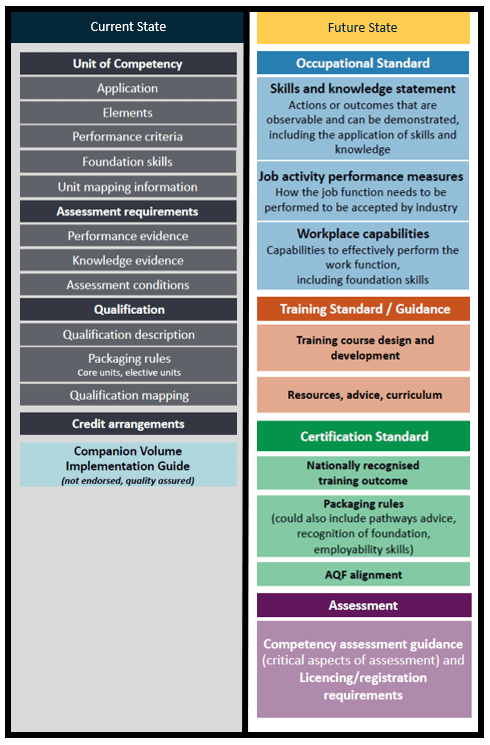
The framework for a future VET Qualifications architecture has been published by the Australian Government. It compares a boring ‘charcoal grey’ framework with a ‘colourful’ future framework. Of course we want to move to the vibrant future state.
In the following diagram, I have compared the current and future states side by side, in an attempt to compare the two frameworks.
And the next diagram show the connections between the current and future states.
It seems that we will be creating new documents, and the new document titles are likely to still confuse people. Also, it seems that we will rearrange the existing information (maybe I should use the ‘rearranging the deck chairs on the Titanic’ metaphor). I think we are adding complexity.
I could further analyse the proposed VET Qualifications Reforms, but that would be a waste of my time. Changes are going to happen anyway. So here is an illustration showing my concerns.
I may be wrong. I would like to see a complete sample for an entire set of documents that are planned to replace what we currently have. Then I will know if I am wrong, or right. I hope we get to see a sample before government ministers and their bureaucrats make the decision to implement chaos.
I can image the massive confusion, massive frustration, massive non-compliance, and massive costs associated with implementing the VET Reforms. Unfortunately, I cannot image that the future will be better than what we currently have. My greatest concern with the VET Reforms (now known as Skills Reform) is the potential of damaging, if not destroying, the entire Australian VET system.
Validation is defined as the quality review of the assessment process. It involves checking that the assessment tool produces valid, reliable, sufficient, current and authentic evidence to enable reasonable judgements to be made as to whether the requirements of the training package or VET accredited courses are met. It includes reviewing a statistically valid sample of the assessments and making recommendations for future improvements to the assessment tool, process and/or outcomes and acting upon such recommendations. [1]
Assessment validation has two distinct parts:
Part 1. Check the assessment tool for compliance
Part 2. Review a sample of the assessments.
This article covers the first part only.
If you want to know more about the second part, then I recommend reading the information published by ASQA about how to conduct assessment validation. This information covers: [2]
Who conducts validation?
Scheduling validation
Statistically valid sampling and randomly selecting samples to be validated
Effective validation
Reviewing assessment practice
Reviewing assessment judgements
Validation outcomes and the implementation of recommendations for improvement.
Part 1. Check the assessment tool for compliance
The assessment tool must be checked to ensure it complies with the requirements specified by the Standards for RTOs, in particular: [3]
Compliance with the principles of assessment and the rules of evidence
Compliance with the requirements specified by the training package or VET accredited course.
The following 6-step process can be used to check the assessment tool for compliance:
Step 1. Read the assessment requirements
Step 2. Review the assessment plan
Step 3. Review the assessment matrix (mapping)
Step 4. Check the details about how the knowledge evidence is planned to be being gathered
Step 5. Check the details about how the performance evidence is planned to be being gathered
Step 6. Check the overall quality of the assessment tool.
Step 1. Read the assessment requirements
This is a quick step to perform. You will read and re-read the unit of competency and its assessment requirements many times during the assessment validation process. During this first step, have a quick read of the assessment requirements and answer the following questions:
What is the volume or frequency of performance evidence?
Is the location, facilities, equipment, or other assessment conditions specified?
Step 2. Review the assessment plan
This step should also be quick. The purpose of this step is to get an overview of what is the planned assessment approach During this second step, answer the following questions:
Has the correct unit code and title been used?
How many assessment tasks are planned?
Is there a plan to gather the knowledge evidence?
Does there appear to be sufficient assessment tasks for gathering the volume or frequency of performance evidence?
Does the planned assessment approach seem to be simple or complex?
Note: This planned assessment approach may be found in the Training and Assessment Strategy (TAS) or other documents covering how the RTO plans to implement the delivery of the training and assessment for a unit or cluster of units.
Step 3. Review the assessment matrix (mapping)
This step should be a relatively quick step. The assessment matrix is an important document used to display how the RTO plans to gather evidence that comply with the requirements specified by the training package or VET accredited course. The assessment matrix will be used during Step 4 and Step 5 to cross-check the RTO’s planned assessment approach and the assessment instruments being used to gather evidence.
During this third step, answer the following questions:
Has the correct unit code and title been used?
Has the entire unit of competency and its assessment requirements been copied into the matrix? Are the number of items the same? For example, if the unit has five elements does the matrix have five elements? And scan the wording to ensure the matrix has the exact words as the unit of competency and its assessment requirements.
Is there one column for each planned assessment task?
Are the titles or descriptions of the assessment tasks the same in the assessment plan and assessment matrix?
Is every item from the unit of competency and its assessment requirements planned to be assessed? For example, is there at least one ‘tick’ in every row?
Note: Some assessment matrices will provide information or numerical indicator about the assessment item instead of using a ‘tick’. For example, the matrix may indicate that a piece of knowledge evidence will be gather by Question 1.
Step 4. Check the details about how the knowledge evidence is planned to be being gathered
This step requires an attention to details. The purpose is to ensure that the assessment tool will gather the required knowledge evidence. During this fourth step, answer the following questions:
Is there an assessment instrument for gathering the knowledge evidence?
Are the instructions to the assessor clear and concise?
Are the instructions to the candidate clear and concise?
Is the structure, format, and layout of the assessment instrument easy to follow? This includes headings, sub-headings, page numbers, and numbering of questions.
Is there consistency between the assessment plan, assessment matrix and assessment instrument? For example, if the assessment plan states that there are 17 questions, does the assessment instrument have 17 questions?
Is every item of knowledge evidence being adequately gathered? A judgement about ‘adequately’ will need to be made.
Step 5. Check the details about how the performance evidence is planned to be being gathered
This step requires an attention to details and it can take time to examine the assessment documents for compliance. The purpose is to ensure that the assessment tool will gather the required performance evidence. During this fifth step, answer the following questions:
Is there one or more assessment instruments for gathering the performance evidence?
Are the assessment conditions compliant with those stated in the Assessment Requirements for the unit of competency? This may include assessment location, facilities, equipment, and access to specified documents. For example, if the assessment conditions state that the assessment occurs in the workplace, then the assessment tasks must state that the evidence must be gathered from a workplace (not from a simulated workplace).
Are the instructions to the assessor clear and concise?
Are the instructions to the candidate clear and concise?
Are the items of performance evidence clearly listed or identified?
Is the structure, format, and layout of the assessment instrument or instruments easy to follow? This includes headings, sub-headings, and page numbers.
Is there consistency between the assessment plan, assessment matrix and assessment instrument? For example, if the assessment matrix states that evidence for Performance Criteria 1.1 will be gather during Assessment Task 2, then Assessment Task 2 must cover the gathering of evidence for Performance Criteria 1.1.
Is every item of performance evidence being adequately gathered? A judgement about ‘adequately’ will need to be made. This includes a check that the amount of evidence being gathered is compliant with the specified volume or frequency of performance evidence.
Note: Verbs are important. For example, if performance criteria says, ‘negotiate and agree with a supervisor’, then there needs to be evidence that the candidate has negotiated and agreed with a supervisor’. Also, the letter ‘s’ is important. A item of performance evidence may specify plural rather than singular. For example, if it states ‘write reports’, then more than one written report is required for evidence.
Step 6. Check the overall quality of the assessment tool
This step can take time to examine the assessment tool for compliance, readability, and usability.
Are there sample answers and assessment decision criteria for assessors?
Is the structure, format, and layout of all assessment documents easy to follow?
Are all instructions written clearly and concisely?
Are there any grammar, spelling and typo errors?
Is there a list of all the assessment documents required for the assessor?
Does the assessment tool have all the documents required for the assessor?
Is there a list of all the assessment documents required for the candidate?
Does the assessment tool have all the documents required for the candidate?
Has the correct unit code and title been used throughout all the assessment documents? This may include release number.
Do all the assessment documents have version control information?
In conclusion
Assessment validation has two distinct parts:
Part 1. Check the assessment tool for compliance
Part 2. Review a sample of the assessments
Assessment validation can be time-consuming and mind-bending.
Preparation before an assessment validation meeting can reduce the time at the assessment validation meeting. However, you can expect a typical assessment validation meeting to require anywhere between a few hours and an entire day. The duration of the assessment validation meeting can depend on the quality of the assessment tool and number of assessment samples to be reviewed. I regularly see poor quality assessment tools, and it takes time to properly check large numbers of assessment samples.
Clear and critical thinking is required by people participating in an assessment validation meeting. There are usually many documents to be reviewed and checked. Printing paper copies of documents (or some documents) and using ‘split screens’ on computers will help when comparing information from two or more documents, such as:
unit of competency
assessment requirements
assessment plan
assessment matrix
assessment instructions
assessment instruments.
Frustration and fatigue can be experienced during long assessment validation meetings. Breaks will be needed (and sometimes chocolate helps). It is a good idea to assign an experienced VET practitioner to lead the assessment validation meeting.
Are you a doing the TAE40122 Certificate IV in Training and Assessment, and are you struggling with your studies? Do you want help with your TAE studies?
The Australian VET system has been designed to recognise a person’s competency without prescribing how a person should learn and develop their competence.
This is the fundamental difference between a competency-based training system and a curriculum-based training system. The current competency-based training system was implemented in 1993 to replace the previous curriculum-based training system. And a focus on outcome, or demonstrating competence regardless on how it has been attained, has continued to be a feature of Australia’s VET system.
Some people can learn from performing work. They have learnt from their own work experience rather than attending formal or structured training. The Australian VET system allows a person to have their competence assessed before commencing a training program. We know this assessment-only pathway as Recognition of Prior Learning (RPL).
What is RPL?
The following is the ‘official definition’ of RPL: [1]
RPL is an assessment process that involves assessment of an individual’s relevant prior learning (including formal, informal and non-formal learning) to determine the credit outcomes of an individual application for credit.
An RTO should offer RPL at enrolment or prior to the commencement of training. [2]
Many people report that their experience with RPL has been unsatisfactory. It can be time-consuming. It can be frustrating. Often RPL assessments are poorly conducted. And many RTOs seem to be reluctant to offer RPL.
Fair and flexible assessment process
Two of the four principles of assessment are fairness and flexibility. RPL is an important process that contributes to an RTO’s service being fair and flexible. And the principles of fairness and flexibility must be used to guide the RPL process that is implemented by an RTO.
Fairness
The RTO must fully inform the learner, or RPL candidate, about the assessment process before the assessment process begins. And this includes types of evidence and performance standards expected. [3]
Flexibility
The RTO must ensure that assessment is flexible to the individual learner, or RPL candidate, by assessing competencies. It does not matter how or where competency has been acquired. [4]
The RPL assessment tool
You may be required to design and develop an RPL assessment tool.
If you work for an RTO, the RTO will probably have a template for you to complete. And the RTO should have an RPL assessment tool for other qualifications, skill sets or stand-alone units that it has on it’s scope of registration. Therefore, the RTO should have existing examples of RPL assessment tools for you to refer to.
Often the RPL assessment tool will be known as the ‘RPL Kit’. An RPL Kit will usually consist of:
Information
Ideas for evidence
Instruments
Instructions.
Information
The RPL Kit should give clear and concise information about the RPL assessment process. Relevant RTO’s policies and procedure will need to be communicated to the RPL applicant, including appeals and complaints processes.
A range of general information must be provided.
For example (from the RPL applicant’s perspective):
What is competency-based assessment?
What do I need to do to be assessed?
How do I submit evidence?
When do I need submit evidence?
Who do I contact if I need support?
How much does RPL assessment cost?
What happens if I cannot provide evidence?
What happens if I cannot provide enough evidence?
An RPL applicant may have many questions about the RPL assessment process before they commence. Giving information to prospective RPL applicants aims to provide answers to frequently asked questions.
Ideas for evidence
Specific information must also be provided. An RPL applicant needs to clearly understand the type and amount of evidence that required to be provided. This information may be descriptive rather than prescriptive, and when possible, it is useful to give a range of typical evidence that may support a person’s application for RPL.
Sometimes a single item of evidence may have multiple descriptions because there may not be a single or standard term used in industry or workplaces. For example:
It is only fair that an RPL applicant is informed that evidence is required for every performance criteria. The following example is an extension from the above example for the BSBPEF202 Plan and apply time management unit of competency.
A comprehensive list of evidence has to be communicated to the RPL applicant, otherwise they will not know what to do. They need to know the type and amount of evidence needed to be gathered. This is important information to help the RPL applicant focus on gathering evidence that must comply with the four rules of evidence: valid, current, authentic, and sufficient.
The RPL applicant needs to be provided with specific information relating to the required evidence for the unit or units of competency being assessed, such as:
What specific evidence do I need to submit?
What is current evidence? How can I prove that the evidence is current?
What is authentic evidence? How can I prove that the evidence is authentic?
How much evidence is sufficient evidence?
Volume or frequency of performance evidence
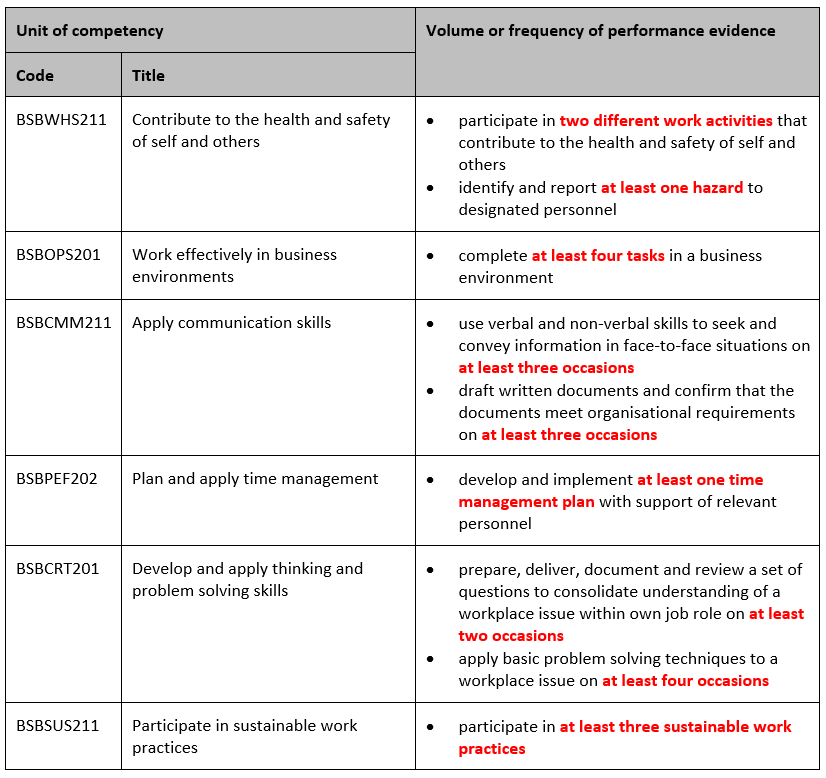
Some units of competency specify a volume or frequency of performance evidence. The specified amount of evidence to be provided must be communicated to the RPL applicant. The following are some examples.
The specified quantity of evidence is still required when a person is seeking RPL.
Instruments
Assessment instruments are required to gather knowledge evidence and gather performance evidence. Also, these instruments are used by the assessor to conduct the assessment and make their decisions about competence.
Gathering knowledge evidence
A common method for gathering knowledge evidence is asking questions. Questions can be written, verbal, or combination of both.
Written questions are often used because it can be a cost effective methods for the RTO. Using verbal questions help to explore a person’s breath and depth of knowledge. Having a ‘competency conversation’ is a useful approach. Verbal questions can be to tailored to specifically relate to an individual’s Portfolio of Evidence. Many people will find it easier to talk from their own experience rather than talking theoretically or hypothetically.
A verbal questioning approach has the additional benefit of helping to verify the authenticity of items from a Portfolio of Evidence.
Gathering performance evidence
A common method for gathering performance evidence during an RPL assessment process are:
Portfolio of Evidence
Third Party Reports.
Often indirect evidence is extensively used during an RPL assessment. And a favourable assessment result can not be made based solely on supplementary evidence.
Many people do not keep documents when they are performing their everyday work. Therefore, many people will not have ready access to document evidence. An RTO should be prepared to offer assessment tasks to the RPL applicant. This may include gathering direct evidence if an assessor can observe the RPL applicant performing tasks.
Assessment conditions
The assessment conditions specified for a unit of competency must be complied with. For example, the assessment conditions for the BSBPEF202 Plan and apply time management unit of competency states:
Skills in this unit must be demonstrated in a workplace or simulated environment where the conditions are typical of those in a working environment in this industry.
Basically, evidence for the BSBPEF202 unit must be from a workplace.
Assessment matrix
An assessment matrix gives an outline of the various assessment methods that can be used for gathering evidence. The following is an example for the BSBPEF202 Plan and apply time management unit of competency.
The above assessment matrix is incomplete. The matrix should also include:
Performance Evidence
Knowledge Evidence
Assessment Conditions.
Some units of competency may also require evidence for the specified Foundation Skills. For examples units from:
BSB Business Services Training Package
FNS Financial Services Training Package
ICT Information and Communications Technology Training Package.
Instructions
Clear and concise instructions will be required:
Instructions for the RPL assessor
Instructions for the RPL applicant.
The RPL assessor needs instruction about conducting the RPL assessment process. And the RPL applicant needs instructions to guide them through the RPL assessment process, in particular the gathering of evidence.
Non-evidence
It is common for RPL applicants to be asked to submit a resume, position descriptions, and job descriptions. And some RPL applicants are asked to complete a self-assessment. These documents may be useful background about a person’s previous work experience but:
A resume or CV is not evidence
Position or job description is not evidence
Self-assessment is not evidence.
Asking ‘how-to’ questions
Asking ‘how-to’ questions should not be used as a method for gathering performance evidence. A person may not be able to describe how to perform a task, but they might have the ability to do it. And a person may have the words to describe how to perform a task, but they don’t have the ability to do it. Asking questions can gather knowledge evidence but not used to gather performance evidence.
How to develop an RPL Kit
It is common for the RPL assessment tool to be called an ‘RPL Kit’.
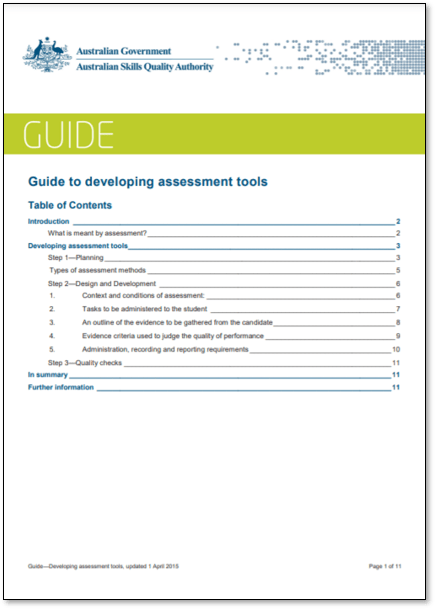
ASQA’s Guide to developing assessment tools is a document that is worthwhile reading before creating any assessment tool. It is brief, easy-to-read, and it covers essential information.
However, ASQA’s Guide does not go into the details about how to develop an RPL assessment tool.
Step 1. Get your RTO’s RPL assessment tool template
Step 2. Check that the general information about the RPL assessment process is clear, concise, and current (if not, re-write)
Step 3. List ideas for evidence and add this specific information to the RPL Kit
Step 4. Develop assessment instruments for the unit or units of competency that are covered by the RPL Kit
Step 5. Write clear and concise instructions for assessors and RPL applicants.
Usually, an RPL Kit will be developed for an entire qualification. Hence, it will cover many units of competency. The RPL Kit can become a very big document. It will be important to organise and structure the RPL Kit to make it easier to read, navigate and use. This includes:
Using headings, sub-headings, and a Table of Contents
Using language that is clear, concise, and written in plain English.
In summary
The walnut has a hard shell. The effort to crack open the hard shell is rewarded by the tasty nut. RPL seems to be a hard nut to crack in the Australian VET system.
In this article, I have covered some key considerations when developing an RPL assessment tool, and I have listed a 5-step process for developing an RPL Kit.
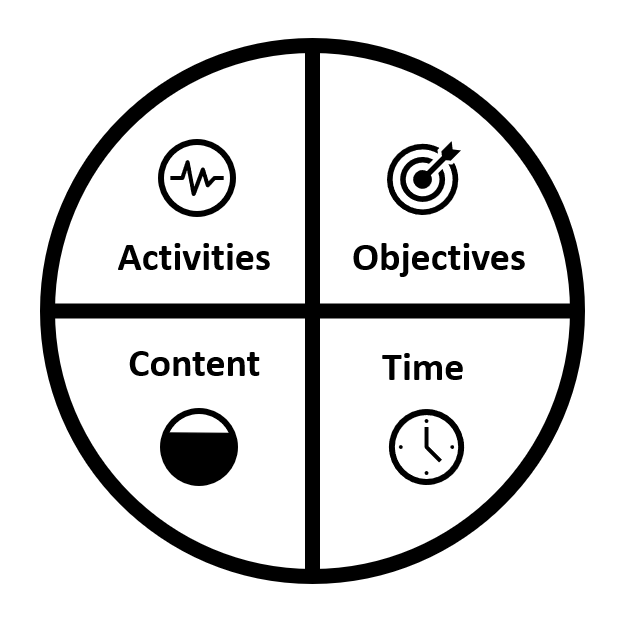
An RPL assessment tool, also commonly known as an RPL Kit, should consist of the following four things:
Are you a doing the TAE40122 Certificate IV in Training and Assessment, and are you struggling with your studies? Do you want help with your TAE studies?
The following has been announced by the Education IRC:
“The TAE Training Package was last reviewed in 2015 and uploaded in 2016. In the five years since, the VET teaching, training and assessment landscape has drastically changed. The IRC considers that the TAE Training Package is currently not fit for purpose and does not fully address the needs of the VET sector for the following reasons:
TAE units of competency do not deliver the variety, nor depth, of skills and knowledge that are relevant in a modern VET teaching, training and assessment environment;
The packaging rules of TAE40116 Certificate IV in Training and Assessment do not provide adequate flexibility for learners pursuing the variety of VET teaching, training and assessment job roles that exist in the modern labour market;
The TAE Training Package does not make use of ‘stackable’ skill sets that allow for a ‘scaffolded’ approach to skill development and attainment of qualifications;
The TAE Training Package is not structured to support the range, and diversity of career pathways available to workers in the VET industry, meaning that existing qualifications (beyond TAE40116 Certificate IV in Training and Assessment) are often underutilised;
The structure and content of the TAE Training Package does not address the skills gaps of those working in other education sub-sectors such as VET for Secondary Students or enterprise training.
As a result, the Education Industry Reference Committee (IRC) is proposing a holistic review of the TAE Training Package to ensure it aligns with the current skills needs of the VET sector and provides greater pathways into the profession.”
How has the VET teaching, training and assessment landscape drastically changed?
I have identified three things that have changed:
More trainers and TAFE teachers have used web conferencing platforms, such as Zoom, to deliver training sessions. It has not been difficult to learn how to use this technology.
It has become common for a learning management system (LMS), such as Moodle, to be used for students to submit their evidence and assessors to assess online. Again, it has not been too difficult to learn how to use this technology.
Increased emphasis on gathering evidence for all performance criteria and specified assessment requirements. This has often increased the workload of conducting assessments.
Can you think of anything else that has changed?
I agree that the VET teaching, training and assessment landscape has changed but I feel that the word ‘drastically’ has been used for impact, making it sound more ‘dramatic’. From a VET practitioner’s perspective, I think the changes associated with technology has been acceptable and relatively easy to cope with, but the increased workload associated with doing administration and assessment tasks is unacceptable. Often more tasks must be done by trainers and assessors without an increase in remuneration.
TAE units of competency
The Education IRC says that the TAE units of competency do not deliver the variety, nor depth, of skills and knowledge. This may be true, however, many people are ignorant of the details within the TAE units of competency. And many people don’t know how to interpret and contextualise the TAE units of competency to ensure the breadth and width of skills and knowledge are delivered.
What is the Education IRC proposing?
What additional variety is proposed?
What additional depth is proposed?
Often people unfairly condemn the TAE units of competency. Sometimes, the condemnation should be directed at how an RTO delivers the TAE training rather than thinking that the problem is with the units of competency.
TAE qualification packaging rules
The Education IRC say that the packaging rules of TAE40116 Certificate IV in Training and Assessment do not provide adequate flexibility for learners who will get employed by different types of RTO, such as:
TAFE
Private RTO
Schools (VET in Schools)
Community RTO
Enterprise RTO.
Also, some TAE Graduates want the qualification to work in a non-VET training role. Many of these people do not need the ‘full qualification’. An appropriate skill set would usually be what’s needed.
Increase the number of qualifications
One solution is to develop several qualifications; one qualification for each different type of RTO.
What does the Education IRC think the different tasks performed by trainers and assessors are when they work at the different types of RTOs?
Let’s say a person gets a customised qualification for working at one type of RTO. What happen when this person moves jobs from one type to another type of RTO? Do they need to re-train? And what happens when this person works for multiple types of RTO? Do they need multiple qualifications?
Many people do not know exactly what type of RTO they will work for after becoming qualified. If there are multiple qualifications to choose from, what qualification will they select?
Increase the number of elective units
Another solution is to increase the number of elective units. It is rare for TAE Student to select the elective units. It is usual for RTOs to offer a TAE program with elective unit or units already selected.
Some qualifications are designed to have a lot of flexibility, while other qualifications are designed to have very little flexibility. It seems that the more regulated a work environment is, the less flexibility there is.
Career pathways
The Education IRC says that the TAE Training Package is not structured to support the range, and diversity of career pathways. Currently, the Australian VET system has qualifications for the following job roles:
LLN specialist or consultant
Senior trainer/Senior TAFE teacher
Course design and development
Sales and customer service
Compliance and auditing
Administration
Management.
What jobs in VET require new qualifications to be developed?
Also, the Education IRC says that the existing TAE qualifications (beyond TAE40116 Certificate IV in Training and Assessment) are often underutilised. This may be due to market demand rather than lack of relevant qualifications.
Gaps in the TAE Training Package
The Education IRC says that theTAE Training Package does not address the skills for:
Secondary school teachers delivering VET in Schools programs
Enterprise trainers, industry trainers and workplace trainers.
What are the skill gaps that have been identified by the Education IRC?
The delivery of good training starts with good training design. And the design of competency-based training require an attention to particular details to ensure it is compliant within the Australian VET system.
On Target Work Skills is proud to be presenting an interactive webinar about how to design competency-based training. It has been designed as a professional development opportunity for trainers wanting to learn more about training program design or refresh their current competency.
The webinar shall be facilitated by Alan Maguire.
Webinar objectives
In this webinar you will learn the following techniques:
How to estimate total training duration
How to determine training program content
How to use blocks of time to build a training program.
And topics covered during the webinar shall include:
Establishing learning objectives
Volume of learning and nominal hours
Unpacking a unit of competency
Interpretation and contextualisation
Cognitive load and attention span
Gagné’s 9-events of instruction.
Webinar dates
Select one of the following:
Tuesday 10th of August, 2021
Wednesday 18th of August, 2021
Thursday 26th of August, 2021
Start time 2:00pm Australian Eastern Standard Time, finish by 4:30pm.
Webinar location
You can attend from your workplace or home because the webinar will be delivered via Zoom.
Are you new to Zoom video conferencing? If you are, please don’t be concerned. The connection to Zoom is quick, and using Zoom is easy. Instructions about joining and using Zoom will be provided when your webinar enrolment is confirmed.
Please call Alan Maguire on 0493 065 396 to reserve your place.