Do trainers and TAFE teachers need the capability to develop assessment tools?

One of the core units of the TAE40116 Certificate IV in Training and Assessment qualification was the TAEASS502 Design and develop assessment tools unit of competency.

In the new TAE40122 Certificate IV in Training and Assessment qualification, the TAEASS512 Design and develop assessment tools unit of competency is no longer a core unit, and it is unlikely to be offered by RTOs to their TAE40122 students.

Does a trainer or TAFE teacher need the capability to design and develop an assessment tool?

Many trainers and TAFE teachers delivering the TAE40116 qualification struggled with helping their TAE40116 students learn how to design and develop assessment tools. Sometimes, this was due to a lack of time allocated for training by the RTO. And sometimes, the trainer or TAFE teacher didn’t have the capability to deliver the training on how to design and develop assessment tools. The consequence was that TAE40116 students struggled with learning and completing their assessments relating to the design and development of assessment tools. Many TAE40116 students raised their concerns or made complaints. This situation was fed into the review of the TAE40116 qualification and the subsequent development of the TAE40122 qualification.

Some RTOs delivering the TAE40116 qualification, or people working for those RTOs, said that the ‘Design and develop assessment tools’ unit of competency should no longer be a core unit for the Certificate IV in Training and Assessment qualification. This was based on TAE40116 students finding it difficult and complaining, but an argument was put that trainers and TAFE teachers didn’t need to design and develop assessment tools, therefore, the ‘Design and develop assessment tools’ unit of competency was not needed to be covered by the Certificate IV in Training and Assessment qualification.

Do employers of qualified trainers and TAFE teachers want them to have the capability to design and develop an assessment tool?

During 2023, I have seen many assessment tools used by many RTOs, and many have of these assessment tools have been non-compliant and of poor-quality. I believe the capability of designing and developing assessment tools is urgently needed. I am unsure if employers of trainers and TAFE teachers were asked during the review of the TAE40116 qualification and the subsequent development of the TAE40122 qualification if the capability of designing and developing assessment tools was needed. I believe that no job analysis or skills needs analysis was conducted by the Education IRC. Instead, misinformed people and people with vested interests were able to influence the design of the TAE40122 qualification.

Some RTOs delivering the TAE40116 qualification, or people working for those RTOs, and others, were able to get the ‘Design and develop assessment tools’ unit of competency removed as a core unit for the TAE40122 qualification. This should result in RTOs delivering the Certificate IV in Training and Assessment qualification getting less complaints from their students. However, the VET system will suffer because less of the VET workforce will have the capability to design and develop assessment tools – a critical skills to ensure quality outcomes in the Australian VET system. It is an issue today, and we can expect it to become a VET system failure in the future.

Looking forward, looking back

The following information provides the background and evolution of the ‘Design and develop assessment tools’ unit of competency. It starts in 1992, when Australia began to implement it’s current competency-based training system.

1992

In 1992, the Category 2 Workplace Trainer Competency Standards were released. A core requirement was ‘Develop simple assessment tools’.

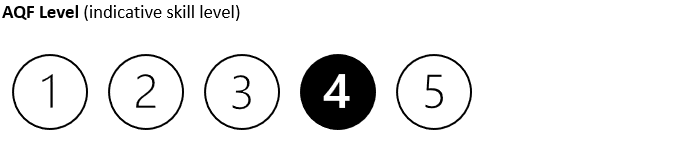
This was a time before Training Packages, and it preceded the Australian Qualification Framework (AQF). However, the Category 2 Workplace Trainer Competency Standards evolved into the BSZ40198 Certificate IV in Assessment and Workplace Training qualification. Therefore, in the language that we use today, the ‘Develop simple assessment tools’ was at the ‘AQF Level 4’.
1998

In 1998, the BSZ507A Develop assessment tools unit of competency was released as an elective unit for the BSZ50198 Diploma of Training and Assessment Systems qualification.

This means the word ‘simple’ was removed form the unit’s title and that the ‘Develop assessment tools’ was reclassified at the ‘AQF Level 5’

2004

In 2004, the TAAASS403A Develop assessment tools unit of competency was released as a core unit for the TAA40104 Certificate IV in Training and Assessment qualification.

This means that the ‘Develop assessment tools’ was reclassified again. This time it was at reclassified at the ‘AQF Level 4’. Also, this means that it had been identified as a skill required by trainers and TAFE teachers.

2010

In 2010, the TAEASS502A Design and develop assessment tools unit of competency was released as an elective unit for the TAE40110 Certificate IV in Training and Assessment qualification and a core unit for the TAE50111 Diploma of Vocational Education and Training qualification.

Re-classification of the unit to be ‘AQF Level 5’ instead of ‘AQF Level 4’ indicated that a higher level of skill is required to develop quality and compliant assessment tools.

2016

Australian Skills Quality Authority (ASQA), the national VET regulator, had conducted many audits and strategic reviews between 2013 and 2016, and it had identified that many RTOs used non-compliant and poor-quality assessment tools. During the review of the TAE40110 qualification and the subsequent development of the TAE40116 qualification, ASQA demanded that the ‘Design and develop assessment tools’ become a core unit for the new Certificate IV in Training and Assessment qualification. The aim was to ensure the VET workforce had the capability to address this critical issue – a significant threat to the Australian VET system.

In 2016, the unit was re-released using the new format for units of competency. The unit’s code and title became TAEASS502 Design and develop assessment tools and it was a core unit for the TAE40116 Certificate IV in Training and Assessment qualification.

2022

During the review of the TAE40116 qualification and the subsequent development of the TAE40122 qualification, ASQA decide to no longer argue for the ‘Design and develop assessment tools’ to remain a core unit for the new Certificate IV in Training and Assessment qualification. ASQA was probably wanting to distance itself from the distress and dissatisfaction associated with the TAE40116 Certificate IV in Training and Assessment qualification. The TAE40116 qualification is the all-time most hated qualification in the Australian VET system.

In 2022, the TAEASS512 Design and develop assessment tools unit of competency was released as an elective unit for the TAE40122 Certificate IV in Training and Assessment qualification and an elective unit for the TAE50122 Diploma of Vocational Education and Training qualification.

As from 2022, it is possible for a trainer or TAFE teacher to attained their Certificate IV in Training and Assessment and Diploma of Vocational Education and Training qualifications without learning how to design and develop assessment tools.

Does it matter what ‘AQF level’ a unit is?

Technically speaking, qualifications have an AQF Level – and units of competency do not. For this reason, some Training Packages have removed reference to ‘AQF Level’ from the unit’s code. The following are three examples from the HLT Health Training Package.

Notice that the first number in the unit’s code has been changed to be a zero.
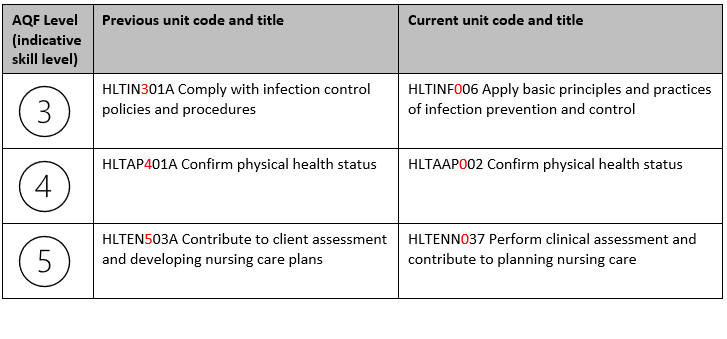
Previously, the unit codes for the above three HLT units provided an indication of the indicative skill level. It indicated if the unit was at a lower or higher skill level. The current coding of the same three units does not indicate the indicative skill level. However, the ‘zero’ does not alter the fact that different units are at a different skill level.

It is not unusual for a qualification to have units of competency with different skill levels. The above three HLT units are core units of the HLT54121 Diploma of Nursing qualification.

In conclusion

I acknowledge that the development of quality and compliant assessment tools can be difficult and time-consuming. However, there is no impediment having an ‘AQF Level 5’ unit as part of an AQF Level 4 qualification. Some people argue that since the TAEASS512 Design and develop assessment tools unit of competency is at the ‘AQF Level 5’, it should only be in the Diploma and not in the Certificate IV. This is nonsense. If a trainer or TAFE teacher needs particular competencies to perform their job, then those competencies should be part of their qualification – regardless of unit’s ‘AQF Level’.

The critical issue of non-compliant and poor-quality assessment tools has been repeatedly identified during various audits and strategic reviews conduct by ASQA. This issue has not yet been resolved. I believe RTOs need trainers and TAFE teachers with the skills to develop simple assessment tools. This means that trainers and TAFE teachers should be able to develop questions to gather knowledge evidence and checklists to gather performance evidence. These skills are what were identified 25 years ago, and they are the skills still required today.

RTOs delivering the TAE40122 Certificate IV in Training and Assessment qualification are unlikely to offer the TAEASS512 Design and develop assessment tools unit of competency. Therefore, the typical TAE40122 graduate is unlikely to have the capability to develop simple assessment tools. Without these skills the quality of the entire VET system is at risk.

Do you need help with your TAE studies?

Are you a doing the TAE40122 Certificate IV in Training and Assessment, and are you struggling with your studies? Do you need help to learn how to design and develop assessment tools? Do you want help with your TAE studies?
Ring Alan Maguire on 0493 065 396 to discuss.

Contact now!

logo otws

Training trainers since 1986

Do you need help with your TAE40122 studies?

Over the years, I have helped many people as they have struggled with the study and assessment requirements of the Certificate IV in Training and Assessment qualification. It is not an easy qualification to get, and it can be very time consuming.

I have established a TAE Tutoring service to help people who need assistance with their TAE studies, or are wanting to speed-up their progress. Central to my service are tutoring sessions via Zoom video conferencing (frequently using the ‘Share Screen’ function). These sessions are supplemented by emails, text messages, and the occasional phone call.

TAE Tutoring sessions can be weekly, or as required. And some people have had multiple sessions in the one week. My tutoring service is tailored for each individual, and it is totally flexible.

Common problems experienced by TAE40122 students

Some common problems that are experienced by many TAE40122 students include:

  • Unsupported self-paced online learning
  • Complicated assessment instructions
  • Insufficient or unhelpful training.

Unsupported self-paced online learning

Many people doing their Certificate IV in Training and Assessment qualification as self-paced online learning often feel unsupported for various reasons, including:

  • Slow or no response from the RTO when help is needed
  • Lack of timely useful information and advice
  • Unfriendly or uncaring attitude.

Complicated assessment instructions

Many people find the instructions for their assessments are complicated and confusing. And jargon or terminology is often used that is difficult to understanding; especially for people new to the Australian VET system.

In addition to complicated assessment instruments, many TAE students are confronted with a range of templates that must be completed. Sometimes, these templates can be challenging to understand. Also, these templates can be challenging to use; especially if a person only has limited or basic word processing skills.

Insufficient or unhelpful training

The Certificate IV in Training and Assessment qualification can be delivered in different ways, for example:

  • Training delivered by a trainer in a training room
  • Training delivered by a trainer via video conferencing application; such as, Zoom or Teams
  • Self-paced online learning
  • Combination of the above.

Regardless of how the qualification is being delivered, many people find the training they received is insufficient or unhelpful. And in some cases, people feel that they haven’t received any training relevant to their assessment tasks. Without proper training, many people often find themselves wasting time and getting frustrated.

Do you need help with your TAE studies?

Are you a doing the TAE40122 Certificate IV in Training and Assessment, and are you struggling with your studies? Do you want help with your TAE studies?

Ring Alan Maguire on 0493 065 396 to discuss.

Contact now!

logo otws

Training trainers since 1986

The 30-minute training session

Many people studying for their TAE40122 Certificate IV in Training and Assessment qualification will be required to complete the following three units of competency:

These TAE units of competency specifies the following:

  • The TAEDEL311 Provide work skill instruction unit of competency requires the delivery of three training sessions, with each training session being of at least 30 minutes duration.
  • The TAEDEL411 Facilitate vocational training unit of competency requires the delivery of five training sessions, with each training session being of at least 30 minutes duration.
  • The TAEDEL405 Plan, organise and facilitate online learning unit of competency requires the delivery of two training sessions, with each training session being of at least 30 minutes duration.

There will be some differences between the training sessions. Some training sessions must be delivered face-to-face, while other training sessions must be delivered online. Some training sessions must be delivered to small groups, while other training sessions must be delivered to individual learners. And some training sessions must cover content relating to a unit of competency, while other training sessions do not need to relate to a unit of competency.

The TAE40122 Student can expect to deliver at least ten training sessions as specified by the above three TAE units of competency, and each training session must be at least 30 minutes. That adds up to the delivery of at least 5 hours of training.

How much time does it take develop training?

The TAE Student will be required to develop:

  • Training session plans
  • Training materials.

Training materials may include:

  • PowerPoint slides
  • Handouts.

Some training materials may exist and be ready to use without breaching copyright laws. However, some training materials may need to be created, while other training materials may exist but need to be customised.

A TAE40122 Student may need a day to develop their training session plan and training materials for a 30-minute training session. Various factors may increase or decrease the time required to develop the training, such as:

  • Type of content
  • Amount of content
  • Type of learning activities
  • Availability of relevant training materials
  • Computer skills of the person developing the training.

The TAE40122 Student may need 10 days to prepare for delivering ten 30-minute training sessions. Depending on the elective units selected for the TAE40122 Certificate IV in Training and Assessment qualification, there may be more than ten training sessions that will need to be delivered.

What can be achieved in 30 minutes?

Very little learning can be achieved during a 30-minute training session.

As a general rule, allocate at least 50% of the available time to learning activities. This means that 15 minutes of every 30-minute training session should be used for one or some of the following:

  • activity to learn or apply knowledge
  • quiz to check if knowledge has been attained
  • brainstorming solutions to a problem
  • discussing a case study or scenario
  • practicing a skill or performing a task.

A TAE40122 Student will be expected to conduct an introduction and conclusion to the training session. These segments of training session will take about 5 minutes.

Therefore, there will be 10 minutes or less, available for presenting information or demonstrating the performance of a skill or task. Time will also be needed to answer questions raised by your learners.

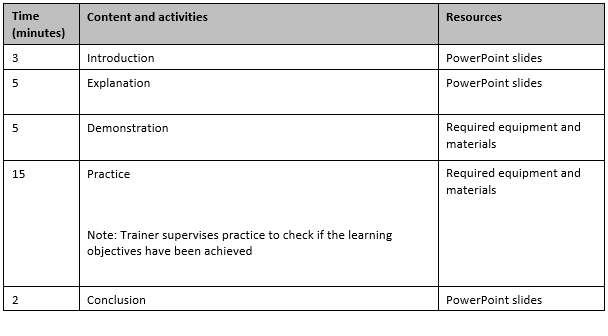
Timeframe for a knowledge training session

The following is an example that shows how time can be used for a knowledge training session.

Timeframe for a skill or task-based training session

The following is an example that shows how time can be used for a skill or task-based training session.

In conclusion

The TAE40122 Student is likely to be required to deliver many 30-minute training sessions. Very little learning can be achieved in 30 minutes. Therefore, do not try to cover too much content.

The development of a training session plan and training materials can be very time-consuming. Are you wanting to learn effective and efficient ways to prepare your training sessions?

My tutoring services can hep you learn:

  • How to write learning objectives
  • How to develop a task breakdown
  • How to identify the knowledge and skills required to perform a task
  • How to determine key content points to be covered during the training session
  • How to develop a training session plan
  • How to find, develop or customise learning resources
  • How to develop PowerPoint slides and handouts
  • How to use artificial intelligence (AI) to reduce the time to develop the training.

Do you need help with your TAE studies?

Are you a doing the TAE40122 Certificate IV in Training and Assessment, and are you struggling with your studies? Do you want help with your TAE studies?

Ring Alan Maguire on 0493 065 396 to discuss.

Contact now!

logo otws

Training trainers since 1986

A short history of online learning

This is a short history of online learning. It may be incomplete but I have tried to capture the big historical events. Also, I have written this article with a connection to Australia and the Australian VET system.

Distance learning

Before online learning we had distance learning. Distance learning was traditionally conducted by correspondence where the student corresponded with the school, university, or learning institution via mail. Wikipedia tells me that one of the earliest attempts to provide a correspondence course was in 1728. [1]

In the 1930s, two hundred years later, there was a rapid spread of radio. This led to the wide-spread use of radio for distance education in the USA.

In Australia, the School of the Air started broadcasting lessons to school children in 1951.

The Australian Broadcasting Commission (ABC) started using television to broadcast education programs to schools in the 1960s.

The use of broadcast television for adult education has been limited.

During the 1980s audio cassettes and video cassettes were being widely used for educational purposes. This included personal development, motivational and business training. Some business training topics covered by audio and video cassettes included selling skills, customer service skills, meeting skills, and presentation skills.

Computer-based training

I was working in an office in 1986 when the first desktop computer arrived. It was a ‘share computer’ for everyone in the office to use. There was about 25 people working in the office at that time. A second computer arrived soon after the first, but it was for the exclusive use of the office administrator.

Personal computers started to take off in the mid 1980s and early 1990s. Computers were becoming part of the office and more people were buying computers for their home. At this time I was working for Telecom Australia (now known as Telstra Corporation), and we were beginning to develop computer-based training. I bought my first computer in 1986. It had MultiMate word processing software, a 5-¼ inch floppy disk drive, monochrome monitor, and a dot matrix printer.

Data storage

The early personal computers had limited data storage capability. Over the years the internal storage capacity increased. And the ability to install new software increased as we went from big floppy disks, to smaller floppy disks, to CD-ROMs. Later, USB memory sticks made it even easier and quicker for the installation of new software and transfer of files.

During the 1990s, everyone in the office I was working at was using a computer. And the new, big thing was email. Email and word processing revolutionalise the way we worked. But internet access was limited to a few ‘trusted people’ because it was thought that productivity would be lowered if everyone had it.

The installation of games onto home computers, including educational games for children, was happening during the late 1990s and the early 2000s. Using computers for the purpose of learning was beginning to gain general acceptance.

Internet

The internet changed everything. I can still remember connecting to the internet via dial-up modem. Connecting to the internet was slow and the speed of the internet was slow. The next big thing was fast broadband internet with the capability to support voice and video.

The widespread use of computers and the internet have made distance learning easier and faster, and today virtual schools and virtual universities deliver full curricula online.

Faster, smaller and cheaper computers and the development of applications

In recent years, computers have got faster, smaller and cheaper. And access to strong, stable and fast internet connections are reasonably priced. I understand that some Australians in remote and rural areas may not have the same connectivity or they still have internet issues. And, it is said that, some Australians may struggle to afford access to the internet. However, the vast majority of people in Australia today have at least one device connected to the internet.

Ready access to computer hardware and software has removed many of the technology barriers to accessing online learning. Today’s personal computers have access to a large number of applications, such as email and word processing. Learning management systems (LMS) can be easily downloaded and installed. And many personal computers come with a camera and microphone that enable video conferencing.

Smart phone

By the mid-2010s, the smartphone had become common. These days, it is rare for someone to have a dumb-phone.

Smart phones are ubiquitous. Many people have got use to using technology in their everyday life. People use their smart phone for communicating with others by voice, by text, by email, by video. And people use their smart phone for social media, banking, shopping, searching the internet, etc.

Generally, people have overcome many of their fears and concerns about using technology. Therefore, using technology for learning has been legitimised.

COVID-19

In 2020, COVID-19 arrived in Australia. Work went online, school went online, university went online, so much of our lives went online for many people. And during this time a significant number of RTOs shifted training delivery online in response to the COVID-19 pandemic. Getting learning resources to learners and using video conferencing for training became common. For many trainers, this was their first experience at facilitating online learning. This crisis became an opportunity for many trainers to develop their capability to deliver online learning.

Many trainers will no longer be resistant to changing from ‘traditional training methods’ to using online learning. However, many things in vocational education and training can not be delivered or assessed using online methods. The future will be a blended approach, combining traditional and online methods.

In conclusion

There are still some real barriers to using online learning. For example:

  • Some people have no or limited experience using computers. This continues to be a barrier for them to participate in online learning.
  • Some developers of online learning lack the ability to design and develop user-friendly and effective online learning programs and resources. This frustrates learners and creates unnecessary barriers to learning, regardless of the learner’s technology skills.

The TAE40122 Certificate IV in Training and Assessment qualification has recognised that many trainers and assessors will need the capability to deliver online learning and conduct assessments using online methods. Two elective units of competency that are likely to be included in the TAE40122 Certificate IV in Training and Assessment qualification are:

  • TAEDEL405 Plan, organise and facilitate online learning
  • TAEASS404 Assess competence in an online environment

Reference

[1] https://en.wikipedia.org/wiki/Distance_education accessed 23 October 2023

Do you need help with your TAE studies?

Are you a doing the TAE40122 Certificate IV in Training and Assessment, and are you struggling with your studies? Do you want help with your TAE studies?

Ring Alan Maguire on 0493 065 396 to discuss.

Contact now!

logo otws

Training trainers since 1986

Integrated assessment

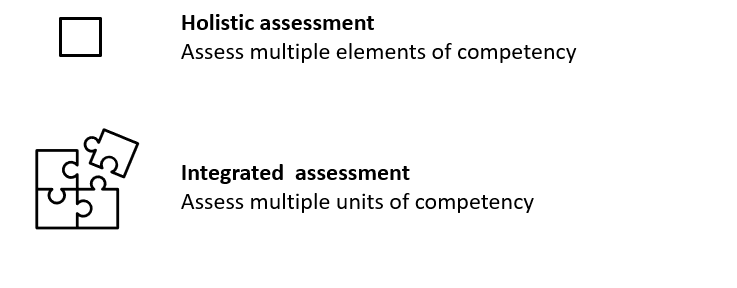
In the Australian VET system, the terms ‘holistic assessment’ and ‘integrated assessment’ are often used interchangeably. However, there is a differences between the two concepts.

Holistic assessment is an assessment approach that covers multiple elements of competency. This approach would not explicitly gather evidence for each item of required knowledge or required skill. The assessor would consider the learner’s overall performance, including their application of knowledge and skills.

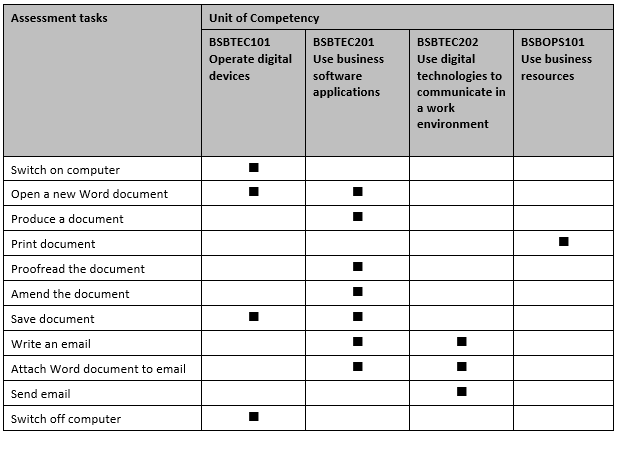
Integrated assessment occurs when a learner performs an assessment task that can be used to gather evidence for multiple units of competency. The assessment task would be designed to explicitly gather evidence specified by two or more units of competency. [1]

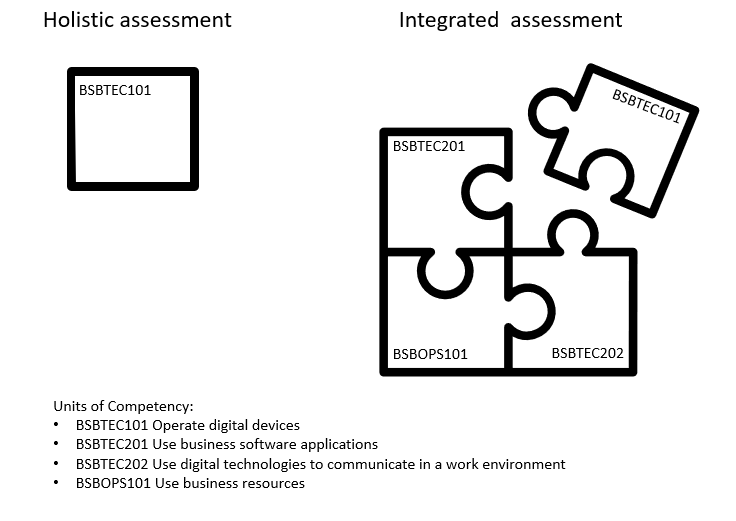
Holistic assessment focuses on one unit of competency, and integrated assessment focuses on multiple units of competency. The following illustrates the difference between an holistic and integrated approach to assessment.

Both holistic and integrated assessment can be used to improve the quality of assessment in the Australian VET system. They can help to ensure that learners are assessed on their ability to apply their knowledge and skills to real-world situations.

What is integrated assessment?

Individual competencies are rarely performed in isolation in the workplace. Typical job roles involve a number of related tasks, and evidence gathering should reflect this.

Integrated assessment is the simultaneous assessment of two or more related units of competency. The integrated approach can reduce the time spent on assessing, but more importantly it will make assessment more realistic because it more closely reflects the real nature of work. [2]

An example of integrated assessment

The following is an example of an assessment task that can be used to gather evidence for four different units of competency.

In conclusion

Although, ‘holistic assessment’ and ‘integrated assessment’ are often used interchangeably, they are two different concepts.

Integrated assessment can reduce the time spent on assessing, but more importantly it will make assessment more realistic because it more closely reflects the real nature of work.

This article has explored and described integrated assessment. Although, ‘holistic assessment’ and ‘integrated assessment’ are often used interchangeably, they are two different concepts. You may be interested in an article that I have published that focuses on holistic assessment.

Also, I have published another relevant article that gives examples on how to identify integrated assessment opportunities.

References

[1] https://www.voced.edu.au/vet-knowledge-bank-glossary-vet accessed 11 April 2022

[2] https://www.myskills.gov.au/media/1781/back-to-basics-vet-assessment.pdf accessed 11 April 2022 (the myskills website seems to have been removed and the link to this reference has been broken)

Do you need help with your TAE studies?

The terminology used in the Australian VET system can be confusing and overwhelming. Are you a doing the TAE40122 Certificate IV in Training and Assessment, and are you struggling with your studies? Do you want help with your TAE studies?

Ring Alan Maguire on 0493 065 396 to discuss.

Contact now!

logo otws

Training trainers since 1986