Anyone who knows me, knows that I love PowerPoint. And anyone who knows me, knows that I create PowerPoint presentations to support training programs I am designing, developing and delivering.
Recently, I have been delivering the ‘How to implement the National Microcredentials Framework’ training. Here is a sneak preview of some PowerPoint slides that I have developed for this training.
I hope you enjoy having a ‘walk-through the gallery’.
The Conversation published the following description on the 14th of October 2021:
“In Australia, the term microcredential describes different types of smaller bites of learning offered by universities, TAFEs and private education providers. The term is often used interchangeably with short courses…” [1]
The Australian Government’s Department of Education, Skills and Employment released the National Microcredentials Framework on the 22nd of April 2022. This document gives the following definition:
The framework defines microcredentials as a certification of assessed learning or competency, with a minimum volume of learning of one hour and less than an AQF award qualification, that is additional, alternate, complementary to or a component part of an AQF award qualification. [2]
From these sources, we can say that a microcredential is usually a short duration training program that includes assessment. Certification is issued to people who can demonstrate their attainment of the learning outcomes.
Who can provide a microcredential?
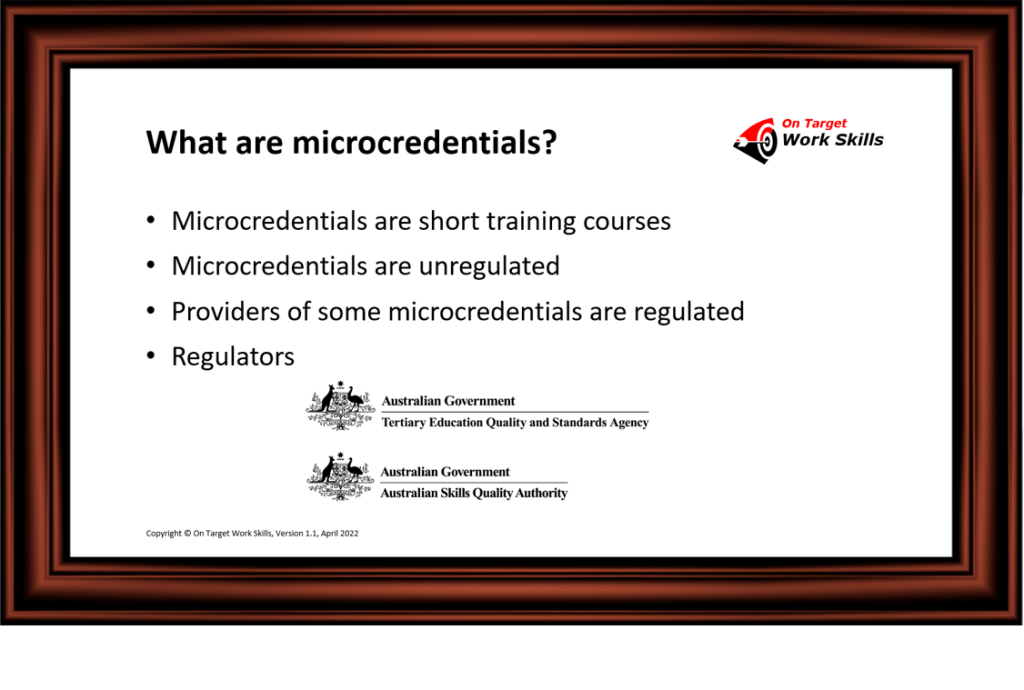
Microcredentials are unregulated, which differentiates them from other products delivered by higher education or vocational education and training sectors. [3] There are many providers of microcredentials.
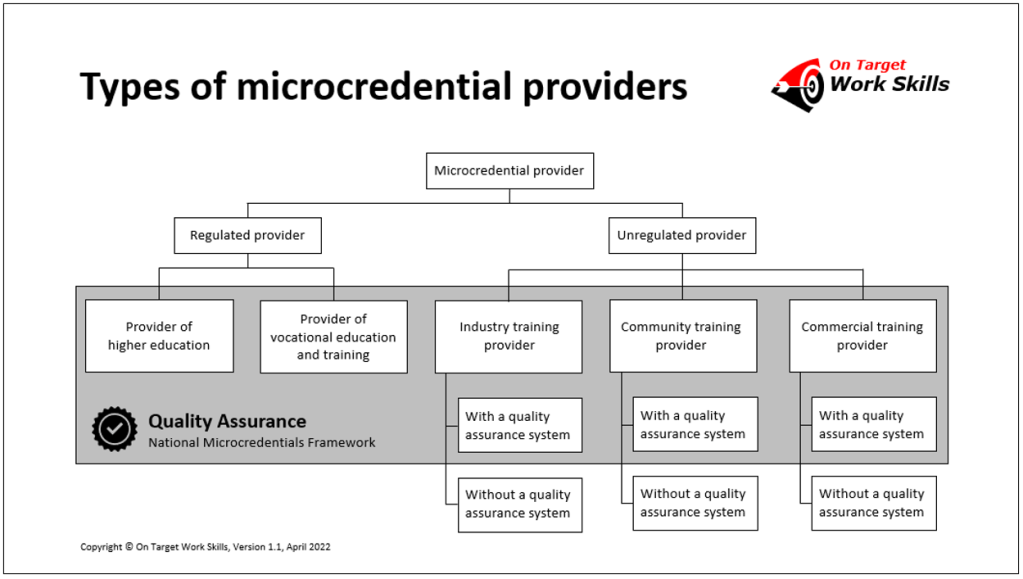
There are ‘regulated providers’ of microcredentials:
Universities and other higher education providers (regulated by TEQSA)
Registered training organisations (regulated by ASQA).
There is a myriad of ‘unregulated providers’ of microcredentials:
Providers of industry training (some are industry associations, others can be affiliated with an industry associations, and others may align their microcredentials to industry standards)
Providers of community training
Providers of commercial training.
Also, some ‘regulated providers’ are providing microcredentials that are ‘non-regulated microcredentials’. For example, a registered training organisation can provide a microcredential that is not a skill set, unit or units of competency from a Training Package. This leverages from the brand recognition of the provider and avoids requiring the microcredential to comply with the regulations for operating as a registered training organisation.
The following diagram provides a simplistic view of the range of microcredential providers.
In conclusion
The microcredentials ecosystem is disparate. The National Microcredentials Framework aims to bring some coherence to this ecosystem. [4]
Do you want to learn more about the National Microcredentials Framework? I am presenting a ‘How to implement the National Microcredentials Framework‘ training course. The following topics will be covered during the 2-hours of training:
National Microcredentials Framework
Unifying principles of microcredentials
Volume of learning for microcredentials
Learning outcomes and assessment methods
Critical information requirements for microcredentials
Essential quality assurance processes for microcredentials
The National Microcredentials Framework was released on the 22nd of March 2022. The Framework aims to provide a nationally consistent framework for defining microcredentials across higher education (HE), vocational education and training (VET), and industry.
On Target Work Skills is proud to have developed a learning program about how to implement the National Microcredentials Framework. This program consists of:
2-hour training session
Assessment tasks (optional).
This program is being delivered as a microcredential with the following characteristics specified by the National Microcredentials Framework:
The learning outcomes for the microcredential must be clearly stated
A microcredential requires assessment that provides evidence that learning outcomes have been achieved
Microcredentials must have a volume of learning that is at least one hour
Microcredentials may certify the attainment of skills, knowledge, and competencies.
Learning outcomes
The learning outcomes for this program are:
Develop learning outcomes for a microcredential
Describe the assessment method for a microcredential
Estimate the volume of learning for a microcredential
Write a microcredential descriptor using the critical information requirements as a guide
Write a quality assurance statement
Draft an accurate and truthful certificate of attainment for a microcredential.
Key content points
The key content for this learning program are:
National Microcredentials Framework
Unifying principles of microcredentials
Volume of learning
Learning outcomes
Assessment methods
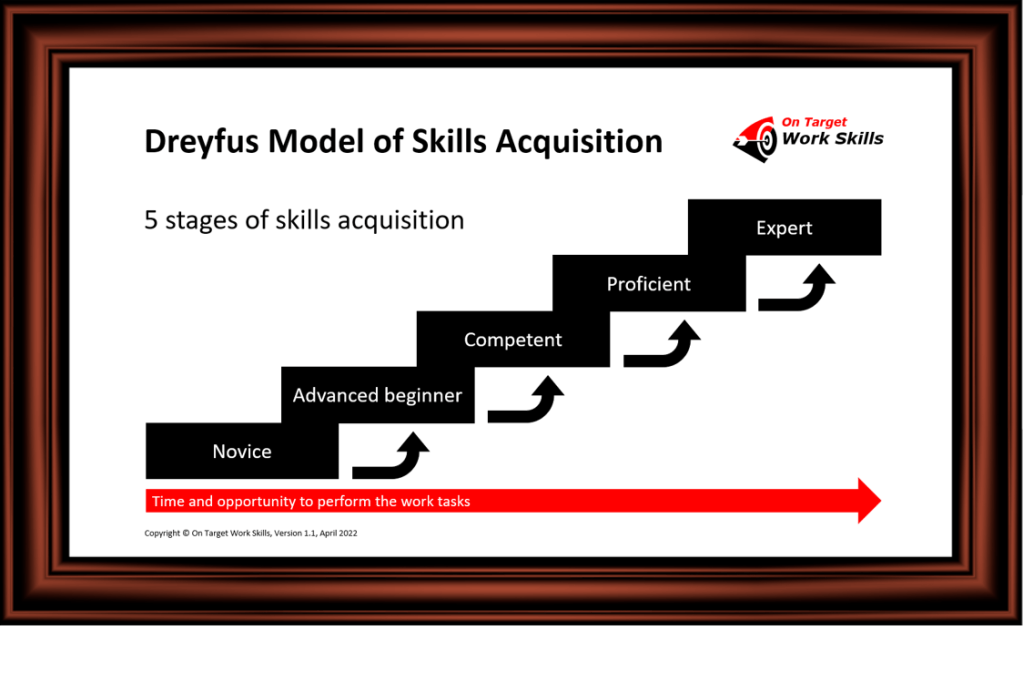
Levels of skills acquisition
Critical information requirements
Accurate and truthful certification
Essential quality assurance processes
Quality assurance statement
Implementation steps.
Assessment
Assessment is optional. You may complete and submit the following practical assessment tasks:
Develop learning outcome for a microcredential
Describe the assessment method for a microcredential
Estimate the volume of learning for a microcredential
Write a microcredential descriptor using the critical information requirements as a guide
Write a quality assurance statement
Draft an accurate and truthful certificate of attainment for a microcredential.
If you are assessed as having attained the learning outcome, then you will receive a ‘Certificate of Attainment’.
If you decide not to be assessed, you will be issued with a ‘Certificate of Attendance’ that still can be valid evidence of participation in structured professional development.
Please call Alan Maguire on 0493 065 396 for further details or to discuss.










 On Target Work Skills