What tasks do trainers do?

Background

Some people are working towards shifting Australia’s VET system from being a ‘training system’ to being an ‘education system’.

I have recently written articles exploring the difference between ‘training’ and ‘teaching’, and the difference between ‘trainers’ and ‘teachers’. I appreciate that there can be a crossover but the responses to my articles have overwhelmingly endorsed my view that there is a difference.

A difference between teaching and training can be expressed as:

  • Teaching is about imparting knowledge and providing information, while training is about developing capabilities.
  • Teaching is more theoretical and abstract, while training is more hands-on and practical.
  • Teaching is more academic and knowledge based, while training is more practical and skills based or job focused.

In the Australian context, vocational education and training (VET) is about helping others learn to perform work tasks and activities. The prime focus has been on helping people get a job or get a better job. And the prime role of a trainer or TAFE teacher has been to deliver ‘training’, not ‘teaching’. Training involves ‘hands-on learning’. It involves performing the task or activity, and practicing until it has been learnt. Some learning is quick and easy. And sometimes learning can be a long and slow process.

Training involves ‘hands-on learning’

Tasks performed by trainers

Australia’s VET system has been organised around qualifications. Each qualification relates to an occupation or a job function. However, in the past decade, skill sets have emerged to develop skills relating to part of a job. It is highly likely that the required qualification to be a trainer working in the VET sector will be reviewed during 2021/22. I look forward to the TAE40122 Certificate IV in Training and Assessment qualification, or whatever the qualification code and title will be. Maybe there will be more than one qualification targeting the work needs of different types of trainers.

An Australian VET qualification is meant to be a pathway to an occupational outcome. A review of the current TAE40116 Certificate IV in Training and Assessment qualification will require an analysis of the work tasks and activities performed by trainers and assessors.

The main target audience for the TAE40116 qualification are individuals delivering training and assessment services in the vocational education and training (VET) sector.

The following are some tasks performed by trainers and assessors working in the Australian VET sector:

  • Complete administrative tasks
  • Design and develop training and assessment resources
  • Plan, organise, and deliver training
  • Plan, organise, and conduct assessments
  • Participate in assessment validation and moderation activities
  • Evaluate training and assessment services
  • Plan, organise, and monitor learning in the workplace
  • Maintain and enhance vocational competencies.

Task titles can be vague

The task titles above may be a bit vague. Knowledge and skills required to perform a task can be hidden in the details. Therefore, the following begins to clarify some of the typical tasks performed by a trainer, without getting into too much details.

Complete administrative tasks may include the following sub-tasks:

  • Attend meetings
  • Reply to emails
  • Resolve issues.

Design and develop training and assessment resources may include the development of technology based resources and non-technology based resources. There may be an advantage to splitting this task into two sub-tasks:

  • Design and develop assessment resources
  • Design and develop training resources.

It has become a common task for trainers to address adult language, literacy, and numeracy skills. Many adult learners have LLN skills that are less than the required level for the specified outcome of the training program. This task would be performed in conjunction with the delivery of training and assessment of competency.

Plan, organise, and deliver training may include the following sub-tasks:

  • Plan and prepare for the delivery of training
  • Request facilities or equipment required for assessment
  • Conduct safety risk assessment
  • Gather training materials, including photocopying
  • Ensure safe learning environment
  • Deliver group-based training
  • Maintain records, including attendance and participation records
  • Provide support and training to an individual
  • Gather feedback or evaluation data about training services.

Plan, organise, and conduct assessments may include the following sub-tasks:

  • Request facilities or equipment required for assessment
  • Conduct safety risk assessment
  • Gather assessment materials, including photocopying
  • Ensure safe assessment environment
  • Assess competence
  • Maintain records, including assessment evidence and results
  • Gather feedback or evaluation data about training and assessment services.

RTOs may require their trainers and assessors to participate in assessment validation and moderation activities. This is an important task for ensuring quality and continuous improvement.

RTOs may require their trainers and assessors to analyse feedback and evaluate training and assessment services. This task may include identifying trends and recommending improvements.

Plan, organise, and monitor learning in the workplace is required when coordinating apprenticeships, traineeships, or work placements.

Trainers and assessors must maintain and enhance their vocational competencies, including their the continued development of their training and assessment skills (as specified by the Standards for RTOs).

Note: Additional tasks may be performed by an experienced trainer or senior TAFE teacher. For example, supervise and mentor new trainers.

Are all VET trainers the same?

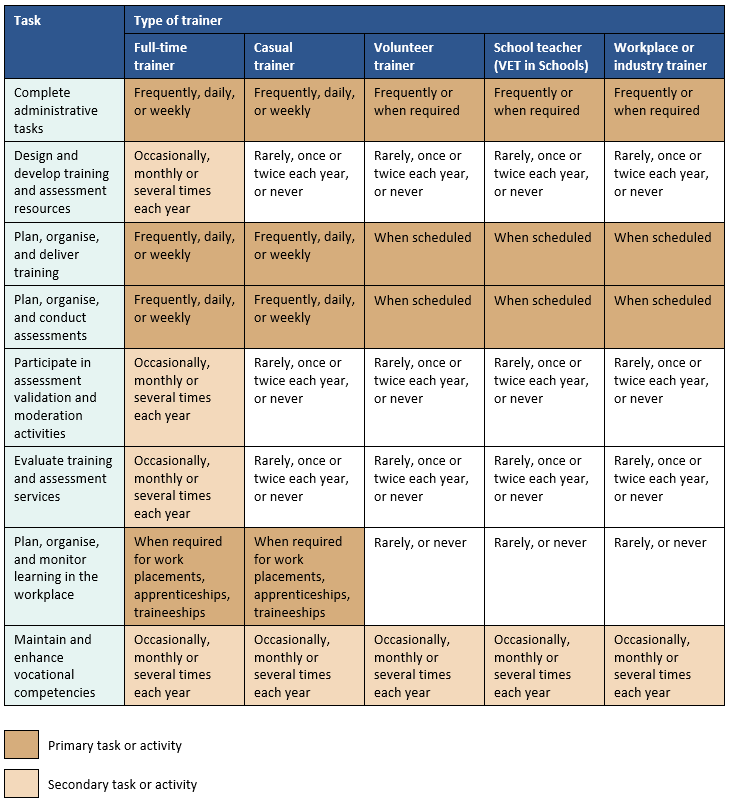
Not all trainers perform the same tasks or spend the same amount of time on performing a particular task or activity.

There can be a difference determined by the type of trainer:

  • Full-time trainer
  • Casual trainer
  • Volunteer trainer
  • School teacher who delivers a VET in Schools program
  • Workplace or industry trainer who’s main job is not being a trainer.

The following table gives an indicative amount of time on performing the various tasks.
In conclusion

I am seeking your help to further clarify or confirm the tasks performed by trainers. A clear understanding of work tasks and activities can have, and should have, an impact on the future qualification or qualifications required to be a trainer.

  • Are the tasks I have identified, the tasks performed by trainers?
  • Are my estimates for the indicative amount of time performing each task reasonable?
  • Are there other tasks performed by trainers that I haven’t listed? For example, should I include ‘design and develop a training program’ task?
  • Do you think there should be one TAE qualification for all trainers, or should there be different qualifications for different types of trainers?

If there are different qualifications we may have some trainers restricted in moving from one type of RTO to another type of RTO, or from one type of employment as a trainer to another. This may create a ‘gap training’ requirement, and a delay in taking up new job or career opportunities until the ‘qualified trainer’ gets further qualified. Is it desirable to set up two categories of ‘qualified trainers’? Would this confuse would-be trainers? How many would-be trainers will want to pay money to become a ‘qualified but restricted trainer’?

I welcome your comments.

I am especially keen to hear from RTO managers who employ trainers. What tasks do you want a ‘qualified trainer’ to perform when they work for your RTO?

Learning styles and the Australian VET system

This article was originally published in 2021.

Learning style theories have been criticised by many academics, researchers, and educationalists. The manta from these people sounds like:

“Numerous studies have debunked the concept of learning styles.”

The TAEDEL401 Plan, organise and deliver group-based learning and TAEDEL402 Plan, organise and facilitate learning in the workplace units of competency specify that a competent trainer or TAFE teacher must have some knowledge about learning styles. Therefore, learning styles must be covered during the TAE40116 Certificate IV in Training and Assessment qualification.

In this article, I want to explore:

  • Are learning styles a myth?
  • Should learners be treated as an individual?
  • Do people learn in different ways?

Are learning styles a myth?

Critics say there is no consistent evidence that identifying an individual student’s learning style and teaching for specific learning styles produces better student outcomes. [1] Most of this rhetoric refers to school systems. And most of the criticism seems to stem from an argument against ‘streaming school children’ based on their ‘learning style’. For example, offer ‘hands-on’ school subjects for ‘kinaesthetic learners’; compared with offering them ‘academic’ school subjects.

Learning styles may be a pseudoscience. Learning styles may be a myth. However, learning styles as a concept may be useful for trainers and TAFE teachers. I am not an academic. I am a person who likes good ideas that work, and I think the concept of learning styles can be useful. I shall explain myself soon.

Should learners be treated as an individual?

I believe that in the Australian VET sector there is a wide-spread agreement that learners should be treated as individuals. But it does not matter if people were to disagree with this because the Standards for RTOs demand that learners are to be treated as individuals.

Learners must be treated as individuals in the Australian VET system.

Do people learn in different ways?

Individuals are different. And individuals may prefer different approaches or methods to learning. Often the different preferred learning methods are referred to as learning styles.

Learning style models

There are many different learning styles models. I like to cover two models during the delivery of the TAE40116 Certificate IV in Training and Assessment qualification:

  • VAK or VARK models
  • Honey and Mumford’s model

VAK or VARK models

The five senses of sight, hearing, smell, taste, and touch collect information about our environment, and this information is interpreted by the brain. The VAK or VARK models is based on learning through our senses and the way that the brain processes information.

Walter Burke Barbe and colleagues proposed the VAK model:

  • Visual learning
  • Auditory learning
  • Kinaesthetic learning.

And Neil Fleming’s VARK model adds the possibility that some people may prefer to learn by reading/writing.

The VAK or VARK models promote the idea that people can have a preferred learning style and some people prefer to use a combination of learning styles. According to research conducted by Walter Burke Barbe and colleagues, the most common learning styles are visual or combination. [2]

It does not matter to me if the concept of learning styles have been debunked. I still believe that the following methods or learning styles are ways that people learn:

  • Learn by reading
  • Learn by writing
  • Learn by listening
  • Learn by watching
  • Learn by doing.

And I believe that trainers and TAFE teachers must address different learning styles by designing and implementing a range of strategies:

  • Reading textbooks and writing notes
  • Using visual aids, diagrams and charts
  • Explaining a topic aloud for auditory learners
  • Practical activities for the kinaesthetic learners.

The vocational education and training (VET) system is focused on helping people learn to perform work tasks and activities. All learners, regardless of their preferred learning styles, will need to perform tasks described by units of competency. They will need to learn by doing.

The following flow chart shows a typical VET training pathway and the corresponding learning style or method.

Note: In the above training pathway, I would suggest that using appropriate visual aids can greatly assist when we explain and clarify the task. For example, use task breakdowns, flow charts, cycle diagrams, photos, etc.

Honey and Mumford’s model

Peter Honey and Alan Mumford adapted David Kolb’s experiential learning model. Their model is based on a learning cycle: [3]

  • Doing something, having an experience
  • Reflecting on the experience
  • Concluding from the experience, developing a theory
  • Planning the next steps, to apply or test the theory.

Honey and Mumford gave names (also called learning styles) to the people who prefer to enter the cycle at different stages: [4]

  • Activist – prefers doing something
  • Reflector – prefers reflecting on the experience
  • Theorist – prefers developing a theory
  • Pragmatist – prefers planning to test the theory.

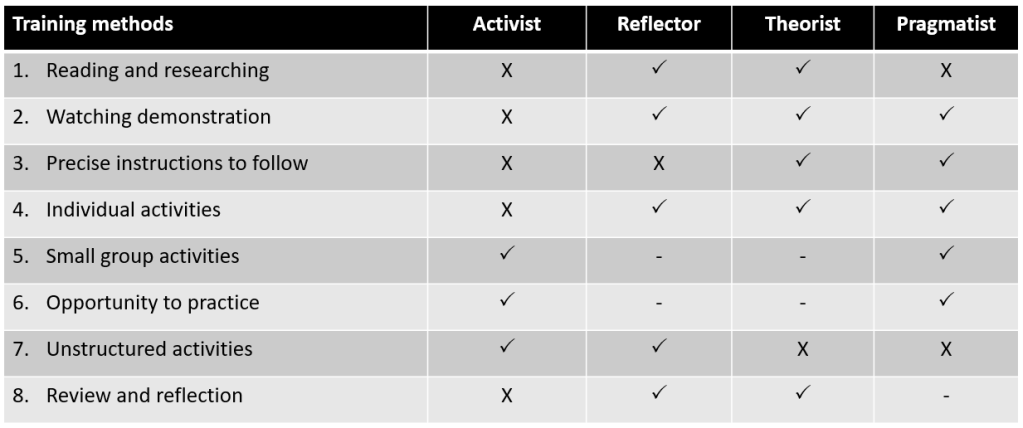
During my delivery of the TAE40116 Certificate IV in Training and Assessment qualification, I use the Honey and Mumford’s Learning Styles Questionnaire as a ‘learn by doing’ activity. My TAE Students learn that not everyone likes to learn the same way, and a group will consist of people with different preferred learning styles. At the end of this activity, I provide the following information about various training methods that may be liked or disliked by people with different learning styles.

As previously stated, I believe that trainers and TAFE teachers must cater for different learning styles by designing and implementing a range of strategies. I encourage my TAE Students to incorporate the above eight training methods when they deliver their training sessions.

Also, knowing that some people do not like to learn certain ways helps us to respond to situations when learners complain about having to do something during training. For example, most VET practitioners are likely to think that reflection is an important part of the learning process. But an ‘activist’ may not want to spend their time reviewing and reflecting.

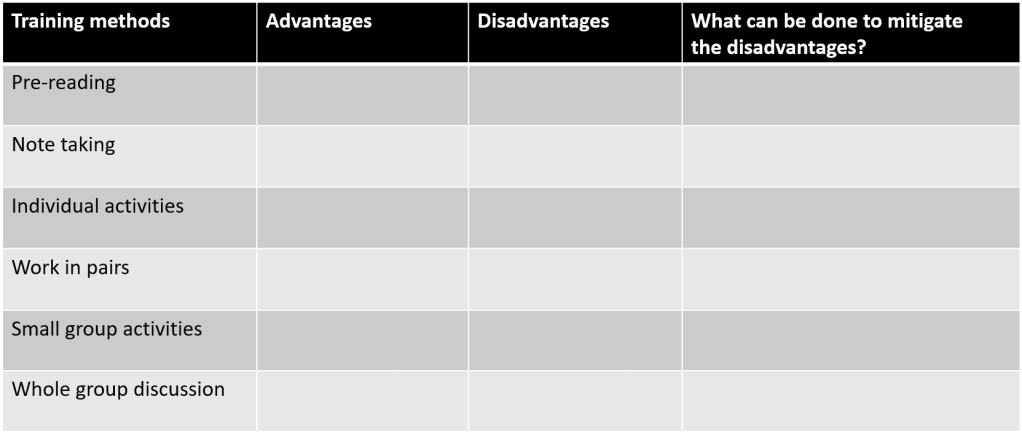
All training methods will have some advantages and disadvantages. Therefore, another activity I facilitate during the TAE40116 Certificate IV in Training and Assessment qualification is based on the following table.

In conclusion

Trainers and TAFE teachers must expect to encounter a diversity of learners with different characteristics and needs. Different training methods will be needed to cater for a range of preferred learning styles or methods.

I believe that preferred learning styles can change over time. An individual’s may favour a learning method at the start of a training program that is different to what they would prefer at the end of a training program. And from my own experience, preferred learning styles or methods can change with age.

My most important insight is:

“Not every learner will like to learn the way we do.”

We need to design and implement a range of training methods to address different learning styles; not just use the training methods that we prefer.

Wikipedia’s Learning styles has been used as a reference for some content in this article marked as [1], [2], [3], and [4].

It does not matter to me if learning styles are based on science, pseudoscience, or folklore. I do find the concept of learning styles useful to introduce the need for VET practitioners to use a variety of training methods. However, I welcome your feedback and comments.

  • Do you like the concept of learning styles? Can you explain why?
  • Do you dislike the concept of learning styles? Can you explain why?
  • Do you have any experience with learners who have exhibited particular learning styles?

Australia’s VET system

Australia’s vocational education and training (VET) system is complex and forever changing. People studying for their TAE40122 Certificate IV in Training and Assessment qualification may find useful information on this website. Tap or click on the following ABC logo to find out more.

ABC logo

Contact now!

logo otws

Training trainers since 1986

How to determine the requirements for competency-based assessment

Quality assessment begins with a proper understanding of the assessment requirements. In theory, all qualified trainers and TAFE teachers should be able to analyse and interpret assessment requirements because it is covered during the TAE40116 Certificate IV in Training and Assessment qualification.

Element 5 from the TAEDES402 Use training packages and accredited courses to meet client needs unit of competency requires assessment information to be analysed and interpreted. The following are questions that need to be answered when we ‘unpack’ a competency standard to determine the requirements for assessment:

  • What are the tasks to be performed?
  • Is the location of assessment specified?
  • Is access to specified resources specified?
  • What knowledge must be demonstrated?
  • What is the volume or frequency of evidence required?

What are the tasks to be performed?

Generally, the assessment tasks used to gather performance evidence should be realistic tasks or activities that would be performed in a typical workplace. Each unit of competency provides a description of performance criteria that must be demonstrated before a candidate can be deemed competent. And there must be evidence for every performance criteria.

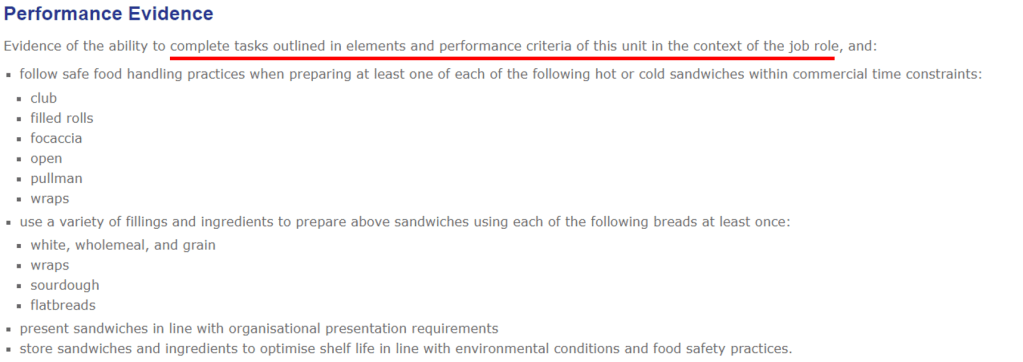
Performance evidence

The following is the Performance Evidence for the SITHCCC003 Prepare and present sandwiches unit of competency. This is an example showing that all the elements and performance criteria must be assessed.

Some Training Packages, such as the BSB Business Services, FNS Financial Services, and ICT Information and Communications Technology, have specified that the foundation skills must also be demonstrated before a candidate can be deemed competent. The following is the Performance Evidence for the ICTICT216 Design and create basic organisational documents unit of competency. This is an example showing that all the elements, performance criteria and foundations skills must be assessed.

If you would like more information about integrating foundation skills and performance criteria, please see my previous article titled, How to incorporate foundation skills in vocational education and training.

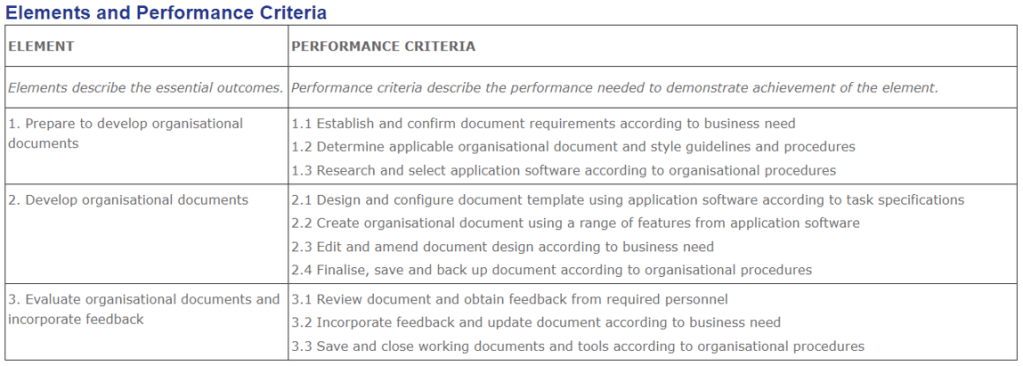
Elements and performance criteria

Some units of competency may describe one, and only one, work task or activity. The following are the elements and performance criteria for the ICTICT216 Design and create basic organisational documents unit of competency. This is an example showing that all elements flow together to describe one task:

  • Prepare to develop a document
  • Develop the document
  • Evaluate and finalise the document.

One assessment task could be used to gather the performance evidence for all the elements and performance criteria.

Some units of competency may describe more than one work task or activity. The following are the elements and performance criteria for the BSBWHS211 Contribute to the health and safety of self and others unit of competency.

In the above example, the range of tasks include:

  • Carry out pre-start checks
  • Identify, respond and report incidents (this implies that more than one or different incidents need to be covered)
  • Identify, record and report hazards (this may to part of a pre-start check or a workplace inspection)
  • Participate at a workplace safety meeting.

Therefore, three or four assessment tasks would be needed to gather the performance evidence for the different work tasks or activities covered by the BSBWHS211 unit.

Is the location of assessment specified?

Sometimes the assessment must be conducted in the workplace. For example, the TLIC3033 Drive an electric tram to operational requirements unit of competency states that the practical assessment must occur in the workplace.

The next example is for the CHCECE005 Provide care for babies and toddlers unit of competency. This unit specified that the assessment must be conducted in a workplace, and that workplace must be a registered childcare centre.

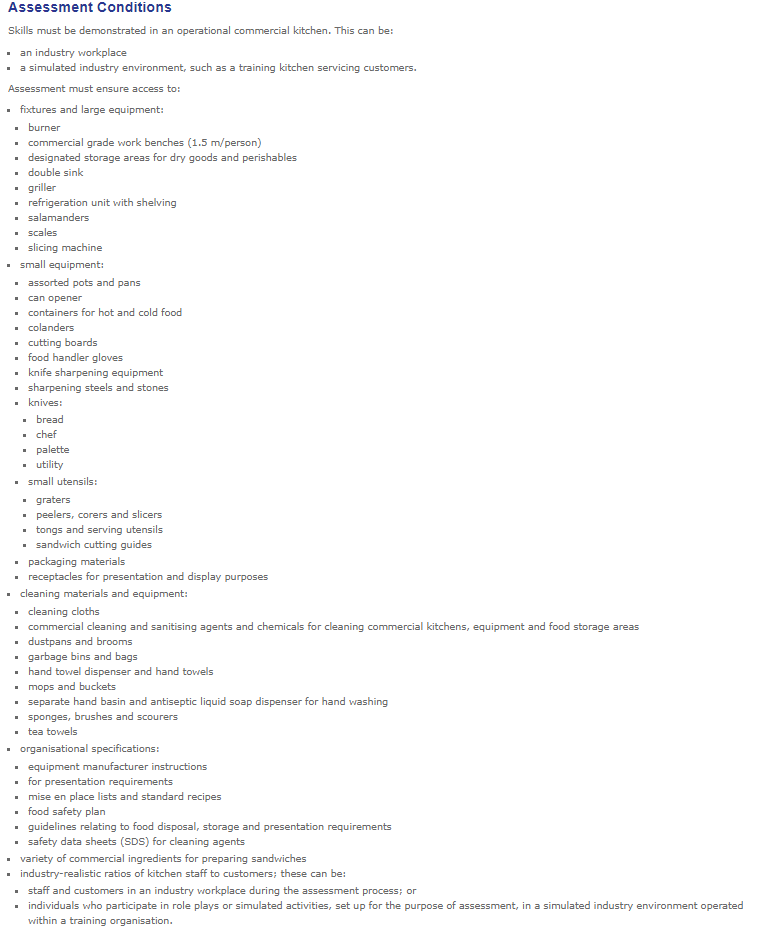
The SITHCCC003 Prepare and present sandwiches unit of competency requires the assessment to be conducted in an operational commercial kitchen. This location can be a workplace or a ‘fully-equipped training kitchen’. During the 1990s, many TAFEs established ‘training kitchens’ to serve ‘training restaurants’. These facilities operate exactly like any other operational commercial kitchen with paying customers.

It is common to find units that permit assessment to be conducted in a workplace or a simulated workplace. The following example is for the ICTICT216 Design and create basic organisational documents unit of competency. It clearly states that a simulated environment must replicate the conditions that would be found in a real workplace.

The above four examples illustrates the variation in assessment locations that have been specified by industry.

Is access to specified resources specified?

It is common for units to specify facilities, equipment, or materials that a candidate must have access to.Sometimes the list of resources required are short. For example, here are the two requirements (two bullet points) specified for the ICTICT216 Design and create basic organisational documents unit of competency.

Sometimes the list of resources required are extensive. For example, here are the requirements specified for the SITHCCC003 Prepare and present sandwiches unit of competency. There are many bullet points with most have many sub-bullet points (and some sub-bullet points have sub-bullet points).

An RTO needs a checklist to ensure all the specified resources are available at the time of assessment. The checklist would need to be signed and dated by the assessor for quality assurance purposes, with the date being the same date as the assessment.

What knowledge must be demonstrated?

Identifying the required knowledge evidence is reasonably straight forward. Some units of competency list a small number of knowledge evidence items. For example, the following short list (three bullet points) is for the ICTICT216 Design and create basic organisational documents unit of competency.

Some units of competency have a long list of knowledge evidence items. For example, the following is the list (many bullet points and sub-bullet points) for the SITHCCC003 Prepare and present sandwiches unit of competency.

What is the volume or frequency of evidence required?

Many units of competency specify a volume or frequency of evidence require. For example, the TAEDES402 Use training packages and accredited courses to meet client needs unit of competency requires a candidate to analyse training specifications at least twice.

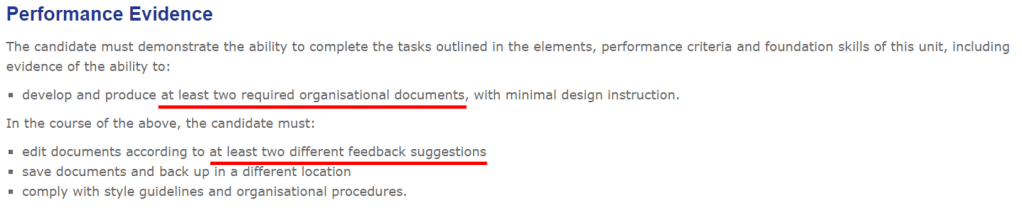
Here is another example for the ICTICT216 Design and create basic organisational documents unit of competency. It requires a candidate to produce at least two documents. Also, it requires the candidate to edit documents according to at least two different feedback suggestions.

The performance evidence must be read carefully to understand the amount of evidence required or the number of times the work task needed to be performed by the candidate. In the next example for the SITHCCC003 Prepare and present sandwiches unit of competency specifies six types of sandwiches that must be prepared, and a specified variety of breads and fillings must be used to make those sandwiches. Also, the sandwiches must be prepared within commercial time constraints.

Sometimes the volume or frequency of performance evidence required can become complex.

Contextualisation

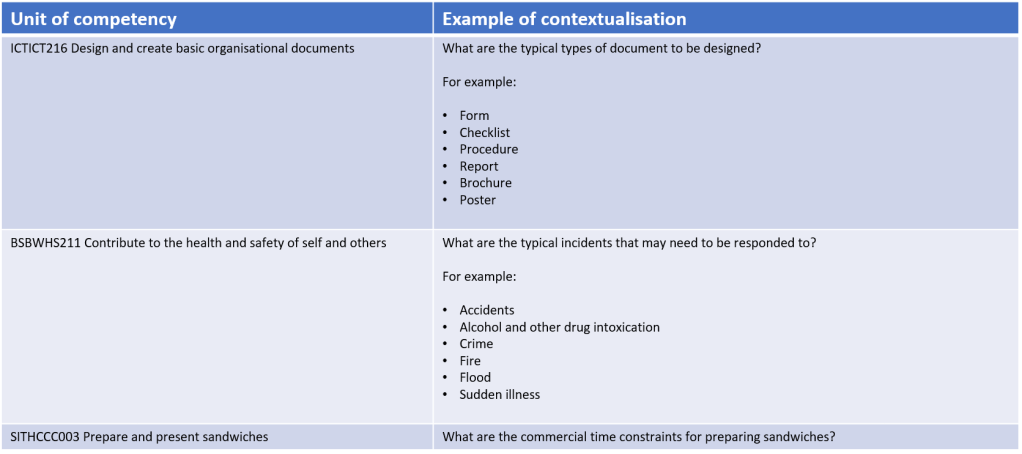
Units of competency and their assessment requirements are usually written in a vague or ambiguous way. This allows us to contextualise them to fit different workplaces, different work tasks and activities, different facilities, equipment and materials, etc.

The following are some examples of contextualisation.

If you would like more information about contextualisation, please see my previous article titled, Importance of interpretation and contextualisation in the Australian VET system.

Usually, contextualisation will be needed to clearly determine the assessment requirements for different situations and circumstances. This is one of the great features of Australia’s VET system.

In conclusion

How do we determine the requirements for competency-based assessment? We must read the entire unit of competency and its associated assessment requirements. Industry will have specified:

  • Knowledge evidence required
  • Performance evidence required
  • Assessment conditions.

Evidence for all elements and performance criteria must be gathered. And some Training Packages are mandating that the foundation skills must also be assessed.

Other assessment requirements need to be identified, such as:

  • Volume or frequency of evidence
  • Location and resource required.

Quality assessment begins with a proper understanding of the assessment requirements.

Australia’s VET system

Australia’s vocational education and training (VET) system is complex and forever changing. People studying for their TAE40122 Certificate IV in Training and Assessment qualification may find useful information on this website. Tap or click on the following ABC logo to find out more.

ABC logo

Contact now!

logo otws

Training trainers since 1986

Why does it cost $133,333 to train a sheep shearing teacher?

This morning I read a media release from the Victorian Minister for Training and Skills. It proudly announced that the Victorian Government spent $1.2m to train nine expert sheep shearers to be trainers. That works out at costing $133,333 to train each trainer.

The $1.2m was used to deliver the Certificate IV in Training and Assessment qualification. And some of the money was used for the development of an App with some videos. Did someone make a profit? Was this value for money? Should tax-payers be outraged?

I would have delivered the Certificate IV in Training and Assessment qualification and made some videos for half that price!!!

Is someone pulling the wool over our eyes?

The following is the media release.

Designing and developing basic documents: A guide for trainers and TAFE teachers

Introduction

From my experience, many new and existing trainers and TAFE teachers struggle with the design and development of learning resources. And some struggle with the basics of using software applications and developing basic documents.

The Australian VET system has units that can provide a structured approach to learning the basics:

  • BSBTEC201 Use business software applications
  • ICTICT216 Design and create basic organisational documents.

These two low level units of competency can be seen as foundations for others units, such as the TAEDES502 Design and develop learning resources unit.

Also, a person studying for their TAE40116 Certificate IV in Training and Assessment qualification need basic computer skills. Most trainers and TAFE teachers use technology on a daily basis to perform their role.

Using software applications

The BSBTEC201 Use business software applications unit of competency can cover:

  • Using a word processing application, such as Microsoft Word
  • Using a presentation application, such as Microsoft PowerPoint.

Managing files including version control of documents is another basic skill required. And a trainer or TAFE teacher will usually need technology skills for:

  • Using an Learning Management System (LMS), such as Moodle or Canvas
  • Using a web conferencing application, such as Zoom.

Developing basic documents

The ICTICT216 Design and create basic organisational documents unit of competency gives a useful framework for learning how to design and develop basic documents. The following lists the elements and performance criteria for the ICTICT216 unit.

I have interpreted, simplified, and reworded the above performance criteria to develop a 9-step procedure for designing and creating documents. The following outlines the nine steps with reference to the associated ICTICT216 performance criteria.

The ‘design document stage’ can be relatively quick compared with creating the document. The time and effort required to create a document can vary greatly depending on the type and size of the document being developed. The time and effort for the ‘finalise document stage’ can also vary depending on the feedback received.

How to design and create basic documents

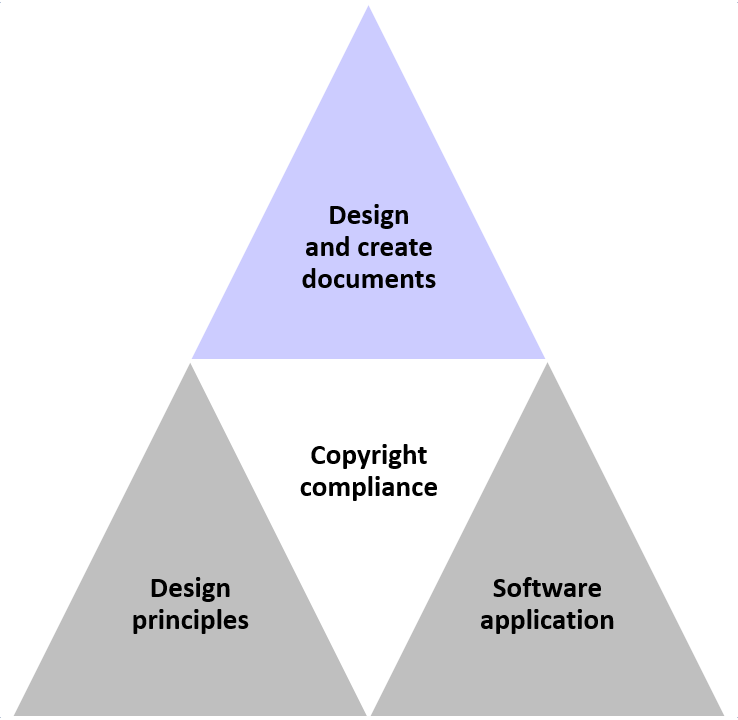
Over a series of articles, I will explore how to design and create basic documents. Some key topics I will cover are document design principles, copyright compliance, and how to use software applications to create basic documents.

What is a basic document?

My aim to cover the basic knowledge and skills required to produce basic documents. I won’t go beyond the basics. I believe that we can create quality documents without having advanced capabilities. However, the more experience we get, the better our documents will become.

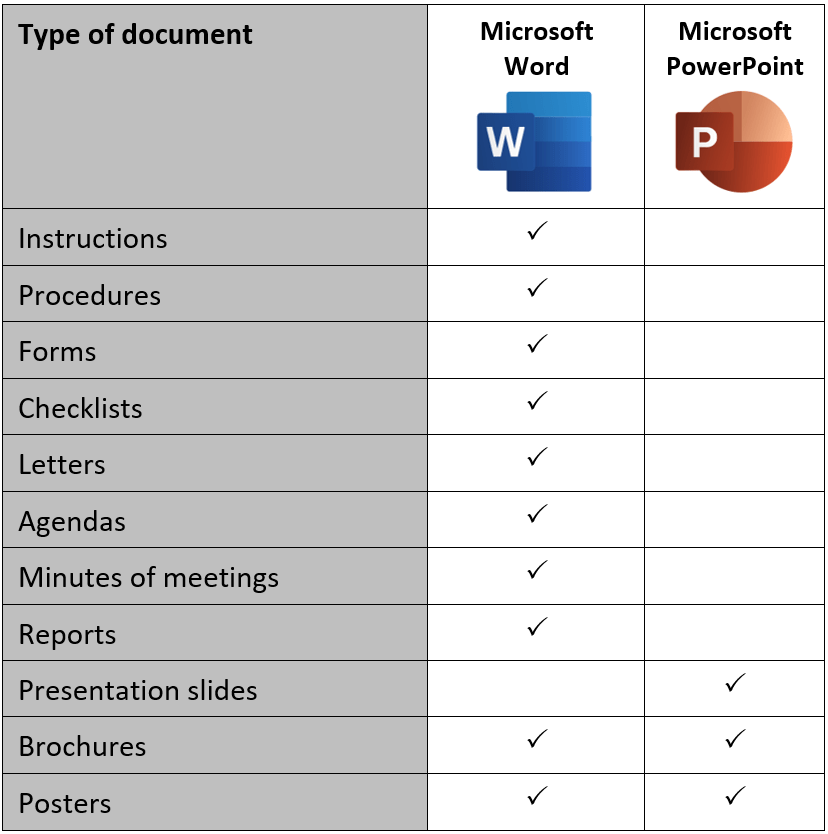
Basic documents that may be produced by a trainer or TAFE teacher are:

  • Instructions
  • Procedures
  • Forms
  • Checklists
  • Presentation slides
  • Brochures
  • Posters.

Other basic documents may include letters, agendas, minutes of meetings, and reports.

The 9-step procedure

I will use the 9-step procedure to guide my exploration of how to design and develop basic documents.

Let’s start looking at the first three steps associated with the ‘design document phase’.

Step 1. Establish and confirm document requirements

The following questions can help us establish and confirm the document requirements:

  • What type of document is to be created?
  • Who will read or use the document?
  • Who will provide the content?
  • Is there a style guide?
  • Are there any special requirements?

Step 2. Determine document orientation, style, and format

A document can be ‘paper-based’ or ‘screen-based’.

A ‘paper-based’ document will usually be A4 sized or A3 sized. Typically, the default size will be A4. If we are using Microsoft Word and want to change the size to A3, we select [Layout] then [Size].

The design of screen-based documents, such as presentation slides and web pages, is different than paper-based documents. I will cover this topic in greater depth in later articles.

Document orientation

A document can be orientated in two directions: portrait and landscape. If we are using Microsoft Word we select [Layout] then [Orientation].

Most basic documents will have a portrait orientation with the exception of presentation slides. However, a basic document may include a diagram or table that would require a landscape orientation. A document can have a mix of portrait and landscape pages.

Another consideration is the width of margins. If we are using Microsoft Word we select [Layout] then [Margins].

I recommend ‘normal’ margins for most basic documents. But ‘narrow’ margins might be used for some forms, checklists or landscape documents if required.

Document style and format

Document formatting refers to the way a document is laid out on the page, in other words, the way it looks and how it is visually organised. It may include:

  • Font type, size, and colour
  • Line and paragraph spacing
  • Margins and alignment.

I do not recommend the use of columns. It is becoming more common for ‘paper-based’ documents not to be printed on paper. Instead, these documents are being read and used onscreen. Reading up and down columns on a screen decreases readability and increases the time it takes to read the document.

My one most important guiding principle is to keep our documents simple. We should always think about the readers or users of the documents that we produce. We want them to find our documents to be easy to read and easy to use.

Style guides

If your organisation has a style guide, this eliminates the need for you to devise your own style and format for documents. A style guide is a reference point that sets standards for creating documents within an organisation. It may include:

  • Logo size and placement
  • Colour scheme to be used
  • Image and photography guidelines
  • Layout and document formatting.

The topic of style and format will be comprehensively covered in the articles:

Step 3. Select application software

From my experience working with Registered Training Organisations (RTOs), Microsoft applications are more widely used compared with Apple or Google applications. Having said this, I know that some trainers and TAFE teachers prefer and use Apple, Google and other software applications.

Microsoft Word will be used for most basic documents, and Microsoft PowerPoint will be used for presentation slides. Either of these Microsoft applications can be used to produce brochures or posters. However, I have a preference to use Microsoft PowerPoint. This will get explained in the next and later articles.

In conclusion

The ICTICT216 Design and create basic organisational documents unit of competency can be used to provide a structured approach to learning how to produce basic documents.

The ICTICT216 unit has been interpreted and simplified, resulting in a 9-step procedure for designing and creating documents. The first three steps can be relatively quick to complete:

  • What type of document is to be developed?
  • What software application will be used?
  • Will the document use a portrait or landscape orientation?
  • Will the document be A4 or A3 sized?
  • Should the margins be kept at ‘normal’ or changed to ‘narrow’?
  • Is there a style guide to be complied with?

This has been the first of a series of articles about how to design and develop basic documents.

Also, it would be great to hear about your experience:

  • What software applications does your RTO use?
  • What types of document do you need to produce?
  • Does your RTO have a style guide?

Australia’s VET system

Australia’s vocational education and training (VET) system is complex and forever changing. People studying for their TAE40122 Certificate IV in Training and Assessment qualification may find useful information on this website. Tap or click on the following ABC logo to find out more.

ABC logo

Contact now!

logo otws

Training trainers since 1986