Risk-based approach: How to determine sample size for assessment validation

Introduction

The Standards for Registered Training Organisations (RTOs) 2015 required an RTO to review a statistically valid sample of the assessments. The national VET regulator, Australian Skills Quality Authority (ASQA) provided an online calculator to determine the sample size so that it would be statistically valid.

ASQA’s Validation sample size calculator has been used to calculate the statistically valid sample size for the following two examples. [1]

Example 1

Example 2

The new Standards for RTOs 2025 has introduced a significant change to assessment validation. Instead of a fixed requirement, RTOs are now required to adopt a risk-based approach to determine their validation sample size. This means the number of assessments validated will vary considerably across RTOs, reflecting their individual risk assessments.

Select the units to be validated

The new Standards for RTOs 2025 states that “every training product on the organisation’s scope of registration is validated at least once every five years and on a more frequent basis where the organisation becomes aware of risks to training outcomes, any changes to the training product, or receives relevant feedback from VET students, trainers, assessors, and industry.” [2]

What is a training product?

The new Standards for RTOs 2025 defines training products as:

  • VET Qualification
  • Skill set
  • Unit of competency
  • Accredited short course or module.

How many units per qualification should be validated?

ASQA has provided the following guidance for RTOs: [3]

“At least two units from each qualification must be validated; however, your RTO may choose to validate more if validation of the two units identifies risks or a potential harm to learners who may not have met the required assessment outcomes, inconsistent assessment judgements have been made by assessors or assessment has not been conducted in accordance with the Principles of Assessment or the Rules of Evidence.”

Prioritising high-risk units

When RTOs prioritise the validation of high-risk units over low-risk ones, they are strategically focusing their quality assurance efforts where they matter most. High-risk units often involve complex skills, critical safety implications, or significant industry impact. By concentrating validation on these areas, RTOs can identify and rectify potential assessment flaws that could lead to serious consequences, such as workplace accidents or compromised professional standards. This approach ensures that training quality is rigorously maintained in the most crucial areas, safeguarding both learner outcomes and industry integrity. Essentially, it’s about maximising the impact of validation resources by addressing the areas with the greatest potential for negative consequences.

Identifying risks

The new Standards for RTOs 2025 states that a risk-based approach should be used to determine the sample size of assessments that should be validated. It’s important to understand that the risk-based approach in the Australian VET sector is about ensuring quality and compliance. Therefore, the risks considered relate to factors that could negatively impact those outcomes. Here are five risks that RTOs could consider when determining assessment validation sample sizes:

  • Type of unit
  • Experience of assessors
  • Changes to assessment practices
  • Volume of assessments
  • Historical compliance and validation outcomes.

Risk 1. Type of unit

Units involving high-risk activities, complex skills, or critical safety components require more rigorous validation. The potential consequences of incompetent performance are higher.

Risk 2. Experience of assessors

If assessors are new, less experienced, or are not fully qualified, there is a higher risk of inconsistent or inaccurate assessments. This necessitates a larger validation sample.

Risk 3. Changes to assessment practices

Any recent changes to assessment tools or assessment procedures can introduce inconsistencies. A larger validation sample size helps identify any unforeseen issues.

Risk 4. Volume of assessments

A high volume of assessments within a short period can increase the risk of errors or inconsistencies. Larger sample sizes are needed to maintain quality assurance.

Risk 5. Historical compliance and validation outcomes

A history of non-compliance or poor validation outcomes should lead to a more conservative approach with larger sample sizes. This allows for closer scrutiny and helps build confidence in the RTO’s assessment practices.

The above five risks are examples, not a complete list, of risks that may influence an RTO’s risk assessment. In essence, the risk-based approach should encourage an RTO to prioritise validation efforts where the potential for errors or negative impacts is greatest.

Determining sample size

Let’s look at how a risk-based approach to assessment validation sample sizes might work with some numerical examples. Here are three scenarios.

Scenario 1. High-risk unit

Scenario 2. Medium-risk unit
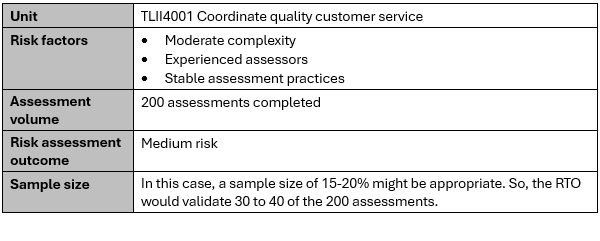
Scenario 3. Low-risk unit
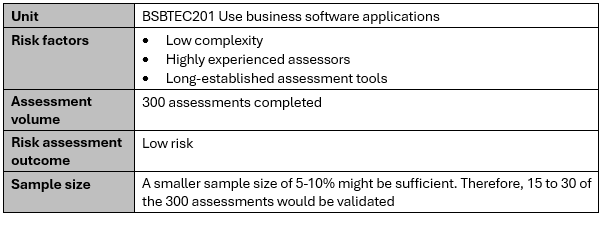
The numbers in the above three scenarios are examples. The exact percentages will vary depending on the RTO’s own risk assessment and validation policies.

The following table compares the statistically valid sample size with the sample size for the three previous scenarios.

High-risk units should be selected for validation rather than low-risk units. Therefore, the new risk-based approach should not significantly reduce the sample size of assessments to be validated.

Selecting units to be validated

A VET qualification consists of many units of competency. The RTO will need to select at least two units to be validated. The following is a three-step process that can be used for risk-based selection of unit.

  • Step 1. Select the risk assessment criteria
  • Step 2. Create a risk assessment table
  • Step 3. Conduct and document the risk assessment.

Step 1. Select the risk assessment criteria

Here are some examples of risk assessment criteria:

  • Complex skills
  • High-risk activities
  • New, inexperienced or partly qualified assessors
  • New or changed assessment tools
  • Feedback or complaints from students, trainers, assessors, or industry.

Step 2. Create a risk assessment table

The following risk assessment table show an example with four risk assessment criteria. The number of risk assessment criteria shall be determined by the RTO, and this shall determine the number of columns required.

Step 3. Conduct and document the risk assessment

Here are risk assessment examples for two different qualifications.

Example 1
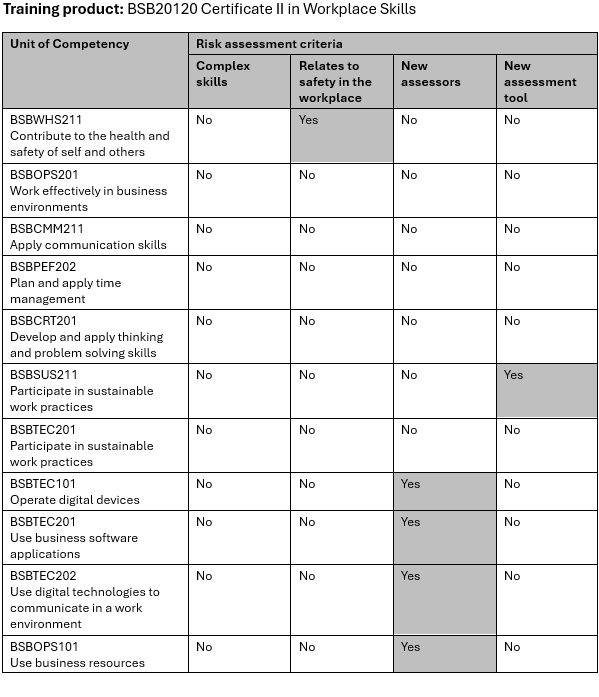
Selection of units to be validated based on the above risk assessment table should consider:

  • Units with newly implemented assessment tools (for example, BSBSUS211 Participate in sustainable work practices)
  • Units assessed by new assessors (for example, BSBTEC201 Use business software applications)
  • Units related to critical areas like safety (for example, BSBWHS211 Contribute to the health and safety of self and others).

Example 2

Unit selection for validation based on the above risk assessment table may prioritise two of the following:

  • SITHFAB025 Prepare and serve espresso coffee
  • SITHACS009 Clean premises and equipment
  • SITXFSA005 Use hygienic practices for food safety
  • SITXWHS005 Participate in safe work practices.

What assessment items must be kept? And how long do these items need to be kept?

ASQA has provided the following guidance for RTOs: [4]

“An RTO must keep all completed assessment items for each student for a period of six months from the date on which the judgement of competence for the student has been made. Completed student assessment items include the actual work completed by a student or evidence of that work, including evidence collected for a Recognition of Prior Learning (RPL) process.

If a student’s actual work is unable to be retained, an assessor’s completed marking guide, criteria, and observation checklist for each student may be sufficient. However, this evidence must have enough detail to demonstrate the assessor’s judgement of the student’s performance.”

Assessment items must be kept for at least 6 months. Some state and territory governments may require RTOs delivery government-funded or subsidised training to keep assessment items for a longer period of time.

Therefore, completed assessment items should be available for conducting assessment validation.

Random selection of assessments

While random selection is a common approach to assessment validation, best practice dictates including assessments conducted by new, inexperienced, or partially qualified assessors. Additionally, a sample of any Recognition of Prior Learning (RPL) assessments should always be included in the validation process.

In conclusion

The Standards for RTOs 2025 replace the previous fixed statistically valid sample size requirements with a risk-based approach. RTOs must now determine their own sample size based on their risk assessment.

Apart from determining the validation sample size, the RTO must select the units to be validated. An RTO should select units that are high risk rather than low risk. Prioritising high-risk units for validation allows RTOs to focus quality assurance where it’s most critical. By concentrating on complex skills and high-impact areas, RTOs can ensure assessment quality is maintained and mitigate potential serious consequences.

References

[1] https://www.asqa.gov.au/resources/tools/validation-sample-size-calculator accessed 15 March 2025

[2] Standard 1.5 (2) (b) https://www.legislation.gov.au/F2025L00354/asmade/text accessed 15 March 2025

[3] https://www.asqa.gov.au/faqs/how-many-units-qualification-should-be-validated accessed 15 March 2025

[4] https://www.asqa.gov.au/faqs/what-student-assessment-items-do-i-need-keep-and-how-long-do-i-need-keep-them accessed 15 March 2025

Do you need help with your TAE studies?

Are you a doing the TAE40122 Certificate IV in Training and Assessment, and are you struggling with your studies? Do you want help with your TAE studies?

Ring Alan Maguire on 0493 065 396 to discuss.

Contact now!

logo otws

Training trainers since 1986

Update from TAE40116 to TAE40122: Shop around for an RTO

During November 2024, I will be presenting a webinar titled, ‘An RPL guide for updating from TAE40116 to TAE40122‘. The webinar will cover a 5-step process:

This is the third article in a series about updating from the TAE40116 qualification to the TAE40122 qualification.

Step 3. Shop around for an RTO

An RTO can determine its own RPL process and associated fees. It is a good idea to contact a few RTOs and gather information about:

  • Cost of the RPL
  • Support provided
  • Flexibility
  • Cost of gap training

Cost of the RPL

The fee charged by RTO for RPL assessment can vary. I just did a quick internet search and found three different RTOs offering RPL at $1,300, $2,100 and $2,400. You may like to check if the RTO you work for is willing to pay for or subsidise your RPL.

Support provided

Cost is one criteria. Other criteria, such as the support provided by the RTO, may be important to you.

  • Does the RTO appear to be friendly and supportive?
  • What support will the RTO provide during the RPL process?
  • How much support will you need?

Another important criteria is the RTO’s willingness to be flexible.

Flexibility

Flexibility is one of the four principles of assessment. Is the RTO willing to be flexible?

  • Can you select the elective units that you want?
  • Is the RTO willing to recognise parts of a superseded and non-equivalent unit as substantive RPL evidence (therefore, no need to repeat training or assessment for those parts of the unit)?
  • Does the RTO willing to adapt or modify there assessment documents used to gather RPL evidence?

Cost of gap training

You may need to do some training to close any gaps. Some people many have a small number of units that can not attained by credit transfer and RPL. Each person applying for RPL will have their own unique circumstances.

  • How many units may be potential gaps?
  • How much would it costs to do gap training?

Compare RTOs

Shopping around for an RTO could save you money. And you could save time associated with the RPL application and assessment process. The following is a table that can be used to help you gather and compare information about different RTOs.

More tips and strategies shall be presented at the upcoming webinar.

Go to the webinar webpage for further details.

Please contact Alan Maguire on 0493 065 396 if you would like more details or if you would like to discuss.

Contact now!

logo otws

Updating from TAE40116 to TAE40122: Select elective units

Do you want to update your TAE40116 qualification to the TAE40122 qualification? And if you do, what is the first thing to be done?

During November 2024, I will be presenting a webinar titled, ‘An RPL guide for updating from TAE40116 to TAE40122‘. The webinar will cover a 5-step process:

The first step is to select the elective units.

TAE40122 Qualification packaging rules

The following are the packaging rules for the TAE40122 qualification:

  • Total number of units = 12
  • 6 core units plus
  • 6 elective units.

Refer to the TAE40122 Qualification packaging rules for detailed information about core units and elective units.

TAE40122 Core units

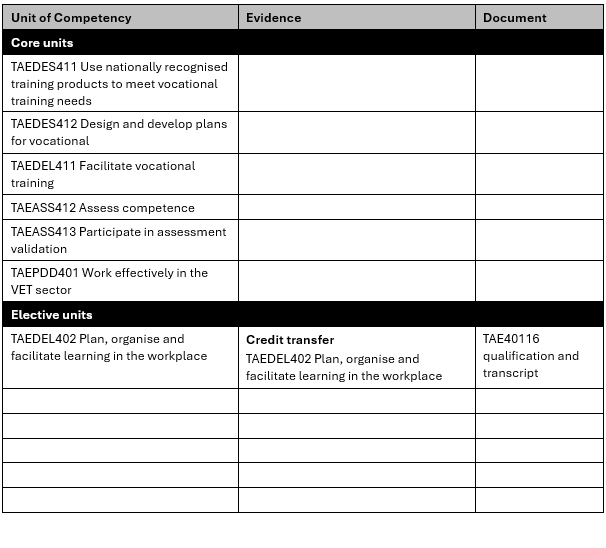
The core units for TAE40122 qualification are specified as shown in the following table.

The use of this table shall be explain at the webinar.

Select elective units that give credit transfer

Most people with the TAE40116 qualification will be able to select at least two elective units that will give credit transfer.

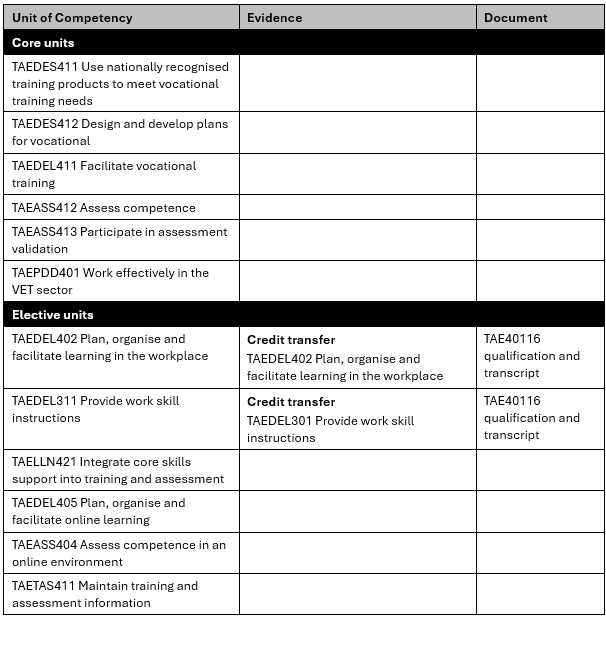
First elective unit to be selected is TAEDEL412 Facilitate workplace-based learning because it supersedes and is equivalent to TAEDEL402 Plan, organise and facilitate learning in the workplace. And the TAEDEL402 was a core unit for the TAE40116. So, everyone will get credit transfer for the TAEDEL412 unit.

Next, select other units that give credit transfer. For example:

  • TAEDEL311 Provide work skill instructions
  • TAEDEL414 Mentor in the workplace
  • BSBCMM411 Make presentations.

Select other elective units

Select units with the least amount of evidence required to demonstrate your competence. For example:

  • Consider selecting an LLN unit
  • Consider selecting TAEDEL405 and TAEASS404 if you have recently facilitated online learning and conducted assessment in an online.

Everyone’s circumstances are unique. At least eight units will be the same for everyone, and there may be some variation in the selection of the remaining four units. The following is an example of the 6 core units and 6 selected elective units.

In conclusion

This first step of the 5-step process is relatively quick and easy. However, it is important for you to do this step to minimise the time and effort later when gathering your RPL evidence:

  • Select elective units that give you credit transfer
  • Select elective units with the least amount of evidence required to demonstrate your competence.

More tips and strategies shall be presented at the upcoming webinar.

Go to the webinar webpage for further details.

Please contact Alan Maguire on 0493 065 396 if you would like more details or if you would like to discuss.

Contact now!

logo otws

TAE40122: A qualification that disappoints

The TAE40122 Certificate IV in Training and Assessment qualification, while intended to equip learners with the skills necessary to become effective trainers and assessors, often falls short due to several significant shortcomings. One of the most frustrating aspects of the qualification is the incomprehensible assessment instructions that can leave learners feeling confused and overwhelmed.

Additionally, the excessive focus on completing assessment tasks can create a sense of disengagement and hinder meaningful learning. Other common issues include insufficient training, inadequate or nonexistent trainer support, a lack of practical demonstrations, and repetitive content. These combined challenges can make the TAE40122 qualification a frustrating and unfulfilling experience for many learners.

This article exposes and explores some of the shortcomings experienced by many learners who are currently studying for their TAE40122 qualification.

Incomprehensible assessment instructions

The pursuit of precision in writing, while commendable, can lead to unintended consequences. When language becomes overly technical, jargon-laden, or overly specific, it can alienate readers. This can result in a loss of meaning, as the intended message becomes obscured by complex terminology or convoluted explanations. In essence, the effort to be precise can inadvertently create a barrier to understanding, defeating the very purpose of clear communication.

The assessment instructions for the TAE40122 qualification have often become so precise and detailed that they have inadvertently lost their clarity, making it difficult for learners to understand and follow.

Focused on assessment tasks

The TAE40122 qualification often prioritises the completion of assessment tasks over meaningful learning experiences. This narrow focus can leave learners feeling frustrated and unfulfilled. Instead of fostering a deep understanding of the subject matter, the focus on assessments can create a superficial approach to learning. Such a narrow focus can result in a lack of motivation and diminish the overall value of the qualification.

Learners often enrol in the TAE40122 qualification with the desire to gain valuable knowledge and skills. However, the excessive emphasis on completing assessment tasks can hinder their ability to truly learn and understand the material. This can lead to a sense of frustration and a feeling that their learning journey is not fulfilling their expectations.

Too many learners want to learn, but feel that they are not learning.

Insufficient training

Some RTOs delivering the TAE40122 qualification are providing insufficient training to their learners. This inadequate training often manifests in the form of brief or superficial training sessions that fail to equip learners with the necessary knowledge and skills to successfully complete the assessment tasks. As a result, learners may find themselves struggling to understand the requirements, apply the concepts, and ultimately demonstrate their competency. This lack of comprehensive training can lead to increased stress, decreased confidence, and ultimately, withdrawal from the training program.

Inadequate or no trainer

In addition to insufficient training, some RTOs are employing trainers who lack the expertise and experience to effectively deliver the TAE40122 qualification. These trainers may be unfamiliar with the specific requirements of the course, leading to confusion and inconsistencies in their instruction. Their inexperience may also result in a lack of guidance and support. This can create a chaotic or disorganised learning environment where learners are unsure of what is expected of them, resulting in decreased motivation and engagement, and potentially hindering their progress and overall success in the qualification.

Self-paced online training offers flexibility and convenience, but it can also present challenges when a trainer is not readily available. One significant issue is the lack of immediate feedback and guidance. Learners may encounter difficulties understanding concepts or completing assessment tasks without the support of a trainer to clarify questions or provide personalised assistance. This can lead to frustration and a decreased sense of motivation. Additionally, self-paced learners may struggle to stay on track and maintain a consistent pace. Without a trainer to provide deadlines or encourage progress, learners may find it difficult to stay motivated and complete the course on time.

Inadequate or no demonstrations

In the TAE40122 qualification, practical demonstrations are essential for learners to understand the complexities of various training and assessment activities. By observing a trainer’s approach to various activities like developing training plans, delivering training sessions, conducting assessments, or validating assessment tools, learners can gain valuable insights into effective practices. Unfortunately, many TAE40122 programs may lack sufficient demonstrations or may present them in a way that is unclear or difficult to follow. This can hinder learners’ ability to learn the skills necessary to become competent trainers and assessors.

Repetitive

There is duplication of knowledge and performance requirements across different TAE units of competency. Many RTOs delivering the TAE40122 qualification have not integrated the assessment tasks to avoid repetition. The result has been the need to answer the same or similar questions and the relentless delivery of 30-minute training session without meaningful differences. This repetitive nature of the TAE40122 training program can be frustrating and time-consuming without adding significant value.

In conclusion

The TAE40122 Certificate IV in Training and Assessment qualification often disappoints learners due to unclear assessment instructions, excessive focus on assessments, insufficient training, and inadequate support.

If you’re struggling or disappointed with your TAE40122 qualification, here are some steps you can take:

Communicate with your RTO

Reach out to your RTO’s support team or course coordinator. They may be able to provide additional resources, guidance, or adjustments to help you succeed.

Seek peer support

Connect with other learners in your course or online forums. Sharing experiences and seeking advice from peers can be helpful.

Utilise available resources

Take advantage of any additional resources provided by your RTO or elsewhere, such as information published on this website.

Consider tutoring

If you’re finding the course challenging, consider seeking tutoring to supplement your learning.

Do you need help with your TAE studies?

Are you a doing the TAE40122 Certificate IV in Training and Assessment, and are you struggling with your studies? Do you want help with your TAE studies?

Ring Alan Maguire on 0493 065 396 to discuss.

Contact now!

logo otws

Training trainers since 1986

Was the Certificate IV in Training and Assessment overhaul necessary?

The Certificate IV in Training and Assessment qualification has become a monotonous carousel. Every six years, it undergoes an overhaul, spinning around the same curriculum, offering the same familiar content with minor tweaks. The changes have been fundamentally superficial. Trainers and assessors have felt trapped in a cycle of endless repetition, unable to break free from the real or implied compliance requirements to upgrade. The journey has become devoid of meaningful growth and development, reduced to a mere formality that trainers must endure rather than embrace.

Background

2004

The first Certificate IV in Training and Assessment qualification was released in 2004. This TAA40104 Certificate IV in Training and Assessment qualification superseded the BSZ40198 Assessment and Workplace Training qualification.

2010

Six years later in 2010, the TAE40110 Certificate IV in Training and Assessment qualification superseded the TAA40104 Certificate IV in Training and Assessment qualification. The TAE40110 qualification required a total of 10 units:

  • 7 core units, plus
  • 3 elective units.

2016

And six years later in 2016, the TAE40116 Certificate IV in Training and Assessment qualification superseded the TAE40110 Certificate IV in Training and Assessment qualification. The TAE40116 qualification required a total of 10 units:

  • 9 core units, plus
  • 1 elective units.

Several strategic audits conducted by the national VET regulator prior to 2016 had identified that trainers and assessors lacked assessment related capability. Also, it had become apparent that many VET students had low level language, literacy and numeracy skills. The national VET regulator had demanded two units that were previously elective units to become core units for the TAE40116 qualification: TAEASS502 Design and develop assessment tools and TAELLN411 Address adult language, literacy and numeracy skills.

2022

And again, six years later in 2022, the TAE40122 Certificate IV in Training and Assessment qualification superseded the TAE40116 Certificate IV in Training and Assessment qualification. The TAE40122 qualification requires a total of 12 units:

  • 6 core units, plus
  • 6 elective units.

The developers of the TAE40122 qualification said that the previous TAE40116 qualification needed to have greater flexibility to meet the different needs within the VET sector. Two years after the release of the TAE40122 qualification, it has become apparent that this need for greater flexibility was untrue or overstated. Most RTOs delivering the TAE40122 Certificate IV in Training and Assessment qualification have selected very similar elective units. There is a trend towards a fairly standardised TAE40122 training program.

You may ask yourself, did we really need to change the Certificate IV in Training and Assessment qualifications every six years over the past 20 years?

What has changed?

The following shows sample training programs for the previous two and the current Certificate IV in Training and Assessment qualifications.

The TAE40122 qualification has two differences from its predecessors:

  • Assessment capability, and
  • Online learning and assessment capability.

Assessment capability

There is a reduced emphasis on developing assessment related capability. The unit relating to the design and development of assessment tools has been re-categorised as an elective unit. Most RTOs delivering the TAE40122 qualification are not selecting this elective unit because many TAE40116 participants found it difficult and time-consuming.

Also, the competency to plan assessment activities and processes has been integrated into the TAEASS412 Assess competence unit of competency.

Online learning and assessment capability

The capability to delivery online learning and conduct online assessment has been emphasised. Initially, this was because the Australian Government felt there was need to respond to the shift to online delivery during the COVID-19 pandemic. The technology to deliver online training and conduct online assessment is relatively easy to learn and easy to use. And each RTO can use different technology.

A person who can deliver training should have the capability to deliver online training. Likewise, a person who can conduct assessment should have the capability to conduct online assessment. It is not that difficult to learn and use the technology.

Changes to the units

There has been changes to the units for the TAE40122 qualification relating to:

  • Professional development plan
  • Training capability
  • Pre-assessment validation
  • Unreal and duplicated content.

Professional development plan

The TAEPDD401 Work effectively in the VET sector unit has introduced the need to develop a professional development plan. Every trainer and assessor working for an RTO will need to develop a professional development plan. RTOs will have a template to be completed, usually on an annual basis. This is not a difficult administrative task to perform, and it didn’t warrant inclusion into a unit.

Training capability

The duration of training sessions to a group has been reduced from 40 minutes to 30 minutes. And the group size has been reduced from ‘at least 8 learners’ to ‘at least 4 learners’. This change is significantly more unrealistic compared to the actual competencies required as a trainer working for an RTO. This means that the TAE40122 graduate will have less proven training capability compared with their predecessors.

Pre-assessment validation

The TAEASS413 Participate in assessment validation unit has introduced the need to participate in pre-assessment valuations as well as participate in assessment valuations. This is unnecessary since a person who is competent at participating in assessment valuations will have the ability to participate in pre-assessment valuations. Also, participating in pre-assessment valuations is one of many unrealistic requirements that have been added to the TAE40122 qualification. It is highly unlikely that a trainer or assessor will be involved with pre-assessment valuations. It is much more likely that trainers or assessors will be given assessment tools to use, and they will not be expected to question if the assessment tools are valid.

Unreal and duplicated content

Content that is unrealistic has been added to the TAE40122 qualification. Also, content has been duplicated across many units making the training course unnecessarily repetitive for the TAE40122 participant. Awkward and complicated language has been created and used throughout many units. All these things are making the training far more complex and difficult to understand than it needs to be.

In conclusion

In this article, I have argued that the never-ending overhaul to the Certificate IV in Training and Assessment qualification have been generally unnecessary. I have also raised some of the consequences associated with the creation of the TAE40122 qualification, such as:

  • Training capability of the TAE40122 graduate is decreased compared with their predecessors
  • Assessment capability of the TAE40122 graduate is decreased compared with their predecessors
  • Poorly-written units that include unnecessary, unrealistic and duplicated content that has made training more complex and confusing for TAE40122 participants.

Is the solution another overhaul to the Certificate IV in Training and Assessment qualification?