Conquering studies as an adult learner: Tips for success

This article has been written for adult learners who have not studied for a long time and are undertaking studies for a TAE40116 or TAE40122 qualification. It’s a brave, rewarding, and sometimes daunting step to commence studying for a qualification as an adult learner. Here are some tips to help you navigate this journey.

Embrace the refresh

You already have a wealth of life experience. Use it! Draw connections between what you’re learning and your past experiences. This will make the material more relatable and engaging.

Rekindle your studying skills

Start small: Don’t overwhelm yourself. Begin with short, focused study sessions and gradually increase the duration.

Find your rhythm: Experiment with different times of day and environments to discover when and where you focus best.

Prioritise and plan: Adult life often means juggling commitments at home, at work and your studies. Block out dedicated study time in your calendar and stick to it as much as possible.

Master the material

Active learning: Don’t just passively read. Take notes, rewrite concepts in your own words, and summarise key points.

Find your learning style: Do you learn best visually, by doing, or through discussion? Explore different study methods and find what works for you.

Don’t be afraid to ask for help

Seek help from the trainer: Don’t hesitate to ask your trainer questions.

Support services: Utilise the support services from your training provider.

Form a study group: Find colleagues who are undertaking the same training to discuss ideas, share resources, and motivate each other.

Seek help from a tutor: Get help from a tutor if your trainer and support services from the training provider are insufficient for your needs.

Stay motivated

Set goals: Goals will keep you focused and give you a sense of accomplishment.

Focus on the why: Remind yourself of your larger goal for pursuing this qualification. This will provide the drive to keep going when things get tough.

Celebrate milestones: Acknowledge and reward yourself for completing tasks, achieving goals, and overcoming challenges.

In conclusion

You have the life skills, intelligence, and determination to succeed. Be kind to yourself. There will be bumps along the road.

If you are finding your studies are difficult, please remember that it isn’t you. It is common for many people studying for their TAE40116 or TAE40122 qualification to find it difficult, challenging, confusing, overwhelming, frustrating, and exhausting. It is the training provider that has created the training and assessment experience that is dreadful.

Before concluding, I would like to highlight the following five tips for study success:

  • Get support from your trainer
  • Get support from your training provider
  • Get support from a tutor
  • Make a plan and allocate time for your study
  • Focus on one thing at a time.

By embracing these tips and believing in yourself, you’ll be well on your way to conquering your studies and making progress towards achieving your qualification!

Do you need help with your TAE studies?

Are you a doing the TAE40122 Certificate IV in Training and Assessment, and are you struggling with your studies? Do you want help with your TAE studies?
Ring Alan Maguire on 0493 065 396 to discuss.

Contact now!

logo otws

Training trainers since 1986

How to develop questions and sample answers to gather Knowledge Evidence

I recently published an article titled, ‘Assessment methods, assessment tasks and other jargon used by RTOs’. It provided examples that mainly focused on gathering Performance Evidence.

In this article, I shall focus on how to gather Knowledge Evidence:

  • Step 1. Identify the required knowledge evidence
  • Step 2. Write questions to gather the required knowledge evidence
  • Step 3. Develop sample answers or marking guide
  • Step 4. Add details to the assessment mapping matrix

Step 1. Identify the required knowledge evidence

All units of competency specify the required knowledge evidence. The following is an example of the knowledge evidence specified for the BSBCMM411 Make presentations unit of competency.

Step 2. Write questions to gather the required knowledge evidence

The RTO must explicitly gather the Knowledge Evidence. This will be achieved by getting the candidate to answer questions that have been designed specifically to gather all the Knowledge Evidence. Generally, this means that at least one question will be developed to gather each item of Knowledge Evidence (each bullet point).

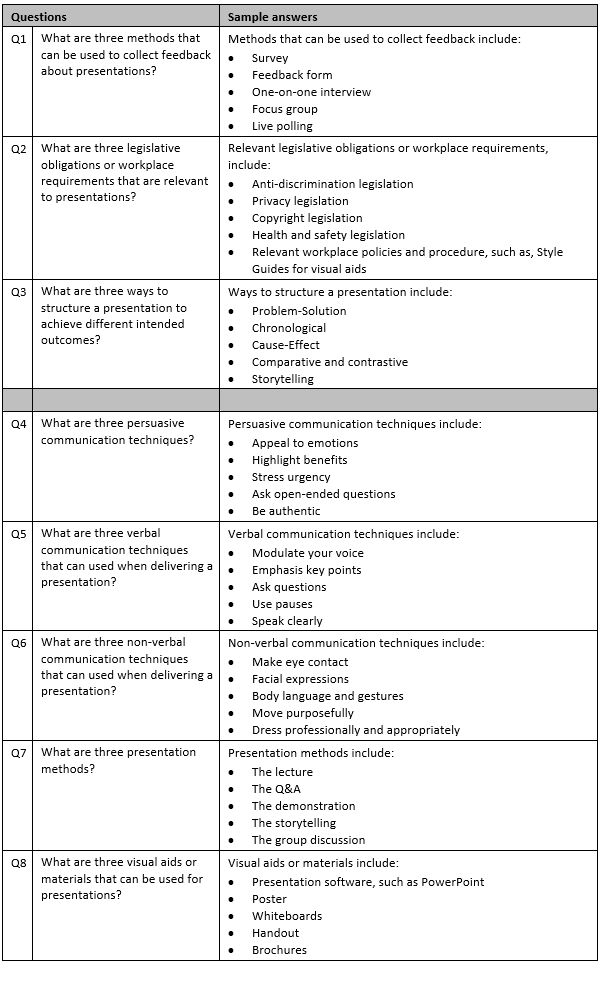
The following is an example of questions written to gather the Knowledge Evidence specified for the BSBCMM411 Make presentations unit of competency.

Note: Answers to questions may be oral or written.

Step 3. Develop sample answers or marking guide

The RTO must ensure that assessments are reliable. In other words, evidence presented for assessment should be consistently interpreted and assessment results are comparable irrespective of the assessor conducting the assessment. Sample answers or marking guide are used to support reliable assessment practices.

The following is an example of sample answers for the questions that have been designed to gather the Knowledge Evidence specified for the BSBCMM411 Make presentations unit of competency.

Note: AI was used to generate ideas for the sample answers.

Step 4. Add details to the assessment mapping matrix

The following is an example of an assessment mapping matrix that provides cross referencing details relating to the gathering of Knowledge Evidence for the BSBCMM411 Make presentations unit of competency.

In conclusion

All units of competency specify the required knowledge evidence. And all RTOs must explicitly gather the specified Knowledge Evidence. This article has outlined a 4-step process for writing questions and sample answers to gather knowledge evidence.

Here are some other relevant articles about gather knowledge evidence:

Do you need help with your TAE studies?

Are you a doing the TAE40122 Certificate IV in Training and Assessment, and are you struggling with your studies? Do you want help with your TAE studies?

Ring Alan Maguire on 0493 065 396 to discuss.

Contact now!

logo otws

Training trainers since 1986

Assessment methods, assessment tasks and other jargon used by RTOs

This article aims to clarify some of the jargon used by RTOs relating to assessments:

  • Assessment methods
  • Assessment instruments
  • Assessment tasks
  • Assessment mapping matrix.

Assessment methods

ASQA has published a Guide to assessment tools. This is a reputable source of information about assessment.

On pages 4 and 5 of this guide, it describes four types of assessment methods:

  • Questioning
  • Direct observation
  • Product based methods
  • Third-party evidence.

All other assessment methods are a variation of these four assessment methods. For example, an interview or competency conversation is questioning. And a Portfolio of Evidence is a product based method.

Questioning is applicable for gathering knowledge evidence. The other three types of assessment methods are applicable to gathering performance evidence.

Assessment instruments

The assessment instrument is the document used to support the gathering of evidence and recording the assessor’s judgements about the quality of the evidence (Satisfactory or Not Yet Satisfactory).

The following shows the assessment instrument relevant for each assessment method.

Assessment tasks

RTOs will use assessment tasks to organise and implement their assessment strategies. I would usually plan to gather the knowledge evidence first unless otherwise stated. Therefore, the first assessment tasks would be Knowledge Questions (the candidate provides oral or written answers to questions).

One or more assessment tasks would be needed to gather sufficient performance evidence. These days, many units of competency specify a frequency or volume of Performance Evidence.

For example, the Performance Evidence for the BSBCMM411 Make presentations states that the candidate must demonstrate the ability to complete the tasks outlined in the elements, performance criteria and foundation skills of this unit, including evidence of the ability to prepare and deliver at least two different presentations.

Therefore, one assessment task can be used to gather the knowledge evidence and two assessment tasks can be used to gather the performance evidence.

The following table shows the relationship between assessment tasks and assessment methods.

Unit of Competency: BSBCMM411 Make presentations

The above table shows that Assessment Task 2 uses two assessment methods to gather the performance evidence (direct observation and the review of product, and Assessment Task 3 also uses two assessment methods (third-party report and the review of product).

In this example, products may include relevant emails, presentation plans, feedback forms, visual aids, presentation materials, evaluation reports, self-reflections, etc.

Assessment mapping matrix

Competency-based assessment is assessment based the competency, and competency is described by the Unit of Competency and its associated Assessment Requirements. We use a matrix to visually connect the unit of competency with the assessment methods or assessment tasks.

There are two types of assessment matrix:

  • Mapping against assessment methods
  • Mapping against assessment tasks

Mapping assessment methods

The following is an example a mapping the assessment methods for the BSBCMM411 Make presentations unit of competency.

The above example visually shows that questioning is not being used to gather the performance evidence.

Mapping assessment tasks

The following is an example a mapping the assessment tasks for the BSBCMM411 Make presentations unit of competency.

The above example visually shows that questioning is not being used to gather the performance evidence.

Adding cross-referencing details

The following is an example of an assessment mapping matrix that provides cross referencing details relating to the assessment instruments for the BSBCMM411 Make presentations unit of competency.

The level of detail in the above example supports the review, validation or audit processes conducted by an RTO.

In conclusion

The jargon associated with competency-based assessments can be confusing, especially if the person is new to the Australian VET system. And using a matrix for mapping the assessment may take time to understand.

Competency-based assessment is assessment based the competency. We use a matrix to visually connect the unit of competency with the assessment methods or assessment tasks.

Step 1. Copy and paste the unit of competency

Step 2. Identify the assessment methods or assessment tasks that will be used to gather evidence of competency

My preference is to use assessment tasks rather than assessment methods to organise and implement the assessments.

Do you need help with your TAE studies?

Are you a doing the TAE40122 Certificate IV in Training and Assessment, and are you struggling with your studies? Do you want help with your TAE studies?

Ring Alan Maguire on 0493 065 396 to discuss.

Contact now!

logo otws

Training trainers since 1986

Making a start on designing competency-based training programs and training sessions

The TAEDES412 Design and develop plans for vocational training unit of competency will require the TAE Student to:

  • design and develop plans for group learning that covers at least 2 entire units of competency
  • design and develop the detail for 3 consecutive training sessions for each different unit of competency.

Designing a group-based training program

The following information focuses on designing a training program that covers one unit of competency. If you are a TAE Student, you will need to do the following twice because you will required to design a training program that covers two units of competency. Avoid integrating the delivery of the two units because this will make it more complicated than it needs to be. Keep you approach as simple as possible.

The TAEDES412 unit does not specify the duration a training session. It does not specify that the training plan covering a unit of competency must consist of 30-minute training sessions. The duration of 30 minutes is not a realistic timeframe for a training session to train a group of learners. When designing a training program, I start by creating a training agenda consisting of one-hour blocks of time.

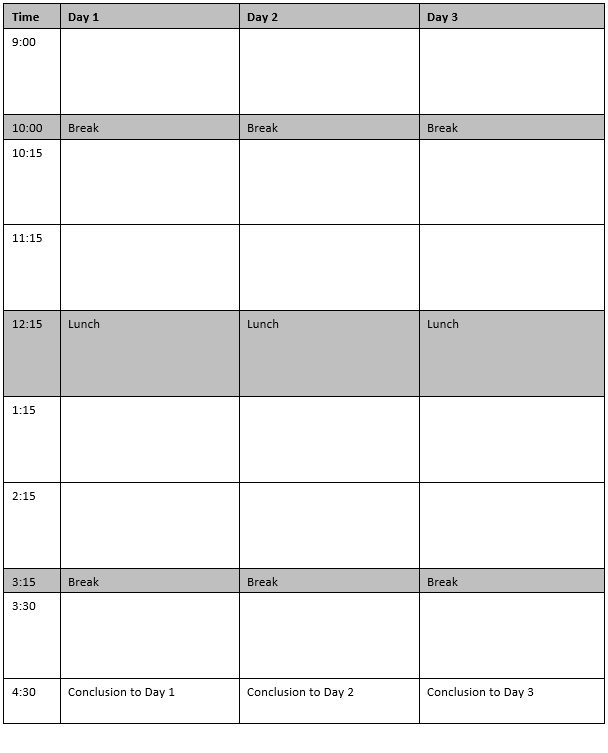
The following shows the outline for a 3-day training program with 6 one-hour blocks of time for each day.

Most units of competency in the Australian VET system will require more than one training day. The total training duration will usually be between 2 and 5 days.

The one-hour block of time structure is simple and makes it easier to figure out the chunking and sequencing of content to be delivered. And remember to factor in time for learning activities, including the practice of skills and tasks. I like to allocate at least 50% of the available time for conducting learning activities.

I design the training using one hour as the duration for a ‘standard training session’. Sometimes a period of time greater than one hour is required. This usually is required to cater for learning activities that need more time, such as, case studies or role playing.

The following shows two examples of training sessions with a duration greater than one hour:

  • Day 1 has used two one-hour blocks of time for a two-hour training session
  • Day 3 has used three one-hour blocks of time for a three-hour training session.

Design three 30-minute training sessions

The TAEDES412 Design and develop plans for vocational training unit of competency requires the TAE Student to design and develop the detail for 3 consecutive training sessions for each different unit of competency.  And the TAEDEL411 Facilitate vocational training unit of competency requires the TAE Student to deliver a series of 3 sequential training sessions of at least 30 minutes duration each to a group of at least 4 learners.

The following table compares the requirements specified by the TAEDES412 unit and the TAEDEL411 unit.

Many RTO delivering the TAE40122 Certificate IV in Training and Assessment qualification will ask their TAE Student to design, develop and deliver a series of 3 sequential training sessions. Unfortunately, there can be a disconnect between designing a realistic training program consisting of training sessions with a duration that are greater than 30 minutes and the requirement of delivering 30-minute training sessions.

The duration of 30 minutes for training sessions is unrealistic. The timeframe of 30 minutes was influenced by RTOs delivering the Certificate IV in Training and Assessment qualification. These RTOs wanted to make it easier for themselves to organise the observation of training sessions being delivered by their TAE Students, and minimise the time consumed by their assessors. The timeframe was not based on the ‘real’ requirements and duration of delivering this type of training session.

If you are a TAE Student, it is best to think that the 30-minute training sessions are an exercise to prove you can deliver training. These training sessions do not represent what happens in the real world. This raises a question: how do you deign a realistic training program and then extract a series of 3 sequential 30-minute training sessions for delivery?

After you have designed the training program covering the unit of competency, split the one-hour blocks of time in half and select a series of three 30-minutes to be your training session to deliver.

The following shows an example of picking three 30-minute blocks of time that can form the basis for a series of 3 sequential 30-minute training sessions.

In conclusion

The total duration of training will need to be estimated before staring to design the competency-based training program. This is required to know how many columns your training agenda will need.

Design the training program using one-hour blocks of time. Blocks of time can be merge to create training sessions with a duration that is greater than one hour.

Recognise the disconnect between the requirements specified by the TAEDES412 Design and develop plans for vocational training unit of competency and the TAEDEL411 Facilitate vocational training unit of competency. Identify 90 minutes from your competency-based training program that can be transformed into series of 3 sequential training sessions for delivery.

Do you need help with your TAE studies?

Are you a doing the TAE40122 Certificate IV in Training and Assessment, and are you struggling with your studies? Do you want help with your TAE studies?

Ring Alan Maguire on 0493 065 396 to discuss.

Contact now!

logo otws

Training trainers since 1986

Quickly turn PowerPoint slides into Handouts in 5 easy steps

If you are a TAE Student, you are likely to be encouraged or required to create visual aids and handouts. A common visual aid are PowerPoint slides. These PowerPoint slides can be quickly transformed into a handout.

Step 1. Prepare PowerPoint slides for the handout

Make a copy of your PowerPoint slides and remove slides that you do not want included in the handout. For example, you may have slides with quiz answers or administrivia that should be removed.

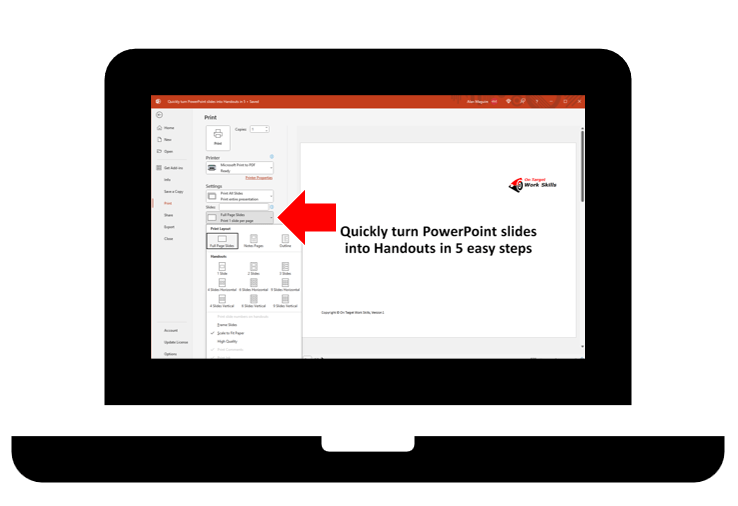
Step 2. Select ‘Print to PDF’

The handout shall be created as a PDF files. Go to the ‘Print’ function and select ‘Print to PDF’.

Step 3. Open ‘Print Layout’

Use the drop-down menu to open ‘Print Layout’ options.

Step 4. Select ‘Handout 3 Slides’

There is a range of handout layouts. Generally, I have found the 3 slides to each page as the most useful layout. This layout provides space for the learner to write their own notes relating to each slides.

Step 5. ‘Print’ and save PDF file

Select ‘Print’ and then you will need to select the location where you want to save the PDF file. This PDF file can be sent to your learners electronically or printed on paper and given to your learners.

In conclusion

Creating a handout from your PowerPoint slides is quick and easy. If you are a TAE Student, this can save you time so that you can move onto other things.

There are some advanced features such as adding RTO details, copyright details, version number or other information to the handout. This is done from the ‘Handout Master’.

What if you don’t have PowerPoint slides?

If you must create a handout and you don’t have PowerPoint slides, then you will need to develop a document. But this needs to be a topic for another article.

Other related articles that I have published are:

Do you need help with your TAE studies?

Are you a doing the TAE40122 Certificate IV in Training and Assessment, and are you struggling with your studies? Do you want help with your TAE studies?

Ring Alan Maguire on 0493 065 396 to discuss.

Contact now!

logo otws

Training trainers since 1986