What is formative assessment? And how does it differ from summative assessment and diagnostic assessment?

The TAEDES412 Design and develop plans for vocational training is a core unit of competency for the new TAE40122 Certificate IV in Training and Assessment qualification. It describes the skills and knowledge required to design, develop and document delivery plans and session plans within the Australian VET system.

The TAEDES412 unit specifies that the delivery plan and session plans must include formative assessment activities. You may also come across other terms such as summative assessment and diagnosis assessment. This article shall explore:

  • What is formative assessment?
  • What is summative assessment?
  • What is diagnosis assessment?

Searching for definitions

There is no definitive definition of these three terms:

  • Formative assessment
  • Summative assessment
  • Diagnosis assessment.

The Standards for RTOs 2015 does not define these terms. The TAE Training Package does not define these terms.  And the Implementation Guide for the TAE Training Package does not define these terms.

I have used the VOCEDplus website to search a glossary of VET terms. This website is maintained by the National Centre for Vocational Research (NCVER).

The VOCEDplus website provides a definition for ‘Formative assessment’.

The VOCEDplus website provides a definition for ‘Summative assessment’.

The VOCEDplus webpages for ‘Formative assessment’ and ‘Summative assessment’ says that both terms are also called ‘Assessment of learning’. However, VOCEDplus website provides two different definitions for ‘Assessment of learning’. If you follow the link from the ‘Formative assessment’ webpage you are given the definition for formative assessment. And if you follow the link form the ‘Summative assessment’ webpage you are given the definition for summative assessment.

It is strange that two different definitions are provided for the same thing.

The VOCEDplus website does not provide a definition for ‘Diagnostic assessment’.

What are the origins of formative and summative assessment?

The origins of the formative and summative assessment in the modern era can be traced back to the mid-20th century when educators and researchers started to promote the use of standardised tests and other assessments in educational settings.

Benjamin Bloom, an American educational psychologist, was influential in the development of formative assessment. In his book, ‘Taxonomy of Educational Objectives’, Bloom described the importance of formative assessment in the learning process. He argued that formative assessment is essential for helping students to progress towards achieving learning objectives. Bloom believed that formative assessment should be an ongoing process that occurs throughout the learning experience, rather than a one-time event. He emphasised the importance of providing students with feedback on their progress, so that they can make adjustments and improvements as needed. [1]

The following is an example showing when formative assessment would be conducted during a training program.

Bloom also wrote about summative assessment. He distinguished between formative assessment, which is used to guide and monitor learning, and summative assessment, which is used to evaluate learning at the end of a unit or course of study. Bloom believed that summative assessment is important for measuring student achievement. His ideas have influenced the development of many of the assessment practices that are used today, and have helped to promote a more balanced approach to assessment, with both formative and summative assessment playing important roles. [2]

The following are examples showing how formative assessment is conduct during a training program and summative assessment would be conducted at the end of a training program.
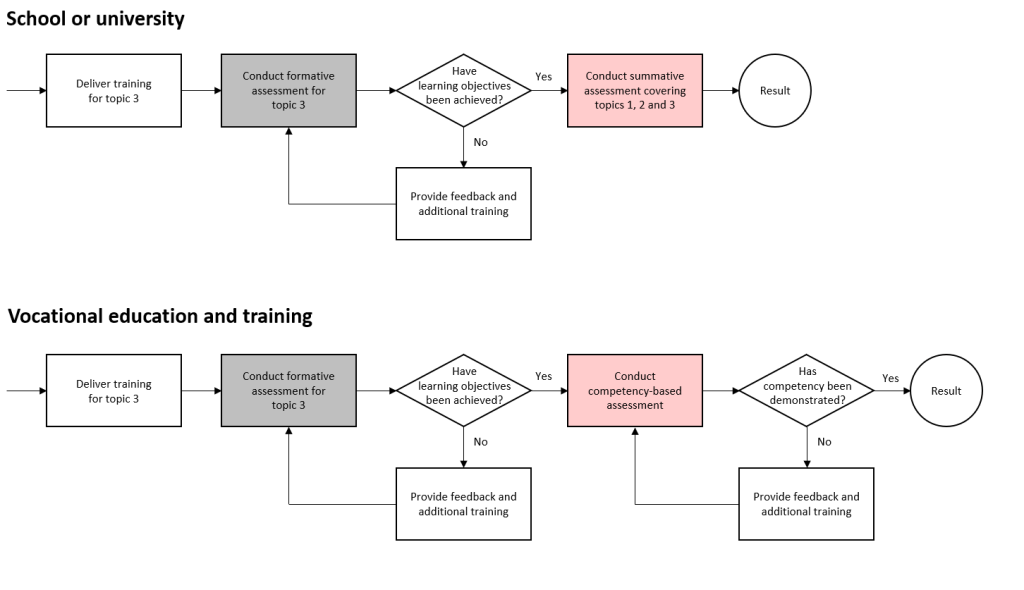
Schools and universities tend to conduct summative assessment and give the result as a grade or mark. The vocational education and training (VET) system in Australia has been designed to allow multiple attempts at becoming competent. The aim is to help people become competent rather than abruptly ending the training and assessment process when a person has been deemed not competent. The aim is to provide an employment pathway for job seekers or for people seeking work skills and career progression.

What is formative assessment?

The VOCEDplus website defines ‘Formative assessment’ as:

Assessment that takes place at regular intervals during a course, with feedback provided along the way to help improve the student’s performance. [3]

A ‘formative assessment’ in the Australian VET system is an activity used to check what has been learnt, or to determine if the learning objectives have been met. This activity could be conducted:

  • at the end of a training session
  • at the end of a training day
  • at the end of a training topic
  • at the end of a training module.

Questions and quizzes (I don’t like the terms ‘tests’ or ‘exams’) can be used to check if people have learnt the required knowledge. And observed practice can be used to check if people have learnt the required skills. Feedback can be provided to the learners. Feedback can be motivational and should be constructive. Feedback should identify areas needing additional training or further practice.

What is summative assessment?

The VOCEDplus website defines ‘Summative assessment’ as:

Assessment that occurs at a point in time and is carried out to summarise achievement at that point in time. Often more structured than formative assessment, it provides teachers, students and parents with information on student progress and level of achievement. [4]

This definition seems to be for a school context because it refers to teachers, students and parents. We need a definition for the Australian VET context.

In the Australian VET system, ‘Summative assessment’ is the assessment used to determine if a person is competent. This ‘assessment’ is defined in the glossary from the Standards for RTOs 2015 as:

Assessment is the process of collecting evidence and making judgements on whether competency has been achieved, to confirm that an individual can perform to the standard required in the workplace, as specified in a training package or VET accredited course. [5]

The VOCEDplus website provides this same definition for ‘assessment’.

Trainers and TAFE teachers working in the Australian VET system conduct assessment after all the training for a unit or cluster of units has been completed. This assessment is used to determine if a person is competent.

What is diagnosis assessment?

The VOCEDplus website does not give a definition for ‘Diagnosis assessment’.

Clause 1.7 of the Standards for RTOs 2015 states:

The RTO determines the support needs of individual learners and provides access to the educational and support services necessary for the individual learner to meet the requirements of the training product as specified in training packages or VET accredited courses. [6]

Most RTOs conduct a pre-training review to determine a person’s suitability for the training program. This includes a ‘diagnosis assessment’ to measure a person’s LLN skills and identify LLN skill gaps that may hinder their participation in the training program.

Many trainers and TAFE teachers are not directly involved in the administration of the pre-training review or the ‘diagnostic assessment’ of a person’s LLN skills.

In conclusion

People studying for their TAE40122 Certificate IV in Training and Assessment qualification will need to know about ‘formative assessment’ because it has been specified within the TAEDES412 Design and develop plans for vocational training unit of competency. It is highly likely that ‘diagnostic assessment’ and ‘summative assessment’ will also be covered.

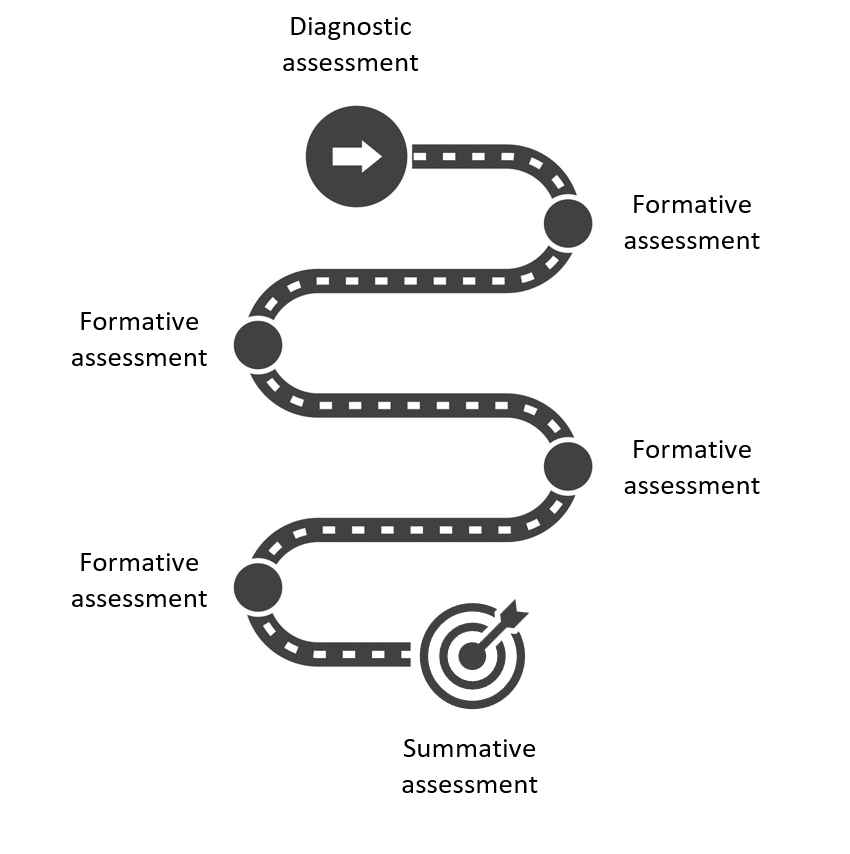
The following illustrates that ‘diagnostic assessment’ occurs before the training program, ‘formative assessment’ occurs multiple times during the training program, and ‘summative assessment’ occurs after the training program.
The following compares the difference between diagnosis assessment, formative assessment and summative assessment.

I have never heard these terms used by a trainer or TAFE teacher working for an RTO. The only reason I am writing an article about these terms is because it is in the TAE Training Packages. I wish the developers of TAE Training Package hadn’t introduced a range of unnecessary terms that complicates things.

In practice, I would discourage the use of these terms, in particular, ‘formative assessment’ and ‘summative assessment’. The following shows better terms that are more commonly used in the Australian VET system.

References

[1] ChatGPT response generate 21 April 2023 (what did Benjamin Bloom say about formative assessment?)

[2] ChatGPT response generate 21 April 2023 (what did Benjamin Bloom say about summative assessment?)

[3] https://glossary-vet.voced.edu.au/ assessed 22 April 2023 (formative assessment)

[4] https://glossary-vet.voced.edu.au/ assessed 22 April 2023 (summative assessment)

[5] Standards for Registered Training Organisations (RTOs) 2015

[6] Standards for Registered Training Organisations (RTOs) 2015

Do you need help with your TAE studies?

Are you a doing the TAE40122 Certificate IV in Training and Assessment, and are you struggling with your studies? Do you want help with your TAE studies?

Ring Alan Maguire on 0493 065 396 to discuss.

Contact now!

logo otws

Training trainers since 1986

What is a scope of registration?

This article has been written for people who are new to the Australian vocational education and training (VET) system. There is so many terms and acronyms to learn. It is like learning a new language.

You should be fluent at ‘VET speak’ by the time you have completed your Certificate IV in Training and Assessment qualification. However, it is best to avoid using this language when speaking to the people that you train and assess. You need to learn ‘VET speak’, but they don’t. When speaking with our students and learners, it is important for us to use plain English. We need to be a translator.

In this article I will explain what is an RTO’s scope of registration, and how to find an RTO’s scope of registration.

Introduction to scope of registration

A training organisation must be registered with a VET regulator before is can deliver nationally recognised training (NRT) and issue qualifications or statements of attainment. A registered training organisation (RTO) does not automatically have the approval to deliver all qualifications and skill sets. The RTO must apply to their VET regulator for approval to deliver particular training products. A training product can be:

  • A qualification from a Training Package
  • A skill set from a Training Package
  • A stand-alone unit of competency, such as, first aid
  • A VET accredited course.

The scope of registration is the list of training products the RTO has approval to deliver.

How to find an RTO’s scope of registration

The training.gov.au website is the National Register for VET in Australia. It provides details about all RTOs. [1]

Step 1

Go to the search function on the training.gov.au website. Select the ‘RTO/Org’ tab. Then enter the RTO’s name or RTO’s number.

Step 2

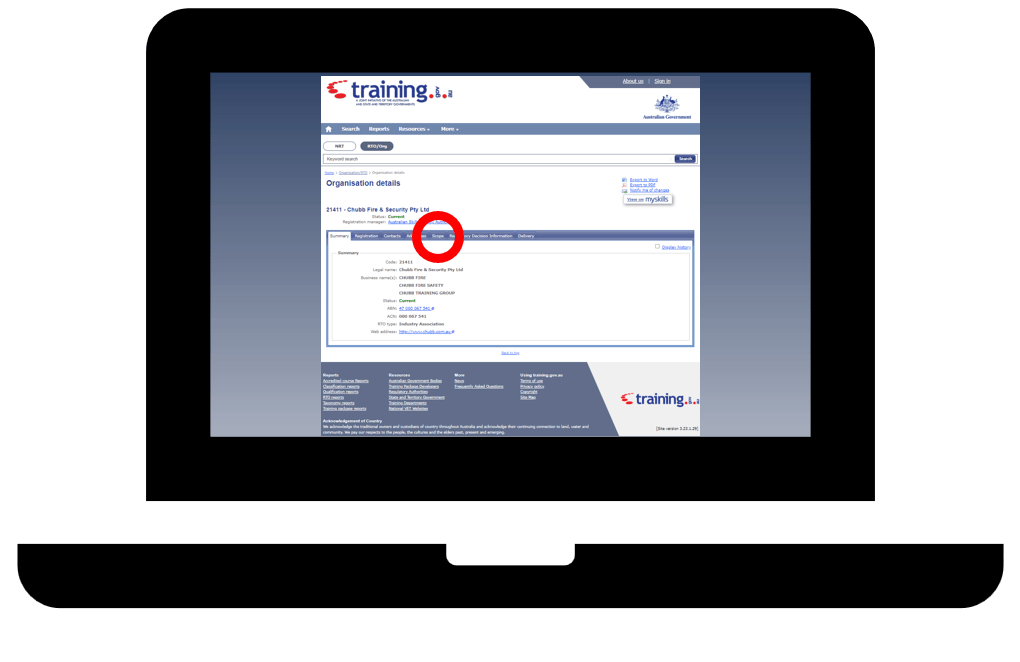
Go to the RTO’s webpage on the training.gov.au website. Select ‘Scope’.

Step 3

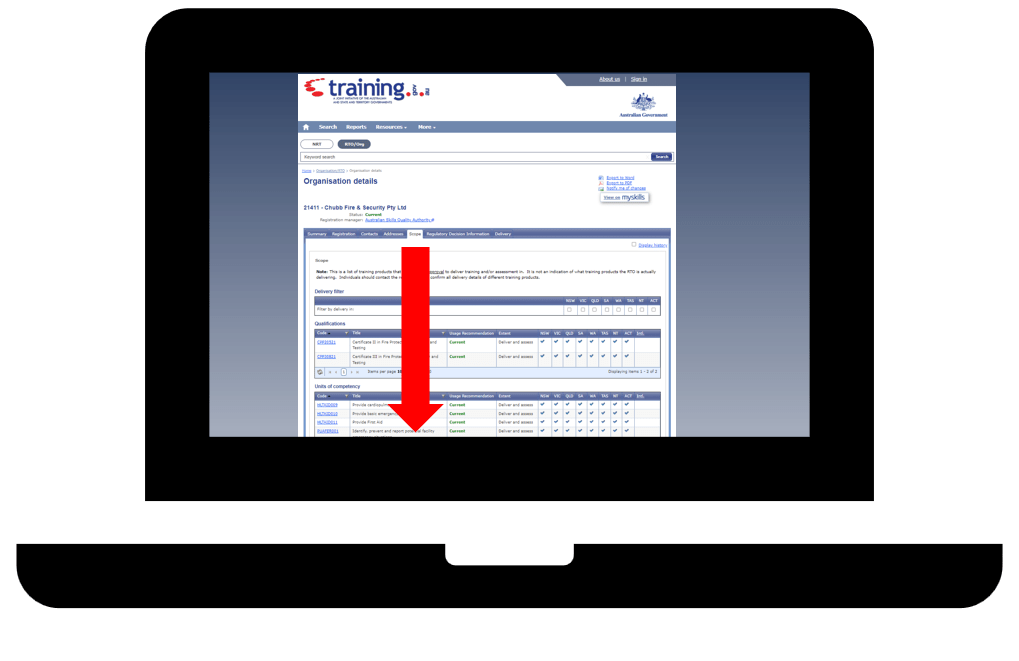
The RTO’s scope of registration will be displayed onscreen. You may need to scroll down to see all the training products that are on the scope of registration.

Big and small scopes of registration

Some RTOs have a small number of training products on their scope of registration, while other RTOs have a large number of training products on scope.

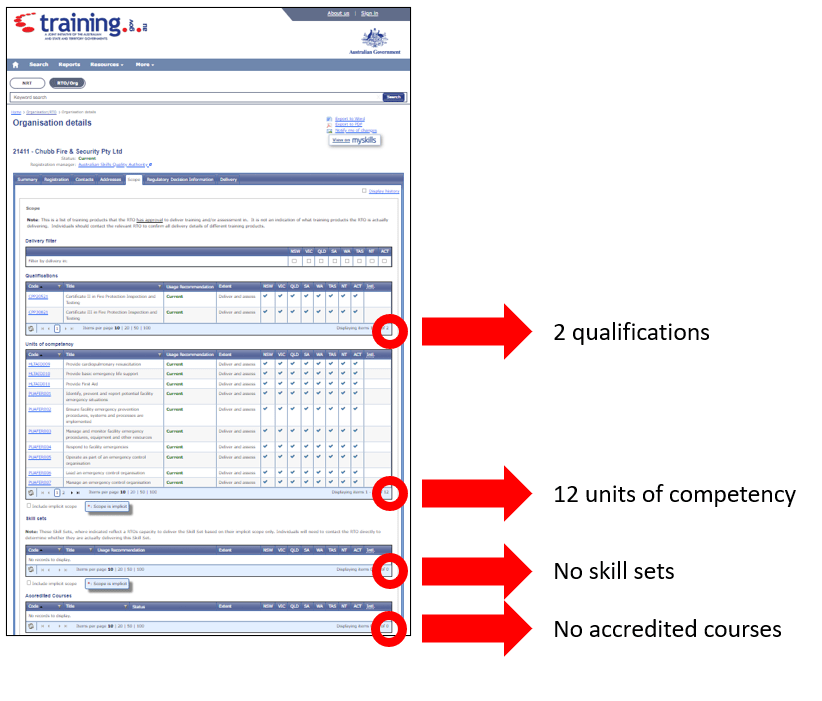
An example of an RTO with a small scope of registration

The following is an example of an RTO with a small scope of registration. Only 2 qualifications are listed.

An example of an RTO with a large scope of registration

The following is an example of an RTO with a large scope of registration. It lists 286 qualifications.

Exploring an RTO’s scope of registration

A scope of registration will list ‘Current’ and ‘Superseded’ qualifications. The ‘Superseded’ qualifications would disappear after the transition period has expired. The following shows the scope of registration for TAFE SA. It is only displaying the first 10 qualifications from a total of 286 qualifications.

As we would expect, the following shows that TAFE SA delivers training in South Australia.

A scope of registration shows the states, territories or international locations that the RTO delivers a particular training product. The following is an example for TAFE SA.

In conclusion

An RTO must apply for approval to deliver a training product. This approval process is conducted by the relevant VET regulator, and the approved training products are listed on the RTO’s scope of registration. The scope of registration for all RTOs are easily found on the training.gov.au website.

Note: The examples in this article when taken from the training.gov.au website on the 19th of April 2023. Information on the training.gov.au website is dynamic, and is constantly being updated.

Reference

[1] https://training.gov.au/Home/About accessed 19th of April 2023

Do you need help with your TAE studies?

Are you a doing the TAE40122 Certificate IV in Training and Assessment, and are you struggling with your studies? Do you want help with your TAE studies?

Ring Alan Maguire on 0493 065 396 to discuss.

Contact now!

logo otws

Training trainers since 1986
What are four key success factors for effective assessment validation?

Recently, I have been thinking deeply about assessment validation.

What are the key success factors for effective assessment validation?

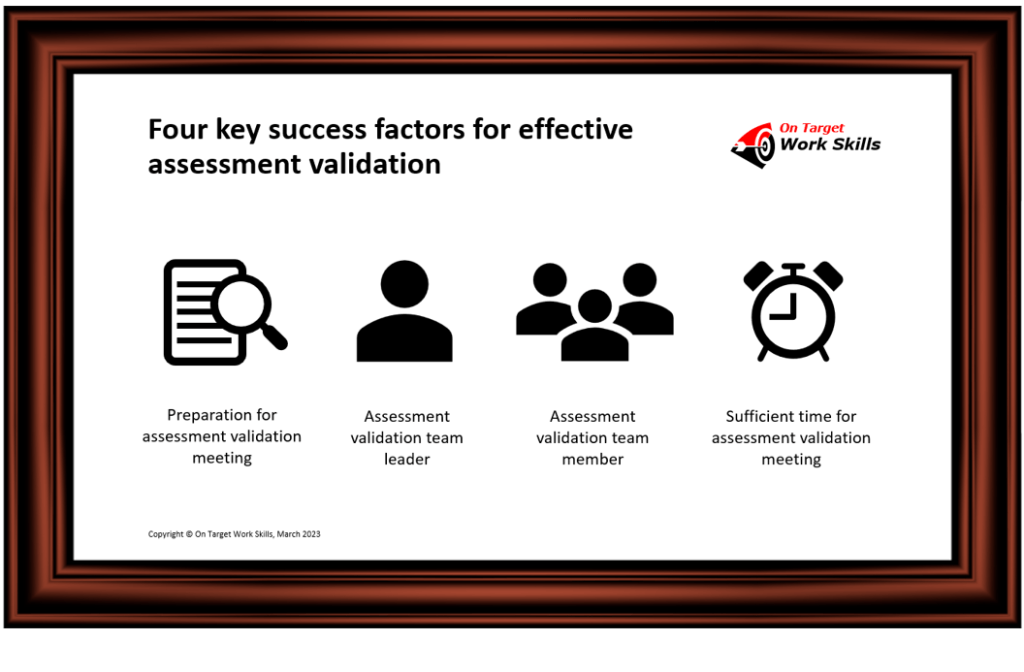
I have identified four key factors for effective assessment validation:

  • Preparation for the assessment validation meetings
  • Attributes of the assessment validation team leader
  • Attributes of the assessment validation team members
  • Sufficient time allocated for the assessment validation meetings.

Attributes of the assessment validation team leader

The team leader of the assessment validation must be qualified and experienced at guiding the assessment validation process. They must have a deep knowledge of assessment systems, assessment methods, and assessment tools. And they must have the ability to investigate details.

Attributes of the assessment validation team member

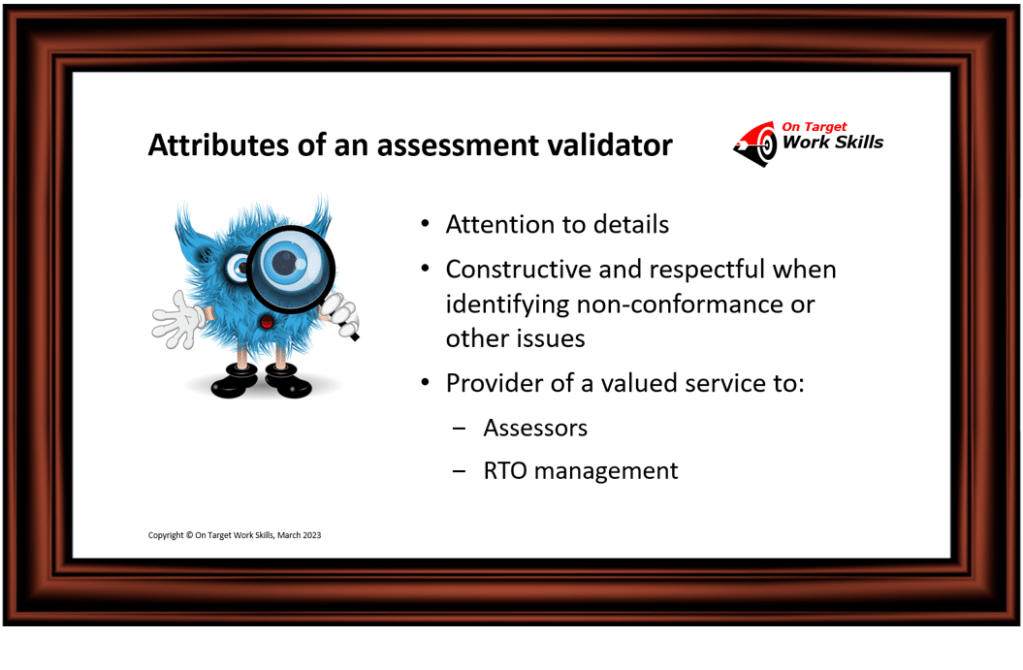
All members of the assessment validation team should have the ability to focus on and investigate details. Also, they should be constructive and respectful when identifying non-conformance or other issues. They play an important role in an RTO’s endeavors to continuous improve its assessment processes.

What does an assessment validation process look like?

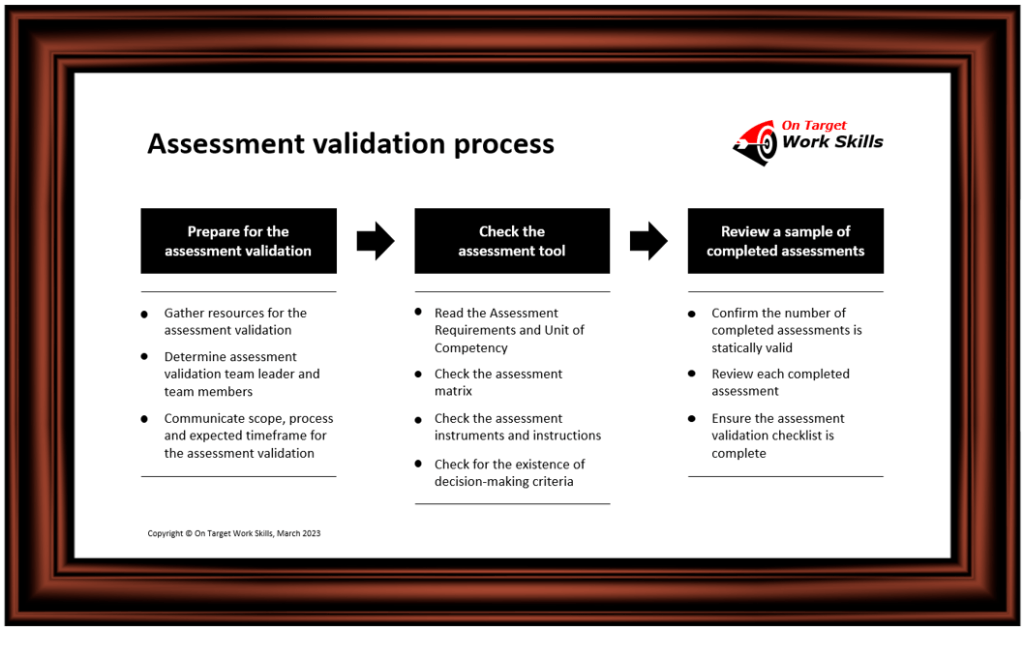
The following shows the 10-steps I have identified as being essential when preparing and conducting assessment validation.

It can be seen from the above, that I have simplified the assessment validation into 3 stages:

  • Prepare for the assessment validation
  • Check the assessment tool
  • Review a sample of completed assessments.

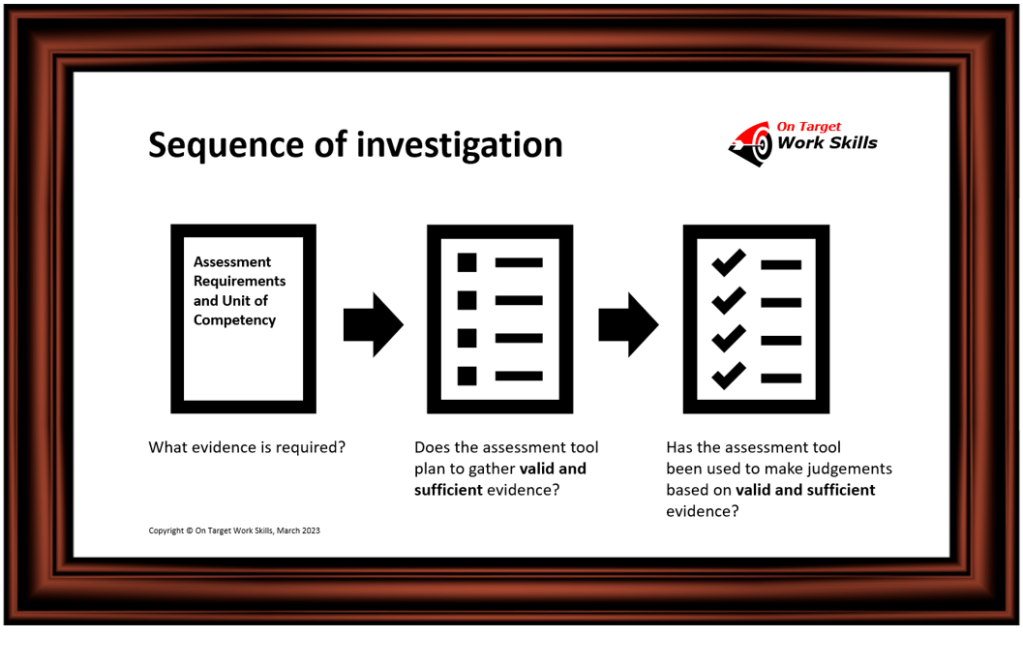
Assessment validation is an investigation. The following shows a logical sequence of investigation.

It should be noted that the four principles of assessment and the four rules of evidence are investigated during the assessment validation process.

What is the definition of assessment validation?

The Standards for RTOs define assessment validation as a quality review of the assessment process.

Assessment validation should identify how assessments could be improved.

The following shows how the assessment validation process feeds into the continuous improvement of an RTO’s service.

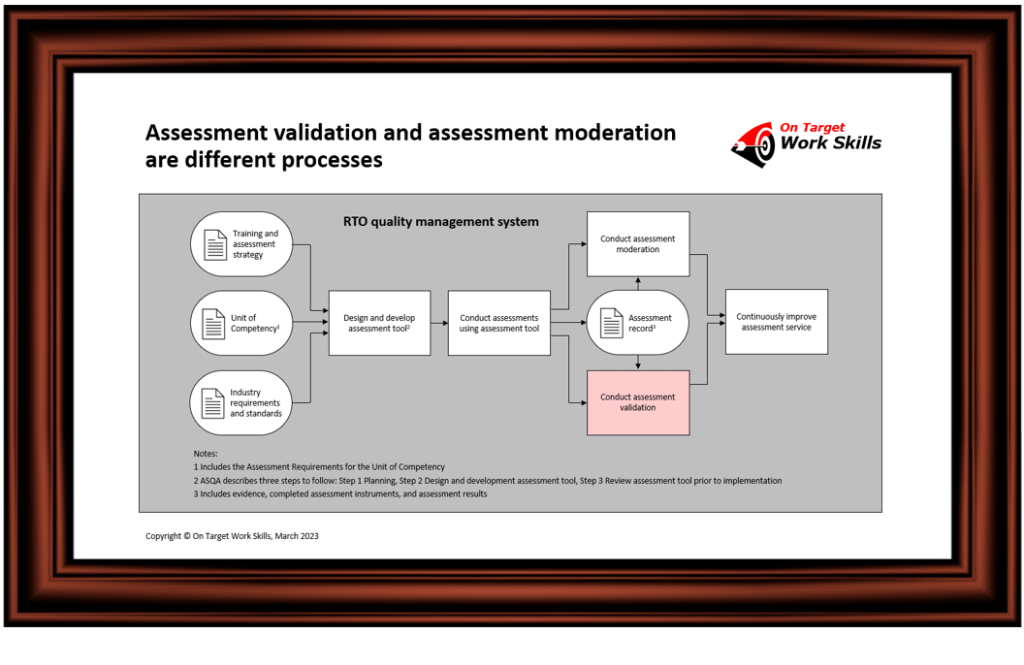
And the following shows that assessment validation process is different to activities associated with assessment moderation.

Do you need help with your TAE studies?

Are you a doing the TAE40122 Certificate IV in Training and Assessment, and are you struggling with your studies? Do you want help with your TAE studies?

Ring Alan Maguire on 0493 065 396 to discuss.

Contact now!

logo otws

Training trainers since 1986
TAEDEL311 Provide work skill instruction

The TAEDEL311 Provide work skill instruction unit of competency is an elective unit for the TAE40122 Certificate IV in Training and Assessment qualification. And it is highly likely that this unit will be selected as one of the elective units.

This article outlines and clarifies the TAEDEL311 unit.

Understanding the terminology

I have found that the TAEDEL311 Provide work skill instruction unit of competency has used clumsy terminology. It uses terminology that wouldn’t be used in the workplace. I have never heard someone in the workplace say that they are going to ‘provide work skill instruction’. It would be common for someone to say that they are going to ‘deliver training’.

Therefore, the very first thing we need to do is understand the terminology used in the TAEDEL311 Provide work skill instruction unit.

  • What is instruction?
  • What is a work skills?

What is instruction?

To understand the TAEDEL311 unit of competency, we need to understand what is meant by ‘instruction’. Instruction and training are often used interchangeably. Therefore, we can replace the word ‘instruction’ with ‘training’.

The application statement for the TAEDEL311 Provide work skill instruction unit infers that it is about conducting training for an individual and small groups. The size of the small group could be two or three learners.

The TAEDEL411 Provide vocational training unit of competency covers the delivery of training to groups of at least four learners. This is a relatively small group size for most trainers and TAFE teachers.

What is a work skill?

A skill is the ability to do something. Therefore, a work skill is the ability to do something at work.

In the Australian VET system, there are two prime domains of learning: knowledge and skills. The title of the TAEDEL311 Provide work skill instruction unit focuses us on conducting skills training, rather than knowledge training. In others words, the training is to help a person learn how to perform a work skill or work task. It is not about helping someone learn some knowledge.

What is the difference between a work skill and a work task?

A work skill is a specific ability that is required to perform a particular job or task effectively. It can be a technical skill or a foundation skill, such as:

  • Use a chainsaw (is an example of a technical skills)
  • Speak with others (is an example of a foundation skill).

A work task, on the other hand, refers to a specific activity that needs to be completed as part of a job or project. It can be a one-time task or a recurring responsibility, and it may require the use of one or more work skills to accomplish it. Here are some examples of a work task:

  • Cut down a tree (using a chainsaw)
  • Present product features and benefits to a customer.

In summary, work skills are the abilities that are needed to perform work tasks effectively, while work tasks are the specific activities that need to be completed as part of a job or project.

Translating the TAEDEL311 unit

Also, the elements and performance criteria for TAEDEL311 Provide work skill instruction unit of competency uses terminology that require translating in a way that reflects how people speak in the real workplace.

The following table shows the elements of competency compared with my description of the task relating to training to an individual or a small group.

My description of the task uses simple and common language that would typically be used in a workplace. It should be noted that the context for ‘training’ is about helping people to learn to perform work skills or work tasks, and this training is likely to be short duration (one or a small number of training sessions).

The following flowchart illustrates the description of the training process or task.

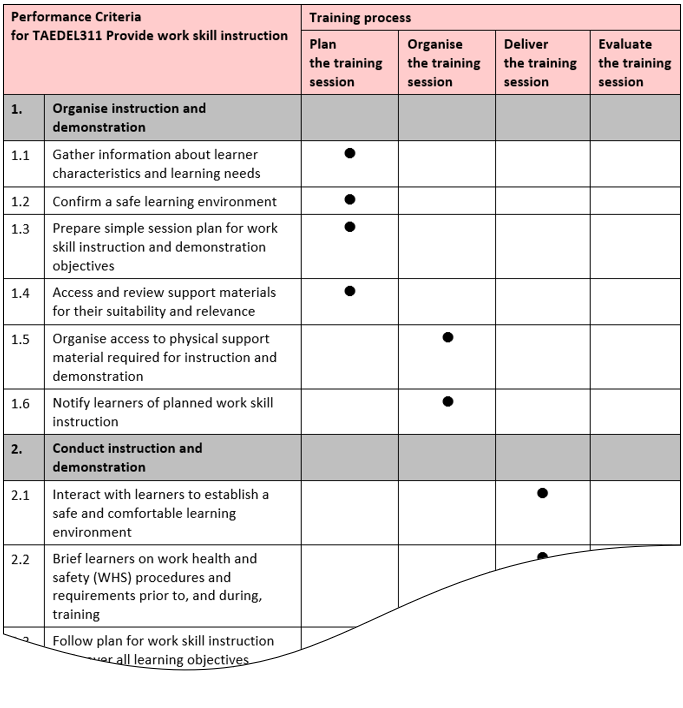
And the following matrix shows how my description of the training process can be mapped to the performance criteria for the TAEDEL311 unit.

Unpacking the TAEDEL311 unit

The required knowledge for the TAEDEL311 unit is specified by the Knowledge Evidence. And the required skills for the TAEDEL311 unit are specified by the Foundation Skills. If you are studying for your TAE40122 qualification, and you don’t yet know what Knowledge Evidence and Foundation Skills are, you will find out about these things later in your studies.

Required knowledge for the TAEDEL311 unit

The following required knowledge is specified by the TAEDEL311 unit:

  • Organisational procedures for gathering feedback from learners on work skill instruction [KE1]
  • Learner characteristics and needs [KE2]
  • Information included in a plan for work skill instruction: [KE3]
    • Session plan, consisting of session objectives, content to be covered, and delivery approach to be used
    • Task breakdown
    • Timing
  • Sources, availability and content of suitable support materials [KE4]
  • Training facilitation and coaching techniques to support adult learning relevant to work skill instruction, and when to use them [KE5]
  • Overview of adult learning principles and their application to work skill instruction [KE6]
  • Key steps for practising self-reflection on own work skill instruction to identify opportunities for improvement [KE7]
  • Sources of assistance relating to contextualising support materials to the workplace [KE8]
  • Work health and safety (WHS) issues in the learning environment, including: [KE9]
    • Roles and responsibilities of key personnel
    • Responsibilities of learners
    • WHS policies and procedures, including those relating to hazard and risk identification, and safe use of equipment and emergency procedures
    • Risk controls for the specific learning environment.

Required skills for the TAEDEL311 unit

The following required skills are specified by the TAEDEL311 unit:

  • Reading: Sources and interprets processes and procedures, support materials, and information relevant to providing work instruction [FS1]
  • Writing: Completes required workplace documentation using appropriate language and format [FS2]
  • Oral communication: Uses communication techniques to build rapport, monitor progress and provide feedback to learners [FS3]
  • Numeracy: Interprets and uses scheduling and sequencing information, and estimates time [FS4]
  • Initiative and enterprise: Asks questions to clarify understanding, and to provide and seek feedback [FS5]
  • Initiative and enterprise: Identifies and responds to potential risks, problems and opportunities for improvement and considers options for different approaches [FS6]
  • Planning and organising: Organises and completes work according to defined requirements, taking responsibility for some decisions and sequencing tasks to achieve efficient outcomes [FS7]
  • Teamwork: Builds rapport and establishes productive working relationships to achieve learning outcomes [FS8]

Knowledge and skills required to deliver training to an individual or small group

The following tables shows how the required knowledge and skills can be mapped to each performance criteria for the TAEDEL311 unit.

And the following table shows how the required knowledge and skills can be mapped against my description of task to help people to learn to perform work skills or work tasks.

In conclusion

The TAEDEL311 Provide work skill instruction unit of competency can be described as a 4-step training process:

  • Step 1. Plan the training
  • Step 2. Organise the training
  • Step 3. Deliver the training
  • Step 4. Evaluate the training.

Do you need help with your TAE studies?

Are you a doing the TAE40122 Certificate IV in Training and Assessment, and are you struggling with your studies? Do you want help with your TAE studies?

Ring Alan Maguire on 0493 065 396 to discuss.

Contact now!

logo otws

Training trainers since 1986
What is neurodiversity? And what do trainers need to know about it?

Background

The TAEDEL411 Facilitate vocational training is a core unit of competency for the new TAE40122 Certificate IV in Training and Assessment qualification. It describes the skills and knowledge required to plan, prepare and deliver training within the Australian VET system.

A range of required knowledge are specified. And one piece of knowledge relates to the training methods and techniques that can be used to support effective learning. Not every learner is the same. Learners can have different characteristics, needs, and behaviours.

The TAEDEL411 Facilitate vocational training unit of competency identifies the following three characteristics that trainers must know how to respond to:

  • cultural and social practices
  • mental health and wellness considerations
  • neurodiversity.

This article will describe what neurodiversity is, and identify training methods and techniques that can be used to support effective learning for learners who are neurodiverse.

What is neurodiversity?

Neurodiversity refers to the natural variations in brain function and behaviour that are considered normal, such as differences in attention, perception, and learning styles. This concept views these differences as a form of diversity rather than as a disorder or deficit, and seeks to promote acceptance, understanding, and support for people with neurodiverse conditions like autism, ADHD, dyslexia, and others.

Neurodiversity is not a scientific term, but rather a cultural and political movement that aims to challenge negative attitudes and stereotypes, and promote equal opportunities and accommodations for people with neurodiverse conditions.

How does autism, ADHD and dyslexia differ?

Autism Spectrum Disorder (ASD), Attention Deficit Hyperactivity Disorder (ADHD), and dyslexia are three distinct neurodevelopmental conditions that can impact an individual’s functioning in different ways.

Autism Spectrum Disorder (ASD) affects social interaction, communication, and behaviour. Individuals with ASD may struggle with social interactions and communication, and may display repetitive behaviours or interests.

Attention Deficit Hyperactivity Disorder (ADHD) is a condition that affects attention, hyperactivity, and impulsivity. Individuals with ADHD may struggle with focus, staying on task, and controlling their impulses.

Dyslexia is a specific learning disorder that affects reading and processing written language. Individuals with dyslexia may have difficulty decoding words, recognising letters, and comprehending text.

While these conditions are distinct, they can also overlap and co-occur. For example, individuals with autism or ADHD may also have dyslexia, and individuals with dyslexia may also have attention difficulties. It is important to note that each individual is unique and may experience these conditions differently. A comprehensive evaluation is typically necessary to diagnose and distinguish between these conditions.

How can trainers support effective learning for a person with autism?

Trainers can support effective learning for a person with autism in a number of ways, such as:

  • Creating a structured and predictable learning environment: Individuals with autism tend to do well with structure and routine. Providing a consistent and predictable learning environment can help reduce anxiety and support learning.
  • Using clear and concise language: Individuals with autism may have difficulty understanding and processing complex language or figurative language. Using simple, clear, and concise language can help ensure that the learner understands the material.
  • Using visual aids: Many individuals with autism are visual learners and may benefit from the use of visual aids such as diagrams, pictures, and videos to support learning.
  • Providing opportunities for hands-on learning: Individuals with autism may benefit from hands-on learning opportunities that allow them to explore and manipulate materials.
  • Incorporating the learner’s interests: Many individuals with autism have strong interests in particular topics. Incorporating these interests into the learning material can help engage the learner and increase their motivation to learn.
  • Allowing breaks and sensory regulation: Individuals with autism may experience sensory overload or have difficulty regulating their sensory input. Allowing breaks or providing sensory regulation tools, such as a fidget items or noise-cancelling headphones, can help the learner manage their sensory needs and stay focused.

How can trainers support effective learning for a person with ADHD?

Trainers can support effective learning for a person with ADHD in the following ways:

  • Providing clear and concise instructions: People with ADHD may have difficulty processing lengthy or complicated instructions. Trainers can break down instructions into smaller, more manageable steps to help learners with ADHD stay focused.
  • Using visual aids: Visual aids such as diagrams, pictures, and videos can help learners with ADHD better understand and retain information.
  • Minimising distractions: Trainers can create a distraction-free learning environment by reducing noise levels, removing unnecessary objects, and limiting interruptions.
  • Incorporating movement breaks: People with ADHD may benefit from short, frequent breaks that allow them to move and release excess energy. Trainers can incorporate movement breaks into the learning experience to help learners with ADHD stay engaged.
  • Providing positive reinforcement: Trainers can use positive reinforcement techniques, such as praise or rewards, to motivate learners with ADHD and reinforce desired behaviours..
  • Allowing for flexibility: People with ADHD may have difficulty adhering to strict schedules or routines. Trainers can allow for flexibility in the learning experience, such as allowing extra time for assignments or providing alternative methods of demonstrating knowledge.
  • Communicating regularly: Regular communication between trainers and learners with ADHD can facilitate progress monitoring, feedback provision, and adjustment making as necessary. This, in turn, can promote a sense of support and keep learners with ADHD on track during the learning process.

How can trainers support effective learning for a person with dyslexia?

Here are some ways in which trainers can support effective learning for a person with dyslexia:

  • Using multisensory approaches: People with dyslexia may benefit from multisensory learning experiences that engage multiple senses, such as visual, auditory, and kinaesthetic. Trainers can incorporate activities that involve writing, drawing, listening, and moving to help learners with dyslexia better understand and retain information.
  • Providing extra time: People with dyslexia may need extra time to process information, read and write. Trainers can provide additional time for assignments and assessments to allow learners with dyslexia to work at their own pace.
  • Using assistive technology: Assistive technology, such as text-to-speech software, can help learners with dyslexia access written material more easily. Trainers can incorporate the use of assistive technology into the learning experience to support learners with dyslexia.
  • Simplifying language: Trainers can simplify language by using shorter sentences, less complex vocabulary, and providing examples to help learners with dyslexia better understand concepts.
  • Providing positive reinforcement: Trainers can use positive reinforcement techniques, such as praise or rewards, to motivate learners with dyslexia and reinforce desired behaviours.
  • Allowing for flexibility: Trainers can allow for flexibility in the learning experience, such as providing alternative methods of demonstrating knowledge or allowing learners to work independently.
  • Communicating regularly: Trainers can communicate regularly with learners with dyslexia to monitor progress, provide feedback, and make adjustments as needed. This can help learners with dyslexia stay on track and feel supported throughout the learning process.

In conclusion

This article has explored neurodiversity as one of three learner characteristics identified by the TAEDEL411 Facilitate vocational training unit of competency.

Trainers can support effective learning for individuals who are neurodiverse by understanding their unique learning styles and needs, and adapting training strategies accordingly.

The following is a summary of some training methods and techniques for trainers to use:

  • Creating a structured and predictable learning environment
  • Simplify language
  • Use clear and concise instructions
  • Minimise distractions
  • Incorporate the learner’s interests
  • Use visual aids
  • Use multisensory approaches
  • Provide opportunities for hands-on learning
  • Incorporate movement breaks
  • Provide extra time
  • Allow for flexibility
  • Communicate regularly
  • Providing positive reinforcement.

Note: ChatGPT has been used to gather content for this article.

Do you need help with your TAE studies?

Are you a doing the TAE40122 Certificate IV in Training and Assessment, and are you struggling with your studies? Do you want help with your TAE studies?

Ring Alan Maguire on 0493 065 396 to discuss.

Contact now!

logo otws

Training trainers since 1986