What are microcredentials?

The Conversation published the following description on the 14th of October 2021:

“In Australia, the term microcredential describes different types of smaller bites of learning offered by universities, TAFEs and private education providers. The term is often used interchangeably with short courses…” [1]

The Australian Government’s Department of Education, Skills and Employment released the National Microcredentials Framework on the 22nd of April 2022. This document gives the following definition:

The framework defines microcredentials as a certification of assessed learning or competency, with a minimum volume of learning of one hour and less than an AQF award qualification, that is additional, alternate, complementary to or a component part of an AQF award qualification. [2]

From these sources, we can say that a microcredential is usually a short duration training program that includes assessment. Certification is issued to people who can demonstrate their attainment of the learning outcomes.

Who can provide a microcredential?

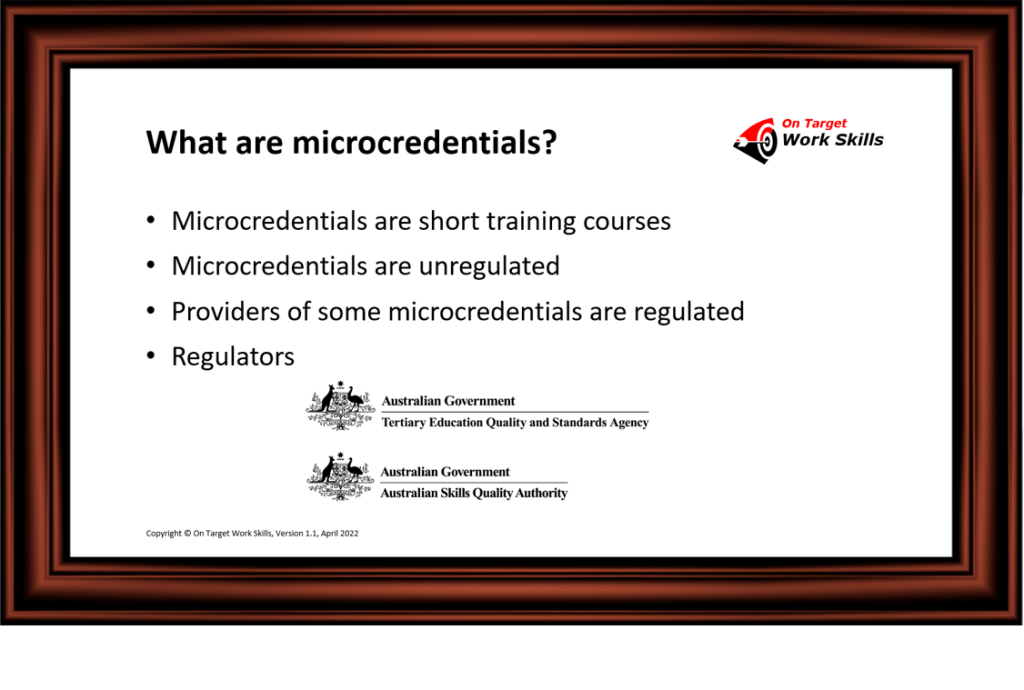
Microcredentials are unregulated, which differentiates them from other products delivered by higher education or vocational education and training sectors. [3] There are many providers of microcredentials.

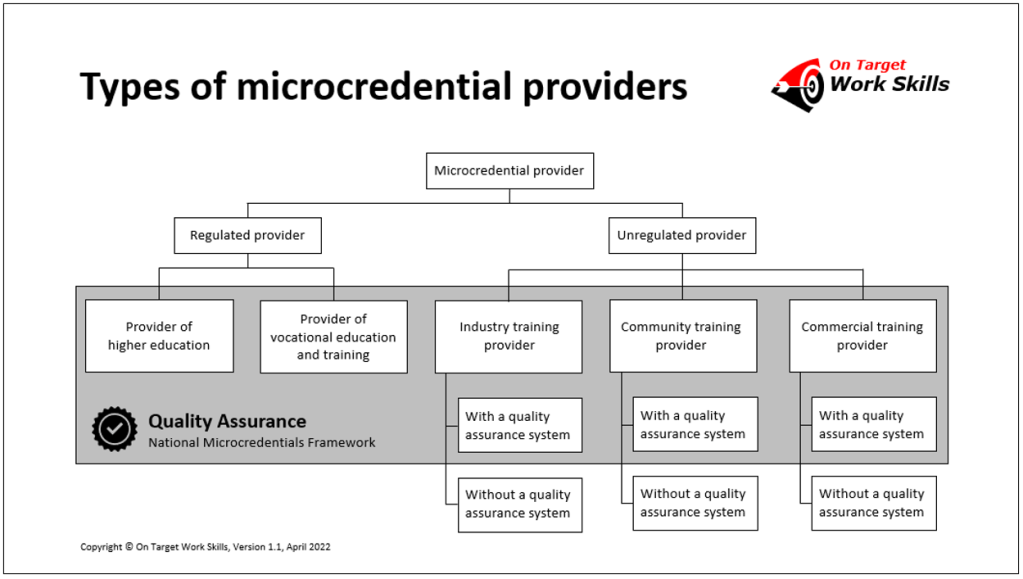
There are ‘regulated providers’ of microcredentials:

  • Universities and other higher education providers (regulated by TEQSA)
  • Registered training organisations (regulated by ASQA).

There is a myriad of ‘unregulated providers’ of microcredentials:

  • Providers of industry training (some are industry associations, others can be affiliated with an industry associations, and others may align their microcredentials to industry standards)
  • Providers of community training
  • Providers of commercial training.

Also, some ‘regulated providers’ are providing microcredentials that are ‘non-regulated microcredentials’. For example, a registered training organisation can provide a microcredential that is not a skill set, unit or units of competency from a Training Package. This leverages from the brand recognition of the provider and avoids requiring the microcredential to comply with the regulations for operating as a registered training organisation.

The following diagram provides a simplistic view of the range of microcredential providers.

In conclusion

The microcredentials ecosystem is disparate. The National Microcredentials Framework aims to bring some coherence to this ecosystem. [4]

Do you want to learn more about the National Microcredentials Framework? I am presenting a ‘How to implement the National Microcredentials Framework‘ training course. The following topics will be covered during the 2-hours of training:

  • National Microcredentials Framework
  • Unifying principles of microcredentials
  • Volume of learning for microcredentials
  • Learning outcomes and assessment methods
  • Critical information requirements for microcredentials
  • Essential quality assurance processes for microcredentials
  • Five steps towards implementing microcredentials.

Look here for more details.

References

[1] https://theconversation.com/microcredentials-what-are-they-and-will-they-really-revolutionise-education-and-improve-job-prospects-169265 accessed 6 April 2022

[2] https://www.dese.gov.au/higher-education-publications/resources/national-microcredentials-framework (page 3) accessed 6 April 2022

[3] https://www.dese.gov.au/higher-education-publications/resources/national-microcredentials-framework (page 12) accessed 6 April 2022

[4] https://www.dese.gov.au/higher-education-publications/resources/national-microcredentials-framework (page 2) accessed 6 April 2022

logo otws

Training trainers since 1986

Webinar: How to implement the National Microcredentials Framework

The National Microcredentials Framework was released on the 22nd of March 2022. The Framework aims to provide a nationally consistent framework for defining microcredentials across higher education (HE), vocational education and training (VET), and industry.

On Target Work Skills is proud to have developed a learning program about how to implement the National Microcredentials Framework. This program consists of:

  • 2-hour training session
  • Assessment tasks (optional).

This program is being delivered as a microcredential with the following characteristics specified by the National Microcredentials Framework:

  • The learning outcomes for the microcredential must be clearly stated
  • A microcredential requires assessment that provides evidence that learning outcomes have been achieved
  • Microcredentials must have a volume of learning that is at least one hour
  • Microcredentials may certify the attainment of skills, knowledge, and competencies.

Learning outcomes

The learning outcomes for this program are:

  • Develop learning outcomes for a microcredential
  • Describe the assessment method for a microcredential
  • Estimate the volume of learning for a microcredential
  • Write a microcredential descriptor using the critical information requirements as a guide
  • Write a quality assurance statement
  • Draft an accurate and truthful certificate of attainment for a microcredential.

Key content points

The key content for this learning program are:

  • National Microcredentials Framework
  • Unifying principles of microcredentials
  • Volume of learning
  • Learning outcomes
  • Assessment methods
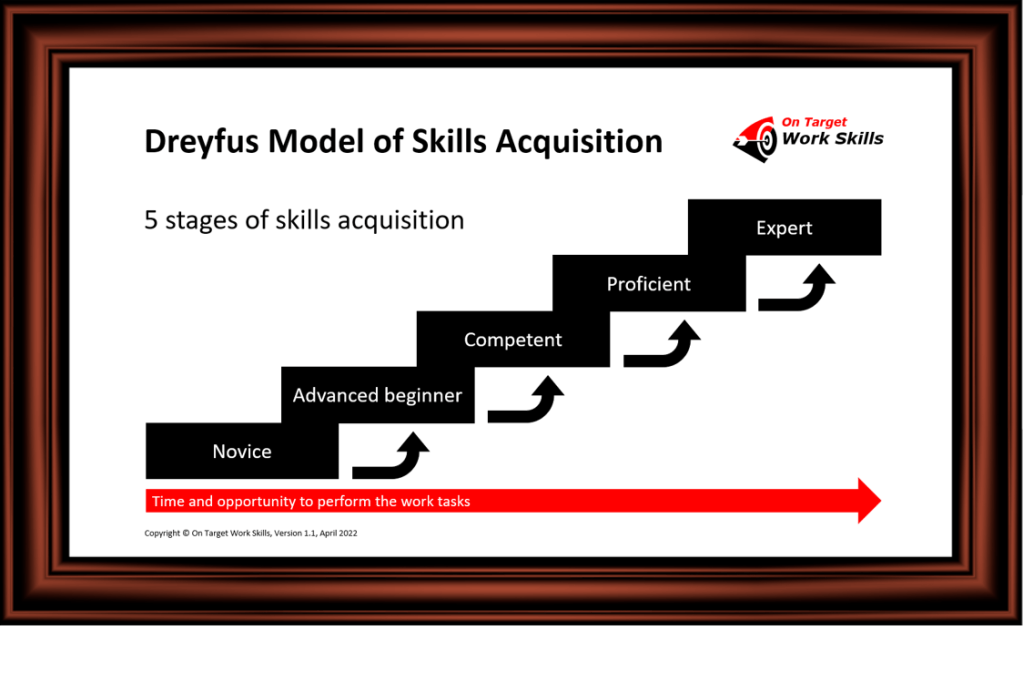
  • Levels of skills acquisition
  • Critical information requirements
  • Accurate and truthful certification
  • Essential quality assurance processes
  • Quality assurance statement
  • Implementation steps.

Assessment

Assessment is optional. You may complete and submit the following practical assessment tasks:

  • Develop learning outcome for a microcredential
  • Describe the assessment method for a microcredential
  • Estimate the volume of learning for a microcredential
  • Write a microcredential descriptor using the critical information requirements as a guide
  • Write a quality assurance statement
  • Draft an accurate and truthful certificate of attainment for a microcredential.

If you are assessed as having attained the learning outcome, then you will receive a ‘Certificate of Attainment’.

If you decide not to be assessed, you will be issued with a ‘Certificate of Attendance’ that still can be valid evidence of participation in structured professional development.

Please call Alan Maguire on 0493 065 396 for further details or to discuss.

Contact now!

logo otws

Training trainers since 1986

National Microcredentials Framework

The National Microcredentials Framework was released on the 22nd of March 2022.

About the National Microcredentials Framework

Microcredentials are unregulated. The aim of the National Microcredentials Framework is to provide a nationally consistent framework for defining microcredentials across higher education, vocational education, and industry.

The Framework encourages all microcredentials to adhere to the following four principles:

  • Outcome-based
  • Driven by industry need
  • Tailored or support lifelong learning
  • Transparent and accessible.

Critical information requirements

The National Microcredentials Framework outlines critical information requirements that providers should consider using when advertising their microcredentials.

Minimum standards

The National Microcredentials Framework describes a number of minimum standards for microcredentials:

The learning outcomes for the microcredential must be clearly stated.

A microcredential requires assessment that provides evidence that learning outcomes have been achieved.

Microcredentials must have a volume of learning that is at least one hour.

Microcredentials may certify the attainment of skills, knowledge, and competencies.

Unregulated providers of microcredentials must provide a quality assurance statement with the following suggested elements:

  • Profile of the provider
  • A description of the quality assurance processes
  • The process for reviewing and updating the microcredential.

Announcement from On Target Work Skills

As from the 29th of March 2022, On Target Work Skills has officially become a provider of microcredentials. The first microcredential being offered is, ‘How to implement the National Microcredentials Framework‘.

logo otws

Training trainers since 1986

Evidence of competency

This article was written in March 2022.

I frequently see assessment instruments being used by TAFEs and private RTOs that do not comply with the requirements specified by the Standards for RTO. The national VET regulator, ASQA, was established in 2011. It is astonishing that after more than a decade, ASQA has been unable to encourage or enforce compliance. And what makes it even more astonishing is a move towards self-regulation. This will allow the many RTOs that are not currently compliant, to self-regulate their future compliance (or should I say, self-regulate their non-compliance).

Recently, I assisted a TAFE employee to develop assessment instruments for the CPCCCA3010 Install windows and doors unit of competency. Consequently, I was prompted to write this article as a case study to explore:

  • How to determine the number of assessment tasks
  • How to develop an assessment instrument to gather performance evidence
  • How to develop an assessment instrument to gather knowledge evidence.

How to determine the number of assessment tasks

I always start with determining how many assessment tasks will be needed to cover the assessment requirements. This must be done before designing and developing the assessment instruments.

As a general rule, there should be a plan for at least two assessment tasks:

  • An assessment task to gather the knowledge evidence
  • At least one other assessment task to gather the performance evidence.

It is common to need more than one assessment task to gather the frequency or volume of performance evidence that is specified by the Assessment Requirements.

Let’s look at how many assessment tasks are required to gather the performance evidence for the CPCCCA3010 Install windows and doors unit of competency. The Performance Evidence for this unit states:

A candidate can not do all these tasks at the same time. Therefore, I would plan for four (4) assessment tasks to gather the specified performance evidence.

I usually assign ‘Assessment Task 1’ for the gathering of knowledge evidence. Therefore, I would have a total of five (5) assessment tasks for the CPCCCA3010 Install windows and doors unit of competency.

The CPCCCA3010 Install windows and doors unit of competency has six (6) elements of competency. The first and last elements are common for installing all windows and doors. The other elements of competency are only relevant to specific tasks determined by the type of door or window being installed. The following matrix shows the connection between each element of competency and each assessment tasks.

The design and development of an assessment tool is a creative process. Sometimes, we may need to change of initial assessment plan in regard to the number of assessment tasks.

How to develop an assessment instruments to gather performance evidence

So far, we have determined the need to have four (4) assessment tasks to gather the performance evidence for the CPCCCA3010 Install windows and doors unit of competency. Each of these assessment tasks may follow a 3-part process:

  • Part 1. Plan and prepare
  • Part 2. Install
  • Part 3. Clean up

An observation checklist may be used to gather the performance evidence. I would consider the need to develop an observation checklist for each assessment task. Therefore, there will be four (4) observation checklists developed. However, some observation items will be the same for each checklist.

For example, the same observation items can be used for:

  • Plan and prepare (as specified by Element 1 of the CPCCCA3010 unit)
  • Clean up (as specified by Element 6 of the CPCCCA3010 unit).

But some observation items will be different because the installation of different types of doors and windows are different, and there are different Performance Criteria specified. For example, the observation checklist for Assessment Task 2 would include the Performance Criteria for Element 2, but not the Performance Criteria for Elements 3, 4 and 5.

The following matrix highlights Assessment Task 2. It shows what elements of competency are the same or different to the other assessment tasks used to gather performance evidence.

The next step will be to develop the assessment instruments.

For the purpose of this example, a third-party report is not being used to gather evidence. It is common for building and construction apprenticeships to include the CPCCCA3010 Install windows and doors unit of competency. Therefore, the apprentice would perform work under the supervision of a builder or building site supervisor. These people would ideally contribute to assessment by providing third-party evidence.

This example is only showing assessment tasks conducted by an assessor to gather performance evidence.

Developing the observation checklist

The items of an observation checklist should not be a ‘copy and paste’ of the performance criteria. Performance criteria can be vague or ambiguous. And performance criteria can lack sufficient details to clearly communicate the benchmark or expected standard of performance.

The following table show how the Performance Criteria could be analysed. It only uses the first four performance criteria of Element 1 as an example.

The technique is basically about you asking yourself questions. These questions aim to seek clarity. And these question help to interpret and contextualise.

The next thing is to draft the observation items for the checklist. The following table shows the development of observation items for the first four (4) performance criteria of Element 1.

The above table also shows how additional evidence could, or should, be gathered. These would be in addition to the observation checklist.

Many RTOs will have their own templates to be used for assessment instruments. The following an example of an observation checklist for the first four (4) performance criteria of Element 1

Sometimes, the sequence of items on the observation checklist can be different than the numerical order of performance criteria. Sometimes one performance criteria may need more than one observation items, and sometimes several performance criteria may be adequately covered by one observation item.

We need to be flexible in our approach to the development of an observation checklist. Each unit of competency is different. Therefore, the observation checklist must be created to meet the unique requirements specified by each unit of competency.

Developing a product review checklist

An observation of a person performing work tasks will often be used to gather direct evidence of performance. Sometimes, the review of a product that has been produced during the performance of the work task will be used as evidence. A product review checklist would need to be developed for an assessor to use during the assessment process.

The product to be reviewed may be:

  • A document
  • A completed form
  • A physical item
  • A non-physical item.

How to develop an assessment instruments to gather knowledge evidence

I recommend the development of an assessment task to gather all the specified Knowledge Evidence. Create a table to ensure you write at least one question to gather the knowledge evidence specified.

The following is an example for a table created for the CPCCCA3010 Install windows and doors unit of competency.

The next step is to start writing questions. Sometimes, one question will not be enough to cover the breath or depth of knowledge required. Therefore, a set of questions may need to be asked. The following are two examples.

Example 1: This is an example for the Knowledge Evidence item 5.

Example 2: This is an example for the Knowledge Evidence item 6.

Numbering the questions

Consider how the questions are going to be numbered.

Let’s say, there are four questions to be asked to gather evidence for one Knowledge Evidence item. The following are three different ways that the questions could be numbered:

  • Q6a, Q6b, Q6c, Q6d.
  • Q6.1, Q6.2, Q6.3, Q6.4
  • Q6, Q7, Q8, Q9

Sequencing the questions

Consider the sequence the questions. Sometimes, the questions may be re-sequenced to present them in a logical order or asking questions that relate to a similar topic. For example, asking all questions relating to safety one after the other rather than scattered.

Structuring the questions

Consider giving structure to the questions. This can be done by using ‘topic headings’ with all questions relating to the topic under that heading. This will make a large number of questions easier to navigate.

Attributes needed to design and develop assessment instruments

The following attributes are required by people wanting to design and develop assessment tools:

  • Good word processing skills
  • Analytical skills and the willingness to spend time conducting the analyst
  • Subject matter expertise.

Good word processing skills

Many RTOs have templates to be used. Unfortunately, many of these templates have been developed by word processing wizards, making them difficult to use or modify for people with limited word processing skills.

Analytical skills and the willingness to spend time conducting the analyst

Earlier this week, one of my TAE Students said,

“We have been working on planning, designing and developing an assessment tool for a day and half. And we still are not yet finished. It takes a long time to create the assessment documents just to assess if some can or cannot use a hand-held radio.”

The time required to conduct an assessment to determine if a person is competent at using a hand-held radio is typically going to be less than an hour. It is a relatively low level skill. But it takes a long time to develop a compliant assessment tool. People need time to analyse the unit of competency and associated assessment requirements. And then more time to draft assessment documents, review and trial assessment documents, and finalise assessment documents prior to implementation.

People need to know how to conduct the analysis and be willing to spend their time doing it. It can take a lot of time to design and develop compliant assessment instruments.

Subject matter expertise

The design and development of assessment instruments require subject matter expertise. It the developer is not a subject matter expert, then they will need to work with one.

In conclusion

Gathering valid and sufficient evidence of competency is a fundamental part of the assessment process. It takes time and effort to design and develop the assessment instruments to gather the required knowledge evidence and required performance evidence. Two essential sources of information are:

ASQA’s Guide to assessment tools

ASQA’s Conduct effective assessment

Other articles

And you may be interested in other related articles that I have written:

Guide to developing assessment tools

How to develop an assessment tool to gather knowledge evidence

Knowledge evidence and the Australian VET system

Do you need help with your TAE studies?

Are you a doing the TAE40122 Certificate IV in Training and Assessment, and are you struggling with your studies? Do you want help with your TAE studies?

Do you want more information? Ring Alan Maguire on 0493 065 396 to discuss.

Contact now!

logo otws

Training trainers since 1986

‘Stackable’ skill sets and the TAE Training Package

The Education Industry Reference Committee (IRC) is exploring ‘stackable’ skill sets. The aim is to support entry-level trainers and assessors working under supervision prior to attaining their full qualification. In this article, I will answer the following questions:

  • What knowledge and skills would benefit a new trainer starting work at an RTO?
  • Why would a person do ‘stackable’ skill sets instead of the full qualification?
  • Do we need ‘stackable’ skill sets developed for the TAE Training Package?

What knowledge and skills would benefit a new trainer starting work at an RTO?

The immediate knowledge and skills that would benefit a new trainer who is starting work at an RTO are:

  • Knowledge about the Australian VET system
  • Training skills
  • Assessment skills

Knowledge about the Australian VET system

The TAEDES402 Use training packages and accredited courses to meet client needs unit of competency can be used to introduce new trainers to the Australian VET system.

Training skills

A trainer needs the knowledge and skills to plan, organise and deliver group-based learning. This is covered by the TAEDEL401 plan, organise and deliver group based learning unit of competency.

The Standards for RTOs allow an RTO to supervise a new trainer prior to them attaining their TAE qualification, TAE skill set or TAE units of competency. The new trainer can deliver training under supervision, but can not conduct assessments.

Assessment skills

The Standards for RTOs prohibit people without the four specified assessment units of competency from conducting assessments. Therefore, it is good if a new trainer can attain these units as soon as possible:

  • TAEASS401 Plan assessment activities and processes
  • TAEASS502 Design and develop assessment tools
  • TAEASS402 Assess competence
  • TAEASS403 Participate in assessment validation.

The ‘stackable’ TAE40116 qualification

I have developed resources for the TAE40116 Certificate IV in Training and Assessment qualification. My TAE40116 training program has been given a ‘stackable structure’, starting with The VET Framework. This covers the essential knowledge to help the new trainer understand VET terminology and concepts about competency-based training. The next topic covered is Competency-based assessment. And the following diagram shows the ‘stackable sequence’ of topics.

The ‘strawberry on top of the stack’ is the elective unit. My recommendation is to select the TAEDEL301 Provide work skill instruction unit of competency and integrate it with the TAEDEL402 Plan, organise and facilitate learning in the workplace unit of competency.

What is being proposed by the Education IRC?

The following has been published to inform us about what is being proposed by the Education IRC.

Reference: TAE Town Hall Series November 2021 (PowerPoints, Slide 10)

There are several issues with what has been proposed. It does not provide a quick pathway to skill-up new trainers to allow them to deliver training and assessment services. And the proposed Assessment Skill Set is missing one of the four specified units of competency that are required to conduct assessments.

The following diagram is an alternative approach. It would provide a quick pathway to skill-up new trainers to allow them to deliver training and assessment services for an RTO.

The above approach does not formally cover VET terminology and concepts about competency-based training. Therefore, the following diagram shows another alternative approach that would be better.

And finally, if we continue with the madness of creating TAE skill sets, the following diagram provides the ‘stackable’ skill sets to support the up-skilling of new trainer employed by an RTO.

Why would a person do ‘stackable’ skill sets instead of the full qualification?

Most RTOs prefer to employ a trainer who has previously attained their full TAE40116 Certificate IV in Training and Assessment qualification. I have only come across a small number of people who have been employed as a trainer without having the TAE40116 qualification. These people have been plumbers, TESOL/ESL trainers and one expert from the pest control industry.

The vast majority of people seeking employment as a trainer or TAFE teacher working in the Australian VET system will be required to attained the full TAE40116 Certificate IV in Training and Assessment qualification. Therefore, most people will continue to enrol into the full qualification. They will not want to enrol into a ‘stackable’ skill set because that will not provide the credential required for employment. RTOs that deliver the TAE units of competency will continue to offer the full TAE40116 qualification. It will be unlikely that ‘stackable’ skill sets will be offered because there will not be the demand.

Generally, a person will not want to do ‘stackable’ skill sets. And if they did, then they will struggle to find an RTO offering them.

Do we need ‘stackable’ skill sets developed for the TAE Training Package?

The TAE40116 Certificate IV in Training and Assessment qualification is already ‘stackable’. If it is implemented using my sequence for delivery, then the aim of supporting entry-level trainers and assessors working under supervision prior to attaining their full qualification can be achieved.

I know of one TAFE that delivered the TAE40116 Certificate IV in Training and Assessment qualification for their own newly employed trainers. This program started with the TAEDEL301 Provide work skill instruction unit of competency. Followed by:

  • TAEASS401 Plan assessment activities and processes
  • TAEASS502 Design and develop assessment tools
  • TAEASS402 Assess competence
  • TAEASS403 Participate in assessment validation

And the other core units of competency were delivered to complete the full qualification. This provided a ‘fast-track’ approach to getting their new trainers delivering training and conducting assessments as soon as possible.

The solution is for RTOs to appropriately sequence the delivery of TAE units of competency. The solution is not about creating ‘stackable’ skill sets. There is no need for the Education IRC to introduce ‘stackable’ skill sets. This will be a waste of time and effort. And this will be a waste of tax-payers’ money.

It seems that the members of the Education IRC have lacked the knowledge and experience about the TAE Training Package, how it can be implemented, and how it is actually implemented. Stupid suggestions, such as ‘stackable’ skill sets, should be stopped. Did anyone on the Education IRC try to stop this initiative? And, what other stupid suggestions are going to be pursued during the holistic review of the TAE Training Package?

Further information and advice

Are you an RTO, and do you want more information about purchasing high-quality and compliant TAE40116 training and assessment resources?

Contact now!

logo otws

Training trainers since 1986