
The TAEASS512 Design and develop assessment tools is an elective unit of competency for the TAE40122 Certificate IV in Training and Assessment qualification. This is a great unit for learning about assessment tools. We need to learn about the structure and content of assessment tools. This is important background knowledge for two core activities performed by TAFE teachers and trainers working for an RTO:
- conducting assessments (TAEASS412 Assess competence)
- validating assessments (TAEASS413 Participate in assessment validation).
But more importantly, the TAEASS512 Design and develop assessment tools unit helps us deeply learn about:
- reading, interpreting and contextualising units of competency
- principles of assessment and the rules of evidence.
Performance Evidence
The Performance Evidence for the TAEASS512 Design and develop assessment tools unit states that a person must demonstrate their ability to design, develop and document three assessment tools for the assessment of nationally recognised units of competency, including:
- at least one assessment tool for a unit of competency packaged in a qualification or accredited course at AQF level 3 or above
- at least one RPL assessment tool for a unit of competency packaged in a qualification or accredited course at AQF level 3 or above.
This means that one of the three assessment tools may be for a unit of competency packaged in a qualification or accredited course at any AQF level, including qualification or accredited course that is below AQF level 3.
What is the difference between an assessment tool and RPL assessment tool?
There are two assessment contexts:
- training and assessment context
- recognition of prior learning (RPL) context.
The ‘training and assessment context’ means that we have delivered training before conducting assessment. The RPL context means that we assess a person’s competency before the training has been delivered.
The template for an RPL assessment tool is usually different than the template for an assessment tool used when conducting assessment after we have delivered the training. This is due to different types of assessment procedures or activities. However, some assessment documents may be the same or similar regardless of the assessment context.
Overview of designing and developing an assessment tool
The following nine steps provides an overview of the tasks to be performed when designing and developing an assessment tool.
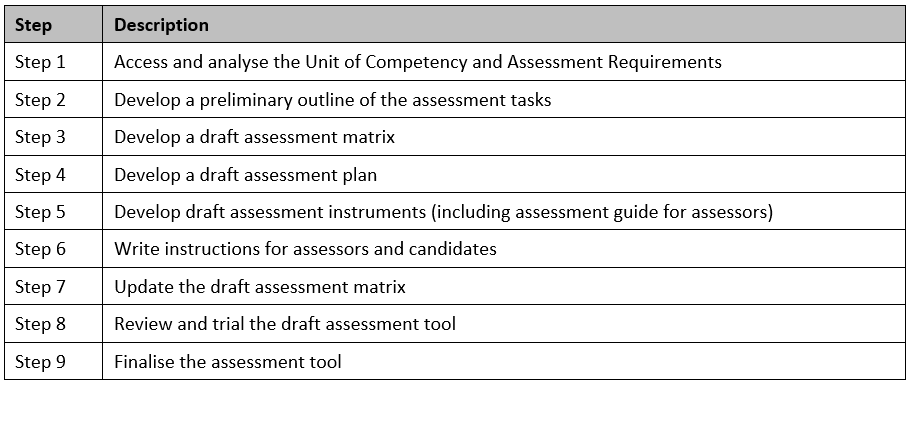
Step 1. Access and analyse the Unit of Competency and Assessment Requirements
The first step is to access and analyse Unit of Competency and the associated Assessment Requirements to identify what is required to demonstrate competence. The training.gov.au website gives us access the Unit of Competency and Assessment Requirements. These two documents can be downloaded as a Word file or PDF file.
The Unit of Competency and Assessment Requirements will need to be interpreted and contextualised. This may require us to consult with industry and employers
The following questions can help guide our analyse of the Unit of Competency and Assessment Requirements.
- What work tasks are to be performed by the candidate?
- Is there a volume of performance evidence specified?
- How many assessment tasks will be required?
- What assessment methods will be used?
- Are the assessment conditions specified?
- Is the location for the assessment specified?
- Are facilities, equipment or resources specified?
Step 2. Develop a preliminary outline of the assessment tasks
This step moves us from analysing to using the information from the Unit of Competency and Assessment Requirements. This is a relatively quick step.
We must use ‘assessment tasks’ to organise our assessment tool. Unfortunately, some RTOs delivering the Certificate IV in Training and Assessment qualification still promote the idea of using ‘assessment methods’ to organise the assessment tool. This is an outdated approach because this is not how we implement assessments. We implement by administrating and conducting assessment tasks.
My first general rule about the number of assessment tasks is that there will always be at least two assessment tasks:
- One assessment task to gather the Knowledge Evidence
- At least one assessment task to gather the Performance Evidence.
My second general rule about the number of assessment tasks is that we should design our assessment tool to make it easy for assessors to implement and easy for candidates to understand. We should aim to use the least number of assessment tasks as possible, without making the assessment tasks too big or too complicated.
An example
The volume of performance evidence specified for the TAEASS512 Design and develop assessment tools unit of competency is three. It requires the candidate to design and develop three assessment tools. Therefore, we can plan to use four assessment tasks for this unit:
- One assessment task to gather the Knowledge Evidence
- Three assessment tasks to gather the Performance Evidence.
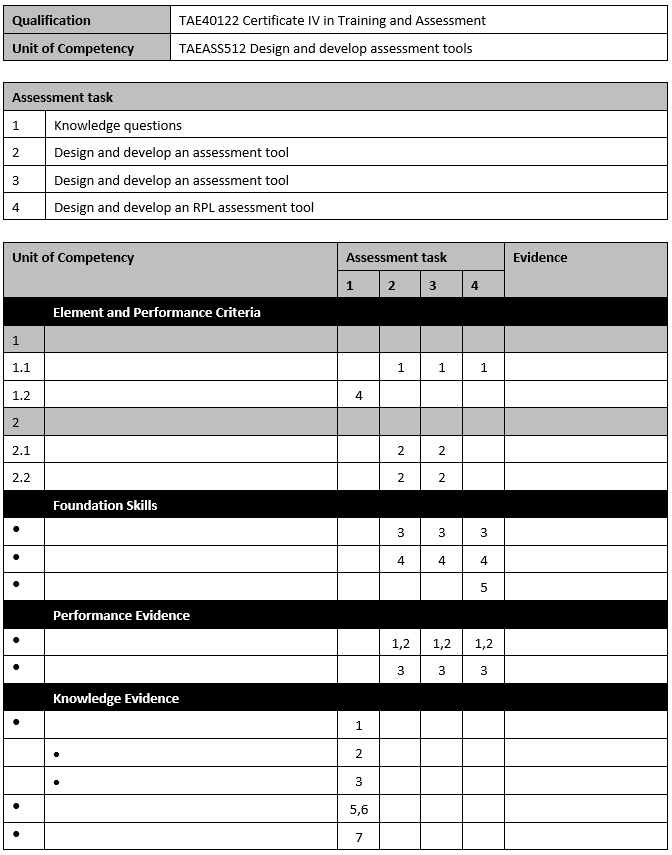
The following is a preliminary outline of the assessment tasks for the TAEASS512 Design and develop assessment tools unit of competency.

The preliminary outline of the assessment tasks is a starting point. We may need to change the assessment approach as we design and develop the assessment tool.
Step 3. Develop a draft assessment matrix
An assessment matrix may also be known as ‘assessment mapping’ or ‘competency map’.
This step relates to the development of draft assessment matrix that includes an outline of the evidence to be gathered from a candidate. At this stage, we use an ‘x’ to link the specifications of the Unit of Competency and Assessment Requirements with the assessment tasks. The assessment matrix is an important part of the assessment tool. It is used to design for compliance and check for compliance. The following is my recommended template for an assessment matrix. It has a column on the right that is used to document the evidence to be gathered from a candidate.

The draft assessment matrix is updated with details after the assessment instruments have been developed (Step 7).
Steps 4, 5 and 6
Steps 4, 5 and 6 covers the development of the assessment tool.
- Step 4. Develop a draft assessment plan
- Step 5. Develop draft assessment instruments (including assessment guide for assessors)
- Step 6. Write instructions for assessors and candidates
The assessment matrix is part of the assessment tool, and it is used to guide the development of the remaining documents. RTOs will usually have templates for these documents, and TAE Students will be provided with templates.
The development of the draft assessment instruments and criteria to be used to make judgements about whether competence has been achieved can be time-consuming. And when we develop the assessment tools, it is important to number assessment items. For example:
- Number each question
- Number each item on an observation checklist
- Number each item on a product review checklist
- Number each item on a third-party report.
The ‘assessment guide for assessors’ may also be known as a ‘marking guide’. The purpose of this document is to support reliable assessment (one of the four principles of assessment). The assessment guide should include:
- Sample answers for the questions being used to gather the Knowledge Evidence
- Criteria for making decisions relating to the standard of Performance Evidence gathered.
Step 7. Update the draft assessment matrix
After the assessment instruments have been documented, we update the assessment matrix with reference to the numbering of each assessment item (see above). The following illustrates an updated assessment matrix that was originally created in Step 3.
Step 8. Review and trial the draft assessment tool
Some people may call this step the pre-validation of an assessment tool. It consists of two different activities:
- Review of the draft assessment tool
- Trial of the draft assessment tool.
These activities will involve others. We need a person or people who have not been involved with the design and develop of the assessment tool to look at what we have created with fresh eyes. And we them to use the assessment tool to find out if it can be understood and implemented from the perspective of an assessor and candidate.
We can identify what needs to be fixed or areas for improvement by observing the assessment tool being used by others. Also, we should seek feedback from the person or people who have been involved in the review and trail of the assessment tool.
Step 9. Finalise the assessment tool
We finalise the assessment tool based on the feedback gathered during the review and trial of the draft assessment tool.
A useful guide to assessment tools
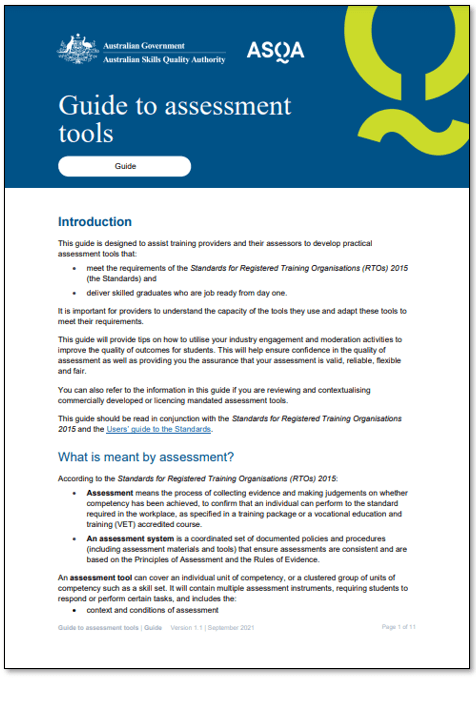
ASQA has published a document titled, Guide to assessment tools. This is a relatively short document that is reasonably easy to read. It is a document that covers important information about designing and developing compliant assessment tools. And it provides practical information and ideas.
In conclusion
It takes time and effort to design and develop an assessment tool that is compliant and works for the assessor and candidate. It regards to time, it can take days. This article has provided a 9-step process that is methodological and practical.
Many TAE Students find the TAEASS512 Design and develop assessment tools unit of competency a bit challenging for a range of reasons, including:
- Unclear or confusing instructions
- Badly designed templates
- Templates that are difficult to use or modify
- No examples of completed templates provided
- Examples of completed templates are confusing
- Insufficient time allocated to the provision of training
- The learning resources are poorly written or lack required content
- The TAE Trainer is unable to explain or demonstrate what needs to be done.
Also, the TAEASS512 Design and develop assessment tools unit of competency has a large number of specified Knowledge Evidence items (41 bullet and sub-bullet points). A TAE Student must expect this unit of competency to take a lot of time and effort to complete, and it may be challenging, confusing and frustrating.
Do you need help with your TAE studies?
Are you a doing the TAE40122 Certificate IV in Training and Assessment, and are you struggling with your studies? Do you want help with your TAE studies?
Ring Alan Maguire on 0493 065 396 to discuss.

Training trainers since 1986

 On Target Work Skills