40+ years experience as a trainer, instructional designer, quality manager, project manager, program manager, RTO auditor, RTO manager and VET adviser.
Digital devices have changed our approach to reading and content consumption, with a significant shift towards on-screen reading over traditional paper formats. This has resulted in a continuous expansion of learning and assessment resources presented on digital platforms.
As trainers, TAFE teachers, or educators, it is imperative for us to comprehend the evolving reading behaviours of individuals and be mindful of the manner in which we present instructions and information to learners.
The importance of reading
Reading plays a vital role in the learning journey, and the way learners read in the digital age greatly impacts their learning outcomes. Perspectives on the subject differ, with some asserting that screens enhance the reading experience, while others argue that on-screen reading is less than ideal and may diminish attention spans.
Short attention span
In general, individuals who read on screens tend to prefer shorter texts as they struggle to sustain their attention for longer than a minute. For some readers, their attention span may be as short as 10 seconds or even less. Consequently, the limited reading time results in a reduced amount of content being absorbed.
Non-linear reading
On-screen text often incorporate hypertext, promoting a non-linear reading approach. Users can conveniently click or tap on links without necessarily completing a paragraph, let alone an entire page. This reading behaviour often results in browsing, scanning, keyword spotting, and engaging in one-time or partial reading. Consequently, non-linear reading reduces the amount of time dedicated to comprehensive and focused reading.
Skim, scan and skip
Many readers do not complete lengthy on-screen documents, nor do they scroll down the page. Instead, they tend to skim, scan, and skip through most sections. However, people tend to do more ‘picture’ reading, where individuals look for graphs, charts, and illustrations that visually aid their understanding of a topic.
In conclusion
Here are four techniques we can use to present content for effective on-screen reading:
Use explanatory subheadings
Keep paragraphs short and sentences simple
Use lists to organise content, enabling quick and easy access
Use images to grab the reader’s attention and keep them interested.
And finally, when presenting on screen content, we need to continuously seek opportunities to grab learners’ attention and maintain their interest. Can you think of some ways for capturing learners’ attention and sustaining their interest?
(Using questions is one technique we can use to engage the learner and maintain their interest.)
Do you need help with your TAE studies?
Are you a doing the TAE40122 Certificate IV in Training and Assessment, and are you struggling with your studies? Do you want help with your TAE studies?

The Certificate IV in Training and Assessment qualification requires the design and development of documents for trainer-led training. It can be for an individual or a group of learners. The design and development of self-paced online training is an advanced skill that is covered by the Diploma of Vocational Education and Training qualification.
This article explore the design and development of documents for trainer-led training.
The current TAE40122 Certificate IV in Training and Assessment qualification has core units of competency that require the design, development, and customisation of training documents. These units are:
The following requirements are specified in the TAEDES412 Design and develop plans for vocational training unit of competency.
Element 2. Design a plan for vocational training The performance criteria for Element 2 specifies that this training delivery plan shall include:
overall plan and structure
duration of training
sequence of delivery
learning activities
learning resources.
Element 3. Develop session plans for vocational training The performance evidence for this unit specifies that this training session plan shall include:
learning objectives
presentation methods
learning activities
formative assessment activities
sequence and timing of activities within a session
required resources
total duration of the session.
The TAEDES412 unit required the development of training delivery plans and training session plans.
This raises the question, ‘What is the difference between a training delivery plan and a training session plan?’ A delivery plan describes the plan to deliver all the training for a unit or a cluster of units. It takes many training sessions to cover the training for one unit of competency. A session plan describes in more details a plan for how each training session is delivered.
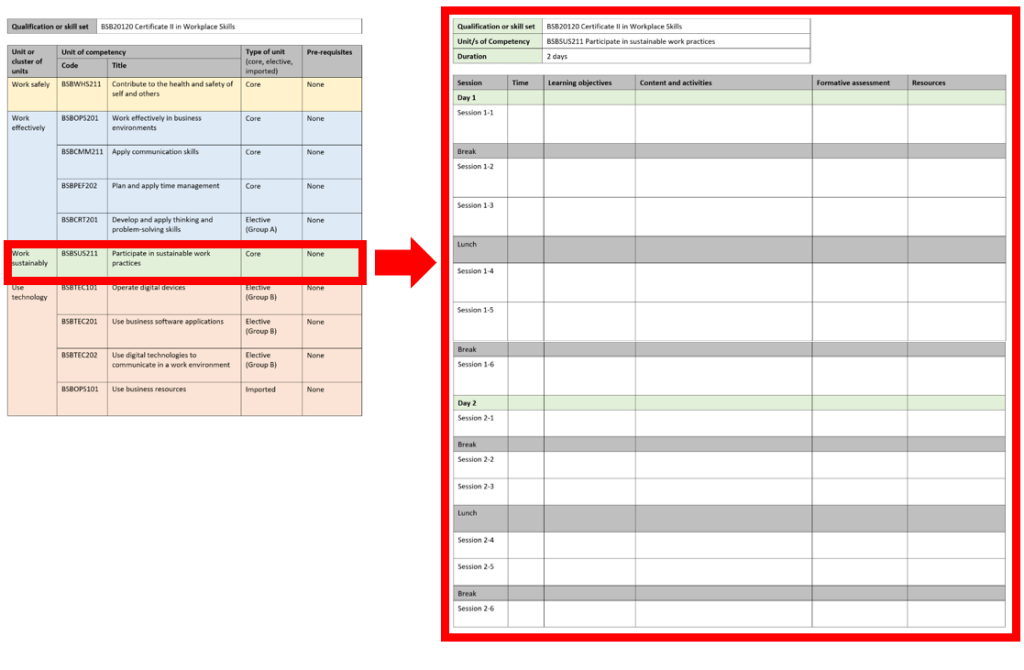
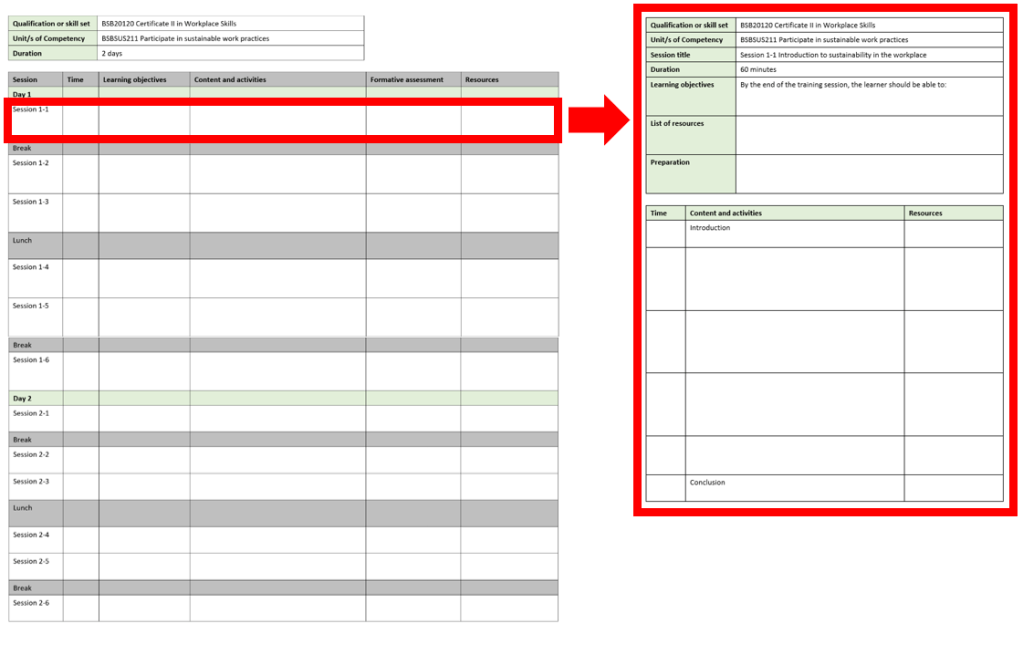
The following illustrates how a training delivery plan describes the training for an entire unit. And a session plan describes the training for a part of the unit.
In the above example, the training has a 2-day duration with a total of 12 training sessions (6 sessions on each day). Therefore, this is an example when there would be one training delivery plan and 12 training sessions plans.
What is specified by the TAEDEL411 unit?
The following requirements are specified in the TAEDEL411 Facilitate vocational training unit of competency:
Performance criteria 1.3 Arrange and review delivery plan, session plans and learning resources according to legislative and regulatory requirements
Performance criteria 2.2 Customise session plans and learning resources to suit learners and their context
These performance criteria make reference to:
delivery plan
session plans
learning resources.
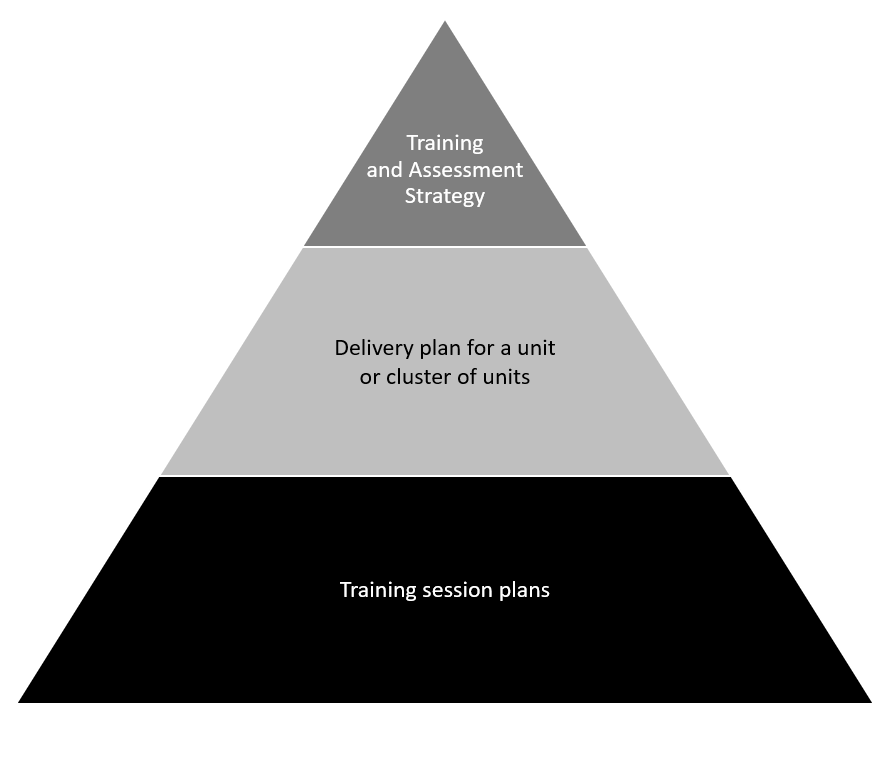
The following diagram shows the relationship between the various training documents frequently used in Australia’s VET system.
Clause 1.1 of the Standards for RTOs 2015 requires an RTO to develop a training and assessment strategy for every training product on the RTO’s scope of registration. [1] The design and development of a training and assessment strategy is an advanced skill that is covered by the Diploma of Vocational Education and Training qualification.
What is the difference between a training and assessment strategy, training delivery plan, and training session plan?
The requirements for an RTO’s Training and Assessment Strategy (TAS) are specified in the Standards for RTOs 2015, and the Users’ guide to the Standards for RTOs 2015 provided additional information. It shall identify the units of competency to be delivered for the qualification or skill set. The following is an example of 10 units of competency identified for a qualification (taken from the TAS). The details for delivering each unit or cluster of units may be documented in a training delivery plan. This example is for one unit.
The next layer of documents are training session plans. The following is an example of a training delivery plan consisting of 12 sessions. The details for delivering each session may be documented in a training session plan. This example is for one session.
The details have not been included in the above examples, so as to keep it easier to comprehend. Typically, a TAS is a document that may be a 10 or more pages. Typically, a training delivery plan may be 5 or more pages (depending on the number of units and number of days). And typically, a training session may be a 2 or 3 pages.
In conclusion
A Training and Assessment Strategy is a document that describe how a training product, such as a qualification or skill set, is planned to be delivered. A delivery plan is a document that describes how training for a unit or cluster of units is planned to be delivered. And a session plan is a document that describes how a training session is planned to be delivered.
An RTO will usually have templates for documents that it requires to be developed, such as:
If you are a TAE Student, you will usually be given templates to be used for developing training delivery plans and training session plans.
Are you a doing the TAE40122 Certificate IV in Training and Assessment, and are you struggling with your studies? Do you want help with your TAE studies?
The TAEDES412 Design and develop plans for vocational training is a core unit of competency for the new TAE40122 Certificate IV in Training and Assessment qualification. It describes the skills and knowledge required to design, develop and document delivery plans and session plans within the Australian VET system.
The TAEDES412 unit specifies that the delivery plan and session plans must include formative assessment activities. This is the second of two articles about formative assessment. The previous article is titled:
Incorporating formative assessment into a training delivery plan
Incorporating formative assessment into a training session plan.
Let’s start with establishing a common terminology.
Explaining the terminology
The terms formative assessment and summative assessment may make sense for a school or higher education context but they can be confusing when applied to the Australian vocational education and training (VET) system. Different people use these terms to mean different things.
Australia has a competency-based VET system. And it uses assessment to determine if a person is competent. Summative assessment can be described as the ‘assessment of competency’.
Formative assessment can be describes as the ‘assessment of learning.’ [1]
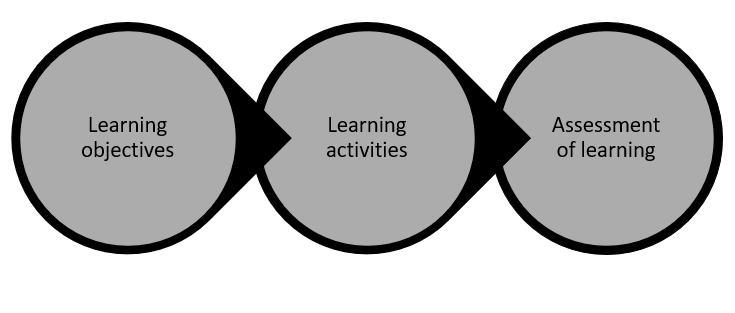
The following shows a better way of expressing these terms for VET.
Also, we should keep our terminology as simple as possible by making the distinction between the assessment of learning and the assessment of competency.
Assessment of learning occurs during the delivery of training to check if the learning objectives have been achieved and to monitor progress.
Assessment of competency occurs after the delivery of training covering a unit or cluster of units. It is used to determine if a person is competent.
Assessment of learning should not to be confused with assessment of competency. The assessment of learning can to be informal, and may not be related to the performance of work tasks because it may relate to the learning of a piece of knowledge or the learning of a foundational skill. The assessment of competency tends to be more formal, and it should include the performance of work tasks in a workplace or a simulated workplace that has the characteristics of a real workplace.
When can formative assessment occur?
The TAEDES412 Design and develop plans for vocational trainingunit of competency specifies that the delivery plan and session plans must include formative assessment activities. Therefore, I am using the term ‘formative assessment’.
Formative assessment can occur:
At the end of a training session to check if the knowledge or skills covered during the training session have been learnt
At the end of a training day to check if the knowledge or skills covered during the training day have been learnt
At the start of a training day to check if the knowledge or skills from the previous training day or days have been learnt
At the end of a training topic or module to check if the required knowledge or skills have been learnt before moving onto the next topic or module.
Incorporating formative assessment into a training delivery plan
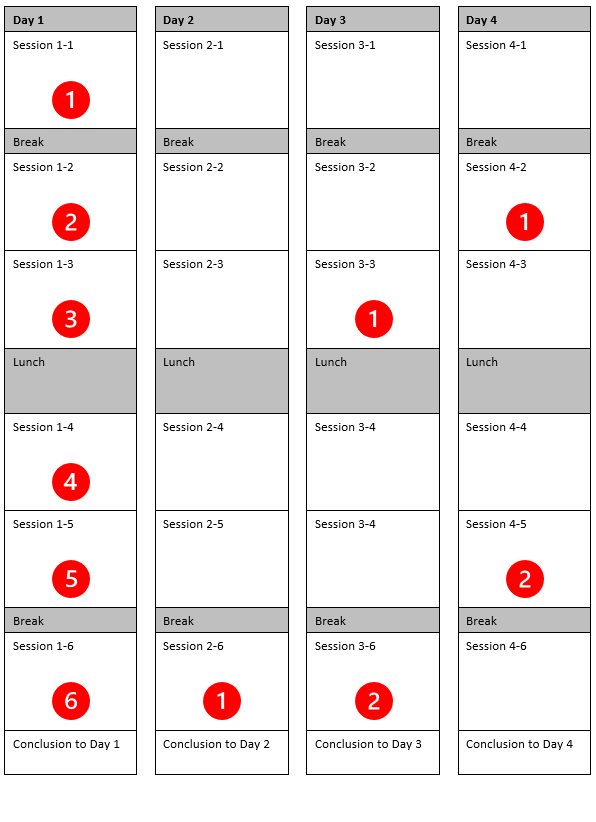
The following shows the outline of a training delivery plan with a four day duration. Each red dot indicates when a formative assessment is planned to be conducted. Six formative assessment on Day 1. One formative assessment on Day 2. Two formative assessment on Day 3. And two formative assessment on Day 4.
Day 1 is an example of formative assessment being conducted at the end of every training session. This scenario is unlikely to be implemented for various reasons including time constraints.
Day 2 is an example of formative assessment being conducted at the end of the training day. It should be noted that formative assessment does not have to be conducted on the same day as the learning.
Day 3 is an example of formative assessment being conducted twice during the training day. This checks what has been learnt in the morning and what has been learnt in the afternoon.
Day 4 is an example of formative assessment being conducted at relevant times, such as at the end of a topic or before moving onto a new stage of learning.
What are the different types of formative assessments?
The Australia VET system aims to help people learn the knowledge and skills required to perform work tasks.
Questions or quizzes can be used to conduct an assessment of learning for knowledge. Observed practice can be used to conduct an assessment of learning for skills or the performance of a work task.
Why are formative assessments conducted?
Formative assessments maybe conducted for various reasons, such as:
To determine if the learning objectives have been achieved
To determine if the person has the required knowledge and skills before moving onto the next topic or module
To determine if the person is ready to commence their assessment of competency.
Incorporating formative assessment into a training session plan
In theory, every training session shall have documented learning objectives. In theory, every training session shall include planned activities that have been designed to help a person learn the knowledge or skills being covered. And in theory, formative assessment shall be conducted before every training session concludes to determine if the learning objectives have been achieved.
Training session plan for knowledge
The following example shows the incorporation of formative assessment into a plan for a knowledge training session.
There are a range of variables that can impact the training session plan, such as:
Total duration of the training session
Amount of content to be learnt
Complexity of the content to be learnt
Resources available
Characteristic of the learner or learners.
Therefore, the above example is provided only as a guide.
Training session plan for a skill or task
The following example shows the incorporation of formative assessment into a plan for a skill or task training session.
Again, there are a range of variables that can impact the training session plan, such as:
Total duration of the training session
Difficulty of the skill or task to be learnt
Safety precautions when the skill or task may be dangerous
Availability of facilities, equipment, materials or resources
Characteristic of the learner or learners.
Therefore, the above example is provided only as a guide.
The importance of feedback
Formative assessment must include the provision of feedback. Feedback can be motivational and should be constructive. Feedback should identify areas needing additional training or further practice.
Formative assessment is essential for helping people progress towards achieving learning objectives. It is used to monitor progress. And it can identify the need for learning support. Feedback from the trainer may include the development of an action plan designed to help the learner progress.
In conclusion
People studying for their TAE40122 Certificate IV in Training and Assessment qualification will be required to incorporate formative assessment activities into their training delivery plan and training session plan.
It is essential that the learning objectives are clearly documented. It is essential that activities are conducted during a training session to help people learn. And before the end of the training session, we can conduct a formative assessment to determine if the learning objectives have been achieved and give feedback to the learner or learners.
Formative assessment is the assessment of learning. Questions or quizzes can be used to conduct an assessment of learning for knowledge. Observed practice can be used to conduct an assessment of learning for skills or the performance of a work task.
Are you a doing the TAE40122 Certificate IV in Training and Assessment, and are you struggling with your studies? Do you want help with your TAE studies?
The TAEDES412 Design and develop plans for vocational training is a core unit of competency for the new TAE40122 Certificate IV in Training and Assessment qualification. It describes the skills and knowledge required to design, develop and document delivery plans and session plans within the Australian VET system.
The TAEDES412 unit specifies that the delivery plan and session plans must include formative assessment activities. You may also come across other terms such as summative assessment and diagnosis assessment. This article shall explore:
What is formative assessment?
What is summative assessment?
What is diagnosis assessment?
Searching for definitions
There is no definitive definition of these three terms:
Formative assessment
Summative assessment
Diagnosis assessment.
The Standards for RTOs 2015 does not define these terms. The TAE Training Package does not define these terms. And the Implementation Guide for the TAE Training Package does not define these terms.
The VOCEDplus website provides a definition for ‘Formative assessment’.
The VOCEDplus website provides a definition for ‘Summative assessment’.
The VOCEDplus webpages for ‘Formative assessment’ and ‘Summative assessment’ says that both terms are also called ‘Assessment of learning’. However, VOCEDplus website provides two different definitions for ‘Assessment of learning’. If you follow the link from the ‘Formative assessment’ webpage you are given the definition for formative assessment. And if you follow the link form the ‘Summative assessment’ webpage you are given the definition for summative assessment.
It is strange that two different definitions are provided for the same thing.
The VOCEDplus website does not provide a definition for ‘Diagnostic assessment’.
What are the origins of formative and summative assessment?
The origins of the formative and summative assessment in the modern era can be traced back to the mid-20th century when educators and researchers started to promote the use of standardised tests and other assessments in educational settings.
Benjamin Bloom, an American educational psychologist, was influential in the development of formative assessment. In his book, ‘Taxonomy of Educational Objectives’, Bloom described the importance of formative assessment in the learning process. He argued that formative assessment is essential for helping students to progress towards achieving learning objectives. Bloom believed that formative assessment should be an ongoing process that occurs throughout the learning experience, rather than a one-time event. He emphasised the importance of providing students with feedback on their progress, so that they can make adjustments and improvements as needed. [1]
The following is an example showing when formative assessment would be conducted during a training program.
Bloom also wrote about summative assessment. He distinguished between formative assessment, which is used to guide and monitor learning, and summative assessment, which is used to evaluate learning at the end of a unit or course of study. Bloom believed that summative assessment is important for measuring student achievement. His ideas have influenced the development of many of the assessment practices that are used today, and have helped to promote a more balanced approach to assessment, with both formative and summative assessment playing important roles. [2]
The following are examples showing how formative assessment is conduct during a training program and summative assessment would be conducted at the end of a training program.
Schools and universities tend to conduct summative assessment and give the result as a grade or mark. The vocational education and training (VET) system in Australia has been designed to allow multiple attempts at becoming competent. The aim is to help people become competent rather than abruptly ending the training and assessment process when a person has been deemed not competent. The aim is to provide an employment pathway for job seekers or for people seeking work skills and career progression.
What is formative assessment?
The VOCEDplus website defines ‘Formative assessment’ as:
Assessment that takes place at regular intervals during a course, with feedback provided along the way to help improve the student’s performance. [3]
A ‘formative assessment’ in the Australian VET system is an activity used to check what has been learnt, or to determine if the learning objectives have been met. This activity could be conducted:
at the end of a training session
at the end of a training day
at the end of a training topic
at the end of a training module.
Questions and quizzes (I don’t like the terms ‘tests’ or ‘exams’) can be used to check if people have learnt the required knowledge. And observed practice can be used to check if people have learnt the required skills. Feedback can be provided to the learners. Feedback can be motivational and should be constructive. Feedback should identify areas needing additional training or further practice.
What is summative assessment?
The VOCEDplus website defines ‘Summative assessment’ as:
Assessment that occurs at a point in time and is carried out to summarise achievement at that point in time. Often more structured than formative assessment, it provides teachers, students and parents with information on student progress and level of achievement. [4]
This definition seems to be for a school context because it refers to teachers, students and parents. We need a definition for the Australian VET context.
In the Australian VET system, ‘Summative assessment’ is the assessment used to determine if a person is competent. This ‘assessment’ is defined in the glossary from the Standards for RTOs 2015 as:
Assessment is the process of collecting evidence and making judgements on whether competency has been achieved, to confirm that an individual can perform to the standard required in the workplace, as specified in a training package or VET accredited course. [5]
The VOCEDplus website provides this same definition for ‘assessment’.
Trainers and TAFE teachers working in the Australian VET system conduct assessment after all the training for a unit or cluster of units has been completed. This assessment is used to determine if a person is competent.
What is diagnosis assessment?
The VOCEDplus website does not give a definition for ‘Diagnosis assessment’.
Clause 1.7 of the Standards for RTOs 2015 states:
The RTO determines the support needs of individual learners and provides access to the educational and support services necessary for the individual learner to meet the requirements of the training product as specified in training packages or VET accredited courses. [6]
Most RTOs conduct a pre-training review to determine a person’s suitability for the training program. This includes a ‘diagnosis assessment’ to measure a person’s LLN skills and identify LLN skill gaps that may hinder their participation in the training program.
Many trainers and TAFE teachers are not directly involved in the administration of the pre-training review or the ‘diagnostic assessment’ of a person’s LLN skills.
In conclusion
People studying for their TAE40122 Certificate IV in Training and Assessment qualification will need to know about ‘formative assessment’ because it has been specified within the TAEDES412 Design and develop plans for vocational training unit of competency. It is highly likely that ‘diagnostic assessment’ and ‘summative assessment’ will also be covered.
The following illustrates that ‘diagnostic assessment’ occurs before the training program, ‘formative assessment’ occurs multiple times during the training program, and ‘summative assessment’ occurs after the training program.
The following compares the difference between diagnosis assessment, formative assessment and summative assessment.
I have never heard these terms used by a trainer or TAFE teacher working for an RTO. The only reason I am writing an article about these terms is because it is in the TAE Training Packages. I wish the developers of TAE Training Package hadn’t introduced a range of unnecessary terms that complicates things.
In practice, I would discourage the use of these terms, in particular, ‘formative assessment’ and ‘summative assessment’. The following shows better terms that are more commonly used in the Australian VET system.
References
[1] ChatGPT response generate 21 April 2023 (what did Benjamin Bloom say about formative assessment?)
[2] ChatGPT response generate 21 April 2023 (what did Benjamin Bloom say about summative assessment?)
[5] Standards for Registered Training Organisations (RTOs) 2015
[6] Standards for Registered Training Organisations (RTOs) 2015
Do you need help with your TAE studies?
Are you a doing the TAE40122 Certificate IV in Training and Assessment, and are you struggling with your studies? Do you want help with your TAE studies?
This article has been written for people who are new to the Australian vocational education and training (VET) system. There is so many terms and acronyms to learn. It is like learning a new language.
You should be fluent at ‘VET speak’ by the time you have completed your Certificate IV in Training and Assessment qualification. However, it is best to avoid using this language when speaking to the people that you train and assess. You need to learn ‘VET speak’, but they don’t. When speaking with our students and learners, it is important for us to use plain English. We need to be a translator.
In this article I will explain what is an RTO’s scope of registration, and how to find an RTO’s scope of registration.
Introduction to scope of registration
A training organisation must be registered with a VET regulator before is can deliver nationally recognised training (NRT) and issue qualifications or statements of attainment. A registered training organisation (RTO) does not automatically have the approval to deliver all qualifications and skill sets. The RTO must apply to their VET regulator for approval to deliver particular training products. A training product can be:
A qualification from a Training Package
A skill set from a Training Package
A stand-alone unit of competency, such as, first aid
A VET accredited course.
The scope of registration is the list of training products the RTO has approval to deliver.
How to find an RTO’s scope of registration
The training.gov.au website is the National Register for VET in Australia. It provides details about all RTOs. [1]
Step 1
Go to the search function on the training.gov.au website. Select the ‘RTO/Org’ tab. Then enter the RTO’s name or RTO’s number.
Step 2
Go to the RTO’s webpage on the training.gov.au website. Select ‘Scope’.
Step 3
The RTO’s scope of registration will be displayed onscreen. You may need to scroll down to see all the training products that are on the scope of registration.
Big and small scopes of registration
Some RTOs have a small number of training products on their scope of registration, while other RTOs have a large number of training products on scope.
An example of an RTO with a small scope of registration
The following is an example of an RTO with a small scope of registration. Only 2 qualifications are listed.
An example of an RTO with a large scope of registration
The following is an example of an RTO with a large scope of registration. It lists 286 qualifications.
Exploring an RTO’s scope of registration
A scope of registration will list ‘Current’ and ‘Superseded’ qualifications. The ‘Superseded’ qualifications would disappear after the transition period has expired. The following shows the scope of registration for TAFE SA. It is only displaying the first 10 qualifications from a total of 286 qualifications.
As we would expect, the following shows that TAFE SA delivers training in South Australia.
A scope of registration shows the states, territories or international locations that the RTO delivers a particular training product. The following is an example for TAFE SA.
In conclusion
An RTO must apply for approval to deliver a training product. This approval process is conducted by the relevant VET regulator, and the approved training products are listed on the RTO’s scope of registration. The scope of registration for all RTOs are easily found on the training.gov.au website.
Note: The examples in this article when taken from the training.gov.au website on the 19th of April 2023. Information on the training.gov.au website is dynamic, and is constantly being updated.
Are you a doing the TAE40122 Certificate IV in Training and Assessment, and are you struggling with your studies? Do you want help with your TAE studies?