40+ years experience as a trainer, instructional designer, quality manager, project manager, program manager, RTO auditor, RTO manager and VET adviser.
TAEDES411 Use nationally recognised training products to meet vocational training needs
TAEDES412 Design and develop plans for vocational training
TAEPDD401 Work effectively in the VET sector.
The above list is in alphabetical order for the unit codes.
About this article
This article focuses on the TAEDES411 Use nationally recognised training products to meet vocational training needs unit of competency. It is the unit of competency that provides an introduction to the Australian competency-based VET system.
This unit has three elements:
Prepare to use nationally recognised training products
Analyse nationally recognised training products
Apply and evaluate selected nationally recognised training products.
Assessment requirements for the TAEDES411 unit
Knowledge evidence
A TAE Student must demonstrate they have the following knowledge:
VET regulatory requirements for using nationally recognised training products
Function of nationally recognised training products in a competency-based VET system
Purpose and use of the the National Register of VET
Structure, levels and overarching content of the AQF
Purpose, structure and content of accredited courses and endorsed training package qualifications, skill sets, units of competency, and their associated assessment requirements
Purpose, key content and use of support material relating to nationally recognised training products
Basic overview of the nature, purpose and structure of current authorised Australian foundation skill frameworks
Methodology relating to analysing and using nationally recognised training products to meet the skills and knowledge needs of learners.
Do you need help with your TAE studies?
Are you a doing the TAE40122 Certificate IV in Training and Assessment, and are you struggling with your studies? Do you want help with your TAE studies?
TAEDES411 Use nationally recognised training products to meet vocational training needs
TAEDES412 Design and develop plans for vocational training
TAEPDD401 Work effectively in the VET sector.
The above list is in alphabetical order for the unit codes.
About this article
This article focuses on the TAEDEL411 Facilitate vocational training unit of competency.
This unit has five elements:
Plan and prepare for vocational training
Customise vocational training
Deliver face-to-face vocational training
Support individual and group learning
Review vocational training practice.
Assessment requirements for the TAEDEL411 unit
Knowledge evidence
A TAE Student must demonstrate they have the following knowledge:
Legislative and VET regulatory requirements relating to the facilitation of individual and group-based training
RTO procedures for facilitating individual and group-based training
Processes for interpreting nationally recognised training products to identify the standard of performance required
Dimensions of competency and how they guide training practices
Strategies and processes for identifying and organising foundation skills support for learners
Learning theories and adult learning principles relevant to the learning cohort, and their application to the facilitation of individual and group-based training
Training practices, methods and techniques for facilitating individual and group-based training
Resources available to support identifying training facilitation techniques that suit different learners
Techniques for customising session plans and learning resources to suit learner characteristics and needs
WHS responsibilities relating to training, including common hazards and risks, and risk controls.
Do you need help with your TAE studies?
Are you a doing the TAE40122 Certificate IV in Training and Assessment, and are you struggling with your studies? Do you want help with your TAE studies?
TAEDES411 Use nationally recognised training products to meet vocational training needs
TAEDES412 Design and develop plans for vocational training
TAEPDD401 Work effectively in the VET sector.
The above list is in alphabetical order for units codes.
About this article
This article focuses on the TAEASS413 Participate in assessment validation unit of competency.
This unit has three elements:
Prepare for validation activities
Participate in validation activities
Contribute to validation outcomes.
Assessment requirements for the TAEASS413 unit
Knowledge evidence
An assessment task will be required to gather the specified Knowledge Evidence. A TAE Student must demonstrate they have the following knowledge:
Legislative and VET regulatory requirements relating to assessing competence and participating in assessment validation activities
Key aspects of assessment validation
Key features of the RTO’s assessment system
Dimensions of competency and how they guide assessment practices
Key structure, functions and content of assessment tools
Key features of common assessment methods.
Do you need help with your TAE studies?
Are you a doing the TAE40122 Certificate IV in Training and Assessment, and are you struggling with your studies? Do you want help with your TAE studies?
The TAE40122 Certificate IV in Training and Assessment qualification was released on the 8th of December 2022. There are six core units of competency:
TAEASS412 Assess competence
TAEASS413 Participate in assessment validation
TAEDEL411 Facilitate vocational training
TAEDES411 Use nationally recognised training products to meet vocational training needs
TAEDES412 Design and develop plans for vocational training
TAEPDD401 Work effectively in the VET sector.
The above list is in alphabetical order for the unit codes.
About this article
This article focuses on the TAEASS412 Assess competence unit of competency.
This unit has six elements:
Plan and prepare to conduct assessment
Customise assessment process
Prepare candidate
Collect evidence
Make assessment judgement
Review assessment practice.
Assessment requirements for the TAEASS412 unit
Knowledge evidence
An assessment task will be required to gather the specified Knowledge Evidence. A TAE Student must demonstrate they have the following knowledge:
VET regulatory requirements relating to assessing competence
Assessment system policies and procedure
Competency-based assessment
Key content of training and assessment strategies related to assessing competence
Structure, content and application of units of competency relevant to assessing competence
Difference between assessment tools and assessment instruments
Key contents of assessment tools
Assessment purposes and contexts
Types of evidence
Assessment methods
Nature and scope of reasonable in assessment, when it applies and how to check and maintain the rigor of the assessment process
How the principles of assessment and rules of evidence guide the assessment process
Practices and methods that promote safe and inclusive assessment environments
Cultural sensitivity and equity and wellness considerations in assessment
WHS responsibilities relating to assessing competence.
Performance evidence
The volume of performance evidence will require the TAE Student to assess 5 different candidates against one unit of competency.
Assessment conditions
An RTO that plans to deliver the TAEASS412 Assess competence unit of competency will need to provide the TAE Student with the following:
RTO policies and procedure relating to assessing competence (TAEASS412 Performance Criteria 1.1)
Training and Assessment Strategy (TAS) that includes the unit of competency being assessed by the TAE Student (TAEASS412 Performance Criteria 1.2)
Assessment tool for the unit of competency being assessed by the TAE Student (TAEASS412 Performance Criteria 1.4) – and this assessment tool must be current and validated.
Do you need help with your TAE studies?
Are you a doing the TAE40122 Certificate IV in Training and Assessment, and are you struggling with your studies? Do you want help with your TAE studies?
I am regularly being asked, “should I upgrade to the new TAE40122 qualification?”
My initial response is, “it would be a very brave person to directly answer this question, and I am unsure if I am that brave”. I cannot give a short and direct answer, but I am happy to provide the following information so that people can make an informed decision.
Background
The TAE40122 Certificate IV in Training and Assessment qualification has replaced the TAE40116 Certificate IV in Training and Assessment qualification. Thankfully, the TAE40122 qualification has been deemed ‘equivalent to’ and the ‘successor of’ the TAE40116 qualification.
Qualifications are equivalent but units are not
The purpose of declaring the TAE40122 qualification as ‘equivalent to’ and the ‘successor of’ the TAE40116 qualification was to avoid creating a situation that would automatically require another TAE upgrade (like the upgrade from the TAE40110 qualification to the TAE40116 qualification).
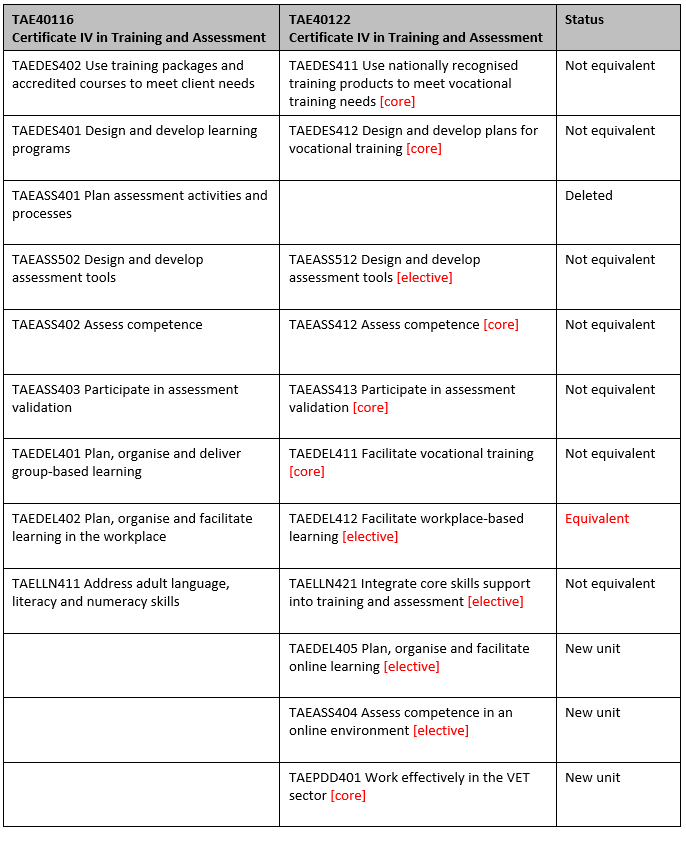
The TAE40116 qualification required ten units of competency. The following chart compares the nine core units for the TAE40116 qualification with units for the TAE40122 qualification.
Only one unit of competency is equivalent (and it is not listed as a core unit for the TAE40122 qualification). This means that most TAE units of competency that people have attained are not equivalent.
It can get complicated for a person who wants to upgrade from the TAE40116 qualification to the TAE40122 qualification. There are several extra units required and many gaps because units from their TAE40116 qualification have been declared as ‘non-equivalent’. This means the opportunity for credit transfer is extremely limited. People may be able to apply for recognition of prior learning (RPL), but that will be dependent upon the person’s experience working for an RTO.
It will get more complicated for people wanting to upgrade from a TAE40110 qualification, and there are still some people who may want to upgrade from their TAA40104 qualification or BSZ40198 qualification.
What might create a situation that forces an upgrade?
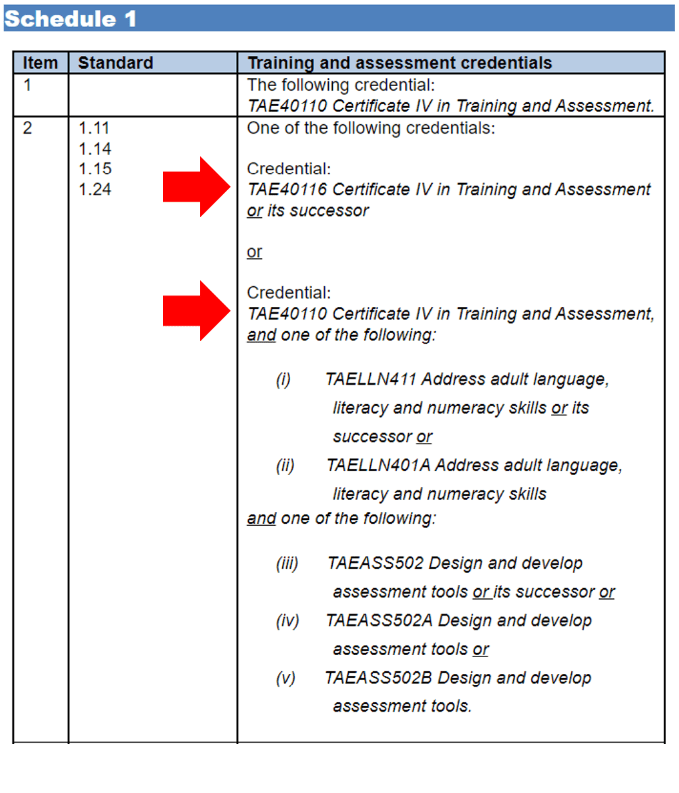
The Standards for RTOs are the regulations that specify the credentials to be held by people delivering training and assessment services. Currently, the ‘TAE40116 Certificate IV in Training and Assessment or its successor’ is the specified credential.
The following is an extract from the Standards for RTOs, Schedule 1 that shows the details, and it shows the additional complexity for people who have the TAE40110 qualification instead of the TAE40116 qualification.
Upgrade is not required just because the qualification has changed
The change of qualification, from TAE40116 to TAE40122, does not automatically require a trainer or assessor working for an RTO to upgrade. This is because the TAE40122 qualification has been deemed the successor of the TAE40116 qualification.
What happens when the Standards for RTOs get changed?
The Standards for RTOs are being reviewed, and new Standards for RTOs are likely to be released during 2023. Currently, there are no details regarding the credentials that will be specified for trainers and assessors working for an RTO.
It is the Standards for RTOs that will determine if trainers or assessors will be required to upgrade their TAE qualification. We need to wait for the details.
Should I upgrade?
At the time when this article was written, 5th of December 2022, it is unnecessary to upgrade because the TAE40116 qualification is still the credential that is specified in current Standards for RTOs. Therefore, upgrading from the TAE40116 qualification to the TAE40122 qualification is discretionary, not mandatory if you want to continue working as a trainer or assessor for an RTO. However, some people may still want to explore if they should upgrade.
What will it cost to upgrade? And how much time and effort will it take to upgrade?
Will it be worth the time and money to upgrade?
Answers to these questions may vary for each individual, and the amount and type of experience they have had working for an RTO. A person may be able to apply for recognition of prior learning (RPL). A person may need to do ‘gap training’ to cover non-equivalent units and ‘full training’ to cover new units.
The process to determine the upgrade pathway is likely to be complex. The time and effort needed will depend on the amount of RPL and the number of gap units that an individual has. And the cost is likely to depend on the amount of training cover the number of new units and the number of gap units required by the individual.
As an exercise, you might like to try mapping the non-equivalent TAE units to identify the gaps. (Then again, you may not like to try this!)
Is a TAE40122 qualified trainer better than a TAE40116 qualified trainer?
Will you be a better trainer and assessor if you upgrade to the TAE40122 qualification? Probably not!
And when will the TAE40122 qualification be replaced? This seems like a strange question to be asking since the new TAE40122 Certificate IV and Training and Assessment qualification has just been endorsed. I am assuming that many people will complain about TAE40122 (for a wide variety of reasons). The Education IRC and their SSO cease to exist after the 31st of December 2022. The Industry Cluster that takes over the responsibility for the TAE Training Package will have no ‘ownership’ of the new TAE40122 qualification. And Skill Standards are planned to replace Units of Competency by mid-2024. We will probably be talking about a new qualification for trainers and assessors working for RTOs in the next two years. Therefore, another upgrade to be considered.
Please tell me, has this article provided you with useful information?








 On Target Work Skills