How to use the Australian Core Skills Framework (ACSF) to identify LLN skill gaps

This is the second of two articles covering the Australian Core Skills Framework (ACSF). My first article describes the Australian Core Skills Framework (ACSF).

In this article I shall cover how to use the ACSF to identify LLN skill gaps.

Although this article has been primarily written for people studying for their TAE40116 or TAE40122 Certificate IV in Training and Assessment qualification, qualified VET practitioners may still get something from the content or the way the content has been presented.

The information covered by this article is relevant to the following units of competency:

  • TAELLN411 Address adult language, literacy and numeracy skills
  • TAELLN421 Integrate core skills support into training and assessment.

LLN skills

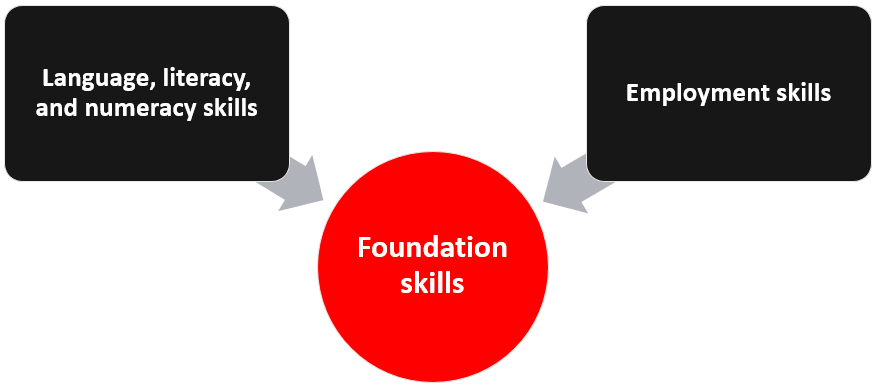
In the Australian VET system, foundation skills consist of language, literacy, and numeracy (LLN) skills and employment skills. In other words, LLN skills are a sub-set of foundation skills.

Let’s broadly define these LLN skills:

  • What are language skills?
  • What are literacy skills?
  • What are numeracy skills?
  • What are digital literacy skills?

What are language skills?

Wikipedia defines ‘language’ as a structured system of communication used by humans consisting of speech (spoken language) and gestures (sign language). The ACSF identifies Oral Communication as a core skill and its covers:

  • Speaking skills
  • Listening skills.

The Australian VET system mostly delivers training and assessment services using the English language. Sometimes, a training program may be delivered in Auslan or a local indigenous language.

It may be possible to use translation services for people who speak languages other than English. However, most workplaces in Australia require a person to communicate in English to managers, supervisors, work colleagues, customers, suppliers, and others. An RTO must ensure that the people they train and qualify have the oral communication skills required to work safely and effectively in an Australian workplace.

What are literacy skills?

Wikipedia states that literacy is popularly understood as an ability to read and write. The ACSF has the two core skills:

  • Reading skills
  • Writing skills.

What are numeracy skills?

Numeracy in the ACSF is about using mathematics to make sense of the world and applying, representing and communicating mathematics and mathematical results. Numeracy includes:

  • Measuring and using measuring equipment
  • Calculating
  • Using data
  • Using graphs, diagrams and tables
  • Using maps or plans.

Numbers, algebra, quantities, time, geometry, statistics and probability are numeracy skills. Often numeracy skills support analysis and problem solving at work.

What are digital literacy skills?

In 2020, the Digital Literacy Skills Framework was published by the Australian Government Department of Education, Skills and Employment. This framework adds onto the ACSF.

A focus on digital literacy is not new. Computers and other digital devices are frequently used when people read information or write documents. Technology is used for communicating and collaborating with others. And various digital devises and software applications are used to measure, calculate, analyse, display data, create graphs, etc.

Digital literacy skills are integrated with the five core skills covered by the ACSF. In the future, digital literacy skills are likely to be treated as a sixth core skill alongside learning, reading, writing, oral communication, and numeracy.

For more details about the ACSF go to: What is the Australian Core Skills Framework (ACSF)?

4-steps to using the ACSF to identify LLN skill gaps

The following 4 steps provides a relatively simple procedure for using the ACSF to identify LLN skill gaps:

  • Step 1. Identify and describe the required LLN skills
  • Step 2. Analyse the complexity of the required LLN skills
  • Step 3. Use ACSF Performance Indicators to estimate the required ACSF Levels
  • Step 4. Compare an individual’s ACSF Levels with the required ACSF Levels.

Step 1. Identify and describe the required LLN skills

The ACSF can be used to identify the LLN skill requirements of a VET program. There are two methods for identifying the required LLN skills:

  • Method 1. Identifying the required LLN skills for units of competency with foundation skills
  • Method 2. Identifying the required LLN skills for units of competency without foundation skills.

Method 1. Identifying the required LLN skills for a unit of competency with foundation skills

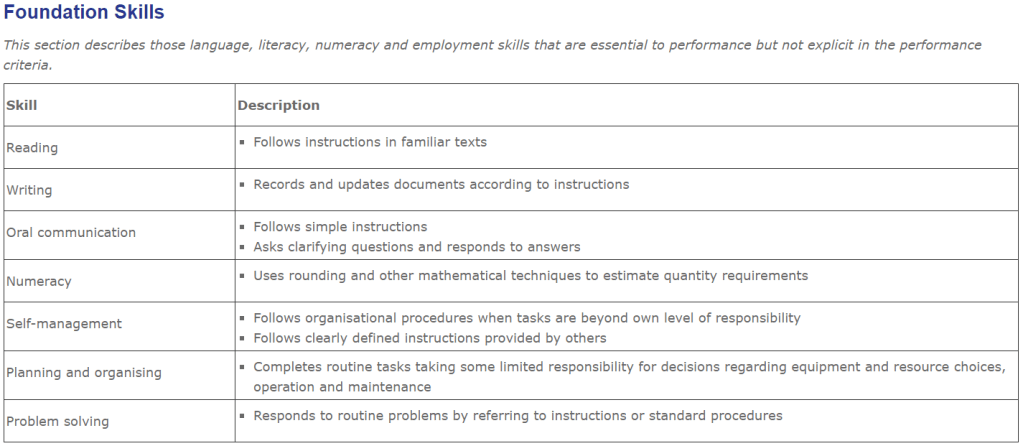
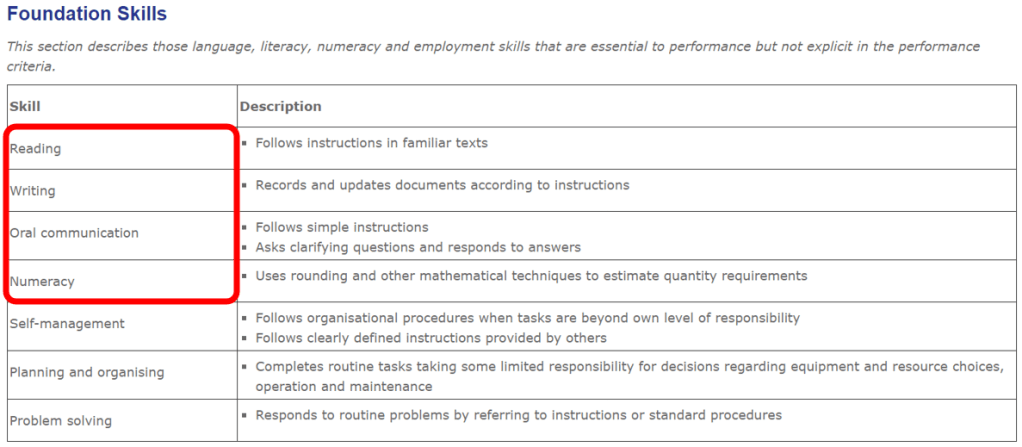
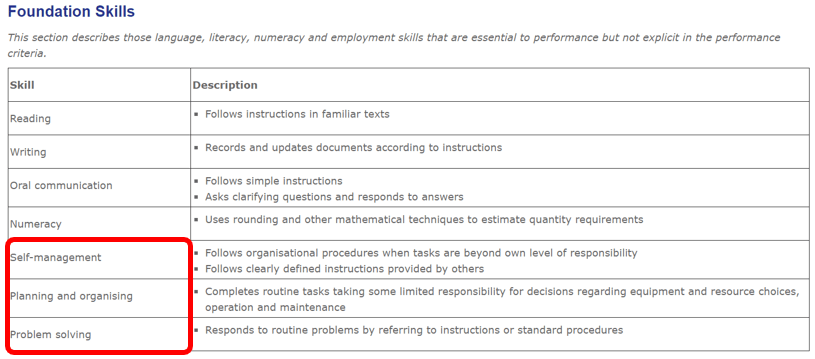
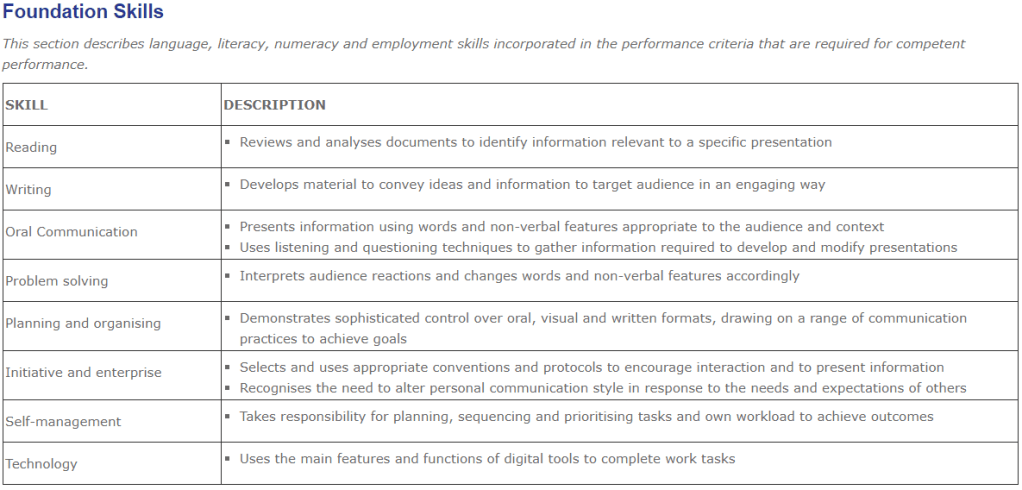
Some Training Package Developers have identified and described the foundation skills for a unit of competency. The following is an example for the BSBOPS101 Use business resources unit of competency.

In the above example, four of the seven foundation skills are LLN skills. And a brief descriptions helps to give a scope or context for each skill.

Method 2. Identifying the required LLN skills for a unit of competency without foundation skills

Some Training Package Developers have not identified or have only provided limited information about the foundation skills for a unit of competency. And many Accredited Courses have units of competencies in a format that did not require foundation skills to be identified. These situations will require you to identify and describe the LLN skills.

Step 1.1 Create an LLN skill template

Create a table.

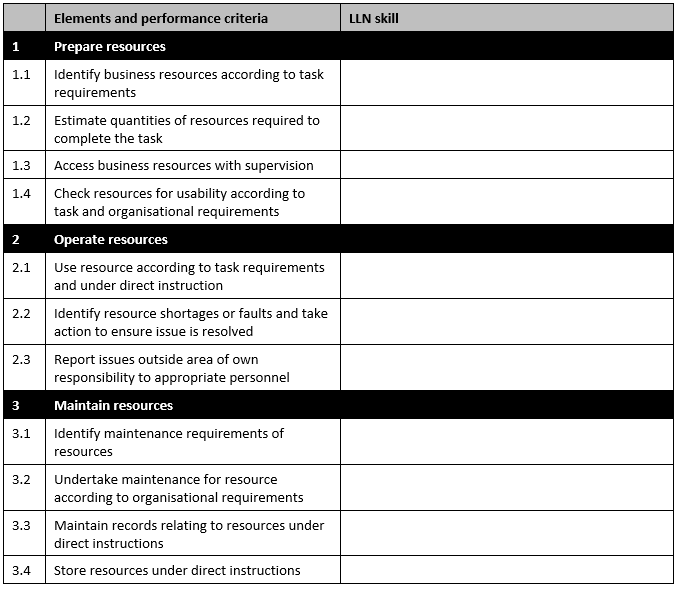
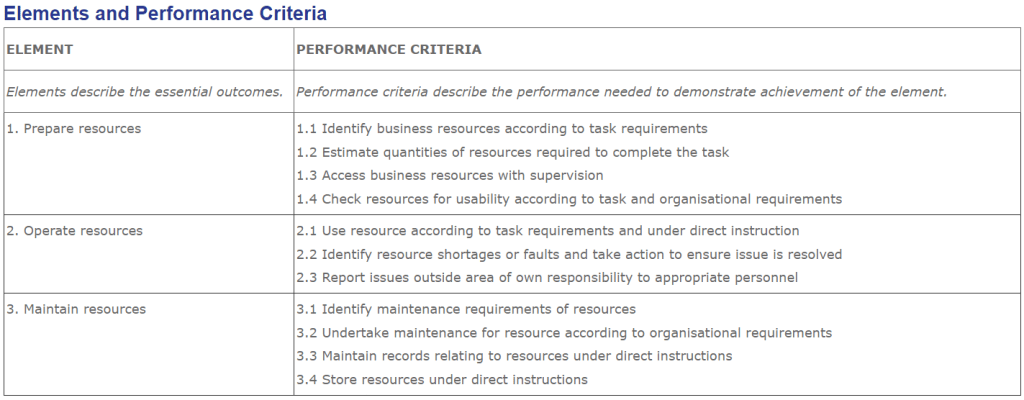
Then insert the elements and performance criteria for the unit of competency that will be analysed. The following is an example for the BSBOPS101 Use business resources unit of competency.

You should also read the Assessment Requirements because there may be relevant information relating to LLN skills required to perform the work task or activities.

Step 1.2 Identify the LLN trigger words

LLN trigger words are the ‘verbs’. These words help us locate the underpinning LLN skills required to perform the work task or activities specifed by the unit of competency. Others terms may also indicate underpinning LLN skills. For example, ‘within a designated timeframe’ indicates the need for numeracy skills.

The following example highlights the LLN trigger words for the BSBOPS101 Use business resources unit of competency.

Step 1.3 Use trigger words to identify LLN skills

ASQA has published Foundation Skills Trigger Words. These can be used to identify LLN skills. For example, the ‘identify’ verb can indicate that reading skills and oral communication skills are likely to be required. Using the BSBOPS101 Use business resources unit of competency as an example, the identification of these underpinning LLN skills for the ‘identify’ verb is relevant for Performance criteria 1.1 and 3.1 (see the table below).

The following example identifies the all the underpinning LLN skills for the BSBOPS101 Use business resources unit of competency.

Step 1.4 Describe each LLN skill

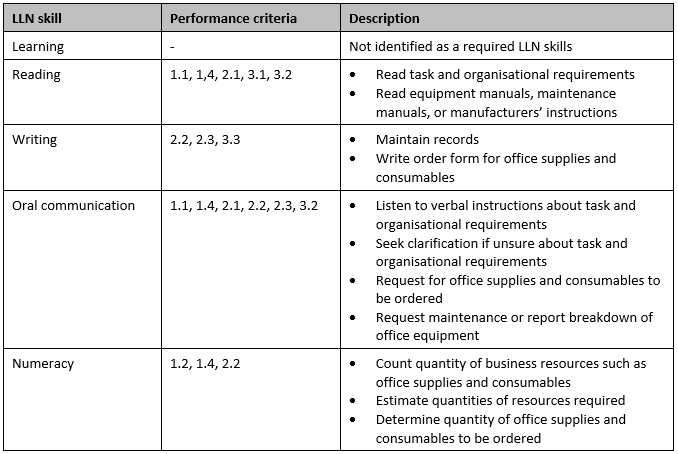
The above information can be restructured, simplified and any duplication can be removed. The description can be re-written to give a clear and concise scope or context for each LLN skill.

The following example describes the LLN skills for the BSBOPS101 Use business resources unit of competency.

Step 2. Analyse the complexity of the required LLN skills

Think about the typical tasks or activities performed in the workplace. How complex is the task to perform? Is the task performed with or without supervision? What is the relevant AQF level? Answers to these questions will help you analyse the complexity of the required LLN skills.

The following examples analyse the LLN skills for the BSBOPS101 Use business resources unit of competency. Business resources may include printers, phone and intercom systems, laminators, binding machines, and other office equipment. Also, business resources may include consumables such as paper, printer toner cartridges, laminating supplies, and binding supplies.

Reading requirement for the BSBOPS101 unit

What reading is required when performing the work task specified by the unit of competency? How complex are the required reading skills?

A competent person will need to read task lists or emails giving instructions about what and when tasks are to be completed. Workplace procedures about operating and maintaining office equipment will need to be read. And equipment manuals and manufacturers’ instructions giving details about using, maintaining and trouble-shooting will need to be read. Each procedural document or equipment manual can vary in content and layout, and some will require a moderate level of concentration and comprehension to read.

Writing requirement for the BSBOPS101 unit

What writing is required when performing the typical work tasks or activities specified by the unit of competency? How complex are the required writing skills?

A competent person will need to complete simple forms and maintenance records, or write emails.

Oral communication requirement for the BSBOPS101 unit

What oral communication is required when performing the typical work tasks or activities specified by the unit of competency? How complex are the required oral communication skills?

A competent person will need to clarify priorities or negotiate deadlines with their supervisor or other people in the workplace. Also, they will need to speak with maintenance or repair technicians to explain and discuss equipment faults or issues.

Numeracy requirement for the BSBOPS101 unit

What numeracy is required when performing the typical work tasks or activities specified by the unit of competency? How complex are the required numeracy skills?

A competent person will need to count office supplies and consumables. Also, they will need to estimate qualities required to complete tasks. The timeframe for each estimate can vary from quantities required to perform a task immediately, or quantities required during a day, or quantities required over a week. Usage rates from the past or order records can be used to inform estimate for the future.

Step 3. Use ACSF Performance Indicators to estimate the required ACSF Levels

Step 2 above and Step 3 may be combined and completed at the same time.

The ACSF Performance Indicators are used to estimate the ACSF Level required for each LLN skill. For more background information about the ACSF Performance Indicators go to: What is the Australian Core Skills Framework (ACSF)?

Step 3.1 Estimate the required ACSF Levels

The ACSF Performance Indicators are used to estimate the required ACSF Level for each LLN skill. The following example will show how to estimate the ACSF Level for the reading skills required for the BSBOPS101 Use business resources unit of competency.

Start by reviewing the ACSF Performance Indicators for ACSF Level 1.

A competent person would need reading skills greater than at the ACSF Level 1. Move on to review the ACSF Performance Indicators for ACSF Level 2.

A competent person would need reading skills greater than at the ACSF Level 2 because some unfamiliar texts or topics may need to be read. Move on to review the ACSF Performance Indicators for ACSF Level 3.

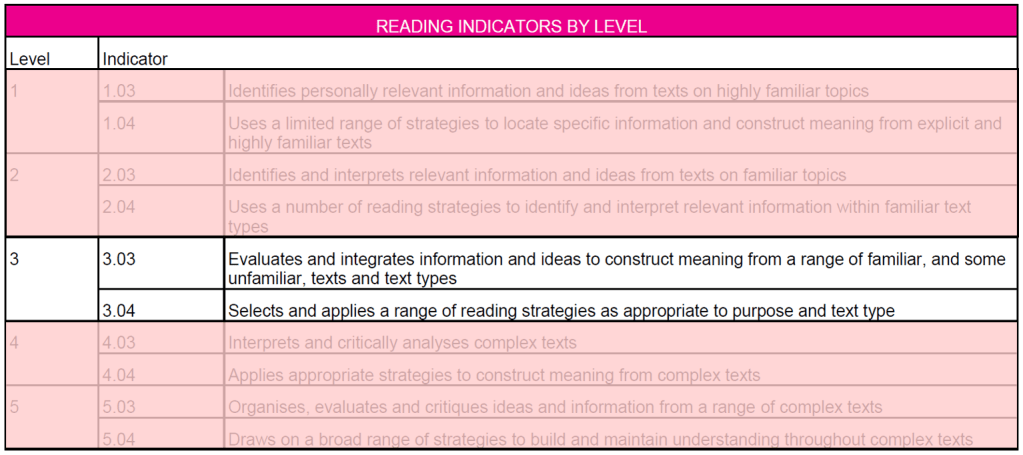
The ACSF Performance Indicators for ACSF Level 3 seem to be a reasonable description for the reading skills required by a competent person. Some information would be familiar, but some unfamiliar. And there would be a range of document types.

Before making a final decision, review the ACSF Performance Indicators for ACSF Level 4.

The critical analysis of complex text is beyond the scope for the BSBOPS101 Use business resources unit of competency. Therefore, the estimated ACSF Level for reading is 3.

The above procedure is repeated using the ACSF Performance Indicators for writing, oral communication, and numeracy.

Step 3.2 Record the required ACSF Levels

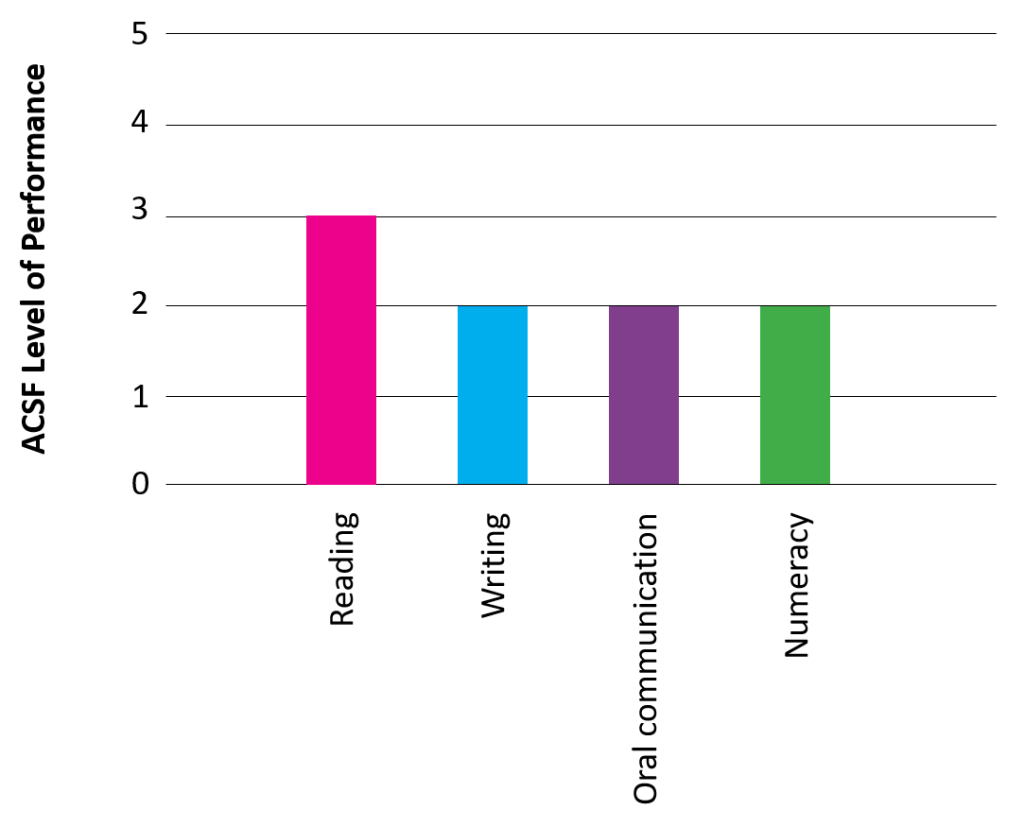
Use the following template to record the required ACSF Levels for each LLN skill.

Step 4. Compare an individual’s ACSF Levels with the required ACSF Levels

RTO will conduct a pre-training review (PTR) before someone enrols into a training program. Part of the PTR will be a diagnostic assessment of a person’s current ACSF Levels, and these can be compared with the ACSF Level required to perform the work tasks or activities specified by the unit of competency.

The ACSF encourages us to graph this information about ACSF Levels. These graphs may be refers to as being a ‘spiky profile’. A ‘spiky profile’ is a visual representation that provides valuable information about an individual’s areas of strength and specifically identifies any areas where there is a gap. An LLN skill gap may require additional training or support.

Step 4.1 Plot the required ACSF Levels

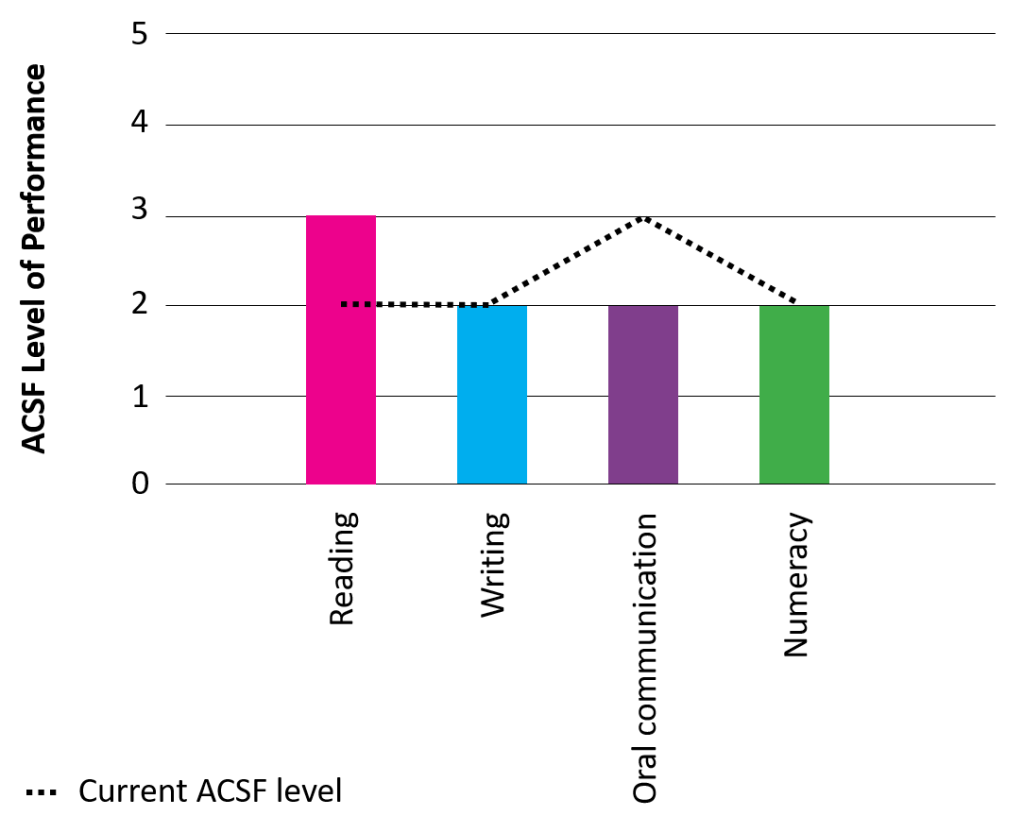
Plot the required ACSF Level for each LLN skill. The following example plots the ACSF Levels required for the BSBOPS101 Use business resources unit of competency.

Step 4.2 Plot the individual’s ACSF Level

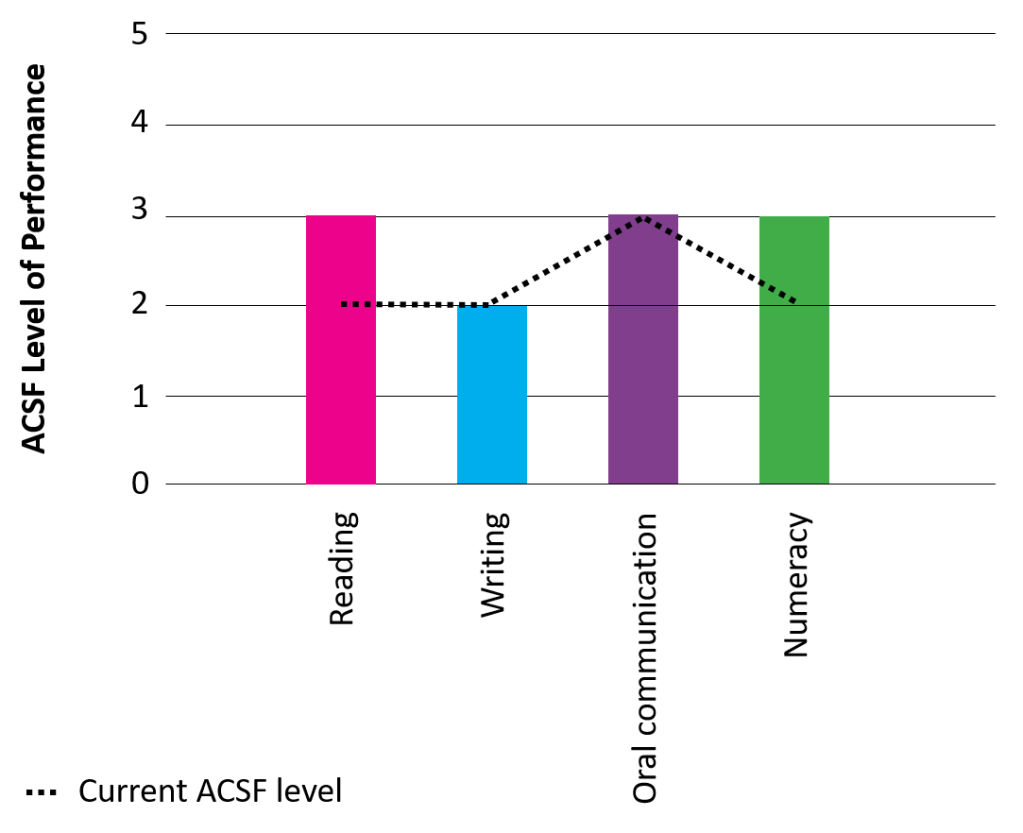
For the purpose of this example, let us say that an individual has been assessed as having reading skills at the ACSF Level 2, writing skills at the ACSF Level 2, oral communication skills at the ACSF Level 3, and numeracy skills at the ACSF Level 2. The following graph shows this person’s current ACSF Levels plotted.

The comparison between required and current LLN skills can be easily seen. In this example, an LLN skill gap for reading is apparent.

Qualification

Throughout this article, I have demonstrated how to use the ACSF to identify LLN skill gaps for a single unit of competency. Usually, we will determine the required LLN skills for an entire qualification. The following is an example of the ACSF Levels required for the BSB20120 Certificate II in Workplace Skills qualification.

Here is a revised ‘spiky profile’ for the BSB20120 qualification, instead of the BSBOPS101 unit.

The person can be identified as having two LLN skill gaps: reading skills and numeracy skills.

Identifying an LLN skill gap or gaps is only the first step. Next, we mostly will need to take action:

  • Discuss the LLN skill gap or gaps with the learner
  • Develop an agreed action plan with the learner
  • Implement the action plan, and this may include the involvement of other people such as LLN specialists or support services.

In conclusion

The identification of LLN skill gaps using the ACSF takes time and effort.

There is a high chance that all trainers and TAFE teachers will frequently have learners with LLN skills lower than what is required, and this includes having lower digital literacy skills than what is needed. I think it is important for VET practitioners to understand the ACSF and how LLN skill gaps are identified.

Identifying LLN skill gaps is the starting point for providing or arranging additional training and support for those learner who need it. Without this some learners will not succeed at attaining competency.

Do you need help with your TAE studies?

Are you doing the TAE40122 Certificate IV in Training and Assessment, and are you struggling with your studies? Do you want help with your TAE studies?

Ring Alan Maguire on 0493 065 396 to discuss.

Contact now!

logo otws

Training trainers since 1986

What is the ACSF? And what are the ACSF Performance Indicators?

This is the first of two articles covering an overview of the Australian Core Skills Framework (ACSF). My aim is to answer the following questions:

  • What is the Australian Core Skills Framework (ACSF)?
  • What are the ACSF Performance Indicators?
  • Is there a connection between the ACSF and the AQF?
  • What is the Digital Literacy Skills Framework (DLSF)?
  • Is there a connection between the DLSF and the ACSF?

The second article explains how to use the Australian Core Skills Framework (ACSF) to identify LLN skill gaps.

This article has been primarily written for people studying for their TAE40116 Certificate IV in Training and Assessment qualification. However, qualified VET practitioners may still get something from the content or the way the content has been presented.

The information covered by this article is relevant to the TAELLN411 Address adult language, literacy and numeracy skills unit of competency. It is essential knowledge required by trainers and TAFE teachers.

I don’t think I need to repeat everything that is readily available from the internet. If you need more details than what I am providing in this article, I would highly recommend reading the following documents:

Also, general information about the ACSF can be accessed from the Australian Government Department of Education, Skills and Employment website.

What is the Australian Core Skills Framework (ACSF)?

The Australian Core Skills Framework (ACSF) was introduced in 2012. It is a tool used to describe an individual’s performance in the following five core skills:

  • Learning
  • Reading
  • Writing
  • Oral communication
  • Numeracy.

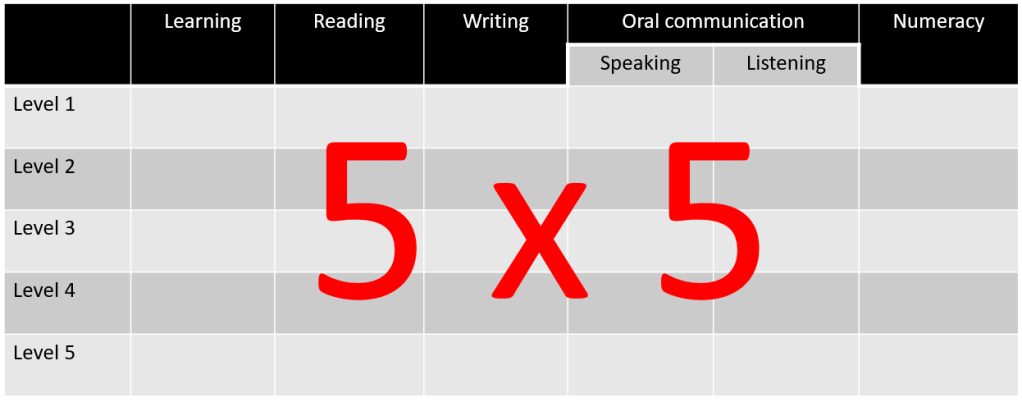
A 5 x 5 framework

Each core skill is described using five levels of performance ranging from one (low level performance) to five (high level performance).

The ACSF is a 5 x 5 framework:

  • Five core skills (learning, reading, writing, oral communication, numeracy)
  • Five levels of performance for each core skill.

ACSF Level 3

In 2006, the Australian Bureau of Statistics (ABS) released the results of the Adult Literacy and Life Skills Survey. It proposed that ‘Level 3’ in language, literacy, and numeracy skills was the minimum required for individuals to meet the complex demands of everyday life and work.

This ABS survey was conducted before the ACSF was published. However, it is common for people to consider that a minimum of ACSF Level 3 is required by skilled workers in today’s world of work.

ACSF Pre-Level 1

In  2017, a new Pre-Level 1 was introduced. Most trainers or TAFE teachers wouldn’t normally have learners that have been assessed with Pre-Level 1 core skills. These learners would usually need to participate in a qualification from the FSK Foundation Skills Training Package . And they would probably need extensive support from an LLN specialist.

Are you interested in finding out more about the ACSF Pre-Level 1? Please refer to the Pre-Level 1 supplement to the Australian Core Skills Framework (ACSF).

What are the ACSF Performance Indicators?

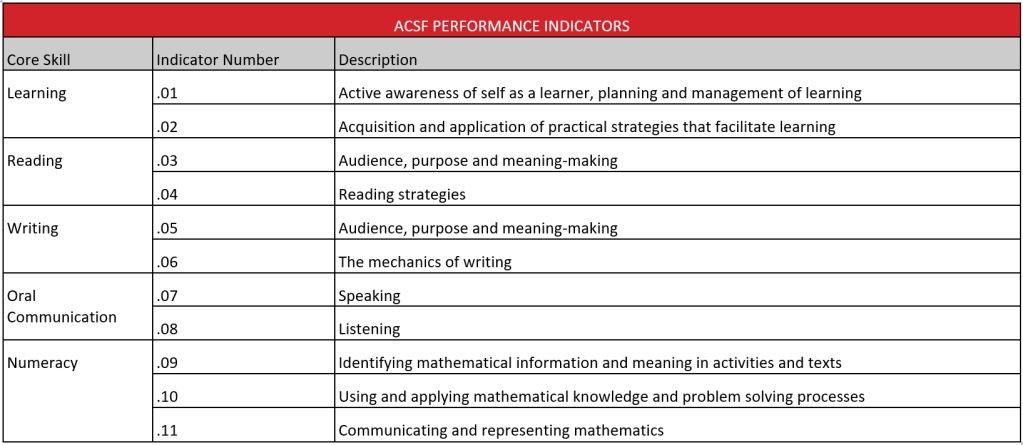
The ACSF Performance Indicators are statements that briefly describe performance at each level of the five core skills. There are eleven ACSF Performance Indicators:

  • 2 ACSF Performance Indicators for the Learning core skill
  • 2 ACSF Performance Indicators for the Reading core skill
  • 2 ACSF Performance Indicators for the Writing core skill
  • 2 ACSF Performance Indicators for the Oral Communication core skill
  • 3 ACSF Performance Indicators for the Numeracy core skill.

The following table has been copied from the ACSF (page 9). It gives a brief description for each ACSF Performance Indicators.

Some people can get confused by the numbering of the ACSF Performance Indicators. If you get confused, please come back to the above table to see how the numbering starts at .01 and .02 for the Learning core skill and continues until .09, .10 and .11 for the Numeracy core skill. It is just the way the core skills have been numbered.

Also, the ACSF has colour-coded each core skill. The following information uses the colours that are consistent with the ACSF document.

ACSF Performance Indicator for the Learning core skill

The following table has been copied from the ACSF (page 17). It briefly describes the ACSF Performance Indicators of each ACSF Level for the Learning core skill.

ACSF Performance Indicator for the Reading core skill

The following table has been copied from the ACSF (page 41). It briefly describes the ACSF Performance Indicators of each ACSF Level for the Reading core skill.

ACSF Performance Indicator for the Writing core skill

The following table has been copied from the ACSF (page 65). It briefly describes the ACSF Performance Indicators of each ACSF Level for the Writing core skill.

ACSF Performance Indicator for the Oral Communication core skill

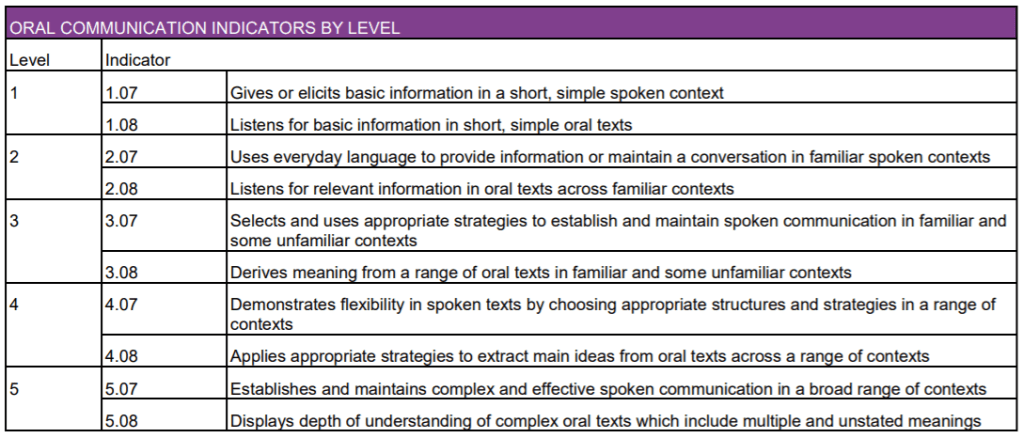
The following table has been copied from the ACSF (page 90). It briefly describes the ACSF Performance Indicators of each ACSF Level for the Oral Communication core skill.

ACSF Performance Indicator for the Numeracy core skill

The following table has been copied from the ACSF (page 114). It briefly describes the ACSF Performance Indicators of each ACSF Level for the Numeracy core skill.

Numbering of ACSF Performance Indicators

The first number of the ACSF Performance Indicator is the ACSF Level. For example, all core skills at the ACSF Level 2 will start with the number 2.

The numbers after the decimal point are for the indicators that describe a specific ACSF core skill . For example, 2.03 and 2.04 refer to the two indicators used to determine if the Reading core skill is at the ACSF Level 2.

Note: The ACSF Performance Indicators provide a brief description. Additional information and examples are provided by the ACSF document. There are several pages of additional information for each ACSF Performance Indicator, and this information helps us understand the ACSF Level for each core skill.

Is there a connection between the ACSF and the AQF?

No. The Australian Core Skills Framework (ACSF) does not correlate with the Australian Qualification Framework (AQF). The levels of the AQF do not match up directly with the levels of the ACSF.

It is possible for a Certificate III (AQF Level 3 qualification) to have units of competency that require core skills at an ACSF Level greater than 3. For example, several units from the UEE30820 Certificate III in Electrotechnology Electrician require Numeracy skills at the ACSF Level 4 or 5.

And it is possible for a Diploma (AQF Level 5 qualification) to have units of competency that would only require core skills as the ACSF Level 3 or 4.

Digital literacy

Technology is frequently used to perform work tasks and activities. For example, screen-based reading and writing is common. Computers and other digital devices have transformed the type and amount of data available. This and other factors require improved numeracy skills. And during 2020, there was a massive increase in workers using web conferencing platforms, such as Zoom. This has required many people to further develop there speaking and listening skills to effectively communicate and collaborate online.

The world of work requires people to have effective language, literacy, and numeracy (LLN) skills, and these LLN skills are interrelated with digital literacy. Digital literacy covers the physical operations of digital devices and the software operations in those devices.

Is there a connection between the DLSF and the ACSF?

In 2020, the Digital Literacy Skills Framework (DLSF) was published by the Australian Government Department of Education, Skills and Employment. The DLSF adds onto the ACSF. The following table has been copied from the DLSF (pages 10 and 11).

You can see that Digital Literacy has been added to the five core skills of the ACSF. The two ACSF Performance Indicators for Digital Literacy (.12 and .13) have a descriptive statement for ACSF Levels 1, 2, and 3. There are no details given for ACSF Levels 4 and 5.

The following table has been taken from the DLSF (page 12). It briefly describes the ACSF Performance Indicators of ACSF Levels 1, 2, and 3 for the Digital Literacy core skill.

In conclusion

The Australian Core Skills Framework (ACSF) is a tool used to describe an individual’s performance in essential core skills. Descriptive statements, known as ACSF Performance Indicators, are used to determine the level of each core skill.

This article is the first of two articles about the ACSF. The how-to use the ACSF to determine levels and identify LLN skill gaps is covered by the second article.

There are three separate documents relating to the Australian Core Skills Framework, and this can make things complicated:

  • Australian Core Skills Framework (ACSF), 2012
  • Pre-Level 1 supplement to the Australian Core Skills Framework, 2017
  • Digital Literacy Skills Framework, 2020.

The future

Creating an updated version of the Australian Core Skills Framework (ACSF) that incorporates all three documents would significantly simplify things. The following diagram illustrates my suggestion.

This updated ACSF would become a 6 x 6 framework:

  • Six core skills (learning, reading, writing, oral communication, numeracy, digital literacy)
  • Six levels of performance for each core skill (Pre-Level 1, Level 1, Level 2, Level 3, Level 4, Level 5)

The following table shows what is currently available but we have to get the information from three different documents.

Note: The current Digital Literacy Skills Framework does not describe Digital Literacy Levels 4 and 5. Therefore, the above table show that information is ‘Not available’.

Do you need help with your TAE studies?

Are you doing the TAE40122 Certificate IV in Training and Assessment, and are you struggling with your studies? Do you want help with your TAE studies?

Ring Alan Maguire on 0493 065 396 to discuss.

Contact now!

logo otws

Training trainers since 1986

Foundation Skills and the Australian VET system

This is the first of two articles covering foundation skills in the Australian VET system. In this article, I shall provide an overview of foundation skills:

  • What are foundation skills?
  • When were foundation skills introduced?
  • What is the FSK Foundation Skills Training Package?
  • When was the FSK Foundation Skills Training Package introduced?

The second article explains how to incorporate foundation skills when we design and develop competency-based training.

This article has been primarily written for people studying for their TAE40116 Certificate IV in Training and Assessment qualification. However, qualified VET practitioners may still get something from the content or the way the content has been presented.

What are foundation skills?

The Australian VET system uses ‘foundation skills’ in two ways:

  • Foundations skills from the units of competency
  • FSK Foundation Skills Training Package.

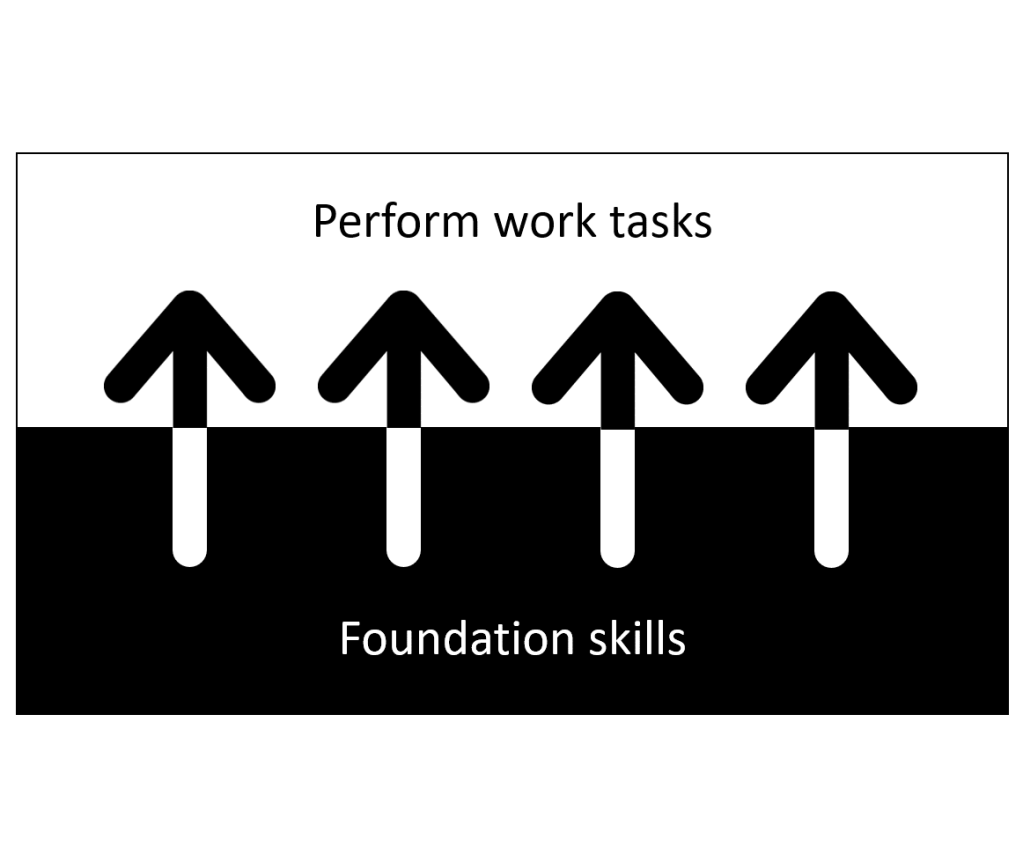
The following illustrates how foundation skills underpin the performance of work tasks and activities.

Foundation Skills from the units of competency

The prime function of Australia’s VET system is to help people learn to perform work tasks and activities. Units of competency describe the work tasks and activities to be performed and specify the standards of performance expected by industry and employers.

And the Australian VET system defines competency as the consistent application of knowledge and skills to the standard of performance required in the workplace. This definition acknowledges that a person needs knowledge and skills to have the ability to perform work tasks and activities.

The following are examples of information from units of competency.

Description of performance

Performance of work tasks and activities are described by elements and performance criteria. The following is an example for the BSBOPS101 Use business resources unit of competency:

Knowledge required to perform a work task

The essential knowledge required to perform work tasks and activities are described by Knowledge Evidence. The following is an example for the BSBOPS101 Use business resources unit of competency:

Skills required to perform a work task

And the essential skills required to perform work tasks and activities are described by Foundation Skills. The following is an for example for the BSBOPS101 Use business resources unit of competency:

Definition of foundation skills

Foundation skills are defined as those language, literacy, numeracy and employment skills that are essential to the performance of a work task or activity but are not explicit in the performance criteria.

Language, literacy, and numeracy (LLN) skills

The Australian Core Skills Framework (ACSF) is used by Training Packages developers to describe the language, literacy, and numeracy (LLN) skills that underpin the performance of a work task or activity.

The following is an for example for the BSBOPS101 Use business resources unit of competency. It shows that the underpinning LLN skills are reading, writing, oral communication, and numeracy skills.

In the above table, you can see a clear and concise description beside the LLN skills. This gives us context and helps us understand the scope and application of each LLN skill.

Employment skills

There are two frameworks used by Training Packages developers to describe the employment skills that underpin the performance of a work task or activity:

  • Employability Skills Framework
  • Core Skills for Work Developmental Framework.

The Employability Skills Framework was introduced in 2002. It was replaced by the Core Skills for Work Developmental Framework in 2012. Both frameworks are currently in use.

The following is an for example for the BSBOPS101 Use business resources unit of competency. It shows that the underpinning employment skills are self-management, planning and organising, and problem solving skills.

Again, in the above table, you can see a clear and concise description beside the employment skills. This gives us context and helps us understand the scope and application of each employment LLN skill.

If you like history …

If you like history, then you may like to know that before foundations skills and before employability skills, the Australian VET system had Key Competencies, also known as the Mayer Key Competencies. They were introduced in 1992.

A significant change came in 2012, when the new Standards for Training Packages were released. Employablity skills were removed from qualifications, and foundation skills were added to the units of competency.

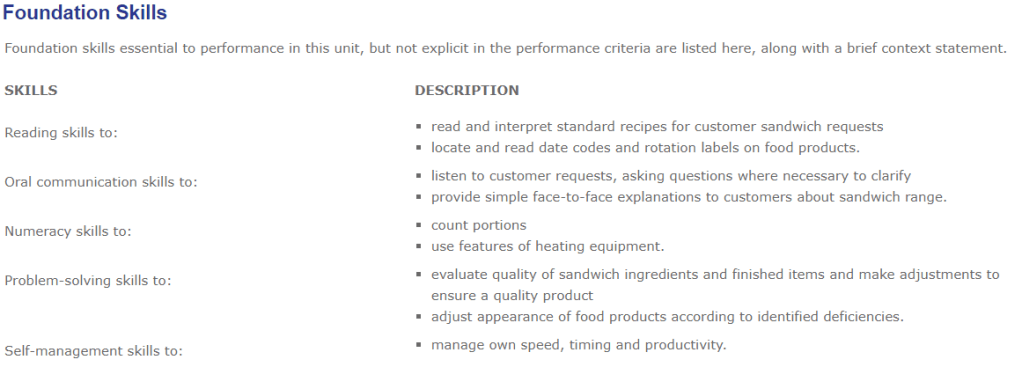
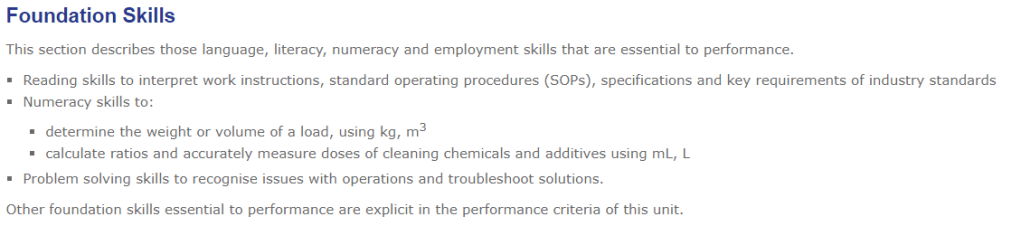
Unfortunately, Training Package developers have implemented foundation skills in different ways. There is a lack of consistency across different training packages. Here are some examples.

The following shows the foundation skills for the TAELLN411 unit. It provide useful information connecting each foundation skill with the relevant performance criteria. And it is using the 2012 Core Skills for Work framework to specify the employment skills required.

The following shows are the foundation skills for the BSBCMM411 unit. It has used the 2002 Employability Skills framework to specify the employment skills required.

The following shows the foundation skills for the SITHCCC003 unit. It is not as easy to read without table lines.

The following shows the foundation skills for the MSTDC2013 unit. It has not used a table format. I think that the information is better when presented in a table (and with table lines).

The following is from the TLID2010 Operate a forklift unit, and it is an example when a Training Package developer has decided not to specify the foundation skills. I do not believe that the foundation skills to operate a forklift have been explicitly described by the performance criteria. I do believe that the Training Package developer did not do the work required to identify the underpinning skills required to perform the task.

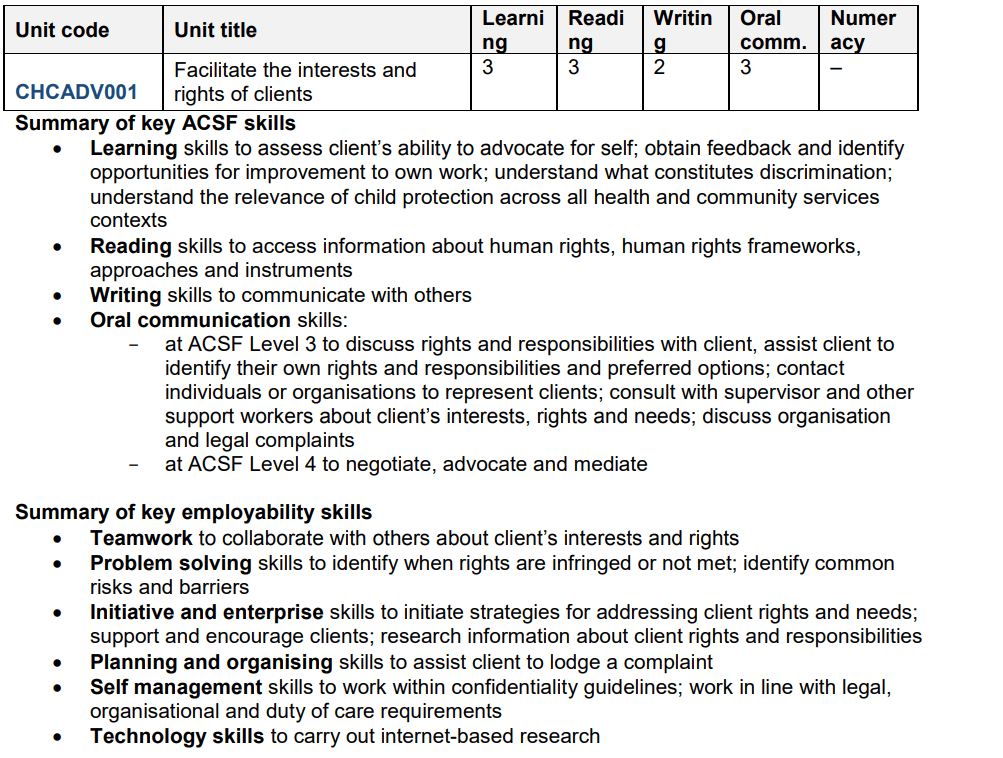
There are many units of competency that do not provide information about foundation skills. And in the case of the HLT Health and CHC Community Services Training Packages, there is a Foundation Skills Guide (available from the vetnet.gov.au website). This guide identifies foundation skills for many HLT and CHC units of competency.

The following shows the foundation skills for the CHCADV001 unit.

Are Foundation Skills assessable?

The recently released units of competency in the BSB Business Services, FNS Financial Services, and ICT Information and Communications Technology Training Packages are stating that foundation skills are assessable. The following is an example for the BSBOPS101 Use business resources unit of competency:

FSK Foundation Skills Training Package

The following information was extracted from the Implementation Guide for the FSK Foundation Skills Training Package (Release 2).

Foundation skills have regularly been identified by employers as essential for successful performance in the workplace. The National Foundation Skills Strategy for Adults reports that 40 per cent of employed Australians do not have the foundation skills needed to meet the complex demands of the modern workplace. These individuals may have difficulty participating in workforce development opportunities and may be limited in their ability to build new vocational skills and knowledge.

The FSK Foundation Skills Training Package was first released in 2013. It was designed to support a greater emphasis on building foundation skills within VET programs, enabling individuals to:

  • acquire the foundation skills that will enable them to participate successfully in education and training
  • build the foundation skills that underpin vocational competence.

There are three qualifications in the FSK Foundation Skills Training Package:

  • FSK10119 Certificate I in Access to Vocational Pathways
  • FSK10219 Certificate I in Skills for Vocational Pathways
  • FSK20119 Certificate II in Skills for Work and Vocational Pathways.

These qualifications are prevocational and do not provide specific vocational outcomes. However, RTOs delivering the FSK qualifications are expected to contextualise the units of competency to enable learners to develop the specific skills and knowledge that are relevant to an industry sector or a typical workplace. This contextulaisation will prepare learners for entry into a vocational learning pathway. In other words, enroll into a vocational qualification.

The FSK Foundation Skills Training Package differs from all other training packages in that it is designed to work in combination with other training packages to support learner achievement of vocational outcomes. It can be delivered before starting a vocational qualification or delivered in conjunction with a vocational qualification.

Most groups of learners will be using the FSK Foundation Skills Training Package to develop or enhance foundation skills in one or more of the following areas:

  • learning
  • reading
  • writing
  • oral communication
  • numeracy
  • digital technology.

Many learners who undertake qualifications from the FSK Foundation Skills Training Package will need considerable support from LLN specialists to address and overcome severe barriers to learning.

In conclusion

Foundation skills are important because they underpin the performance of work tasks and activities.

The Australian VET system uses ‘foundation skills’ in two ways:

  • Foundations skills from the units of competency
  • FSK Foundation Skills Training Package.

I have published another article that describe how to incorporate foundation skills in vocational education and training. The 5-step procedure described in that article will become useful as more Training Packages mandate the assessment of foundation skills.

Do you need help with your TAE studies?

Are you doing the TAE40122 Certificate IV in Training and Assessment, and are you struggling with your studies? Do you want help with your TAE studies?

Ring Alan Maguire on 0493 065 396 to discuss.

Contact now!

logo otws

Training trainers since 1986

How to incorporate foundation skills in vocational education and training

This is the second of two articles covering foundation skills in the Australian VET system. It explains how to incorporate foundation skills when we design and develop competency-based training.

The following 5 steps aim to give some practical tools and a simple procedure to incorporate foundation skills into our training:

  • Step 1. Create a table with a list of the Foundation Skills
  • Step 2. Create a Performance Criteria / Foundation Skills matrix
  • Step 3. Analyse the Foundation Skills
  • Step 4. Determine a timeframe for the training agenda
  • Step 5. Develop a Training Matrix

It is desirable to integrate foundation skills as you deliver the training. This is better than keeping foundation skills separate from learning how to perform a work task or activity.

Some Training Packages are mandating the assessment of the foundation skills. For example, the Performance Evidence for the BSBOPS101 Use business resources unit states:

“The candidate must demonstrate the ability to complete the tasks outlined in the elements, performance criteria and foundation skills of this unit …”

Therefore, we will often need to ensure that we deliver training so that the foundation skills are learnt. I acknowledge that some learners may already have the specified foundation skills but some learners will not.

Step 1. Create a table with a list of the Foundation Skills

Foundation skills are documented in the units of competency, after the elements and performance criteria.

Copy the foundation skills from the unit of competency. For example, the following are the Foundation Skills for the BSBOPS101 Use business resources unit.

Add a column for notes

This can be done very quickly. You are creating a template to assist you to analyse each Foundation Skill and you will record your analysis in the ‘Notes’ column. This template will be used in Step 3.

Step 2. Create a Performance Criteria / Foundation Skills matrix

Foundation Skills are not stand-alone skills. They are the identified foundations for the performance of the work tasks. Work tasks could not be performed safely or effectively without having the Foundation Skills.

The performance of work tasks is described by the Performance Criteria. We need to make the connection between Performance Criteria and Foundation Skills. Without this connection, Foundation Skills lack meaning.

In this example, it is important to note that the headings for Foundation Skills must be read in conjunction with the specific description from the BSBOPS101 Use business resources unit.

Step 3. Analyse the Foundation Skills

Use the Performance Criteria / Foundation Skills matrix (from Set 2) and the Foundation Skills template (from Step 1) to analyse the scope of each Foundation Skill and how it connects with the Performance Criteria.

Performance Criteria / Foundation Skills matrix

The following is a completed example of a Performance Criteria / Foundation Skills matrix for the BSBOPS101 Use business resources unit. It must be read in conjunction with the Foundation Skills template (see below).

Foundation Skills template

The following is a completed example of a Foundation Skills template for the BSBOPS101 Use business resources unit.

Step 4. Determine a timeframe for the training agenda

For this example, let us say we are going to allocate on day to deliver training for the BSBOPS101 Use business resources unit. The following is a sample agenda for the training day.

Step 5. Develop a Training Matrix

The Training Matrix is used to ensure there is a plan to cover all Performance Criteria and Foundation Skills during the training.

Performance Criteria 2.2 is ‘identify resource shortages or faults and take action to ensure issue is resolved’. The following additional details shows how the Foundation Skills connect with the Performance Criteria when operating a printer. Typical tasks may include:

  • Refill paper
  • Replace toner cartridges
  • Fix simple paper jams
  • Report complex paper jams and faults
  • Reorder paper, toner cartridges, and other consumables.

The above is an example showing how specific Foundation Skills should be seamlessly incorporated into the delivery of training covering the performance of a work task. This example is only for operating a printer. The same analysis would need to be done for using other office equipment, such as: binding machines, laminator, coffee machine, etc. And the same analysis would need to be done for other Performance Criteria.

In conclusion

I have used a simple example to demonstrate how to incorporate foundation skills when designing and developing competency-based training. This procedure will work. However, for some units of competency you may need to use a ‘landscape orientation’ for the documents rather than ‘portrait’. And you will need time to do the analysis and mapping.

Some learners will need training to help them learn the foundation skills. And it is better to integrate the foundation skills when the person is learning how to perform the work tasks or activities. This approach will give context and purpose each foundation skill.

The 5-step procedure described in this article will become useful as more Training Packages mandate the assessment of foundation skills.

Do you need help with your TAE studies?

Are you doing the TAE40122 Certificate IV in Training and Assessment, and are you struggling with your studies? Do you want help with your TAE studies?

Ring Alan Maguire on 0493 065 396 to discuss.

Contact now!

logo otws

Training trainers since 1986

Rest In Peace ICTICT102

The ICTICT102 Operate word-processing applications unit of competency was deleted on the 18th of January 2021. This was part of the newly released version of the ICT Information and Communications Technology Training Package (Release 7.0).

In 2015, the ICTICT102 Operate word-processing applications unit of competency replaced the ICAICT102A Operate word-processing applications unit of competency.

In 2011, the ICAICT102A Operate word-processing applications unit of competency had replace the ICAU1129B Operate a word processing application unit of competency.

The ICAU1129B Operate a word processing application unit of competency was released on the 8th of July 2010.

After more than a decade of use a decision has been made to remove the ‘word processing’ unit of competency from the Australian VET system. Up until the last few months we have had the ICTICT102 Operate word-processing applications and BSBITU201 Produce simple word processed documents units of competency to give structure to the training and assessing of word processing skills. Has word processing become a thing of the past, just like dinosaurs?

It seems that the modern worker now needs the BSBTEC201 Use business software applications or ICTICT216 Design and create basic organisational documents unit of competency. However, I think these units can be ‘word processing’ in disguise. We must contextualise the newly released units to ensure people can do what we use to call ‘word processing’, but for some reason we cannot call it word processing.
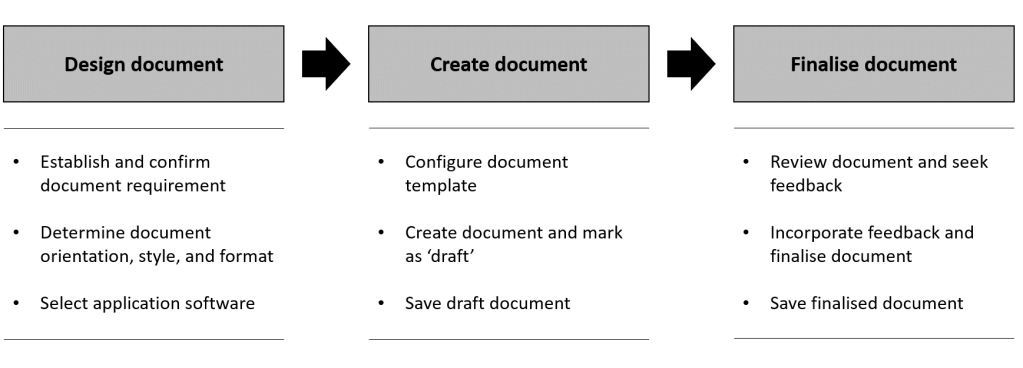
I think we are witnessing George Orwells’s Newspeak being implemented. I am picking up a trend that makes units of competency extremely vague. I know that units must be written in a way to be somewhat generic, but I feel we are heading towards making units meaningless.

Can anyone give me an answer to the following questions?

  • Is ‘word processing’ an antiquated term?
  • Does any workplace still use the term ‘word processing’?
  • Is Microsoft Word still referred to as a word processing application?

The BSB and ICT Training Packages are both developed by PwC’s Skills for Australia. I assume they hope to be displaying leadership regarding Training Package development. Are they?

Australia’s VET is changing. It is certain that the current VET Reforms are disrupting the system. But will the VET system be improved, or will the VET system be damaged? Could the VET system be destroyed?

The BSB and ICT are not the only Training Packages that are changing. Unfortunately, each Training Package developer seems to be doing their own thing. And then the new Skills Organisations are likely to do different things again. No consistency. A lack of consistency create chaos, confusion, and frustration. How are you feeling? Confused? Frustrated?

Are you looking forward to the full force of the VET Reforms?

Please tell me what you think and how you are feeling.