Risk-based approach: How to determine sample size for assessment validation

Introduction

The Standards for Registered Training Organisations (RTOs) 2015 required an RTO to review a statistically valid sample of the assessments. The national VET regulator, Australian Skills Quality Authority (ASQA) provided an online calculator to determine the sample size so that it would be statistically valid.

ASQA’s Validation sample size calculator has been used to calculate the statistically valid sample size for the following two examples. [1]

Example 1

Example 2

The new Standards for RTOs 2025 has introduced a significant change to assessment validation. Instead of a fixed requirement, RTOs are now required to adopt a risk-based approach to determine their validation sample size. This means the number of assessments validated will vary considerably across RTOs, reflecting their individual risk assessments.

Select the units to be validated

The new Standards for RTOs 2025 states that “every training product on the organisation’s scope of registration is validated at least once every five years and on a more frequent basis where the organisation becomes aware of risks to training outcomes, any changes to the training product, or receives relevant feedback from VET students, trainers, assessors, and industry.” [2]

What is a training product?

The new Standards for RTOs 2025 defines training products as:

  • VET Qualification
  • Skill set
  • Unit of competency
  • Accredited short course or module.

How many units per qualification should be validated?

ASQA has provided the following guidance for RTOs: [3]

“At least two units from each qualification must be validated; however, your RTO may choose to validate more if validation of the two units identifies risks or a potential harm to learners who may not have met the required assessment outcomes, inconsistent assessment judgements have been made by assessors or assessment has not been conducted in accordance with the Principles of Assessment or the Rules of Evidence.”

Prioritising high-risk units

When RTOs prioritise the validation of high-risk units over low-risk ones, they are strategically focusing their quality assurance efforts where they matter most. High-risk units often involve complex skills, critical safety implications, or significant industry impact. By concentrating validation on these areas, RTOs can identify and rectify potential assessment flaws that could lead to serious consequences, such as workplace accidents or compromised professional standards. This approach ensures that training quality is rigorously maintained in the most crucial areas, safeguarding both learner outcomes and industry integrity. Essentially, it’s about maximising the impact of validation resources by addressing the areas with the greatest potential for negative consequences.

Identifying risks

The new Standards for RTOs 2025 states that a risk-based approach should be used to determine the sample size of assessments that should be validated. It’s important to understand that the risk-based approach in the Australian VET sector is about ensuring quality and compliance. Therefore, the risks considered relate to factors that could negatively impact those outcomes. Here are five risks that RTOs could consider when determining assessment validation sample sizes:

  • Type of unit
  • Experience of assessors
  • Changes to assessment practices
  • Volume of assessments
  • Historical compliance and validation outcomes.

Risk 1. Type of unit

Units involving high-risk activities, complex skills, or critical safety components require more rigorous validation. The potential consequences of incompetent performance are higher.

Risk 2. Experience of assessors

If assessors are new, less experienced, or are not fully qualified, there is a higher risk of inconsistent or inaccurate assessments. This necessitates a larger validation sample.

Risk 3. Changes to assessment practices

Any recent changes to assessment tools or assessment procedures can introduce inconsistencies. A larger validation sample size helps identify any unforeseen issues.

Risk 4. Volume of assessments

A high volume of assessments within a short period can increase the risk of errors or inconsistencies. Larger sample sizes are needed to maintain quality assurance.

Risk 5. Historical compliance and validation outcomes

A history of non-compliance or poor validation outcomes should lead to a more conservative approach with larger sample sizes. This allows for closer scrutiny and helps build confidence in the RTO’s assessment practices.

The above five risks are examples, not a complete list, of risks that may influence an RTO’s risk assessment. In essence, the risk-based approach should encourage an RTO to prioritise validation efforts where the potential for errors or negative impacts is greatest.

Determining sample size

Let’s look at how a risk-based approach to assessment validation sample sizes might work with some numerical examples. Here are three scenarios.

Scenario 1. High-risk unit

Scenario 2. Medium-risk unit
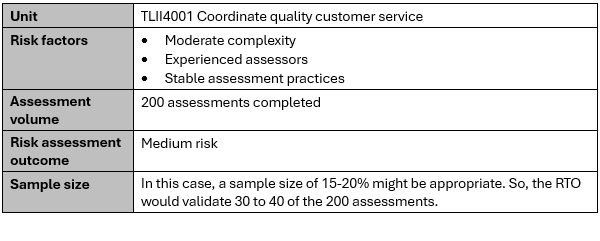
Scenario 3. Low-risk unit
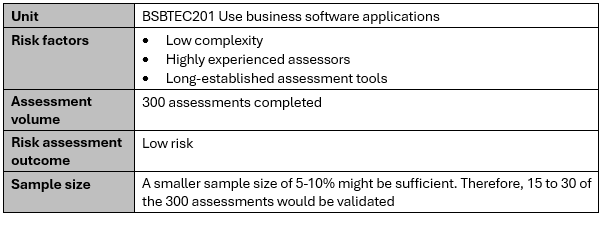
The numbers in the above three scenarios are examples. The exact percentages will vary depending on the RTO’s own risk assessment and validation policies.

The following table compares the statistically valid sample size with the sample size for the three previous scenarios.

High-risk units should be selected for validation rather than low-risk units. Therefore, the new risk-based approach should not significantly reduce the sample size of assessments to be validated.

Selecting units to be validated

A VET qualification consists of many units of competency. The RTO will need to select at least two units to be validated. The following is a three-step process that can be used for risk-based selection of unit.

  • Step 1. Select the risk assessment criteria
  • Step 2. Create a risk assessment table
  • Step 3. Conduct and document the risk assessment.

Step 1. Select the risk assessment criteria

Here are some examples of risk assessment criteria:

  • Complex skills
  • High-risk activities
  • New, inexperienced or partly qualified assessors
  • New or changed assessment tools
  • Feedback or complaints from students, trainers, assessors, or industry.

Step 2. Create a risk assessment table

The following risk assessment table show an example with four risk assessment criteria. The number of risk assessment criteria shall be determined by the RTO, and this shall determine the number of columns required.

Step 3. Conduct and document the risk assessment

Here are risk assessment examples for two different qualifications.

Example 1
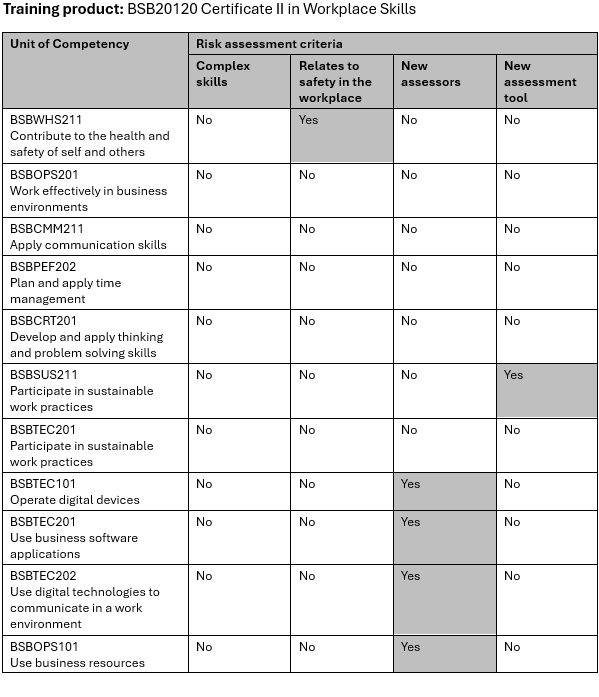
Selection of units to be validated based on the above risk assessment table should consider:

  • Units with newly implemented assessment tools (for example, BSBSUS211 Participate in sustainable work practices)
  • Units assessed by new assessors (for example, BSBTEC201 Use business software applications)
  • Units related to critical areas like safety (for example, BSBWHS211 Contribute to the health and safety of self and others).

Example 2

Unit selection for validation based on the above risk assessment table may prioritise two of the following:

  • SITHFAB025 Prepare and serve espresso coffee
  • SITHACS009 Clean premises and equipment
  • SITXFSA005 Use hygienic practices for food safety
  • SITXWHS005 Participate in safe work practices.

What assessment items must be kept? And how long do these items need to be kept?

ASQA has provided the following guidance for RTOs: [4]

“An RTO must keep all completed assessment items for each student for a period of six months from the date on which the judgement of competence for the student has been made. Completed student assessment items include the actual work completed by a student or evidence of that work, including evidence collected for a Recognition of Prior Learning (RPL) process.

If a student’s actual work is unable to be retained, an assessor’s completed marking guide, criteria, and observation checklist for each student may be sufficient. However, this evidence must have enough detail to demonstrate the assessor’s judgement of the student’s performance.”

Assessment items must be kept for at least 6 months. Some state and territory governments may require RTOs delivery government-funded or subsidised training to keep assessment items for a longer period of time.

Therefore, completed assessment items should be available for conducting assessment validation.

Random selection of assessments

While random selection is a common approach to assessment validation, best practice dictates including assessments conducted by new, inexperienced, or partially qualified assessors. Additionally, a sample of any Recognition of Prior Learning (RPL) assessments should always be included in the validation process.

In conclusion

The Standards for RTOs 2025 replace the previous fixed statistically valid sample size requirements with a risk-based approach. RTOs must now determine their own sample size based on their risk assessment.

Apart from determining the validation sample size, the RTO must select the units to be validated. An RTO should select units that are high risk rather than low risk. Prioritising high-risk units for validation allows RTOs to focus quality assurance where it’s most critical. By concentrating on complex skills and high-impact areas, RTOs can ensure assessment quality is maintained and mitigate potential serious consequences.

References

[1] https://www.asqa.gov.au/resources/tools/validation-sample-size-calculator accessed 15 March 2025

[2] Standard 1.5 (2) (b) https://www.legislation.gov.au/F2025L00354/asmade/text accessed 15 March 2025

[3] https://www.asqa.gov.au/faqs/how-many-units-qualification-should-be-validated accessed 15 March 2025

[4] https://www.asqa.gov.au/faqs/what-student-assessment-items-do-i-need-keep-and-how-long-do-i-need-keep-them accessed 15 March 2025

Do you need help with your TAE studies?

Are you a doing the TAE40122 Certificate IV in Training and Assessment, and are you struggling with your studies? Do you want help with your TAE studies?

Ring Alan Maguire on 0493 065 396 to discuss.

Contact now!

logo otws

Training trainers since 1986

What is pre-assessment validation?

I have discovered some key problem areas with the delivery of the TAE40122 Certificate IV in Training and Assessment qualification. One of those problem areas is assessment validation.

I am finding that some TAE40122 students are expected to conduct assessment validation without knowing what they are meant to be doing. It seems that some RTOs delivering the TAE40122 qualification are not providing training, not providing sufficient training, or providing training that does not help.

The purpose of this article is to provide some basic information about pre-assessment validation. I have published other articles relating to assessment validation:

Introduction to pre-assessment validation

The TAEASS413 Participate in assessment validation unit of competency describes the skills and knowledge required to participate in the validation of assessment tools, practices and judgements, including in:

  • pre-assessment validation of assessment tools before they are first used with candidates
  • post-assessment validation of the assessment tools after having been used to assess candidates, and assessment practices including the assessment decisions made by assessors.

In this article we are focusing on pre-assessment validation, including answers to the following questions:

  • What is pre-assessment validation?
  • What do we need to know before we can participate in a pre-assessment validation meeting?
  • How much training would be required to help someone learn how to participate in pre-assessment validation?

What is pre-assessment validation?

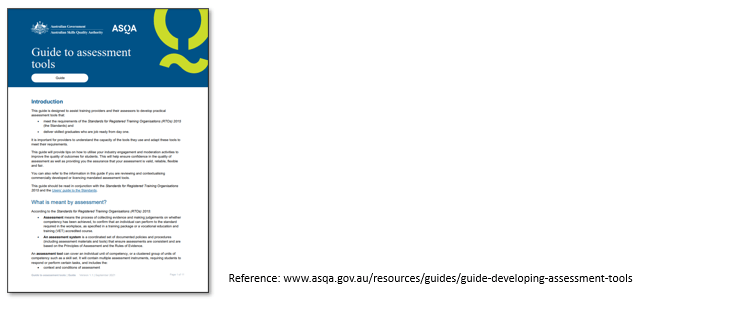
Pre-assessment validation is a check or review of an assessment tool. Firstly, we have to understand what is an assessment tool. ASQA has published a guide to assessment tools. This is a must-read document for TAFE teachers or trainers working in the Australian VET system.

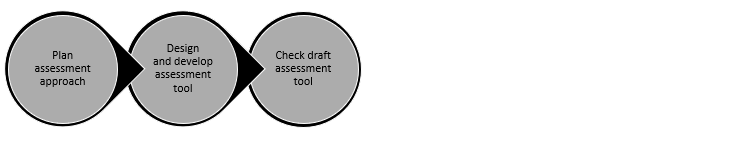
ASQA describes 3 steps for developing an assessment tool:

  • Planning
  • Design and development
  • Quality checks.

The following diagram show these three steps as a flowchart.

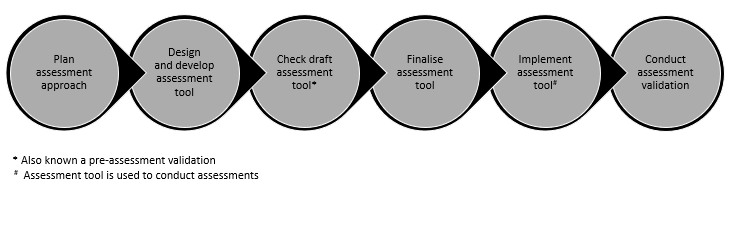
The next diagram adds onto ASQA’s 3 steps to show all the steps that should be taken before implementing the assessment tool. Also, it shows what happens after we have implemented the assessment tool.

The use of the term ‘pre-assessment validation’ is relatively new. Previously the activity of pre-validating an assessment tool was known as checking or reviewing the assessment tool before using it. Unfortunately, the word ‘validating’ is not as familiar to us the the words ‘checking’ or ‘reviewing’.

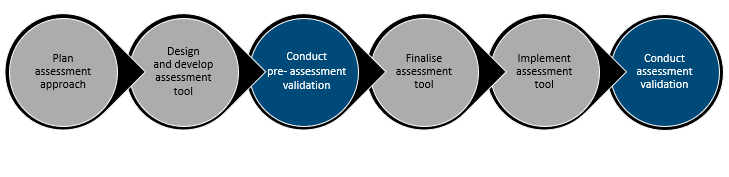
Pre-assessment validation is conducting a check of the assessment tool before it is implemented, in other words, before it has been used to conduct assessments. Post-assessment validation is a review of the assessment process after the assessment tool has been implemented.

The following diagram highlights when pre-assessment validation and post-assessment validation occur.

What do we need to know before we can participate in a pre-assessment validation meeting?

There is much to know before we can effectively participate in a pre-assessment validation meeting. For example:

  • What is assessment? And what is meant by ‘competency-based assessment’?
  • What is evidence? And why is evidence important?
  • What the four rules of evidence? And how do we know if the assessment complies with the rules of evidence?
  • What are the four principles of assessment? And how do we know if the assessment complies with the principles of assessment?
  • What are the four methods of assessment? What assessment method is used to gather knowledge evidence? And assessment method is used to gather performance evidence?
  • What is an assessment instrument?
  • What is an assessment matrix? And how is it used when conducting pre-assessment validation?
  • What is an assessment tool? And what is look for when conducting pre-assessment validation?
  • How does RPL assessment differ from ‘non-RPL assessment’?
  • What is the step-by-step procedure for conducting pre-assessment validation?

The following diagram gives an outline of the many things we need to know before we participate in pre-assessment validation.

How much training would be required to help someone learn how to participate in pre-assessment validation?

Ideally, an entire training day should be allocated to helping a TAE40122 student learn how to a participate in pre-assessment validation. For example:

  • Introduction to competency-based assessment [about 3 to 4 hours]
  • Demonstrate the conduct of a pre-assessment validation [about 1 ½ hours]
  • Practice conducting a pre-assessment validation in small groups of 3 or 4 [about 1 ½ hours]

In appears that some TAE Students are expected to undertake assessment tasks associated with the TAEASS413 Participate in assessment validation unit of competency with no or limited relevant training. Some TAE Students are being given an assessment tool to validate without knowing what is an assessment tool, or what is an assessment instrument, or what are all the other documents in the assessment tool. These TAE Students are being given no or limited background information about competency-based assessment, principles of assessment, rules of evidence, or methods of assessment. And the assessment matrix or assessment mapping is still a mystery.

In conclusion

I am finding that some TAE40122 students are not receiving sufficient training before they are expected to complete assessment tasks relating to assessment validation. People with no previous experience with competency-based assessment should not be expected to figure it out for themselves about how to conduct pre-assessment validation or post-assessment validation. Proper training is the solution.

Do you need help with your TAE studies?

Are you a doing the TAE40122 Certificate IV in Training and Assessment, and are you struggling with your studies? Do you want help with your TAE studies?

Ring Alan Maguire on 0493 065 396 to discuss.

Contact now!

logo otws

Training trainers since 1986
TAEASS512 Design and develop assessment tools

The TAEASS512 Design and develop assessment tools is an elective unit of competency for the TAE40122 Certificate IV in Training and Assessment qualification. This is a great unit for learning about assessment tools. We need to learn about the structure and content of assessment tools. This is important background knowledge for two core activities performed by TAFE teachers and trainers working for an RTO:

But more importantly, the TAEASS512 Design and develop assessment tools unit helps us deeply learn about:

Performance Evidence

The Performance Evidence for the TAEASS512 Design and develop assessment tools unit states that a person must demonstrate their ability to design, develop and document three assessment tools for the assessment of nationally recognised units of competency, including:

  • at least one assessment tool for a unit of competency packaged in a qualification or accredited course at AQF level 3 or above
  • at least one RPL assessment tool for a unit of competency packaged in a qualification or accredited course at AQF level 3 or above.

This means that one of the three assessment tools may be for a unit of competency packaged in a qualification or accredited course at any AQF level, including qualification or accredited course that is below AQF level 3.

What is the difference between an assessment tool and RPL assessment tool?

There are two assessment contexts:

  • training and assessment context
  • recognition of prior learning (RPL) context.

The ‘training and assessment context’ means that we have delivered training before conducting assessment. The RPL context means that we assess a person’s competency before the training has been delivered.

The template for an RPL assessment tool is usually different than the template for an assessment tool used when conducting assessment after we have delivered the training. This is due to different types of assessment procedures or activities. However, some assessment documents may be the same or similar regardless of the assessment context.

Overview of designing and developing an assessment tool

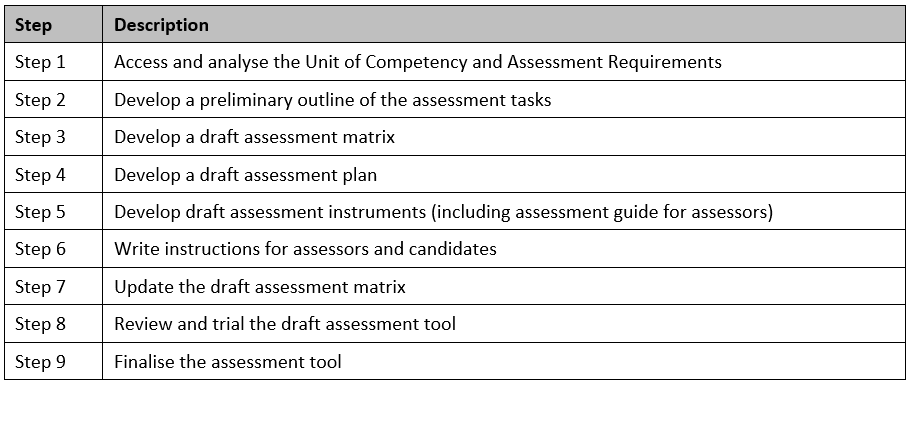
The following nine steps provides an overview of the tasks to be performed when designing and developing an assessment tool.

Step 1. Access and analyse the Unit of Competency and Assessment Requirements

The first step is to access and analyse Unit of Competency and the associated Assessment Requirements to identify what is required to demonstrate competence. The training.gov.au website gives us access the Unit of Competency and Assessment Requirements. These two documents can be downloaded as a Word file or PDF file.

The Unit of Competency and Assessment Requirements will need to be interpreted and contextualised. This may require us to consult with industry and employers

The following questions can help guide our analyse of the Unit of Competency and Assessment Requirements.

  • What work tasks are to be performed by the candidate?
  • Is there a volume of performance evidence specified?
  • How many assessment tasks will be required?
  • What assessment methods will be used?
  • Are the assessment conditions specified?
  • Is the location for the assessment specified?
  • Are facilities, equipment or resources specified?

Step 2. Develop a preliminary outline of the assessment tasks

This step moves us from analysing to using the information from the Unit of Competency and Assessment Requirements. This is a relatively quick step.

We must use ‘assessment tasks’ to organise our assessment tool. Unfortunately, some RTOs delivering the Certificate IV in Training and Assessment qualification still promote the idea of using ‘assessment methods’ to organise the assessment tool. This is an outdated approach because this is not how we implement assessments. We implement by administrating and conducting assessment tasks.

My first general rule about the number of assessment tasks is that there will always be at least two assessment tasks:

  • One assessment task to gather the Knowledge Evidence
  • At least one assessment task to gather the Performance Evidence.

My second general rule about the number of assessment tasks is that we should design our assessment tool to make it easy for assessors to implement and easy for candidates to understand. We should aim to use the least number of assessment tasks as possible, without making the assessment tasks too big or too complicated.

An example

The volume of performance evidence specified for the TAEASS512 Design and develop assessment tools unit of competency is three. It requires the candidate to design and develop three assessment tools. Therefore, we can plan to use four assessment tasks for this unit:

  • One assessment task to gather the Knowledge Evidence
  • Three assessment tasks to gather the Performance Evidence.

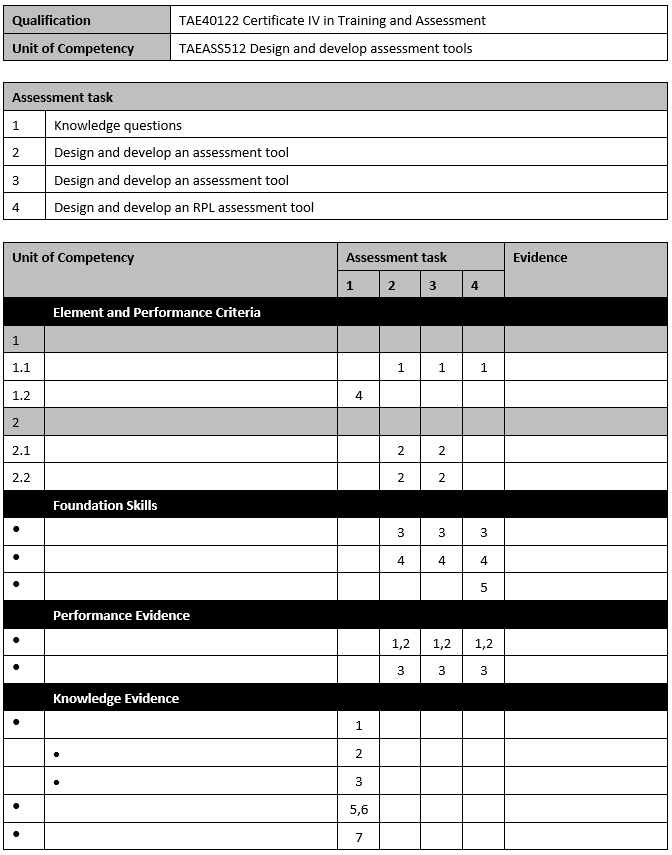
The following is a preliminary outline of the assessment tasks for the TAEASS512 Design and develop assessment tools unit of competency.

The preliminary outline of the assessment tasks is a starting point. We may need to change the assessment approach as we design and develop the assessment tool.

Step 3. Develop a draft assessment matrix

An assessment matrix may also be known as ‘assessment mapping’ or ‘competency map’.

This step relates to the development of draft assessment matrix that includes an outline of the evidence to be gathered from a candidate. At this stage, we use an ‘x’ to link the specifications of the Unit of Competency and Assessment Requirements with the assessment tasks. The assessment matrix is an important part of the assessment tool. It is used to design for compliance and check for compliance. The following is my recommended template for an assessment matrix. It has a column on the right that is used to document the evidence to be gathered from a candidate.

The draft assessment matrix is updated with details after the assessment instruments have been developed (Step 7).

Steps 4, 5 and 6

Steps 4, 5 and 6 covers the development of the assessment tool.

  • Step 4. Develop a draft assessment plan
  • Step 5. Develop draft assessment instruments (including assessment guide for assessors)
  • Step 6. Write instructions for assessors and candidates

The assessment matrix is part of the assessment tool, and it is used to guide the development of the remaining documents. RTOs will usually have templates for these documents, and TAE Students will be provided with templates.

The development of the draft assessment instruments and criteria to be used to make judgements about whether competence has been achieved can be time-consuming. And when we develop the assessment tools, it is important to number assessment items. For example:

  • Number each question
  • Number each item on an observation checklist
  • Number each item on a product review checklist
  • Number each item on a third-party report.

The ‘assessment guide for assessors’ may also be known as a ‘marking guide’. The purpose of this document is to support reliable assessment (one of the four principles of assessment). The assessment guide should include:

  • Sample answers for the questions being used to gather the Knowledge Evidence
  • Criteria for making decisions relating to the standard of Performance Evidence gathered.

Step 7. Update the draft assessment matrix

After the assessment instruments have been documented, we update the assessment matrix with reference to the numbering of each assessment item (see above). The following illustrates an updated assessment matrix that was originally created in Step 3.

Step 8. Review and trial the draft assessment tool

Some people may call this step the pre-validation of an assessment tool. It consists of two different activities:

  • Review of the draft assessment tool
  • Trial of the draft assessment tool.

These activities will involve others. We need a person or people who have not been involved with the design and develop of the assessment tool to look at what we have created with fresh eyes. And we them to use the assessment tool to find out if it can be understood and implemented from the perspective of an assessor and candidate.

We can identify what needs to be fixed or areas for improvement by observing the assessment tool being used by others. Also, we should seek feedback from the person or people who have been involved in the review and trail of the assessment tool.

Step 9. Finalise the assessment tool

We finalise the assessment tool based on the feedback gathered during the review and trial of the draft assessment tool.

A useful guide to assessment tools

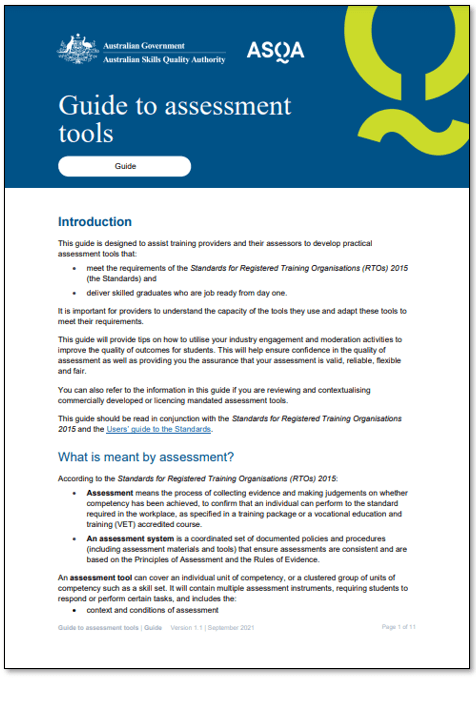
ASQA has published a document titled, Guide to assessment tools. This is a relatively short document that is reasonably easy to read. It is a document that covers important information about designing and developing compliant assessment tools. And it provides practical information and ideas.

In conclusion

It takes time and effort to design and develop an assessment tool that is compliant and works for the assessor and candidate. It regards to time, it can take days. This article has provided a 9-step process that is methodological and practical.

Many TAE Students find the TAEASS512 Design and develop assessment tools unit of competency a bit challenging for a range of reasons, including:

  • Unclear or confusing instructions
  • Badly designed templates
  • Templates that are difficult to use or modify
  • No examples of completed templates provided
  • Examples of completed templates are confusing
  • Insufficient time allocated to the provision of training
  • The learning resources are poorly written or lack required content
  • The TAE Trainer is unable to explain or demonstrate what needs to be done.

Also, the TAEASS512 Design and develop assessment tools unit of competency has a large number of specified Knowledge Evidence items (41 bullet and sub-bullet points). A TAE Student must expect this unit of competency to take a lot of time and effort to complete, and it may be challenging, confusing and frustrating.

Do you need help with your TAE studies?

Are you a doing the TAE40122 Certificate IV in Training and Assessment, and are you struggling with your studies? Do you want help with your TAE studies?

Ring Alan Maguire on 0493 065 396 to discuss.

Contact now!

logo otws

Training trainers since 1986
Incorporating formative assessment into VET delivery

The TAEDES412 Design and develop plans for vocational training is a core unit of competency for the new TAE40122 Certificate IV in Training and Assessment qualification. It describes the skills and knowledge required to design, develop and document delivery plans and session plans within the Australian VET system.

The TAEDES412 unit specifies that the delivery plan and session plans must include formative assessment activities. This is the second of two articles about formative assessment. The previous article is titled:

What is formative assessment? And how does it differ from summative assessment and diagnostic assessment?

In this article, I shall cover:

  • Incorporating formative assessment into a training delivery plan
  • Incorporating formative assessment into a training session plan.

Let’s start with establishing a common terminology.

Explaining the terminology

The terms formative assessment and summative assessment may make sense for a school or higher education context but they can be confusing when applied to the Australian vocational education and training (VET) system. Different people use these terms to mean different things.

Australia has a competency-based VET system. And it uses assessment to determine if a person is competent. Summative assessment can be described as the ‘assessment of competency’.

Formative assessment can be describes as the ‘assessment of learning.’ [1]

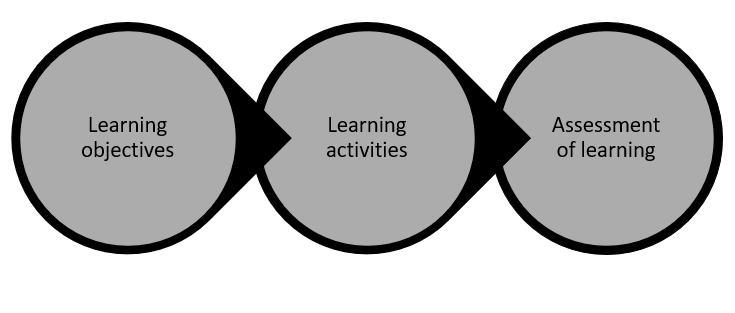
The following shows a better way of expressing these terms for VET.

Also, we should keep our terminology as simple as possible by making the distinction between the assessment of learning and the assessment of competency.

Assessment of learning occurs during the delivery of training to check if the learning objectives have been achieved and to monitor progress.

Assessment of competency occurs after the delivery of training covering a unit or cluster of units. It is used to determine if a person is competent.

Assessment of learning should not to be confused with assessment of competency. The assessment of learning can to be informal, and may not be related to the performance of work tasks because it may relate to the learning of a piece of knowledge or the learning of a foundational skill. The assessment of competency tends to be more formal, and it should include the performance of work tasks in a workplace or a simulated workplace that has the characteristics of a real workplace.

When can formative assessment occur?

The TAEDES412 Design and develop plans for vocational training unit of competency specifies that the delivery plan and session plans must include formative assessment activities. Therefore, I am using the term ‘formative assessment’.

Formative assessment can occur:

  • At the end of a training session to check if the knowledge or skills covered during the training session have been learnt
  • At the end of a training day to check if the knowledge or skills covered during the training day have been learnt
  • At the start of a training day to check if the knowledge or skills from the previous training day or days have been learnt
  • At the end of a training topic or module to check if the required knowledge or skills have been learnt before moving onto the next topic or module.

Incorporating formative assessment into a training delivery plan

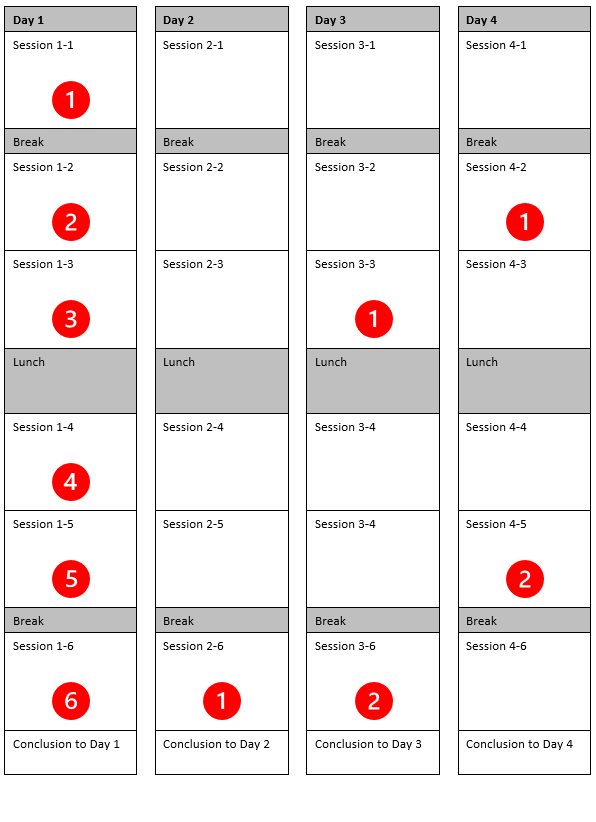
The following shows the outline of a training delivery plan with a four day duration. Each red dot indicates when a formative assessment is planned to be conducted. Six formative assessment on Day 1. One formative assessment on Day 2. Two formative assessment on Day 3. And two formative assessment on Day 4.

Day 1 is an example of formative assessment being conducted at the end of every training session. This scenario is unlikely to be implemented for various reasons including time constraints.

Day 2 is an example of formative assessment being conducted at the end of the training day. It should be noted that formative assessment does not have to be conducted on the same day as the learning.

Day 3 is an example of formative assessment being conducted twice during the training day. This checks what has been learnt in the morning and what has been learnt in the afternoon.

Day 4 is an example of formative assessment being conducted at relevant times, such as at the end of a topic or before moving onto a new stage of learning.

What are the different types of formative assessments?

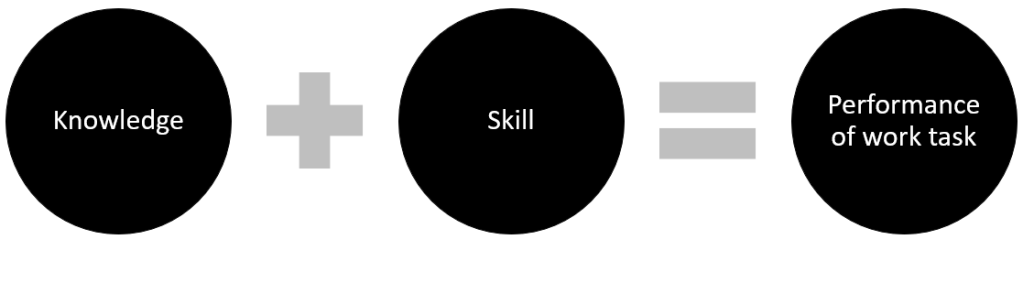
The Australia VET system aims to help people learn the knowledge and skills required to perform work tasks.

Questions or quizzes can be used to conduct an assessment of learning for knowledge. Observed practice can be used to conduct an assessment of learning for skills or the performance of a work task.

Why are formative assessments conducted?

Formative assessments maybe conducted for various reasons, such as:

  • To determine if the learning objectives have been achieved
  • To determine if the person has the required knowledge and skills before moving onto the next topic or module
  • To determine if the person is ready to commence their assessment of competency.

Incorporating formative assessment into a training session plan

In theory, every training session shall have documented learning objectives. In theory, every training session shall include planned activities that have been designed to help a person learn the knowledge or skills being covered. And in theory, formative assessment shall be conducted before every training session concludes to determine if the learning objectives have been achieved.

Training session plan for knowledge

The following example shows the incorporation of formative assessment into a plan for a knowledge training session.

There are a range of variables that can impact the training session plan, such as:

  • Total duration of the training session
  • Amount of content to be learnt
  • Complexity of the content to be learnt
  • Resources available
  • Characteristic of the learner or learners.

Therefore, the above example is provided only as a guide.

Training session plan for a skill or task

The following example shows the incorporation of formative assessment into a plan for a skill or task training session.

Again, there are a range of variables that can impact the training session plan, such as:

  • Total duration of the training session
  • Difficulty of the skill or task to be learnt
  • Safety precautions when the skill or task may be dangerous
  • Availability of facilities, equipment, materials or resources
  • Characteristic of the learner or learners.

Therefore, the above example is provided only as a guide.

The importance of feedback

Formative assessment must include the provision of feedback. Feedback can be motivational and should be constructive. Feedback should identify areas needing additional training or further practice.

Formative assessment is essential for helping people progress towards achieving learning objectives. It is used to monitor progress. And it can identify the need for learning support. Feedback from the trainer may include the development of an action plan designed to help the learner progress.

In conclusion

People studying for their TAE40122 Certificate IV in Training and Assessment qualification will be required to incorporate formative assessment activities into their training delivery plan and training session plan.

It is essential that the learning objectives are clearly documented. It is essential that activities are conducted during a training session to help people learn. And before the end of the training session, we can conduct a formative assessment to determine if the learning objectives have been achieved and give feedback to the learner or learners.

Formative assessment is the assessment of learning. Questions or quizzes can be used to conduct an assessment of learning for knowledge. Observed practice can be used to conduct an assessment of learning for skills or the performance of a work task.

Reference

[1] VOCEDplus website assessed 25 April 2023

Do you need help with your TAE studies?

Are you a doing the TAE40122 Certificate IV in Training and Assessment, and are you struggling with your studies? Do you want help with your TAE studies?

Ring Alan Maguire on 0493 065 396 to discuss.

Contact now!

logo otws

Training trainers since 1986

What is formative assessment? And how does it differ from summative assessment and diagnostic assessment?

The TAEDES412 Design and develop plans for vocational training is a core unit of competency for the new TAE40122 Certificate IV in Training and Assessment qualification. It describes the skills and knowledge required to design, develop and document delivery plans and session plans within the Australian VET system.

The TAEDES412 unit specifies that the delivery plan and session plans must include formative assessment activities. You may also come across other terms such as summative assessment and diagnosis assessment. This article shall explore:

  • What is formative assessment?
  • What is summative assessment?
  • What is diagnosis assessment?

Searching for definitions

There is no definitive definition of these three terms:

  • Formative assessment
  • Summative assessment
  • Diagnosis assessment.

The Standards for RTOs 2015 does not define these terms. The TAE Training Package does not define these terms.  And the Implementation Guide for the TAE Training Package does not define these terms.

I have used the VOCEDplus website to search a glossary of VET terms. This website is maintained by the National Centre for Vocational Research (NCVER).

The VOCEDplus website provides a definition for ‘Formative assessment’.

The VOCEDplus website provides a definition for ‘Summative assessment’.

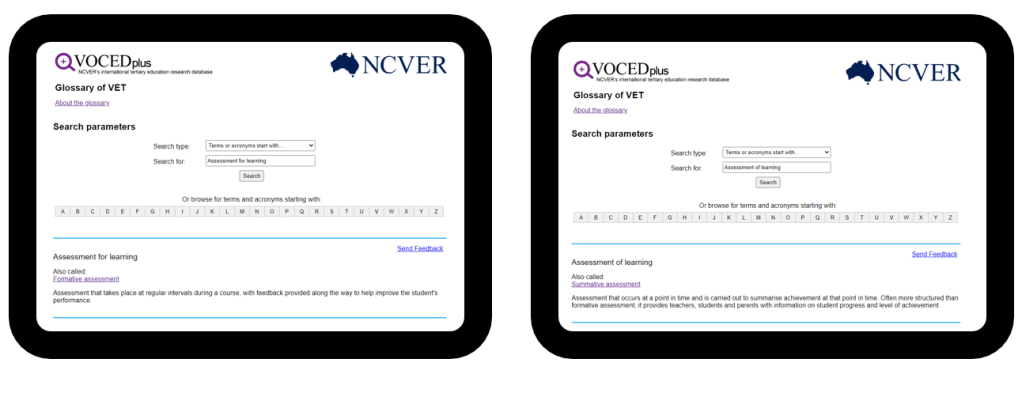
The VOCEDplus webpages for ‘Formative assessment’ and ‘Summative assessment’ says that both terms are also called ‘Assessment of learning’. However, VOCEDplus website provides two different definitions for ‘Assessment of learning’. If you follow the link from the ‘Formative assessment’ webpage you are given the definition for formative assessment. And if you follow the link form the ‘Summative assessment’ webpage you are given the definition for summative assessment.

It is strange that two different definitions are provided for the same thing.

The VOCEDplus website does not provide a definition for ‘Diagnostic assessment’.

What are the origins of formative and summative assessment?

The origins of the formative and summative assessment in the modern era can be traced back to the mid-20th century when educators and researchers started to promote the use of standardised tests and other assessments in educational settings.

Benjamin Bloom, an American educational psychologist, was influential in the development of formative assessment. In his book, ‘Taxonomy of Educational Objectives’, Bloom described the importance of formative assessment in the learning process. He argued that formative assessment is essential for helping students to progress towards achieving learning objectives. Bloom believed that formative assessment should be an ongoing process that occurs throughout the learning experience, rather than a one-time event. He emphasised the importance of providing students with feedback on their progress, so that they can make adjustments and improvements as needed. [1]

The following is an example showing when formative assessment would be conducted during a training program.

Bloom also wrote about summative assessment. He distinguished between formative assessment, which is used to guide and monitor learning, and summative assessment, which is used to evaluate learning at the end of a unit or course of study. Bloom believed that summative assessment is important for measuring student achievement. His ideas have influenced the development of many of the assessment practices that are used today, and have helped to promote a more balanced approach to assessment, with both formative and summative assessment playing important roles. [2]

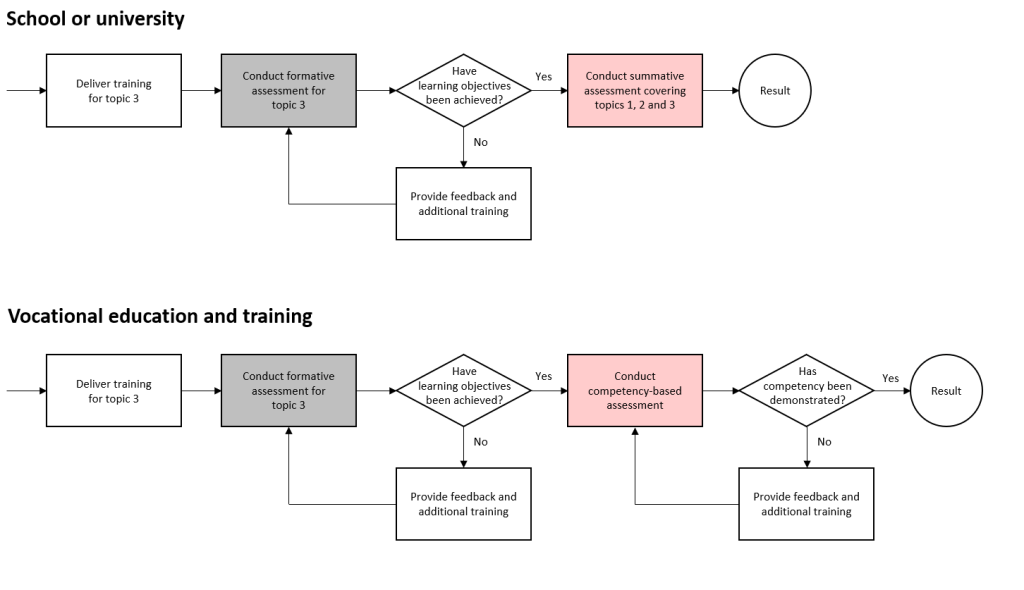
The following are examples showing how formative assessment is conduct during a training program and summative assessment would be conducted at the end of a training program.

Schools and universities tend to conduct summative assessment and give the result as a grade or mark. The vocational education and training (VET) system in Australia has been designed to allow multiple attempts at becoming competent. The aim is to help people become competent rather than abruptly ending the training and assessment process when a person has been deemed not competent. The aim is to provide an employment pathway for job seekers or for people seeking work skills and career progression.

What is formative assessment?

The VOCEDplus website defines ‘Formative assessment’ as:

Assessment that takes place at regular intervals during a course, with feedback provided along the way to help improve the student’s performance. [3]

A ‘formative assessment’ in the Australian VET system is an activity used to check what has been learnt, or to determine if the learning objectives have been met. This activity could be conducted:

  • at the end of a training session
  • at the end of a training day
  • at the end of a training topic
  • at the end of a training module.

Questions and quizzes (I don’t like the terms ‘tests’ or ‘exams’) can be used to check if people have learnt the required knowledge. And observed practice can be used to check if people have learnt the required skills. Feedback can be provided to the learners. Feedback can be motivational and should be constructive. Feedback should identify areas needing additional training or further practice.

What is summative assessment?

The VOCEDplus website defines ‘Summative assessment’ as:

Assessment that occurs at a point in time and is carried out to summarise achievement at that point in time. Often more structured than formative assessment, it provides teachers, students and parents with information on student progress and level of achievement. [4]

This definition seems to be for a school context because it refers to teachers, students and parents. We need a definition for the Australian VET context.

In the Australian VET system, ‘Summative assessment’ is the assessment used to determine if a person is competent. This ‘assessment’ is defined in the glossary from the Standards for RTOs 2015 as:

Assessment is the process of collecting evidence and making judgements on whether competency has been achieved, to confirm that an individual can perform to the standard required in the workplace, as specified in a training package or VET accredited course. [5]

The VOCEDplus website provides this same definition for ‘assessment’.

Trainers and TAFE teachers working in the Australian VET system conduct assessment after all the training for a unit or cluster of units has been completed. This assessment is used to determine if a person is competent.

What is diagnosis assessment?

The VOCEDplus website does not give a definition for ‘Diagnosis assessment’.

Clause 1.7 of the Standards for RTOs 2015 states:

The RTO determines the support needs of individual learners and provides access to the educational and support services necessary for the individual learner to meet the requirements of the training product as specified in training packages or VET accredited courses. [6]

Most RTOs conduct a pre-training review to determine a person’s suitability for the training program. This includes a ‘diagnosis assessment’ to measure a person’s LLN skills and identify LLN skill gaps that may hinder their participation in the training program.

Many trainers and TAFE teachers are not directly involved in the administration of the pre-training review or the ‘diagnostic assessment’ of a person’s LLN skills.

In conclusion

People studying for their TAE40122 Certificate IV in Training and Assessment qualification will need to know about ‘formative assessment’ because it has been specified within the TAEDES412 Design and develop plans for vocational training unit of competency. It is highly likely that ‘diagnostic assessment’ and ‘summative assessment’ will also be covered.

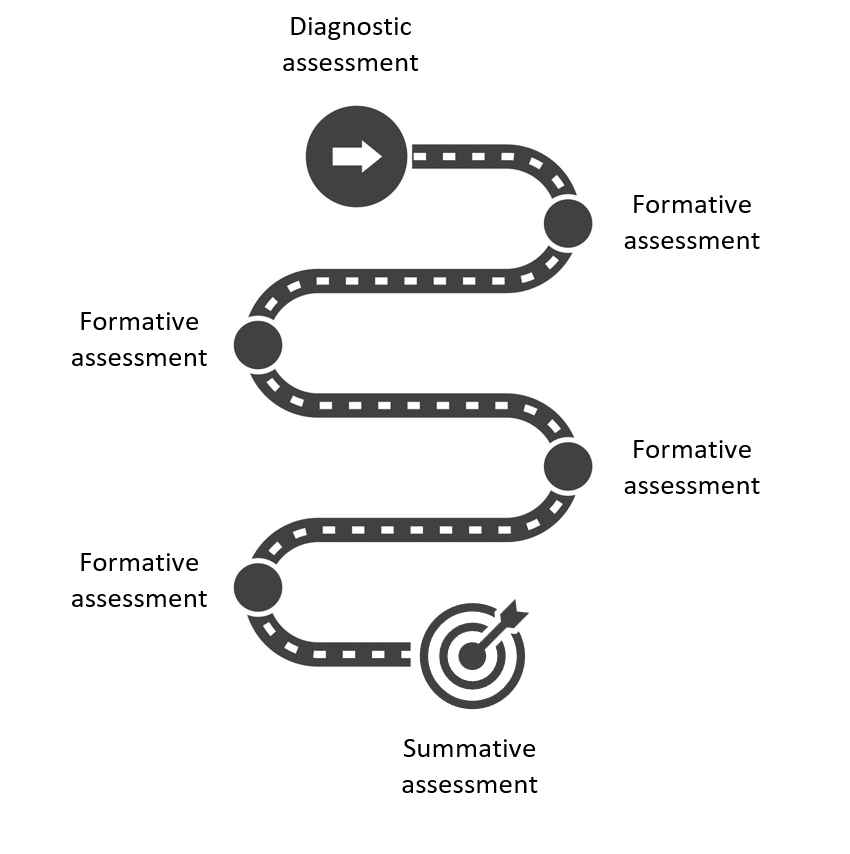
The following illustrates that ‘diagnostic assessment’ occurs before the training program, ‘formative assessment’ occurs multiple times during the training program, and ‘summative assessment’ occurs after the training program.

The following compares the difference between diagnosis assessment, formative assessment and summative assessment.

I have never heard these terms used by a trainer or TAFE teacher working for an RTO. The only reason I am writing an article about these terms is because it is in the TAE Training Packages. I wish the developers of TAE Training Package hadn’t introduced a range of unnecessary terms that complicates things.

In practice, I would discourage the use of these terms, in particular, ‘formative assessment’ and ‘summative assessment’. The following shows better terms that are more commonly used in the Australian VET system.

References

[1] ChatGPT response generate 21 April 2023 (what did Benjamin Bloom say about formative assessment?)

[2] ChatGPT response generate 21 April 2023 (what did Benjamin Bloom say about summative assessment?)

[3] https://glossary-vet.voced.edu.au/ assessed 22 April 2023 (formative assessment)

[4] https://glossary-vet.voced.edu.au/ assessed 22 April 2023 (summative assessment)

[5] Standards for Registered Training Organisations (RTOs) 2015

[6] Standards for Registered Training Organisations (RTOs) 2015

Do you need help with your TAE studies?

Are you a doing the TAE40122 Certificate IV in Training and Assessment, and are you struggling with your studies? Do you want help with your TAE studies?

Ring Alan Maguire on 0493 065 396 to discuss.

Contact now!

logo otws

Training trainers since 1986