The TAESS00023 Online Learning and Assessment Skill Set was released on the 1st of June 2022. The skill set consists of two units of competency:
TAEDEL405 Plan, organise and facilitate online learning
TAEASS404 Assess competence in an online environment.
This skill set addresses the skills and knowledge required to plan, organise and facilitate online learning and assess competence across various electronic applications and communication channels. It involves gathering evidence using both synchronous and asynchronous assessment methods, and making judgements on the outcomes of the online assessment using a range of devices and digital tools. [1]
Professional development
The new online learning and assessment units or skill set can deliver an immediate value for many TAFE teachers, trainers and assessors.
The TAESS00023 Online Learning and Assessment Skill Set can be used to deliver a structured professional development program for current trainers, assessors and TAFE teachers working in the VET sector.
In additional to being relevant professional development, the attainment of the two new online learning and assessment units can be used as credits towards the TAE40122 Certificate IV in Training and Assessment qualification (expected to be endorsed before the end of 2022). [2]
Are you a doing the TAE40122 Certificate IV in Training and Assessment, and are you struggling with your studies? Do you want help with your TAE studies?
Do you want more information? Ring Alan Maguire on 0493 065 396 to discuss.
Most TAFE teachers, trainers and assessors working for an RTO learnt about designing competency-based assessment when they studied for their Certificate IV in Training and Assessment qualification . But designing a competency-based assessment for real is often very different to learning about it at a TAE training course.
On Target Work Skills is delivering a training webinar that provides a simple and practical approach to designing competency-based assessment. The aim is to improve capability for new and experienced VET practitioners.
Webinar objectives
The webinar objectives are:
Identify compliance requirements relating to the development of competency-based assessment
Describe a 7-step process for developing competency-based assessment
Determine the volume of performance evidence
Decide the number of assessment tasks
Check that the entire competency standard is planned to be assessed.
Key content points
The key content for this training are:
Compliance requirements (as per the Standards for RTOs 2015)
Definition of assessment
Principles of assessment and rules of evidence
Assessment Requirements
Knowledge evidence
Performance evidence
Assessment conditions
Sequence and structure of assessment tasks
Assessment methods
Assessment matrix
Assessment tools
Assessment instruments
Assessment instructions
Review and trial of the assessment tool before implementation
Nine golden rules when developing as assessment tool.
Location
The webinar shall be conducted via Zoom. Therefore, you can attend the webinar from your workplace or home.
Duration
3 hours webinar.
Note: There are two short breaks provided during the webinar.
Also, this webinar can be delivered to a work group. It can be a relevant and timely professional development activity for a group of trainers.
Date and start time
Please call Alan Maguire on 0493 065 396 to discuss.
Most TAFE teachers, trainers and assessors working for an RTO learnt about designing competency-based training when they studied for their Certificate IV in Training and Assessment qualification . But designing a competency-based training program for real is often very different to learning about it at a TAE training course.
On Target Work Skills is delivering a training webinar that provides a simple and practical approach to designing competency-based training. The aim is to improve capability for new and experienced VET practitioners.
Webinar objectives
The training objectives are:
Identify compliance requirements relating to the design of competency-based training
Describe a 7-step process for designing competency-based training
Estimate total training duration
Develop a draft training agenda
Check that the entire unit of competency is covered
List the 6 essential elements of a training program plan.
Key content points
The key content for this training are:
Compliance requirements (as per the Standards for RTOs)
Definition of competency
Units of Competency and Assessment Requirements
Instructional design theory
Robert Gagné’s 9-events of instruction
David Merrill’s first principles of instruction
Malcolm Knowles’ assumptions about adult learners
7-step process for designing competency-based training
Modes of delivery
AQF volume of learning and nominal hours
Chucking and sequencing
Training session structure
Introductions and conclusions
Structure of a knowledge training session
Structure of a skill or task-based training session
Summaries, self-reflection and breaks
Active learning and the importance of learn by doing
6 essential elements of a training program plan.
Location
The webinar shall be conducted via Zoom. Therefore, you can attend the webinar from your workplace or home.
Duration
3-hour webinar
Note: There are two short breaks provided during the webinar.
Also, this webinar can be delivered to a work group. It can be a relevant and timely professional development activity for a group of trainers.
Date and start time
Please call Alan Maguire on 0493 065 396 to discuss.
The TAELLN421 Integrate core skills support into training and assessment unit of competency can be difficult to read and understand because of the jargon it uses.
This unit has four elements:
Identify core skill demands
Identify learner and candidate core skill needs
Integrate core skill support
Review effectiveness of integrated core skill support.
Just looking at the elements of competency, there are a few questions raised:
What is a core skill?
What are core skill demands?
What is the difference between a learner and candidate?
What is core skills support?
What is meant by integrated core skill support?
What is a core skill?
There are five core skills in the Australian Core Skills Framework (ACSF):
Learning
Reading
Writing
Oral communication
Numeracy.
What are core skill demands?
I will use the word ‘requirement’ instead of the word ‘demand’. The following is an example of questions we can ask to help us determine the reading skill requirements:
What level of reading skill is required to perform a work task?
What level of reading skill is required to participate in the training and assessment?
What level of reading skill is required to use the training and assessment materials?
And ask the same questions for the other four core skills.
What is the difference between a learner and candidate?
A learner is a person we provide training to. A candidate is a person we assess. Often, the learner and the candidate are the same person.
What is core skills support?
We can support the development of a person’s core skills by using training strategies and learning resources designed. For example:
We could allow more time for the person to learn the content
We could provide support sessions for the individual learner
We could use learning resources based on images and diagrams to help the person learn the content.
Also, we can use assessment strategies appropriate for the person being assessed. For example, we could use oral questioning instead of written questioning to gather knowledge evidence if the person has low level of reading and writing skills.
What is meant by integrated core skill support?
We need to address the development of the core skill at the same time as helping the person learn how to perform the work skills. For example, we can help a person develop their reading skill by helping them learn to read a relevant workplace procedure.
Also, ‘integrated core skill support’ means incorporating strategies and resources when we deliver training and conduct assessment. In other words, no doing something separately.
How do we integrate core skills support into training and assessment?
I have unpacked the elements, performance criteria and performance evidence to create the following 4-part process that gives greater clarity to the TAE Student about what they need to do.
Assessment requirements for the TAELLN421 unit
Knowledge evidence
An assessment task will be required to gather the specified Knowledge Evidence. A TAE Student must demonstrate they have the following knowledge:
Core skill levels of the Australian adult population, and of VET learners
Australian Core Skills Framework and Digital Literacy Skills Framework
Impact of core skills on a person’s capability to participate in work and in training and assessment, and the implications for design and delivery of vocational training and assessment
Overview of core skill demands in the workplace that relate to the nationally recognised training products
VET regulatory requirements relating to integrating core skills support into training and assessment
RTO procedures relating to integrating core skills support into training and assessment
Benefits of integrating vocational and core skill training for all individuals
How to identify core skills in nationally recognised training products, workplace tasks and texts, etc.
Responsibilities and limitations of own job and practice in relation to providing core skills support in training and assessment.
Performance evidence
The Performance Evidence for the TAELLN421 Integrate core skills support into training and assessment unit of competency is reasonably complex. This complexity may mean that the assessment task or tasks will be complex.
Do you need help with your TAE studies?
Are you a doing the TAE40122 Certificate IV in Training and Assessment, and are you struggling with your studies? Do you want help with your TAE studies?
I frequently see assessment instruments being used by TAFEs and private RTOs that do not comply with the requirements specified by the Standards for RTO. The national VET regulator, ASQA, was established in 2011. It is astonishing that after more than a decade, ASQA has been unable to encourage or enforce compliance. And what makes it even more astonishing is a move towards self-regulation. This will allow the many RTOs that are not currently compliant, to self-regulate their future compliance (or should I say, self-regulate their non-compliance).
Recently, I assisted a TAFE employee to develop assessment instruments for the CPCCCA3010 Install windows and doors unit of competency. Consequently, I was prompted to write this article as a case study to explore:
How to determine the number of assessment tasks
How to develop an assessment instrument to gather performance evidence
How to develop an assessment instrument to gather knowledge evidence.
How to determine the number of assessment tasks
I always start with determining how many assessment tasks will be needed to cover the assessment requirements. This must be done before designing and developing the assessment instruments.
As a general rule, there should be a plan for at least two assessment tasks:
An assessment task to gather the knowledge evidence
At least one other assessment task to gather the performance evidence.
It is common to need more than one assessment task to gather the frequency or volume of performance evidence that is specified by the Assessment Requirements.
Let’s look at how many assessment tasks are required to gather the performance evidence for the CPCCCA3010 Install windows and doors unit of competency. The Performance Evidence for this unit states:
A candidate can not do all these tasks at the same time. Therefore, I would plan for four (4) assessment tasks to gather the specified performance evidence.
I usually assign ‘Assessment Task 1’ for the gathering of knowledge evidence. Therefore, I would have a total of five (5) assessment tasks for the CPCCCA3010 Install windows and doors unit of competency.
The CPCCCA3010 Install windows and doors unit of competency has six (6) elements of competency. The first and last elements are common for installing all windows and doors. The other elements of competency are only relevant to specific tasks determined by the type of door or window being installed. The following matrix shows the connection between each element of competency and each assessment tasks.
The design and development of an assessment tool is a creative process. Sometimes, we may need to change of initial assessment plan in regard to the number of assessment tasks.
How to develop an assessment instruments to gather performance evidence
So far, we have determined the need to have four (4) assessment tasks to gather the performance evidence for the CPCCCA3010 Install windows and doors unit of competency. Each of these assessment tasks may follow a 3-part process:
Part 1. Plan and prepare
Part 2. Install
Part 3. Clean up
An observation checklist may be used to gather the performance evidence. I would consider the need to develop an observation checklist for each assessment task. Therefore, there will be four (4) observation checklists developed. However, some observation items will be the same for each checklist.
For example, the same observation items can be used for:
Plan and prepare (as specified by Element 1 of the CPCCCA3010 unit)
Clean up (as specified by Element 6 of the CPCCCA3010 unit).
But some observation items will be different because the installation of different types of doors and windows are different, and there are different Performance Criteria specified. For example, the observation checklist for Assessment Task 2 would include the Performance Criteria for Element 2, but not the Performance Criteria for Elements 3, 4 and 5.
The following matrix highlights Assessment Task 2. It shows what elements of competency are the same or different to the other assessment tasks used to gather performance evidence.
The next step will be to develop the assessment instruments.
For the purpose of this example, a third-party report is not being used to gather evidence. It is common for building and construction apprenticeships to include the CPCCCA3010 Install windows and doors unit of competency. Therefore, the apprentice would perform work under the supervision of a builder or building site supervisor. These people would ideally contribute to assessment by providing third-party evidence.
This example is only showing assessment tasks conducted by an assessor to gather performance evidence.
Developing the observation checklist
The items of an observation checklist should not be a ‘copy and paste’ of the performance criteria. Performance criteria can be vague or ambiguous. And performance criteria can lack sufficient details to clearly communicate the benchmark or expected standard of performance.
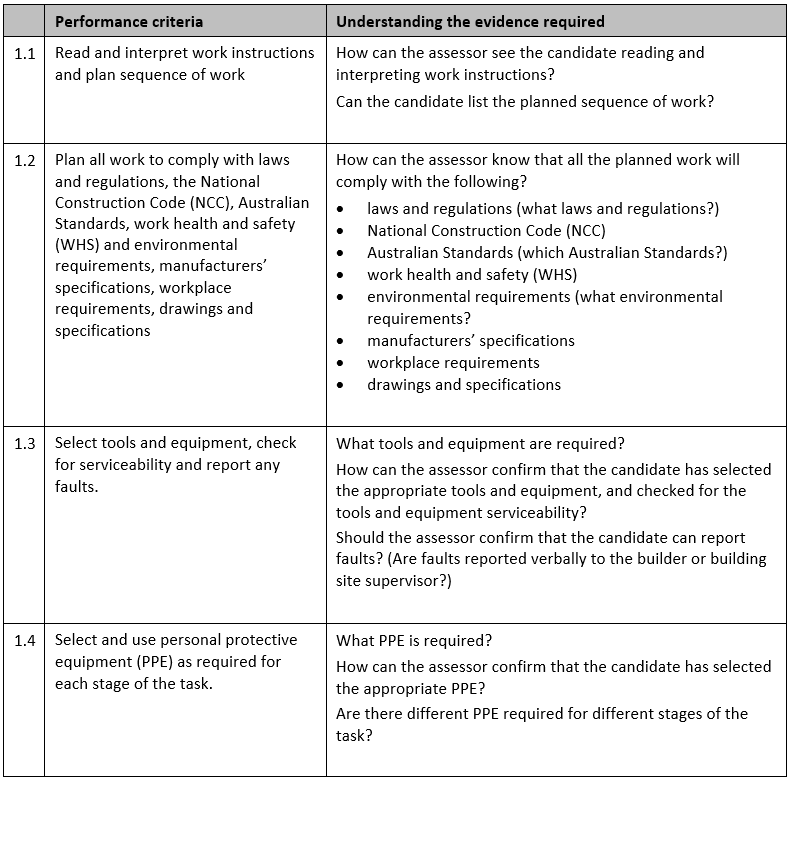
The following table show how the Performance Criteria could be analysed. It only uses the first four performance criteria of Element 1 as an example.
The technique is basically about you asking yourself questions. These questions aim to seek clarity. And these question help to interpret and contextualise.
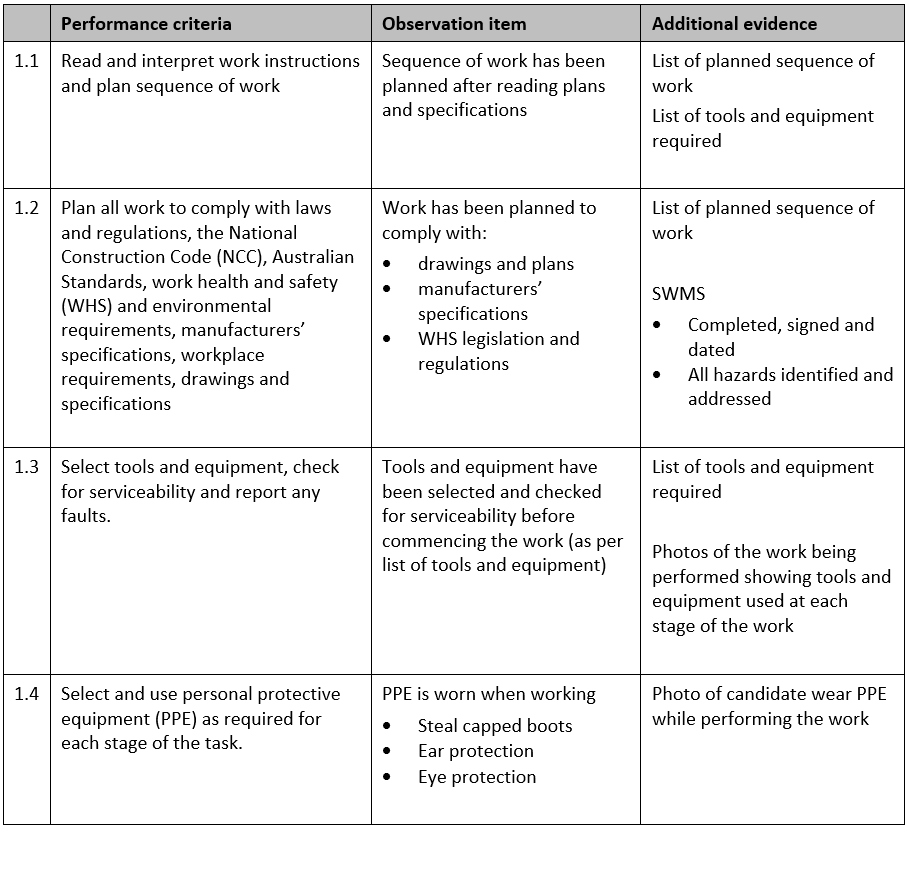
The next thing is to draft the observation items for the checklist. The following table shows the development of observation items for the first four (4) performance criteria of Element 1.
The above table also shows how additional evidence could, or should, be gathered. These would be in addition to the observation checklist.
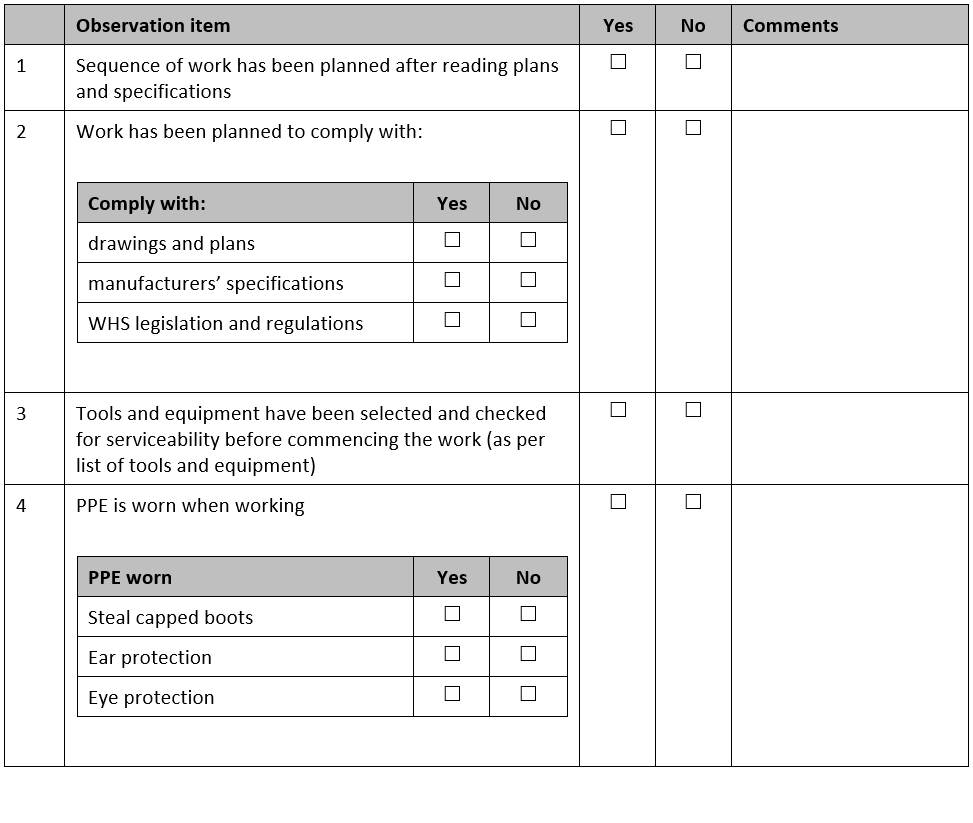
Many RTOs will have their own templates to be used for assessment instruments. The following an example of an observation checklist for the first four (4) performance criteria of Element 1
Sometimes, the sequence of items on the observation checklist can be different than the numerical order of performance criteria. Sometimes one performance criteria may need more than one observation items, and sometimes several performance criteria may be adequately covered by one observation item.
We need to be flexible in our approach to the development of an observation checklist. Each unit of competency is different. Therefore, the observation checklist must be created to meet the unique requirements specified by each unit of competency.
Developing a product review checklist
An observation of a person performing work tasks will often be used to gather direct evidence of performance. Sometimes, the review of a product that has been produced during the performance of the work task will be used as evidence. A product review checklist would need to be developed for an assessor to use during the assessment process.
The product to be reviewed may be:
A document
A completed form
A physical item
A non-physical item.
How to develop an assessment instruments to gather knowledge evidence
I recommend the development of an assessment task to gather all the specified Knowledge Evidence. Create a table to ensure you write at least one question to gather the knowledge evidence specified.
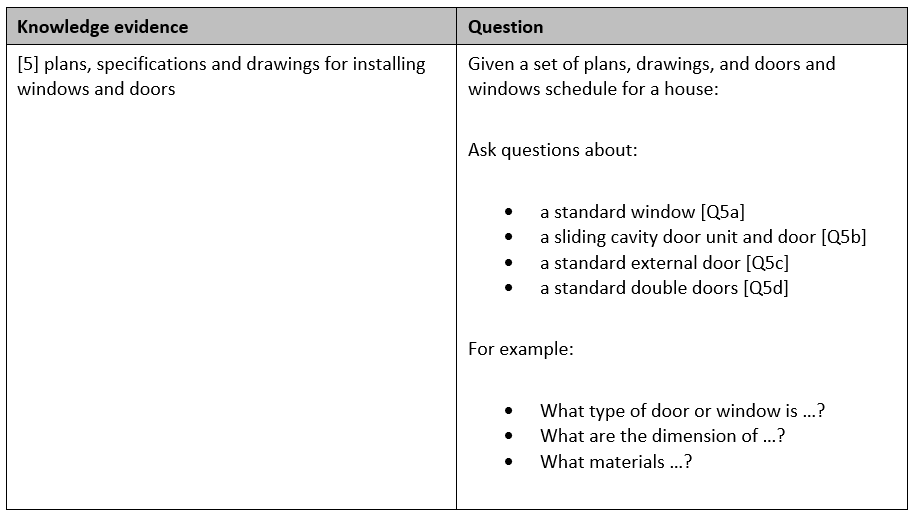
The following is an example for a table created for the CPCCCA3010 Install windows and doors unit of competency.
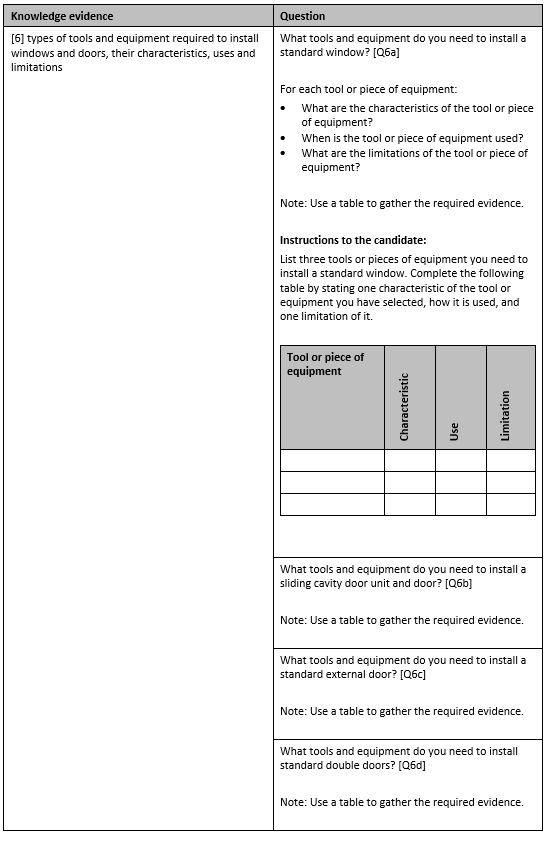
The next step is to start writing questions. Sometimes, one question will not be enough to cover the breath or depth of knowledge required. Therefore, a set of questions may need to be asked. The following are two examples.
Example 1: This is an example for the Knowledge Evidence item 5.
Example 2: This is an example for the Knowledge Evidence item 6.
Numbering the questions
Consider how the questions are going to be numbered.
Let’s say, there are four questions to be asked to gather evidence for one Knowledge Evidence item. The following are three different ways that the questions could be numbered:
Q6a, Q6b, Q6c, Q6d.
Q6.1, Q6.2, Q6.3, Q6.4
Q6, Q7, Q8, Q9
Sequencing the questions
Consider the sequence the questions. Sometimes, the questions may be re-sequenced to present them in a logical order or asking questions that relate to a similar topic. For example, asking all questions relating to safety one after the other rather than scattered.
Structuring the questions
Consider giving structure to the questions. This can be done by using ‘topic headings’ with all questions relating to the topic under that heading. This will make a large number of questions easier to navigate.
Attributes needed to design and develop assessment instruments
The following attributes are required by people wanting to design and develop assessment tools:
Good word processing skills
Analytical skills and the willingness to spend time conducting the analyst
Subject matter expertise.
Good word processing skills
Many RTOs have templates to be used. Unfortunately, many of these templates have been developed by word processing wizards, making them difficult to use or modify for people with limited word processing skills.
Analytical skills and the willingness to spend time conducting the analyst
Earlier this week, one of my TAE Students said,
“We have been working on planning, designing and developing an assessment tool for a day and half. And we still are not yet finished. It takes a long time to create the assessment documents just to assess if some can or cannot use a hand-held radio.”
The time required to conduct an assessment to determine if a person is competent at using a hand-held radio is typically going to be less than an hour. It is a relatively low level skill. But it takes a long time to develop a compliant assessment tool. People need time to analyse the unit of competency and associated assessment requirements. And then more time to draft assessment documents, review and trial assessment documents, and finalise assessment documents prior to implementation.
People need to know how to conduct the analysis and be willing to spend their time doing it. It can take a lot of time to design and develop compliant assessment instruments.
Subject matter expertise
The design and development of assessment instruments require subject matter expertise. It the developer is not a subject matter expert, then they will need to work with one.
In conclusion
Gathering valid and sufficient evidence of competency is a fundamental part of the assessment process. It takes time and effort to design and develop the assessment instruments to gather the required knowledge evidence and required performance evidence. Two essential sources of information are:
Are you a doing the TAE40122 Certificate IV in Training and Assessment, and are you struggling with your studies? Do you want help with your TAE studies?
Do you want more information? Ring Alan Maguire on 0493 065 396 to discuss.










 On Target Work Skills