Using a one-page training agenda when starting to design competency-based training

The TAEDES412 Design and develop plans for vocational training unit of competency is a core unit for the TAE40122 Certificate IV in Training and Assessment qualification. This unit of competency requires the TAE Student to document a training delivery plan and training session plans for group-based training.

I have found that many people new to the Australian VET system are unsure about how to start designing a competency-based training program. The development of a one-page training agenda based on the Unit of Competency is a good starting point.

In this article, the following questions shall be answered:

  • What is the difference between a training delivery plan and training session plans?
  • What is a training agenda?
  • What are the steps to developing a training agenda?

What is the difference between a training delivery plan and training session plans?

The training delivery plan provides an overview about how the entire training covering the unit or units of competency will be delivered. The training will be delivered over many sessions. The training session plans provides the details about how each session will be delivered.

It is highly likely that TAE Students shall be given a templates to use when documenting their training delivery plan and training session plans. But there are many steps and decisions to be taken before those templates can be used.

It is essential for the development of a one-page view of the training program. Let’s call this document a ‘training agenda’.

What is a training agenda?

A training agenda is an outline of:

  • Timeframe
  • Content points
  • Sequence of content.

What are the steps to developing a training agenda?

The following 5 steps can be used to develop an agenda for competency-based training:

  • Step 1. Develop the timeframe
  • Step 2. Determine content points
  • Step 3. Consider learning activities
  • Step 4. Sequence the content points
  • Step 5. Develop a training matrix.

Before looking at each of these steps, I want to talk about modes of delivery.

There are different modes of delivery. For example:

  • Group-based, face-to-face
  • Self-paced, online
  • Self-paced, workbook
  • Workplace learning
  • Blended (combination of some or all of the above).

If you are a TAE Student, I suggest you keep things simple by designing face-to-face training that will be delivered by a trainer. Also, the training you design must be for a group of learners rather than for an individual learner. And it is highly likely that your training delivery plan will be uses as the background for training sessions that you will deliver later in your TAE40122 program. Avoid adding complexity by trying to incorporate different modes of delivery.

Step 1. Develop the timeframe

When developing a timeframe for a training program we will need to consider:

  • The total training duration, such as, total number of training days
  • Start time and expected finish time for each training day
  • Blocks of time representing each training session.

Total training duration

One of the first things we need to do is estimate the total training duration. Most units of competency will require more than one day of training. We need to determine or estimate the duration of training.

If you are a TAE Student, I suggest you keep things simple by designing your training program around days. You will need to answer the following questions:

  • How many training days will be needed?
  • What time will the training start and finish?

Time is usually a major constraint. Many RTOs tend to want training with a shorter duration than what is needed by the typical learner. If you are a TAE Student, I suggest you select a sufficient number of days to deliver all the content specified by the unit of competency and associated assessment requirements.

Also, the timeframe for training shall need to consider:

  • Breaks
  • Introductions and conclusions
  • Revision.

Breaks

Breaks are needed to avoid information overload or fatigue. Also, breaks allows for ‘spaced learning’. Spaced learning requires us to use several sessions of shorter durations with breaks in between the sessions. This approach aims to help learners retain more information.

Introductions and conclusions

We need to allocate time for introductions and conclusions. There will be an introduction and conclusion for every unit of competency. There will be an introduction and conclusion for every training day. And there will be an introduction and conclusion for every training session. The time required for introductions and conclusions will vary. However, as a general rule, allow about 30 minutes at the end of each day for a conclusion. The end-of-day conclusion may include:

  • Revise the content covered during the training day
  • Opportunity for learners to ask questions
  • Preview the next training day
  • Explain pre-work to be completed prior to the next training day.

Revision

We need to allocate time for revisions. Revision and repetition is important because it improves understanding and reduces forgetting. The time required for revisions will vary. However, as a general rule, allow time at the beginning of each training day to recap what was covered during the previous training day. Revision after lunch of the content covered during the morning is a good idea.

Blocks of time

The timeframe for the training agenda can be represented as ‘blocks of time’. This provides a visual structure for the entire training program.

Do’s and don’ts:

  • Do keep the training agenda to one page
  • Don’t start developing a training delivery plan until you have developed a one-page training agenda.

We can use Microsoft Word to create a table that will gives us a structure for our timeframe. The following are examples of one-page training agendas for a 1-day and a 3-day training program.

Use a ‘landscape orientation’ when there will be more than four training days. The following is an example for a 5-day training program.

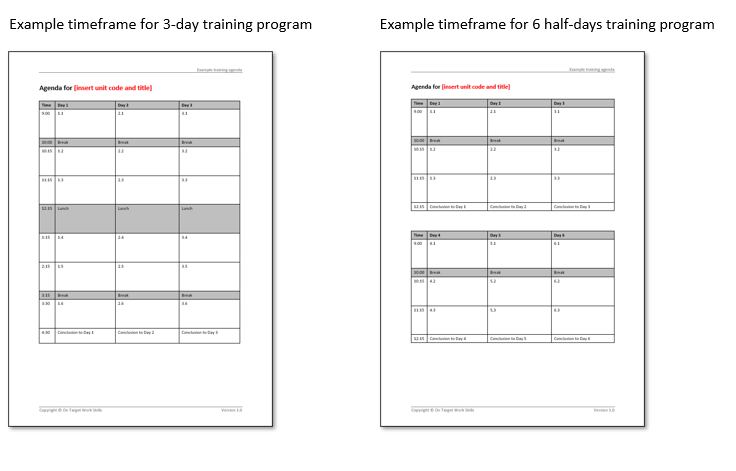
The next example shows the layout for a training program with full days compared with a training program with half-days.
The above examples have shown when every training session has a duration of one hour. But sometimes a training session may require more time. The following example shows the layout for a training program with all training session with a one hour duration compared with a training program with a three hour training session on Day 2 and a two hour session on Day 3.

The purpose of showing a range of examples is to demonstrate the need for flexibility when developing the timeframe for the training agenda. However, start with one hour blocks of time. And keep the timeframe simple.

Step 2. Determine content points

We need to design training to ensure it is based on the unit of competency and associated assessment requirements.

Read and unpack the Unit of Competency and associate Assessment Requirements. Identify the content that must be covered during the training program, such as:

  • Task or tasks to be performed
  • Required knowledge
  • Required skills.

Step 3. Consider learning activities

We need to design training to ensure it promote ‘active learning’ or ‘learn by doing’.

As a general rule, at least 50% of the available time should be allocated to activity. However, some training programs may have 80% or 90% of the available time allocate to activity.

Activities may include:

  • Performing the task
  • Role playing
  • Researching
  • Discussion
  • Case studies
  • Brainstorming
  • Small group work.

Icebreakers and quizzes are two other types of activities that are useful to include.

Watching a video is passive and is not an activity. However, we can make it part of an activity by conducting a discussion or setting questions to be answered after viewing the video. The content from the video become an input for the activity.

Some activities can be conducted before or after the training day. These activities may include advance organisers and pre-work. These are valuable additions to a training program.

Step 4. Sequence the content points

Add content points and learning activities to the training agenda.

Sequence the content points:

  • Overview before the details
  • Simple before the complex (easy before the difficult)
  • Step-by step sequence (logical or chronological sequence)

Take into consideration how much training time may be required as you add information to the training agenda. Estimate time required for:

  • Presenting the content
  • Demonstrating the performance of skills or tasks
  • Explaining, conducting and debriefing learning activities
  • Conducting introductions, conclusions and revision.

At this stage it will be an estimate of time. These estimates may need to be revised when you work on the details.

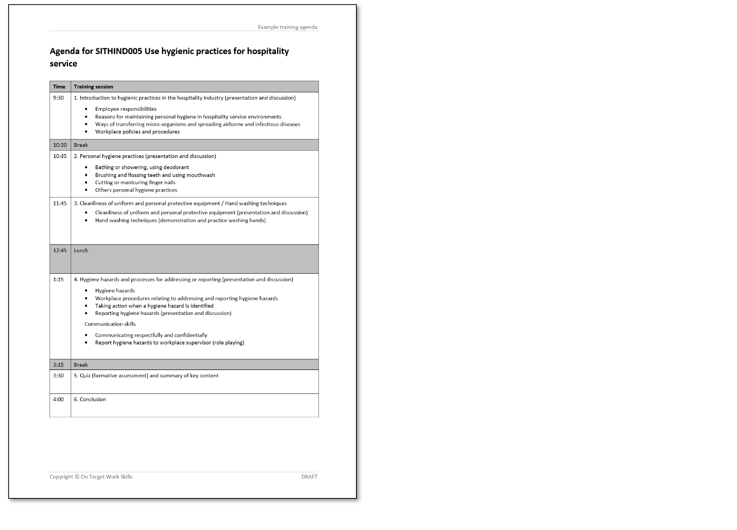
Very few units of competency in the Australian VET system can be adequately covered in one training day. The following is an example of a training agenda for the SITHIND005 Use hygienic practices for hospitality service unit of competency. It is one of those rare units that can be delivered in one day.
The next example is a 3-day agenda for the BSBOPS203 Deliver a service to customers unit of competency.

The above two examples show how very few details are provided on the training agenda. It is only meant to be an outline.

The training agenda is likely to be amended after you have developed the training delivery plan and training session plans. Some amendments may include:

  • Time allocated
  • Additional content
  • Sequence of content
  • Type and number of activities.

Step 5. Develop a training matrix

A training matrix is used to check that the training program shall cover the requirements specified by the Unit of Competency and associated Assessment Requirements.

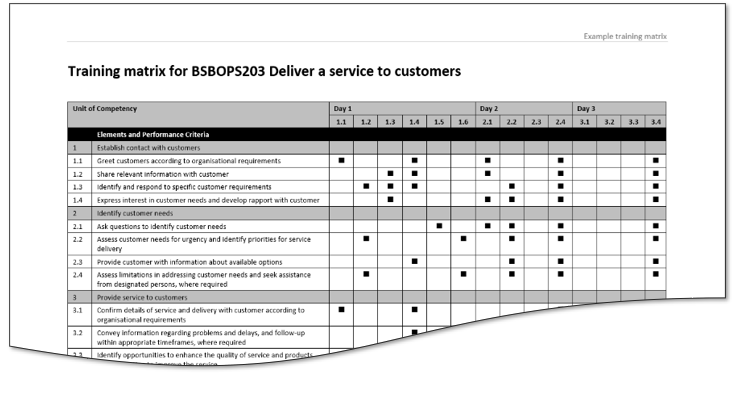
The training agenda gives a structure that can be used to create the training matrix. The following is an example of a training matrix. It is only showing the first page of a 3-page document. The other two pages covers the Performance Evidence and Knowledge Evidence.

The next example shows the layout for a training matrix covering the BSBOPS203 Deliver a service to customers unit of competency.
The development of the training matrix may identify content points that had not previously been considered while developing the training agenda. If this occurs, we will need to adjust the timing to cater for the additional content to be covered.

Consider your training agenda as a draft until you have completed developing the training delivery plan and training session plans. Your preliminary ideas may be changed after you have worked on the details. The training agenda must be consistent with your training delivery plan and training session plans.

The training agenda is useful piece of information for trainers and their learners. The one-page format gives a quick outline of the entire training program. It is a roadmap for the training. It is a good starting point for designing a competency-based training program. It is a roadmap for training.

Do you need help with your TAE studies?

Are you a doing the TAE40122 Certificate IV in Training and Assessment, and are you struggling with your studies? Do you want help with your TAE studies?

Ring Alan Maguire on 0493 065 396 to discuss.

Contact now!

logo otws

Training trainers since 1986
A case study: Using qualification packaging rules for the SIT20322 Certificate II in Hospitality

People studying for their TAE40122 Certificate IV in Training and Assessment qualification will need to demonstrate that they can use qualification packaging rules. This is a requirement for the TAEDES411 Use nationally recognised training products to meet vocational training needs unit of competency.

This article covers:

  • What are qualification packaging rules?
  • How are the qualification packaging rules used?

What are qualification packaging rules?

Qualification packaging rules specifies the total number of units of competency required to achieve the qualification. Also, the number of core and elective units are specified. All core and elective unit codes and titles are listed, including identification where prerequisite units apply.

Each qualification has been designed to meet the needs of an occupation or job function. Packaging rules ensure that the selection of elective units achieve the desired outcomes for the qualification.

How are the qualification packaging rules used?

The following is a 7-step process for using the qualification packaging rules:

  • Step 1. Access the qualification packaging rules
  • Step 2. Read the qualification packaging rules
  • Step 3. Create a Microsoft Word table
  • Step 4. Insert the core units for the qualification
  • Step 5. Select elective units according to the qualification packaging rules
  • Step 6. Sequence the units of competency
  • Step 7. Check compliance with qualification packaging rules

The following is a case study showing how to use the qualification packaging rules for the SIT20322 Certificate II in Hospitality qualification.

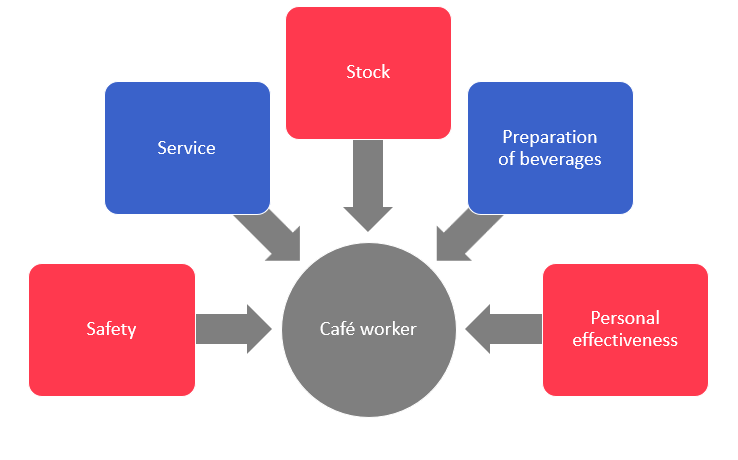
This qualification provides a pathway to work in various hospitality settings, such as restaurants, hotels, motels, catering operations, clubs, pubs, cafés, and coffee shops. For the purposes of this case study, I have focused on a training program for a worker in a café or coffee shop. The following is a brief job description for a café worker.

Step 1. Access the qualification packaging rules

The training.gov.au website provides access to the packaging rule for the qualification. Use the search function to find the qualification details, and scroll down.

Step 2. Read the qualification packaging rules

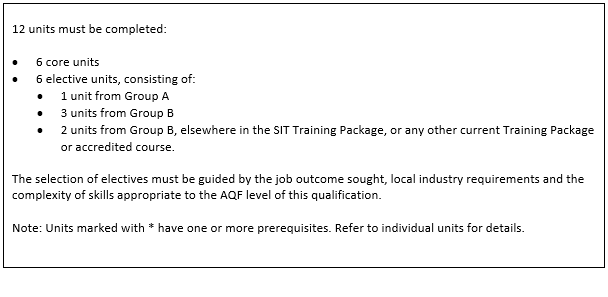
The following are the packaging rules for the SIT20322 Certificate II in Hospitality qualification.

Step 3. Create a Microsoft Word table

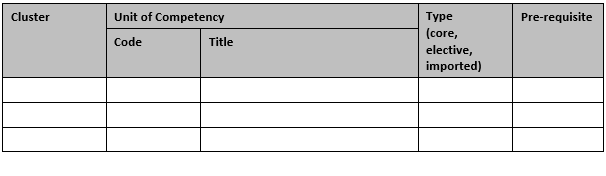
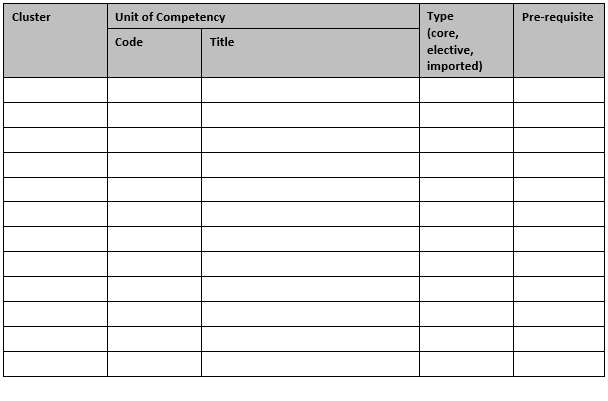
Create a 5-column table using Microsoft Word. The following shows the table headings and recommended format for the table.

The packaging rules for the SIT20322 qualification states that there must be a total of twelve units of competency. Therefore, I make sure the Microsoft Word table has 12 rows available for inserting 12 units.

Step 4. Insert the core units for the qualification

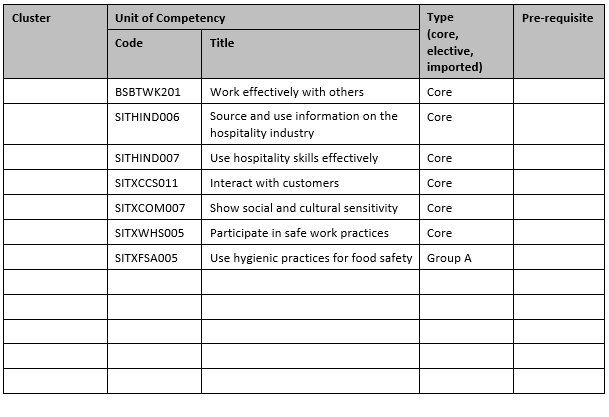
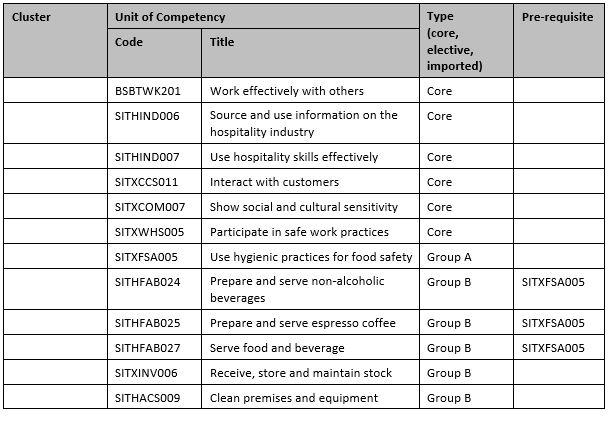
The core units for a qualification are listed. Insert the unit codes and titles. Also, insert the word ‘Core’ in the column indicating the type of unit. The SIT20322 qualification has six core units as shown below.

Step 5. Select elective units according to the qualification packaging rules

Consult with employers or industry about the typical work tasks or units of competency that should be covered by the qualification.

The qualification packaging rules specifies that one unit must be selected from the Group A list. The SITXFSA005 Use hygienic practices for food safety unit of competency has been selected and it has been added to the Microsoft Word table. Also, ‘Group A’ has been inserted in the column indicating the type of unit.

The remaining five elective units have been selected from the Group B list. The choice of electives is determined by the typical tasks performed by workers in a café or coffee shop.

The above table shows that three of the selected units identify the SITXFSA005 unit as a prerequisite. The SITXFSA005 unit had already been selected from the Group A list.

Step 6. Sequence the units of competency

Sequence

Safety first. If there is a unit relating to safety, I usually plan for it to be delivered first or close to the commencement of the training program. Then I consider delivering units covering simple tasks before delivering units covering advanced or complex tasks. Also, I consider if there is a logical sequence that the delivery of units would best follow. For example, learn customers service skills before learning how to prepare and serve beverages.

Prerequisites

Some units specify a prerequisite unit. A prerequisite unit or units must be completed before the unit that specifies it. This is a rule that must be considered when sequencing the units of competency.

Clusters

I often use clustering to organise the units of competency. This technique makes it easier for trainers to implement and easier for learners to understand the training program structure. A short descriptive title for the cluster can be used instead of using unit codes and titles that many learners can find confusing, especially at the commencement of the training program.

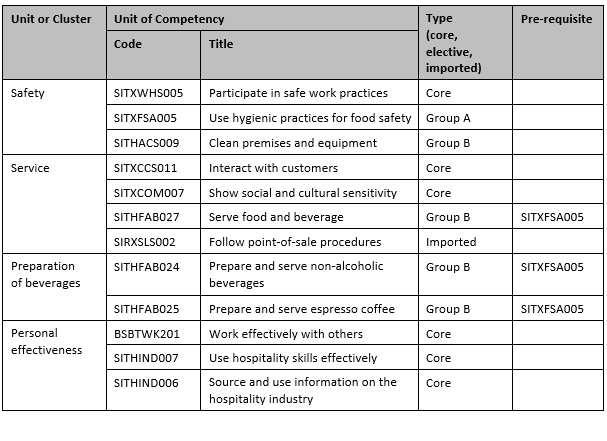
The following illustrates how five key areas have been used to structure the training program. It is much similar than the codes and titles for twelve units of competency.

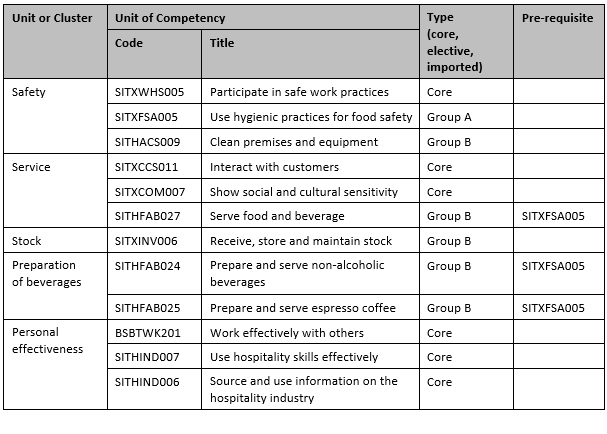
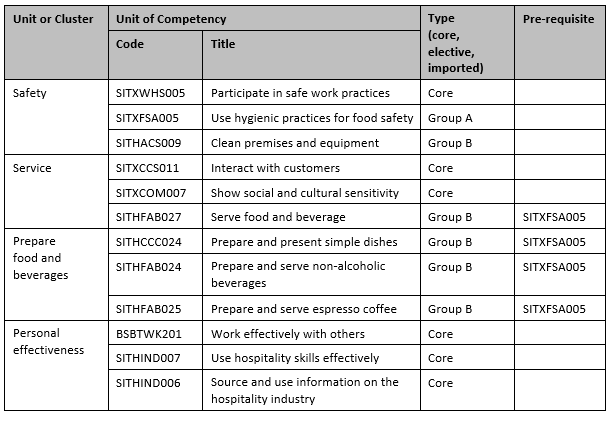
The following table shows how the twelve units of competency for the SIT20322 Certificate II in Hospitality qualification has been clustered and sequenced.

Step 7. Check compliance with qualification packaging rules

Check that the qualification packaging rules have been complied with. In the case of the SIT20322 Certificate II in Hospitality qualification:

  • Are there a total of 12 units?
  • Have the 6 core units been included?
  • Has 6 elective units been selected according to the packaging rules?
  • Are prerequisite unit requirements addressed?

Again, consult with employers or industry. Confirm that the units of competency for proposed training program meet the requirements for the occupation or job function. In this case, are the requirements for a café worker adequately covered.

In conclusion

Qualification packaging rules provide the flexibility required to customise a training program to respond to the needs of a client or industry.

In the following example, the SIRXSLS002 Follow point-of-sale procedures unit has been imported to cover taking cash and card payments and giving out change and receipts.

And in the following example, the SITHCCC024 Prepare and present simple dishes unit has been included to cover the preparation of food as well as beverages.

Do you need help with your TAE studies?

Are you a doing the TAE40122 Certificate IV in Training and Assessment, and are you struggling with your studies? Do you want help with your TAE studies?

Ring Alan Maguire on 0493 065 396 to discuss.

Contact now!

logo otws

Training trainers since 1986
What are the dimensions of competency?

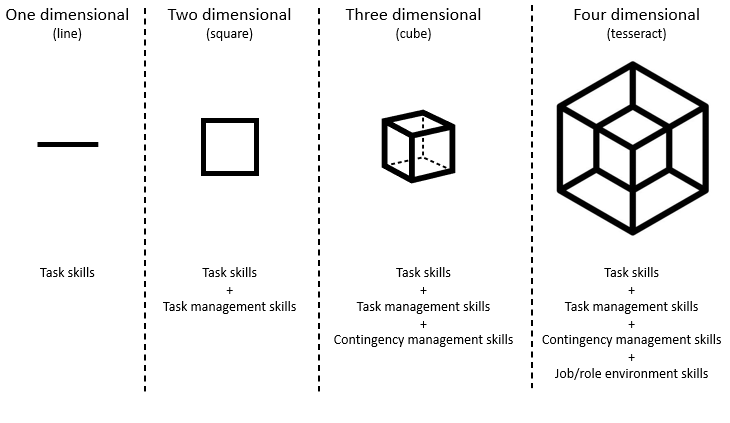
The ‘dimensions of competency’ is a concept. They are part of the broad concept of competency, which includes all aspects of work performance as represented by: [1]

  • Task skills: the ability to perform individual tasks
  • Task management skills: the ability to manage a number of different tasks or activities within the job role or work environment
  • Contingency management skills: the ability to respond to irregularities and break downs in routine
  • Job/role environment skills: demonstrating the ability to deal with responsibilities and expectations of the workplace, including working with others.

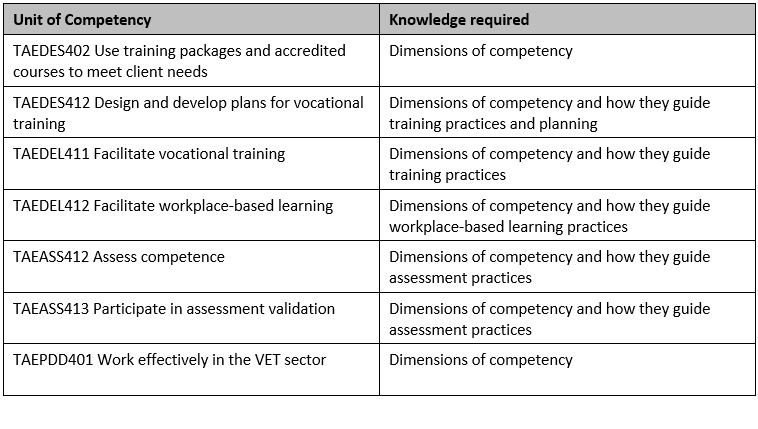
When the Education Industry Reference Committee (IRC) released the TAE40122 Certificate IV in Training and Assessment qualification in 2022, they tried to embed the dimensions of competency into as many units of competency as possible. For example:

Unfortunately, some people studying for their TAE40122 Certificate IV in Training and Assessment qualification are being asked to answer ridiculous questions on multiple occasions about dimensions of competency. This article explores the four dimensions of competency and how they can guide training and assessment practices.

Task skills

Applying the dimensions of competency means that the training or assessment is comprehensive, rather than focusing narrowly on a single work task. However, the ability to perform the work task is still essential.

The first dimension of competency, task skills, refers to the knowledge and skills required to perform a work task. This includes both learning and assessing the ability to apply this knowledge and skills.

Task management skills

Work usually involves performing many different tasks, so it’s easier to apply the dimensions of competency when considering all the units of competency required for an entire job or role. It’s difficult and sometimes unrealistic to try to apply the dimensions to a single unit of competency.

Dimensions of competency mean that training and assessment are not narrowly focused on a single task. Instead, they embrace all aspects of performance and represent an integrated and holistic approach to work.

The second dimension of competency, task management skills, refers to a person prioritising, planning and organising their work to accomplish all that needs to be done. Learning to perform a single task in isolation from other tasks does not demonstrate that a person can manage multiple tasks.

Contingency management skills

Sometimes things at work do not go as planned. Accidents and emergencies occur. Mistakes and errors are made. And unexpected things happen.

The third dimension of competency, contingency management skills, refers to the ability to respond safely and appropriately when irregularities and break downs in routine occur.

Job/role environment skills

Employees are expected follow workplace policies and procedures. Also, employees need to take responsibility for getting work done and meeting expected standards.

The fourth dimension of competency, job/role environment skills, refers to an employee’s ability to take responsibility, meet expected standards, and interact effectively with others in the workplace.

How can the dimensions of competency guide training practices

A person studying for their TAE40122 Certificate IV in Training and Assessment is likely to be asked how do the dimensions of competency guide training practices.

The dimensions of competency in the Australian VET system guide training practices in a number of ways:

  • They help to ensure that training is focused on the skills and knowledge that are most relevant to the workplace. By considering all four dimensions of competency, training providers can develop programs that help learners to develop the skills they need to be successful in their chosen occupation.
  • They provide a framework for designing and delivering effective learning experiences. By understanding the different dimensions of competency, trainers can develop activities that allow learners to develop the skills they need in each area.

Here are some specific examples of how the dimensions of competency can guide training practices:

  • Task skills: When training learners how to perform a specific task, trainers can provide them with opportunities to practice the task in a variety of settings and with different levels of complexity. This helps learners to develop the skills they need to perform the task safely and effectively in the workplace.
  • Task management skills: Trainers can help learners to develop task management skills by training them how to plan, organise, and prioritise their work. They can also provide learners with opportunities to practice managing multiple tasks simultaneously.
  • Contingency management skills: Trainers can help learners to develop contingency management skills by training them how to identify and respond to unexpected situations or problems. They can also provide learners with opportunities to practice managing these situations in a simulated or real workplace.
  • Job/role environment skills: Trainers can help learners to develop job/role environment skills by informing them about the workplace culture and expectations. They can also provide learners with opportunities to practice interacting with other people in the workplace or simulated workplace, and working as part of a team.

How can the dimensions of competency guide assessment practices

A person studying for their TAE40122 Certificate IV in Training and Assessment is likely to be asked how do the dimensions of competency guide assessment practices.

The dimensions of competency guide assessment practices in the Australian VET system in a number of ways:

  • Assessment tasks should be designed to assess all four dimensions of competency. This means that assessment tasks should not only focus on learners’ ability to perform specific tasks, but also on their ability to manage their work tasks effectively, respond to problems and challenges, and meet the expectations of the workplace.
  • Assessment should be conducted in a simulated or real workplace to gather the performance evidence under realistic workplace conditions.

Here are some specific examples of how the dimensions of competency can be used to guide assessment practices:

  • Task skills: An assessor might assess a learner’s task skills by observing them perform a specific task in a simulated or real workplace. For example, an assessor might observe a student electrician install a new electrical outlet.
  • Task management skills: An assessor might assess a learner’s task management skills by asking them to plan and complete a complex task. For example, an assessor might ask an apprentice chef to plan and prepare a meal for a large group of people.
  • Contingency management skills: An assessor might assess a learner’s contingency management skills by asking them to respond to a simulated problem or challenge in the workplace. For example, an assessor might ask a student nurse to respond to a medical emergency in a simulated hospital setting.
  • Job/role environment skills: An assessor might assess a learner’s job/role environment skills by observing them interact with others in a simulated or real workplace. For example, an assessor might observe a trainee customer service representative interacting with a customer over the phone.

The complexity of work

Work is more complex than repeatedly doing one task. The following uses a geometry analogue to show how the four dimensions of competency attempt to capture the complexity of working safely and effectively in the modern workplace.

In conclusion

The ‘dimensions of competency’ is a concept.

Australia adopted the current competency-based approach to training and assessment in 1992. I have worked in the Australian VET system for over 30 years, and I have never consciously thought about how I have been applying the dimensions of competency. It has not been necessary for me to do so. However, I have always considered whether my training is realistic and whether my assessments are based on the performance of real work tasks under typical workplace conditions.

It is essential for trainers and assessors to make their training and assessment real, or as realistic as possible.

Other relevant articles about the dimensions of competency that you may like to read, include:

Reference

[1] NCVER Glossary of VET

Do you need help with your TAE studies?

Are you a doing the TAE40122 Certificate IV in Training and Assessment, and are you struggling with your studies? Do you want help with your TAE studies?

Ring Alan Maguire on 0493 065 396 to discuss.

Contact now!

logo otws

Training trainers since 1986
What is pre-assessment validation?

I have discovered some key problem areas with the delivery of the TAE40122 Certificate IV in Training and Assessment qualification. One of those problem areas is assessment validation.

I am finding that some TAE40122 students are expected to conduct assessment validation without knowing what they are meant to be doing. It seems that some RTOs delivering the TAE40122 qualification are not providing training, not providing sufficient training, or providing training that does not help.

The purpose of this article is to provide some basic information about pre-assessment validation. I have published other articles relating to assessment validation:

Introduction to pre-assessment validation

The TAEASS413 Participate in assessment validation unit of competency describes the skills and knowledge required to participate in the validation of assessment tools, practices and judgements, including in:

  • pre-assessment validation of assessment tools before they are first used with candidates
  • post-assessment validation of the assessment tools after having been used to assess candidates, and assessment practices including the assessment decisions made by assessors.

In this article we are focusing on pre-assessment validation, including answers to the following questions:

  • What is pre-assessment validation?
  • What do we need to know before we can participate in a pre-assessment validation meeting?
  • How much training would be required to help someone learn how to participate in pre-assessment validation?

What is pre-assessment validation?

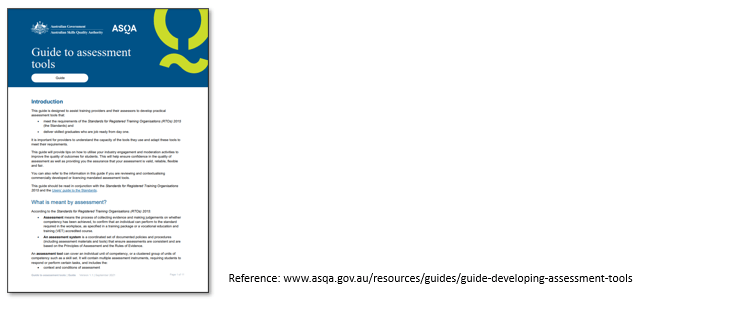
Pre-assessment validation is a check or review of an assessment tool. Firstly, we have to understand what is an assessment tool. ASQA has published a guide to assessment tools. This is a must-read document for TAFE teachers or trainers working in the Australian VET system.

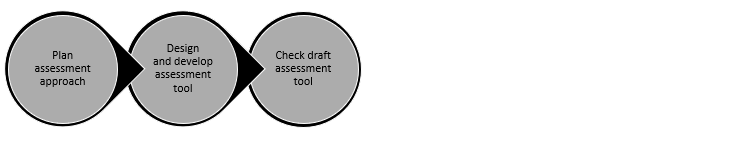
ASQA describes 3 steps for developing an assessment tool:

  • Planning
  • Design and development
  • Quality checks.

The following diagram show these three steps as a flowchart.

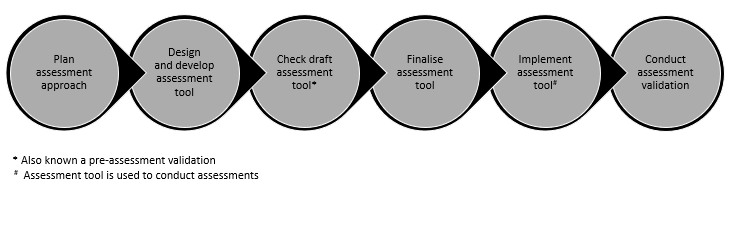
The next diagram adds onto ASQA’s 3 steps to show all the steps that should be taken before implementing the assessment tool. Also, it shows what happens after we have implemented the assessment tool.

The use of the term ‘pre-assessment validation’ is relatively new. Previously the activity of pre-validating an assessment tool was known as checking or reviewing the assessment tool before using it. Unfortunately, the word ‘validating’ is not as familiar to us the the words ‘checking’ or ‘reviewing’.

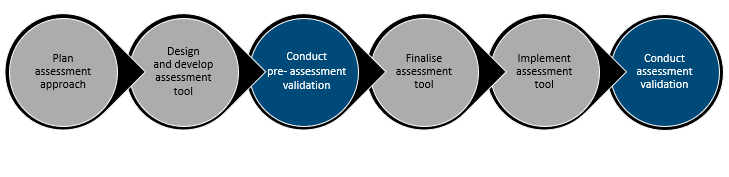
Pre-assessment validation is conducting a check of the assessment tool before it is implemented, in other words, before it has been used to conduct assessments. Post-assessment validation is a review of the assessment process after the assessment tool has been implemented.

The following diagram highlights when pre-assessment validation and post-assessment validation occur.

What do we need to know before we can participate in a pre-assessment validation meeting?

There is much to know before we can effectively participate in a pre-assessment validation meeting. For example:

  • What is assessment? And what is meant by ‘competency-based assessment’?
  • What is evidence? And why is evidence important?
  • What the four rules of evidence? And how do we know if the assessment complies with the rules of evidence?
  • What are the four principles of assessment? And how do we know if the assessment complies with the principles of assessment?
  • What are the four methods of assessment? What assessment method is used to gather knowledge evidence? And assessment method is used to gather performance evidence?
  • What is an assessment instrument?
  • What is an assessment matrix? And how is it used when conducting pre-assessment validation?
  • What is an assessment tool? And what is look for when conducting pre-assessment validation?
  • How does RPL assessment differ from ‘non-RPL assessment’?
  • What is the step-by-step procedure for conducting pre-assessment validation?

The following diagram gives an outline of the many things we need to know before we participate in pre-assessment validation.

How much training would be required to help someone learn how to participate in pre-assessment validation?

Ideally, an entire training day should be allocated to helping a TAE40122 student learn how to a participate in pre-assessment validation. For example:

  • Introduction to competency-based assessment [about 3 to 4 hours]
  • Demonstrate the conduct of a pre-assessment validation [about 1 ½ hours]
  • Practice conducting a pre-assessment validation in small groups of 3 or 4 [about 1 ½ hours]

In appears that some TAE Students are expected to undertake assessment tasks associated with the TAEASS413 Participate in assessment validation unit of competency with no or limited relevant training. Some TAE Students are being given an assessment tool to validate without knowing what is an assessment tool, or what is an assessment instrument, or what are all the other documents in the assessment tool. These TAE Students are being given no or limited background information about competency-based assessment, principles of assessment, rules of evidence, or methods of assessment. And the assessment matrix or assessment mapping is still a mystery.

In conclusion

I am finding that some TAE40122 students are not receiving sufficient training before they are expected to complete assessment tasks relating to assessment validation. People with no previous experience with competency-based assessment should not be expected to figure it out for themselves about how to conduct pre-assessment validation or post-assessment validation. Proper training is the solution.

Do you need help with your TAE studies?

Are you a doing the TAE40122 Certificate IV in Training and Assessment, and are you struggling with your studies? Do you want help with your TAE studies?

Ring Alan Maguire on 0493 065 396 to discuss.

Contact now!

logo otws

Training trainers since 1986
How is a Training Package developed and endorsed?

The Australian VET system is currently undergoing significant changes. One of those changes that is being implemented during 2023 is how Training Packages are developed and endorsed, including who develops and endorses Training Packages.

This article answers the following questions:

  • What is a Training Package?
  • Who are the Training Package Developers?
  • Who checks and endorses a Training Package?
  • What is the Training Package development and endorsement process?

What is a Training Package?

Training Packages are a key feature of Australia’s vocational education and training (VET) system. Training Packages contain:

  • Endorsed components, consisting of units of competency, assessment requirements, qualifications and credit arrangements
  • Non-endorsed components, includes the mandatory Implementation Guide for the Training Package and other documents known as ‘Companion Volumes’.

How do we access Training Packages?

We access the endorsed components from the training.gov.au website, and we access the companion volumes from the vetnet.gov.au website. Skill sets are not endorsed components but are considered as part of the Training Package, therefore, accessed from the training.gov.au website.

What is a training product?

Sometimes, the Training Package components are referred to as training products. A Training Product can be a qualification, skill set or a stand-alone unit of competency. An example of a stand-alone unit of competency is HLTAID011 Provide First Aid.

Who are the Training Package Developers?

As from the 1st of January 2023, the Industry Reference Committees (IRCs) and Skills Service Organisations (SSOs) have been replaced by Jobs and Skills Councils (JSCs).

Jobs and Skills Councils (JSCs) are contracted, and funded by, the Australian Government’s Department of Employment and Workplace Relations (DEWR) to develop Training Packages. There are 10 Jobs and Skills Councils (JSCs):

The Jobs and Skills Council (JSC) is also known as the ‘Training Package Developer’.

How to identify who is the Training Package Developer for a Training Package?

We can use the training.gov.au website to quickly identify who is the Training Package Developer for a particular Training Package. Go to the training.gov.au website and open the relevant Training Package page. Look down (or scroll down) to the heading ‘Training Package Developer’.

For example, the following illustration shows where to locate who the Training Package Developer is for the CHC Community Services Training Package.

Who checks and endorses a Training Package?

The Training Package Organising Framework is a set of rules owned by Skills and Workforce Ministerial Council which include content and process requirements that guide the development and content of Training Packages. It is comprised of the following policies:

  • Standards for Training Packages
  • Training Package Product Policy
  • Training Package Product Development and Endorsement Process Policy.

The Training Package Organising Framework was updated in November 2022 in preparation for the implementation of new industry engagement arrangements from the 1st of January 2023.

Training Package Assurance is the review of new or changed Training Products to ensure they meet the requirements set out in the Training Package Organising Framework.

The Department of Employment and Workplace Relations (DEWR) shall establish a Training Package Assurance team during 2023. This team shall review new and changed training products developed by Jobs and Skills Councils (JSCs) to ensure they meet the requirements set out in the Training Package Organising Framework. These arrangements will be in place for a limited time, to allow time for the Jobs and Skill Councils (JSCs) and Jobs and Skills Australia (JSA) to become established before a decision is made on where to house the Assurance Function long-term.

The Training Package Assurance team recommends to the Skills and Workforce Ministerial Council to endorse training products that meet the framework’s requirements.  Once it is endorsed, the training package is updated on the National Register of VET training website (training.gov.au) so that it can be implemented by the VET sector.

What is the Training Package development and endorsement process?

Training Packages are developed through a process of national consultation with industry. Industry, includes employers, unions, industry associations, and regulators relevant to the industry sector covered by the Training Package.

Jobs and Skills Councils (JSCs) develop new training products or change existing training products. This includes the development of endorsed and non-endorsed Training Package components.

Training Package Assurance is the review of new or changed training products to ensure they meet the requirements set out in the Training Package Organising Framework. This function is performed by a team within the Department of Employment and Workplace Relations (DEWR).

Skills and Workforce Ministerial Council consists of ministers with responsibility for skills and training in their State or Territory, including the Commonwealth Minister for Skills and Training as the Chair. They endorse new and changes training products.

Following endorsement, training packages are published on the National Register of VET training (training.gov.au).

The following flowchart gives an overview of the Training Package development and endorsement process.

In conclusion

Some information available on the Internet about the Training Package development and endorsement process may not be current and scattered across different websites. The aim of this article was to provide current information that was easy to understand. Also, this information has been written for people who are new to the Australian VET system, such as, people who are studying for their TAE40122 Certificate IV in Training and Assessment qualification.

References

Training Packages

[1] https://www.dewr.gov.au/nci/training-packages accessed 17 August 2023

[2] https://www.asqa.gov.au/about/vet-sector/training-packages accessed 17 August 2023

Jobs and Skills Councils

[3] https://www.dewr.gov.au/skills-reform/industry-engagement-reforms accessed 17 August 2023

[4] https://www.dewr.gov.au/skills-reform/resources/jobs-and-skills-councils-stage-one-outcomes accessed 17 August 2023

Training Package Organising Framework

[5] https://www.dewr.gov.au/nci/training-packages accessed 17 August 2023

[6] https://www.dewr.gov.au/skills-support-individuals/resources/standards-training-packages accessed 17 August 2023

Training Package Assurance

[7] https://www.dewr.gov.au/training-package-assurance accessed 17 August 2023

[8] https://www.dewr.gov.au/training-package-assurance/announcements/independent-training-package-assurance-supporting-jobs-and-skills-councils-program accessed 17 August 2023

Skills and Workforce Ministerial Council

[9] https://www.dewr.gov.au/skills-commonwealthstate-relations accessed 17 August 2023

[10] https://www.dewr.gov.au/skills-commonwealthstate-relations/skills-and-workforce-ministerial-council-swmc-members accessed 17 August 2023

Do you need help with your TAE studies?

Are you a doing the TAE40122 Certificate IV in Training and Assessment, and are you struggling with your studies? Do you want help with your TAE studies?

Ring Alan Maguire on 0493 065 396 to discuss.

Contact now!

logo otws

Training trainers since 1986