The TAESS00023 Online Learning and Assessment Skill Set was released on the 1st of June 2022. The skill set consists of two units of competency:
TAEDEL405 Plan, organise and facilitate online learning
TAEASS404 Assess competence in an online environment.
This skill set addresses the skills and knowledge required to plan, organise and facilitate online learning and assess competence across various electronic applications and communication channels. It involves gathering evidence using both synchronous and asynchronous assessment methods, and making judgements on the outcomes of the online assessment using a range of devices and digital tools. [1]
Professional development
The new online learning and assessment units or skill set can deliver an immediate value for many TAFE teachers, trainers and assessors.
The TAESS00023 Online Learning and Assessment Skill Set can be used to deliver a structured professional development program for current trainers, assessors and TAFE teachers working in the VET sector.
In additional to being relevant professional development, the attainment of the two new online learning and assessment units can be used as credits towards the TAE40122 Certificate IV in Training and Assessment qualification (expected to be endorsed before the end of 2022). [2]
Are you a doing the TAE40122 Certificate IV in Training and Assessment, and are you struggling with your studies? Do you want help with your TAE studies?
Do you want more information? Ring Alan Maguire on 0493 065 396 to discuss.
Most TAFE teachers, trainers and assessors working for an RTO learnt about designing competency-based assessment when they studied for their Certificate IV in Training and Assessment qualification . But designing a competency-based assessment for real is often very different to learning about it at a TAE training course.
On Target Work Skills is delivering a training webinar that provides a simple and practical approach to designing competency-based assessment. The aim is to improve capability for new and experienced VET practitioners.
Webinar objectives
The webinar objectives are:
Identify compliance requirements relating to the development of competency-based assessment
Describe a 7-step process for developing competency-based assessment
Determine the volume of performance evidence
Decide the number of assessment tasks
Check that the entire competency standard is planned to be assessed.
Key content points
The key content for this training are:
Compliance requirements (as per the Standards for RTOs 2015)
Definition of assessment
Principles of assessment and rules of evidence
Assessment Requirements
Knowledge evidence
Performance evidence
Assessment conditions
Sequence and structure of assessment tasks
Assessment methods
Assessment matrix
Assessment tools
Assessment instruments
Assessment instructions
Review and trial of the assessment tool before implementation
Nine golden rules when developing as assessment tool.
Location
The webinar shall be conducted via Zoom. Therefore, you can attend the webinar from your workplace or home.
Duration
3 hours webinar.
Note: There are two short breaks provided during the webinar.
Also, this webinar can be delivered to a work group. It can be a relevant and timely professional development activity for a group of trainers.
Date and start time
Please call Alan Maguire on 0493 065 396 to discuss.
Most TAFE teachers, trainers and assessors working for an RTO learnt about designing competency-based training when they studied for their Certificate IV in Training and Assessment qualification . But designing a competency-based training program for real is often very different to learning about it at a TAE training course.
On Target Work Skills is delivering a training webinar that provides a simple and practical approach to designing competency-based training. The aim is to improve capability for new and experienced VET practitioners.
Webinar objectives
The training objectives are:
Identify compliance requirements relating to the design of competency-based training
Describe a 7-step process for designing competency-based training
Estimate total training duration
Develop a draft training agenda
Check that the entire unit of competency is covered
List the 6 essential elements of a training program plan.
Key content points
The key content for this training are:
Compliance requirements (as per the Standards for RTOs)
Definition of competency
Units of Competency and Assessment Requirements
Instructional design theory
Robert Gagné’s 9-events of instruction
David Merrill’s first principles of instruction
Malcolm Knowles’ assumptions about adult learners
7-step process for designing competency-based training
Modes of delivery
AQF volume of learning and nominal hours
Chucking and sequencing
Training session structure
Introductions and conclusions
Structure of a knowledge training session
Structure of a skill or task-based training session
Summaries, self-reflection and breaks
Active learning and the importance of learn by doing
6 essential elements of a training program plan.
Location
The webinar shall be conducted via Zoom. Therefore, you can attend the webinar from your workplace or home.
Duration
3-hour webinar
Note: There are two short breaks provided during the webinar.
Also, this webinar can be delivered to a work group. It can be a relevant and timely professional development activity for a group of trainers.
Date and start time
Please call Alan Maguire on 0493 065 396 to discuss.
The TAELLN421 Integrate core skills support into training and assessment unit of competency can be difficult to read and understand because of the jargon it uses.
This unit has four elements:
Identify core skill demands
Identify learner and candidate core skill needs
Integrate core skill support
Review effectiveness of integrated core skill support.
Just looking at the elements of competency, there are a few questions raised:
What is a core skill?
What are core skill demands?
What is the difference between a learner and candidate?
What is core skills support?
What is meant by integrated core skill support?
What is a core skill?
There are five core skills in the Australian Core Skills Framework (ACSF):
Learning
Reading
Writing
Oral communication
Numeracy.
What are core skill demands?
I will use the word ‘requirement’ instead of the word ‘demand’. The following is an example of questions we can ask to help us determine the reading skill requirements:
What level of reading skill is required to perform a work task?
What level of reading skill is required to participate in the training and assessment?
What level of reading skill is required to use the training and assessment materials?
And ask the same questions for the other four core skills.
What is the difference between a learner and candidate?
A learner is a person we provide training to. A candidate is a person we assess. Often, the learner and the candidate are the same person.
What is core skills support?
We can support the development of a person’s core skills by using training strategies and learning resources designed. For example:
We could allow more time for the person to learn the content
We could provide support sessions for the individual learner
We could use learning resources based on images and diagrams to help the person learn the content.
Also, we can use assessment strategies appropriate for the person being assessed. For example, we could use oral questioning instead of written questioning to gather knowledge evidence if the person has low level of reading and writing skills.
What is meant by integrated core skill support?
We need to address the development of the core skill at the same time as helping the person learn how to perform the work skills. For example, we can help a person develop their reading skill by helping them learn to read a relevant workplace procedure.
Also, ‘integrated core skill support’ means incorporating strategies and resources when we deliver training and conduct assessment. In other words, no doing something separately.
How do we integrate core skills support into training and assessment?
I have unpacked the elements, performance criteria and performance evidence to create the following 4-part process that gives greater clarity to the TAE Student about what they need to do.
Assessment requirements for the TAELLN421 unit
Knowledge evidence
An assessment task will be required to gather the specified Knowledge Evidence. A TAE Student must demonstrate they have the following knowledge:
Core skill levels of the Australian adult population, and of VET learners
Australian Core Skills Framework and Digital Literacy Skills Framework
Impact of core skills on a person’s capability to participate in work and in training and assessment, and the implications for design and delivery of vocational training and assessment
Overview of core skill demands in the workplace that relate to the nationally recognised training products
VET regulatory requirements relating to integrating core skills support into training and assessment
RTO procedures relating to integrating core skills support into training and assessment
Benefits of integrating vocational and core skill training for all individuals
How to identify core skills in nationally recognised training products, workplace tasks and texts, etc.
Responsibilities and limitations of own job and practice in relation to providing core skills support in training and assessment.
Performance evidence
The Performance Evidence for the TAELLN421 Integrate core skills support into training and assessment unit of competency is reasonably complex. This complexity may mean that the assessment task or tasks will be complex.
Do you need help with your TAE studies?
Are you a doing the TAE40122 Certificate IV in Training and Assessment, and are you struggling with your studies? Do you want help with your TAE studies?
I have found that some people studying for their Certificate IV in Training and Assessment qualification struggle with understanding what a task breakdown is, and how to develop a task breakdown. In this article, I aim to answer the following questions:
What is a task breakdown?
How can a task breakdown be developed?
When can a task breakdown be used?
Where do we start
Australia’s VET system is competency-based. A primary objective of VET is to help people learn how to perform work tasks and activities.
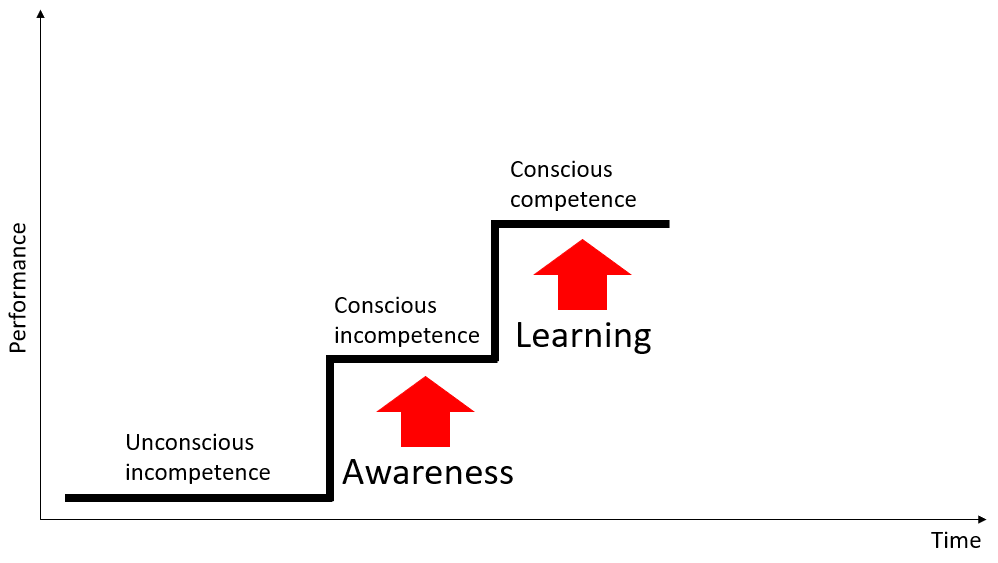
The four stages of competence, also known as the ‘conscious competence learning model’, describes the process of progressing from incompetence to competence in performing a task or activity. [1]
Stage 1. Unconscious incompetence
At this ‘unconscious incompetence’ stage, a person is unaware of their inability to perform a particular task or activity.
Stage 2. Conscious incompetence
At the ‘conscious incompetence’ stage, a person becomes aware that they are unable to perform a particular task or activity.
Stage 3. Conscious competence
A person who is aware of their incompetence may decide it is worth their time and effort to learn how to perform the particular task or activity. At the ‘conscious competence’ stage, the person can perform the task but they will require concentration and may need to think about each step.
Stage 4. Unconscious competence
In the final stage of ‘unconscious competence’, performing the task becomes second nature because the person has learnt and practiced performing the task so much. They can perform the task easily and without thinking about it. As a result, the task may be performed while executing another task.
An experienced or skilled worker often performs many work tasks and activities without needing to think about how or what to do.
Becoming conscious again
As a trainer, we often have mastered skills and we are no longer conscious about how we perform work tasks or activities. We just do it.
But as a trainer, we must explain and demonstrate to others how to perform work tasks, and to do this we have to again become conscious about the steps required to perform the task. The development of a task breakdown is a method that helps us become conscious again about how to perform a work task or activity.
A task breakdown is a step-by-step description about how to perform a task. It may also be known as a procedure or work instructions.
What is a task breakdown?
A ‘task breakdown’ is a document that breaks down a task. It describes the steps in a logical sequence to perform the particular work task or activity.
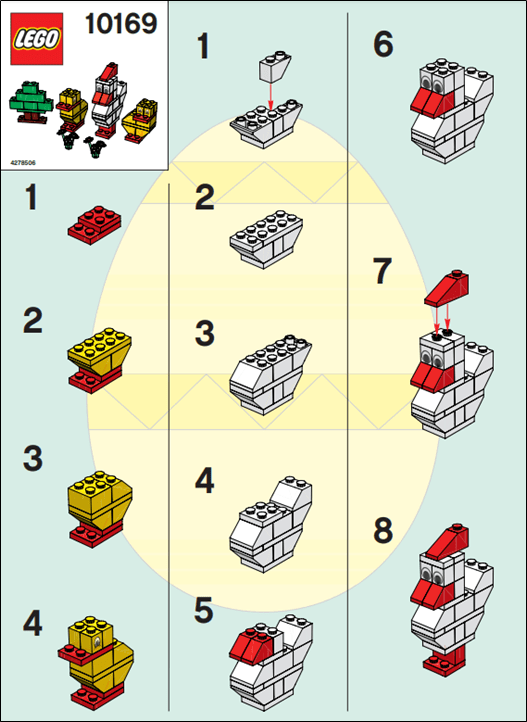
I use three analogies to help people understand and appreciate the value of a task breakdown: Lego instructions, Ikea instructions, and a cooking recipe.
The following three examples have three common features:
Steps are numbered
Illustrations are used to visually communicate
The outcome or desired result is shown.
Lego instructions
Ikea instructions
Cooking recipe
How can a task breakdown be developed?
Use the following six steps to develop a task breakdown.
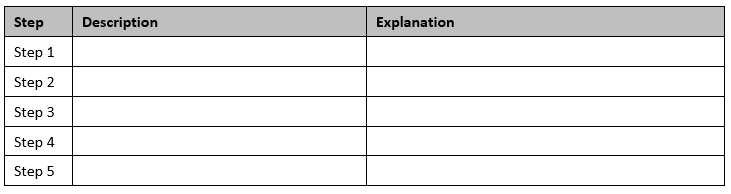
Step 1. Create 3-column table
Open a new Microsoft Word document and create a 3-column table. For example:
Step 2. Add table headings and adjust column width
The following illustrates the recommended layout and format for the task breakdown. For example:
Note: Layout and format can be modified later, if required.
Step 3. Enter step numbers
Use the first column to enter step numbers. The numbers imply a logical sequence to followed, and repeatedly use the word ‘step’ because this reinforces that each row is a step to be performed. For example:
Note: Table rows can be added or removed later, as required.
Step 4. Write brief description for each step
Perform the task or observe someone performing the task. Write a brief description for each step. For example:
Step 5. Write explanations
Write a clear and concise explanation for each step. Use illustrations, diagrams, and photos to show examples. Do not decorate or use unnecessary visuals. For example:
Important note: Remember to highlight safety requirements for the task or for a particular step.
Step 6. Review and finalise task breakdown
Ask someone to use your draft task breakdown to perform the task. Observe the person performing the task, checking the sequence of steps, and seek feedback about readability.
Check your task breakdown for grammar and spelling. Add task title, version control, and page numbers before finalising the document. For example:
Download the finished product
You can download a PDF version of the finished task breakdown for creating a task breakdown from here.
Used as a planning tool to identify required knowledge, required skills, safety requirements, and resources required to perform a task
Used to explain the process or performance of the task
Used to demonstrate the process or performance of the task
Used by the learner to guide them when they learn or practice performing the task
Used to check or assess the performance of the task
Used as a diagnostic tool when a person is struggling with learning or performing the task (used to identify what step the learner is stuck on).
Training session plan
A task breakdown describes a task. A session plan is used to describe the training to be delivered. The task breakdown should not make reference to the training process. It should only describes the work task or activity.
A training session plan can be developed based on the steps described by the task breakdown.
Observation checklist
A task breakdown can be converted into an observation checklist. For example:
A task breakdown should be written to guide performance of a work task or activity. It should describe the step-by-step procedure to be followed in a training environment or in a real workplace. The task breakdown should be the procedure to follow, no matter where the task is performed.
In conclusion
Creating a task breakdown is a basic skill that all trainers and TAFE teachers must have. A task breakdown describes the steps in a logical sequence to perform a particular work task or activity.
A task breakdown has a multitude of uses:
Used by the trainer as a planning tool
Used by the trainer when explaining and demonstrating the performance of the task
Used by the learner to guide them when they learn or practice performing the task
Used by the trainer when checking or assessing the performance of the task
Are you a doing the TAE40122 Certificate IV in Training and Assessment, and are you struggling with your studies? Do you want help with your TAE studies?













 On Target Work Skills