

The Australian VET system is changing.
I’ve recently published the following articles relating to the current VET Reforms:
- How is the Australian VET system changing? (exploring how the VET system is splitting into two systems)
- Change management and the Australian VET system (highlighting that ASK units will change things for VET practitioners)
- A deep dive into unpacking an ASK unit of competency (unpacking an ASK unit developed by Skills Insight)
- Another deep dive into unpacking an ASK unit competency (unpacking an ASK unit developed by HumanAbility)
- Deep dive or deep water? Why I’m sinking in this ASK unit of competency (unpacking an ASK unit developed by Future Skills Organisation).
In this article, I want to emphasis the ongoing importance of ‘performance’ in the Australian VET system.
Competence relates to Performance
The Australian VET system is still based on competencies.
Competency, in the Australian VET system, is defined as the consistent application of knowledge and skills to the standard of performance required in the workplace.
Three key words that I want to focus on are: Knowledge, Skills and Performance.
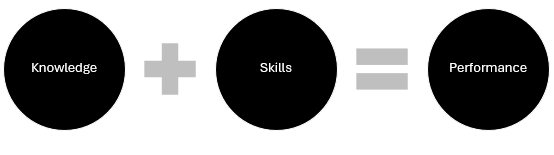
A fundamental purpose of the Australian VET system
A fundamental purpose of the Australian VET system is to ensure Australia has a productive workforce. This is achieved by delivering training that develops the ability of people to perform work. Each year, billions of dollars are spent by governments on the VET system. It would be a waste of Australian taxpayers’ money if VET didn’t produce people with the ability to perform work safely and effectively.
A major outcome for VET should be work-ready people. These people may be seeking a job, seeking a new job, or seeking a better job.
Capability is not the same as Performance
VET must focus on ‘performance’. Having knowledge is not enough. Having skills is not enough. A person may know the theory (knowledge) and possess the capability (skill), but without action and real-world application, they remain unable to perform work.
The new Application of Skills and Knowledge (ASK) units will remove information about Elements and Performance Criteria. This significantly de-emphasises ‘performance’. However, each RTO delivering an ASK unit will still need to interpret it, contextualise it, and reconstruct it to describe the required performance.
Focusing on performance allows us to see how work actually happens. The required performance must be clearly described before assessment tools can be developed and before training programs can be designed.
Describing performance, linking knowledge and skills
The ASK units will specify the required knowledge, required skills, and application of knowledge and skills. However, the application of knowledge and skills in the ASK units do not necessarily describe anything about performance.
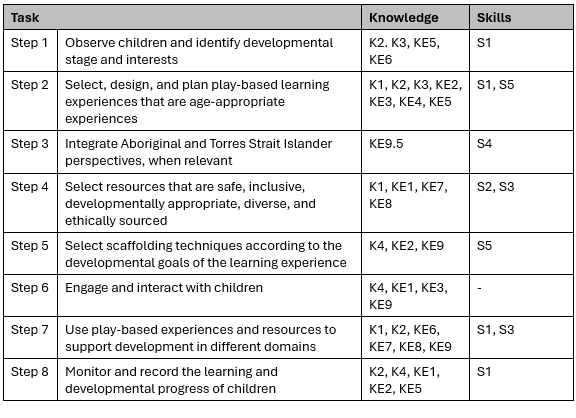
An RTO may use task breakdowns and step-by-step procedures to describe the required performance, as illustrated by the table below. In addition, extra columns can be added to the table to include information to show the link between each step of performance and the required knowledge and required skills.
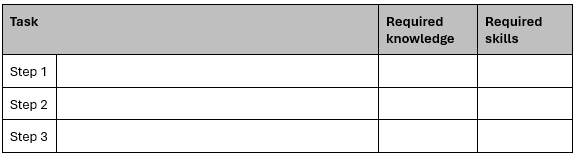
This table format reconstructs the three piece of information: Knowledge, Skills and Performance.
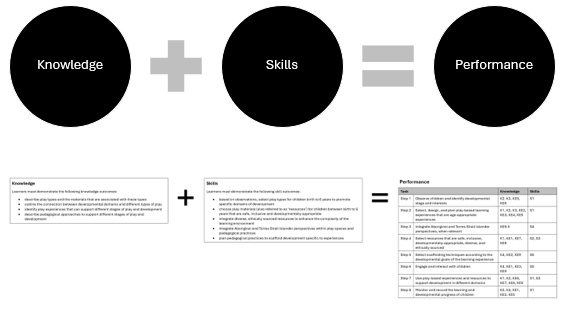
This example clearly describes the required performance, and the step-by-step procedure can be used to develop observation checklist for assessment. Also, it provides information about when and what knowledge and skills need to be covered during training.
Do you want more information?
Are you an RTO manager or course coordinator?
Could your RTO team benefit from professional development about changes to the Australian VET system? In particular, how the Training Package Organising Framework or how the new EPC and ASK formatted units impact their work as VET practitioners?

Ring Alan Maguire on 0493 065 396 to discuss.

Training trainers since 1986

 On Target Work Skills
Insightful article Alan and well researched.
LikeLike
Well documented and well written article.
LikeLike
Dear Alan,
Your latest articles have been very sobering.
Though semi-retired, I still tutor electrical trade students struggling with the concepts and applications of electrical theory.
The electrical trades TP is undergoing a major revamp, and I am not looking forward to the actual updated Units of Competency soon to be published.
Your acumen, knowledge and application are sincerely appreciated.
Thank you.
LikeLike