

Okay, I get it. The Australian VET system is changing but I’ve deep-dived into an ASK unit of competency and it is officially time to throw me a lifeline.
Recently I have published the following articles:
- Change management and the Australian VET system (highlighting that ASK units will change things for VET practitioners)
- A deep dive into unpacking an ASK unit of competency (unpacking an ASK unit developed by Skills Insight)
- Another deep dive into unpacking an ASK unit competency (unpacking an ASK unit developed by HumanAbility).
This time it is a deep dive into an ASK unit of competency that has been developed by Future Skills Organisation. It is radically different to the other two ASK units that I have unpacked.
I have randomly select the BSBXXX102 Develop Basic Digital Content Creation Skills unit to unpack. Please note, that it is a draft unit. It hasn’t yet been finalised, endorsed, or released for implementation.
Let’s dive in.
Unpacking the unit of competency
1. Unit outcome
The following is the Unit outcome for the BSBXXX102 Develop Basic Digital Content Creation Skills unit.
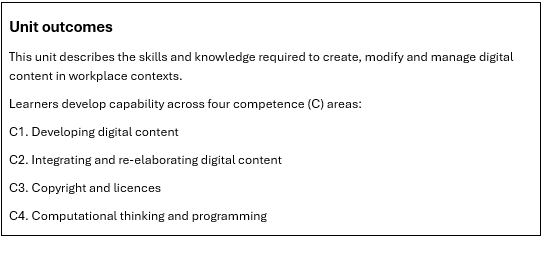
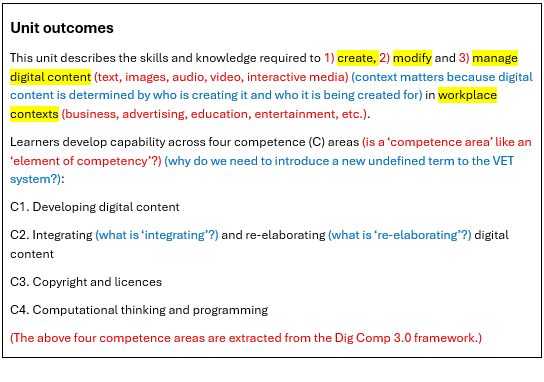
Analyse the Unit outcome by highlighting key words and writing notes.
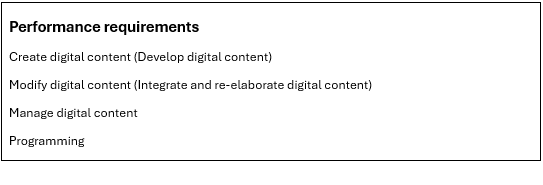
Extract performance requirements from the Unit outcomes.
2. Knowledge (K)
The following are the Knowledge items for the BSBXXX102 Develop Basic Digital Content Creation Skills unit.
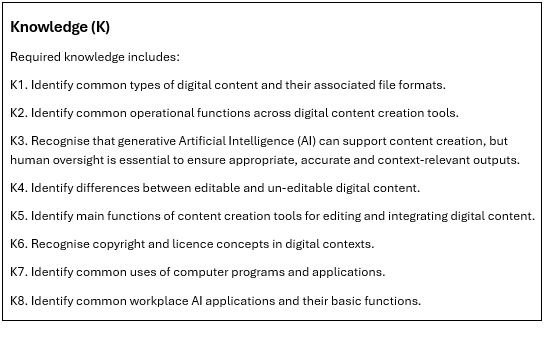
Analyse the Knowledge items by highlighting key words and writing notes.
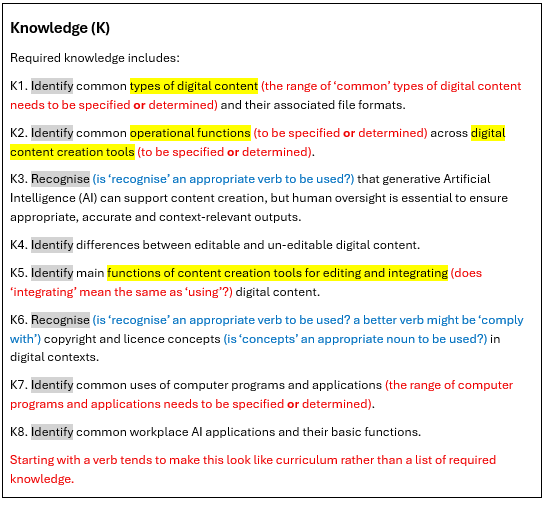
There is a great amount of ambiguity.
3. Skills (S)
The following are the Skills items for the BSBXXX102 Develop Basic Digital Content Creation Skills unit.
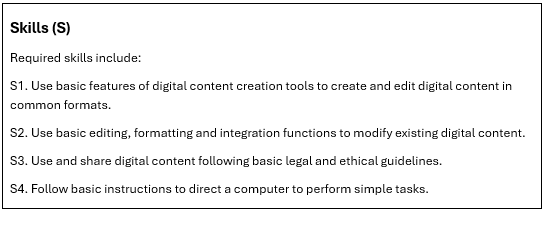
Analyse the Skills items by highlighting key words and writing notes.
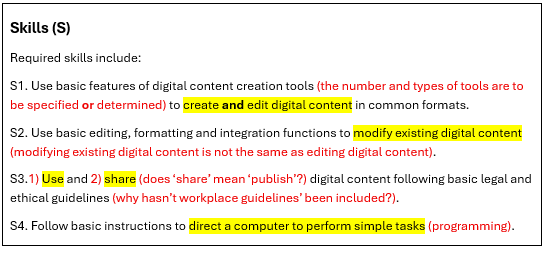
Extract performance requirements from the Skills items.
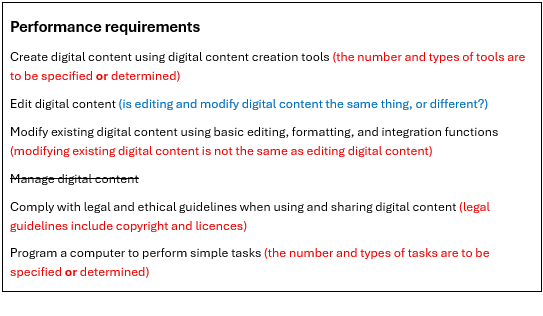
There continues to be a great amount of ambiguity.
4. Application of knowledge and skills
The following are the Application of knowledge and skills for the BSBXXX102 Develop Basic Digital Content Creation Skills unit.
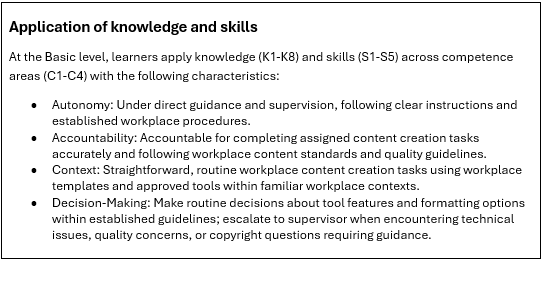
This information is aligned to the AQF, but it is an unstructured and an unhelpful way to describe the application of knowledge and skills. This information seems to better fit under the Assessment conditions heading.
Analyse the Application of knowledge and skills by highlighting key words and writing notes.
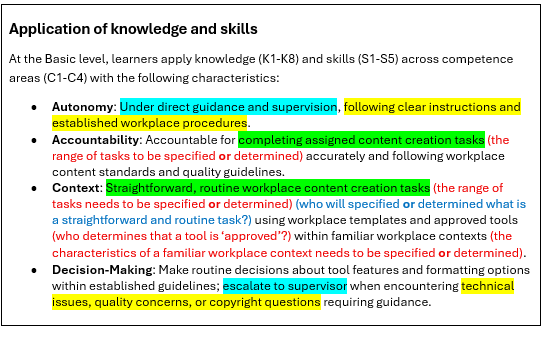
Extract performance requirements from the Application of knowledge and skills.
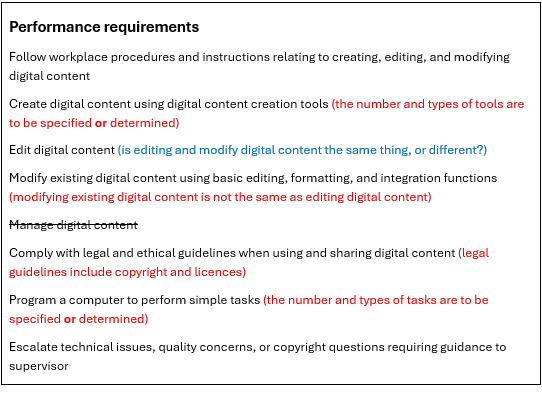
After analysing the Knowledge, Skills and Application of knowledge and skills, there remains is a great amount of ambiguity. Greater specificity is required before designing assessment tools and developing training strategies.
5. Performance evidence (PE)
The following are the Performance evidence for the BSBXXX102 Develop Basic Digital Content Creation Skills unit.
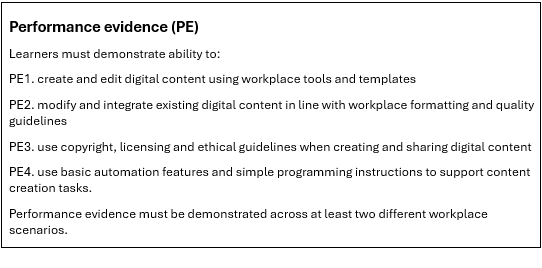
Analyse the Performance evidence by highlighting key words and writing notes.
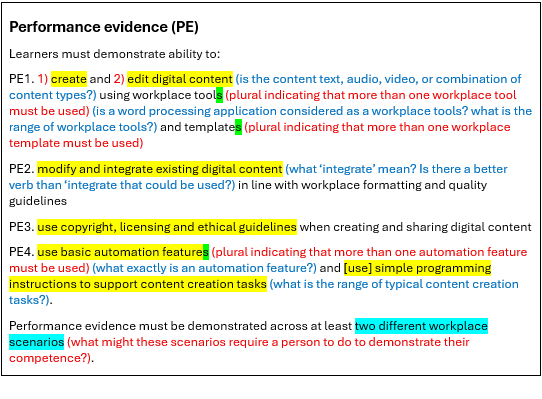
Extract performance requirements from the Performance evidence.
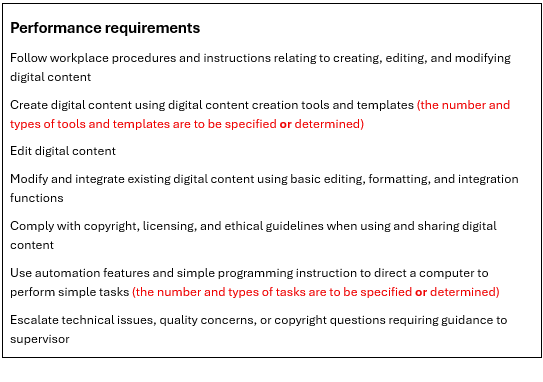
6. Knowledge evidence (KE)
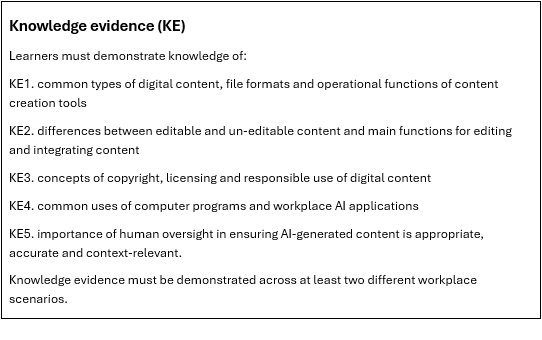
The following are the Knowledge evidence for the BSBXXX102 Develop Basic Digital Content Creation Skills unit.
The following table compares the list of Knowledge evidence (KE) items with the list of Knowledge (K) items.
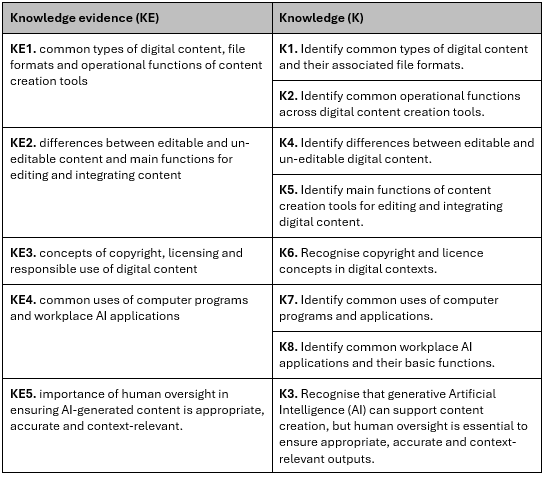
Clearly, there is a duplication of information.
7. Assessment conditions
The following are the Assessment conditions for the BSBXXX102 Develop Basic Digital Content Creation Skills unit.
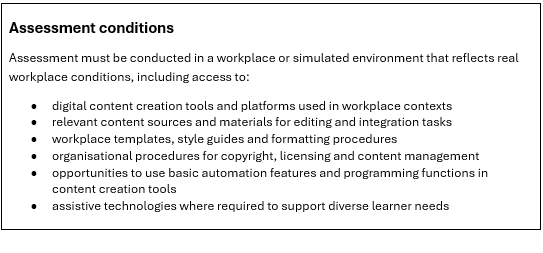
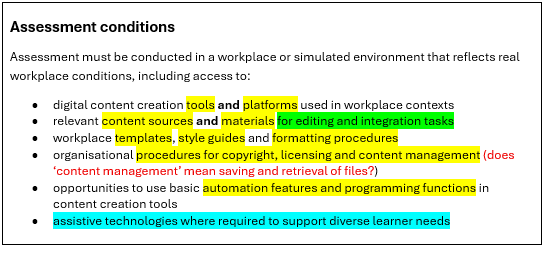
Analyse the Assessment conditions by highlighting key words and writing notes.
Extract performance requirements from the Assessment conditions.
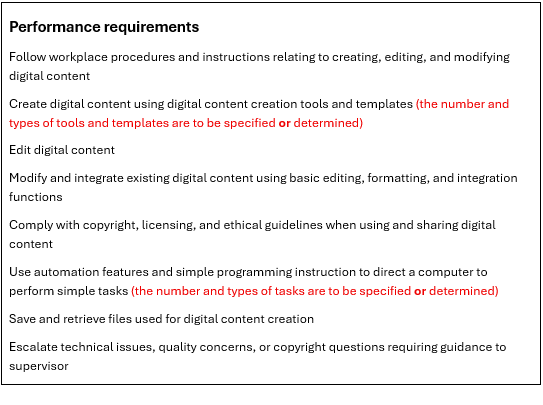
Clearly, there is a great amount of ambiguity. Ambiguity is being called ‘flexibility’. Calling it ‘flexibility’ often masks information that is devoid of meaning. Ambiguity leads to inconsistent and unreliable assessments, while creating confusing, unmeasurable learning objectives where learners don’t know what success looks like. Nobody knows what success looks like.
Without clear, unambiguous descriptions of performance requirements, it is impossible to commence designing assessment tools and developing training strategies.
Reconstructing the unit of competency
The following is a 3-column mapping table that aligns the Performance elements from with the required Knowledge and required Skills.
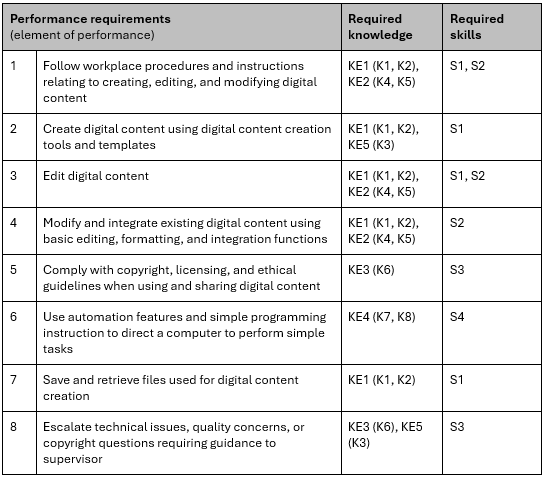
Competency is defined as the consistent application of knowledge and skills to the standard of performance required in the workplace. The above shows the connection between performance, knowledge. and skills. However, the standard of performance is yet to be specified or determined.
Specifying the performance requirements
It is essential for the performance requirements to be known before designing assessment tools and developing training strategies. After unpacking the BSBXXX102 Develop Basic Digital Content Creation Skills unit, there are still significant work to be done by an RTO to specify or determine exactly what needs to be performed and what standard of performance is required in the workplace.
In this example, fundamental questions that must be answered are:
- What types of digital content should a competent person be able to create? For example: text, images, audio, video, animated media, interactive media, etc.
- How many and what types of digital content creation tasks should a competent person be able to use?
- How many and what types of digital content creation tools should a competent person be able to use?
- What programming skills should a competent person have?
Each RTO must consult with their local industry, in particular, potential employers of their VET graduates. These consultations seek to clarify requirements and remove ambiguity.
Each RTO may end up delivering the same unit of competency but with very different outcomes. Attainment of a unit of competency will be extremely variable. And variation is the enemy of quality.
In conclusion
In this article, I dived deep into one ASK formatted unit that has been developed by Future Skills Organisation (FSO). This ASK unit is very different compared with the other two ASK units that I have recently unpacked. Those units had been developed by Skills Insight and HumanAbility. The BSBXXX102 Develop Basic Digital Content Creation Skills unit is one of 39 Digital Capability Units of Competency developed by FSO.
Unpacking these new ASK units developed by FSO can feel like getting caught in a sudden rip. But when you are thrust into deep water, you need to know how to swim and, above all, stay calm. If we panic at how radically different this new ASK approach looks, we’ll sink. If we stay calm and tread water, we give ourself a chance to survive the new wave of changes to the Australian VET system.
I was intending to go deep into the Digital Capability Units of Competency as a whole, but this article is already long enough. Until next time, keep your head above water.
Do you want more information?
Are you an RTO manager or course coordinator?
Could your RTO team benefit from professional development about changes to the Australian VET system? In particular, how the Training Package Organising Framework or how the new EPC and ASK formatted units impact their work as VET practitioners?

Ring Alan Maguire on 0493 065 396 to discuss.

Training trainers since 1986


One thought on “Deep dive or deep water? Why I’m sinking in this ASK unit of competency”