

The Training Package Organising Framework 2025 has introduced two different formats for units of competency:
- Element and Performance Criteria (EPC) format
- Application of Skills and Knowledge (ASK) format
Stating the obvious, a unit of competency is a unit of competency regardless of it being in an Element and Performance Criteria (EPC) format of an Application of Skills and Knowledge (ASK) format. It is a document that describes ‘competency’, and the Australian VET system is a competency-based system.
Definition of competency
Before diving deep into one of the new ASK units of competency, I would like to quickly define ‘competency’ as it applies to the Australian VET system.
Competency is defined as the consistent application of knowledge and skill to the standard of performance required in the workplace. It embodies the ability to transfer and apply skills and knowledge to new situations and environments. [1]
I want to highlight the importance of ‘performance’ in the above definition.
The Australian VET system has not been created as an education system to develop a person’s knowledge. Knowledge is needed but being able to apply that knowledge is what’s required. Likewise, skills are needed but a person must be able to apply those skills to perform work tasks.
A clear description of performance is essential
The ASK format for units of competency does not explicitly specify or describe performance requirements (however, limited or overview information is provided under the Performance evidence heading). We still need clear and industry-approved descriptions of work tasks to be performed. This is essential for collecting observable or measurable evidence to determine whether a person is competent. Also, descriptive Performance requirements are needed to design training and assessment strategies, develop assessment tools, and develop training resources.
I am assuming that an expected outcome of the Australian VET system is to develop people with the ability to perform work tasks to an expected standard (as per the definition of competency) and these people are work-ready when deemed competent.
Jobs and Skills Councils (JSCs) that use the ASK format to document units of competency are pushing the responsibility to determine Performance requirements onto all RTOs who use those units of competency. Extensive interpretation, contextualisation, and description will need to be done before the unit of competency has any usable meaning.
Several JSCs have drafted units of competency using the ASK format. I would expect the first of the ASK formatted units to be endorsed and released about August or September 2026.
The following is an example of unpacking an ASK unit of competency. Please note that the unit being used is a draft of an ASK unit developed by Skills Insight.
Before unpacking the ASK unit of competency, here is some background information.
Skills Insight is conducting a review of the Certificate IV in Veterinary Nursing. It has drafted some units of competency using the new formats specified by the Training Package Organising Framework 2025. [2]
Unpacking the ASK unit of competency
The draft ACMGEN3X03 Maintain cleaning, hygiene and sterility standards in animal care workplaces unit has been documented using the ASK format, and it was randomly selected for this example.
1. Start with the Unit outcomes
This deep dive into unpacking the ASK unit of competency starts with looking at the Unit outcomes.
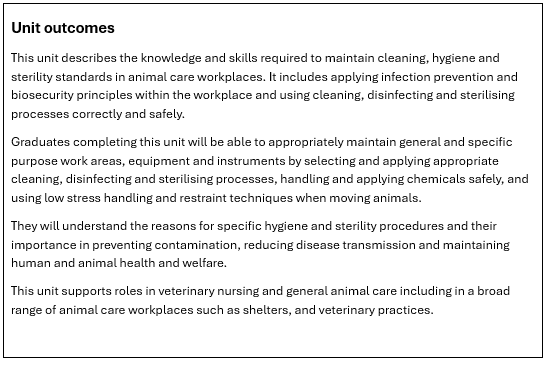
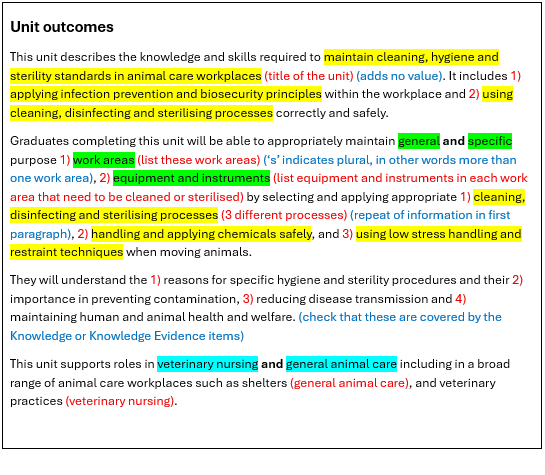
2. Highlight key words and write notes
The analyse of the Unit outcomes begins with highlighting key words and writing notes.
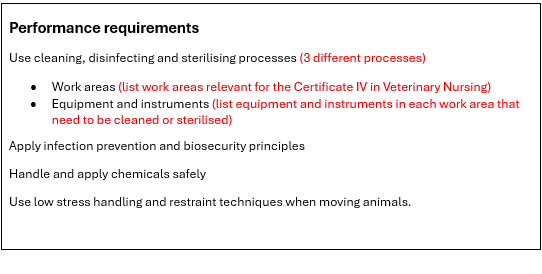
3. Extract relevant information
The following shows the relevant information that has been extracted from the three paragraphs of the Unit outcome.
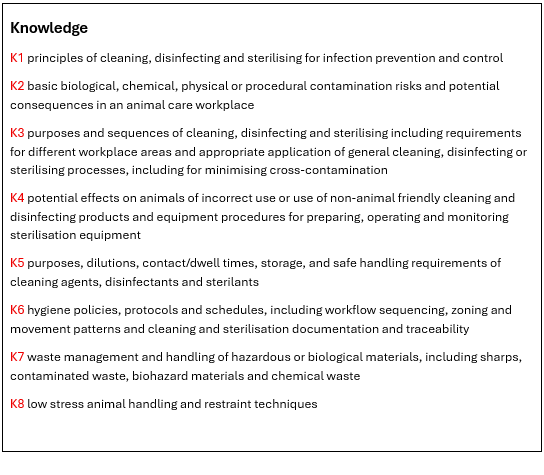
4. Quick read of Knowledge and Skills
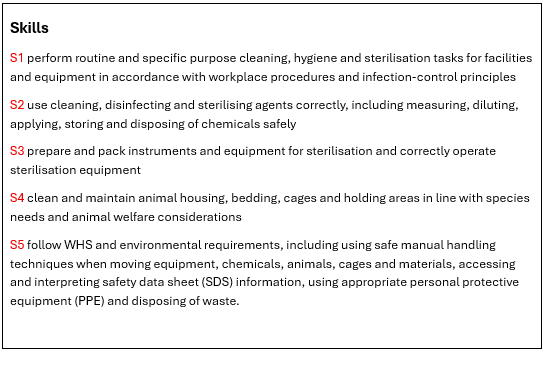
A quick read of Knowledge items and Skills items is a prelude to the analysis of the Application of knowledge and skills. A useful technique is to give each Knowledge item a ‘K’ number and each Skills item a ‘S’ number.
The following shows the Knowledge items and the allocation of ‘K’ numbers.
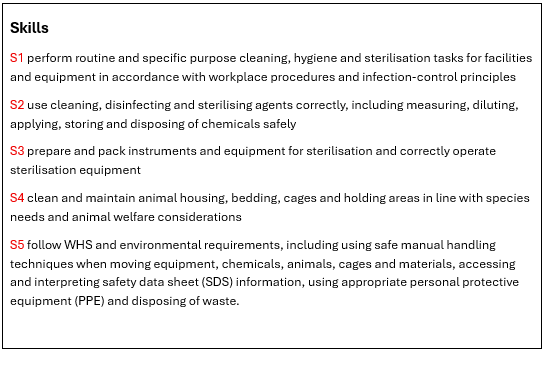
The following shows the Skills items and the allocation of ‘S’ numbers.
5. Go to the Application of knowledge and skills
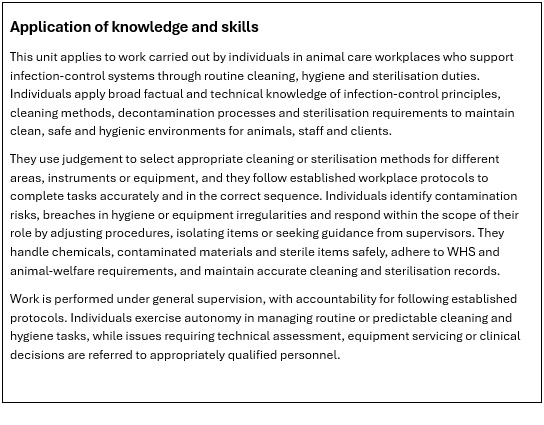
After a quick read of the Knowledge and Skills, go to the Application of knowledge and skills because this should guide what needs to be performed to determine a person’s competence.
6. Highlight key words and write notes
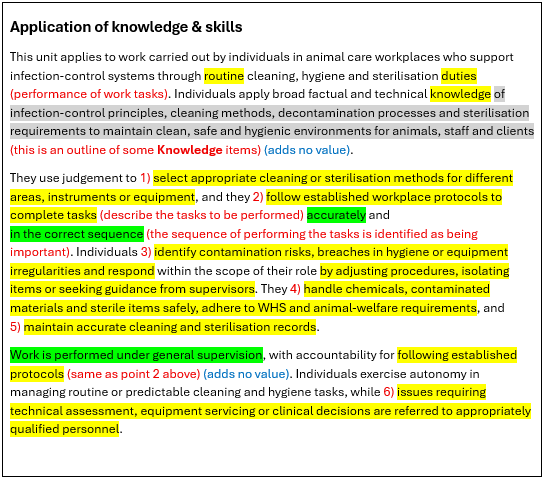
The analyse of the Application of knowledge and skills begins with highlighting key words and writing notes.
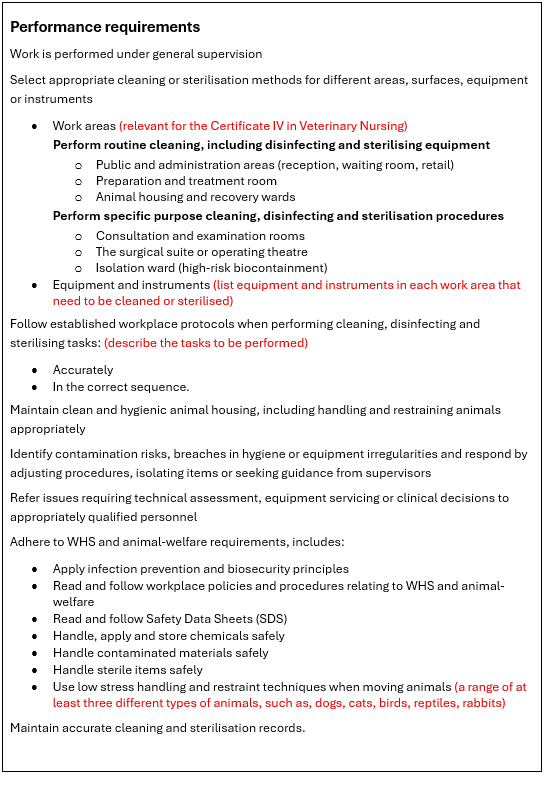
7. Extract relevant information and add to Performance requirements
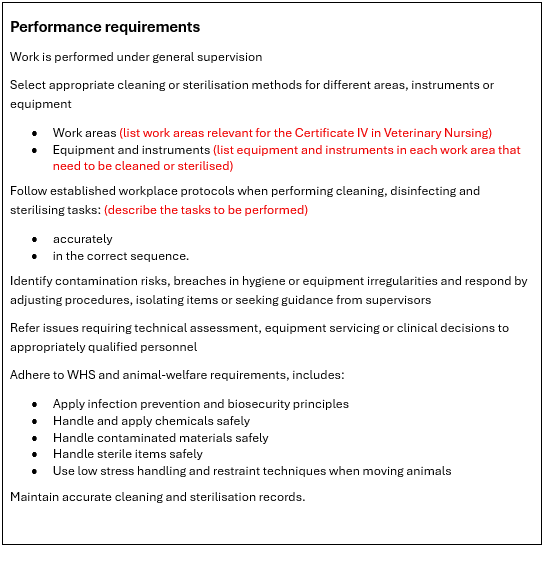
The following shows the relevant information that has been extracted from the Application of knowledge and skills, and added to the Performance requirements.
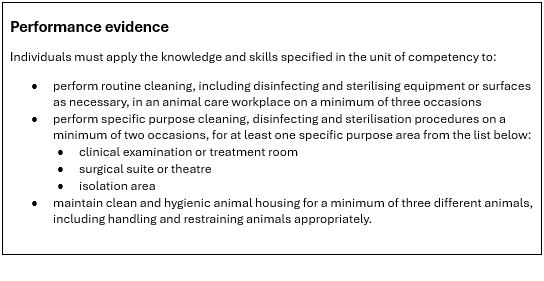
8. Go to the Performance evidence
The Performance evidence gives an overview of the required performance to be assessed.
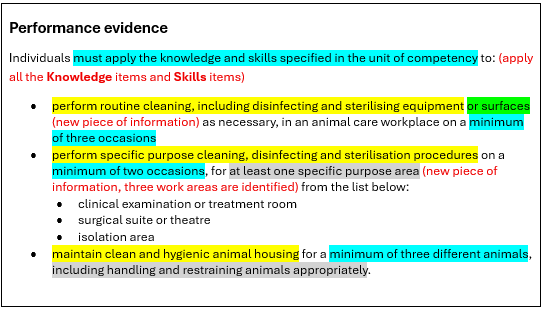
9. Highlight key words and write notes
The analyse of the Performance evidence begins with highlighting key words and writing notes.
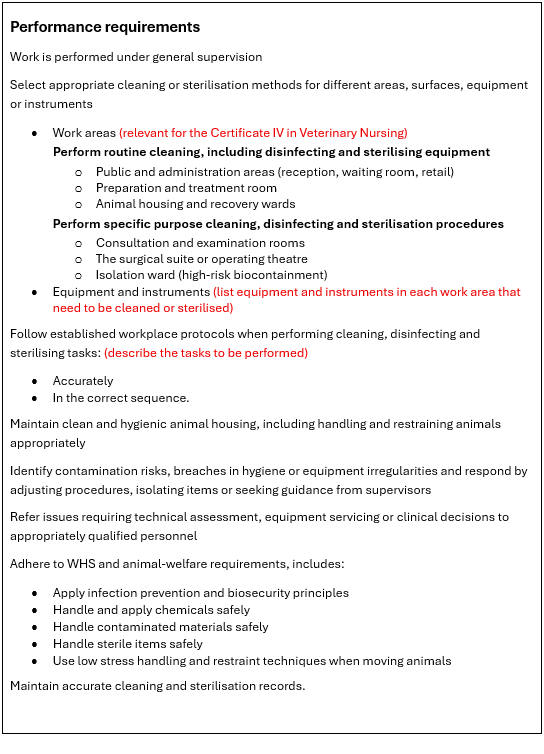
10. Extract relevant information and add to Performance requirements
The following shows the relevant information that has been extracted from the Performance evidence, and added to the Performance requirements.
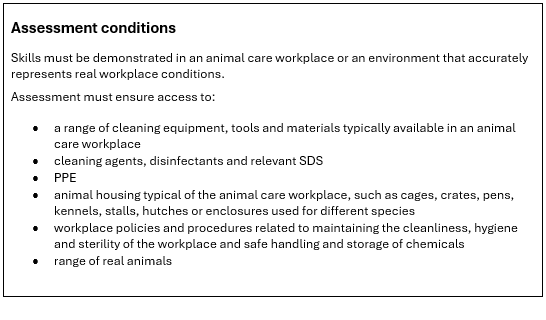
11. Go to the Assessment conditions
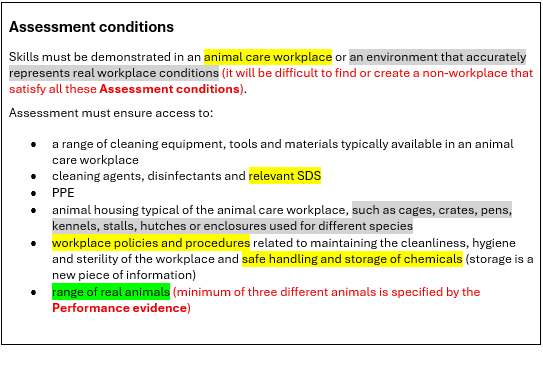
The Assessment conditions may provide relevant information relating to required performance.
12. Highlight key words and write notes
The analyse of the Assessment conditions begins with highlighting key words and writing notes.
13. Extract relevant information and add to Performance requirements
The following shows the relevant information that has been extracted from the Assessment conditions, and added to the Performance requirements.
14. Read and analyse the Knowledge items
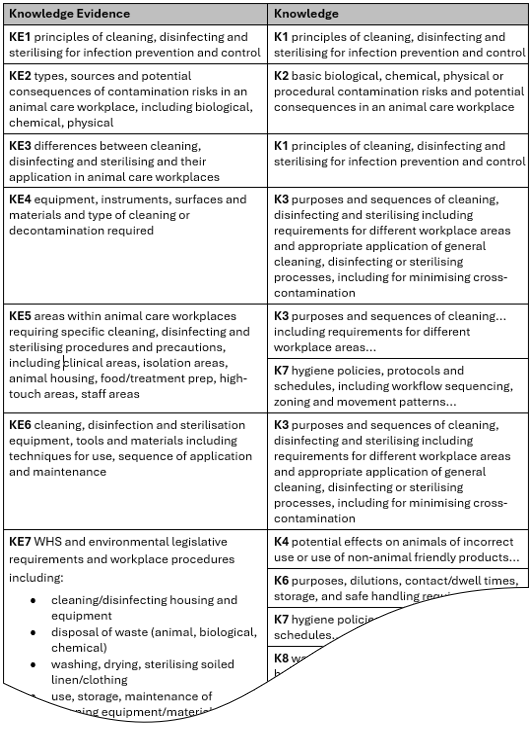
The ASK format describes knowledge twice: Knowledge items and Knowledge evidence items. Sometimes there may be the same or similar items, and sometimes it takes some time to analyse and identify the connection between the two lists of knowledge items.
A useful technique is to match items from both lists of knowledge items.
Here are two examples:
- A 2-column table with the Knowledge items in the left column
- A 2-column table with the Knowledge evidence items in the left column.
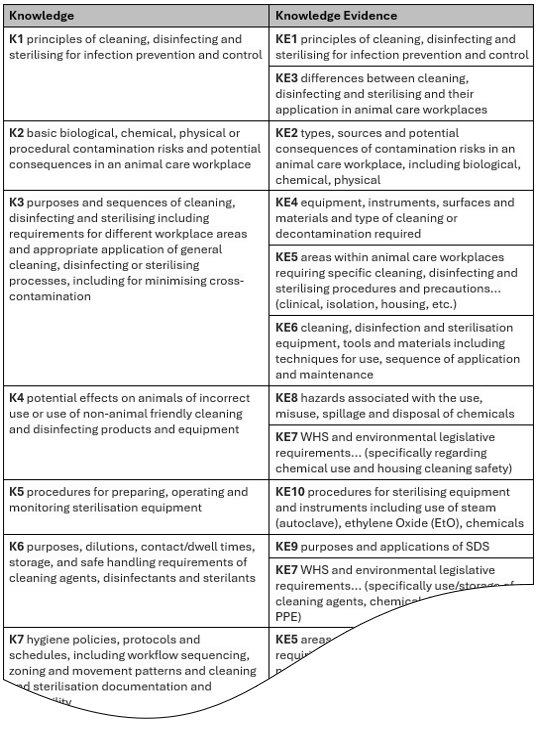
Please note: These two examples are showing incomplete tables matching Knowledge items and Knowledge evidence items (above) and Knowledge evidence items and Knowledge items (below).
15. Read and analyse the Skills items
In this example for the ACMGEN3X03 Maintain cleaning, hygiene and sterility standards in animal care workplaces unit, I find that the Skills items are more like description of performance rather than descriptions of skills. The reading, writing, oral communication, and numeracy skills are not explicitly described. Also, I think there is some confusion between what is a skill and what is an application of skills.
16. Describe work tasks to be performed
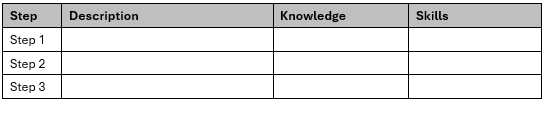
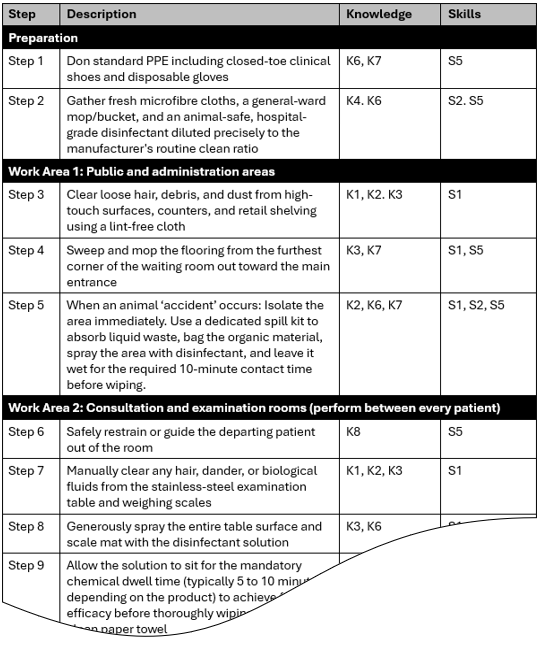
There is still work to be done to clearly describe the work tasks to be performed. A technique for describing the performance of work tasks is to use a 4-column approach. This provides a clear and structured approach to describing performance.
The following is an incomplete example of how the work tasks can be described. It focuses on performing routine environmental hygiene.
In conclusion
While the ASK format for units of competency provides a broad overview under the Performance Evidence heading, it lacks explicit and detailed performance requirements. To accurately determine competency, we require clear and industry-approved descriptions of work tasks that yield observable and measurable evidence. Furthermore, these detailed performance requirements are essential for designing structured and compliant training and assessment strategies, developing effective assessment tools, and creating aligned learning resources.
By adopting the ASK format, JSCs effectively shift the responsibility of defining explicit performance requirements onto RTOs. Consequently, RTOs must undertake extensive interpretation, contextualisation, and detailed task description before these units of competency can be meaningfully applied in practice.
The ASK format for units of competency are problematic. This article primarily looked at unpacking an ASK unit of competency, without detailing the problems and additional complexity that with comes from having ASK formatted units. Also, not all JSCs are using the ASK unit format in the same way.
References
[1] Training Package Organising Framework 2025, page 13, paragraph 2
[2] https://skillsinsight.com.au/project/veterinary-nursing-review/ accessed 28 May 2026
Do you want more information?
Are you an RTO manager or course coordinator?
Could your RTO team benefit from professional development about changes to the Australian VET system? In particular, how the Training Package Organising Framework or how the new EPC and ASK formatted units impact our work as VET practitioners?

Ring Alan Maguire on 0493 065 396 to discuss.

Training trainers since 1986

 On Target Work Skills
Thank you, Alan, for an exceptionally excellent, erudite article.
LikeLike
Alan, after reading this I’m impressed with your restraint! I fear the CB syst
LikeLike
Yes, I did restrain myself. I can’t change the unit formats, I can only work with what we get given.
LikeLike