Are there 4 or 5 dimensions of competency?

If we search Google for ‘The 5th Dimension’ we will find information about the American popular music vocal group. They had many hit songs during the 1960s and 1970s. But what about the dimensions of competency in the Australian VET system? How many are there? And does it really matter? Some people say there are four dimensions of competency, while others say there are five.

These questions got me thinking about how much I detest the ‘dimensions of competency’ concept. It was useful in 1993 when Australia was implementing its ‘new competency-based training system’. At that time, it was necessary to educate people in the ‘new concept’ of competencies and how it differed from a curriculum-based approach.

I don’t think the dimensions of competency matter anymore to the ‘everyday’ trainer and assessor. Most ‘everyday’ trainers and assessors do not determine the content of the training to be delivered, and they do not develop the assessment tools to be used.

Also, I believe that the developers of Training Packages and VET Accredited Courses build the dimensions of competency into each unit of competency, as required. This includes considering how the ability to transfer skills and knowledge to new situations and environments are to be addressed. Australia has a mature VET system based on more than 25 years’ experience of developing Training Packages. I believe that new trainers and assessors need a more contemporary view about understanding and using competency standards.

However, it does not matter what I think. Many of the new TAE units of competencies release at the end of 2022 require knowledge of the dimensions of competency. Therefore, anyone studying for their TAE40122 Certificate IV in Training and Assessment qualification must know something about the dimensions of competency and how they are ‘theoretically’ used by trainers and assessors working for an RTO.

What are the dimensions of competency?

Dimensions of competency are part of the broad concept of competency, which includes all aspects of work performance as represented by: [1]

  • Task skills
  • Task management skills
  • Contingency management skills
  • Job/role environment skills.

Some people like to add a fifth dimension: Transfer skills.

Why do we still talk about the dimensions of competency?

(This article was originally published in 2019 but has been update in 2023.)

During 2019, when I did a Google search for the dimension of competency, I was presented with a limited or narrow range of results. Nothing seemed credible or relevant. I then searched the following reputable sources of VET information but could not find the term ‘dimensions of competency’:

  • ASQA website [2]
  • ASQA’s Users’ Guide to the Standards [3]
  • ASQA’s Guide to developing assessment tools [4]
  • Government of Western Australia, Department of Training and Workforce Development: Designing assessment tools for quality outcomes in VET, 4th Edition 2013 [5].

I think the only reason we still talk about the dimensions of competency is because it is listed as a Knowledge Evidence item in several TAE units of competency. This is not a good enough reason for regurgitating this unnecessary concept in today’s VET system. I am an experience developer of training and assessment materials. I am about to make a confession. I have never said to myself, “how am I going to incorporate the dimensions of competency?”

During the recent review of the TAE Training Package, I had recommended the removal this antiquated concept from the TAE40122 Certificate IV in Training and Assessment. Instead of removing the dimensions of competency, many more TAE units of competency have had it listed as Knowledge Evidence.

What do I think trainers and assessors need to know?

Trainers and assessors need to know the following:

  • Definition of competency
  • Definition of assessment
  • Principles of assessment
  • Rules of evidence.

If should be noted that the second sentence of the definition of competency covers what some people call the fifth dimension of competency:

the ability to transfer and apply skills and knowledge to new situations and environments.”

Also, I think trainers and assessor need to know how to read, interpret and contextualise competency standards. This requires a person to understand the structure and intent of the following:

  • Unit application
  • Elements and performance criteria
  • Foundation skills
  • Performance evidence
  • Knowledge evidence
  • Assessment conditions.

In conclusion

To answer the question: Are there 4 or 5 dimensions of competency ?

There are 4 dimensions. But whether there is 4 or 5, it is purely academic. Some people may disagree with me. That is okay. I am more pragmatic than academic.

Since 1997, Training Package developers have been incorporating the dimensions of competency into the units of competency.

Unfortunately, if you are studying for your TAE40116 or TAE40122 Certificate IV in Training and Assessment qualification, you will still need to know something about the these dimensions of competency.

The following articles provide further details about the four dimensions of competency:

On a positive note, the dimensions of competency remind us that a safe and productive worker must do more than focus on performing one task at a time. And when irregularities and break downs in routine occur, they must be able to respond.

References

[1] https://www.voced.edu.au/vet-knowledge-bank-glossary-vet accessed 17 March 2023

[2] https://www.asqa.gov.au/ accessed 25 October 2019

[3] https://www.asqa.gov.au/standards accessed 25 October 2019

[4] https://www.asqa.gov.au/sites/g/files/net3521/f/Guide_to_developing_assessment_tools.pdf accessed 25 October 2019

Do you need help with your TAE studies?

Are you a doing the TAE40122 Certificate IV in Training and Assessment, and are you struggling with your studies? Do you want help with your TAE studies?

Ring Alan Maguire on 0493 065 396 to discuss.

Contact now!

logo otws

Training trainers since 1986

What does ChatGPT know about the dimensions of competency?

People studying for their TAE40122 Certificate IV in Training and Assessment qualification will need to know about the dimensions of competency. The dimensions of competency are specified as the required knowledge for several TAE units of competency.

Many years ago I published an article about the dimensions of competency. And many people read this article each week. Today, I have published this new article that may help people to further understand this often confusing term. I have used ChatGPT to assist me in developing content for this article.

What are the dimensions of competency?

Initially I asked ChatGPT, what are the dimensions of competency? And the response follows.

Competency can be understood as a combination of knowledge, skills, abilities, and behaviours required to perform a particular task or job successfully. These dimensions of competency can be further elaborated as follows:

  1. Knowledge: It refers to the understanding and awareness of information, concepts, and principles related to a particular field or domain. This includes theoretical and practical knowledge gained through education, training, and experience.
  2. Skills: It refers to the practical application of knowledge to perform a task or activity effectively. It involves the ability to use tools, techniques, and methods to achieve desired results.
  3. Abilities: It refers to the natural or acquired capacity to perform a particular task or activity. Abilities include physical, cognitive, and social-emotional abilities that enable individuals to perform tasks effectively.
  4. Behaviours: It refers to the attitudes, values, and habits that individuals exhibit in performing tasks or activities. Positive behaviours such as teamwork, communication, and problem-solving are essential for success in any job or task.

Overall, competency can be understood as a multidimensional construct that encompasses knowledge, skills, abilities, and behaviours required for successful performance in a particular field or domain.

This was an interesting answer but not the answer I was looking for. Therefore, I asked ChatGPT, what are the 4 dimensions of competency in the Australian VET system? And the response follows.

The Australian VET system has four dimensions of competency, and they are:

  1. Task skills: Refers to the specific skills required to perform tasks related to a particular job or occupation
  2. Task management skills: Refers to the ability to plan, organise, and prioritise tasks to achieve desired outcomes efficiently
  3. Contingency management skills: Refers to the ability to identify and respond to unexpected situations or problems that may arise in a particular job or occupation
  4. Job/role environment skills: Refers to the ability to understand and adapt to the broader context in which a job or occupation is performed, including the industry, workplace, and cultural factors

These dimensions are used to develop competency standards, training packages, and assessment tools to ensure that individuals have the necessary knowledge, skills, and attitudes to perform their jobs or occupations effectively.

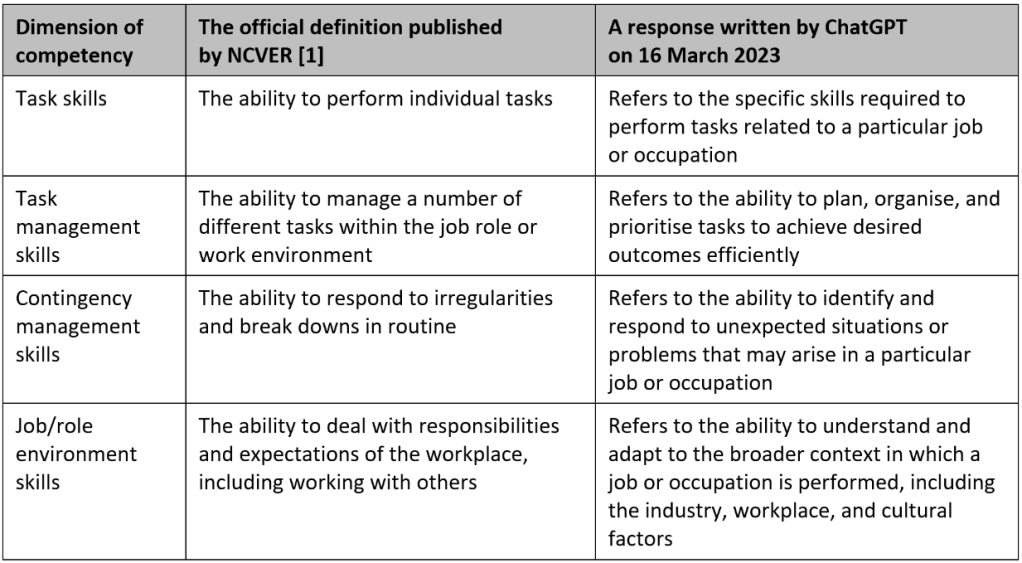
This was an excellent answer. The following table compares the ‘official definition’ for dimensions of competency and the response provided by ChatGPT.

[1] https://www.voced.edu.au/vet-knowledge-bank-glossary-vet accessed 16 March 2023

Examples about how to use each dimension of competence

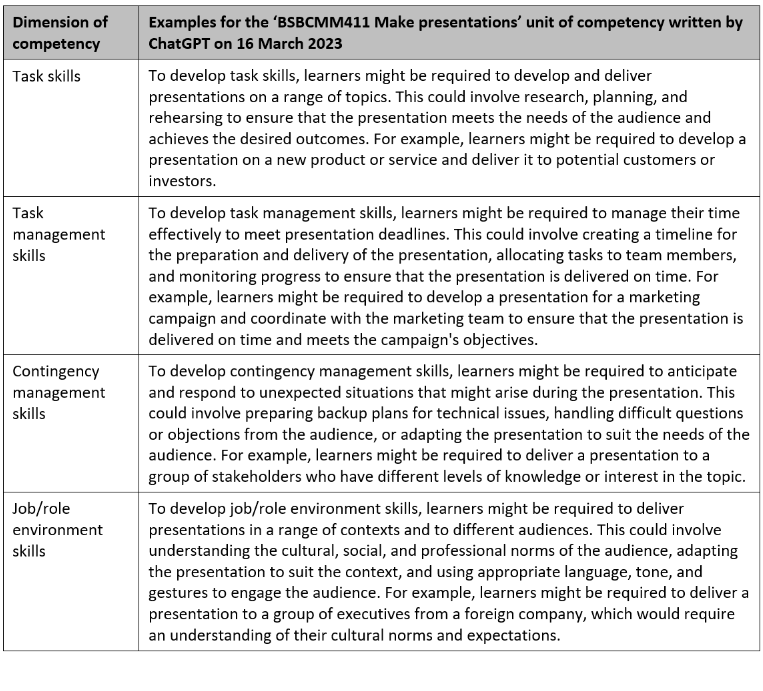
Knowing the definition of the four dimensions of competency is one thing, but examples about how these dimensions are used would help our understanding. Therefore, I asked ChatGPT, to give examples about how to use each dimension of competency for the BSBCMM411 unit of competency. And the response follows.

Example 1

The BSBCMM411 unit of competency in the Australian VET system is ‘Make presentations’. Here are some examples of how each dimension of competency can be used for this unit of competency.

By using each dimension of competency in the BSBCMM411 unit of competency, learners can develop the necessary knowledge, skills, and attitudes to make effective presentations in a range of contexts and to different audiences.

Example 2

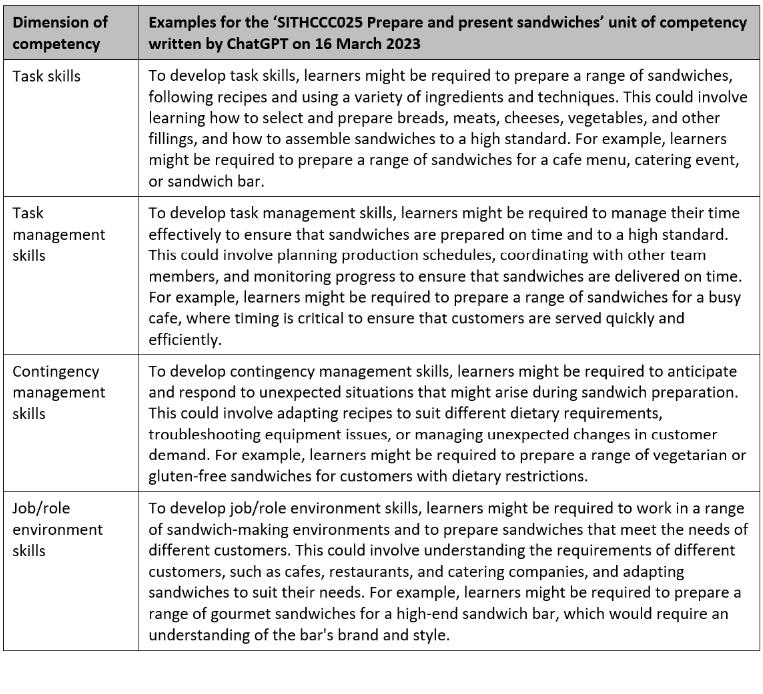
And I asked ChatGPT to give a second example about how to use each dimension of competency for a different unit of competency. The following is the response provided.

The SITHCCC025 unit of competency in the Australian VET system is ‘Prepare and present sandwiches’. Here are some examples of how each dimension of competency can be used for this unit of competency.

By using each dimension of competency in the SITHCCC025 unit of competency, learners can develop the necessary knowledge, skills, and attitudes to prepare and present a range of sandwiches to a high standard and to meet the needs of different customers in a range of sandwich-making environments.

Example 3

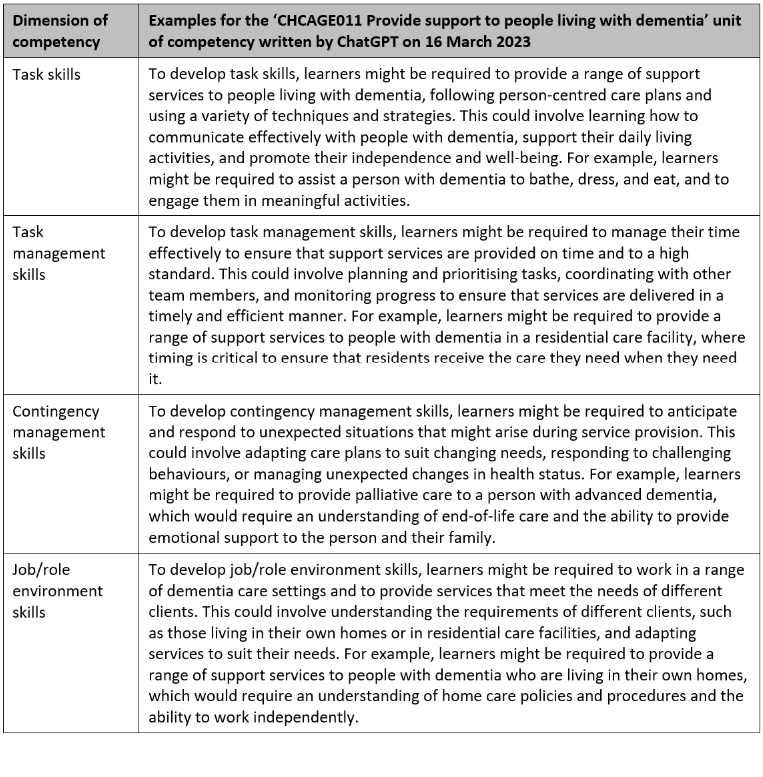
And I asked ChatGPT to give a third example about how to use each dimension of competency for another unit of competency. The following is the response provided.

The CHCAGE011 unit of competency in the Australian VET system is ‘Provide support to people living with dementia’. Here are some examples of how each dimension of competency can be used for this unit of competency.

By using each dimension of competency in the CHCAGE011 unit of competency, learners can develop the necessary knowledge, skills, and attitudes to provide support to people living with dementia in a person-centred and compassionate manner, and to meet the needs of different clients in a range of dementia care settings.

In conclusion

There are four dimensions of competency. This article has provided examples to show how each dimension of competency may be applied to three units of competency from different industry sectors.

You could use ChatGPT to create examples for other units of competency that relates to your occupation or area of expertise. The following is the ChatGPT prompt that I used:

Can you give examples about how to use each dimension of competency for the [insert unit code] unit of competency?

ChatGPT does not always give the correct answer. Therefore, you must take responsibility for checking the validity or accuracy of responses provided by ChatGPT.

Please contact Alan Maguire on 0493 065 396 if you want to know more about how to use ChatGPT before and during training.

Do you need help with your TAE studies?

Are you a doing the TAE40122 Certificate IV in Training and Assessment, and are you struggling with your studies? Do you want help with your TAE studies?

Ring Alan Maguire on 0493 065 396 to discuss.

Contact now!

logo otws

Training trainers since 1986

Webinar: ChatGPT and how to use it before and during training

You may have heard about ChatGPT. And you may be wondering what all the hype is about. What ChatGPT can do is impressive but there are some limitations.

Whether you’re a trainer, instructional designer, training materials developer, or just someone interested in the latest advancements in artificial intelligence (AI), this webinar is for you.

The webinar will cover:

  • What is ChatGPT?
  • What can and can’t ChatGPT do?
  • How to use ChatGPT before and during training?

A real-time demonstration of ChatGPT’s capability will occur throughout this interactive webinar.

The following booklet has been developed as support material for the webinar.

Location

The webinar shall be conducted via Zoom. Therefore, you can attend the webinar from your workplace or home.

Also, this webinar can be delivered to a work group. It can be a relevant and timely professional development activity for a group of trainers.

Duration

90 minutes

Date and start time

Please call Alan Maguire on 0493 065 396 to discuss.

Contact now!

logo otws

Training trainers since 1986

What are the key features of the Australian VET system?

This image of Vegemite, cake, sausage, pizza, sandwich and training wheels on a bike will only make sense half way through this article.

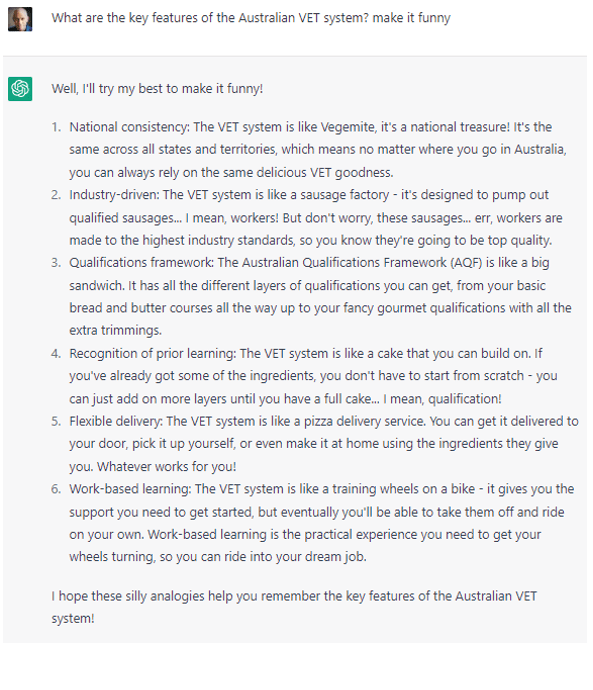
I have discovered that ChatGPT can be addictive. This morning I asked ChatGPT, what are the key features of the Australian VET system?

Here is the first response given.

Not a bad answer. However, I would edit the terms ‘Accredited training providers’ to be ‘Registered training providers’, and ‘private colleges’ to be ‘private training providers’.

Again using ChatGPT, I regenerated the response to the same question and was given the following.

Again, not a bad answer. But I dislike the American English spelling of words with a ‘z’ rather than the Australian English spelling of words with an ‘s’. For example, ‘recognize’ should be ‘recognise’.

And I may disagree that there is consistency across all states and territories. There is often great inconsistencies from one RTO to another RTO. Therefore, this may be misleading. Also, it may be contestable to say that the Australian VET system is highly regarded. This claim would need further evidence or justification.

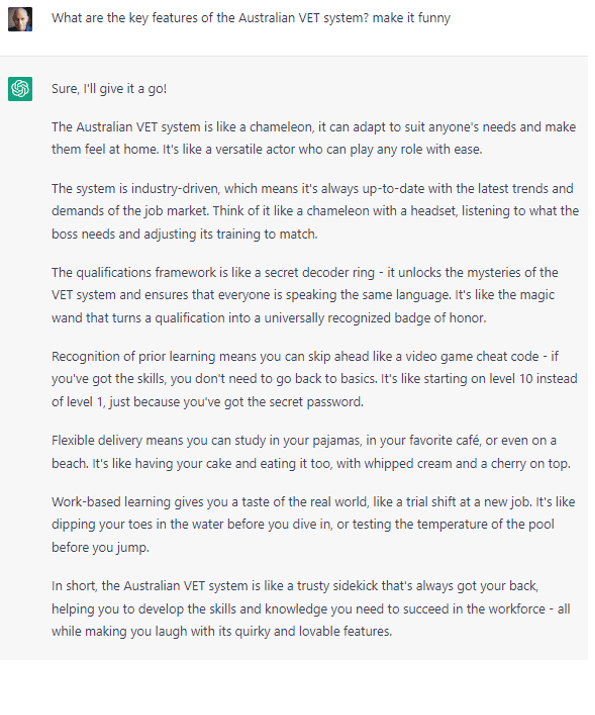
Next, I got ChatGPT to regenerate the answer to the same question but to make it funny. And this is what I was given.

Well done ChatGPT! However, some Victorians may remember that in recent years a TAFE was involved in the rorting of government funding, and one of the rorters referred to what they were doing as a ‘sausage factory’. So, this may not be funny to some people, but the full analogy is nicely written.

I regenerated the response and was given the following.

I don’t think the second response is as good as the first response, but there are some interesting ideas.

I wonder if ChatGPT can be used as a discussion generator when delivering the Certificate IV in Training and Assessment or Diploma of Vocational Education and Training. It could be a bit of fun. What do you think?

Postscript

I added this postscript about 6 hours after publishing the article because I had received some comments that prompted me to further use ChatGPT.

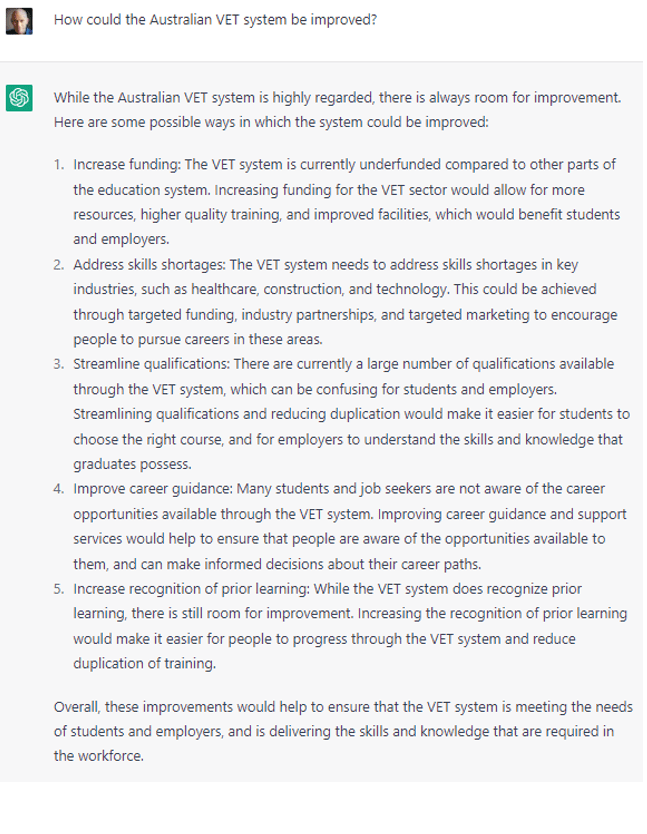
How could the Australia VET system be improved?

A vision statement for the Australian VET system

This vision statement is quite inspirational. I think it is better written than the current vision statement that was agreed by Skills Ministers and endorsed by the National Cabinet on 31 August 2022 (replacing the previous government’s vision statement that was released three years earlier). Did you know that there was a vision statement for the Australian VET system? Here it is.

Reference: https://www.dewr.gov.au/skills-reform/national-skills-agreement-vision-and-principles accessed 21 February 2023

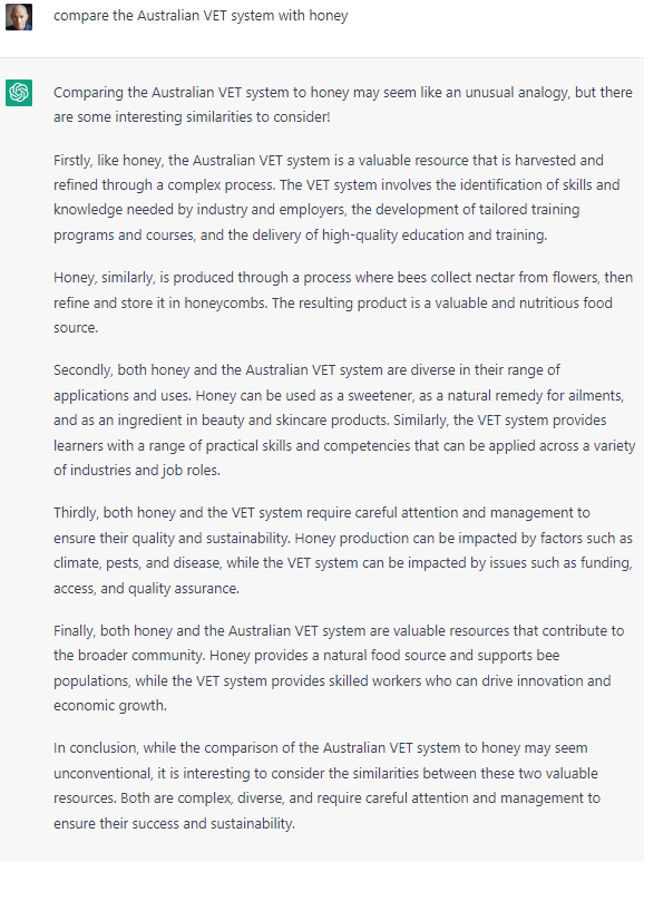
And finally, I use ChatGPT to compare the Australian VET system with honey.

I had better stop now before it gets too silly. I had thought of asking ChatGPT to provide an answer in the writing style of Dr Seuss.

Oops! Too late …

Do you need help with your TAE studies?

Are you a doing the TAE40122 Certificate IV in Training and Assessment, and are you struggling with your studies? Do you want help with your TAE studies?

Ring Alan Maguire on 0493 065 396 to discuss.

Contact now!

logo otws

Training trainers since 1986

Selection and sequence of units for the TAE40122 qualification

Structure for the TAE40122 qualification

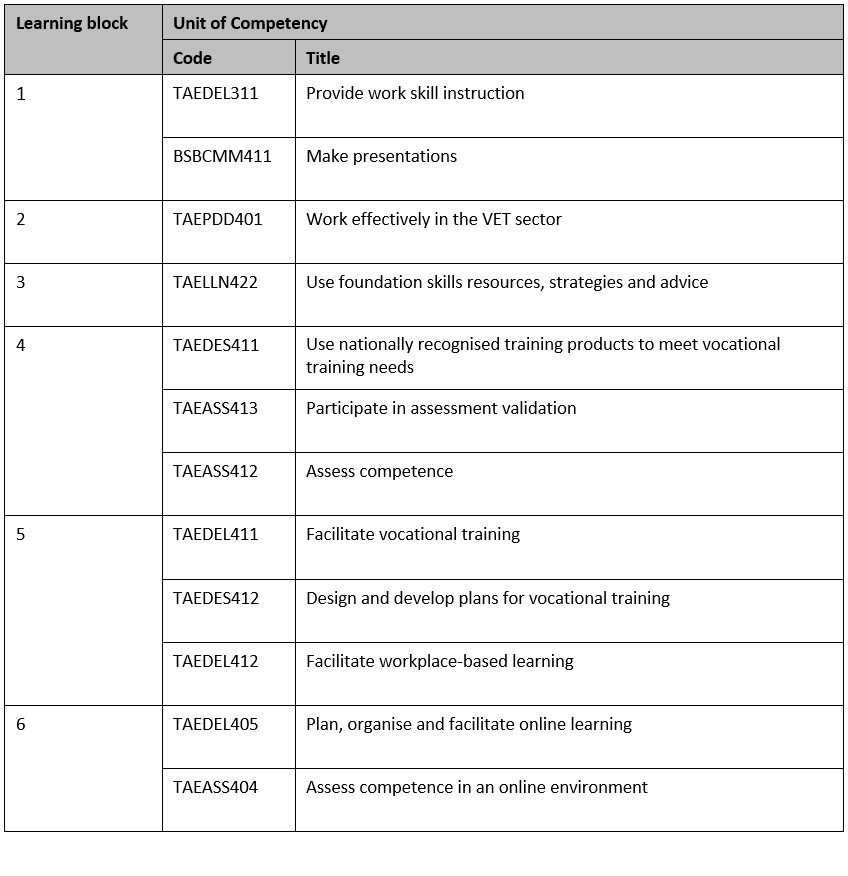
I have recently looked at a proposed selection and sequence of units for the new TAE40122 Certificate IV in Training and Assessment qualification. The following has been suggested as the units, order of units, and clustering of units.

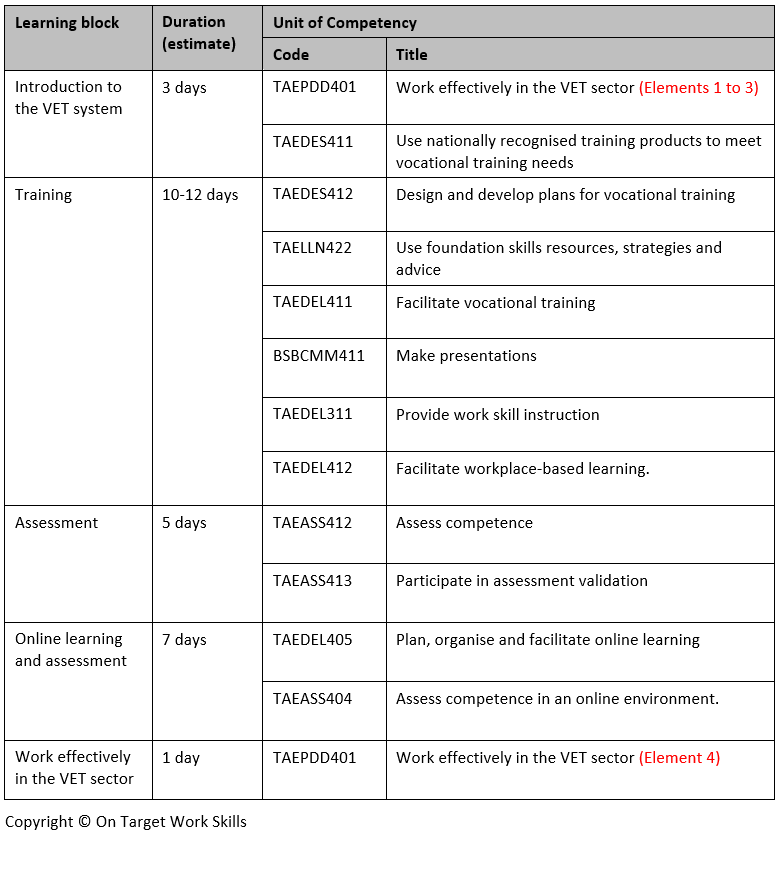
I didn’t like the above for many reasons. For me, it is incoherent and would result in significant duplication of assessment tasks. TAE student and TAE assessors would be burgeoned by additional and unnecessary workload.

The following is my suggested sequence and clustering of the same units. It consists of five learning block. Also, it includes my estimated duration for trainer-led delivery of the TAE40122 qualification.

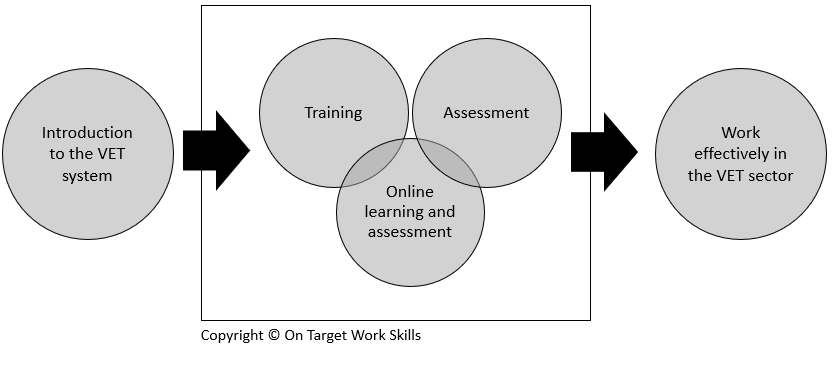
The following diagram illustrates the logic or the rationale for my sequence and clustering. It makes sense to start with the big picture being an introduction to the Australian VET system. Followed by how to design and deliver training, how to conduct and validate assessment, and how to deliver training and conduct assessment in an online environment. The TAE40122 training program concludes by covering how to work effectively in the VET sector, including the ongoing professional development after the the training program has concluded.

My proposed structure and sequence gives a sensible and logical flow to the Certificate IV in Training and Assessment qualification. It brings focus to the topics of training and assessment.

Integrated assessment

The new TAE units of competency are complex and consist of a duplication of content. The above suggested structure for the TAE40122 qualification aims to simplify and combine assessment requirements.

Here is an example about how I have created an integrated assessment approach for the Training learning block.

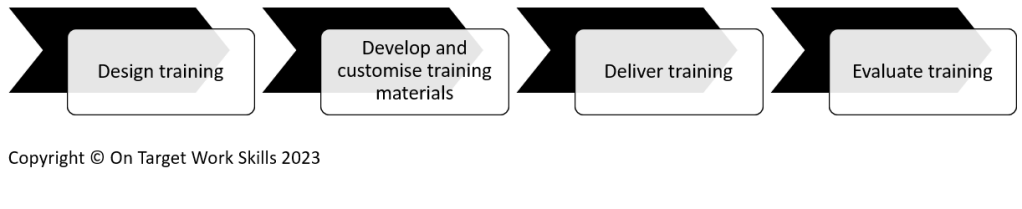
First, I have taken a typical systematic approach to training.

Next, I identified two broad functions performed by a trainer that are specified by the various TAE units of competency:

  • Small group training
  • Work-based learning.

Note: A small group is defined as being a group of at least four learners, and the scope of work-based learning is the training of an individual.

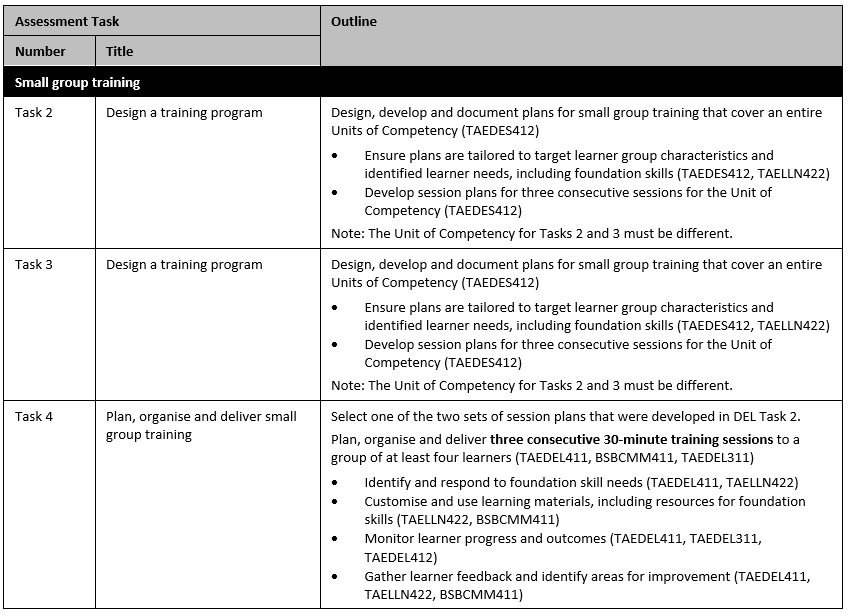
The following jumps a few steps to show you some details of my assessment tasks for the six units of competency that have been clustered together for the Training learning block.

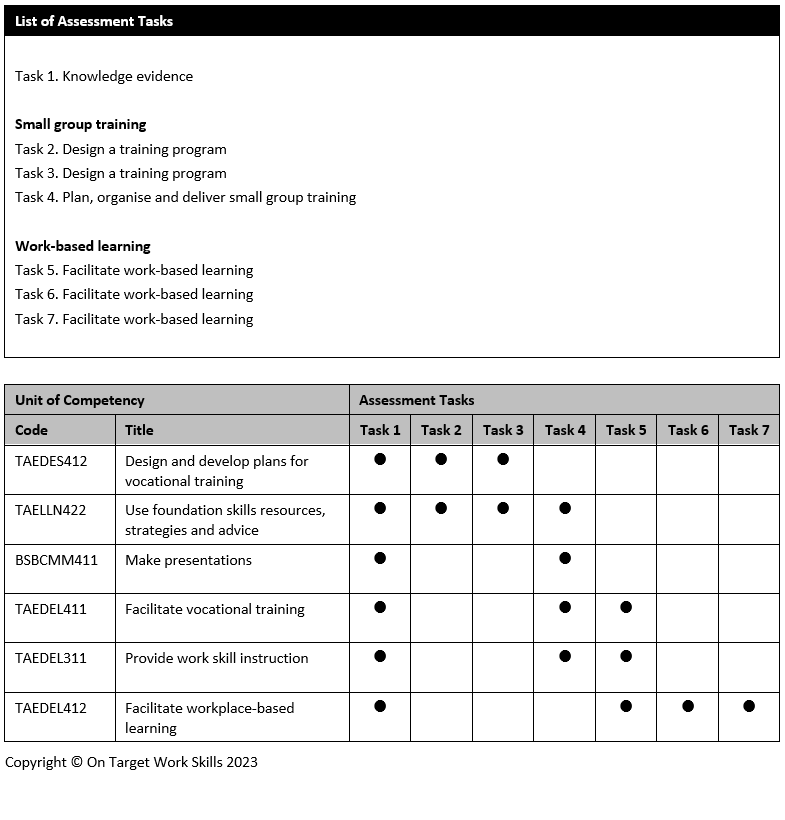
The following takes away some of the above details and give an outline of my integrated assessment approach.

In conclusion

Generally, the new TAE units of competency have been poorly designed. They are complex and can be confusing. Some common content is duplicated across various TAE units of competency. But, this should not mean that the delivery of the TAE40122 qualification should be complicated and confusing.

This article illustrates how to design a TAE40122 training program so that it simple, logical, and avoids duplication of content. An integrated assessment approach can minimise the workload of TAE students and TAE assessors.

If you work for an RTO with the TAE40122 qualification on its scope of registration, and if you are trying to figure out how to implement it, please give me a call on 0493 065 396 to discuss how I could help you.

Do you need help with your TAE studies?

Are you a doing the TAE40122 Certificate IV in Training and Assessment, and are you struggling with your studies? Do you want help with your TAE studies?

Ring Alan Maguire on 0493 065 396 to discuss.

Contact now!

logo otws

Training trainers since 1986